REVIEW 4 major objections 5 minor 53 references
Lost in the Mix: Evaluating LLM Understanding of Code-Switched Text
T0 review · 4 major / 5 minor · reviewed 2026-08-07 · deepseek-v4-flash
Pith's one-line read Foreign words in English confuse LLMs; English words abroad help
desk verdict Solid and genuinely new empirical study, but the headline asymmetry rests on thin statistics and unverified generation fidelity; deserves review with pressure on the facilitation claim. read the letter →
The pith
A machine-rendered reading of the paper's core claim, the machinery that carries it, and where it could break.
The reading
What carries the argument
The load-bearing object is the code-switched benchmark generation pipeline itself: a two-step LLM-centric approach in which Claude 3.5 Sonnet first marks candidate switch points (nouns for the linguistically grounded variant, random tokens for the heuristic variant) and then fills the placeholders with words from a parallel sentence under instructions to respect the Equivalence Constraint Theory and the Matrix Language Frame model. An alignment-based pipeline using the AWESOME aligner with LaBSE embeddings and Stanza POS tagging serves as the controlled comparison, and GPT-4o acts as judge to select the more natural outputs. The evaluation machinery is the accuracy delta, the difference between accuracy on a code-switched benchmark and its monolingual baseline, which makes the asymmetry visible: negative deltas when foreign tokens enter English, positive deltas when English enters other languages.
What would settle it
If bilingual human annotators rated a sample of the generated code-switched items as unnatural or as switching only easy, high-frequency nouns, and if the accuracy deltas on those items disappeared or reversed, the central asymmetry would be an artifact of the generation pipeline rather than a property of LLM comprehension.
Extended reading notes
Core claim
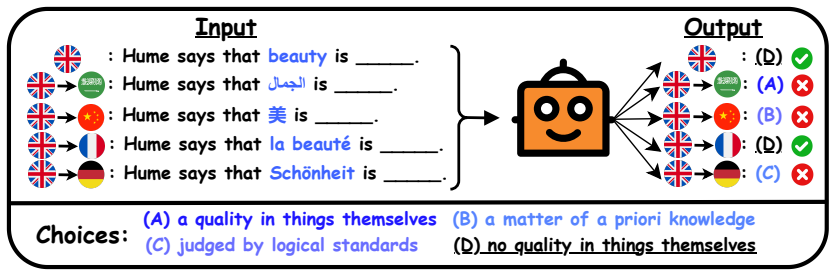
Using a two-step LLM pipeline built on the Equivalence Constraint Theory and the Matrix Language Frame model, the paper replaces nouns in English benchmark items with translations in Arabic, German, French, and Chinese (noun-token CSW), and in a second experiment replaces roughly 20% of random tokens (ratio-token CSW). On weighted average accuracy across Belebele, MMLU, and XNLI, LLaMA-70B drops from 0.70 in English to 0.66 on EN→AR and EN→DE; Qwen-7B falls from 0.61 to 0.52–0.57. Reversing the roles, Mistral-7B on Arabic rises from 0.35 to 0.48 when English nouns are embedded, and gains appear for other low-proficiency matrix languages as well. Extreme mixing with four embedded languages does not always cause the largest drops, and script type (Latin vs. non-Latin) has no uniform effect. The results are taken as evidence that the degradation is structural, not merely lexical unfamiliarity.
Load-bearing premise
All conclusions rest on the assumption that the generated code-switched sentences faithfully represent natural code-switching; only 100 examples per language pair were human-checked, and the rest of the generation and quality judgments were handled by Claude 3.5 Sonnet and GPT-4o without per-instance human verification.
Editorial extensions
If this is right
- If the asymmetry is real, LLM deployment in multilingual communities will systematically under-serve users who code-switch into a local language from English, while over-crediting comprehension when English words appear in local-language input.
- Benchmarks built on this pipeline can be reused to track whether future models reduce the English-centric bias, by measuring the same accuracy deltas over time.
- Fine-tuning on synthetic code-switched data, demonstrated on LLaMA-8B, offers a practical route to recover a few points of accuracy for models that do not respond to prompting.
- The absence of a uniform Latin/non-Latin penalty in the extreme-mixing experiment implies that robustness to code-switching is not simply a function of script or number of languages mixed, but of model-specific language representations.
- Because gains from embedding English appear mainly when the model is weak in the matrix language, English may act as a crutch that offsets gaps in multilingual proficiency rather than evidence of genuine cross-lingual comprehension.
Reading between the lines
- The paper's noun-token design means the measured asymmetry concerns noun substitutions only; a natural extension would switch verbs, adjectives, or function words, which the Equivalence Constraint Theory treats differently, and which may produce larger or opposite effects.
- An implicit testable claim is that the English-as-embedded-language boost should shrink as models' non-English proficiency improves; one could verify this by correlating per-model accuracy gains with per-language pretraining token counts.
- The finding that prompting helps only some model families suggests that instruction-following behavior interacts with code-switching robustness in ways that could be probed by varying prompt position and phrasing systematically; the paper does not do that.
- If correctness holds, downstream applications such as multilingual search, social-media moderation, and LLM training-data recycling should treat code-switched text as a distinct domain, not a minor variant of monolingual text.
Editorial analysis
A structured set of objections, weighed in public.
Referee Report
Summary. The paper introduces a pipeline for generating code-switched (CSW) versions of three established benchmarks (Belebele, MMLU, XNLI) using two strategies: a linguistically motivated noun-token method grounded in the Equivalence Constraint Theory (ECT) and Matrix Language Frame (MLF) model, and a heuristic ratio-token method that substitutes roughly 20% of aligned tokens at random. The authors evaluate eight LLMs across five languages and report two main findings: (i) embedding non-English tokens into English text degrades performance, and (ii) embedding English tokens into non-English text frequently improves comprehension, especially for models with weaker proficiency in the matrix language. They also test prompt-based and fine-tuning-based mitigation strategies, concluding that fine-tuning yields more stable recovery. The central claim is an asymmetric, English-centric structural bias in LLM processing of code-switched input.
Significance. If the asymmetric effect is genuine and attributable to properties of code-switching rather than to artifacts of the generation procedure, the paper would make a valuable contribution to multilingual NLP evaluation and to the study of English-centric biases in LLMs. The authors release code and data, evaluate a diverse set of models and languages, and ground their generation in established linguistic theories, which are all concrete strengths. However, the headline claims currently rest on small test sets without statistical support and on a generation pipeline whose fidelity is only weakly validated, so the significance of the finding is conditional on addressing these issues.
major comments (4)
- [Section 3.4 and Tables 1–3] The test set comprises only 300 samples per embedded language, and the reported deltas (e.g., LLaMA-70B on EN→AR: 0.70→0.66, Δ≈−0.04) correspond to roughly 12 examples on 300 instances. No confidence intervals, bootstrap estimates, or significance tests are reported anywhere in the paper. Given the number of models (8) × languages (4) × tasks (3) comparisons, many of the headline differences are within the noise band of a 300-sample evaluation. The authors should report uncertainty intervals and, if appropriate, apply multiple-testing corrections, or otherwise justify that the deltas are not chance-level fluctuations.
- [Section 3.2 and Tables 1–2] The noun-token and ratio-token methods are compared to isolate the effect of linguistic constraints, but the two conditions differ in more than constraints: noun-token replaces all identified nouns, while ratio-token replaces ~20% of aligned tokens at random, which may include function words and content words of varying categories, at a different substitution rate. Therefore, the Discussion's inference (Section 8) that comparable degradation under both methods reveals a 'structural vulnerability' beyond token-level unfamiliarity is confounded. A matched comparison (e.g., same proportion of random nouns, or same token category with and without ECT/MLF constraint) is necessary before this claim can be drawn.
- [Appendix B.1/B.4, Tables 6/8, and Section 3.3] The validity of the central asymmetric result—particularly the facilitation observed when English is embedded into non-English matrix languages (Table 3)—depends on the generated CSW faithfully representing natural code-switching. However, the generation-selection evidence is thin: only 100 examples per language were human-checked for the choice of generation model (preferences as low as 52% for Arabic in Table 6), and the decisive comparison between the LLM-Centric and Alignment-Based pipelines was judged solely by GPT-4o (Table 8), with no human verification and preferences as low as 53.4% for German. Furthermore, the LLM-Centric prompt (Figures 4–5) explicitly instructs the model to avoid switching nouns in common expressions and to adjust inflections, potentially biasing the inserted nouns toward short, high-frequency, semantically transparent items. If so, the observed EL-matrix improvement (e.g., Mistral-7B on Arabic: 0.35→0.48) could be an artifact of the predictability or recoverability of the inserted English words rather than a genuine CSW comprehension effect. The authors should provide per-instance human evaluation of the final benchmark instances (naturalness, switch-point grammaticality, and the representativeness of the chosen nouns) and report inter-annotator agreement.
- [Section 3.3 and Section 6.1 (Table 3)] When English is the embedded language, the inserted English words are drawn from the parallel English source sentence (the original benchmark text), while the baseline is the non-English translation. For models that are English-centric and have limited proficiency in the matrix language, replacing selected nouns with the original English nouns may simply make the instance easier because those exact English words are from the source-side text and are highly accessible in the model's pretraining distribution. This confound could trivially produce the facilitation effect reported in Table 3. The authors should control for this by, for example, inserting English nouns that are not taken from the parallel source sentence, or by comparing against insertion of matrix-language nouns matched for frequency and semantic content; otherwise the 'English embedding improves comprehension' claim is not separable from a source-leakage artifact.
minor comments (5)
- [References] Several references are malformed: 'Li Nguyen and. 2018' is missing the author's given name, 'Pranjal Khanuja et al. 2020' should be 'Khanuja et al.', and 'Genta Winata et al. 2021a' is inconsistently formatted; the reference list should be checked for completeness and consistency.
- [Figure 7] The caption of Figure 7 says the prompt was given to Claude 3.5 Sonnet for choosing the best summary, but the text in Appendix B.2/B.4 states that GPT-4o was used as the judge; the caption also refers to 'summaries' rather than code-switched sentences. Please correct the model attribution and the description.
- [Table 5] In Table 5, the entry for Llama 3B on EN→AR contains an extraneous ':a' after the accuracy value; please fix the typo.
- [Abstract and Section 7.2] The abstract states that 'fine-tuning offers a more stable path', but the fine-tuning experiment is performed on a single model (Llama 8B) with gains of +0.03–0.04; the claim should be tempered to reflect the limited evidence, or additional models should be fine-tuned.
- [Section 3.1] The notation 'B = {Bp}P p=1' is typeset incorrectly; it should read B = {B_p}_{p=1}^P. Please also define the indexing and the product set explicitly.
Circularity Check
No construction-level circularity: the evaluation is self-contained against external benchmarks, with only a peripheral self-citation preventing a score of 0.
full rationale
The paper's central claims are empirical accuracy deltas (Eq. 3) measured on fixed external benchmarks (Belebele, MMLU, XNLI) by frozen public LLMs (Llama, Qwen, Mistral, ALLaM). No parameter is fitted to the evaluation data, and no predictive quantity is defined in terms of the measured quantities. The code-switched stimuli are generated by a Claude-based pipeline and selected via GPT-4o preferences plus a small human check, but the evaluated models are independent of the generator, so the measured deltas are not forced by construction. The self-citation to Mohamed et al. (2025) in Section 4 is used only as a loose analogy for language-pair similarity effects in machine translation and is not load-bearing for any conclusion. The acknowledged limitations (noun-token switching only, fixed 20% ratio-token rate) concern scope and external validity, not circularity. Even if the generation fidelity is arguable, that is a data-quality concern, not a derivation-level circularity.
Assumptions & free parameters
free parameters (1)
- ratio-token substitution rate =
0.20 (20%)
assumptions (4)
- domain assumption Equivalence Constraint Theory and Matrix Language Frame model correctly characterize natural code-switching, and Claude's generation respects them.
- domain assumption GPT-4o's pairwise preferences correlate with human judgments of code-switched text quality and are free of generator bias.
- domain assumption The five languages (EN, AR, DE, FR, ZH) span enough linguistic distance to support Hypothesis 1, with no explicit distance metric.
- domain assumption Baseline and code-switched evaluations are comparable: same harness, same prompts, and same data instances in the compared conditions.
Cite this review
Pith. "Pith review of Lost in the Mix: Evaluating LLM Understanding of Code-Switched Text." pith.science (2026). https://pith.science/paper/VSZXNJTF
@misc{pith2026250614012,
  author       = {Pith},
  title        = {Pith review of: Lost in the Mix: Evaluating LLM Understanding of Code-Switched Text},
  year         = {2026},
  howpublished = {\url{https://pith.science/paper/VSZXNJTF}},
  note         = {Machine review of arXiv:2506.14012}
}
abstract
Code-switching (CSW) is the act of alternating between two or more languages within a single discourse. This phenomenon is widespread in multilingual communities, and increasingly prevalent in online content, where users naturally mix languages in everyday communication. As a result, Large Language Models (LLMs), now central to content processing and generation, are frequently exposed to code-switched inputs. Given their widespread use, it is crucial to understand how LLMs process and reason about such mixed-language text. This paper presents a systematic evaluation of LLM comprehension under code-switching by generating CSW variants of established reasoning and comprehension benchmarks. While degradation is evident when foreign tokens disrupt English text$\unicode{x2013}$even under linguistic constraints$\unicode{x2013}$embedding English into other languages often improves comprehension. Though prompting yields mixed results, fine-tuning offers a more stable path to degradation mitigation.
Figures


Figures from the paper (12 more)









Reference graph
Works this paper leans on
-
[1]
online" 'onlinestring :=
ENTRY address archivePrefix author booktitle chapter edition editor eid eprint eprinttype howpublished institution journal key month note number organization pages publisher school series title type volume year doi pubmed url lastchecked label extra.label sort.label short.list INTEGERS output.state before.all mid.sentence after.sentence after.block STRING...
-
[2]
write newline
" write newline "" before.all 'output.state := FUNCTION n.dashify 't := "" t empty not t #1 #1 substring "-" = t #1 #2 substring "--" = not "--" * t #2 global.max substring 't := t #1 #1 substring "-" = "-" * t #2 global.max substring 't := while if t #1 #1 substring * t #2 global.max substring 't := if while FUNCTION word.in bbl.in capitalize " " * FUNCT...
-
[3]
Gustavo Aguilar, Sudipta Kar, and Thamar Solorio. 2020. https://aclanthology.org/2020.lrec-1.223/ L in CE : A centralized benchmark for linguistic code-switching evaluation . In Proceedings of the Twelfth Language Resources and Evaluation Conference, pages 1803--1813, Marseille, France. European Language Resources Association
work page 2020
-
[4]
Q Jiang Albert, Alexandre Sablayrolles, Arthur Mensch, Chris Bamford, and Devendra Singh Chaplot. 2023. Mistral 7b. arXiv
work page 2023
- [5]
-
[6]
Lucas Bandarkar, Davis Liang, Benjamin Muller, Mikel Artetxe, Satya Narayan Shukla, Donald Husa, Naman Goyal, Abhinandan Krishnan, Luke Zettlemoyer, and Madian Khabsa. 2023. The belebele benchmark: a parallel reading comprehension dataset in 122 language variants. arXiv preprint arXiv:2308.16884
arXiv 2023
-
[7]
M Saiful Bari, Yazeed Alnumay, Norah A Alzahrani, Nouf M Alotaibi, Hisham A Alyahya, Sultan AlRashed, Faisal A Mirza, Shaykhah Z Alsubaie, Hassan A Alahmed, Ghadah Alabduljabbar, et al. 2024. Allam: Large language models for arabic and english. arXiv preprint arXiv:2407.15390
arXiv 2024
-
[8]
Bullock and Almeida Jacqueline Toribio
Barbara E. Bullock and Almeida Jacqueline Toribio. 2009. The Cambridge Handbook of Linguistic Code-switching. Cambridge Handbooks in Language and Linguistics. Cambridge University Press
work page 2009
Show all 53 references
-
[9]
Kelvin Wey Han Chan, Christopher Bryant, Li Nguyen, Andrew Caines, and Zheng Yuan. 2024. https://aclanthology.org/2024.lrec-main.698/ Grammatical error correction for code-switched sentences by learners of E nglish . In Proceedings of the 2024 Joint International Conference on...
2024
-
[10]
Alexis Conneau, Kartikay Khandelwal, Naman Goyal, Vishrav Chaudhary, Guillaume Wenzek, Francisco Guzm \'a n, Edouard Grave, Myle Ott, Luke Zettlemoyer, and Veselin Stoyanov. 2020. https://doi.org/10.18653/v1/2020.acl-main.747 Unsupervised cross-lingual representation learning ...
2020 doi
-
[11]
Alexis Conneau, Ruty Rinott, Guillaume Lample, Adina Williams, Samuel Bowman, Holger Schwenk, and Veselin Stoyanov. 2018. https://doi.org/10.18653/v1/D18-1269 XNLI : Evaluating cross-lingual sentence representations . In Proceedings of the 2018 Conference on Empirical Methods ...
2018 doi
-
[12]
Richeek Das, Sahasra Ranjan, Shreya Pathak, and Preethi Jyothi. 2023. https://doi.org/10.18653/v1/2023.acl-long.66 Improving pretraining techniques for code-switched NLP . In Proceedings of the 61st Annual Meeting of the Association for Computational Linguistics (Volume 1: Lon...
2023 doi
-
[13]
Sourya Dipta Das, Ayan Basak, Soumil Mandal, and Dipankar Das. 2022. Advcodemix: Adversarial attack on code-mixed data. In Proceedings of the 5th Joint International Conference on Data Science & Management of Data (9th ACM IKDD CODS and 27th COMAD), pages 125--129
2022
-
[14]
Jacob Devlin, Ming-Wei Chang, Kenton Lee, and Kristina Toutanova. 2019. https://doi.org/10.18653/v1/N19-1423 BERT : Pre-training of deep bidirectional transformers for language understanding . In Proceedings of the 2019 Conference of the North A merican Chapter of the Associat...
2019 doi
-
[15]
Seza Do g ru \"o z, Sunayana Sitaram, Barbara E
A. Seza Do g ru \"o z, Sunayana Sitaram, Barbara E. Bullock, and Almeida Jacqueline Toribio. 2021. https://doi.org/10.18653/v1/2021.acl-long.131 A survey of code-switching: Linguistic and social perspectives for language technologies . In Proceedings of the 59th Annual Meeting...
2021 doi
-
[16]
Zi-Yi Dou and Graham Neubig. 2021. https://doi.org/10.18653/v1/2021.eacl-main.181 Word alignment by fine-tuning embeddings on parallel corpora . In Proceedings of the 16th Conference of the European Chapter of the Association for Computational Linguistics: Main Volume, pages 2...
2021 doi
-
[17]
Fangxiaoyu Feng, Yinfei Yang, Daniel Cer, Naveen Arivazhagan, and Wei Wang. 2022. https://doi.org/10.18653/v1/2022.acl-long.62 Language-agnostic BERT sentence embedding . In Proceedings of the 60th Annual Meeting of the Association for Computational Linguistics (Volume 1: Long...
2022 doi
-
[18]
Leo Gao, Jonathan Tow, Baber Abbasi, Stella Biderman, Sid Black, Anthony DiPofi, Charles Foster, Laurence Golding, Jeffrey Hsu, Alain Le Noac'h, Haonan Li, Kyle McDonell, Niklas Muennighoff, Chris Ociepa, Jason Phang, Laria Reynolds, Hailey Schoelkopf, Aviya Skowron, Lintang S...
2024 doi
-
[19]
Aaron Grattafiori, Abhimanyu Dubey, Abhinav Jauhri, Abhinav Pandey, Abhishek Kadian, Ahmad Al-Dahle, Aiesha Letman, Akhil Mathur, Alan Schelten, Alex Vaughan, et al. 2024. The llama 3 herd of models. arXiv preprint arXiv:2407.21783
2024 arXiv
-
[20]
Nicolas Guerin, Shane Steinert-Threlkeld, and Emmanuel Chemla. 2024. The impact of syntactic and semantic proximity on machine translation with back-translation. arXiv preprint arXiv:2403.18031
2024 arXiv
-
[21]
Ayushman Gupta, Akhil Bhogal, and Kripabandhu Ghosh. 2024. Code-mixer ya nahi: Novel approaches to measuring multilingual llms' code-mixing capabilities. arXiv preprint arXiv:2410.11079
2024 arXiv
-
[22]
Dan Hendrycks, Collin Burns, Steven Basart, Andy Zou, Mantas Mazeika, Dawn Song, and Jacob Steinhardt. 2020. Measuring massive multitask language understanding. arXiv preprint arXiv:2009.03300
2020 arXiv
-
[23]
Maite Heredia, Gorka Labaka, Jeremy Barnes, and Aitor Soroa. 2025. Conditioning llms to generate code-switched text: A methodology grounded in naturally occurring data. arXiv preprint arXiv:2502.12924
2025
-
[24]
Muhammad Huzaifah, Weihua Zheng, Nattapol Chanpaisit, and Kui Wu. 2024. https://aclanthology.org/2024.lrec-main.565/ Evaluating code-switching translation with large language models . In Proceedings of the 2024 Joint International Conference on Computational Linguistics, Langu...
2024
-
[25]
Pranjal Khanuja et al. 2020. https://aclanthology.org/2020.acl-main.338 Improving code-switched nlp using data augmentation . In Proceedings of ACL 2020, pages 1860--1871
2020
-
[26]
Prashant Kodali, Anmol Goel, Likhith Asapu, Vamshi Krishna Bonagiri, Anirudh Govil, Monojit Choudhury, Manish Shrivastava, and Ponnurangam Kumaraguru. 2024. From human judgements to predictive models: Unravelling acceptability in code-mixed sentences. arXiv preprint arXiv:2405.05572
2024 arXiv
-
[27]
Garry Kuwanto, Chaitanya Agarwal, Genta Indra Winata, and Derry Tanti Wijaya. 2024. Linguistics theory meets llm: Code-switched text generation via equivalence constrained large language models. arXiv preprint arXiv:2410.22660
2024 arXiv
-
[28]
Zihan Liu, Genta Indra Winata, Zhaojiang Lin, Peng Xu, and Pascale Fung. 2020. https://doi.org/10.1609/aaai.v34i05.6362 Attention-informed mixed-language training for zero-shot cross-lingual task-oriented dialogue systems . Proceedings of the AAAI Conference on Artificial Inte...
2020 doi
-
[29]
Amr Mohamed, Mingmeng Geng, Michalis Vazirgiannis, and Guokan Shang. 2025. Llm as a broken telephone: Iterative generation distorts information. arXiv preprint arXiv:2502.20258
2025
-
[30]
Melissa G. Moyer. 2002. https://doi.org/10.1017/S004740450224405X Pieter muysken, bilingual speech: A typology of code-mixing. cambridge: Cambridge university press, 2000. pp. xvi, 306. hb 59.95. Language in Society, 31(4):621–624
2002 doi
-
[31]
P. Muysken. 2000. https://books.google.fr/books?id=lJI7qrIKmokC Bilingual Speech: A Typology of Code-Mixing . Cambridge University Press
2000
-
[32]
Myers-Scotton
R. Myers-Scotton. 1993. Social Motivations for Code-Switching: Evidence from Africa. Oxford University Press
1993
-
[33]
Mark Mysl \'i n. 2014. https://api.semanticscholar.org/CorpusID:272681368 Codeswitching and predictability of meaning in discourse . In Codeswitching and predictability of meaning in discourse
2014
-
[34]
Lynnette Hui Xian Ng and Luo Qi Chan. 2024. What talking you?: Translating code-mixed messaging texts to english. arXiv preprint arXiv:2411.05253
2024 arXiv
-
[35]
Millicent Ochieng, Varun Gumma, Sunayana Sitaram, Jindong Wang, Vishrav Chaudhary, Keshet Ronen, Kalika Bali, and Jacki O'Neill. 2024. Beyond metrics: evaluating llms' effectiveness in culturally nuanced, low-resource real-world scenarios. arXiv preprint arXiv:2406.00343
2024 arXiv
-
[36]
Tanmay Parekh, Emily Ahn, Yulia Tsvetkov, and Alan W Black. 2020. https://doi.org/10.18653/v1/2020.conll-1.46 Understanding linguistic accommodation in code-switched human-machine dialogues . In Proceedings of the 24th Conference on Computational Natural Language Learning, pag...
2020 doi
-
[37]
o rn Gamb \
Parth Patwa, Gustavo Aguilar, Sudipta Kar, Suraj Pandey, Srinivas PYKL, Bj \"o rn Gamb \"a ck, Tanmoy Chakraborty, Thamar Solorio, and Amitava Das. 2020. https://doi.org/10.18653/v1/2020.semeval-1.100 S em E val-2020 task 9: Overview of sentiment analysis of code-mixed tweets ...
2020 doi
-
[38]
Shana Poplack. 1988. https://doi.org/doi:10.1515/9783110849615.215 8. Contrasting patterns of codeswitching in two communities , pages 215--244. De Gruyter Mouton, Berlin, New York
1988 doi
-
[39]
Susan Poplack. 1978. Sometimes i'll start a sentence in spanish y termino en español: Toward a typology of code-switching. Linguistics, 16(7-8):581--618
1978
-
[40]
Tom Potter and Zheng Yuan. 2024. https://doi.org/10.18653/v1/2024.emnlp-main.942 LLM -based code-switched text generation for grammatical error correction . In Proceedings of the 2024 Conference on Empirical Methods in Natural Language Processing, pages 16957--16965, Miami, Fl...
2024 doi
-
[41]
Adithya Pratapa, Gayatri Bhat, Monojit Choudhury, Sunayana Sitaram, Sandipan Dandapat, and Kalika Bali. 2018. https://doi.org/10.18653/v1/P18-1143 Language modeling for code-mixing: The role of linguistic theory based synthetic data . In Proceedings of the 56th Annual Meeting ...
2018 doi
-
[42]
Peng Qi, Yuhao Zhang, Yuhui Zhang, Jason Bolton, and Christopher D. Manning. 2020. https://doi.org/10.18653/v1/2020.acl-demos.14 S tanza: A python natural language processing toolkit for many human languages . In Proceedings of the 58th Annual Meeting of the Association for Co...
2020 doi
-
[43]
Ye Qi, Devendra Sachan, Matthieu Felix, Sarguna Padmanabhan, and Graham Neubig. 2018. https://doi.org/10.18653/v1/N18-2084 When and why are pre-trained word embeddings useful for neural machine translation? In Proceedings of the 2018 Conference of the North A merican Chapter o...
2018 doi
-
[44]
Samson Tan and Shafiq Joty. 2021. https://doi.org/10.18653/v1/2021.naacl-main.282 Code-mixing on sesame street: Dawn of the adversarial polyglots . In Proceedings of the 2021 Conference of the North American Chapter of the Association for Computational Linguistics: Human Langu...
2021 doi
-
[45]
Genta Winata et al. 2021 a . https://aclanthology.org/2021.emnlp-main.190 Multilingual pretrained models are effective for code-switching nlp . In Proceedings of EMNLP 2021, pages 2345--2356
2021
-
[46]
Genta Indra Winata, Andrea Madotto, Zhaojiang Lin, Rosanne Liu, Jason Yosinski, and Pascale Fung. 2021 b . https://doi.org/10.18653/v1/2021.mrl-1.1 Language models are few-shot multilingual learners . In Proceedings of the 1st Workshop on Multilingual Representation Learning, ...
2021 doi
-
[47]
Genta Indra Winata, Andrea Madotto, Chien-Sheng Wu, and Pascale Fung. 2019. https://doi.org/10.18653/v1/K19-1026 Code-switched language models using neural based synthetic data from parallel sentences . In Proceedings of the 23rd Conference on Computational Natural Language Le...
2019 doi
-
[48]
Anjali Yadav, Tanya Garg, Matej Klemen, Matej Ulcar, Basant Agarwal, and Marko Robnik Sikonja. 2024. Code-mixed sentiment and hate-speech prediction. arXiv preprint arXiv:2405.12929
2024 arXiv
-
[49]
An Yang, Anfeng Li, Baosong Yang, Beichen Zhang, Binyuan Hui, Bo Zheng, Bowen Yu, Chang Gao, Chengen Huang, Chenxu Lv, et al. 2025. Qwen3 technical report. arXiv preprint arXiv:2505.09388
2025 arXiv
-
[50]
Ruochen Zhang, Samuel Cahyawijaya, Jan Christian Blaise Cruz, Genta Winata, and Alham Fikri Aji. 2023. https://doi.org/10.18653/v1/2023.emnlp-main.774 Multilingual large language models are not (yet) code-switchers . In Proceedings of the 2023 Conference on Empirical Methods i...
2023 doi
-
[51]
Wayne Xin Zhao, Kun Zhou, Junyi Li, Tianyi Tang, Xiaolei Wang, Yupeng Hou, Yingqian Min, Beichen Zhang, Junjie Zhang, Zican Dong, et al. 2023. A survey of large language models. arXiv preprint arXiv:2303.18223, 1(2)
2023 arXiv
-
[52]
Lianmin Zheng, Wei-Lin Chiang, Ying Sheng, Siyuan Zhuang, Zhanghao Wu, Yonghao Zhuang, Zi Lin, Zhuohan Li, Dacheng Li, Eric Xing, et al. 2023. Judging llm-as-a-judge with mt-bench and chatbot arena. Advances in Neural Information Processing Systems, 36:46595--46623
2023
-
[53]
Zhihong Zhu, Xuxin Cheng, Zhiqi Huang, Dongsheng Chen, and Yuexian Zou. 2023. https://doi.org/10.18653/v1/2023.emnlp-main.486 Enhancing code-switching for cross-lingual SLU : A unified view of semantic and grammatical coherence . In Proceedings of the 2023 Conference on Empiri...
2023 doi
Reviewed August 7, 2026 · model on record in the stance chip above.
Discussion (0). Sign in to comment.