REVIEW 4 major objections 5 minor 67 references
Modeling flying formations as flow-mediated matter
T0 review · 4 major / 5 minor · reviewed 2026-08-07 · deepseek-v4-flash
Pith's one-line read In-line flapping flyers self-organize into a soft crystal with quantized spacing and spring-like wake bonds, while self-amplifying 'flonon' waves limit cohesive groups to roughly 4-9 members.
desk verdict A useful modeling extension with clean analytics, but the erase-and-replace wake rule carries a lot of weight and deserves a sensitivity check before the material analogy is taken as established. read the letter →
The pith
A machine-rendered reading of the paper's core claim, the machinery that carries it, and where it could break.
The reading
What carries the argument
The central object is the follower-wake interaction model (Eqs. 2-4), a system of nonlinear, state-dependent delay differential equations in which each flyer's thrust depends on $(V_n - V_{n-1}(t_n)e^{-(t-t_n)/\tau})^2$, with memory time $t_n$ defined implicitly by $X_n(t)=X_{n-1}(t_n)$ and obeying its own evolution equation. The erase-and-replace wake scheme makes interactions strictly nearest-neighbor and one-way downstream. The analysis then reduces the pairwise equilibrium to $\cos(2\pi S^*) = e^{-S^*/(f\tau)}$, whose $\tau\to\infty$ limit gives $S^*=j+1/6$; linear stability gives the spring constant $k$, and the driven-damped-oscillator gain factor explains flonon amplification. A dispersion relation $\Omega(q)=\sqrt{k/M}(1-e^{iq\lambda})^{1/2}$ for longitudinal waves in a one-way (diodic) mass-spring chain supplies the group speed. The flapping-speed-squared thrust law, the 3/2-power skin-friction drag, and the exponential wake decay are the three physical ingredients that make the balance produce quantization.
What would settle it
In a three-foil in-line experiment, independently vary the last foil's flapping amplitude or frequency and measure the leader's speed: the model predicts zero upstream response, so any measurable change in leader speed falsifies the one-way nearest-neighbor assumption. Conversely, measure the distribution of gaps in a five-foil array: the model predicts peaks at $S=j+1/6$ (gaps of about $1.2\lambda$); a gap distribution without a peak at 1.2 times the trajectory wavelength would falsify the lattice constant.
Extended reading notes
Core claim
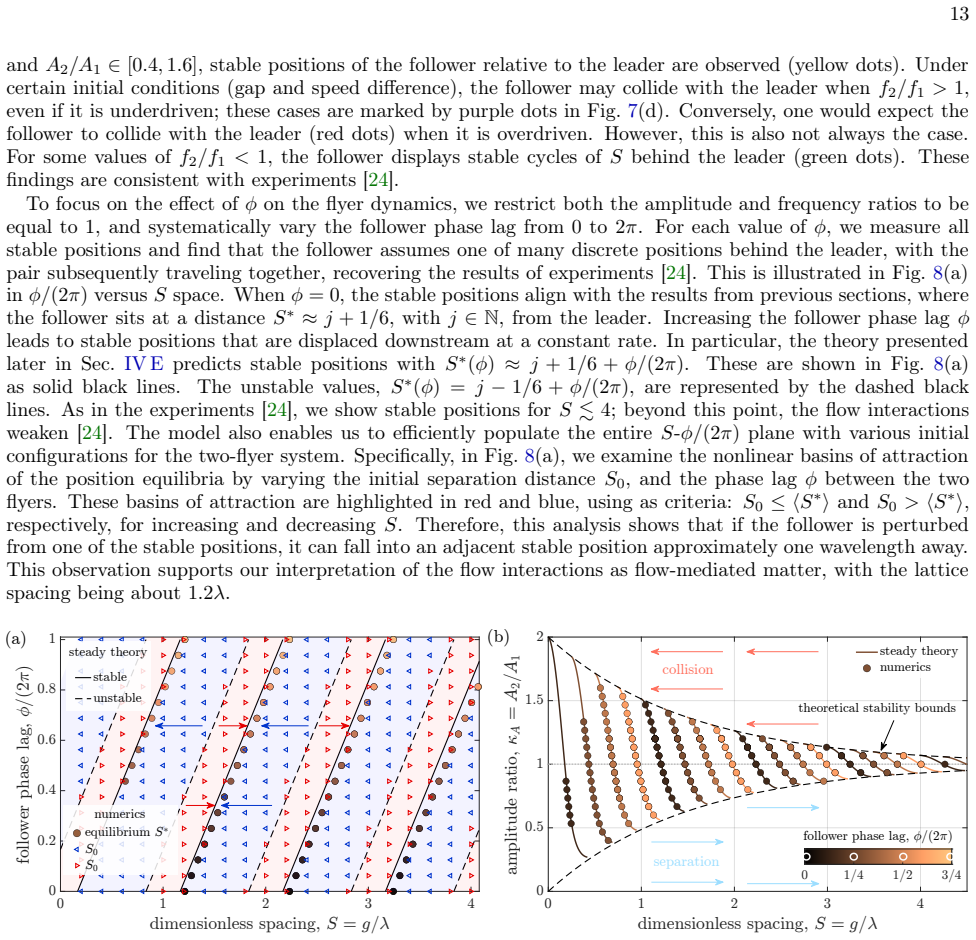
The central claim is that a minimal delay-differential model of wake interactions is sufficient to produce the crystalline order observed in in-line flapping-flyer formations, and to explain its breakdown. Each flyer's thrust is taken to depend on the square of its flapping speed relative to the 'erase-and-replace' wake signal left by the immediately upstream neighbor, which decays exponentially and is encountered after a memory delay that is itself a state variable. Steady-state analysis of a leader-follower pair shows that equilibrium spacings satisfy $\cos(2\pi S^*)=1/2$ in the long-lived-wake limit, quantizing the lattice spacing to $S^*=j+1/6$ (dimensionless gap of about 1.2 wake wavelengths), with $j+5/6$ unstable. Linear perturbation theory yields a spring constant $k$ for the inter-flyer bond, a resonant frequency, and compressive and tensile strengths of roughly 20% and 10% strain. The one-way directionality of the bonds lets each pair be treated as an isolated driven damped oscillator, so an oscillatory disturbance is amplified by each successive pair; nonlinear simulations show spontaneous collisions for groups beyond roughly 4-9 members.
Load-bearing premise
Everything rests on the erase-and-replace wake rule: a flyer's wake fully overwrites its upstream neighbor's at the position of the downstream flyer, so interactions are only between nearest neighbors, only downstream, and the wake speed equals the flapping speed.
Editorial extensions
If this is right
- In-line formations of flapping flyers should display quantized equilibrium spacings at $S^*=j+1/6$, with the first stable gap at about $1.2\lambda$, matching prior two-foil experiments.
- Each inter-flyer bond should respond like a spring with stiffness $k$ given by Eq. (25), failing in compression at roughly 20% strain and in tension at roughly 10% strain.
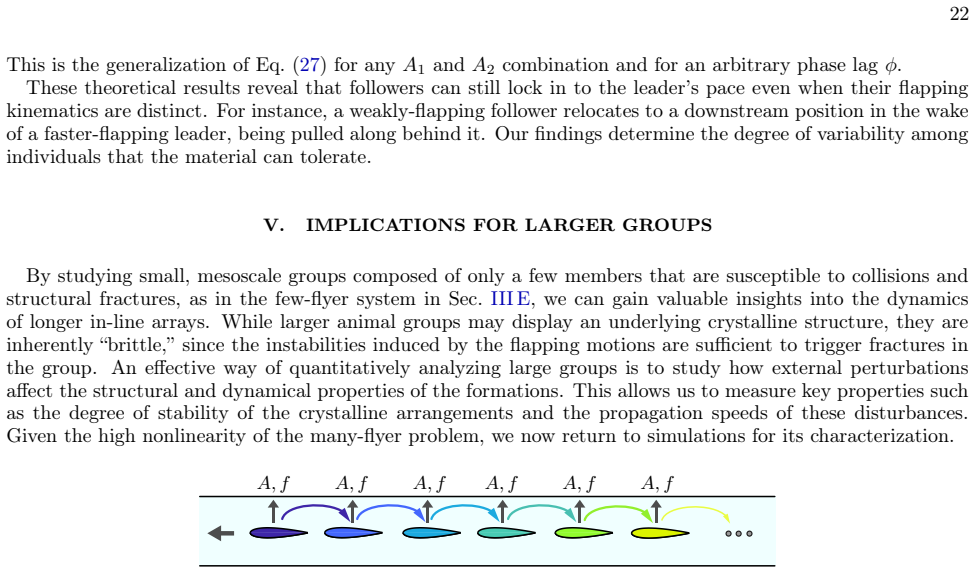
- A small oscillatory disturbance applied to the leader should grow in amplitude as it travels downstream, with the per-pair gain given by the driven-damped-oscillator resonance curve.
- Without feedback control, cohesive in-line groups should be limited to roughly 4-9 members, with the largest groups at small dimensionless mass and flapping Reynolds number, and instability times of 2-20 flaps.
- Information propagates downstream at a speed bounded by the flight speed at low mass and by the non-reciprocal wave speed at high mass.
Reading between the lines
- If the erase-and-replace scheme is a fair idealization of real high-Reynolds-number wakes, the same framework should apply to fish schools in in-line configurations, predicting the same $j+1/6$ quantization with the tail-beat wavelength replacing the flapping wavelength; this is a testable prediction against existing schooling data.
- The flonon mechanism implies that a trailing member can be a passive amplifier of disturbances the leader never directly sensed, which could be exploited in engineered swarm sensing rather than suppressed.
- The predicted group-size ceiling gives a concrete benchmark for behavioral studies: any natural columnar formation longer than about nine members likely requires active control or kinematic variability that detunes the resonance cascade.
- Measuring flonon propagation times in experiments with different body inertias would let one infer the effective spring constant of the flow bond in vivo, offering a non-intrusive probe of the group's mechanical state.
Signed reviews
Editorial analysis
A structured set of objections, weighed in public.
Referee Report
Summary. The paper proposes a delay-differential-equation model for in-line formations of flapping flyers, in which each flyer's wake is "erased and replaced" by the next downstream flyer, so that interactions are nearest-neighbor and one-way. The model uses a skin-friction drag scaling as U^{3/2} and a state-dependent delay tied to the time an upstream flyer occupied the follower's current position. The paper validates the model against a series of prior robophysical experiments: a single isolated flyer, a self-interacting flyer in a cyclic domain, two flyers with identical and with distinct kinematics, and a five-flyer group. Analytical steady-state analysis yields quantized equilibrium spacings S* = j + 1/6, a Hookean spring constant k, and a resonance frequency f_R; numerical simulations show downstream-amplifying longitudinal waves ("flonons") and a maximum cohesive group size of roughly 4 to 9 flyers in the strong-interaction (tau -> infinity) limit. The authors interpret these results as supporting a view of flying formations as flow-mediated matter.
Significance. If the model is accepted as a faithful minimal phenomenology, the paper makes a valuable contribution by providing an analytically tractable framework that connects individual flapping kinematics to collective ordering, elasticity, and instability. The derivation of the quantized spacing and spring constant directly from the delay equations, rather than by fitting to aggregate data, is a genuine strength, as is the reproduction of hysteresis, force-displacement curves, and flonon amplification without adjusting the interaction rule per experiment. The predictions of maximum stable group size and fragility maps are falsifiable and potentially useful for interpreting animal group behavior. However, the central physical mechanism is the erase-and-replace wake rule, which is assumed rather than measured; all subsequent claims inherit this assumption. The paper would be significant for the modeling community even if the wake-transport rule turns out to be an oversimplification, provided the authors clearly delimit the domain of validity and test the sensitivity of the headline predictions to the rule.
major comments (4)
- [Sec. II.A and Sec. III.E] The erase-and-replace wake scheme is the load-bearing assumption of the paper: it reduces Eq. (3) to a single delayed term and leads directly to the nearest-neighbor, one-way interaction graph on which the quantized spacing (Eq. 20), the spring constant (Eq. 25), and the pairwise resonance-cascade explanation of flonons (Sec. IV.D) all rest. The manuscript, however, provides no direct experimental or numerical evidence that a follower's wake erases the upstream signal, as opposed to superposing with it after advection past several downstream members. The pairwise validations cannot distinguish these alternatives, and the five-flyer comparison in Sec. III.E is an a posteriori reproduction rather than a designed test of the transport rule. I request either (i) a sensitivity study in which the five-flyer case is simulated with a superposition or finite-range-advection wake rule, (ii) a direct comparison to wake-flow measurements if available, or (iii) an explicit, detailed statement that the erase-and-replace rule is an untested modeling postulate, together with a discussion of which observable would most clearly falsify it.
- [Sec. IV.C (tensile strength)] The manuscript reports that the theoretical tensile strength overestimates the numerical values by about 40% and the tensile strains by about 60%, attributing the discrepancy to unsteady terms. Because the material analogy is a central theme, this quantitative mismatch should be addressed rather than stated in passing. Please provide confidence intervals or error bars for the numerical force-displacement data, and either (i) derive a first-order unsteady correction to Eq. (29) that reduces the gap, or (ii) soften the claims of quantitative agreement and explicitly state that only the compressive side is well captured by the steady theory.
- [Sec. III.B (drag law and hysteresis)] The text says the 3/2-power drag law is "crucial" for recovering the experimentally observed hysteresis loops, but no counterfactual simulation with the previously used quadratic drag U^2 is shown. Since this is an empirical modeling claim that motivates the entire model revision, please provide a direct comparison: run the same cyclic self-interacting setup with a quadratic drag term and show whether the multi-loop hysteresis disappears, or revise the wording to "consistent with" rather than "crucial."
- [Sec. III (experimental comparisons)] All experimental comparisons in Secs. III.A-III.E are plotted without error bars, and in Figs. 5(c) and 9 the experimental data points are not shown at all (only cited in the text). To support the claim that the model "faithfully reproduces" the experiments, please overlay the experimental measurements with their reported uncertainties, or, if the original papers do not provide uncertainties, state that explicitly and discuss the resulting limitations on the validation.
minor comments (5)
- [Sec. IV.B, Eq. (27)] The inequality is written as "2πS* tan(2πS*) ln(1/(2cos(2πS*)) > 1", which appears to be missing a division sign; it should read [2πS* tan(2πS*)] / ln(1/(2cos(2πS*))) > 1.
- [Fig. 4(b) caption] The caption contains the typo "single.yer" in the dotted cyan line description; it should be "single flyer."
- [Sec. II.B, Eq. (5)] The notation U1,2(t), V1,2(t), and V2,1(t1,2(t)) in the closed two-flyer equation is confusing; please define the index conventions explicitly (e.g., which subscript refers to the source and which to the receiver).
- [Sec. II.A] The assumption that the wake-flow speed at a flyer's location equals its flapping speed (W_n(X_n(t), t) = V_n(t)) is introduced without a citation or empirical justification; a brief note on the experimental or theoretical basis for this equality would help the reader judge its validity.
- [Sec. V.B, Eqs. (40)-(42)] The allowed wave numbers in the nonreciprocal chain are stated as "q_m = mπ/λ or q_m = (2m±1/2)π/[(N−1)λ]" without a derivation; please clarify the boundary-condition setup (especially the role of the ghost point and the fixed-free conditions) and show how these values follow from the determinant condition.
Circularity Check
In-sample calibration of single-flyer speed and hysteresis is presented as validation, but the central lattice-spacing and spring-constant predictions are analytic and not fitted.
-
fitted input called prediction
[Sec. III.A, Eq. (17), Fig. 3(a)]
"By fitting the data from the flight speed of an isolated flyer in experiments [19, Fig. 2(b)] we can fix the ratio CT /CD in our model to account for flight speeds at all A and f. The model predicts CD ≈ 10 with CT = 1 as the thrust coefficient [30, 39]."
The equilibrium speed U* = (ρc/μ)^(1/3)(CT/(2CD))^(2/3)(πAf)^(4/3) is compared in Fig. 3(a) with the same experimental speeds used to fix CD. Because CD is chosen to make the model match those data, the reported 'agreement is excellent' is in-sample; the speed magnitude is not an independent prediction. Only the 4/3 scaling exponent is untested by the fit. Since the lattice spacing and spring constant do not depend on CD, this is a calibration step rather than the core circularity.
-
fitted input called prediction
[Sec. II.A (drag-law discussion) and Sec. III.B, Fig. 4(b)]
"It is crucial that the drag force follows a 3/2-power law on the flyer’s horizontal speed, instead of a quadratic power law used in previous works [24, 25]. This ensures that hysteresis loops observed experimentally, showing multiple stable modes for the same kinematic parameters [21], are recovered."
The functional form of the drag law is selected specifically to reproduce the experimentally observed hysteresis loops, and the same hysteresis is then presented as validation: 'The simulations confirm the existence of multiple hysteresis loops.' This is a fit to the target phenomenon, not an independent prediction. The choice does not enter the derivation of S* = j + 1/6 or of the spring constant k, so it contributes partial, not total, circularity.
full rationale
The central analytical chain (Eqs. 19-21 for the lattice spacing, Eq. 25 for the spring stiffness, and Eq. 26 for the resonant frequency) follows algebraically from the follower-wake thrust model and does not depend on the drag coefficient CD, the drag-law exponent, or the wake decay time τ in the strong-interaction limit. The erase-and-replace wake rule is a stated modeling assumption rather than a derived result; although it is justified partly by the authors' prior experiments [25], those experiments are externally obtained robophysical data, so citing them is self-citation but not a circular reduction. The large-group predictions (Nmax, fragility maps, disturbance speeds) are compared only with the model's own simulations, making them unvalidated but not circular. The genuine circularity is confined to two calibration-heavy validations: the isolated-flyer speed, where CD is fit to the data then shown to agree with it, and the hysteresis loops, where the drag law is chosen to recover the observed hysteresis and that recovery is then called validation. Because these in-sample checks are not the paper's principal quantitative claims, the overall circularity score is moderate rather than severe.
Assumptions & free parameters
free parameters (3)
- CD (skin-friction drag coefficient) =
10 (with CT=1)
- tau (wake decay timescale) =
0.5 s for validation; infinity for large-N analysis
- CT (thrust coefficient) =
1
assumptions (7)
- ad hoc to paper Erase-and-replace wake scheme: each flyer overwrites the upstream wake signal, making interactions nearest-neighbor and one-way in the downstream direction.
- ad hoc to paper The wake-flow speed at a flyer's location equals that flyer's flapping speed, and the wake signal decays exponentially in time with timescale tau.
- domain assumption Thrust on a flyer scales with the square of the relative vertical speed between the flyer and the ambient wake signal.
- domain assumption Drag is modeled by Blasius skin-friction scaling D proportional to U^(3/2).
- domain assumption Period-averaged (DC) approximation: time-dependent terms are neglected in deriving equilibrium spacing and stability, and the delay Delta t is treated as constant in equilibrium.
- domain assumption For the large-group analysis, the wake decay timescale is taken as infinite (tau -> infinity).
- domain assumption The N-flyer group is represented by a linear chain of masses connected by one-way diodic springs with stiffness k from Eq. (25).
Cite this review
Pith. "Pith review of Modeling flying formations as flow-mediated matter." pith.science (2026). https://pith.science/paper/Z7AXFYBM
@misc{pith2026250614025,
  author       = {Pith},
  title        = {Pith review of: Modeling flying formations as flow-mediated matter},
  year         = {2026},
  howpublished = {\url{https://pith.science/paper/Z7AXFYBM}},
  note         = {Machine review of arXiv:2506.14025}
}
read the original abstract
Collective locomotion of swimming and flying animals is fascinating in terms of individual-level fluid mechanics and group-level structure and dynamics. Here we bridge and relate these scales through a model of formation flight that views the collective as a material whose properties arise from the flow-mediated interactions among its members. We build on and revise an aerodynamic model describing how flapping flyers produce vortex wakes and how they are forced by others' wakes. While simplistic, the model faithfully reproduces a series of physical experiments carried out over the last decade on pairwise interactions of flapping foils. By studying longer in-line arrays, we show that the group behaves as a soft "crystal" with regularly spaced member "atoms" whose positioning is, however, susceptible to deformations and dynamical instabilities. Poking or wiggling a member excites longitudinal waves (flow-mediated phonons, or "flonons") that pass down the group while growing in amplitude, and indeed the internal excitation from flapping is sufficient to trigger instabilities. Linear analysis of the model explains the aerodynamic origin of the lattice spacing, the springiness of the "bonds" between flyers, and the tendency for disturbances to resonantly amplify. Other properties such as the timescales for instability growth and wave propagation seem to involve the full nonlinear behavior. These findings suggest intriguing analogies with physical materials that could be generally useful for understanding and analyzing animal groups. Several properties displayed by our system seem particularly relevant to biological collectives, namely group cohesion and organization, sensitive detection of and response to perturbations, and transmission of information through traveling waves.
Figures


Figures from the paper (12 more)






Reference graph
Works this paper leans on
-
[1]
D. J. T. Sumpter. The principles of collective animal behaviour.Philosophical transactions of the Royal Society B: Biological Sciences, 361(1465):5–22, 2006
work page 2006
-
[2]
A. Cavagna and I. Giardina. Bird flocks as condensed matter.Annu. Rev. Condens. Matter Phys., 5(1):183–207, 2014
work page 2014
-
[3]
Substituting these values into Eq. (29), we obtain the tensile strength F (St n) of the crystalline formation, for each of the three initial arrangements. However, in this case, the theoretical predictions overestimate the numerical results shown in Fig. 6(a) by about 40%. The analytical predictions of the tensile strength in the different initial arrange...
-
[4]
C. K. Hemelrijk and H. Hildenbrandt. Schools of fish and flocks of birds: their shape and internal structure by self-organization. Interface focus, 2(6):726–737, 2012
work page 2012
- [5]
-
[6]
T. Vicsek and A. Zafeiris. Collective motion.Physics reports, 517(3-4):71–140, 2012
work page 2012
-
[7]
T. Mora, A. M. Walczak, L. Del Castello, F. Ginelli, S. Melillo, L. Parisi, M. Viale, A. Cavagna, and I. Giardina. Local equilibrium in bird flocks.Nature physics, 12(12):1153–1157, 2016
work page 2016
-
[8]
J. J. L. Higdon and S. Corrsin. Induced drag of a bird flock.The American Naturalist, 112(986):727–744, 1978
1978
Show all 67 references
-
[9]
D. Weihs. Hydromechanics of fish schooling.Nature, 241(5387):290–291, 1973
1973
-
[10]
D. Weihs. Some hydrodynamical aspects of fish schooling. Swimming and Flying in Nature: Volume 2, pages 703–718, 1975
1975
-
[11]
P. B. S. Lissaman and C. A. Shollenberger. Formation flight of birds.Science, 168(3934):1003–1005, 1970
1970
-
[12]
D. Hummel. Aerodynamic aspects of formation flight in birds.Journal of theoretical biology, 104(3):321–347, 1983
1983
-
[13]
J. C. Liao. A review of fish swimming mechanics and behaviour in altered flows.Philosophical Transactions of the Royal Society B: Biological Sciences, 362(1487):1973–1993, 2007
1973
-
[14]
B. L. Partridge and T. J. Pitcher. Evidence against a hydrodynamic function for fish schools.Nature, 279(5712):418– 419, 1979
1979
-
[15]
D. S. Pavlov and A. O. Kasumyan. Patterns and mechanisms of schooling behavior in fish: a review.Journal of Ichthyology, 40(2):S163, 2000
2000
-
[16]
J. P. Badgerow and F. R. Hainsworth. Energy savings through formation flight? A re-examination of the vee formation. Journal of Theoretical Biology, 93(1):41–52, 1981
1981
-
[17]
M. V. Abrahams and P. W. Colgan. Fish schools and their hydrodynamic function: a reanalysis.Environmental Biology of Fishes, 20:79–80, 1987
1987
-
[18]
M. Larsson. Why do fish school?Current Zoology, 58(1):116–128, 2012
2012
-
[19]
Lighthill.Mathematical biofluiddynamics
Sir J. Lighthill.Mathematical biofluiddynamics. SIAM, 1975
1975
-
[20]
Ramananarivo, F
S. Ramananarivo, F. Fang, A. Oza, J. Zhang, and L. Ristroph. Flow interactions lead to orderly formations of flapping wings in forward flight.Physical Review Fluids, 1(7):071201, 2016
2016
-
[21]
X. Zhu, G. He, and X. Zhang. Flow-mediated interactions between two self-propelled flapping filaments in tandem configuration. Physical Review Letters, 113(23):238105, 2014
2014
-
[22]
A. D. Becker, H. Masoud, J. W. Newbolt, M. Shelley, and L. Ristroph. Hydrodynamic schooling of flapping swimmers. Nature Communications, 6(1):1–8, 2015
2015
-
[23]
L. Dai, G. He, X. Zhang, and X. Zhang. Stable formations of self-propelled fish-like swimmers induced by hydrody- namic interactions. Journal of The Royal Society Interface, 15(147):20180490, 2018
2018
-
[24]
Z.-R. Peng, H. Huang, and X.-Y. Lu. Hydrodynamic schooling of multiple self-propelled flapping plates.Journal of Fluid Mechanics, 853:587–600, 2018
2018
-
[25]
J. W. Newbolt, J. Zhang, and L. Ristroph. Flow interactions between uncoordinated flapping swimmers give rise to group cohesion. Proceedings of the National Academy of Sciences, 116(7):2419–2424, 2019
2019
-
[26]
J. W. Newbolt, N. Lewis, M. Bleu, J. Wu, C. Mavroyiakoumou, S. Ramananarivo, and L. Ristroph. Flow interactions lead to self-organized flight formations disrupted by self-amplifying waves.Nature Communications, 15(3462):1–12, 2024. 29
2024
-
[27]
A. U. Oza, L. Ristroph, and M. J. Shelley. Lattices of hydrodynamically interacting flapping swimmers.Physical Review X, 9(4):041024, 2019
2019
-
[28]
Saadat, F
M. Saadat, F. Berlinger, A. Sheshmani, R. Nagpal, G. V. Lauder, and H. Haj-Hariri. Hydrodynamic advantages of in-line schooling. Bioinspiration & Biomimetics, 16(4):046002, 2021
2021
-
[29]
Heydari and E
S. Heydari and E. Kanso. School cohesion, speed and efficiency are modulated by the swimmers flapping motion. Journal of Fluid Mechanics, 922:A27, 2021
2021
-
[30]
Nitsche, A
M. Nitsche, A. U. Oza, and M. Siegel. On the stability of an in-line formation of hydrodynamically interacting flapping plates. arXiv preprint arXiv:2410.04626, 2024
2024 arXiv
-
[31]
G. S. Triantafyllou, M. S. Triantafyllou, and M. A. Grosenbaugh. Optimal thrust development in oscillating foils with application to fish propulsion.Journal of Fluids and Structures, 7(2):205–224, 1993
1993
-
[32]
Andersen, T
A. Andersen, T. Bohr, T. Schnipper, and J. H. Walther. Wake structure and thrust generation of a flapping foil in two-dimensional flow.Journal of Fluid Mechanics, 812:R4, 2017
2017
-
[33]
B. M. Boschitsch, P. A. Dewey, and A. J. Smits. Propulsive performance of unsteady tandem hydrofoils in an in-line configuration. Physics of Fluids, 26(5), 2014
2014
-
[34]
Rival, G
D. Rival, G. Hass, and C. Tropea. Recovery of energy from leading-and trailing-edge vortices in tandem-airfoil configurations. Journal of Aircraft, 48(1):203–211, 2011
2011
-
[35]
T. Han, A. Mivehchi, S. Seyedmirzaei Sarraf, and K. W. Moored. Tailoring formations of self-organising hydrofoil schools towards high-efficiency.Journal of Fluid Mechanics, 1012:A26, 2025
2025
-
[36]
Vandenberghe, J
N. Vandenberghe, J. Zhang, and S. Childress. Symmetry breaking leads to forward flapping flight.Journal of Fluid Mechanics, 506:147–155, 2004
2004
-
[37]
Alben and M
S. Alben and M. Shelley. Coherent locomotion as an attracting state for a free flapping body.Proceedings of the National Academy of Sciences, 102(32):11163–11166, 2005
2005
-
[38]
Vandenberghe, S
N. Vandenberghe, S. Childress, and J. Zhang. On unidirectional flight of a free flapping wing.Physics of Fluids, 18(1):014102, 2006
2006
-
[39]
S. E. Spagnolie, L. Moret, M. J. Shelley, and J. Zhang. Surprising behaviors in flapping locomotion with passive pitching. Physics of Fluids, 22(4):041903, 2010
2010
-
[40]
Floryan, T
D. Floryan, T. Van Buren, C. W. Rowley, and A. J. Smits. Scaling the propulsive performance of heaving and pitching foils. Journal of Fluid Mechanics, 822:386–397, 2017
2017
-
[41]
A. J. Smits. Undulatory and oscillatory swimming.Journal of Fluid Mechanics, 874:P1, 2019
2019
-
[42]
D. J. Tritton.Physical fluid dynamics. Springer Science & Business Media, 2012
2012
-
[43]
Schlichting and K
H. Schlichting and K. Gersten.Boundary-layer theory. springer, 2016
2016
-
[44]
Matlab version: R2023a, 2023
The MathWorks Inc. Matlab version: R2023a, 2023
2023
-
[45]
F. E. Fish, J. F. Fegely, and C. J. Xanthopoulos. Burst-and-coast swimming in schooling fish (Notemigonus crysoleu- cas)withimplicationsforenergyeconomy. Comparative Biochemistry and Physiology Part A: Physiology, 100(3):633– 637, 1991
1991
-
[46]
O. K. G. Tietjens and L. Prandtl.Applied hydro-and aeromechanics: based on lectures of L. Prandtl, volume 2. Courier Corporation, 1957
1957
-
[47]
F. M. White.Fluid mechanics. McGraw Hill, 1966
1966
-
[48]
F. Fang, C. Mavroyiakoumou, L. Ristroph, and M. J. Shelley. Flow interactions and forward flight dynamics of tandem flapping wings.arXiv preprint arXiv:2505.13149, 2025
2025 arXiv
-
[49]
C. Eloy. Optimal strouhal number for swimming animals.Journal of Fluids and Structures, 30:205–218, 2012
2012
-
[50]
Sfakiotakis, D
M. Sfakiotakis, D. M. Lane, and J. B. C. Davies. Review of fish swimming modes for aquatic locomotion.IEEE Journal of oceanic engineering, 24(2):237–252, 1999
1999
-
[51]
G. K. Taylor, R. L. Nudds, and A. L. R. Thomas. Flying and swimming animals cruise at a strouhal number tuned for high power efficiency.Nature, 425(6959):707–711, 2003
2003
-
[52]
Beatus, T
T. Beatus, T. Tlusty, and R. Bar-Ziv. Phonons in a one-dimensional microfluidic crystal.Nature Physics, 2(11):743– 748, 2006
2006
-
[53]
P. M. Chaikin, T. C. Lubensky, and T. A. Witten.Principles of condensed matter physics, volume 10. Cambridge University Press, 1995
1995
-
[54]
C. H. Greenewalt. Dimensional relationships for flying animals.Smithsonian miscellaneous collections, 1962
1962
-
[55]
Viscor and J
G. Viscor and J. F. Fuster. Relationships between morphological parameters in birds with different flying habits. Comparative Biochemistry and Physiology Part A: Physiology, 87(2):231–249, 1987
1987
-
[56]
Dimitriadis, J
G. Dimitriadis, J. D. Gardiner, P. G. Tickle, J. Codd, and R. L. Nudds. Experimental and numerical study of the flight of geese.The Aeronautical Journal, 119(1217):803–832, 2015
2015
-
[57]
C. J. Pennycuick. Predicting wingbeat frequency and wavelength of birds. Journal of experimental biology, 150(1):171–185, 1990
1990
-
[58]
S. Dhawan. Bird flight.Sadhana, 16(4):275–352, 1991
1991
-
[59]
J. M. V. Rayner. A new approach to animal flight mechanics.Journal of Experimental Biology, 80(1):17–54, 1979
1979
-
[60]
Krishnan, B
K. Krishnan, B. Garde, A. Bennison, N. C. Cole, E.-L. Cole, J. Darby, K. H. Elliott, A. Fell, A. Gómez-Laich, S. De Grissac, et al. The role of wingbeat frequency and amplitude in flight power.Journal of the Royal Society Interface, 19(193):20220168, 2022
2022
-
[61]
L. A. Taylor, G. K. Taylor, B. Lambert, J. A. Walker, D. Biro, and S. J. Portugal. Birds invest wingbeats to keep a steady head and reap the ultimate benefits of flying together.PLoS biology, 17(6):e3000299, 2019. 30
2019
-
[62]
Maggini, L
I. Maggini, L. V. Kennedy, A. Macmillan, K. H. Elliott, K. Dean, and C. G. Guglielmo. Light oiling of feathers increases flight energy expenditure in a migratory shorebird.Journal of Experimental Biology, 220(13):2372–2379, 2017
2017
-
[63]
A. Nafi, H. Ben-Gida, C. G. Guglielmo, and R. Gurka. Aerodynamic forces acting on birds during flight: a comparative study of a shorebird, songbird and a strigiform.Experimental Thermal and Fluid Science, 113:110018, 2020
2020
-
[64]
J. M. Segreto, A. J. Kirchhefer, E. E. Hackett, C. G. Guglielmo, G. A. Kopp, and R. Gurka. Experimental study of the unsteady aerodynamics during flapping flight of birds: European Starling, Western Sandpiper and American Robin. In 10th Pacific Symposium on Flow Visualization ...
2015
-
[65]
Brandenbourger, X
M. Brandenbourger, X. Locsin, E. Lerner, and C. Coulais. Non-reciprocal robotic metamaterials.Nature communi- cations, 10(1):4608, 2019
2019
-
[66]
J. A. Carrillo, Y.-P. Choi, and M. Hauray. The derivation of swarming models: mean-field limit and wasserstein distances. Collective Dynamics from Bacteria to Crowds: An Excursion Through Modeling, Analysis and Simulation, pages 1–46, 2014
2014
-
[67]
Bruna, M
M. Bruna, M. Burger, and O. de Wit. Lane formation and aggregation spots in a model of ants.SIAM Journal on Applied Dynamical Systems, 24(1):675–709, 2025
2025
Reviewed August 7, 2026 · model on record in the stance chip above.
Discussion (0). Continue with ORCID to comment.