Heralded enhancement in quantum state discrimination
Pith reviewed 2026-05-19 09:57 UTC · model grok-4.3
The pith
Partial post-selection on one mode can achieve strictly lower discrimination error for certain conditional states of two non-orthogonal pure states, even though the average error over all outcomes cannot fall below the original optimum.
A machine-rendered reading of the paper's core claim, the machinery that carries it, and where it could break.
Core claim
When two unknown pure states interact with the same pure environment state via an arbitrary unitary transformation, a partial POVM performed on one output mode followed by classical communication of its outcome to an optimal POVM on the remaining mode produces conditional states whose minimum error probabilities can be strictly lower than that of the original pair, although the error probability averaged over all such conditional states cannot be reduced below the original value.
What carries the argument
A partial POVM on one output mode that heralds a specific conditional state for the unmeasured mode, with the outcome used via classical feed-forward to select the minimum-error POVM for that conditional pair.
Load-bearing premise
The two unknown states interact with the same environment prepared in a pure state through an arbitrary unitary before the partial measurement is performed.
What would settle it
A concrete numerical counter-example in which every possible outcome of the partial POVM yields a conditional pair whose minimum error probability is at least as large as the original optimum would refute the existence of strictly better conditional cases.
Figures


read the original abstract
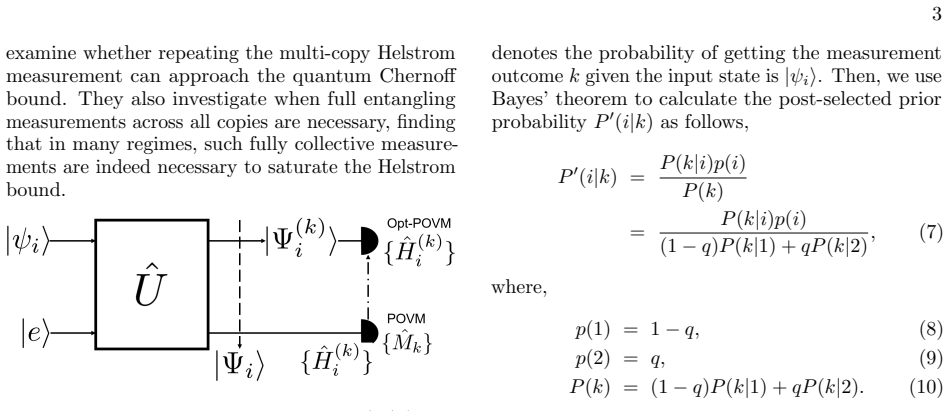
The discrimination of quantum states is a central problem in quantum information science and technology. Meanwhile, partial post-selection has emerged as a valuable tool for quantum state engineering. In this work, we bring these two areas together and ask whether partial measurements can enhance the discrimination performance between two unknown and non-orthogonal pure states. Our framework is general: the two unknown states interact with the same environment--set in a pure state--via an arbitrary unitary transformation. A measurement is then performed on one of the output modes (i.e. a partial measurement), modeled by an arbitrary positive operator-valued measure (POVM). We then allow classical communication to inform the unmeasured mode of the outcome of the partial measurement, which is subsequently measured by a POVM that is optimal in the sense that the discrimination probability of error is minimized. The two POVMs act locally and classical information is exchanged between the two modes, representing a single-round (feed-forward) form of local operations with classical communication. Under these considerations, we first show that, as expected, the minimum error probability, averaged over all possible conditional states, cannot be reduced below the minimum error probability of discriminating the original input states. Then, we devise a generic setup produces specific examples where the conditional discrimination can achieve strictly lower error probabilities than the original optimal measurement, illustrating that while post-selection does not improve the average performance, it can enable better discrimination in certain post-selected ensembles.
Editorial analysis
A structured set of objections, weighed in public.
Referee Report
Summary. The manuscript examines whether partial post-selection via a single-round feed-forward LOCC protocol can improve discrimination between two unknown non-orthogonal pure states. The states interact with a shared pure-state environment through an arbitrary unitary; a partial POVM is performed on one output mode, its outcome is communicated classically, and an optimal Helstrom measurement is applied to the remaining mode. The central results are (i) that the probability-weighted average of the conditional minimum-error probabilities cannot fall below the unconditional Helstrom bound for the original pair (because the overall protocol is itself a valid discrimination strategy) and (ii) that there exist explicit choices of unitary, partial POVM, and input states for which at least one conditional branch achieves a strictly lower error probability than the original optimum.
Significance. If the explicit constructions are correct, the work usefully separates average and conditional performance in quantum state discrimination. The no-go result follows directly from the convexity of the Helstrom error and the fact that the feed-forward protocol is admissible; the existence of heralded improvements is consistent with the same convexity. The generality of the framework (arbitrary unitary and POVM) makes the conditional examples more convincing than ad-hoc constructions would be. The result may inform the design of heralded protocols in quantum sensing or communication where post-selection is already employed.
major comments (2)
- The no-go for the averaged error is load-bearing and appears sound, but the manuscript should explicitly verify that the overall feed-forward protocol reproduces a valid POVM on the original two-mode space whose error is bounded by the Helstrom value (see the paragraph immediately following the statement of the average result).
- For the conditional improvement claim, the paper must supply the concrete unitary, the explicit partial POVM elements, the two input states, and the numerical values of the conditional Helstrom errors (including the original unconditional error for comparison) so that the strict inequality can be checked independently.
minor comments (2)
- Notation for the conditional states and the feed-forward POVM should be introduced with a clear diagram or equation block early in the main text.
- The abstract states that the setup is 'generic' yet produces 'specific examples'; a short sentence clarifying that the examples are constructed rather than generic would avoid possible misreading.
Simulated Author's Rebuttal
We thank the referee for their careful reading of the manuscript and for the constructive comments. We agree that the suggested clarifications will improve the clarity and verifiability of the results. We address each major comment below and will incorporate the requested additions in the revised manuscript.
read point-by-point responses
-
Referee: The no-go for the averaged error is load-bearing and appears sound, but the manuscript should explicitly verify that the overall feed-forward protocol reproduces a valid POVM on the original two-mode space whose error is bounded by the Helstrom value (see the paragraph immediately following the statement of the average result).
Authors: We agree that an explicit verification strengthens the argument. In the revised manuscript, immediately following the statement of the average-result theorem, we will add a short derivation showing that the composite feed-forward protocol (partial POVM on one mode followed by the conditional Helstrom measurement on the other, with classical communication) defines a valid two-mode POVM. We will explicitly construct the effective measurement operators on the original two-mode Hilbert space and confirm that the resulting error probability is bounded below by the unconditional Helstrom value, as required by the optimality of the Helstrom measurement. revision: yes
-
Referee: For the conditional improvement claim, the paper must supply the concrete unitary, the explicit partial POVM elements, the two input states, and the numerical values of the conditional Helstrom errors (including the original unconditional error for comparison) so that the strict inequality can be checked independently.
Authors: We appreciate this request for explicit data. In the revised manuscript we will present a fully specified example, including the explicit 4×4 unitary matrix acting on the two-mode space, the two-element partial POVM on the first mode, the two input pure states, and the numerical values of the conditional minimum-error probabilities together with the original unconditional Helstrom error. These numbers will be computed directly from the Helstrom formula applied to each conditional ensemble, demonstrating the strict improvement in at least one branch while preserving the average. revision: yes
Circularity Check
No significant circularity detected
full rationale
The paper establishes a no-go theorem showing that the probability-weighted average of conditional Helstrom errors cannot fall below the original Helstrom error for the input states. This follows immediately because the entire feed-forward protocol (unitary interaction plus partial POVM plus conditional optimal POVM) is itself a valid discrimination strategy for the original pair, so its average performance is bounded below by optimality of the Helstrom measurement; no self-definition or fitted parameter is involved. The positive results consist of explicit constructions of unitaries, states, and POVMs that improve performance on selected branches while preserving the average bound via convexity. These constructions are presented directly rather than derived from any prior self-citation or ansatz, and the framework relies only on standard properties of POVMs and conditional states. The derivation chain is therefore self-contained against external quantum-information benchmarks with no load-bearing step that reduces to its own inputs by construction.
Axiom & Free-Parameter Ledger
axioms (2)
- standard math Quantum states are represented by density operators, evolution by unitaries, and measurements by POVMs on Hilbert space.
- domain assumption The environment starts in a pure state.
Lean theorems connected to this paper
-
IndisputableMonolith/Cost/FunctionalEquation.leanwashburn_uniqueness_aczel unclear?
unclearRelation between the paper passage and the cited Recognition theorem.
Paveme = 1/2 - sum P(k) ||rho(k)||1 / 2 and the inequality sum P(k) ||rho(k)||1 <= ||rho||1 proved via concavity of sqrt and triangle inequality on overlaps
-
IndisputableMonolith/Foundation/RealityFromDistinction.leanreality_from_one_distinction unclear?
unclearRelation between the paper passage and the cited Recognition theorem.
Helstrom bound Perr >= 1/2 - ||rho||1 / 2 for pure states with overlap |<psi1|psi2>|
What do these tags mean?
- matches
- The paper's claim is directly supported by a theorem in the formal canon.
- supports
- The theorem supports part of the paper's argument, but the paper may add assumptions or extra steps.
- extends
- The paper goes beyond the formal theorem; the theorem is a base layer rather than the whole result.
- uses
- The paper appears to rely on the theorem as machinery.
- contradicts
- The paper's claim conflicts with a theorem or certificate in the canon.
- unclear
- Pith found a possible connection, but the passage is too broad, indirect, or ambiguous to say the theorem truly supports the claim.
Reference graph
Works this paper leans on
-
[1]
C. W. Helstrom, Quantum Detection and Estimation Theory, 1st ed. (Academic Press, New York, 1976)
work page 1976
-
[2]
Optimum testing of multiple hypotheses in quantum detection theory,
H. Yuen, R. Kennedy, and M. Lax, “Optimum testing of multiple hypotheses in quantum detection theory,” IEEE Transactions on Information Theory 21, 125–134 (1975)
work page 1975
-
[3]
Statistical decision theory for quantum systems,
A.S Holevo, “Statistical decision theory for quantum systems,” Journal of Multivariate Analysis 3, 337– 394 (1973)
work page 1973
-
[4]
Linear optics and photodetection achieve near-optimal unambiguous coherent state discrimination,
Jasminder S Sidhu, Michael S Bullock, Saikat Guha, and Cosmo Lupo, “Linear optics and photodetection achieve near-optimal unambiguous coherent state discrimination,” Quantum 7, 1025 (2023)
work page 2023
-
[5]
Quantum advantage for noisy channel discrimination,
Zane M. Rossi, Jeffery Yu, Isaac L. Chuang, and Sho Sugiura, “Quantum advantage for noisy channel discrimination,” Phys. Rev. A 105, 032401 (2022)
work page 2022
-
[6]
Quantum cryptography using any two nonorthogonal states,
Charles H. Bennett, “Quantum cryptography using any two nonorthogonal states,” Phys. Rev. Lett. 68, 3121–3124 (1992)
work page 1992
-
[7]
Quantum il- lumination with gaussian states,
Si-Hui Tan, Baris I. Erkmen, Vittorio Giovannetti, Saikat Guha, Seth Lloyd, Lorenzo Maccone, Stefano Pirandola, and Jeffrey H. Shapiro, “Quantum il- lumination with gaussian states,” Phys. Rev. Lett. 101, 253601 (2008)
work page 2008
-
[8]
Computable bounds for the discrimination of gaussian states,
Stefano Pirandola and Seth Lloyd, “Computable bounds for the discrimination of gaussian states,” Phys. Rev. A 78, 012331 (2008)
work page 2008
-
[9]
Postselected quantum hypothesis testing,
Bartosz Regula, Ludovico Lami, and Mark M. Wilde, 8 “Postselected quantum hypothesis testing,” IEEE Transactions on Information Theory 70, 3453–3469 (2024)
work page 2024
-
[10]
Unambiguous discrimination be- tween linearly independent quantum states,
Anthony Chefles, “Unambiguous discrimination be- tween linearly independent quantum states,” Physics Letters A 239, 339–347 (1998)
work page 1998
-
[11]
Quantum-state engineering with continuous-variable postselection,
Andrew M. Lance, Hyunseok Jeong, Nicolai B. Grosse, Thomas Symul, Timothy C. Ralph, and Ping Koy Lam, “Quantum-state engineering with continuous-variable postselection,” Phys. Rev. A 73, 041801 (2006)
work page 2006
-
[12]
Conversion of gaussian states to non- gaussian states using photon-number-resolving de- tectors,
Daiqin Su, Casey R. Myers, and Krishna Kumar Sabapathy, “Conversion of gaussian states to non- gaussian states using photon-number-resolving de- tectors,” Phys. Rev. A 100, 052301 (2019)
work page 2019
-
[13]
Non-gaussian and gottesman–kitaev–preskill state preparation by photon catalysis,
Miller Eaton, Rajveer Nehra, and Olivier Pfister, “Non-gaussian and gottesman–kitaev–preskill state preparation by photon catalysis,” New Journal of Physics 21, 113034 (2019)
work page 2019
-
[14]
Christos N. Gagatsos and Saikat Guha, “Efficient representation of gaussian states for multimode non- gaussian quantum state engineering via subtraction of arbitrary number of photons,” Phys. Rev. A 99, 053816 (2019)
work page 2019
-
[15]
Postselected versus nonpostselected quantum teleportation us- ing parametric down-conversion,
Pieter Kok and Samuel L. Braunstein, “Postselected versus nonpostselected quantum teleportation us- ing parametric down-conversion,” Phys. Rev. A 61, 042304 (2000)
work page 2000
-
[16]
Closed timelike curves via postselection: Theory and experimental test of consistency,
Seth Lloyd, Lorenzo Maccone, Raul Garcia-Patron, Vittorio Giovannetti, Yutaka Shikano, Stefano Pi- randola, Lee A. Rozema, Ardavan Darabi, Yasaman Soudagar, Lynden K. Shalm, and Aephraim M. Steinberg, “Closed timelike curves via postselection: Theory and experimental test of consistency,” Phys. Rev. Lett. 106, 040403 (2011)
work page 2011
-
[17]
Miller Eaton, Carlos Gonz´ alez-Arciniegas, Rafael N. Alexander, Nicolas C. Menicucci, and Olivier Pfister, “Measurement-based generation and preservation of cat and grid states within a continuous-variable clus- ter state,” Quantum 6, 769 (2022)
work page 2022
-
[18]
Quantum limits on postse- lected, probabilistic quantum metrology,
Joshua Combes, Christopher Ferrie, Zhang Jiang, and Carlton M. Caves, “Quantum limits on postse- lected, probabilistic quantum metrology,” Phys. Rev. A 89, 052117 (2014)
work page 2014
-
[19]
Restoring Heisenberg scaling in noisy quantum metrology by monitoring the environment,
Francesco Albarelli, Matteo A. C. Rossi, Dario Tama- scelli, and Marco G. Genoni, “Restoring Heisenberg scaling in noisy quantum metrology by monitoring the environment,” Quantum 2, 110 (2018)
work page 2018
-
[20]
Cost of postselection in decision theory,
Joshua Combes and Christopher Ferrie, “Cost of postselection in decision theory,” Physical Review A 92, 022117 (2015)
work page 2015
-
[21]
Multiple-copy two-state discrimi- nation with individual measurements,
A. Ac´ ın, E. Bagan, M. Baig, Ll. Masanes, and R. Mu˜ noz Tapia, “Multiple-copy two-state discrimi- nation with individual measurements,” Phys. Rev. A 71, 032338 (2005)
work page 2005
-
[22]
Local discrimination of mixed states,
J. Calsamiglia, J. I. de Vicente, R. Mu˜ noz Tapia, and E. Bagan, “Local discrimination of mixed states,” Phys. Rev. Lett. 105, 080504 (2010)
work page 2010
-
[23]
Local approximation for perfect discrimination of quantum states,
Scott M. Cohen, “Local approximation for perfect discrimination of quantum states,” Phys. Rev. A 107, 012401 (2023)
work page 2023
-
[24]
Postmeasurement information and nonlo- cality of quantum state discrimination,
Jinhyeok Heo, Donghoon Ha, and Jeong San Kim, “Postmeasurement information and nonlo- cality of quantum state discrimination,” (2024), arXiv:2412.17435 [quant-ph]
-
[25]
Attainability of quantum state discrimination bounds with collective measurements on finite copies,
Lorc´ an O. Conlon, Jin Ming Koh, Biveen Shajilal, Jasminder Sidhu, Ping Koy Lam, and Syed M. As- sad, “Attainability of quantum state discrimination bounds with collective measurements on finite copies,” Phys. Rev. A 111, 022438 (2025)
work page 2025
-
[26]
Stephen M. Barnett and Sarah Croke, “Quantum state discrimination,” Adv. Opt. Photon. 1, 238–278 (2009)
work page 2009
discussion (0)
Sign in with ORCID, Apple, or X to comment. Anyone can read and Pith papers without signing in.