REVIEW 3 major objections 5 minor 39 references
$\beta$-integrated local depth and corresponding partitioned local depth representation
T0 review · 3 major / 5 minor · reviewed 2026-08-07 · deepseek-v4-flash
Pith's one-line read This paper proposes β-integrated local depth, a weighted integral of β-local depth that smooths fluctuations, keeps global-depth properties, and via its PILD decomposition improves depth classifiers and outlier detection.
desk verdict A genuinely new local depth construction and a useful PILD matrix, but the continuity proof has a gap and the empirical claims run ahead of the evidence. read the letter →
The pith
A machine-rendered reading of the paper's core claim, the machinery that carries it, and where it could break.
The reading
What carries the argument
The load-bearing object is the integrated local depth $ILD(x|P_X,W)=\int_0^1 LD(\beta|x,P_X)\,dW(\beta)$ (Definition 2.4), with $W$ a probability measure on $(0,1]$, plus its discrete partition $PILD(z|x,X)=\sum_{i=1}^b \mathbf{1}_{\{z\in N_{\beta_i}^x\}} \frac{LD(\beta_i|x,X)}{\lceil n\beta_i\rceil} \int_{\beta_{i-1}}^{\beta_i} w(\beta)\,d\beta$ (Eq. 11). The integration smooths the local-depth curve; the bound of Proposition 2.1 (max adjacent fluctuation of ILD ≤ $\Delta/2$, where $\Delta$ is the max jump of LD) is the quantitative guarantee that this smoothing works. The partitioning then converts the scalar depth into a pairwise contribution matrix whose row sums equal ILD, so that column sums—how much a point is leaned on by others, weighted by their local depth—serve as the paper's new interpretable centrality measure.
What would settle it
Construct an absolutely continuous distribution and a quasi-concave depth satisfying Assumption 1 for which the central regions $R_\beta^x$ do not converge in Hausdorff distance as $x_n\to x$ (e.g., a depth with non-strictly-monotone or non-convex level sets), and check whether the corresponding β-LD is continuous in x; a discontinuity there would invalidate the proof of Property 2 and the paper's continuity claim for ILD.
Extended reading notes
Core claim
The central claim is that the map $\beta\mapsto LD(\beta|x,P_X)$, which can jump substantially between neighbouring $\beta$ levels, can be profitably replaced by $ILD(x|P_X,W)=\int_0^1 LD(\beta|x,P_X)\,dW(\beta)$. Proposition 2.1 shows that the adjacent fluctuation of this integrated version is at most half the maximum jump of the unintegrated local depth, so integration genuinely stabilizes the measure. The paper then shows that when β-ILD is computed in discrete steps and each point's share of the neighborhood is tracked, the resulting PILD matrix decomposes each point's local depth into pairwise contributions, with row sums exactly equal to ILD and column sums acting as a local-centrality score. On the theoretical side, β-ILD inherits consistency, T-invariance, continuity in x, centrality in the extreme-locality limit, and vanishing at infinity from the underlying depth; on the applied side, the paper exhibits classifiers and outlier scores based on these objects that improve over standard depth-based algorithms across several setups.
Load-bearing premise
The continuity of β-ILD in x is proved under the extra, unverified assumption that central regions of the symmetrized distributions converge in the Hausdorff sense as x varies, which needs strict monotonicity and convexity of those regions; if that convergence fails for some depth satisfying the stated assumptions, the continuity claim is not established.
Editorial extensions
If this is right
- With a uniform weight over $(0,1]$, the parameter-free Full-ILD classifier outperforms the max-depth classifier in most of the paper's classification setups, and the cross-validated B-ILD and B-PILD variants achieve the best average ranks among all tested classifiers.
- Column sums of the PILD matrix give an outlier score that beats global depth, β-LD, and β-ILD on the benchmark datasets; the PILD-based similarity matrix also improves LOF on WPBC, WDBC, and SpamBase.
- The PILD matrix provides a point-to-point decomposition of local depth where each row sums to β-ILD, making it a depth-based counterpart of the PaLD matrix used in local community depth.
- β-ILD retains T-invariance, consistency, and vanishing at infinity automatically when the underlying depth does, so the integration does not sacrifice the structural guarantees that make depth functions attractive.
- Proposition 2.1's half-jump bound means the choice of locality level matters less for β-ILD than for β-LD, which is the theoretical basis for the method's improved stability.
Reading between the lines
- The same integration-over-tuning-parameter recipe could stabilize other local depth families, such as kernelized spatial depth over bandwidth σ or lens depth over radius, with an analogous bound whenever the family is bounded and stepwise continuous in its parameter.
- The PILD matrix is effectively a directed, weighted graph on the sample with row sums equal to a global centrality score; normalizing and symmetrizing it (as done for LOF) suggests it could seed spectral clustering, community detection, or low-dimensional embedding, none of which the paper explores.
- A distinction the paper does not draw: a point's column sum in PILD need not align with its own ILD, so a point with low ILD can still be a strong contributor to others' local depth; testing whether such 'influential non-central' points behave differently in clustering or outlier detection would be a natural follow-up.
- If the Hausdorff-convergence premise fails for some depth, the continuity claim would need repair rather than the whole construction, since the integral in β may still smooth out isolated discontinuities in x—an extension worth checking.
Editorial analysis
A structured set of objections, weighed in public.
Referee Report
Summary. The paper proposes β-integrated local depth (β-ILD), defined as ILD(x|P_X,W)=∫_0^1 LD(β|x,P_X)dW(β), where LD is the Paindaveine–Van Bever β-local depth. The authors argue that integrating over the locality parameter smooths the unstable sample β-LD function (Proposition 2.1), and that the resulting functional inherits consistency, T-invariance, continuity in x, vanishing at infinity, and an extreme-locality centrality property. They introduce a paired/partitioned matrix PILD whose row sums equal β-ILD, and they report simulation studies for classification and outlier detection that are claimed to show significant improvements over global and local depth methods.
Significance. If the theoretical claims are established, β-ILD would be a useful tool for removing the sensitivity of local depth to the locality parameter, and the PILD matrix provides a genuinely interpretable local-centrality summary. The paper has clear strengths: Definition 2.4 is simple and natural; Proposition 2.1 gives a clean, parameter-free smoothing bound; the strategy of transferring consistency and invariance properties from β-LD to β-ILD by dominated convergence is sound in outline; and the simulation setups are described in enough detail to be reproducible. However, the continuity-in-x proof rests on an unverified and partly false central-region convergence argument, and Property 4 has a normalization problem in its mean-value step. These gaps affect advertised inherited properties, so the theoretical core of the paper is not yet established in its current form.
major comments (3)
- [§3, Property 2 (Appendix proof)] The proof of continuity in x is not valid under the stated assumptions. Step 2 invokes Dyckerhoff [38] to assert Hausdorff convergence of the central regions R^β_{x_n} to R^β_x, but that result requires strict monotonicity and convexity of central regions, whereas Property 2 only assumes quasi-concavity plus Assumption 1. Quasi-concavity gives convex superlevel sets, not strict monotonicity, and no verification is supplied that the symmetrized mixture distributions satisfy the extra Dyckerhoff conditions. More seriously, the proof then uses the implication that Hausdorff convergence R^β_{x_n} → R^β_x entails eventual inclusion of every z∈R^β_x in R^β_{x_n}. This implication is false: the intervals [1/n,1+1/n] converge to [0,1] in Hausdorff distance, yet 0 belongs to none of the approximating intervals. Consequently, the claimed pointwise convergence of indicators 1_{R^β_{x_n}} → 1_{R^β_x} is not justified, and the subsequent dominated-convergence step also requires a boundary condition μ(∂R^β_x)=0 that is not established. Since continuity of ILD in x is one of the advertised inherited properties, this is a load-bearing gap; it can likely be repaired by adding strict-monotonicity/convexity and boundary-measure-zero assumptions, but as written Property 2 is not proven.
- [§3, Property 4] The proof of the extreme-locality centrality property appears to misuse the weighted mean value theorem. In the statement, W is fixed as a probability measure on (0,1], and ILD_B(x|P)=∫_0^B LD(β|x,P)dW(β). The proof then applies the mean value theorem as if ∫_0^B w(β)dβ=1 for every B, but for a fixed W this integral tends to 0 as B→0. The sentence "where W(0,B]=1" appears to redefine W for each B; if ILD_B is instead defined with W conditionally normalized to (0,B], this is a different object from the original integrated depth and the notation should say so explicitly. Without such normalization, the displayed mean-value identity is incorrect, and the conclusion lim_{B→0} ILD_B(x|P)=lim_{β→0} LD_β(x|P) does not follow from the argument given.
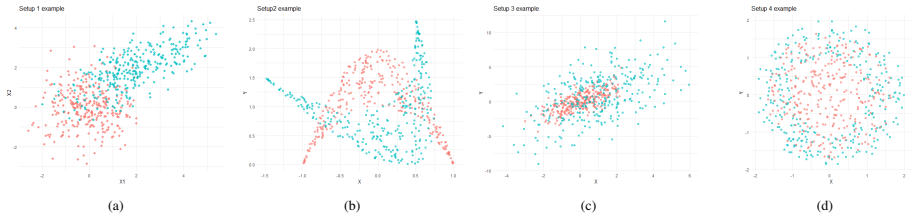
- [§4.1–4.2, Tables 1–2] The empirical claims of "significant improvements" are not supported by uncertainty quantification or by the stated parameter-selection protocol. In Table 1, the text states that PILD and B-PILD are "significantly better" in some setups and that certain methods "consistently outperform" others, but no standard errors, confidence intervals, or significance tests are reported across the 100 simulations. In Table 2, the authors say "we select the optimal parameters that maximize precision" for all methods; since this selection is performed on the same data used for evaluation, the reported precision values are oracle-tuned and cannot be compared directly as estimates of unsupervised out-of-sample performance. The abstract's claim of significant improvements should either be accompanied by proper error bars and non-oracle tuning, or be qualified accordingly.
minor comments (5)
- [Definition 2.3] The β-neighborhood is defined as "the set of ⌈nβ⌉ points with highest depth values", but ties in depth values are not addressed; a tie-breaking rule or a deterministic convention is needed for the sample β-LD and PILD to be well defined.
- [Eq. (7) and Section 3] Definition 2.4 allows an arbitrary probability measure W, but the sample formula in Eq. (7) and the theoretical results in Section 3 assume an absolutely continuous W with density w. Please state explicitly where absolute continuity is required and what happens for discrete W.
- [Table 2] Several entries in the WDBC row are run together as "0.60.70.2" and similar strings, making the table unreadable; the entries need proper spacing or column separation.
- [Throughout] There are several typographical errors, including "multivatiate" in the introduction and "varing" in the conclusion; a careful proofread is needed.
- [Property 3] The phrase "the probability measure W remains unchanged under any transformation of P" is imprecise; since W is a measure on (0,1], it does not depend on P, so the intended condition should be stated more clearly, for example that W is the same measure in both ILD(T(x)|P_{T(X)}) and ILD(x|P_X).
Circularity Check
No circularity: the central derivation integrates an external β-LD definition and relies on independent prior results; the one self-citation is peripheral.
full rationale
The paper's derivation chain is not circular. Definition 2.4 defines β-ILD as an integral of the previously defined β-local depth, which is itself cited from Paindaveine and Van Bever [1]; this is a generalization of an external notion, not a redefinition of the paper's own output. Consistency (Property 1) is obtained by applying the Dominated Convergence Theorem to the external consistency result Theorem 3.1 from [1]. Continuity in x (Property 2) is attempted via a separate external result of Dyckerhoff [38]; although the proof contains a questionable implication (Hausdorff convergence of central regions does not by itself give eventual pointwise inclusion), that is a correctness gap, not a circular reduction. T-invariance (Property 3) follows from Lemma 1 and the invariance of central regions, and centrality and vanishing at infinity (Properties 4 and 5) are inherited from β-LD results in the literature. The PILD matrix in Eq. (11) is constructed from β-neighborhoods and β-LD values, and the statement that rows sum to ILD is a designed normalization rather than a fitted quantity later presented as a prediction. The only self-citation, [21] (Wang, Leblanc and McNicholas, 'Depth-based local center clustering'), appears in an illustrative sentence listing applications of depth-based similarity and is not load-bearing for any theorem or empirical claim. No equation is equivalent to another by construction, and no fitted parameter is renamed as a prediction. Hence the correct circularity finding is 'no significant circularity'.
Assumptions & free parameters
free parameters (3)
- Locality upper bound B1 in uniform weight w_B(β) =
Classification: CV medians 0.5, 0.15, 0.1, 0.2 for Setups 1-4; outlier detection: oracle-selected from {0.1,0.3,0.5,1}
- Minimum neighborhood size n0 =
3 (for spatial depth)
- Weighting measure W over (0,1] =
Uniform density on (B0,B1] by default
assumptions (7)
- domain assumption Assumption 1: D satisfies Definition 1.1 with T the similarity transformations and is weakly continuous
- domain assumption P is absolutely continuous
- domain assumption W is absolutely continuous with bounded measurable density on (0,1]
- domain assumption Quasi-concavity of D in Property 2
- ad hoc to paper Strict monotonicity and convex central regions for Hausdorff convergence (Dyckerhoff [38])
- domain assumption Uniform weak continuity and c_D independent of P for Property 4
- standard math Consistency and β-continuity of β-LD from Paindaveine and Van Bever [1] (Theorem 3.1, Lemma A.1)
Cite this review
Pith. "Pith review of $\beta$-integrated local depth and corresponding partitioned local depth representation." pith.science (2026). https://pith.science/paper/XUSZYBCE
@misc{pith2026250614108,
  author       = {Pith},
  title        = {Pith review of: $\beta$-integrated local depth and corresponding partitioned local depth representation},
  year         = {2026},
  howpublished = {\url{https://pith.science/paper/XUSZYBCE}},
  note         = {Machine review of arXiv:2506.14108}
}
abstract
A novel local depth definition, $\beta$-integrated local depth ($\beta$-ILD), is proposed as a generalization of the local depth introduced by Paindaveine and Van Bever \cite{paindaveine2013depth}, designed to quantify the local centrality of data points. $\beta$-ILD inherits desirable properties from global data depth and remains robust across varying locality levels. A partitioning approach for $\beta$-ILD is introduced, leading to the construction of a matrix that quantifies the contribution of one point to another's local depth, providing a new interpretable measure of local centrality. These concepts are applied to classification and outlier detection tasks, demonstrating significant improvements in the performance of depth-based algorithms.
Figures


Figures from the paper (4 more)


Reference graph
Works this paper leans on
-
[38]
Dyckerhoff, Convergence of depths and depth-trimmed regions, arXiv preprint arXiv:1611.08721 (2016)
R. Dyckerhoff, Convergence of depths and depth-trimmed regions, arXiv preprint arXiv:1611.08721 (2016)
arXiv 2016
-
[1]
D. Paindaveine, G. Van Bever, From depth to local depth: a focus on centrality, Journal of the American Statis- tical Association 108 (503) (2013) 1105–1119
work page 2013
-
[2]
T. J. W., Mathematics and the picturing of data, Proceedings of the International Congress of Mathematicians, Vancouver, 1975 2 (1975) 523–531. URLhttps://cir.nii.ac.jp/crid/1573950399770196096
arXiv 1975
-
[3]
R. Y . Liu, On a notion of data depth based on random simplices, The Annals of Statistics (1990) 405–414
work page 1990
-
[4]
R. Serfling, A depth function and a scale curve based on spatial quantiles, in: Statistical Data Analysis Based on the L 1-Norm and Related Methods, Springer, 2002, pp. 25–38
work page 2002
-
[5]
Y . Zuo, R. Serfling, General notions of statistical depth function, Annals of statistics (2000) 461–482
work page 2000
- [6]
- [7]
Show all 39 references
-
[8]
Mosler, P
K. Mosler, P. Mozharovskyi, Choosing among notions of multivariate depth statistics, Statistical Science 37 (3) (2022) 348–368
2022
-
[9]
Y . Chen, X. Dang, H. Peng, H. L. Bart, Outlier detection with the kernelized spatial depth function, IEEE Transactions on Pattern Analysis and Machine Intelligence 31 (2) (2008) 288–305
2008
-
[10]
Dutta, S
S. Dutta, S. Sarkar, A. K. Ghosh, Multi-scale classification using localized spatial depth, Journal of Machine Learning Research 17 (217) (2016) 1–30. 22
2016
-
[11]
Agostinelli, M
C. Agostinelli, M. Romanazzi, Local depth, Journal of Statistical Planning and Inference 141 (2) (2011) 817– 830
2011
-
[12]
Fernandez-Piana, M
L. Fernandez-Piana, M. Svarc, An integrated local depth measure, AStA Advances in Statistical Analysis 106 (2022) 175–197. doi:10.1007/s10182-021-00424-6
2022 doi
-
[13]
K. S. Berenhaut, K. E. Moore, R. L. Melvin, A social perspective on perceived distances reveals deep community structure, Proceedings of the National Academy of Sciences 119 (4) (2022) e2003634119
2022
-
[14]
Z. Liu, R. Modarres, Lens data depth and median, Journal of Nonparametric Statistics 23 (4) (2011) 1063–1074
2011
-
[15]
Kleindessner, U
M. Kleindessner, U. V on Luxburg, Lens depth function and k-relative neighborhood graph: versatile tools for ordinal data analysis, Journal of Machine Learning Research 18 (58) (2017) 1–52
2017
-
[16]
M. Yang, R. Modarres,β-skeleton depth functions and medians, Communications in Statistics - Theory and Methods 47 (20) (2018) 5127–5143. doi:10.1080/03610926.2017.1386320. URLhttps://doi.org/10.1080/03610926.2017.1386320
2018
-
[17]
X. Liu, Y . Zuo, Z. Wang, Exactly computing bivariate projection depth contours and median, Computational Statistics & Data Analysis 60 (2013) 1–11
2013
-
[18]
X. Liu, Y . Zuo, Computing projection depth and its associated estimators, Statistics and Computing 24 (1) (2014) 51–63
2014
-
[19]
S. Nagy, I. Gijbels, M. Omelka, D. Hlubinka, Integrated depth for functional data: statistical properties and consistency, ESAIM: Probability and Statistics 20 (2016) 95–130
2016
-
[20]
Paindaveine, G
D. Paindaveine, G. Van Bever, Nonparametrically consistent depth-based classifiers, Bernoulli (2015) 62–82
2015
-
[21]
S. Wang, A. Leblanc, P. D. McNicholas, Depth-based local center clustering: A framework for handling different clustering scenarios, arXiv preprint arXiv:2505.09516 (2025)
2025
-
[22]
A. K. Ghosh, P. Chaudhuri, On maximum depth and related classifiers, Scandinavian Journal of Statistics 32 (2) (2005) 327–350
2005
-
[23]
J. Li, J. A. Cuesta-Albertos, R. Y . Liu, Dd-classifier: Nonparametric classification procedure based on dd-plot, Journal of the American statistical association 107 (498) (2012) 737–753
2012
-
[24]
Lange, K
T. Lange, K. Mosler, P. Mozharovskyi, Fast nonparametric classification based on data depth, Statistical Papers 55 (2014) 49–69
2014
-
[25]
Jeong, J
M.-H. Jeong, J. Yin, S. Wang, Outlier detection and comparison of origin-destination flows using data depth, in: 10th International Conference on Geographic Information Science (GIScience 2018), Schloss-Dagstuhl-Leibniz Zentrum für Informatik, 2018
2018
-
[26]
Mozharovskyi, R
P. Mozharovskyi, R. Valla, Anomaly detection using data depth: multivariate case, arXiv preprint arXiv:2210.02851 (2022)
2022 arXiv
-
[27]
R. Y . Liu, J. M. Parelius, K. Singh, Multivariate analysis by data depth: descriptive statistics, graphics and inference,(with discussion and a rejoinder by liu and singh), The annals of statistics 27 (3) (1999) 783–858. 23
1999
-
[28]
Pokotylo, P
O. Pokotylo, P. Mozharovskyi, R. Dyckerhoff, Depth and depth-based classification with r-package ddalpha, arXiv preprint arXiv:1608.04109 (2016)
2016 arXiv
-
[29]
G. O. Campos, A. Zimek, J. Sander, R. J. Campello, B. Micenková, E. Schubert, I. Assent, M. E. Houle, On the evaluation of unsupervised outlier detection: measures, datasets, and an empirical study, Data mining and knowledge discovery 30 (2016) 891–927
2016
-
[30]
M. M. Breunig, H.-P. Kriegel, R. T. Ng, J. Sander, Lof: identifying density-based local outliers, in: Proceedings of the 2000 ACM SIGMOD international conference on Management of data, 2000, pp. 93–104
2000
-
[31]
F. T. Liu, K. M. Ting, Z.-H. Zhou, Isolation forest, in: 2008 eighth ieee international conference on data mining, IEEE, 2008, pp. 413–422
2008
-
[32]
Huang, Q
J. Huang, Q. Zhu, L. Yang, J. Feng, A non-parameter outlier detection algorithm based on natural neighbor, Knowledge-Based Systems 92 (2016) 71–77
2016
-
[33]
B. Tang, H. He, A local density-based approach for outlier detection, Neurocomputing 241 (2017) 171–180
2017
-
[34]
Hahsler, M
M. Hahsler, M. Piekenbrock, dbscan: Density-Based Spatial Clustering of Applications with Noise (DBSCAN) and Related Algorithms, r package version 1.2-0 (2024). URLhttps://CRAN.R-project.org/package=dbscan
2024
-
[35]
Cortes, isotree: Isolation-Based Outlier Detection, r package version 0.6.1-1 (2024)
D. Cortes, isotree: Isolation-Based Outlier Detection, r package version 0.6.1-1 (2024). URLhttps://CRAN.R-project.org/package=isotree
2024
-
[36]
J. H. Madsen, DDoutlier: Distance and Density-Based Outlier Detection, r package version 0.1.0 (2018). URLhttps://CRAN.R-project.org/package=DDoutlier
2018
-
[37]
Hofert, I
M. Hofert, I. Kojadinovic, M. Maechler, J. Yan, copula: Multivariate Dependence with Copulas, r package ver- sion 1.1-4 (2024). URLhttps://CRAN.R-project.org/package=copula
2024
-
[39]
Y . Zuo, R. Serfling, Structural properties and convergence results for contours of sample statistical depth func- tions, Annals of Statistics (2000) 483–499. 24
2000
Reviewed August 7, 2026 · model on record in the stance chip above.
Discussion (0). Continue with ORCID to comment.