REVIEW 5 major objections 6 minor 13 references
Intended Target Identification for Anomia Patients with Gradient-based Selective Augmentation
T0 review · 5 major / 6 minor · reviewed 2026-08-07 · deepseek-v4-flash
Pith's one-line read A retrieval model can identify the word an anomia patient means when circumlocution omits and distorts terms.
desk verdict A plausible new gradient-gated augmentation scheme with consistent but small gains; the distinctive denoising mechanism is not convincingly validated and key hyperparameters are missing. read the letter →
The pith
A machine-rendered reading of the paper's core claim, the machinery that carries it, and where it could break.
The reading
What carries the argument
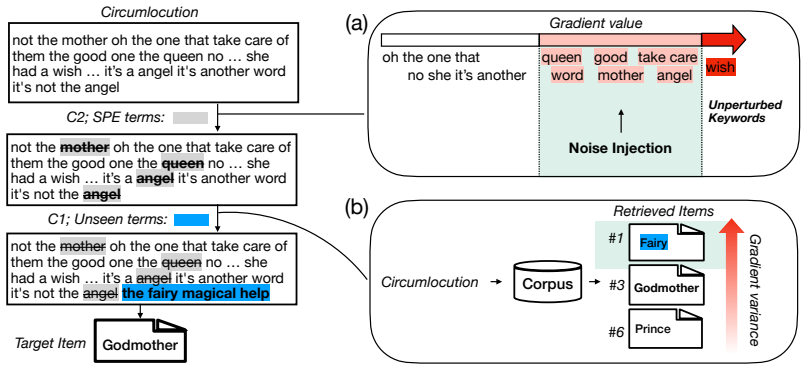
The machinery is a token-level importance score computed as the $\ell^2$ norm of the gradient of the item-relevance prediction with respect to each token embedding, Eq. (1): $\mathrm{IMP}_{c_i} = \left\| \partial F_I(C) / \partial c_i^h \right\|_2^2$. GradSelect ranks tokens by this score, keeps the top $m$ as unperturbed keywords, and applies noise (embedding noise or deletion) only to the $[m:n]$ band, with a training loss that combines cross-entropy on the original and augmented circumlocutions with a Jensen-Shannon consistency term. A second mechanism handles unseen terms: the teacher's retrieval ranking is used to collect top-$k$ items above the true target, and those items become additional positives for a self-distilled student, with relative rank standing in for expensive gradient-variance computation. The gradient score does the work of separating the two failure modes: preserving top-gradient tokens maintains relevance, while noising mid-gradient tokens creates the diversity that robustifies against paraphasic errors.
What would settle it
On a held-out anomic circumlocution set, compute Eq. (1) for each token and delete the top-gradient tokens from the input before retrieval. The paper's claim predicts a large accuracy drop relative to deleting a random or frequency-matched set of the same size; observing no larger drop than random deletion would falsify the claim that top gradients mark unperturbed keywords.
Extended reading notes
Core claim
On the paper's own terms, the central discovery is that the gradient of the retrieval score with respect to each input token is a usable proxy for whether that token is a semantically paraphasic error or an unperturbed keyword. During training, GradSelect computes a token-level gradient importance score, ranks tokens, preserves the top set, and injects noise into a middle band, robustifying the model against diverse paraphasic errors while keeping the semantic anchor. For the missing-terms half of the problem, it treats items ranked above the true target as pseudo-relevant and distills them into a student model by self-knowledge distillation, using relative rank as an inexpensive stand-in for gradient variance. The paper reports that this two-part recipe improves nDCG, recall, MRR, EM, and acc@5 on the Tip-of-the-Tongue benchmarks and on the A-Cinderella patient set, and that gradient-ranked deletion rather than random deletion is what licenses the quality of the augmented data.
Load-bearing premise
The load-bearing premise is that a token's gradient magnitude separates the unperturbed keywords (which must be kept) from the semantically paraphasic errors (which can be safely noised), so that noising only the middle-gradient band preserves the meaning of the circumlocution while creating useful diversity. If gradients instead track word frequency, position, or model artifacts, the augmentation could destroy exactly the terms retrieval needs.
Editorial extensions
If this is right
- A fine-tuned dense retriever with GradSelect can be deployed as a word-finding aid for anomia: given a circumlocution, it outputs a ranked list of candidate intended words, including words not literally spoken.
- The recipe transfers from healthy Tip-of-the-Tongue descriptions to genuine aphasic speech, so Tip-of-the-Tongue benchmarks can serve as an intermediary training ground when clinical data are scarce.
- Quality-controlled augmentation (preserving top-gradient keywords while noising the middle band) beats both purely random augmentation and diversity-only or relevance-only schemes, implying that the selection rule, not the noise itself, drives the gain.
- Because the retrieval formulation does not need the target word's length, it avoids the impractical answer-length requirement of the earlier masked-language-model approach to paraphasia word completion.
- GradSelect also improves on GPT-4 for this task, which suggests the bottleneck is not generative world knowledge but robust alignment between paraphrased queries and items.
Reading between the lines
- A natural extension the paper leaves implicit is using the same gradient ranking at inference time to mask or downweight suspected paraphasic terms before retrieval; the paper says this is hard because the target is unknown, but a soft weighting by gradient magnitude is testable.
- If the gradient proxy is partly a frequency artifact, GradSelect's gains might shrink once token frequency and position are matched; a controlled comparison against random deletion stratified by frequency would settle this.
- The item-augmentation step is a form of selective pseudo-relevance feedback; it could be combined with generative re-rankers that propose unseen terms rather than only corpus items, potentially expanding coverage beyond the item vocabulary.
- The self-distillation loop depends on the teacher already being reasonably accurate; on very noisy or small clinical samples, the rank threshold would need adaptation to avoid amplifying false positives.
Editorial analysis
A structured set of objections, weighed in public.
Referee Report
Summary. The paper proposes GradSelect, a gradient-based selective augmentation method for identifying the intended target item from anomia patients' circumlocutions. It targets two challenges: unseen relevant terms (C1) and semantic paraphasic errors (SPE, C2). The method has two components: (1) circumlocution augmentation that noises tokens in a mid-gradient interval while preserving top-gradient keywords, intended to make the model robust to SPE; and (2) target-item augmentation that uses top-ranked retrieval results as pseudo-labels via self-knowledge distillation, followed by ensembling the teacher and student models. The method is evaluated on the Tip-of-the-Tongue benchmarks Reddit-TOMT and TREC-TOT, and on the A-Cinderella patient dataset plus a newly constructed challenge set. The results show consistent improvements over Cutoff, self-KD baselines, and GPT-4, and the full model is reported to significantly outperform DPRmaxsim on the challenge set.
Significance. If the results hold, GradSelect is a practical step toward assistive retrieval for anomia, and the transfer from Tip-of-the-Tongue benchmarks to clinical transcripts is valuable. The paper's strengths include evaluation on real AphasiaBank-derived patient data, construction of a challenge set that removes answer leakage, significance testing for the full model, and a wide baseline comparison. The method also makes falsifiable predictions about the usefulness of gradient-based noise selection. However, the evidence for the distinctive gradient-based mechanism is not yet fully established because the key validation is confounded by token importance, and the circumlocution augmentation component alone is only marginally significant against the Cutoff baseline.
major comments (5)
- [Sec. 4.3, Fig. 3] The evidence that gradient magnitude identifies SPE tokens is confounded by token importance/content-word status. Removing the top-gradient half of tokens will reduce retrieval performance even if those tokens are entirely clean, because they are likely the most content-bearing words. A proper control should compare gradient-based removal with, for example, frequency-based or random removal of the same number of tokens, ideally stratified by part of speech. Without such a control, the core claim of Sec. 3.1.1 that top-gradient terms are unperturbed keywords is not demonstrated.
- [Appendix C.5] The circumlocution augmentation alone (GradSelect^d_C vs. Cutoff) is only marginally significant (0.05 < p < 0.06), whereas the item augmentation is reported as significant. Since the circumlocution component is the distinctive contribution over Cutoff, the current evidence does not support the claim that gradient-based noise selection itself, rather than item augmentation or ensembling, drives the improvements. Stronger evidence (e.g., more datasets, more folds, or a non-marginal significance result) is needed, or the claims about the C2 mechanism should be tempered.
- [Table 6, Sec. C.2] The main results in Tables 3 and 4 do not report the selected m and n values per dataset; Table 6 only lists alpha and beta. Table 5 uses '5%/70%' for A-Cinderella, but it is unclear whether the same m and n apply to Reddit-TOMT and TREC-TOT and whether the numbers in Tables 3 and 4 correspond to those settings. This omission makes the main results non-reproducible for a method whose core component depends on m and n, and the paper should state the exact hyperparameters used for each reported result.
- [Sec. 2.3] The definition of SPE is model-dependent: a term is considered SPE if it does not assist or hinders the model's target identification. The later validation of the gradient proxy in Fig. 3 is therefore at risk of circularity: the 'perturbedness' of a term is defined by the same performance decrease that the gradient is supposed to predict. The paper should provide an external, semantic grounding for SPE (for example, using human annotations of relatedness) and verify that gradient ranking aligns with that external definition.
- [Sec. 3.2.1] The item augmentation is motivated by gradient variance, but the implementation uses the relative rank of the target item following SimANS, not an actual gradient variance statistic. This substitution should be stated explicitly and the claims in Sec. 3.2 and Alg. 1 should avoid implying that gradient variance is directly computed.
minor comments (6)
- [Eq. (2)] The term 'Ldivergence' should be written as L_JS or defined explicitly as the Jensen-Shannon divergence loss.
- [Fig. 3] The caption should specify the dataset and backbone model used for the deletion experiment, and clarify the exact metric being reported.
- [Table 5] The caption should define 'Error rate' and 'Distance' precisely so the reader knows how these quantities are computed.
- [Sec. C.2] The sentence about manually inspecting low-gradient terms should describe the procedure in more detail, including whether it was done on validation data and how it informed the range for n.
- [Appendix C.5] A paired t-test with 10 folds is underpowered; consider reporting effect sizes or a nonparametric test, and state whether the normality assumption is checked.
- [Throughout] There are several typographical and formatting artifacts in the abstract and introduction (e.g., 'withseman-tic paraphasia'); a careful proofreading pass is needed.
Circularity Check
No significant circularity: the method is an empirical augmentation pipeline evaluated on held-out external targets, and the gradient proxy is a heuristic validated by experiment, not a definitional equivalence.
full rationale
The claimed derivation chain does not reduce to its own inputs. Eq. (1) defines token importance by gradient magnitude, but the assertion that top-gradient tokens are unperturbed keywords is an empirical hypothesis tested in Fig. 3, not a definitional identity. The item-augmentation component uses the teacher model's own rankings as pseudo-labels (Alg. 1 lines 9-16), which is self-referential in the standard self-training/self-KD sense, but the final evaluation uses held-out target labels from Reddit-TOMT, TREC-TOT, and A-Cinderella, so no result is forced by construction. The paper does cite the authors' own co-Condenser* backbone (Kim et al., 2023), but this is a non-load-bearing engineering dependency: the method is also instantiated on DPR and is compared against external baselines, and no uniqueness or theoretical claim is imported from that citation. The main weaknesses are evidential rather than circular: Fig. 3 is correlational and may be confounded by content-word frequency, and Appx. C.5 reports only marginal significance for the circumlocution augmentation over Cutoff (0.05 < p < 0.06). Those concerns bear on correctness and robustness, not on whether the paper's outputs are equivalent to its inputs.
Assumptions & free parameters
free parameters (5)
- m (fraction of top-gradient tokens preserved) =
not reported in paper; searched over {0.05, 0.1}
- n (fraction of mid-gradient tokens noised) =
not reported in paper; searched over {0.3, 0.5, 0.7}
- alpha (cross-entropy loss weight) =
0.05 for all datasets
- beta (Jensen-Shannon consistency loss weight) =
0.7 for Reddit-TOMT, 0.5 for TREC-TOT, 0.3 for A-Cinderella
- k (rank threshold for item augmentation) =
2
assumptions (4)
- domain assumption Token-level gradient magnitude is a reliable proxy for whether a token is an SPE term or a useful keyword.
- domain assumption Relative rank of a retrieved item approximates gradient variance and therefore item relevance.
- domain assumption Top-k items retrieved when the true target is not in the top ranking contain relevant unseen terms.
- domain assumption Tip-of-the-Tongue movie retrieval is a valid intermediary task for anomia.
Cite this review
Pith. "Pith review of Intended Target Identification for Anomia Patients with Gradient-based Selective Augmentation." pith.science (2026). https://pith.science/paper/3ORDOY54
@misc{pith2026250614203,
  author       = {Pith},
  title        = {Pith review of: Intended Target Identification for Anomia Patients with Gradient-based Selective Augmentation},
  year         = {2026},
  howpublished = {\url{https://pith.science/paper/3ORDOY54}},
  note         = {Machine review of arXiv:2506.14203}
}
read the original abstract
In this study, we investigate the potential of language models (LMs) in aiding patients experiencing anomia, a difficulty identifying the names of items. Identifying the intended target item from patient's circumlocution involves the two challenges of term failure and error: (1) The terms relevant to identifying the item remain unseen. (2) What makes the challenge unique is inherent perturbed terms by semantic paraphasia, which are not exactly related to the target item, hindering the identification process. To address each, we propose robustifying the model from semantically paraphasic errors and enhancing the model with unseen terms with gradient-based selective augmentation. Specifically, the gradient value controls augmented data quality amid semantic errors, while the gradient variance guides the inclusion of unseen but relevant terms. Due to limited domain-specific datasets, we evaluate the model on the Tip-of-the-Tongue dataset as an intermediary task and then apply our findings to real patient data from AphasiaBank. Our results demonstrate strong performance against baselines, aiding anomia patients by addressing the outlined challenges.
Figures


Figures from the paper (1 more)

Reference graph
Works this paper leans on
-
[9]
Iain Mackie, Shubham Chatterjee, and Jeffrey Dalton
Decomposing complex queries for tip-of-the- tongue retrieval.arXiv preprint arXiv:2305.15053. Iain Mackie, Shubham Chatterjee, and Jeffrey Dalton
-
[10]
Tri Nguyen, Mir Rosenberg, Xia Song, Jianfeng Gao, Saurabh Tiwary, Rangan Majumder, and Li Deng
Generative and pseudo-relevant feedback for sparse, dense and learned sparse retrieval.arXiv preprint arXiv:2305.07477. Tri Nguyen, Mir Rosenberg, Xia Song, Jianfeng Gao, Saurabh Tiwary, Rangan Majumder, and Li Deng
-
[12]
Yao Qiang, Subhrangshu Nandi, Ninareh Mehrabi, Greg Ver Steeg, Anoop Kumar, Anna Rumshisky, and A
Treatment approaches for word retrieval deficits in persons with aphasia: Recent advances. Yao Qiang, Subhrangshu Nandi, Ninareh Mehrabi, Greg Ver Steeg, Anoop Kumar, Anna Rumshisky, and A. G. Galstyan. 2024. Prompt perturbation con- sistency learning for robust language models. In Findings. Jamie Reilly, Jonathan E Peelle, Sharon M Antonucci, and Murray ...
arXiv 2024
-
[13]
Careful whisper–leveraging advances in automatic speech recognition for robust and in- terpretable aphasia subtype classification.arXiv preprint arXiv:2308.01327. Junlin Wang, Jens Tuyls, Eric Wallace, and Sameer Singh. 2020. Gradient-based analysis of nlp mod- els is manipulable. InFindings of the Association for Computational Linguistics: EMNLP 2020, pa...
work page Pith review arXiv 2023
-
[1999]
InSeminars in speech and language, volume 20, pages 19–31
The emotional impact of aphasia. InSeminars in speech and language, volume 20, pages 19–31. © 1999 by Thieme Medical Publishers, Inc. W Bruce Croft, Donald Metzler, and Trevor Strohman. 2010.Search engines: Information retrieval in prac- tice, volume 520. Addison-Wesley Reading. Marjory Day, Rupam Kumar Dey, Matthew Baucum, Eun Jin Paek, Hyejin Park, and ...
work page 1999
-
[2015]
Distilling the knowledge in a neural network. ArXiv, abs/1503.02531. Kalervo Järvelin and Jaana Kekäläinen. 2002. Cu- mulated gain-based evaluation of ir techniques. ACM Transactions on Information Systems (TOIS), 20(4):422–446. Fan Jiang, Tom Drummond, and Trevor Cohn. 2023. Noisy self-training with synthetic queries for dense retrieval. InFindings of th...
arXiv 2002
-
[2016]
Ms marco: A human-generated machine read- ing comprehension dataset. OpenAI. 2023. Gpt-4 technical report. Aditya kumar Purohit, Aditya Upadhyaya, and Adrian Holzer. 2023. Chatgpt in healthcare: Exploring ai chatbot for spontaneous word retrieval in aphasia. In Companion Publication of the 2023 Conference on Computer Supported Cooperative Work and Social ...
work page 2023
-
[2018]
Co-teaching: Robust training of deep neural networks with extremely noisy labels.Advances in neural information processing systems, 31. Stacy M Harnish. 2018. Anomia and anomic apha- sia: Implications for lexical processing.The Oxford handbook of aphasia and language disorders, pages 121–144. Junxian He, Jiatao Gu, Jiajun Shen, and Marc’Aurelio Ranzato. 2...
arXiv 2018
Show all 13 references
-
[2021]
In2021 43rd Annual International Confer- ence of the IEEE Engineering in Medicine & Biology Society (EMBC), pages 2299–2302
Predicting severity in people with aphasia: A natural language processing and machine learning approach. In2021 43rd Annual International Confer- ence of the IEEE Engineering in Medicine & Biology Society (EMBC), pages 2299–2302. IEEE. Jacob Devlin, Ming-Wei Chang, Kenton Lee,...
2019
-
[2022]
In2022 IEEE/CVF Conference on Com- puter Vision and Pattern Recognition (CVPR), pages 10358–10368
Estimating example difficulty using variance of gradients. In2022 IEEE/CVF Conference on Com- puter Vision and Pattern Recognition (CVPR), pages 10358–10368. IEEE Computer Society. Jaime Arguello, Samarth Bhargav, Fernando Diaz, Evan- gelos Kanoulas, and Bhaskar Mitra. 2023. O...
2023 arXiv
-
[2023]
Samarth Bhargav, Georgios Sidiropoulos, and Evange- los Kanoulas
When the music stops: Tip-of-the-tongue retrieval for music.Proceedings of the 46th Inter- national ACM SIGIR Conference on Research and Development in Information Retrieval. Samarth Bhargav, Georgios Sidiropoulos, and Evange- los Kanoulas. 2022. ’it’s on the tip of my tongue’...
2022
-
[2024]
tip-of-the-tongue
Bias and fairness in large language models: A survey. Luyu Gao and Jamie Callan. 2021. Condenser: a pre- training architecture for dense retrieval. InProceed- ings of the 2021 Conference on Empirical Methods in Natural Language Processing, pages 981–993, Online and Punta Cana,...
2021
-
[3166]
Jiaao Chen, Dinghan Shen, Weizhu Chen, and Diyi Yang
Springer Berlin, Germany. Jiaao Chen, Dinghan Shen, Weizhu Chen, and Diyi Yang. 2021. Hiddencut: Simple data augmentation for natural language understanding with better gener- alizability. InProceedings of the 59th Annual Meet- ing of the Association for Computational Linguist...
2021
Reviewed August 7, 2026 · model on record in the stance chip above.
Discussion (0). Sign in to comment.