REVIEW 5 major objections 5 minor 45 references
Socially Aware Robot Crowd Navigation via Online Uncertainty-Driven Risk Adaptation
T0 review · 5 major / 5 minor · reviewed 2026-08-07 · deepseek-v4-flash
Pith's one-line read A robot learns which waypoints are risky and uses uncertainty to pick socially aware paths through crowds.
desk verdict Competent incremental crowd-navigation paper with a coherent architecture, but the social-awareness claim is undercut by a circular training/evaluation link and missing statistics; worth reviewing if the authors add ablations. read the letter →
The pith
A machine-rendered reading of the paper's core claim, the machinery that carries it, and where it could break.
The reading
What carries the argument
The load-bearing object is the Probabilistic Ensemble Neural Network risk model paired with a dual uncertainty filter. The ensemble members each output a Gaussian mean and variance over the risk of a candidate waypoint, trained with a Gaussian negative log-likelihood loss, so the spread across members carries information about how confident the model is. Epistemic uncertainty is measured as divergence across ensemble members, and aleatoric risk is bounded by taking the worst-case Conditional Value at Risk over members; only waypoints whose predictions survive both filters and have the lowest risk are sent to the MPC. This is what lets the learned pipeline hedge against out-of-distribution inputs and tail risks rather than trusting a single point prediction.
What would settle it
Run LR-MPC and HR-MPC on identical crowd seeds in the same environment and compare time spent inside the intimate and personal proxemic zones, plus discomfort ratings from independent human observers; if LR-MPC does not reduce those measures below HR-MPC's or does not exceed HR-MPC's success rate in matched runs, the paper's central claim is refuted.
Extended reading notes
Core claim
LR-MPC's central claim is that crowd navigation can be made simultaneously safe, efficient, and socially aware by replacing handcrafted risk rules with a learned risk model whose outputs are screened for reliability. Offline, a Probabilistic Ensemble Neural Network, an ensemble of networks each predicting a Gaussian distribution over risk, is trained on 39,653 samples labeled by HR-MPC, a heuristic MPC that sums path, orientation, goal-distance, and goal-direction penalties. Online, the robot samples local waypoints, uses a Multi-RRT planner for global guidance, evaluates each waypoint with the ensemble, discards predictions with high epistemic uncertainty or high aleatoric tail risk, and commands the lowest-risk surviving waypoint through an MPC controller with a control barrier function safety constraint. The paper reports that in four simulated environments, with or without static obstacles and with or without humans reacting to the robot, LR-MPC has the highest success rate, between 80% and 98%, and the lowest intrusion into intimate and personal zones, and that a real-world trial with seven actively interfering humans confirms the behavior.
Load-bearing premise
The method's training labels come from a hand-written risk formula, so the learned model can only be as socially aware as that formula's idea of risk; if the formula misses what actually makes humans uncomfortable, the whole pipeline inherits that blind spot.
Editorial extensions
If this is right
- LR-MPC reports the highest success rate in every simulated scenario, with the largest gaps appearing when humans do not react to the robot and a static obstacle is present.
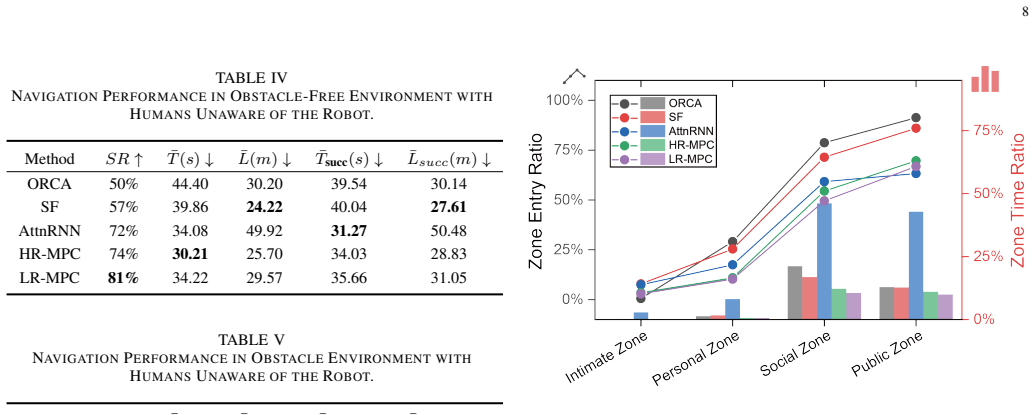
- Its zone entry and zone time ratios are lowest in the intimate and personal proxemic zones among all tested methods, which is the paper's operational definition of social awareness.
- The uncertainty filters reject waypoints whose risk predictions the ensemble does not agree on, so the robot can keep moving even when crowd behavior is unfamiliar instead of committing to a confidently wrong waypoint.
- The MPC layer with a control barrier function keeps the robot from violating safety distance even when the learned risk model is imperfect, giving the approach a formal safety guarantee rather than relying purely on the neural network.
Reading between the lines
- Because the ensemble is trained on HR-MPC's heuristic risk labels, LR-MPC's social awareness is bounded by that heuristic; the paper does not test whether a different supervision signal, such as human discomfort ratings or demonstrated pedestrian trajectories, would teach it norms the heuristic misses.
- The uncertainty filters are used only to discard waypoints, so a natural extension the paper does not explore is to use high epistemic uncertainty as a trigger for slowing down, asking for help, or switching to a conservative policy.
- The simulated crowds are generated by the same social force model that serves as the SF baseline, so the reported advantage over SF may partly reflect training and testing on the same crowd model; re-testing with independently collected pedestrian trajectories would be a stronger check.
Editorial analysis
A structured set of objections, weighed in public.
Referee Report
Summary. The paper proposes LR-MPC, a two-phase crowd navigation algorithm. In the offline phase, a Probabilistic Ensemble Neural Network (PENN) is trained on risk labels generated by a heuristic MPC baseline (HR-MPC), where the risk is a weighted combination of inverse obstacle distance, nearest-human orientation, goal distance, and goal-direction alignment. In the online phase, local waypoints are sampled, guided by a Multi-RRT global planner, evaluated by the PENN, filtered through epistemic and aleatoric uncertainty checks, and the lowest-risk waypoint is sent to an MPC controller with a discrete-time CBF safety constraint. The paper claims that LR-MPC outperforms ORCA, SF, AttnRNN, and HR-MPC in success rate and social awareness in both simulation and a real-world trial.
Significance. If the empirical claims held, the paper would offer a practical, relatively simple integration of learned risk prediction with MPC for crowd navigation, and the availability of implementation details (e.g., CasADi/IPOPT, training setup) is a positive feature. The real-world demonstration is a useful existence proof. However, the central 'social awareness' claim is currently supported by metrics derived from the same proxemic distances that generate the training heuristic, and the simulation evidence lacks variance or significance testing. The paper's novelty and conclusions therefore rest on a circular evaluation and on single-point estimates, which substantially limits the significance of the contribution as presented.
major comments (5)
- [Sec. III-A, III-B, IV-D] The social-awareness claim is circular. The PENN is trained on risk labels γ_risk generated by the HR-MPC heuristic in Eq. (1)–(5), which penalize closeness to humans/obstacles, head-on orientation, goal distance, and goal-direction misalignment. The evaluation metrics in Sec. IV-D are zone entry/time ratios computed from the same proxemic distances. Consequently, the reported 'highest social awareness' of LR-MPC does not independently validate learning of human comfort; it largely verifies that LR-MPC reproduces the HR-MPC heuristic. Add an ablation that replaces PENN with the exact γ_risk, remove the uncertainty filters, and include an external human-discomfort or real-pedestrian-displacement measure to separate learning from the heuristic.
- [Sec. IV-E, Tables II–V] All simulation results are single-point estimates. Although Sec. IV-E states that each scenario is executed 100 times, no variance, confidence interval, number of seeds, or significance test is reported. The claimed superiority (e.g., 98% vs 93% in Table II and 81% vs 74% in Table IV) could be within seed-to-seed noise. Report mean±std over multiple seeds or random crowd configurations and perform pairwise significance tests; also add error bars to Fig. 4–7.
- [Sec. III-D.2, Eq. (13)–(14)] The chain of inequalities in Eq. (13) is reversed: for a fixed distribution, CVaR_ε ≥ VaR_ε, so sup_f CVaR ≤ sup_f VaR does not hold in general. Therefore the probability guarantee in Eq. (14) is not established by the given argument. Use the direct condition sup_f CVaR ≤ μ̄ and state the correct implication, or revise the robustness argument.
- [Sec. IV-F] The real-world experiment is qualitative: it reports no quantitative success metrics, no trajectory or social metrics, no comparison to baselines, and no repeated trials. The claim that 'extensive experiments' demonstrate superiority is therefore supported only by simulation results with the issues noted above. Provide quantitative real-world results or temper the claim accordingly.
- [Sec. IV-E and Sec. V] The contribution of the learned PENN relative to the heuristic HR-MPC is unidentified. Since LR-MPC and HR-MPC both select the lowest-risk waypoint according to the same training signal, the differences in Tables II–V and Fig. 4–7 could come from the uncertainty filters, the Multi-RRT global guide, or sampling, rather than from learned patterns of human-robot interaction. The paper needs ablations isolating each component—PENN vs exact γ_risk, EU/AU filters on/off—and a quantitative attribution of where the improvements originate.
minor comments (5)
- [Sec. IV-E] The text says 'In Tables I–IV' but the presented tables are Tables II–V; please correct the reference.
- [Fig. 4 and Fig. 6] The figure captions conflict with the main text's statement that Fig. 4 and Fig. 6 depict obstacle-free environments 'with and without human awareness, respectively'; the captions label Fig. 4 as unaware and Fig. 6 as aware, which is the opposite order.
- [Eq. (6)] The covariance subscript uses ω_i, which is inconsistent with the ensemble index j used elsewhere in the same equation; it should be Σ_{ω_j}(X).
- [Eq. (7)] The symbol d is used both as the dimension of the target and, earlier, in the risk definitions (e.g., d_min); using a different symbol for the dimension would avoid ambiguity.
- [Sec. III-E] The discrete-time omnidirectional kinematic model O(x_t, u_t) in Eq. (18b) is not written out; including the explicit dynamics or a reference would make the NMPC implementation reproducible.
Circularity Check
LR-MPC's social-awareness claim is partially circular: the learned risk model is trained on HR-MPC's handcrafted proxemic heuristic, and the social-awareness metrics reward the same distance-based quantity.
-
fitted input called prediction
[Section III (Methodology), Sec. III-A and III-B, Eq. (1)-(5)]
"In the offline phase, we construct a training dataset using the Heuristic-Risk-MPC (HR-MPC) method for risk annotation based on predefined rules (Sec. III-A). This dataset is used to train a PENN model that learns the mapping between environmental features and risk (Sec. III-B)."
The only supervision for PENN is the handcrafted risk label γ_risk = γ_p + γ_ori + γ_g + γ_dir (Eq. 1), computed from inverse distance to obstacles, head-on orientation, goal distance, and goal direction. PENN is therefore a function approximator for that exact heuristic. At inference, the waypoint with the lowest PENN-predicted risk is selected, so the online 'risk prediction' is a re-evaluation of the same heuristic (plus ensemble averaging and uncertainty filtering), not an independent measure of social comfort or collision risk.
-
self definitional
[Section III-A Eq. (2) and Section IV-D2 (Socially aware Metrics), Eq. (20)]
"γi_p = max λdist/(d_i_min + ε), where d_i_min is the minimum distance from a sampled waypoint to any obstacle ... we propose two socially aware metrics: (1) Zone Entry Ratio, measuring the proportion of humans entering defined proxemic zones (intimate, personal, social, and public), and (2) Zone Time Ratio."
The training-label term γ_p penalizes small distance to obstacles (including crowd agents), and the 'social awareness' evaluation measures human entry into and time spent in close proxemic zones. Thus the metric rewards exactly the distance-based quantity that the heuristic labels penalize. LR-MPC's low zone-entry/time ratios are therefore a fit to the same handcrafted proxemic rule, not evidence of learning human-robot interaction from independent data.
full rationale
The circularity is specific to the social-awareness claim. PENN's training target is HR-MPC's handcrafted γ_risk (Eq. 1-5), and the social-awareness metrics (zone entry/time ratios) are distance-based in the same sense as the inverse-distance risk in Eq. (2). Consequently, the claimed 'highest level of social awareness' is substantially a learned surrogate for the authors' own heuristic rather than validation against independent human comfort data. The success-rate comparisons (Tables II-V) are not circular: they are measured against ORCA, SF, AttnRNN, and HR-MPC on task completion, and that evidence stands on its own. The Multi-RRT global planner is taken from prior work by the same group ([21], [34]), but that self-citation is not load-bearing for the social-awareness result. The absence of an ablation separating the PENN output from the uncertainty filters further obscures why LR-MPC beats its teacher HR-MPC, but the circularity finding rests on the quoted training/evaluation construction. Overall: partial circularity of a central claim, score 6.
Assumptions & free parameters
free parameters (12)
- lambda_dist
- epsilon_singularity
- lambda_dir
- eta_safe
- xi_cbf_rate
- E_delta
- mu_bar_cvar
- epsilon_var_level
- noise_std =
5%
- ensemble_size =
3
- horizon_N
- cost_weights_Q_R
assumptions (6)
- standard math Discrete-time CBF theory guarantees forward invariance of the safe set.
- standard math Closed-form Jensen-Renyi divergence for Gaussian mixtures is valid.
- standard math CVaR is a coherent risk measure and the inequality in Eq. 13-14 transfers to distributional robustness.
- domain assumption Simulated humans follow the Social Force model and do or do not react to the robot.
- domain assumption The robot is an omnidirectional agent with known dynamics and sensor range of 5 m.
- ad hoc to paper The heuristic risk function in Eq. 1-5 is a valid proxy for social and safety risk.
Cite this review
Pith. "Pith review of Socially Aware Robot Crowd Navigation via Online Uncertainty-Driven Risk Adaptation." pith.science (2026). https://pith.science/paper/QRU6IHNN
@misc{pith2026250614305,
  author       = {Pith},
  title        = {Pith review of: Socially Aware Robot Crowd Navigation via Online Uncertainty-Driven Risk Adaptation},
  year         = {2026},
  howpublished = {\url{https://pith.science/paper/QRU6IHNN}},
  note         = {Machine review of arXiv:2506.14305}
}
read the original abstract
Navigation in human-robot shared crowded environments remains challenging, as robots are expected to move efficiently while respecting human motion conventions. However, many existing approaches emphasize safety or efficiency while overlooking social awareness. This article proposes Learning-Risk Model Predictive Control (LR-MPC), a data-driven navigation algorithm that balances efficiency, safety, and social awareness. LR-MPC consists of two phases: an offline risk learning phase, where a Probabilistic Ensemble Neural Network (PENN) is trained using risk data from a heuristic MPC-based baseline (HR-MPC), and an online adaptive inference phase, where local waypoints are sampled and globally guided by a Multi-RRT planner. Each candidate waypoint is evaluated for risk by PENN, and predictions are filtered using epistemic and aleatoric uncertainty to ensure robust decision-making. The safest waypoint is selected as the MPC input for real-time navigation. Extensive experiments demonstrate that LR-MPC outperforms baseline methods in success rate and social awareness, enabling robots to navigate complex crowds with high adaptability and low disruption. A website about this work is available at https://sites.google.com/view/lr-mpc.
Figures


Figures from the paper (7 more)


Reference graph
Works this paper leans on
-
[1]
Effective multi-agent communication under limited bandwidth,
L. Yu, Q. Wang, Y . Qiu, J. Wang, X. Zhang, and Z. Han, “Effective multi-agent communication under limited bandwidth,”IEEE Transac- tions on Mobile Computing, vol. 23, no. 7, pp. 7771–7784, 2024
work page 2024
-
[2]
Towards efficient distributed collision avoidance for heterogeneous mobile robots,
J. Chen, J. Cao, Z. Cheng, and S. Jiang, “Towards efficient distributed collision avoidance for heterogeneous mobile robots,”IEEE Transac- tions on Mobile Computing, vol. 23, no. 5, pp. 3605–3619, 2024
work page 2024
-
[3]
Reciprocal n- body collision avoidance,
J. Van Den Berg, S. J. Guy, M. Lin, and D. Manocha, “Reciprocal n- body collision avoidance,” inRobotics Research: The 14th International Symposium ISRR. Springer, 2011, pp. 3–19
work page 2011
-
[4]
Social force model for pedestrian dynamics,
D. Helbing and P. Molnar, “Social force model for pedestrian dynamics,” Physical review E, vol. 51, no. 5, p. 4282, 1995
1995
-
[5]
Z. Ning, H. Ji, X. Wang, E. C. H. Ngai, L. Guo, and J. Liu, “Joint optimization of data acquisition and trajectory planning for uav-assisted wireless powered internet of things,”IEEE Transactions on Mobile Computing, vol. 24, no. 2, pp. 1016–1030, 2025
work page 2025
-
[6]
C. Chen, Y . Liu, S. Kreiss, and A. Alahi, “Crowd-robot interaction: Crowd-aware robot navigation with attention-based deep reinforcement learning,” in2019 international conference on robotics and automation (ICRA). IEEE, 2019, pp. 6015–6022
work page 2019
-
[7]
Decentralized structural-rnn for robot crowd navigation with deep reinforcement learning,
S. Liu, P. Chang, W. Liang, N. Chakraborty, and K. Driggs-Campbell, “Decentralized structural-rnn for robot crowd navigation with deep reinforcement learning,” in2021 IEEE international conference on robotics and automation (ICRA). IEEE, 2021, pp. 3517–3524
work page 2021
-
[8]
Intention aware robot crowd navigation with attention-based interaction graph,
S. Liu, P. Chang, Z. Huang, N. Chakraborty, K. Hong, W. Liang, D. L. McPherson, J. Geng, and K. Driggs-Campbell, “Intention aware robot crowd navigation with attention-based interaction graph,” in2023 IEEE international conference on robotics and automation (ICRA). IEEE, 2023, pp. 12 015–12 021
work page 2023
Show all 45 references
-
[9]
Proxemics [and comments and replies],
E. T. Hall, R. L. Birdwhistell, B. Bock, P. Bohannan, A. R. Diebold Jr, M. Durbin, M. S. Edmonson, J. Fischer, D. Hymes, S. T. Kimballet al., “Proxemics [and comments and replies],”Current anthropology, vol. 9, no. 2/3, pp. 83–108, 1968. 11 Fig. 10. Comparison of the navigatio...
1968
-
[10]
A human-friendly robot navigation algorithm using the risk- rrt approach,
W. Chi, H. Kono, Y . Tamura, A. Yamashita, H. Asama, and M. Q.-H. Meng, “A human-friendly robot navigation algorithm using the risk- rrt approach,” in2016 IEEE International Conference on Real-time Computing and Robotics (RCAR). IEEE, 2016, pp. 227–232
2016
-
[11]
Mobile robot path planning based on social interaction space in social environment,
W. Chen, T. Zhang, and Y . Zou, “Mobile robot path planning based on social interaction space in social environment,”International Journal of Advanced Robotic Systems, vol. 15, no. 3, p. 1729881418776183, 2018
2018
-
[12]
Human- aware path planning with improved virtual doppler method in highly dynamic environments,
K. Cai, W. Chen, C. Wang, S. Song, and M. Q.-H. Meng, “Human- aware path planning with improved virtual doppler method in highly dynamic environments,”IEEE Transactions on Automation Science and Engineering, vol. 20, no. 2, pp. 1304–1321, 2022
2022
-
[13]
Long- term dynamic window approach for kinodynamic local planning in static and crowd environments,
Z. Jian, S. Zhang, L. Sun, W. Zhan, N. Zheng, and M. Tomizuka, “Long- term dynamic window approach for kinodynamic local planning in static and crowd environments,”IEEE Robotics and Automation Letters, vol. 8, no. 6, pp. 3294–3301, 2023
2023
-
[14]
Bridging active explo- ration and uncertainty-aware deployment using probabilistic ensemble neural network dynamics,
T. Kim, J. Mun, J. Seo, B. Kim, and S. Hong, “Bridging active explo- ration and uncertainty-aware deployment using probabilistic ensemble neural network dynamics,”arXiv preprint arXiv:2305.12240, 2023
2023 arXiv
-
[15]
Learning to refine input constrained control barrier functions via uncertainty-aware online parameter adapta- tion,
T. Kim, R. I. Kee, and D. Panagou, “Learning to refine input constrained control barrier functions via uncertainty-aware online parameter adapta- tion,”arXiv preprint arXiv:2409.14616, 2024
2024 arXiv
-
[16]
Deep reinforce- ment learning in a handful of trials using probabilistic dynamics models,
K. Chua, R. Calandra, R. McAllister, and S. Levine, “Deep reinforce- ment learning in a handful of trials using probabilistic dynamics models,” Advances in neural information processing systems, vol. 31, 2018
2018
-
[17]
The dynamic window approach to collision avoidance,
D. Fox, W. Burgard, and S. Thrun, “The dynamic window approach to collision avoidance,”IEEE robotics & automation magazine, vol. 4, no. 1, pp. 23–33, 2002
2002
-
[18]
Reciprocal velocity obsta- cles for real-time multi-agent navigation,
J. Van den Berg, M. Lin, and D. Manocha, “Reciprocal velocity obsta- cles for real-time multi-agent navigation,” in2008 IEEE international conference on robotics and automation. Ieee, 2008, pp. 1928–1935
2008
-
[19]
Kinodynamic trajectory optimization and control for car-like robots,
C. R ¨osmann, F. Hoffmann, and T. Bertram, “Kinodynamic trajectory optimization and control for car-like robots,” in2017 IEEE/RSJ Inter- national Conference on Intelligent Robots and Systems (IROS). IEEE, 2017, pp. 5681–5686
2017
-
[20]
Online state-time trajectory planning using timed-esdf in highly dynamic environments,
D. Zhu, T. Zhou, J. Lin, Y . Fang, and M. Q.-H. Meng, “Online state-time trajectory planning using timed-esdf in highly dynamic environments,” in2022 International Conference on Robotics and Automation (ICRA), 2022, pp. 3949–3955
2022
-
[21]
Multi- risk-rrt: An efficient motion planning algorithm for robotic autonomous luggage trolley collection at airports,
Z. Sun, B. Lei, P. Xie, F. Liu, J. Gao, Y . Zhang, and J. Wang, “Multi- risk-rrt: An efficient motion planning algorithm for robotic autonomous luggage trolley collection at airports,”IEEE Transactions on Intelligent V ehicles, vol. 9, no. 2, pp. 3450–3463, 2024
2024
-
[22]
Gmr-rrt*: Sampling-based path planning using gaussian mixture regression,
J. Wang, T. Li, B. Li, and M. Q.-H. Meng, “Gmr-rrt*: Sampling-based path planning using gaussian mixture regression,”IEEE Transactions on Intelligent V ehicles, vol. 7, no. 3, pp. 690–700, 2022
2022
-
[23]
Namr-rrt: Neural adaptive motion planning for mobile robots in dynamic environments,
Z. Sun, B. Xia, P. Xie, X. Li, and J. Wang, “Namr-rrt: Neural adaptive motion planning for mobile robots in dynamic environments,”IEEE Transactions on Automation Science and Engineering, 2025
2025
-
[24]
Learning human-to-humanoid real-time whole-body teleoperation,
T. He, Z. Luo, W. Xiao, C. Zhang, K. Kitani, C. Liu, and G. Shi, “Learning human-to-humanoid real-time whole-body teleoperation,” in 2024 IEEE/RSJ International Conference on Intelligent Robots and Systems (IROS), 2024, pp. 8944–8951
2024
-
[25]
Long- term pedestrian trajectory prediction using mutable intention filter and warp lstm,
Z. Huang, A. Hasan, K. Shin, R. Li, and K. Driggs-Campbell, “Long- term pedestrian trajectory prediction using mutable intention filter and warp lstm,”IEEE Robotics and Automation Letters, vol. 6, no. 2, pp. 542–549, 2020
2020
-
[26]
Ia-lstm: Interaction-aware lstm for pedestrian trajectory prediction,
J. Yang, Y . Chen, S. Du, B. Chen, and J. C. Principe, “Ia-lstm: Interaction-aware lstm for pedestrian trajectory prediction,”IEEE Trans- actions on Cybernetics, vol. 54, no. 7, pp. 3904–3917, 2024
2024
-
[27]
Tbd pedestrian data collection: Towards rich, portable, and large-scale natural pedestrian data,
A. Wang, D. Sato, Y . Corzo, S. Simkin, A. Biswas, and A. Steinfeld, “Tbd pedestrian data collection: Towards rich, portable, and large-scale natural pedestrian data,” in2024 IEEE International Conference on Robotics and Automation (ICRA). IEEE, 2024, pp. 637–644
2024
-
[28]
Drl-vo: Learning to navigate through crowded dy- namic scenes using velocity obstacles,
Z. Xie and P. Dames, “Drl-vo: Learning to navigate through crowded dy- namic scenes using velocity obstacles,”IEEE Transactions on Robotics, vol. 39, no. 4, pp. 2700–2719, 2023
2023
-
[29]
Principles and guidelines for evaluating social robot navigation algorithms,
A. Francis, C. P ´erez-d’Arpino, C. Li, F. Xia, A. Alahi, R. Alami, A. Bera, A. Biswas, J. Biswas, R. Chandraet al., “Principles and guidelines for evaluating social robot navigation algorithms,”ACM Transactions on Human-Robot Interaction, vol. 14, no. 2, pp. 1–65, 2025
2025
-
[30]
A survey on socially aware robot navigation: Taxonomy and future challenges,
P. T. Singamaneni, P. Bachiller-Burgos, L. J. Manso, A. Garrell, A. San- feliu, A. Spalanzani, and R. Alami, “A survey on socially aware robot navigation: Taxonomy and future challenges,”The International Journal of Robotics Research, vol. 43, no. 10, pp. 1533–1572, 2024. 12
2024
-
[31]
Sacson: Scalable au- tonomous control for social navigation,
N. Hirose, D. Shah, A. Sridhar, and S. Levine, “Sacson: Scalable au- tonomous control for social navigation,”IEEE Robotics and Automation Letters, vol. 9, no. 1, pp. 49–56, 2023
2023
-
[32]
Socialgail: Faithful crowd simulation for social robot navigation,
B. Ling, Y . Lyu, D. Li, G. Gao, Y . Shi, X. Xu, and W. Wu, “Socialgail: Faithful crowd simulation for social robot navigation,” in2024 IEEE International Conference on Robotics and Automation (ICRA), 2024, pp. 16 873–16 880
2024
-
[33]
Dr-mpc: Deep residual model predictive control for real-world social navigation,
J. R. Han, H. Thomas, J. Zhang, N. Rhinehart, and T. D. Barfoot, “Dr-mpc: Deep residual model predictive control for real-world social navigation,”IEEE Robotics and Automation Letters, 2025
2025
-
[34]
Multi-tree guided efficient robot motion planning,
Z. Sun, J. Wang, and M. Q.-H. Meng, “Multi-tree guided efficient robot motion planning,”Procedia Computer Science, vol. 209, pp. 31–39, 2022
2022
-
[35]
On measures of entropy and information,
A. R ´enyi, “On measures of entropy and information,” inProceedings of the fourth Berkeley symposium on mathematical statistics and probabil- ity, volume 1: contributions to the theory of statistics, vol. 4. University of California Press, 1961, pp. 547–562
1961
-
[36]
Closed-form jensen-renyi divergence for mixture of gaussians and applications to group-wise shape registration,
F. Wang, T. Syeda-Mahmood, B. C. Vemuri, D. Beymer, and A. Ran- garajan, “Closed-form jensen-renyi divergence for mixture of gaussians and applications to group-wise shape registration,” inMedical Image Computing and Computer-Assisted Intervention–MICCAI 2009: 12th Internation...
2009
-
[37]
Value at risk,
T. J. Linsmeier and N. D. Pearson, “Value at risk,”Financial analysts journal, vol. 56, no. 2, pp. 47–67, 2000
2000
-
[38]
Risk-sensitive and robust decision-making: a cvar optimization approach,
Y . Chow, A. Tamar, S. Mannor, and M. Pavone, “Risk-sensitive and robust decision-making: a cvar optimization approach,”Advances in neural information processing systems, vol. 28, 2015
2015
-
[39]
Safety-critical model predictive control with discrete-time control barrier function,
J. Zeng, B. Zhang, and K. Sreenath, “Safety-critical model predictive control with discrete-time control barrier function,” in2021 American Control Conference (ACC). IEEE, 2021, pp. 3882–3889
2021
-
[40]
Rule-based safety-critical control design using control barrier functions with application to au- tonomous lane change,
S. He, J. Zeng, B. Zhang, and K. Sreenath, “Rule-based safety-critical control design using control barrier functions with application to au- tonomous lane change,” in2021 American Control Conference (ACC). IEEE, 2021, pp. 178–185
2021
-
[41]
Robotic autonomous trolley collection with progressive perception and nonlinear model predictive control,
A. Xiao, H. Luan, Z. Zhao, Y . Hong, J. Zhao, W. Chen, J. Wang, and M. Q.-H. Meng, “Robotic autonomous trolley collection with progressive perception and nonlinear model predictive control,” in2022 International Conference on Robotics and Automation (ICRA). IEEE, 2022, pp. 4480–4486
2022
-
[42]
Casadi: a software framework for nonlinear optimization and optimal control,
J. A. Andersson, J. Gillis, G. Horn, J. B. Rawlings, and M. Diehl, “Casadi: a software framework for nonlinear optimization and optimal control,”Mathematical Programming Computation, vol. 11, pp. 1–36, 2019
2019
-
[43]
Large-scale nonlinear programming using ipopt: An integrating framework for enterprise-wide dynamic optimization,
L. T. Biegler and V . M. Zavala, “Large-scale nonlinear programming using ipopt: An integrating framework for enterprise-wide dynamic optimization,”Computers & Chemical Engineering, vol. 33, no. 3, pp. 575–582, 2009
2009
-
[44]
Deep learning using rectified linear units (relu),
A. F. Agarap, “Deep learning using rectified linear units (relu),”arXiv preprint arXiv:1803.08375, 2018
2018 arXiv
-
[45]
Adam: A method for stochastic optimization,
D. P. Kingma, “Adam: A method for stochastic optimization,”arXiv preprint arXiv:1412.6980, 2014. Zhirui Sunreceived the B.E. degree in informa- tion engineering from the Department of Electronic and Electrical Engineering, Southern University of Science and Technology, Shenzhe...
2014 arXiv
Reviewed August 7, 2026 · model on record in the stance chip above.
Discussion (0). Continue with ORCID to comment.