REVIEW 2 major objections 6 minor 37 references
Thermodynamic control of non-equilibrium systems
T0 review · 2 major / 6 minor · reviewed 2026-08-07 · deepseek-v4-flash
Pith's one-line read Far-from-equilibrium drives can overshoot and still save entropy.
desk verdict The expansion is a real contribution, but the headline claims come from a regime the paper itself says the expansion cannot handle. read the letter →
The pith
A machine-rendered reading of the paper's core claim, the machinery that carries it, and where it could break.
The reading
What carries the argument
The load-bearing device is the second-order adiabatic expansion of the probability distribution, $p(t) = p_{\rm SS} + \dot\alpha W^\dagger \partial_\alpha p_{\rm SS} + \dot\alpha^2 W^\dagger(\partial_\alpha W^\dagger \partial_\alpha p_{\rm SS} + W^\dagger \partial_\alpha^2 p_{\rm SS}) + \ddot\alpha (W^\dagger)^2 \partial_\alpha p_{\rm SS}$, in which $W^\dagger$ is the pseudo-inverse of the master-operator transition matrix. Inserting this expansion into the entropy-production rate makes the dissipation depend only on the instantaneous parameter, its velocity, and the steady state, not on the full trajectory; the coefficients can be rewritten as time-correlation functions of three observables, making them measurable in simulations or experiments. The same expansion plus the Euler-Lagrange first integral turns protocol design into a quadrature, and the non-zero steady-state term $\sigma_{\rm SS}$ acts like a potential landscape that makes overshooting optimal.
What would settle it
For the three-state model, numerically integrate the full master equation for an optimized overshoot protocol of duration, say, $t_p = 10$ and compare the exact entropy production with the expansion; the central claim would be settled if the exact dissipation shows a finite plateau as $t_p$ grows and if including third-order corrections in $\dot\alpha$ leaves that plateau unchanged.
Extended reading notes
Core claim
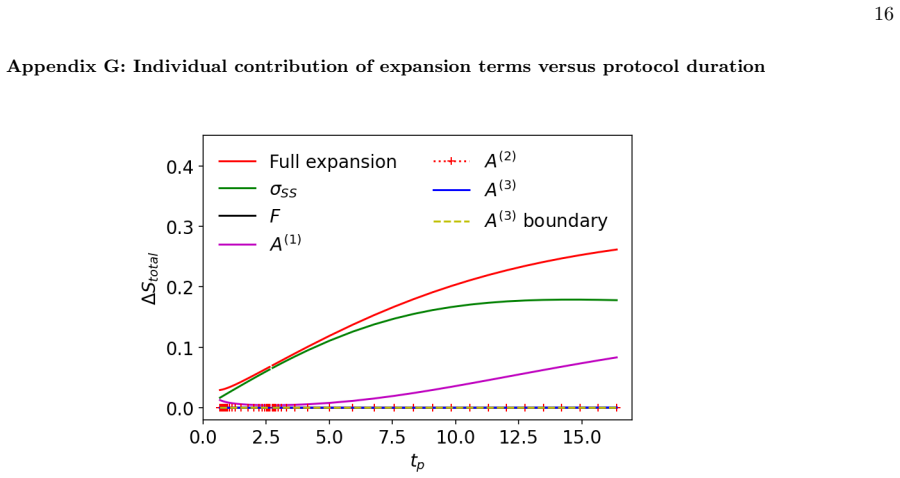
The central claim is that the entropy production of a slowly driven Markov system far from equilibrium can be written as $\Delta S_{\rm tot} = \int_{t_i}^{t_f} L(\alpha,\dot\alpha)\,dt + [\dot\alpha A^{(3)}]_{t_i}^{t_f}$ with $L = \sigma_{\rm SS} + F\dot\alpha + (A^{(1)}+A^{(2)}-A^{(3)})\dot\alpha^2$, where $\sigma_{\rm SS}$ is the steady-state dissipation and $F,A^{(1)},A^{(2)},A^{(3)}$ are correlation functions of three observables: the entropy production per state, the logarithmic derivative of the steady-state distribution, and the logarithmic derivative of the transition rates. The Euler-Lagrange equation for this Lagrangian reduces to a first integral giving $\dot\alpha = \pm \sqrt{(E+\sigma_{\rm SS})/(A^{(1)}+A^{(2)}-A^{(3)})}$, which can be integrated numerically to find protocols of any duration. Applied to a three-state model with a non-conservative force, the optimized protocols split into direct protocols and overshoot protocols for durations beyond $t_p^* \approx 2.70$; the overshoot spends most of the time in a region of low steady-state dissipation and beats the linear protocol, with entropy production leveling off at long durations while the parameter excursion grows without bound.
Load-bearing premise
The results assume that the second-order approximation in the driving speed is accurate for the optimized protocols, even though the paper itself notes those protocols drive fast enough to leave the regime where the approximation is reliable.
Editorial extensions
If this is right
- Entropy production for slow far-from-equilibrium driving is accessible from correlation functions of three local observables, so optimal protocols can be computed numerically for arbitrary Markov models, not only near-equilibrium ones.
- In the model, optimal protocols are non-monotone for durations beyond about 2.70, and their entropy production grows much more slowly with duration than a linear protocol, plateauing at long times.
- In the slow-driving limit the optimal parameter excursion diverges while the entropy production remains finite, so slowness no longer implies small amplitude for non-equilibrium control.
- The framework reduces to the known near-equilibrium result when detailed balance holds, because the terms $F$, $A^{(2)}$, and $A^{(3)}$ vanish while $A^{(1)}$ becomes the familiar thermodynamic metric.
- The appendix extends the construction to several control parameters, allowing simultaneous optimization of multi-parameter protocols.
Reading between the lines
- If the finite-entropy plateau survives higher-order corrections, the practical lesson is that deliberately moving a control parameter outside its operating range can be thermodynamically cheaper than a monotone interpolation; this should be looked for in molecular-motor and memory-reset experiments.
- The correlation-function form suggests the optimal protocol could be estimated from a single long trajectory at fixed parameter values, without knowing the transition rates, which is a testable route the paper does not spell out.
- For multiple control parameters, the matrix structure of the $A$-coefficients means overshoots in one parameter should generically couple to excursions in others, so optimal non-equilibrium protocols in higher dimensions are likely to be curved and non-monotone rather than straight lines.
Signed reviews
Editorial analysis
A structured set of objections, weighed in public.
Referee Report
Summary. The paper develops a second-order expansion of the stochastic entropy production for Markov jump processes driven by a time-dependent parameter α(t), starting from the Mandal–Jarzynski expansion of the probability distribution. It expresses the expansion coefficients in Eqs. (17)–(21), rewrites them as time-correlation functions of three observables in Eqs. (25)–(32), and then uses a Lagrangian/Euler–Lagrange formulation to find protocols that minimize the total entropy production between fixed endpoints. Applied to a three-state non-equilibrium model, the optimization produces 'direct' protocols for short durations and 'overshoot' protocols for durations longer than a threshold, with apparent finite entropy production and diverging control parameters in the long-duration limit. The paper argues that this closes a gap by extending linear-response-type optimization to systems far from equilibrium.
Significance. If the central claims were valid, the framework would be a valuable extension of Sivak–Crooks thermodynamic geometry to non-equilibrium steady states and would provide a computationally tractable route to optimal protocols. The manuscript contains substantial analytic work: the entropy-production coefficients, their correlation-function representation, and the exact toy-model calculations in the appendices are nontrivial and appear internally consistent, aided by the provided Mathematica notebook. The overshoot phenomenon is a surprising and potentially falsifiable prediction. However, because the paper's headline results in the slow-driving limit are obtained in a regime that Appendix F itself identifies as outside the validity of the second-order expansion, the significance of those claims is not currently established; the value of the work at this stage is mainly the formal expansion and its toy-model implementation for short protocols.
major comments (2)
- [Sec. IV, Appendix F, Figs. 5–6] The central claims of finite entropy production and diverging parameters in the slow-driving limit are not supported by the presented evidence. The optimized protocols are obtained by minimizing the approximate Lagrangian in Eq. (24), which is a second-order expansion in α̇. For the optimized 'overshoot' protocols, Fig. 6 and Appendix F show that the difference between the expansion and direct Euler integration of the master equation grows with protocol duration, and the text states that increasing tf does not make α̇ tend to zero and that 'we are not within the α̇ range where a 2nd order expansion is a sufficient approximation for the dissipation.' Consequently, the leveling off of the entropy production in Fig. 5 and the statement that longer durations lead to increasingly extreme overshoots with E→∞ are properties of the approximate objective, not established properties of the exact entropy production. Minimizing an uncontrolled approximation does not determine the true optimal protocol, and the reported discrepancy is direct evidence against the headline claims. The abstract's 'finite entropy production in the slow-driving limit' therefore requires either an exact calculation or a controlled approximation valid on the optimized protocols.
- [Sec. III, Eqs. (23) and (33)] The boundary term [α̇A^(3)] in Eq. (23) cannot be omitted from the variational problem on the stated grounds. Section III says this term is 'fixed' and therefore identical for all protocols with the same boundary conditions, but the variational problem fixes only α(ti), α(tf), and the duration; α̇ at the endpoints is not fixed. Unless additional boundary conditions specifying α̇(ti) and α̇(tf) are imposed, the Euler–Lagrange equation (33) is not the stationarity condition for the full functional (23). Including the boundary term would, at minimum, add natural boundary conditions, and it can shift the minimizing protocol. Since the overshoot protocols have nonzero endpoint velocities, this omission is relevant to the reported optimal protocols.
minor comments (6)
- [Sec. IIB] The phrase 'thirth order expansion' should be 'third order expansion'.
- [Sec. IIA] The sentence 'the main idea is to assumptions are that there exists an equilibrium probability distribution' contains a grammatical error and should be rewritten.
- [Eq. (24)] The expression for L appears to be missing a closing parenthesis before the final α̇² term; it should read (A^(1)(α)+A^(2)(α)−A^(3)(α))α̇².
- [Fig. 5 caption and Sec. IV] The phrase 'up to rather short protocol duration (tp ≳ 1)' is ambiguous or contradictory: 'up to' suggests an upper bound, while '≳' suggests a lower bound. Please clarify which duration regime is meant.
- [Appendix D] The statement 'Since W is symmetric and therefore diagonalizable' is incorrect: the transition matrix W is generally not symmetric. The spectral decomposition used in Eq. (11) requires diagonalizability, which is a generic property but not guaranteed by symmetry of W.
- [Appendix F] The reference 'see 6' should read 'see Fig. 6'.
Circularity Check
No significant circularity: the entropy-production functional is derived from an external slow-driving expansion and benchmarked against direct master-equation integration; the Appendix F limitation is a validity concern, not a circular reduction.
full rationale
The paper's core derivation is self-contained in the relevant sense. Equations (17)-(24) follow by substituting the Mandal-Jarzynski slow-driving expansion of the probability distribution (Eq. (10), citing the external reference [20]) into the standard entropy-production rate (Eq. (6)) and expanding to second order in the driving rate. The optimization is then a direct Euler-Lagrange minimization of the resulting explicit functional, with no fitted parameters, no data-driven objective, and no prediction that reduces by construction to an input. The toy-model results are checked against direct Euler integration of the master equation (Figs. 5-6), so the expansion is treated as a falsifiable approximation rather than as the definition of the result. Self-citations in the reference list are contextual and none is load-bearing, and no uniqueness theorem from the authors' prior work is invoked to force the choice of framework. Appendix F explicitly admits that the optimized long-duration protocols leave the regime where the second-order expansion is accurate; that is a serious correctness limitation, but it is the opposite of circularity, because it acknowledges a discrepancy between the approximation and the exact dynamics rather than equating the two.
Assumptions & free parameters
free parameters (2)
- non-conservative force f =
k_B T / 10
- intrinsic rates omega_ij =
1 for all i,j
assumptions (5)
- domain assumption The system is Markovian with a finite discrete state space and rates W_ij that can be tuned by a control parameter alpha(t).
- domain assumption The pseudo-inverse W-dagger exists and all nonzero eigenvalues of W have negative real parts, so the system relaxes to a unique steady state.
- ad hoc to paper The driving is slow enough that the expansion of p(t) in powers of alpha-dot (to third order) and of the entropy production to second order is accurate.
- standard math The entropy production rate is given by Eq. (6) from stochastic thermodynamics.
- ad hoc to paper The boundary term [alpha-dot A3] at the protocol endpoints is fixed and can be omitted in the variational optimization.
Cite this review
Pith. "Pith review of Thermodynamic control of non-equilibrium systems." pith.science (2026). https://pith.science/paper/THQTLDAB
@misc{pith2026250614416,
  author       = {Pith},
  title        = {Pith review of: Thermodynamic control of non-equilibrium systems},
  year         = {2026},
  howpublished = {\url{https://pith.science/paper/THQTLDAB}},
  note         = {Machine review of arXiv:2506.14416}
}
read the original abstract
We study the thermodynamic cost associated with driving systems between different non-equilibrium steady states. In particular, we combine a linear-response framework for non-equilibrium Markov systems with Lagrangian techniques to minimize the dissipation associated with driving processes. We then apply our framework to a simple toy model. Our results show several remarkable properties for the optimal protocol, such as diverging parameters and finite entropy production in the slow-driving limit.
Figures


Figures from the paper (4 more)


Reference graph
Works this paper leans on
-
[1]
The average entropy production associated with a specific state: O1;j = X i,(ν) W (ν) ij ln W (ν) ij pSS,j W (ν) ji pSS,i (25)
-
[2]
Pertubation of steady state distribution: O2;j = ∂ ln pSS,j ∂α (26)
-
[3]
∂ ∂t + X a ˙αa ∂ ∂αa # pSS(t) = W †
Change in rates: O3;ij = δ(t − τij) ∂ ln(Wij) ∂α (27) In terms of these observables, one can write σss = ⟨O1⟩α (28) F = − Z ∞ 0 ⟨O1(τ )O2(0)⟩αdt (29) A(1) = − Z ∞ 0 ⟨O2(τ )O2(0)⟩αdt (30) A(2) = − Z ∞ 0 ⟨O1(τ )τ O2(0)⟩⟨O2⟩dτ − Z ∞ 0 Z ∞ 0 X (ν) ⟨O1(τ1 + τ2)τ1O3(τ2)O2(0)⟩dτ1dτ2 + Z ∞ 0 ⟨O1(τ )τ ∂O2 ∂α |t=0 + O2(0)2 ⟩dτ (31) A(3) = Z ∞ 0 ⟨O1(τ )τ O2(0)⟩dτ (3...
- [4]
-
[5]
P. R. Zulkowski and M. R. DeWeese, Optimal finite-time erasure of a classical bit, Physical Review E 89, 052140 (2014)
work page 2014
-
[6]
K. Proesmans, J. Ehrich, and J. Bechhoefer, Finite-Time Landauer Principle, Physical Review Letters125, 100602 (2020), publisher: American Physical Society
work page 2020
-
[7]
Y.-Z. Zhen, D. Egloff, K. Modi, and O. Dahlsten, Uni- versal bound on energy cost of bit reset in finite time, Physical Review Letters 127, 190602 (2021)
work page 2021
-
[8]
Learning optimal erasure of a Static Random Access Memory
T. Basile and K. Proesmans, Learning optimal era- sure of a static random access memory, arXiv preprint arXiv:2411.02044 (2024)
work page Pith review arXiv 2024
Show all 37 references
-
[9]
Tu, Stochastic heat engine with the consideration of inertial effects and shortcuts to adiabaticity, Physical Re- view E 89, 052148 (2014)
Z. Tu, Stochastic heat engine with the consideration of inertial effects and shortcuts to adiabaticity, Physical Re- view E 89, 052148 (2014)
2014
-
[10]
Takahashi, Shortcuts to adiabaticity applied to nonequilibrium entropy production: an information ge- ometry viewpoint, New Journal of Physics 19, 115007 (2017)
K. Takahashi, Shortcuts to adiabaticity applied to nonequilibrium entropy production: an information ge- ometry viewpoint, New Journal of Physics 19, 115007 (2017)
2017
-
[11]
Gu´ ery-Odelin, A
D. Gu´ ery-Odelin, A. Ruschhaupt, A. Kiely, E. Tor- rontegui, S. Mart ´ ınez-Garaot, and J. G. Muga, Short- cuts to adiabaticity: Concepts, methods, and applica- tions, Reviews of Modern Physics 91, 045001 (2019)
2019
-
[12]
Gupta, S
D. Gupta, S. J. Large, S. Toyabe, and D. A. Sivak, Opti- mal control of the f1-atpase molecular motor, The Jour- nal of Physical Chemistry Letters 13, 11844 (2022)
2022
-
[13]
A. I. Brown and D. A. Sivak, Pulling cargo increases the precision of molecular motor progress, Europhysics Letters 126, 40004 (2019)
2019
-
[14]
J. N. Lucero, A. Mehdizadeh, and D. A. Sivak, Optimal control of rotary motors, Physical Review E 99, 012119 (2019)
2019
-
[15]
Aurell, C
E. Aurell, C. Mej ´ ıa-Monasterio, and P. Muratore- Ginanneschi, Optimal protocols and optimal transport in stochastic thermodynamics, Physical review letters 106, 250601 (2011)
2011
-
[16]
Van Vu and K
T. Van Vu and K. Saito, Thermodynamic unification of optimal transport: Thermodynamic uncertainty relation, minimum dissipation, and thermodynamic speed limits, Physical Review X 13, 011013 (2023)
2023
-
[17]
G. E. Crooks, Measuring thermodynamic length, Phys- ical Review Letters 99, 100602 (2007), arXiv:0706.0559 [cond-mat]
2007 arXiv
-
[18]
D. A. Sivak and G. E. Crooks, Thermodynamic metrics and optimal paths, Physical Review Letters 108, 190602 (2012), arXiv:1201.4166 [cond-mat]
2012 arXiv
-
[19]
Ritort, Nonequilibrium fluctuations in small systems: From physics to biology, Advances in chemical physics 137, 31 (2008)
F. Ritort, Nonequilibrium fluctuations in small systems: From physics to biology, Advances in chemical physics 137, 31 (2008)
2008
-
[20]
X. Fang, K. Kruse, T. Lu, and J. Wang, Nonequilibrium physics in biology, Reviews of Modern Physics91, 045004 (2019)
2019
-
[21]
Freitas, J.-C
N. Freitas, J.-C. Delvenne, and M. Esposito, Stochastic thermodynamics of nonlinear electronic circuits: A realis- tic framework for computing around k t, Physical Review X 11, 031064 (2021)
2021
-
[22]
Freitas, K
N. Freitas, K. Proesmans, and M. Esposito, Reliabil- ity and entropy production in non-equilibrium elec- tronic memories, Physical Review E 105, 034107 (2022), arXiv:2103.01184 [cond-mat]. 17
2022 arXiv
-
[23]
Mandal and C
D. Mandal and C. Jarzynski, Analysis of slow transitions between nonequilibrium steady states, Journal of Statis- tical Mechanics: Theory and Experiment 2016, 063204 (2016), publisher: IOP Publishing
2016
-
[24]
L. K. Davis, K. Proesmans, and ´E. Fodor, Active Matter under Control: Insights from Response Theory, Physical Review X 14, 011012 (2024), publisher: American Phys- ical Society
2024
-
[25]
Van den Broeck and M
C. Van den Broeck and M. Esposito, Ensemble and tra- jectory thermodynamics: A brief introduction, Physica A: Statistical Mechanics and its Applications 418, 6 (2015)
2015
-
[26]
Blaber and D
S. Blaber and D. A. Sivak, Optimal control in stochastic thermodynamics, Journal of Physics Communications 7, 033001 (2023)
2023
-
[27]
Deffner and M
S. Deffner and M. V. Bonan¸ ca, Thermodynamic con- trol—an old paradigm with new applications, Euro- physics Letters 131, 20001 (2020)
2020
-
[28]
V. V. Uteshev and P. S. Pennefather, Phasic Activation and State-dependent Inhibition: an Explicit Solution for a Three-state Ion Channel System, Journal of Theoretical Biology 181, 11 (1996)
1996
-
[29]
P. D. Boyer, R. L. Cross, and W. Momsen, A New Con- cept for Energy Coupling in Oxidative Phosphorylation Based on a Molecular Explanation of the Oxygen Ex- change Reactions, Proceedings of the National Academy of Sciences of the United States of America 70, 2837 (1973)
1973
-
[30]
J. N. E. Lucero, A. Mehdizadeh, and D. A. Sivak, Op- timal control of rotary motors, Physical Review E 99, 012119 (2019), publisher: American Physical Society
2019
-
[31]
S. J. Large and D. A. Sivak, Optimal discrete control: minimizing dissipation in discretely driven nonequilib- rium systems, Journal of Statistical Mechanics: Theory and Experiment 2019, 083212 (2019)
2019
-
[32]
https://github.com/KarelProesmans/Nonequilibrium control
-
[33]
Tafoya, S
S. Tafoya, S. J. Large, S. Liu, C. Bustamante, and D. A. Sivak, Using a system’s equilibrium behavior to reduce its energy dissipation in nonequilibrium processes, Pro- ceedings of the National Academy of Sciences 116, 5920 (2019), publisher: Proceedings of the National Academ...
2019
-
[34]
Herpich, J
T. Herpich, J. Thingna, and M. Esposito, Collective power: minimal model for thermodynamics of nonequi- librium phase transitions, Physical Review X 8, 031056 (2018)
2018
-
[35]
Nguyen and U
B. Nguyen and U. Seifert, Exponential volume depen- dence of entropy-current fluctuations at first-order phase transitions in chemical reaction networks, Physical Re- view E 102, 022101 (2020), publisher: American Physi- cal Society
2020
-
[36]
T. M. Pham, A. Alonso, and K. Proesmans, Irreversibil- ity in non-reciprocal chaotic systems, New Journal of Physics (2024)
2024
-
[37]
Peliti and S
L. Peliti and S. Pigolotti, Stochastic Thermodynamics - A Primer (Princeton University Press, 2021)
2021
Reviewed August 7, 2026 · model on record in the stance chip above.
Discussion (0). Continue with ORCID to comment.