Collaborative Charging Scheduling via Balanced Bounding Box Methods
Pith reviewed 2026-05-19 09:25 UTC · model grok-4.3
The pith
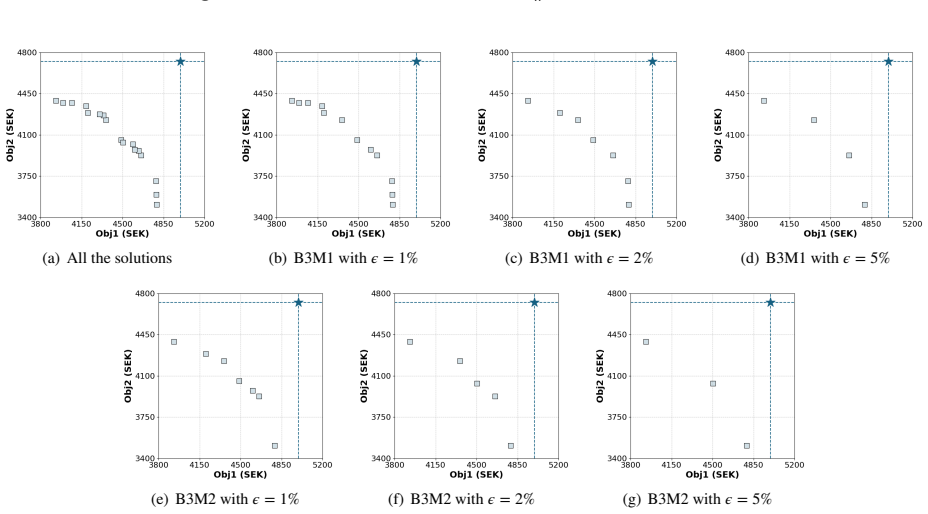
Balanced Bounding Box Methods trim computation for shared charging schedules by reducing the efficient frontier to representative trade-offs.
A machine-rendered reading of the paper's core claim, the machinery that carries it, and where it could break.
Core claim
The Balanced Bounding Box Methods (B3Ms) efficiently derive the efficient frontier for the bi-objective collaborative scheduling model by selectively disregarding closely positioned and competing solutions, thereby reducing computational time while preserving the diversity and representativeness of the solutions over the frontier.
What carries the argument
Balanced Bounding Box Methods (B3Ms), which improve efficiency in bi-objective optimization by selectively disregarding closely positioned solutions on the efficient frontier to produce a reduced yet representative set.
If this is right
- B3Ms significantly reduce computational time for the collaborative charging scheduling problem.
- The reduced set maintains the integrity and representativeness of the original efficient frontier.
- The methods supply a practical framework for other bi-objective nonlinear integer programs.
- Cooperative bargaining applied to the reduced frontier yields a balanced collaboration outcome.
Where Pith is reading between the lines
- The same trimming logic could be applied to real-time rescheduling when charger availability changes during operations.
- Extension to three or more operators would test whether the time savings remain proportional as the number of objectives grows.
- The reduced frontier might serve as input to simulation models that evaluate robustness under uncertain travel times.
Load-bearing premise
Selectively disregarding closely positioned and competing solutions on the efficient frontier will preserve enough diversity to avoid missing practically important cost trade-offs.
What would settle it
Run the complete Pareto front computation on one of the paper's numerical instances and check whether any high-impact trade-off points between the two operators' costs are absent from the reduced set returned by B3Ms.
Figures




read the original abstract
Electric mobility faces several challenges, most notably the high cost of infrastructure development and the underutilization of charging stations. The concept of shared charging offers a promising solution. The paper explores sustainable urban logistics through horizontal collaboration between two fleet operators and addresses a scheduling problem for the shared use of charging stations. To tackle this, the study formulates a collaborative scheduling problem as a bi-objective nonlinear integer programming model, in which each company aims to minimize its own costs, creating inherent conflicts that require trade-offs. The Balanced Bounding Box Methods (B3Ms) are introduced in order to efficiently derive the efficient frontier, identifying a reduced set of representative solutions. These methods enhance computational efficiency by selectively disregarding closely positioned and competing solutions, preserving the diversity and representativeness of the solutions over the efficient frontier. To determine the final solution and ensure balanced collaboration, cooperative bargaining methods are applied. Numerical case studies demonstrate the viability and scalability of the developed methods, showing that the B3Ms can significantly reduce computational time while maintaining the integrity of the frontier. These methods, along with cooperative bargaining, provide an effective framework for solving various bi-objective optimization problems, extending beyond the collaborative scheduling problem presented here.
Editorial analysis
A structured set of objections, weighed in public.
Referee Report
Summary. The manuscript formulates a collaborative charging scheduling problem between two fleet operators as a bi-objective nonlinear integer program, where each operator minimizes its own costs. It introduces Balanced Bounding Box Methods (B3Ms) to approximate the efficient frontier by selectively pruning closely positioned competing solutions while aiming to retain diversity. Cooperative bargaining methods are then applied to select a final balanced solution. Numerical case studies are presented to show that B3Ms reduce computational time while maintaining frontier integrity, with claims of applicability to other bi-objective problems.
Significance. If the B3Ms can be rigorously shown to approximate the Pareto set without omitting practically relevant trade-offs in discrete bi-objective integer programs, the framework could provide useful computational tools for shared EV infrastructure planning and horizontal collaboration in urban logistics. The numerical demonstrations of runtime reduction are potentially valuable for practitioners, but the absence of theoretical approximation guarantees limits the work's broader methodological contribution to multi-objective optimization.
major comments (2)
- [Abstract] Abstract (paragraph on B3Ms): The central claim that selectively disregarding closely positioned solutions 'preserves the diversity and representativeness of the solutions over the efficient frontier' lacks any formal bound (e.g., Hausdorff distance or worst-case deviation) on how much the reduced frontier can deviate from the true Pareto set. This is load-bearing for the integrity claim, especially for a discrete feasible set that may contain clusters or sharp bends.
- [Numerical case studies] Numerical case studies: The studies are asserted to demonstrate viability and scalability with reduced computational time, but no baseline comparisons, error bars, instance data, or quantitative metrics on frontier quality (e.g., coverage of trade-offs) are referenced, undermining verification of the performance claims.
minor comments (1)
- [Abstract] The abstract supplies no equations, model formulation details, or proof sketch for the B3Ms pruning rule, which would aid initial assessment of correctness.
Simulated Author's Rebuttal
We thank the referee for the constructive comments. We address each major point below and have revised the manuscript to clarify limitations and strengthen the numerical evaluation where possible.
read point-by-point responses
-
Referee: [Abstract] Abstract (paragraph on B3Ms): The central claim that selectively disregarding closely positioned solutions 'preserves the diversity and representativeness of the solutions over the efficient frontier' lacks any formal bound (e.g., Hausdorff distance or worst-case deviation) on how much the reduced frontier can deviate from the true Pareto set. This is load-bearing for the integrity claim, especially for a discrete feasible set that may contain clusters or sharp bends.
Authors: We agree that the manuscript provides no formal approximation guarantees such as Hausdorff distance bounds or worst-case deviation results. B3Ms are introduced as a heuristic that prunes nearby solutions via bounding boxes to reduce the frontier size while retaining representative trade-offs, with this property supported only by the numerical case studies. In the revision we have added an explicit limitations paragraph in the methodology section stating that the approach lacks theoretical guarantees and is validated empirically for the EV scheduling instances. We also outline future research directions for deriving such bounds on restricted problem classes. revision: partial
-
Referee: [Numerical case studies] Numerical case studies: The studies are asserted to demonstrate viability and scalability with reduced computational time, but no baseline comparisons, error bars, instance data, or quantitative metrics on frontier quality (e.g., coverage of trade-offs) are referenced, undermining verification of the performance claims.
Authors: We acknowledge that the original numerical section lacked explicit baselines, statistical variability measures, and quantitative frontier-quality metrics. The revised version now includes direct runtime comparisons against the epsilon-constraint method and NSGA-II, reports mean runtimes with standard deviations over ten replications, supplies the full instance data in an appendix, and adds hypervolume and trade-off coverage ratios to quantify frontier quality. These changes allow independent verification of the claimed reductions in computational time while preserving frontier integrity. revision: yes
- Providing rigorous theoretical approximation guarantees (e.g., Hausdorff distance or worst-case deviation bounds) for Balanced Bounding Box Methods on arbitrary discrete bi-objective nonlinear integer programs.
Circularity Check
No circularity: B3Ms introduced as independent algorithmic pruning rule
full rationale
The paper formulates a bi-objective nonlinear integer program and presents Balanced Bounding Box Methods (B3Ms) as a new algorithmic procedure that selectively prunes closely positioned solutions on the efficient frontier. No equations, fitted parameters, or self-citations are shown to reduce the claimed runtime reduction or frontier integrity to a tautological redefinition of the input data or prior results by the same authors. The derivation chain consists of standard multi-objective optimization steps followed by an independent heuristic rule whose correctness is asserted via numerical case studies rather than by construction. This is the most common honest non-finding for an algorithmic contribution paper.
Axiom & Free-Parameter Ledger
Lean theorems connected to this paper
-
IndisputableMonolith/Foundation/AbsoluteFloorClosure.leanreality_from_one_distinction unclear?
unclearRelation between the paper passage and the cited Recognition theorem.
bi-objective nonlinear integer programming model
What do these tags mean?
- matches
- The paper's claim is directly supported by a theorem in the formal canon.
- supports
- The theorem supports part of the paper's argument, but the paper may add assumptions or extra steps.
- extends
- The paper goes beyond the formal theorem; the theorem is a base layer rather than the whole result.
- uses
- The paper appears to rely on the theorem as machinery.
- contradicts
- The paper's claim conflicts with a theorem or certificate in the canon.
- unclear
- Pith found a possible connection, but the passage is too broad, indirect, or ambiguous to say the theorem truly supports the claim.
Reference graph
Works this paper leans on
-
[1]
An optimal charging scheduling model and algorithm for electric buses. Applied Energy 332, 120512. doi:https://doi.org/10.1016/j.apenergy.2022.120512. Bauer,G.,Hsu,C.W.,Nicholas,M.,Lutsey,N.,2021. Chargingupamerica:Assessingthegrowingneedforuscharginginfrastructurethrough2030. White Paper ICCT URL:https://theicct.org/sites/default/files/publications/charg...
-
[2]
INFORMS Journal on Computing 27, 735–754
A criterion space search algorithm for biobjective integer programming: The balanced box method. INFORMS Journal on Computing 27, 735–754. doi:https://doi.org/10.1287/ijoc.2015.0657. Cai, Z., Li, C., Mo, D., Xu, S., Chen, X.M., Lee, D.H.,
-
[3]
Transportation Research Part E: Logistics and Transportation Review 184, 103484
Optimizing consolidated shared charging and electric ride-sourcing services. Transportation Research Part E: Logistics and Transportation Review 184, 103484. doi:https://doi.org/10.1016/j.tre.2024.103484. Charkhgard, H., Takalloo, M., Haider, Z.,
-
[4]
Bi-objective autonomous vehicle repositioning problem with travel time uncertainty. 4OR 18, 477–505. doi:https://doi.org/10.1007/s10288-019-00429-7. Chen, T.D., Kockelman, K.M., Khan, M., et al.,
-
[5]
Operations Research Letters 46, 81–87
A two-stage approach for bi-objective integer linear programming. Operations Research Letters 46, 81–87. doi:https://doi.org/10.1016/j.orl.2017.11.011. Das, R., Wang, Y., Busawon, K., Putrus, G., Neaimeh, M.,
-
[6]
Journal of Cleaner Production 292, 126066
Real-time multi-objective optimisation for electric vehicle charging management. Journal of Cleaner Production 292, 126066. doi:https://doi.org/10.1016/j.jclepro.2021.126066. Das, S., Acharjee, P., Bhattacharya, A.,
-
[7]
IEEE Transactions on Industry Applications 57, 1688–1702
Charging scheduling of electric vehicle incorporating grid-to-vehicle and vehicle-to-grid technology considering in smart grid. IEEE Transactions on Industry Applications 57, 1688–1702. Duan,M.,Liao,F.,Qi,G.,Guan,W.,2023. Integratedoptimizationofelectricbusschedulingandchargingplanningincorporatingflexiblecharging and timetable shifting strategies. Transp...
-
[8]
IEEE Transactions on Intelligent Transportation Systems 23, 5116–5127
A price-based iterative double auction for charger sharing markets. IEEE Transactions on Intelligent Transportation Systems 23, 5116–5127. doi:https://doi.org/10.1109/TITS.2020.3047984. Göteborg Energi,
-
[9]
Electric Power Systems Research 128, 19–29
Real-time charging coordination of plug-in electric vehicles based on hybrid fuzzy discrete particle swarm optimization. Electric Power Systems Research 128, 19–29. doi:https://doi.org/10.1016/j.epsr.2015.06.019. He, Y., Liu, Z., Song, Z.,
-
[10]
Transportation Research Part E: Logistics and Transportation Review 142, 102056
Optimal charging scheduling and management for a fast-charging battery electric bus system. Transportation Research Part E: Logistics and Transportation Review 142, 102056. doi:https://doi.org/10.1016/j.tre.2020.102056. Hu,X.,Yang,Z.,Sun,J.,Zhang,Y.,2021. Sharingeconomyofelectricvehicleprivatechargeposts. TransportationResearchPartB:Methodological 152, 25...
-
[11]
Technical Report. International Energy Agency. Paris. URL: https://www.iea.org/reports/ global-ev-outlook-2024. Ji, J., Bie, Y., Wang, L.,
work page 2024
-
[12]
IEEE Systems Journal 14, 4221–4231
Optimal scheduling of ev charging at a solar power-based charging station. IEEE Systems Journal 14, 4221–4231. doi:https://doi.org/10.1109/JSYST.2020.2968270. Kampshoff, P., Kumar, A., Peloquin, S., Sahdev, S.,
-
[13]
Procedia Computer Science 16, 767–775
Real-time scheduling techniques for electric vehicle charging in support of frequency regulation. Procedia Computer Science 16, 767–775. doi:https://doi.org/10.1016/j.procs.2013.01.080. Kumar,R.R.,Chakraborty,A.,Mandal,P.,2021. Promotingelectricvehicleadoption:Whoshouldinvestincharginginfrastructure? Transportation Research Part E: Logistics and Transport...
-
[14]
Applied Soft Computing 144, 110444
A game-theoretical constructive approach for the multi-objective frequency assignment problem. Applied Soft Computing 144, 110444. doi:https://doi.org/10.1016/j.asoc.2023.110444. Zhou et al.:Preprint submitted to Elsevier Page 31 of 32 Collaborative Charging Scheduling via B3M Levinson, R.S., West, T.H.,
-
[15]
Transportation Research Part D: Transport and Environment 64, 158–177
Impact of public electric vehicle charging infrastructure. Transportation Research Part D: Transport and Environment 64, 158–177. doi:https://doi.org/10.1016/j.trd.2017.10.006. Li, W., He, Y., Hu, S., He, Z., Ratti, C.,
-
[16]
IEEE Transactions on Smart Grid 12, 4029–4038
Efficient real-time ev charging scheduling via ordinal optimization. IEEE Transactions on Smart Grid 12, 4029–4038. doi:https://doi.org/10.1109/TSG.2021.3078445. Ma, T.Y., Xie, S.,
-
[17]
Transportation Research Part D: Transport and Environment 90, 102682
Optimal fast charging station locations for electric ridesharing with vehicle-charging station assignment. Transportation Research Part D: Transport and Environment 90, 102682. doi:https://doi.org/10.1016/j.trd.2020.102682. Mak,H.Y.,Rong,Y.,Shen,Z.J.M.,2013. Infrastructureplanningforelectricvehicleswithbatteryswapping. Managementscience59,1557–1575. doi:h...
-
[18]
Business Strategy and the Environment 32, 1835–1846
The benefits of green horizontal networks: Lessons learned from sharing charging infrastructure for electric freight vehicles. Business Strategy and the Environment 32, 1835–1846. doi:https://doi.org/10.1002/bse.3222. Mukherjee, J.C., Gupta, A.,
-
[19]
IEEE Systems Journal 9, 1541–1553
A review of charge scheduling of electric vehicles in smart grid. IEEE Systems Journal 9, 1541–1553. doi:https://doi.org/10.1109/JSYST.2014.2356559. Nash, J.,
-
[20]
Two-person cooperative games. Econometrica 21, 128–140. Nealer,R.,2015. Cleanercarsfromcradletograve:Howelectriccarsbeatgasolinecarsonlifetimeglobalwarmingemissions. JSTORSustainability Collection URL:https://www.jstor.org/stable/pdf/resrep17225.15.pdf. Nord pool,
work page 2015
-
[21]
IEEE Transactions on Smart Grid 13, 2218–2233
A cooperative hierarchical multi-agent system for ev charging scheduling in presence of multiple charging stations. IEEE Transactions on Smart Grid 13, 2218–2233. doi:https://doi.org/10.1109/TSG.2022.3140927. Sarker,M.R.,Pandžić,H.,Ortega-Vazquez,M.A.,2014. Optimaloperationandservicesschedulingforanelectricvehiclebatteryswappingstation. IEEE transactions ...
-
[22]
Operations ResearchforHealthCare 38,100390
Generatingbalanced workloadallocationsin hospitals. Operations ResearchforHealthCare 38,100390. doi:https://doi.org/ 10.1016/j.orhc.2023.100390. Tan, M., Dai, Z., Su, Y., Chen, C., Wang, L., Chen, J.,
-
[23]
Bi-level optimization of charging scheduling of a battery swap station based on deep reinforcement learning. Engineering Applications of Artificial Intelligence 118, 105557. doi:https://doi.org/10.1016/j.engappai. 2022.105557. Vanrykel,F.,Ernst,D.,Bourgeois,M.,2018. Fosteringshare&chargethroughproperregulation. CompetitionandRegulationinNetworkIndustries ...
-
[24]
Sustainable Cities and Society 44, 597–603
A global comparison and assessment of incentive policy on electric vehicle promotion. Sustainable Cities and Society 44, 597–603. doi:https://doi.org/10.1016/j.scs.2018.10.024. Wang, T., Du, Y., Fang, D., Li, Z.C.,
-
[25]
Transportation Science 54, 1307–1331
Berth allocation and quay crane assignment for the trade-off between service efficiency and operating cost considering carbon emission taxation. Transportation Science 54, 1307–1331. doi:https://doi.org/10.1287/trsc.2019.0946. Wei, Z., Li, Y., Zhang, Y., Cai, L.,
-
[26]
IEEE transactions on industrial electronics 65, 2806–2816
Intelligent parking garage ev charging scheduling considering battery charging characteristic. IEEE transactions on industrial electronics 65, 2806–2816. doi:https://doi.org/10.1109/TIE.2017.2740834. Wu, H., Pang, G.K.H., Choy, K.L., Lam, H.Y.,
-
[27]
Applied Soft Computing 61, 905–920
A charging-scheme decision model for electric vehicle battery swapping station using varied population evolutionary algorithms. Applied Soft Computing 61, 905–920. doi:https://doi.org/10.1016/j.asoc.2017.09.008. Wu, J., Su, H., Meng, J., Lin, M.,
-
[28]
Electric vehicle charging scheduling considering infrastructure constraints. Energy 278, 127806. doi:https://doi.org/10.1016/j.energy.2023.127806. Wu, W., Lin, Y., Liu, R., Li, Y., Zhang, Y., Ma, C.,
-
[29]
IEEE Transactions on Intelligent Transportation Systems 23, 572–586
Online ev charge scheduling based on time-of-use pricing and peak load minimization: Properties and efficient algorithms. IEEE Transactions on Intelligent Transportation Systems 23, 572–586. doi:https://doi.org/10.1109/ TITS.2020.3014088. Yin, W., Ming, Z., Wen, T.,
-
[30]
Scheduling strategy of electric vehicle charging considering different requirements of grid and users. Energy 232, 121118. doi:https://doi.org/10.1016/j.energy.2021.121118. You, P., Yang, Z., Zhang, Y., Low, S.H., Sun, Y.,
-
[31]
IEEE Transactions on Power Systems 31, 3473–3483
Optimal charging schedule for a battery switching station serving electric buses. IEEE Transactions on Power Systems 31, 3473–3483. doi:https://doi.org/10.1109/TPWRS.2015.2487273. Zakariazadeh, A., Jadid, S., Siano, P.,
-
[32]
Energy Conversion and Management 79, 43–53
Multi-objective scheduling of electric vehicles in smart distribution system. Energy Conversion and Management 79, 43–53. doi:https://doi.org/10.1016/j.enconman.2013.11.042. Zhang, Y., You, P., Cai, L.,
-
[33]
IEEE Transactions on Intelligent Transportation Systems 20, 3386–3396
Optimal charging scheduling by pricing for ev charging station with dual charging modes. IEEE Transactions on Intelligent Transportation Systems 20, 3386–3396. doi:https://doi.org/10.1109/TITS.2018.2876287. Zhong, S., Cheng, R., Jiang, Y., Wang, Z., Larsen, A., Nielsen, O.A.,
-
[34]
Transportation Research Part E: Logistics and Transportation Review 141, 102015
Risk-averse optimization of disaster relief facility location and vehicle routing under stochastic demand. Transportation Research Part E: Logistics and Transportation Review 141, 102015. doi:https: //doi.org/10.1016/j.tre.2020.102015. Zhou, F., Arvidsson, A., Wu, J., Kulcsar, B., 2024a. Collaborative electric vehicle routing with meet points. Communicati...
discussion (0)
Sign in with ORCID, Apple, or X to comment. Anyone can read and Pith papers without signing in.