REVIEW 4 major objections 5 minor 38 references
Adaptive Data Augmentation for Thompson Sampling
T0 review · 4 major / 5 minor · reviewed 2026-08-07 · deepseek-v4-flash
Pith's one-line read This paper claims Thompson Sampling can be made nearly minimax optimal in linear contextual bandits.
desk verdict Clever hypothetical-context construction and coupling idea, but Lemma 2 has a false equality that breaks the main self-normalized bound; the claimed O~(d sqrt T) regret for Thompson Sampling is not established as written. read the letter →
The pith
A machine-rendered reading of the paper's core claim, the machinery that carries it, and where it could break.
The reading
What carries the argument
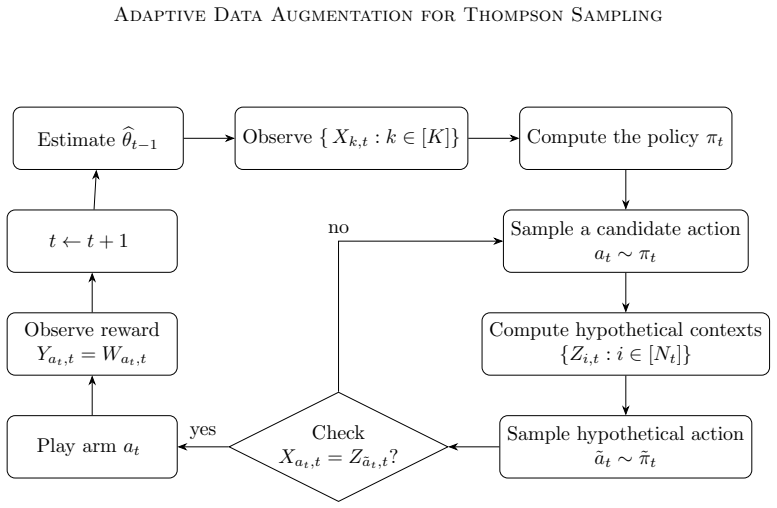
The load-bearing construction is the hypothetical bandit: at each round, the unplayed contexts' Gram matrix $G_t$ is eigen-decomposed, and the hypothetical contexts $Z_{i,t}$ are $\sqrt{\lambda_{i,t}}u_{i,t}$ plus the played context $X_{a_t,t}$, so the identity $\sum_{i=1}^{r_t+1} Z_{i,t}Z_{i,t}^\top = \sum_{k=1}^K X_{k,t}X_{k,t}^\top$ holds with far fewer arms. On selected rounds, an orthonormal basis is added, giving a Gram matrix bounded below by $\sum_{s\notin A_t}\sum_{k=1}^K X_{k,s}X_{k,s}^\top + \max\{x_{\max}^2,1\}h_t I_d$. The coupling step resamples the Thompson draw until the hypothetical arm equals the played arm, so the pseudo-rewards become computable; Lemma 1, the coupling inequality, and the maximal elliptical potential lemma are the three supports of the regret analysis.
What would settle it
For a single round with $N_s=2$ and $\gamma=1/2$, enumerate the resampling tree: if the first draw misses but the second hits, the HCSA estimator uses the second draw while the hypothetical estimator in Lemma 2 uses the first, so computing the two probabilities in Lemma 2 at any $x>0$ will show they differ.
Extended reading notes
Core claim
The paper's central claim is Theorem 3: with probability at least $1-3\delta$, the cumulative regret of HCSA+TS is bounded by a sum whose leading order is $O(d\sqrt{T}\log T)$, matching the $\Omega(d\sqrt{T})$ minimax lower bound up to logarithmic factors. The mechanism is a new estimator, the hypothetical coupled sample augmented (HCSA) estimator, whose normalization matrix $V_t$ includes contexts from all $K$ arms plus an adaptively scheduled orthonormal augmentation. The coupling argument lets the algorithm use only $N_t \le d+1$ pseudo-samples per round instead of $K$, and the paper argues that this removes the IID and strictly-positive-covariance context assumptions used by prior estimators, giving the first nearly minimax-optimal regret guarantee for Thompson Sampling in fully general linear contextual bandits.
Load-bearing premise
The regret bound rests on the claim that once every resampling trial succeeds, the estimator's error distribution is the same as if the first hypothetical sample had been used in every round; that equality is the load-bearing premise of the proof.
Editorial extensions
If this is right
- Linear contextual bandits would get a single Thompson Sampling algorithm whose $O(d\sqrt{T}\log T)$ regret holds even when contexts are deterministic, adversarial, or non-stationary.
- The regret bound would no longer grow with the number of arms $K$ or with the context norm $x_{\max}$, because the Gram matrix contains information about all arms.
- The estimator would deliver accurate reward predictions for all arms, not only the played one, which is exactly what is needed for offline evaluation and for settings with missing context features.
- The compression identity (3) could be reused by any algorithm that needs a well-conditioned Gram matrix, since it reduces $K$ context vectors to $r_t+1$ orthogonal ones without losing the sum of outer products.
Reading between the lines
- The coupling step is the fragile point: the paper does not verify numerically that the stopping-time distribution equals the first-trial distribution, so a small simulation comparing the two probabilities in Lemma 2 would settle the proof.
- Because the hypothetical-context construction is distribution-free, a natural extension would be to generalized linear bandits, replacing the Gram matrix identity with a Fisher-information version.
- One could test the algorithm's practical claim on a fully deterministic context sequence (for example, cyclic basis vectors) where earlier Thompson Sampling variants are known to suffer; the paper's experiments only use random contexts with masking.
Editorial analysis
A structured set of objections, weighed in public.
Referee Report
Summary. The paper proposes HCSA+TS, a Thompson Sampling algorithm for linear contextual bandits that uses a new estimator based on hypothetical contexts, adaptive data augmentation, and a resampling/coupling mechanism. The main theoretical claim is a nearly minimax-optimal regret bound of O(d sqrt(T) log T) under arbitrary (non-IID, non-stationary) context distributions, removing IID and minimum-eigenvalue assumptions used in prior work. The paper also contains experiments comparing the proposed method with several baselines on simulated data. The central result depends on a coupling inequality (Lemma 2) that relates the computable HCSA estimator to an idealized hypothetical-sample-augmented estimator.
Significance. If established, the claimed regret bound would be a significant advance: it would provide the first minimax-optimal (up to log factors) frequentist regret guarantee for Thompson Sampling in linear contextual bandits without distributional assumptions on contexts. The construction of orthogonal hypothetical contexts, the attempt to control a full Gram matrix including unselected arms, and the coupling mechanism are creative and could be of independent interest. However, the main theorem is not supported because Lemma 2, which is the sole bridge between the computable estimator and the idealized estimator, is proved via a false equality. The central claim is therefore currently unsubstantiated.
major comments (4)
- [Section 4.4, Lemma 2] The proof of Lemma 2 contains a false equality. It asserts that P({F(tilde a_1(M_1), ..., tilde a_t(M_t)) > x} cap S_t) equals P({F(tilde a_1(1), ..., tilde a_t(1)) > x} cap S_t cap cap_s {tilde a_s(1) = N_s}), justified by the IID property of resampling trials. This is incorrect because S_t = cap_s M_s includes paths where success occurs only at a later resampling trial, so the event M_s does not imply tilde a_s(1) = N_s; conditioning on eventual success changes the distribution of the first draw. Moreover, F is not invariant under replacing tilde a_s(M_s) with tilde a_s(1): the coupled pseudo-rewards in (14) and the resulting estimator depend on the final successful draw. A concrete counterexample with t=1, gamma=1/2, M_1=3 gives P(M_1)=7/8 while P(tilde a_1(1)=N_1)=1/2, so the claimed equality would force 7/8=1/2 whenever the event F(N_1)>x has positive probability. Because Theorem 5 is proved from Lemma 2 and Theorem 3 relies on Theorem 5, the central regret bound is not derived.
- [Section 5.1 and Appendix A.2, proof of Theorem 5] The proof of Theorem 5 depends on Lemma 2 to replace the HCSA estimator with the HSA estimator on the success event S_t. Since Lemma 2 is invalid, the self-normalized bound for the HCSA estimator is not established. Additionally, the proof in Appendix A.2 applies the triangle inequality to the decomposition from Lemma 4 but then substitutes definitions of the reference estimator and the matrix P_t in a way that appears to require V_t - A_t to be positive semidefinite on the relevant event; this is not shown and is another gap that would need to be addressed even if the coupling equality were repaired.
- [Appendix A.3, Lemma 9] The proof of Lemma 9 states 'Using Lemma 9 and Lemma 10 from Abbasi-Yadkori et al. (2011)', but Lemma 9 is the lemma being proved in this paper; the intended reference is presumably Theorem 1 of Abbasi-Yadkori et al. (2011), which is not stated. This leaves the claimed noise bound of (sigma/gamma) sqrt(d log(1+t/delta)) for the term St without a clear supporting citation or proof. This issue is secondary to the failure of Lemma 2 but still needs correction.
- [Section 5.3, regret decomposition] The derivation of the leading regret term contains unresolved notation and inequalities. In particular, the text moves from a bound involving '2h_T' to '2T_1', uses the expression 't=∈[T]', and the transition from regret(t) <= 2 x_t ||btheta_{t-1}-theta*||_{V_{t-1}} + sqrt(...) to the factored form involving sqrt(2) x_t is not fully justified, though it may be repairable. This is not the main obstruction but indicates that the regret analysis needs careful rewriting.
minor comments (5)
- [Section 4.2, equation (8)] The definition of N_s in (7) and the description of the orthogonal-basis augmentation in Section 4.2 are inconsistent with Algorithm 2: line 11 and line 14 of Algorithm 2 appear to swap the 't in A_t' and 'otherwise' cases relative to the text above equation (8).
- [Appendix A.1, Lemma 4] The statement of Lemma 4 contains stray text 'and. and.' before the displayed equation, and the proof uses 'rs+1' in sums where the full range should be 'N_s' as defined in (7).
- [Appendix A.5, Lemma 7] The proof introduces a sequence 'nu_s' without definition, and the sentence 'for ts such that t<=h_t, we have t in A_t and 1 in A_t for all t in [T]' is confusing; the intended argument that the regularization rounds are nonempty and well-ordered should be stated more clearly.
- [Section 5.1, Theorem 5] The phrase 'arbitral context distributions' should be 'arbitrary context distributions'.
- [Section 6, experimental setup] The hyperparameter tuning procedure is described only briefly; reporting the selected hyperparameter values for each method and the variance across runs would improve reproducibility.
Circularity Check
No significant circularity: the HCSA estimator and regret analysis are derived in-paper; the only self-citation is a non-load-bearing technical bound.
full rationale
The derivation is self-contained. The HCSA estimator (Eq. 15) is constructed from resampled hypothetical contexts and coupled pseudo-rewards (Eq. 14), and the regret analysis proceeds through the paper's own Lemma 2, Lemma 4, Lemmas 8-10, and Lemma 7, with standard martingale and matrix concentration arguments. No fitted parameter is renamed as a prediction, and no central quantity is defined in terms of the claimed regret bound. The single load-bearing external input from the author's prior work is the bound on T1 via Lemma C.6 of Kim et al. 2023a, used in Eq. (6); that bound only controls how many initial rounds are needed before the augmentation set reaches size h_t, and it is not the source of the O(d sqrt(T)) rate. The paper's claimed novelty, the coupling of hypothetical and original bandit samples, is not imported from prior work. A separate reviewer concern that Lemma 2's coupling equality is mathematically false is a proof-correctness issue, not a circularity issue, and therefore does not raise the circularity score.
Assumptions & free parameters
free parameters (4)
- gamma (coupling parameter) =
0.1, 0.5, or 0.9 in experiments; theoretical constant in (0,1)
- delta (confidence level) =
user-specified
- x_max (context norm bound) =
assumed known; can be replaced by running max
- theta_max (upper bound on ||theta*||) =
unknown
assumptions (6)
- domain assumption Rewards are linear: Y_{a_t,t} = X_{a_t,t}^T theta* + eta_{a_t,t}
- domain assumption Noise eta is conditionally zero-mean and sigma-sub-Gaussian
- domain assumption |X_{k,t}^T theta*| <= 1 for all k and t
- domain assumption Contexts are bounded: ||X_{k,t}||_2 <= x_max
- standard math Standard martingale concentration inequalities (Abbasi-Yadkori et al. 2011, Tropp 2012)
- standard math Lemma C.6 of Kim et al. (2023a) bounding T1
invented entities (3)
-
Hypothetical contexts Z_{i,t}
-
Hypothetical bandit problem
-
Coupling resampling mechanism
Cite this review
Pith. "Pith review of Adaptive Data Augmentation for Thompson Sampling." pith.science (2026). https://pith.science/paper/73QUUGIO
@misc{pith2026250614479,
  author       = {Pith},
  title        = {Pith review of: Adaptive Data Augmentation for Thompson Sampling},
  year         = {2026},
  howpublished = {\url{https://pith.science/paper/73QUUGIO}},
  note         = {Machine review of arXiv:2506.14479}
}
read the original abstract
In linear contextual bandits, the objective is to select actions that maximize cumulative rewards, modeled as a linear function with unknown parameters. Although Thompson Sampling performs well empirically, it does not achieve optimal regret bounds. This paper proposes a nearly minimax optimal Thompson Sampling for linear contextual bandits by developing a novel estimator with the adaptive augmentation and coupling of the hypothetical samples that are designed for efficient parameter learning. The proposed estimator accurately predicts rewards for all arms without relying on assumptions for the context distribution. Empirical results show robust performance and significant improvement over existing methods.
Figures


Reference graph
Works this paper leans on
-
[1]
Y. Abbasi-Yadkori, D. P \'a l, and C. Szepesv \'a ri. Improved algorithms for linear stochastic bandits. In Advances in Neural Information Processing Systems, pages 2312--2320, 2011
work page 2011
- [2]
-
[3]
M. Abeille, A. Lazaric, et al. Linear thompson sampling revisited. Electronic Journal of Statistics, 11 0 (2): 0 5165--5197, 2017
work page 2017
-
[4]
S. Agrawal and N. Goyal. Thompson sampling for contextual bandits with linear payoffs. In International Conference on Machine Learning, pages 127--135, 2013
work page 2013
-
[5]
S. Agrawal and N. Goyal. Near-optimal regret bounds for thompson sampling. Journal of the ACM (JACM), 64 0 (5): 0 1--24, 2017
work page 2017
-
[6]
P. Auer. Using confidence bounds for exploitation-exploration trade-offs. Journal of Machine Learning Research, 3 0 (Nov): 0 397--422, 2002a
-
[7]
Bang and J
H. Bang and J. M. Robins. Doubly robust estimation in missing data and causal inference models. Biometrics, 61 0 (4): 0 962--973, 2005
2005
-
[8]
H. Bastani, M. Bayati, and K. Khosravi. Mostly exploration-free algorithms for contextual bandits. Management Science, 67 0 (3): 0 1329--1349, 2021
work page 2021
Show all 38 references
-
[9]
C. M. Bishop. Training with noise is equivalent to tikhonov regularization. Neural computation, 7 0 (1): 0 108--116, 1995
1995
-
[10]
Bouneffouf, I
D. Bouneffouf, I. Rish, and C. Aggarwal. Survey on applications of multi-armed and contextual bandits. In 2020 IEEE Congress on Evolutionary Computation (CEC), pages 1--8. IEEE, 2020
2020
-
[11]
B \"u hlmann and S
P. B \"u hlmann and S. Van De Geer. Statistics for high-dimensional data: methods, theory and applications. Springer Science & Business Media, 2011
2011
-
[12]
Chapelle and L
O. Chapelle and L. Li. An empirical evaluation of thompson sampling. In J. Shawe-Taylor, R. S. Zemel, P. L. Bartlett, F. Pereira, and K. Q. Weinberger, editors, Advances in Neural Information Processing Systems 24, pages 2249--2257. Curran Associates, Inc., 2011
2011
-
[13]
W. Chu, L. Li, L. Reyzin, and R. Schapire. Contextual bandits with linear payoff functions. In Proceedings of the Fourteenth International Conference on Artificial Intelligence and Statistics, pages 208--214, 2011
2011
-
[14]
V. Dani, T. Hayes, and S. Kakade. Stochastic linear optimization under bandit feedback. In 21st Annual Conference on Learning Theory, pages 355--366, 01 2008
2008
-
[15]
Dimakopoulou, Z
M. Dimakopoulou, Z. Zhou, S. Athey, and G. Imbens. Balanced linear contextual bandits. In Proceedings of the AAAI Conference on Artificial Intelligence, volume 33, pages 3445--3453, 2019
2019
-
[16]
K. J. Ferreira, D. Simchi-Levi, and H. Wang. Online network revenue management using thompson sampling. Operations research, 66 0 (6): 0 1586--1602, 2018
2018
-
[17]
Guttorp and G
P. Guttorp and G. Lindgren. Karl pearson and the scandinavian school of statistics. International Statistical Review, 77 0 (1): 0 64--71, 2009
2009
-
[18]
Hsu, W.-K
J.-Y. Hsu, W.-K. Tseng, J.-Y. Hsieh, C.-J. Chang, and H. Chen. The recommending agricultural product sales promotion mode in e-commerce using reinforcement learning with contextual multiarmed bandit algorithms. Mathematical Problems in Engineering, 2020 0 (1): 0 8836000, 2020
2020
-
[19]
T. Huix, M. Zhang, and A. Durmus. Tight regret and complexity bounds for thompson sampling via langevin monte carlo. In International Conference on Artificial Intelligence and Statistics, pages 8749--8770. PMLR, 2023
2023
-
[20]
Kim and M
G. Kim and M. C. Paik. Doubly-robust lasso bandit. In Advances in Neural Information Processing Systems, pages 5869--5879, 2019
2019
-
[21]
Kim, G.-S
W. Kim, G.-S. Kim, and M. C. Paik. Doubly robust thompson sampling with linear payoffs. In A. Beygelzimer, Y. Dauphin, P. Liang, and J. W. Vaughan, editors, Advances in Neural Information Processing Systems, 2021
2021
-
[22]
W. Kim, G. Iyengar, and A. Zeevi. Learning the pareto front using bootstrapped observation samples. arXiv preprint arXiv:2306.00096, 2023 a
2023 arXiv
-
[23]
W. Kim, K. Lee, and M. C. Paik. Double doubly robust thompson sampling for generalized linear contextual bandits. In Proceedings of the AAAI Conference on Artificial Intelligence, volume 37, pages 8300--8307, 2023 b
2023
-
[24]
W. Kim, M. C. Paik, and M.-H. Oh. Squeeze all: Novel estimator and self-normalized bound for linear contextual bandits. In International Conference on Artificial Intelligence and Statistics, pages 3098--3124. PMLR, 2023 c
2023
-
[25]
Kveton, C
B. Kveton, C. Szepesv \' a ri, M. Ghavamzadeh, and C. Boutilier. Perturbed-history exploration in stochastic linear bandits. In R. P. Adams and V. Gogate, editors, Proceedings of The 35th Uncertainty in Artificial Intelligence Conference, volume 115 of Proceedings of Machine L...
2020
-
[26]
Lattimore and C
T. Lattimore and C. Szepesv \'a ri. Bandit algorithms. Cambridge University Press, 2020
2020
-
[27]
J. Mockus. The bayesian approach to global optimization. In System Modeling and Optimization: Proceedings of the 10th IFIP Conference New York City, USA, August 31--September 4, 1981, pages 473--481. Springer, 2005
1981
-
[28]
S. A. Murphy. An experimental design for the development of adaptive treatment strategies. Statistics in medicine, 24 0 (10): 0 1455--1481, 2005
2005
-
[29]
Offer-Westort, A
M. Offer-Westort, A. Coppock, and D. P. Green. Adaptive experimental design: Prospects and applications in political science. American Journal of Political Science, 65 0 (4): 0 826--844, 2021
2021
-
[30]
Rusmevichientong and J
P. Rusmevichientong and J. N. Tsitsiklis. Linearly parameterized bandits. Mathematics of Operations Research, 35 0 (2): 0 395--411, 2010
2010
-
[31]
Satyal, I
S. Satyal, I. Weber, H.-y. Paik, C. Di Ciccio, and J. Mendling. Ab testing for process versions with contextual multi-armed bandit algorithms. In Advanced Information Systems Engineering: 30th International Conference, CAiSE 2018, Tallinn, Estonia, June 11-15, 2018, Proceeding...
2018
-
[32]
K. Smith. On the standard deviations of adjusted and interpolated values of an observed polynomial function and its constants and the guidance they give towards a proper choice of the distribution of observations. Biometrika, 12 0 (1/2): 0 1--85, 1918
1918
-
[33]
Soare, A
M. Soare, A. Lazaric, and R. Munos. Best-arm identification in linear bandits. Advances in Neural Information Processing Systems, 27, 2014
2014
-
[34]
C. Tao, S. Blanco, and Y. Zhou. Best arm identification in linear bandits with linear dimension dependency. In International Conference on Machine Learning, pages 4877--4886. PMLR, 2018
2018
-
[35]
J. A. Tropp. User-friendly tail bounds for sums of random matrices. Foundations of computational mathematics, 12 0 (4): 0 389--434, 2012
2012
-
[36]
J. A. Tropp. An introduction to matrix concentration inequalities. Foundations and Trends in Machine Learning , 8 0 (1-2): 0 1--230, 2015
2015
-
[37]
Xu and A
Y. Xu and A. Zeevi. Upper counterfactual confidence bounds: a new optimism principle for contextual bandits. arXiv preprint arXiv:2007.07876, 2020
2007 arXiv
-
[38]
Zhu and V
Q. Zhu and V. Tan. Thompson sampling algorithms for mean-variance bandits. In International Conference on Machine Learning, pages 11599--11608. PMLR, 2020
2020
Reviewed August 7, 2026 · model on record in the stance chip above.
Discussion (0). Continue with ORCID to comment.