REVIEW 4 major objections 5 minor 67 references
Stochastic motility energetics reveals cooperative bacterial swarming in optical tweezers
T0 review · 4 major / 5 minor · reviewed 2026-08-15 · deepseek-v4-flash
Pith's one-line read Trapped Proteus mirabilis swarms form cooperative non-equilibrium steady states whose vortex-like flagellar flows break detailed balance and dissipate less energy than the sum of uncoordinated cells.
desk verdict Real PMM-OT measurements of trapped bacterial clusters, but the 'cooperative sub-additive dissipation' claim rests on an unmeasured baseline the authors admit to assuming. read the letter →
The pith
A machine-rendered reading of the paper's core claim, the machinery that carries it, and where it could break.
The reading
What carries the argument
The load-bearing machinery is the combination of Photon Momentum Method optical tweezers (PMM–OT), multiple-particle tracking, and a stochastic-thermodynamic coarse-grained phase-space (CGPS) analysis. PMM–OT measures the trapping force directly from photon momentum transfer, with sub-piconewton sensitivity and no assumed spring model, while multiple-particle tracking supplies center-of-mass trajectories. In CGPS, the measured force field is separated by a Helmholtz–Hodge decomposition into a gradient (convergent) part and a rotational (solenoidal) part; the rotational part is the evidence for broken detailed balance. The paper models the active dissipation with a time-dependent friction tensor $\hat{\zeta}(t)$ and a curling tensor $\hat{\kappa} = \partial \hat{\zeta}/\partial t$, then compresses the energy budget into an Ohmic relation $P_{\rm act} = R_\zeta \bar J_\Omega^2$, where $R_\zeta$ is the effective friction resistance and $\bar J_\Omega$ the vortical dissipation current. That machinery converts raw force time-series into a thermodynamic budget—conservative trapping work, frictional loss, and swarming gain—and yields the linear cumulative-work law that anchors the cooperative-dissipation claim.
What would settle it
Trap about 20 live P. mirabilis cells together in one optical trap and, at the same laser power, trap the same number of cells individually in separate traps; if the summed single-cell dissipation is not clearly larger than the cluster dissipation, the paper's sub-additive cooperative-swarming claim would not survive a direct test.
Extended reading notes
Core claim
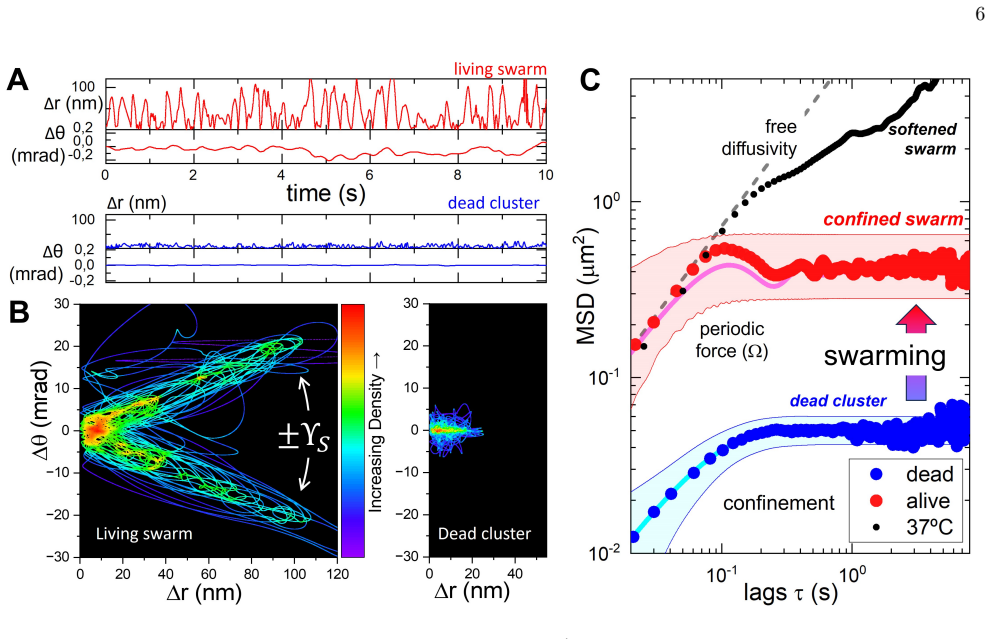
The paper's central claim is that a cluster of roughly 20 Proteus mirabilis cells held in an optical tweezer behaves as a cooperative non-equilibrium steady state. Direct Photon Momentum Method force measurements give active fluctuating forces of about 1.2–1.5 pN, an order of magnitude above the passive Brownian value of about 0.2 pN, and a coarse-grained phase-space decomposition of the force field shows that above $N_S \approx 9$–$10$ cells the dominant current changes from convergent, trap-dominated relaxation to vortical, curl-driven circulation. That switch is the paper's operational signature of broken detailed balance: flagellar swarming sustains rotational force currents that passive friction cannot produce. Integrating these forces along the cluster's center-of-mass path gives a cumulative work that grows linearly in time, $\bar W \approx R_\zeta \bar J_\Omega^2\, t$, corresponding to a measured power $P_S = (1.3 \pm 0.2)\times 10^{5}\,k_B T/\mathrm{s}$ for clusters of about 20 cells. The paper interprets the fact that this lies well below the assumed uncooperative bound $N P_1 \approx 3$ fW as evidence that swarming is cooperative and sub-additive: the group dissipates less energy than the same number of bacteria would dissipate acting alone.
Load-bearing premise
The claim that swarming is energetically cooperative assumes that uncoordinated bacteria would dissipate exactly $N$ times the single-cell power, $W_{UC}=N W_0^{(1)}$; if uncoordinated force fluctuations add in quadrature instead, the measured cluster power could fall at or below the baseline and the cooperative advantage would weaken or disappear.
Editorial extensions
If this is right
- A cluster of about 20 swarming bacteria dissipates $P_S \approx 1.3\times 10^{5}\,k_B T/\mathrm{s}$, about 40 times a passive cluster and below the assumed $N P_1$ uncooperative bound, so cooperation lowers the energetic cost of collective motility.
- Above $N_S \approx 9$–$10$ cells, the dominant force current switches from convergent to vortical, giving a measurable structural signature of the cooperative onset.
- Cumulative work grows linearly with time, $\bar W \approx R_\zeta \bar J_\Omega^2 t$, so the swarm's dissipated power can be predicted from an effective friction resistance and the vortical current, independent of trajectory details.
- Rotational work, $\bar W_R \approx \bar{\kappa} \bar J_\Omega^2 t$, appears only in living clusters, identifying the vortex as a genuine dissipative engine rather than a passive artifact.
- Entropy production is strictly positive, so a confined swarm can be treated thermodynamically as a well-defined non-equilibrium steady state.
Reading between the lines
- Because the uncoordinated baseline is assumed rather than measured, the cleanest extension is a direct comparison of dissipation for the same cells clustered versus individually trapped; if confirmed, the result would imply that energy efficiency is itself a selected property of swarming.
- The small Hill coefficient ($\alpha \approx 0.2$) suggests weak positive cooperativity in force generation; a testable consequence is that per-cell dissipation declines with $N$ toward the onset and then plateaus, a trend the paper does not report.
- The Ohmic mapping of dissipation suggests a design rule for synthetic active clusters: energy cost could be programmed by shaping the effective friction tensor (for example, with asymmetric surface textures) rather than by controlling each motor individually.
Signed reviews
Editorial analysis
A structured set of objections, weighed in public.
Referee Report
Summary. The paper reports an experimental study of the stochastic energetics of optically trapped Proteus mirabilis swarming clusters, combining Photon Momentum Method (PMM) force measurements with multiparticle tracking. The authors measure fluctuating forces and center-of-mass work, identify vortex-like force currents that break detailed balance, and propose a Navier–Stokes-inspired framework with a 'curling tensor' to model active friction. Their central quantitative claim is that swarming clusters of about N ≈ 20 cells dissipate power PS = (1.3 ± 0.2) × 10^5 k_BT/s, which is 'well below the uncooperative bound' P_UC = N P_1 ≈ 3 fW, implying cooperative sub-additive dissipation. They also report a Hill-like cooperative onset near N_S ≈ 9–10 and an Ohmic linear cumulative work relation.
Significance. If the central claim holds, the paper would provide one of the first direct energetic characterizations of collective bacterial swarming at the mesoscale, with a potentially generalizable experimental platform (PMM-OT plus multiparticle tracking) and a quantitative link between active matter thermodynamics and microbial cooperation. Strengths include direct, calibration-free force measurements via PMM; the use of coarse-grained phase-space (CGPS) analysis in the spirit of Battle et al.; dead-cell and bead controls; bootstrapped error bars; and explicit reporting of raw quantities such as power values. The conclusion of cooperative sub-additive dissipation, however, rests on an assumed baseline that is not measured, and the Ohmic and curling-tensor elements are imposed rather than independently tested.
major comments (4)
- [Results, 'Dissipated motility work: Ohmic currents' and Discussion] The central claim that swarming 'realizes optimal mesoscopic dissipation well below the uncooperative bound' depends entirely on the baseline W_UC = N W_0^(1), which is explicitly labeled 'assumed' in the text. This baseline is never measured: a dead cluster has zero active dissipation, and a single live cell gives P_1 but not N independent cells under the same confinement. If uncoordinated cells' flagellar forces partially cancel or hydrodynamic interactions reduce per-cell cost, the scaling of N independent cells need not be N P_1, and the reported factor of ~6 below the bound could shrink or disappear. The arithmetic is also inconsistent: with N ≈ 20 (the cluster size stated for P_S) and P_1 ≈ 0.3 fW, N P_1 = 6 fW, not the quoted 3 fW; using N = 10 makes the comparison inconsistent with the reported largest clusters. A directly measured independent-cells baseline is required before the sub-additivity conclusion can be supported.
- [Results, Eq. (1) and Fig. 2B] The Hill-like fit reports a Hill coefficient α = 0.21 ± 0.12, which is statistically consistent with zero (the 'cooperative amplification' is not distinguished from no N-dependence at the 2σ level). The critical cluster size N_S = 9 ± 2 is also used later (Fig. 3B) as the onset of vorticity, so the threshold is not independent of the fitting procedure. As written, the claim of a cooperative transition is not strongly supported by the reported fit parameters.
- [Results, Eqs. (10) and (11)] The Ohmic relation P_act = R_ζ J̄_Ω^2 is not tested independently: R_ζ is defined as the effective friction coefficient and J̄_Ω as the measured rotational current, so Eq. (10) is a restatement rather than a falsifiable prediction. The linear cumulative work in Eq. (11) follows from stationarity of the Stratonovich integral for a stationary force–displacement process, so the 'Ohmic' behavior is largely imposed by construction. The Dextran experiment (Suppl. Fig. S7) only checks the viscosity scaling of R_ζ; it does not test the quadratic dependence on J̄_Ω. The authors should provide a parameter-free test of P ∝ J̄_Ω^2 by varying the current (e.g., through cluster size or metabolic perturbation) and comparing the predicted versus measured power.
- [Results, 'Trapping convergence and active vorticity' and Suppl. Note N1] The 'curling tensor' κ̂ ≡ ∂ζ̂/∂t and the swarming force F_S = +κ̂ u are introduced without derivation in the main text, and the key constructs (R_ζ, Φ_S, Φ_L, κ̂) are not independently measured. The Helmholtz–Hodge / Navier–Stokes decomposition is used as the interpretive framework, but no identifiability analysis is shown to demonstrate that the decomposition into conservative and dissipative components is unique from the measured force fields. As a result, the mechanistic statements about 'lubricated curling' and the 'swarming gauge' are not currently falsifiable from the data.
minor comments (5)
- [Figure 3] The text refers to 'Fig. 3D' for the normalized cross-correlation functions, but Figure 3 contains only panels A–C; the cross-correlation appears to be in panel C.
- [Materials and Methods, 'Stochastic energetics'] The sentence 'Work was computed using discrete Itô calculus as ΔW_i = F_i ◦ Δr_i, where ◦ denotes Stratonovich multiplication' is internally contradictory; please clarify whether the discretization is Itô or Stratonovich.
- [Throughout] There are several typographical and stylistic issues, including 'bacteromotive fluxes' (Results), 'in-milieu propulsion' (Introduction), and inconsistent italicization of P. mirabilis.
- [Results, 'Cumulative trapping work: frictional gauges'] The statement 'The observed path-independence of W̄ ... confirms a steady Ohmic regime' is not supported by a quantitative test of path-independence. Please report the spread of W̄ over different integration protocols or a direct comparison of clockwise vs. counterclockwise trajectories.
- [Results, Eq. (9)] The quantities Φ_L and Φ_S are used in Eq. (9) before they are defined in the following sentence; please define them explicitly before first use.
Circularity Check
No significant circularity: the measured dissipation is a direct PMM-OT/MPT readout, and the explicitly 'assumed uncooperative bound' is a stated modeling assumption, not a hidden derivation.
full rationale
The paper's central quantities are measured rather than derived from the conclusion. The Stratonovich work integral (Eq. 5) and the Hookean proxy (Eq. 6) are definitions/consistency relations: Eq. 6 follows from dr_i <=> F_i/k, and the reported agreement between W and W_inf is an internal check, not an out-of-sample prediction. The Ohmic relations (Eqs. 10-11) define an effective resistance in terms of measured power and rotational current and fit the observed linear cumulative work; they are presented as a modeling vocabulary, not as a falsifiable prediction generated from first principles. Parameters such as N_S, alpha, omega_S, and DeltaE_act are fit to the same data they describe, but the paper does not disguise these fits as predictions. The 'assumed uncooperative bound' W_UC = N W_0^(1) is explicitly labelled as assumed near Eq. 9 and in the Discussion, so the comparison P_S < N P_1 is conditional on an unmeasured single-cell-additive baseline; this is a limitation or missing control for the sub-additivity claim, but it is not a circular reduction because the measured P_S and the assumed baseline are independent inputs. Self-citations (refs. 44, 45, 49, 50) are methodological and are not load-bearing for the energetics conclusion. No step in the derivation chain is equivalent to its own input by construction.
Assumptions & free parameters
free parameters (7)
- critical cluster size N_S =
9 +/- 2
- Hill coefficient alpha =
0.21 +/- 0.12
- saturation force <DeltaF>_max =
1.3 +/- 0.2 pN
- swarming oscillation frequency omega_S =
about 20 s^-1
- active energy scale DeltaE_act =
10 to 20 kBT
- effective internal viscosity eta =
about 50 mPa s
- effective Ohmic resistance R_zeta =
not stated as a number; from Ohmic slope
assumptions (6)
- domain assumption The optical trap is a linear harmonic spring with constant, isotropic stiffness k (16 to 20 pN/um) even for living, internally driven clusters
- domain assumption The cluster center-of-mass plus effective friction tensor zeta(t) is a sufficient coarse-grained description of the swarm
- standard math The system is in a non-equilibrium steady state and the Stratonovich work integral is thermodynamically consistent (Sekimoto framework)
- domain assumption Force fluctuations follow Maxwell statistics with variance DeltaF^2 related to Teff
- ad hoc to paper The uncoordinated bound is W_UC = N W_0^(1), i.e., independent bacteria dissipate additively
- ad hoc to paper The 'curling tensor' kappa = partial zeta/partial t exists and generates a swarming force F_S = +kappa u
invented entities (3)
-
curling tensor kappa (time derivative of the friction tensor)
-
vector potential A = F_frict x u for the dissipative force
-
swarming gauge Phi_S and lubrication gauge Phi_L
Cite this review
Pith. "Pith review of Stochastic motility energetics reveals cooperative bacterial swarming in optical tweezers." pith.science (2026). https://pith.science/paper/RZPCS5SW
@misc{pith2026250614573,
  author       = {Pith},
  title        = {Pith review of: Stochastic motility energetics reveals cooperative bacterial swarming in optical tweezers},
  year         = {2026},
  howpublished = {\url{https://pith.science/paper/RZPCS5SW}},
  note         = {Machine review of arXiv:2506.14573}
}
read the original abstract
Bacterial flagellar swarming enables dense microbial populations to migrate collectively across surfaces, often resulting in emergent, coordinated behaviors. However, probing the underlying energetics of swarming at the single cluster level remains a challenge. Here, we combine optical tweezers and multiparticle tracking within a stochastic thermodynamic framework to characterize the active motility of confined Proteus mirabilis clusters. Using the Photon Momentum Method to directly measure trapping forces, we show that swarming clusters generate persistent, dissipative flows indicative of non equilibrium stationary motility within confined solenoidal mesostructures. These flagellar rotational dynamics break detailed balance in mesoscopic force space and exceed the limits of passive friction, as evidenced by force velocity correlations and vortex like circulations. By coarse graining cluster trajectories into an active Brownian phase space, we quantify the work performed by bacterial swarms at cooperative coupling to thermal fluctuations, resulting in dissipative Ohmic like currents overcoming conservative trapping. Our findings establish a generalizable approach to quantify collective motility and energetic dissipation in active bacterial clusters, offering new insights into the physical principles governing microbial cooperativity.
Figures


Figures from the paper (2 more)

Reference graph
Works this paper leans on
-
[1]
Boltzmann, Sitzungsberichte Akademie der Wis- senschaften 66, 275 (1872)
L. Boltzmann, Sitzungsberichte Akademie der Wis- senschaften 66, 275 (1872)
-
[2]
Chandrasekhar, Reviews of modern physics 15, 1 (1943)
S. Chandrasekhar, Reviews of modern physics 15, 1 (1943)
1943
-
[3]
Q. A. Wang, Astrophysics and Space Science305, 273 (2006)
2006
-
[4]
Sekimoto, Progress of Theoretical Physics Supple- ment 130, 17 (1998)
K. Sekimoto, Progress of Theoretical Physics Supple- ment 130, 17 (1998)
work page 1998
-
[5]
Seifert, Reports on progress in physics75, 126001 (2012)
U. Seifert, Reports on progress in physics75, 126001 (2012)
2012
-
[6]
Ciliberto, Physical Review X7, 021051 (2017)
S. Ciliberto, Physical Review X7, 021051 (2017)
2017
-
[7]
L. Peliti and S. Pigolotti,Stochastic Thermodynamics: An Introduction (Princeton University Press, 2021)
work page 2021
-
[8]
C.Bechinger, R.DiLeonardo, H.Löwen, C.Reichhardt, G. Volpe, and G. Volpe, Reviews of Modern Physics88, 045006 (2016)
work page 2016
Show all 67 references
-
[9]
Battle, C
C. Battle, C. P. Broedersz, N. Fakhri, V. F. Geyer, J. Howard, C. F. Schmidt, and F. C. MacKintosh, Sci- ence 352, 604 (2016)
2016
-
[10]
D. A. Egolf, Science287, 101 (2000)
2000
-
[11]
Prigogine,Non-Equilibrium Statistical Mechanics (In- terscience, 1962)
I. Prigogine,Non-Equilibrium Statistical Mechanics (In- terscience, 1962)
1962
-
[12]
G. T. Landi and M. Paternostro, Reviews of Modern Physics 93, 035008 (2021)
2021
-
[13]
Monroy, M
I.DiTerlizzi, M.Gironella, D.Herráez-Aguilar, T.Betz, F. Monroy, M. Baiesi, and F. Ritort, Science383, 971 (2024)
2024
-
[14]
Stochastic energetics,
K. Sekimoto, “Stochastic energetics,” (2010)
2010
-
[15]
Dieball and A
C. Dieball and A. Godec, Physical Review Letters133, 067101 (2024)
2024
-
[16]
J. Li, J. M. Horowitz, T. R. Gingrich, and N. Fakhri, Nature communications10, 1666 (2019)
2019
-
[17]
Aoki, Thermochimica Acta250, 359 (1995)
I. Aoki, Thermochimica Acta250, 359 (1995)
1995
-
[18]
Martin, A
P. Martin, A. Hudspeth, and F. Jülicher, Proceedings of the National Academy of Sciences98, 14380 (2001)
2001
-
[19]
Turlier, D
H. Turlier, D. A. Fedosov, B. Audoly, T. Auth, N. S. Gov, C. Sykes, J.-F. Joanny, G. Gompper, and T. Betz, Nature physics12, 513 (2016)
2016
-
[20]
C. W. Lynn, E. J. Cornblath, L. Papadopoulos, M. A. Bertolero, and D. S. Bassett, Proceedings of the Na- tional Academy of Sciences118, e2109889118 (2021)
2021
-
[21]
E.M.Purcell,AmericanJournalofPhysics 45,3(1977)
1977
-
[22]
Lucia, Theoretical Biology and Medical Modelling 12, 1 (2015)
U. Lucia, Theoretical Biology and Medical Modelling 12, 1 (2015)
2015
-
[23]
N. S. Goel and N. Richter-Dyn, Stochastic models in biology (Elsevier, 2016)
2016
-
[24]
M. E. Cates and J. Tailleur, Annu. Rev. Condens. Mat- ter Phys.6, 219 (2015)
2015
-
[25]
A. E. Patteson, A. Gopinath, and P. E. Arratia, Nature communications 9, 5373 (2018)
2018
-
[26]
D.J.SkinnerandJ.Dunkel,ProceedingsoftheNational Academy of Sciences of the United States of America 118, e2024300118 (2021)
2021
-
[27]
Y. Deng, D. R. Beahm, S. Ionov, and R. Sarpeshkar, BMC biology19, 101 (2021)
2021
-
[28]
P. E. Schavemaker and M. Lynch, elife 11, e77266 (2022)
2022
-
[29]
J. P. Armitage and R. M. Berry, Annual review of mi- crobiology 74, 181 (2020)
2020
-
[30]
M. D. Manson, P. Tedesco, H. C. Berg, F. M. Harold, and C. Van der Drift, Proceedings of the National Academy of Sciences74, 3060 (1977)
1977
-
[31]
S. E. Tusk, N. J. Delalez, and R. M. Berry, Journal of molecular biology430, 4557 (2018)
2018
-
[32]
Gottschalk, Regulation of bacterial metabolism (Springer, 1986)
G. Gottschalk, Regulation of bacterial metabolism (Springer, 1986)
1986
-
[33]
Lauga, Annual Review of Fluid Mechanics48, 105 (2016)
E. Lauga, Annual Review of Fluid Mechanics48, 105 (2016)
2016
-
[34]
J. A. Nirody, Y.-R. Sun, and C.-J. Lo, Advances in Physics: X2, 324 (2017)
2017
-
[35]
Kitao and H
A. Kitao and H. Hata, Biophysical reviews 10, 617 (2018)
2018
-
[36]
D. L. Koch and G. Subramanian, Annual Review of Fluid Mechanics43, 637 (2011)
2011
-
[37]
Elgeti, R
J. Elgeti, R. G. Winkler, and G. Gompper, Reports on progress in physics78, 056601 (2015)
2015
-
[38]
Jones, M
C. Jones, M. Gomez, R. M. Muoio, A. Vidal, R. A. Mcknight, N.D.Brubaker, andW.W.Ahmed,Physical Review E103, 032403 (2021)
2021
-
[39]
C. J. Bustamante, Y. R. Chemla, S. Liu, and M. D. Wang, Nature Reviews Methods Primers1, 25 (2021)
2021
-
[40]
Farré and M
A. Farré and M. Montes-Usategui, Optics express18, 11955 (2010)
2010
-
[41]
Farré, F
A. Farré, F. Marsà, and M. Montes-Usategui,Optical Tweezers: Methods and Protocols , edited by A. Gen- nerich (Springer New York, New York, NY, 2017) pp. 41–76
2017
-
[42]
Polin, I
M. Polin, I. Tuval, K. Drescher, J. P. Gollub, and R. E. Goldstein, Science325, 487 (2009)
2009
-
[43]
Tailleur and M
J. Tailleur and M. E. Cates, Physical review letters100, 218103 (2008)
2008
-
[44]
Mell and F
M. Mell and F. Monroy, PloS one13, e0207376 (2018)
2018
-
[45]
Salinas-Almaguer, M
S. Salinas-Almaguer, M. Mell, V. G. Almendro-Vedia, M. Calero, K. C. M. Robledo-Sánchez, C. Ruiz-Suarez, 13 T. Alarcón, R. A. Barrio, A. Hernández-Machado, and F. Monroy, Scientific reports12, 933 (2022)
2022
-
[46]
Shinkai and Y
S. Shinkai and Y. Togashi, EPL (Europhysics Letters) 105, 30002 (2014)
2014
-
[47]
Zhang, T
Z. Zhang, T. E. Kimkes, and M. Heinemann, Scientific reports 9, 19086 (2019)
2019
-
[48]
G. Soni, B. J. Ali, Y. Hatwalne, and G. Shivashankar, Biophysical journal84, 2634 (2003)
2003
-
[49]
Rodríguez-García, I
R. Rodríguez-García, I. López-Montero, M. Mell, G. Egea, N. S. Gov, and F. Monroy, Biophysical journal 108, 2794 (2015)
2015
-
[50]
Herráez-Aguilar, E
D. Herráez-Aguilar, E. Madrazo, H. López-Menéndez, M. Ramírez, F. Monroy, and J. Redondo-Muñoz, Sci- entific reports10, 6707 (2020)
2020
-
[51]
Speck, Europhysics Letters114, 30006 (2016)
T. Speck, Europhysics Letters114, 30006 (2016)
2016
-
[52]
Mandal, K
D. Mandal, K. Klymko, and M. R. DeWeese, Physical review letters119, 258001 (2017)
2017
-
[53]
C. E. Armbruster, H. L. Mobley, and M. M. Pearson, EcoSal Plus8, 10 (2018)
2018
-
[54]
Douglas, Journal of Medical Microbiology12, 195 (1979)
C. Douglas, Journal of Medical Microbiology12, 195 (1979)
1979
-
[55]
Matsuyama, Y
T. Matsuyama, Y. Takagi, Y. Nakagawa, H. Itoh, J. Wakita, and M. Matsushita, Journal of Bacteriol- ogy 182, 385 (2000)
2000
-
[56]
Chen, Y.-H
C.-Y. Chen, Y.-H. Chen, P.-L. Lu, W.-R. Lin, T.-C. Chen, and C.-Y. Lin, Journal of Microbiology, Im- munology and Infection45, 228 (2012)
2012
-
[57]
C. E. Armbruster and H. L. Mobley, Nature Reviews Microbiology 10, 743 (2012)
2012
-
[58]
J. F. Hoeniger, Microbiology40, 29 (1965)
1965
-
[59]
Methods for studying swarming and swimming motility,
M. M. Pearson, “Methods for studying swarming and swimming motility,” inProteus mirabilis: Methods and Protocols, edited by M. M. Pearson (Springer, NY,
-
[60]
H. H. Tuson, M. F. Copeland, S. Carey, R. Sacotte, and D. B. Weibel, Journal of bacteriology195, 368 (2013)
2013
-
[61]
C. W. Gardineret al., Handbook of stochastic methods , Vol. 3 (springer Berlin, 1985)
1985
-
[62]
Ashkin and J
A. Ashkin and J. M. Dziedzic, Science235, 1517 (1987)
1987
-
[63]
M. E. Cates, in Active Matter and Nonequilibrium Statistical Physics: Les Houches Summer School: Volume 112, 2018 (Oxford University Press, 2022) https://academic.oup.com/book/0/chapter/385616349/chapter- pdf/50136465/oso-9780192858313-chapter-6.pdf
2018
-
[64]
G. E. Piñas, V. Frank, A. Vaknin, and J. S. Parkinson, Proceedings of the National Academy of Sciences113, 3335 (2016)
2016
-
[65]
L. D. Landau and E. M. Lifshitz,Fluid Mechanics: Vol- ume 6, Vol. 6 (Elsevier, 1987)
1987
-
[66]
K. C. Leptos, M. Chioccioli, S. Furlan, A. I. Pesci, and R. E. Goldstein, Physical Review E107, 014404 (2023)
2023
-
[67]
Dautray and J.-L
R. Dautray and J.-L. Lions, Spectral Theory and Ap- plications, Mathematical Analysis and Numerical Meth- ods for Science and Technology, Vol. 3 (Springer-Verlag, 1990)
1990
Reviewed August 15, 2026 · model on record in the stance chip above.
Discussion (0). Continue with ORCID to comment.