REVIEW 5 minor 84 references
BEBOP VII. SOPHIE discovery of BEBOP-3b, a circumbinary giant planet on an eccentric orbit
T0 review · 0 major / 5 minor · reviewed 2026-08-15 · deepseek-v4-flash
Pith's one-line read The 547-day radial-velocity wobble of the binary BEBOP-3 is caused by a circumbinary giant planet of about half a Jupiter mass, making this the first radial-velocity detection of a previously unknown circumbinary system.
desk verdict BEBOP-3b is a convincing, well-documented RV discovery of a circumbinary giant planet; the main weakness is the usual activity-null-model caveat, not the detection itself. read the letter →
The pith
A machine-rendered reading of the paper's core claim, the machinery that carries it, and where it could break.
The reading
What carries the argument
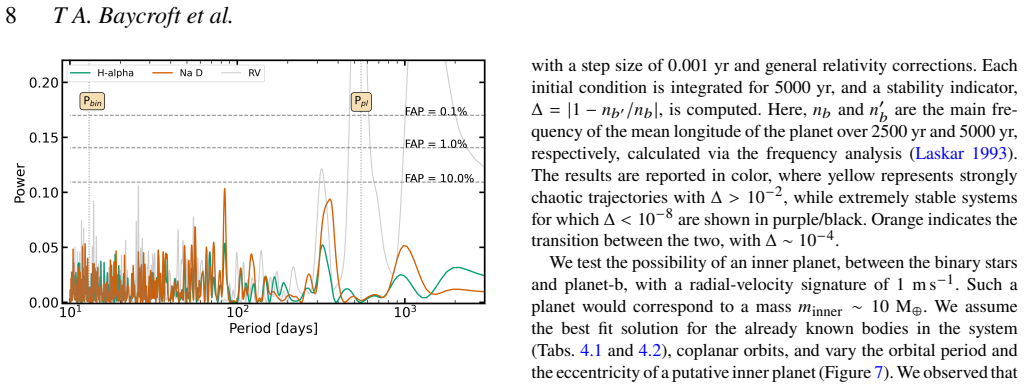
The central mechanism is Doppler reflex motion: the planet pulls the binary's center of mass, producing an 11.8 m/s sinusoidal variation in the radial velocities of the primary star. The detection rests on the BINARIES model in the kima nested-sampling code, which fits the binary's Keplerian orbit (including apsidal precession and general relativity) and simultaneously treats the number of additional Keplerian signals as a free parameter, reporting Bayes factors between models. The False Inclusion Probability periodogram and the activity indices H$\alpha$ and Na D serve as the filters that separate a planetary signal from stellar noise. High-resolution cross-correlation spectroscopy supplies the secondary's velocity semi-amplitude, converting the single-lined binary into an effectively double-lined one to give model-independent masses.
What would settle it
If a stellar activity tracer with a period near 547 days is found in the same spectra—e.g. in the Ca II H&K S-index, line bisectors, or the CCF full-width-at-half-maximum—the planetary interpretation fails. Alternatively, if a further three to five years of radial velocities do not preserve a coherent Keplerian phase at 547 days, with the period locked to better than a few days, the signal is not a planet.
Extended reading notes
Core claim
From 141 high-resolution spectra obtained over six years, the authors model the binary orbit and search the residuals for additional Keplerian signals with a nested-sampling algorithm that lets the number of planets float. The evidence for one planet over none is overwhelming (Bayes factor $3.4 \times 10^{13}$), with a signal at $P = 547^{+6.2}_{-7.6}$ days, semi-amplitude $K = 11.8 \pm 1.1$ m/s, eccentricity $e = 0.247^{+0.077}_{-0.089}$, and a mass of $0.558^{+0.051}_{-0.048}\ M_{\rm Jup}$ if the orbit is coplanar with the binary. Because the chromospheric activity indices H$\alpha$ and Na D show no significant periodicity near 547 days, they interpret the wobble as planetary. A second signal near 1400 days is reported only as a candidate. By applying high-resolution cross-correlation spectroscopy to the same spectra, they recover the secondary star's absorption at $5.5\sigma$, obtaining dynamical masses of $1.083 \pm 0.026\ M_\odot$ and $0.2615 \pm 0.0039\ M_\odot$ for the primary and secondary. Stability integrations show stable orbits exist for a hypothetical inner planet near the boundary where the Kepler circumbinary planets are found.
Load-bearing premise
The planet interpretation assumes that the 547-day wobble is not produced by a stellar activity signal that leaves no detectable periodicity in the H-alpha and Na D indices, which are the only activity tracers precise enough to use.
Editorial extensions
If this is right
- BEBOP-3b becomes the first previously unknown circumbinary system found by radial velocities, showing that the method can discover planets in configurations transits would miss: long-period and eccentric.
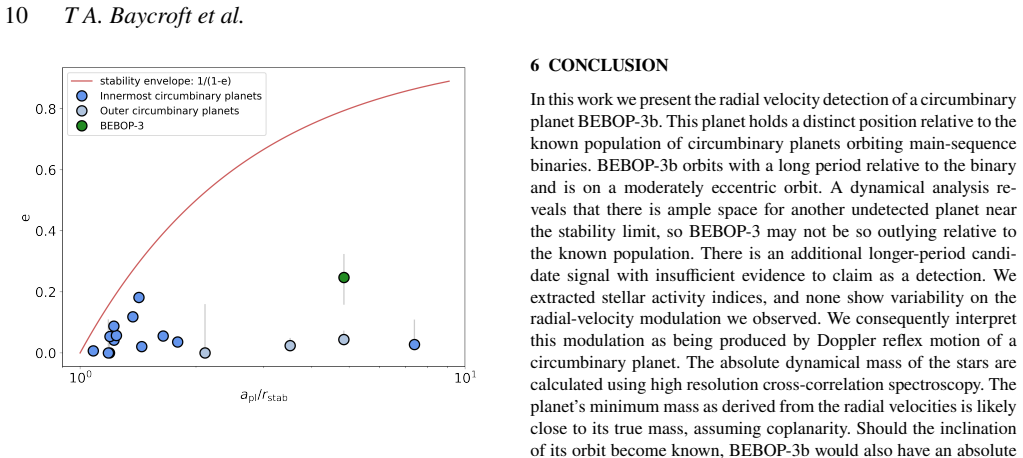
- The system's scaled semi-major axis $a_{\rm sc} \approx 4.85$ places it far beyond the pile-up region occupied by almost all other circumbinary planets, joining Kepler-1647 as an outlier that formation and migration models will need to reproduce.
- The stability analysis implies that an inner planet of roughly ten Earth masses near the stability limit would be stable and would have escaped detection in the present data, so the apparent absence of such planets in RV surveys may be a sensitivity limit rather than a real scarcity.
- The HRCCS result demonstrates that dynamical masses for both binary components can be extracted from a ground-based échelle spectrograph with 141 spectra, independent of stellar models.
- If the ~1400-day candidate signal is confirmed with further data, BEBOP-3 would contain a second, lower-mass planet ($M \sin i \approx 0.2\ M_{\rm Jup}$), making it a multi-planet circumbinary system with widely separated orbits.
Reading between the lines
- If wide-orbit eccentric circumbinary giants like BEBOP-3b are common, the apparent pile-up near the stability limit is likely inflated by the transit method's bias toward short periods; RV surveys with long baselines should be able to test this by measuring the orbital-separation distribution of a larger sample.
- The 11.8 m/s amplitude is only about twice the 6.7 m/s jitter, so the signal would be vulnerable to a slowly varying stellar activity cycle; computing line-bisector or full CCF shape indicators from the same spectra would provide an immediate, low-cost check.
- The period ratio between the 1400-day candidate and BEBOP-3b is close to 5:2; if confirmed, resonant dynamics would link this system to the period-ratio structure seen among giant planets around single stars, and would favor migration rather than in-situ formation.
- Eccentric circumbinary orbits beyond the stability limit are a natural outcome if the planet was scattered by a companion or if the circumbinary disc was eccentric; comparing the eccentricity--$a_{\rm sc}$ distribution across all known circumbinary planets could distinguish these pathways.
Signed reviews
Editorial analysis
A structured set of objections, weighed in public.
Referee Report
Summary. The manuscript reports the discovery of BEBOP-3b, a circumbinary giant planet detected with SOPHIE radial velocities. Using 141 spectra spanning 2197 days, the authors fit the binary orbit and planetary signals with the trans-dimensional Bayesian tool kima, finding strong evidence for a 547-day Keplerian signal with K = 11.8 m/s, a planet mass of 0.558 M_Jup, and a moderately eccentric orbit (e = 0.247). They validate the signal against stellar activity using H-alpha and Na D indices, present a marginal 1400-day outer candidate, perform stability simulations for putative inner planets, derive dynamical stellar masses via HRCCS, and compare those with a joint photometric and RV analysis.
Significance. If correct, this is the first radial-velocity detection of a previously unknown circumbinary system and the first RV-discovered circumbinary planet with a significant eccentricity. The paper also strengthens the empirical population of circumbinary planets by adding a long-period, moderately eccentric member outside the usual "pile-up" region. The analysis is thorough: the RV dataset is large and homogeneous, the detection is supported by both a Bayes factor and a FIP periodogram, the HRCCS mass measurement is an independent cross-check, and the stability maps address whether the system is dynamically plausible. The authors are appropriately cautious about the eccentricity and the outer candidate. The main limitation, that the RV null model does not include a correlated-activity component, is real but is mitigated by the lack of significant activity-index periodicity near the planet period and is acknowledged in the text; it does not undermine the central detection claim.
minor comments (5)
- [Table A4] The BEBOP-3 b row lists the secondary stellar mass as 0.3615(39) M_sun, which is inconsistent with Table 1 and Table 2, where M_sec = 0.2615 +/- 0.0039 M_sun. One of these values is a typo and should be corrected.
- [Table A3] The marginalised time of periastron is reported as T_peri = 59633(+45,-62) BJD, which is inconsistent with Table 3, where T_peri = 9633(+31,-36) BJD. Please verify and correct this entry.
- [Section 4.3] The text states that "the highest activity signal is found at ~1000 days," but Section 4.4 identifies only a 55.57-day H-alpha peak and an 84.07-day Na D peak, with no 1000-day periodicity described. This apparent contradiction should be resolved, as it bears on the discussion of the candidate outer signal.
- [Section 4.4] The activity validation would be more quantitative if the authors estimated what amplitude of a 550-day RV signal could be produced by stellar activity given the measured H-alpha and Na D variations. As written, the conclusion that the signal is "unlikely" to be activity is reasonable, but an explicit upper limit would strengthen the planetary interpretation.
- [Abstract / Section 5.2] The abstract states an eccentricity of 0.25 without qualification, while Section 5.2 calls the eccentricity detection "marginal." The abstract should reflect this uncertainty, for example by giving the uncertainty or using language such as "moderately eccentric."
Circularity Check
No significant circularity: the radial-velocity detection is the measurement itself, and the activity check, HRCCS masses, and stability maps are independent or self-contained.
full rationale
The derivation chain is self-contained. The planet's orbital and physical parameters (P=547 d, K=11.8 m/s, e=0.247, M=0.558 MJup) are obtained by fitting Keplerian signals to the SOPHIE radial velocities in the kima trans-dimensional analysis (Sections 3.4 and 4.2); this is the measurement itself, not a prediction from a fitted input. The planetary interpretation is checked against H-alpha and Na D activity indicator periodograms (Section 4.4), which are independent spectral diagnostics and show no significant 550-day power; this evidence is weak but not circular. The stellar masses used to convert K to M_pl come either from HRCCS (Section 3.2), an independent cross-correlation analysis of the secondary, or from the joint RV+photometry fit; neither is derived from the planet signal. Stability maps (Section 5.1) are forward integrations that do not assume the conclusion. The candidate 1400-day signal is explicitly not claimed as a detection. Self-citations to kima (Faria et al. 2018; Baycroft et al. 2023a), FIP (Hara et al. 2022, 2024), and HRCCS (Sebastian et al. 2024b, 2025) are to published, code-released methods with independent validation; none is an unverified assertion that forces the detection. No equation or parameter is defined in terms of the target result, and no fitted quantity is renamed as a prediction.
Assumptions & free parameters
free parameters (2)
- Radial velocity jitter =
6.73 (+1.08, -0.93) m/s
- Student's t shape parameter nu =
7.9 (+29.0, -3.6)
assumptions (4)
- domain assumption H-alpha and Na D indices, despite lacking significant periodicity, are sufficient to rule out stellar activity as the source of the 547-day RV signal.
- domain assumption The planet's quoted true mass assumes exact coplanarity with the binary orbit at i = 88.7488 degrees.
- domain assumption The Kipping (2013) eccentricity prior is appropriate for the circumbinary planet.
- domain assumption The HRCCS K2 measurement of 80.22 km/s is unaffected by SVD detrending and line-mask choice.
Cite this review
Pith. "Pith review of BEBOP VII. SOPHIE discovery of BEBOP-3b, a circumbinary giant planet on an eccentric orbit." pith.science (2026). https://pith.science/paper/OHNUS475
@misc{pith2026250614615,
  author       = {Pith},
  title        = {Pith review of: BEBOP VII. SOPHIE discovery of BEBOP-3b, a circumbinary giant planet on an eccentric orbit},
  year         = {2026},
  howpublished = {\url{https://pith.science/paper/OHNUS475}},
  note         = {Machine review of arXiv:2506.14615}
}
abstract
Planetary systems orbiting close binaries are valuable testing grounds for planet formation and migration models. More detections with good mass measurements are needed. We present a new planet discovered during the BEBOP survey for circumbinary exoplanets using radial velocities. We use data taken with the SOPHIE spectrograph at the Observatoire de Haute-Provence, and perform a spectroscopic analysis to obtain high precision radial velocities. This planet is the first radial velocity detection of a previously unknown circumbinary system. The planet has a mass of $0.56$ $M_{Jup}$ and orbits its host binary in 550 days with an eccentricity of 0.25. Compared to most of the previously known circumbinary planets, BEBOP-3b has a long period (relative to the binary) and a high eccentricity. There also is a candidate outer planet with a $\sim1400$ day orbital period. We test the stability of potential further candidate signals inside the orbit of BEBOP-3b, and demonstrate that there are stable orbital solutions for planets near the instability region which is where the Kepler circumbinary planets are located. We also use our data to obtain independent dynamical masses for the two stellar components of the eclipsing binary using High Resolution Cross-Correlation Spectroscopy (HRCCS), and compare those results to a more traditional approach, finding them compatible with one another.
Figures


Figures from the paper (6 more)




Reference graph
Works this paper leans on
-
[1]
E., 2010, @doi [The Astrophysical Journal] 10.1088/0004-637X/709/1/168 , 709, 168
Anglada-Escudé G., López-Morales M., Chambers J. E., 2010, @doi [The Astrophysical Journal] 10.1088/0004-637X/709/1/168 , 709, 168
-
[2]
Baranne A., et al., 1996, Astronomy and Astrophysics Supplement, v.119, p.373-390, 119, 373
1996
-
[3]
Baycroft T. A., Triaud A. H. M. J., Faria J., Correia A. C. M., Standing M. R., 2023a, @doi [Monthly Notices of the Royal Astronomical Society] 10.1093/mnras/stad607 , 521, 1871
-
[4]
Baycroft T. A., Triaud A. H. M. J., Kervella P., 2023b, @doi [Monthly Notices of the Royal Astronomical Society] 10.1093/mnras/stad2794 , 526, 2241
-
[5]
Benedict G. F., Harrison T. E., 2017, @doi [The Astronomical Journal] 10.3847/1538-3881/aa6d59 , 153, 258
-
[6]
P., et al., 2016, @doi [The Astronomical Journal] 10.3847/0004-6256/152/5/125 , 152, 125
Bennett D. P., et al., 2016, @doi [The Astronomical Journal] 10.3847/0004-6256/152/5/125 , 152, 125
-
[7]
Blanco-Cuaresma S., 2019, @doi [Monthly Notices of the Royal Astronomical Society] 10.1093/mnras/stz549 , 486, 2075
- [8]
Show all 84 references
-
[9]
Bouchy F., et al., 2009b, @doi [Astronomy and Astrophysics] 10.1051/0004-6361/200912427 , 505, 853
-
[10]
J., Foreman-Mackey D., 2018, @doi [Journal of Statistical Software] 10.18637/jss.v086.i07 , 86, 1
Brewer B. J., Foreman-Mackey D., 2018, @doi [Journal of Statistical Software] 10.18637/jss.v086.i07 , 86, 1
2018 doi
-
[11]
Coleman G. A. L., Nelson R. P., Triaud A. H. M. J., 2023, @doi [Monthly Notices of the Royal Astronomical Society] 10.1093/mnras/stad833 , 522, 4352
2023 doi
-
[12]
Coleman G. A. L., Nelson R. P., Triaud A. H. M. J., Standing M. R., 2024, @doi [Monthly Notices of the Royal Astronomical Society] 10.1093/mnras/stad3216 , 527, 414
2024 doi
-
[13]
A., et al., 2018, @doi [The Astronomical Journal] 10.3847/1538-3881/aae582 , 156, 234
Collins K. A., et al., 2018, @doi [The Astronomical Journal] 10.3847/1538-3881/aae582 , 156, 234
2018 doi
-
[14]
Correia A. C. M., Udry S., Mayor M., Laskar J., Naef D., Pepe F., Queloz D., Santos N. C., 2005, @doi [Astronomy and Astrophysics] 10.1051/0004-6361:20042376 , 440, 751
2005 doi
-
[15]
Correia A. C. M., Boué G., Laskar J., 2016, @doi [Celestial Mechanics and Dynamical Astronomy] 10.1007/s10569-016-9709-9 , 126, 189
2016 doi
-
[16]
Courcol B., et al., 2015, @doi [Astronomy and Astrophysics] 10.1051/0004-6361/201526329 , 581, A38
2015 doi
-
[17]
T., et al., 2024, @doi [Monthly Notices of the Royal Astronomical Society] 10.1093/mnras/stae842 , 530, 2565
Davis Y. T., et al., 2024, @doi [Monthly Notices of the Royal Astronomical Society] 10.1093/mnras/stae842 , 530, 2565
2024 doi
-
[18]
M., 2011, @doi [Monthly Notices of the Royal Astronomical Society] 10.1111/j.1365-2966.2011.19657.x , 418, 2656
Doolin S., Blundell K. M., 2011, @doi [Monthly Notices of the Royal Astronomical Society] 10.1111/j.1365-2966.2011.19657.x , 418, 2656
2011
-
[19]
R., et al., 2011, @doi [Science] 10.1126/science.1210923 , 333, 1602
Doyle L. R., et al., 2011, @doi [Science] 10.1126/science.1210923 , 333, 1602
2011 doi
-
[20]
P., Santos N
Faria J. P., Santos N. C., Figueira P., Brewer B. J., 2018, @doi [The Journal of Open Source Software] 10.21105/joss.00487 , 3, 487
2018 doi
-
[21]
V., et al., 2024, @doi [Monthly Notices of the Royal Astronomical Society] 10.1093/mnras/stae1405 , 531, 4085
Freckelton A. V., et al., 2024, @doi [Monthly Notices of the Royal Astronomical Society] 10.1093/mnras/stae1405 , 531, 4085
2024 doi
-
[22]
V., Albrecht S., Deeg H
Goldberg M., Fabrycky D., Martin D. V., Albrecht S., Deeg H. J., Nowak G., 2023, @doi [Monthly Notices of the Royal Astronomical Society] 10.1093/mnras/stad2568 , 525, 4628
2023 doi
-
[23]
O., Corbally C
Gray R. O., Corbally C. J., 1994, @doi [The Astronomical Journal] 10.1086/116893 , 107, 742
1994 doi
-
[24]
N., Daylan T., 2019, Astrophysics Source Code Library, p
Günther M. N., Daylan T., 2019, Astrophysics Source Code Library, p. ascl:1903.003
2019
-
[25]
N., Daylan T., 2021, @doi [The Astrophysical Journal Supplement Series] 10.3847/1538-4365/abe70e , 254, 13
Günther M. N., Daylan T., 2021, @doi [The Astrophysical Journal Supplement Series] 10.3847/1538-4365/abe70e , 254, 13
2021 doi
-
[26]
C., Boué G., Laskar J., Delisle J.-B., Unger N., 2019, @doi [Monthly Notices of the Royal Astronomical Society, Volume 489, Issue 1, p.738-762] 10.1093/mnras/stz1849 , 489, 738
Hara N. C., Boué G., Laskar J., Delisle J.-B., Unger N., 2019, @doi [Monthly Notices of the Royal Astronomical Society, Volume 489, Issue 1, p.738-762] 10.1093/mnras/stz1849 , 489, 738
2019 doi
-
[27]
C., Unger N., Delisle J.-B., Díaz R
Hara N. C., Unger N., Delisle J.-B., Díaz R. F., Ségransan D., 2022, @doi [Astronomy and Astrophysics] 10.1051/0004-6361/202140543 , 663, A14
2022 doi
-
[28]
C., de Poyferré T., Delisle J.-B., Hoffmann M., 2024, @doi [Annals of Applied Statistics] 10.1214/23-AOAS1810 , 18, 749
Hara N. C., de Poyferré T., Delisle J.-B., Hoffmann M., 2024, @doi [Annals of Applied Statistics] 10.1214/23-AOAS1810 , 18, 749
2024 doi
-
[29]
Heidari N., 2022, PhD Thesis , Universit 'e C ote d'Azur; Shahid Beheshti University (Tehran)
2022
-
[30]
Heidari N., et al., 2024, @doi [Astronomy and Astrophysics] 10.1051/0004-6361/202347897 , 681, A55
2024 doi
-
[31]
J., Wiegert P
Holman M. J., Wiegert P. A., 1999, @doi [The Astronomical Journal] 10.1086/300695 , 117, 621
1999 doi
-
[32]
M., et al., 2016, @doi [Proceedings of the SPIE] 10.1117/12.2233418 , 9913, 99133E
Jenkins J. M., et al., 2016, @doi [Proceedings of the SPIE] 10.1117/12.2233418 , 9913, 99133E
2016 doi
-
[33]
Kalman D., 1996, @doi [The College Mathematics Journal] 10.1080/07468342.1996.11973744 , 27, 2
1996
-
[34]
M., 2013, @doi [Monthly Notices of the Royal Astronomical Society] 10.1093/mnrasl/slt075 , 434, L51
Kipping D. M., 2013, @doi [Monthly Notices of the Royal Astronomical Society] 10.1093/mnrasl/slt075 , 434, L51
2013 doi
-
[35]
B., et al., 2016, @doi [The Astrophysical Journal] 10.3847/0004-637X/827/1/86 , 827, 86
Kostov V. B., et al., 2016, @doi [The Astrophysical Journal] 10.3847/0004-637X/827/1/86 , 827, 86
2016 doi
-
[36]
B., et al., 2020, @doi [The Astronomical Journal] 10.3847/1538-3881/ab8a48 , 159, 253
Kostov V. B., et al., 2020, @doi [The Astronomical Journal] 10.3847/1538-3881/ab8a48 , 159, 253
2020 doi
-
[37]
B., et al., 2021, @doi [The Astronomical Journal] 10.3847/1538-3881/ac223a , 162, 234
Kostov V. B., et al., 2021, @doi [The Astronomical Journal] 10.3847/1538-3881/ac223a , 162, 234
2021 doi
-
[38]
L., 2005, Memorie della Societa Astronomica Italiana Supplementi, 8, 14
Kurucz R. L., 2005, Memorie della Societa Astronomica Italiana Supplementi, 8, 14
2005
-
[39]
Laskar J., 1990, @doi [Icarus] 10.1016/0019-1035(90)90084-M , 88, 266
1990 doi
-
[40]
Laskar J., 1993, @doi [Physica D Nonlinear Phenomena] 10.1016/0167-2789(93)90210-R , 67, 257
1993 doi
-
[41]
Laskar J., Robutel P., 2001, @doi [Celestial Mechanics and Dynamical Astronomy] 10.1023/A:1012098603882 , 80, 39
2001 doi
-
[42]
J., Tao M., 2016, @doi [The Astrophysical Journal] 10.3847/0004-637X/831/1/96 , 831, 96
Li G., Holman M. J., Tao M., 2016, @doi [The Astrophysical Journal] 10.3847/0004-637X/831/1/96 , 831, 96
2016 doi
-
[43]
ascl:1812.013
Lightkurve Collaboration et al., 2018, Astrophysics Source Code Library, p. ascl:1812.013
2018
-
[44]
V., 2017, @doi [Monthly Notices of the Royal Astronomical Society] 10.1093/mnras/stw2851 , 465, 3235
Martin D. V., 2017, @doi [Monthly Notices of the Royal Astronomical Society] 10.1093/mnras/stw2851 , 465, 3235
2017 doi
-
[45]
V., Triaud A
Martin D. V., Triaud A. H. M. J., 2014, @doi [Astronomy & Astrophysics] 10.1051/0004-6361/201323112 , 570, A91
2014 doi
-
[46]
V., Triaud A
Martin D. V., Triaud A. H. M. J., 2015, @doi [Monthly Notices of the Royal Astronomical Society] 10.1093/mnras/stv121 , 449, 781
2015 doi
-
[47]
V., Mazeh T., Fabrycky D
Martin D. V., Mazeh T., Fabrycky D. C., 2015, @doi [Monthly Notices of the Royal Astronomical Society] 10.1093/mnras/stv1870 , 453, 3554
2015 doi
-
[48]
V., et al., 2019, @doi [Astronomy and Astrophysics] 10.1051/0004-6361/201833669 , 624, A68
Martin D. V., et al., 2019, @doi [Astronomy and Astrophysics] 10.1051/0004-6361/201833669 , 624, A68
2019 doi
-
[49]
Maxted P. F. L., 2016, @doi [Astronomy and Astrophysics] 10.1051/0004-6361/201628579 , 591, A111
2016 doi
-
[50]
Maxted P. F. L., Triaud A. H. M. J., Martin D. V., 2023, @doi [Universe] 10.3390/universe9120498 , 9, 498
2023 doi
-
[51]
Meschiari S., 2012, @doi [The Astrophysical Journal] 10.1088/2041-8205/761/1/L7 , 761, L7
2012 doi
-
[52]
Moriwaki K., Nakagawa Y., 2004, @doi [The Astrophysical Journal] 10.1086/421342 , 609, 1065
2004 doi
-
[53]
J., Lai D., 2015, @doi [Proceedings of the National Academy of Science] 10.1073/pnas.1505671112 , 112, 9264
Muñoz D. J., Lai D., 2015, @doi [Proceedings of the National Academy of Science] 10.1073/pnas.1505671112 , 112, 9264
2015 doi
-
[54]
A., et al., 2012, @doi [Science] 10.1126/science.1228380 , 337, 1511
Orosz J. A., et al., 2012, @doi [Science] 10.1126/science.1228380 , 337, 1511
2012 doi
-
[55]
A., et al., 2019, @doi [The Astronomical Journal] 10.3847/1538-3881/ab0ca0 , 157, 174
Orosz J. A., et al., 2019, @doi [The Astronomical Journal] 10.3847/1538-3881/ab0ca0 , 157, 174
2019 doi
-
[56]
M., Thébault P., Baruteau C., 2012, @doi [The Astrophysical Journal] 10.1088/2041-8205/754/1/L16 , 754, L16
Paardekooper S.-J., Leinhardt Z. M., Thébault P., Baruteau C., 2012, @doi [The Astrophysical Journal] 10.1088/2041-8205/754/1/L16 , 754, L16
2012 doi
-
[57]
Penzlin A. B. T., Kley W., Nelson R. P., 2021, @doi [Astronomy and Astrophysics] 10.1051/0004-6361/202039319 , 645, A68
2021 doi
-
[58]
C., Udry S., Burnet M., 2002, @doi [Astronomy and Astrophysics] 10.1051/0004-6361:20020433 , 388, 632
Pepe F., Mayor M., Galland F., Naef D., Queloz D., Santos N. C., Udry S., Burnet M., 2002, @doi [Astronomy and Astrophysics] 10.1051/0004-6361:20020433 , 388, 632
2002 doi
-
[59]
Pepper J., et al., 2007, @doi [Publications of the Astronomical Society of the Pacific] 10.1086/521836 , 119, 923
2007 doi
-
[60]
Perruchot S., et al., 2008, @doi [Proceedings of the SPIE] 10.1117/12.787379 , 7014, 70140J
2008 doi
-
[61]
P., 2008, @doi [Astronomy and Astrophysics] 10.1051/0004-6361:200809453 , 483, 633
Pierens A., Nelson R. P., 2008, @doi [Astronomy and Astrophysics] 10.1051/0004-6361:200809453 , 483, 633
2008 doi
-
[62]
P., McNally C
Pierens A., Nelson R. P., McNally C. P., 2021, @doi [Monthly Notices of the Royal Astronomical Society] 10.1093/mnras/stab2853 , 508, 4806
2021 doi
-
[63]
L., et al., 2006, @doi [Publications of the Astronomical Society of the Pacific] 10.1086/508556 , 118, 1407
Pollacco D. L., et al., 2006, @doi [Publications of the Astronomical Society of the Pacific] 10.1086/508556 , 118, 1407
2006 doi
-
[64]
Pollacco D., et al., 2008, @doi [Monthly Notices of the Royal Astronomical Society] 10.1111/j.1365-2966.2008.12939.x , 385, 1576
2008
-
[65]
B., et al., 2011, @doi [Monthly Notices of the Royal Astronomical Society] 10.1111/j.1745-3933.2011.01045.x , 414, L16
Qian S. B., et al., 2011, @doi [Monthly Notices of the Royal Astronomical Society] 10.1111/j.1745-3933.2011.01045.x , 414, L16
2011
-
[66]
R., et al., 2015, @doi [Journal of Astronomical Telescopes, Instruments, and Systems] 10.1117/1.JATIS.1.1.014003 , 1, 014003
Ricker G. R., et al., 2015, @doi [Journal of Astronomical Telescopes, Instruments, and Systems] 10.1117/1.JATIS.1.1.014003 , 1, 014003
2015 doi
-
[67]
Roy O., Vetterli M., 2007, 15th European Signal Processing Conference, pp 606--610
2007
-
[68]
Sairam L., et al., 2024, @doi [Monthly Notices of the Royal Astronomical Society] 10.1093/mnras/stad3136 , 527, 2261
2024 doi
- [69]
-
[70]
Sebastian D., Triaud A. H. M. J., Brogi M., 2024a, @doi [Monthly Notices of the Royal Astronomical Society] 10.1093/mnras/stad3765 , 527, 10921
-
[71]
Sebastian D., et al., 2024b, @doi [Monthly Notices of the Royal Astronomical Society] 10.1093/mnras/stae459 , 530, 2572
-
[72]
Sebastian D., et al., 2025, @doi [Monthly Notices of the Royal Astronomical Society] 10.1093/mnras/staf863 , 540, 2914
2025 doi
-
[73]
Snellen I. A. G., de Kok R. J., de Mooij E. J. W., Albrecht S., 2010, @doi [Nature] 10.1038/nature09111 , 465, 1049
2010 doi
-
[74]
S., 2020, @doi [Monthly Notices of the Royal Astronomical Society] 10.1093/mnras/staa278 , 493, 3132
Speagle J. S., 2020, @doi [Monthly Notices of the Royal Astronomical Society] 10.1093/mnras/staa278 , 493, 3132
2020 doi
-
[75]
R., et al., 2022, @doi [Monthly Notices of the Royal Astronomical Society] 10.1093/mnras/stac113 , 511, 3571
Standing M. R., et al., 2022, @doi [Monthly Notices of the Royal Astronomical Society] 10.1093/mnras/stac113 , 511, 3571
2022 doi
-
[76]
R., et al., 2023, @doi [Nature Astronomy] 10.1038/s41550-023-01948-4 , 7, 702
Standing M. R., et al., 2023, @doi [Nature Astronomy] 10.1038/s41550-023-01948-4 , 7, 702
2023 doi
-
[77]
Triaud A. H. M. J., 2011, Ph. D . thesis, https://ui.adsabs.harvard.edu/abs/2011PhDT........22T
2011
-
[78]
Triaud A. H. M. J., et al., 2013, @doi [Astronomy and Astrophysics] 10.1051/0004-6361/201219643 , 549, A18
2013 doi
-
[79]
Triaud A. H. M. J., et al., 2017, @doi [Astronomy and Astrophysics] 10.1051/0004-6361/201730993 , 608, A129
2017 doi
-
[80]
Triaud A. H. M. J., et al., 2022, @doi [Monthly Notices of the Royal Astronomical Society] 10.1093/mnras/stab3712 , 511, 3561
2022 doi
-
[81]
Trotta R., 2008, @doi [Contemporary Physics] 10.1080/00107510802066753 , 49, 71
2008 doi
-
[82]
Wang M.-T., Liu H.-G., 2024, @doi [The Astronomical Journal] 10.3847/1538-3881/ad4a60 , 168, 31
2024 doi
-
[83]
F., et al., 2012, @doi [Nature] 10.1038/nature10768 , 481, 475
Welsh W. F., et al., 2012, @doi [Nature] 10.1038/nature10768 , 481, 475
2012 doi
-
[84]
N., Fabrycky D
Winn J. N., Fabrycky D. C., 2015, @doi [Annual Review of Astronomy and Astrophysics, vol. 53, p.409-447] 10.1146/annurev-astro-082214-122246 , 53, 409
2015 doi
Reviewed August 15, 2026 · model on record in the stance chip above.
Discussion (0). Continue with ORCID to comment.