REVIEW 3 major objections 4 minor 32 references
Feasibility-Driven Trust Region Bayesian Optimization
T0 review · 3 major / 4 minor · reviewed 2026-08-15 · deepseek-v4-flash
Pith's one-line read FuRBO, a feasibility-driven trust-region Bayesian optimization method, matches or beats state-of-the-art constrained optimizers on benchmark suites and finds feasible solutions where competitors fail, especially when feasible regions are…
desk verdict FuRBO is a solid incremental improvement over SCBO for rare-feasibility constrained BO; the inspector-based trust region is the real contribution, and the experiments support it despite some presentational overreach. read the letter →
The pith
A machine-rendered reading of the paper's core claim, the machinery that carries it, and where it could break.
The reading
What carries the argument
The carrying mechanism is the inspector-defined trust region: at each iteration, a population of inspector points is sampled uniformly inside a ball of radius $R$ centered at the current best candidate, ranked by surrogate predictions of objective value and constraint violation, and the top $P\%$ of inspectors are enclosed by the smallest axis-aligned hyperrectangle, which becomes the trust region for Thompson sampling. The ranking metric orders feasible samples by objective value and infeasible samples by maximum normalized constraint violation, so the trust region points toward the part of the landscape the surrogates judge most likely to contain high-quality feasible solutions. The radius $R$ is doubled on success and halved on failure, letting the search refocus aggressively.
What would settle it
On a synthetic problem whose feasible region is a narrow curved corridor lying entirely outside the initial ball of radius $R$ around the current best, run FuRBO and a global random-search baseline for the same budget; if FuRBO returns no feasible point while random search does, the claim that inspector-guided trust regions accelerate feasibility discovery is refuted.
Extended reading notes
Core claim
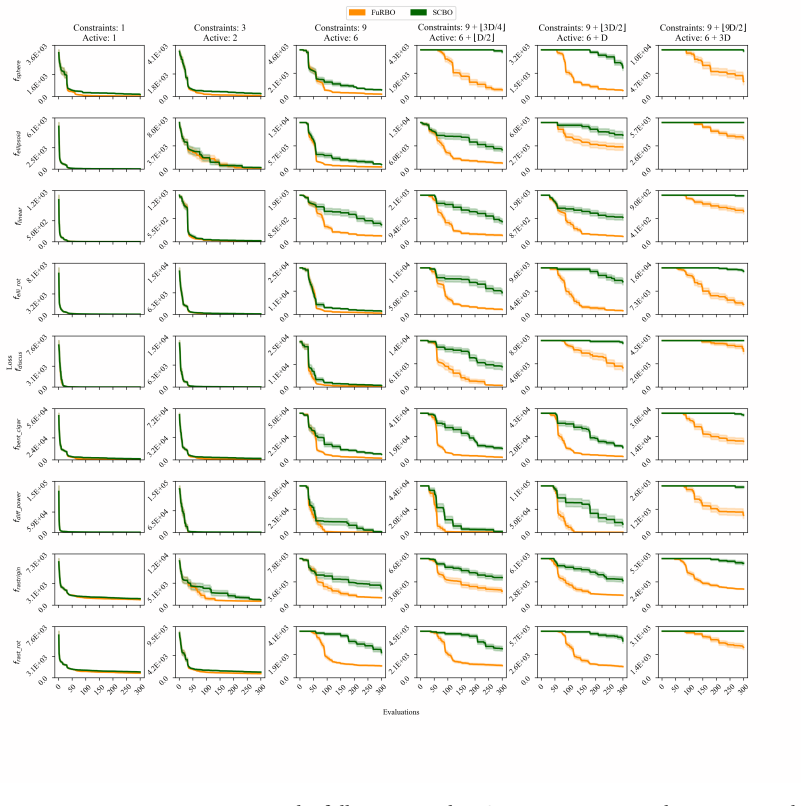
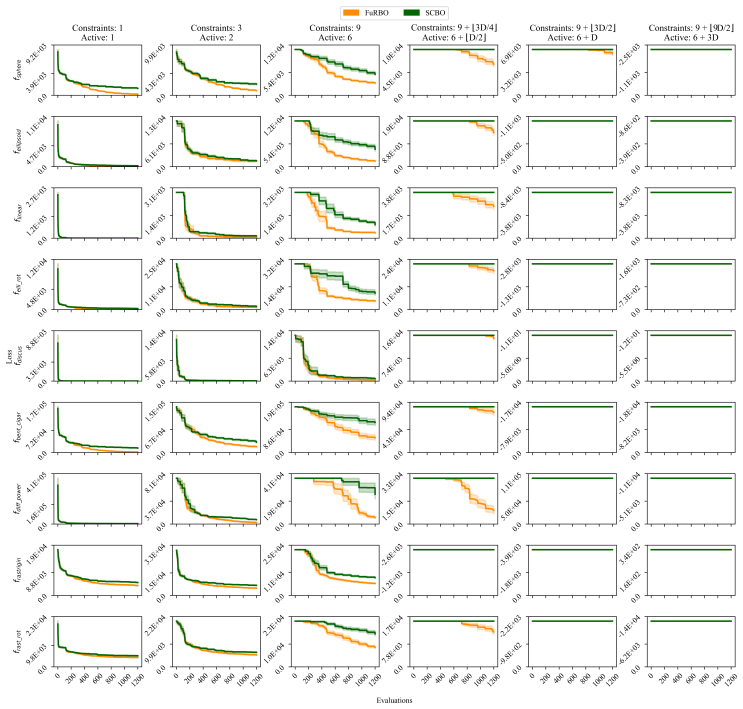
The central claim is that the trust region itself can be made feasibility-driven: instead of using the best feasible point only as a center, FuRBO samples inspector points uniformly in a ball of radius $R$ around the current best, ranks them using the GP surrogate models of objective and constraints, and defines the next trust region as the axis-aligned hyperrectangle containing the top $P\%$ of inspectors. Thompson sampling then selects new candidates within this region. The paper argues that this procedure actively reuses constraint-model information to hunt for feasible territory, making the trust region shift and resize substantially between iterations. Empirically, the authors show that FuRBO either ties or outperforms SCBO, constrained EI, COBYLA, CMA-ES, and random search across the BBOB-constrained benchmark suite and physics-inspired problems, with the largest margins when constraints are numerous, active, or hard to satisfy, and in high dimensions where SCBO stops finding feasible solutions.
Load-bearing premise
The load-bearing premise is that the top-ranked inspector points, sampled in a ball around the current best and scored by Gaussian-process surrogates, outline a hyperrectangle that actually contains a promising feasible region.
Editorial extensions
If this is right
- On the full BBOB-constrained suite in 10D, FuRBO converges faster and reaches lower final regret than SCBO on problems with 17 or more constraints, while performing comparably on problems with one to three constraints.
- In 40D, FuRBO finds feasible solutions under a moderate constraint load ($9+\lfloor 3D/4\rfloor$ constraints) on nearly all benchmark functions, whereas SCBO systematically fails within the same budget.
- On the 60D rover trajectory problem with 15 hard constraints, FuRBO reaches a higher reward than SCBO, and on the 30D Keane bump it slightly outperforms SCBO.
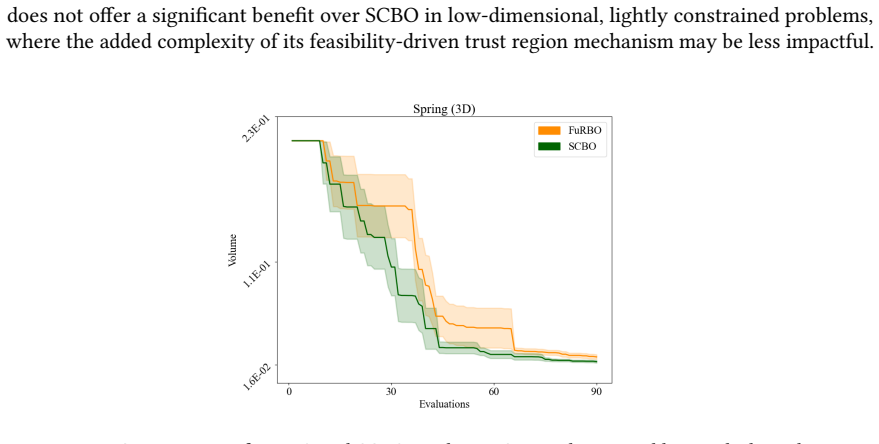
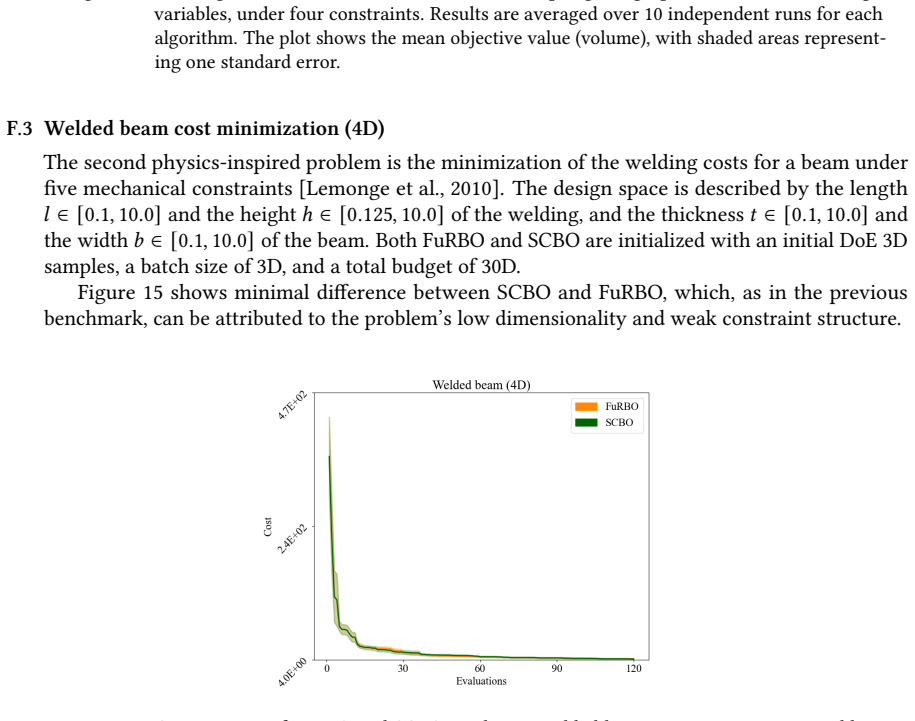
- On low-dimensional, lightly constrained engineering problems such as spring, welded beam, and pressure vessel design, FuRBO matches SCBO without a notable advantage, indicating its benefit is concentrated in hard-feasibility settings.
- Larger inspector percentages and very small initial radii degrade FuRBO's performance, so its gains depend on the choice of these hyperparameters.
Reading between the lines
- The paper does not explore this, but the inspector-ranking idea could be extended to a covariance-shaped trust region fit to the top inspectors, which would likely help when the feasible set is a narrow rotated corridor, a limitation the paper itself acknowledges.
- A testable prediction of the mechanism is that FuRBO's advantage over SCBO grows with the fraction of the budget spent before the first feasible point is found; a benchmark that varies only that fraction would isolate the trust-region effect.
- Because the extra cost comes from surrogate evaluations of inspectors, FuRBO is most attractive when each true evaluation is expensive; on cheap problems the overhead may erase the gain, a tradeoff the paper notes only in passing.
Signed reviews
Editorial analysis
A structured set of objections, weighed in public.
Referee Report
Summary. The paper introduces FuRBO, a trust-region Bayesian optimization algorithm for constrained black-box problems. FuRBO extends SCBO by constructing the trust region from a set of 'inspector' points sampled uniformly in a ball around the current best solution, ranking them with surrogate models of the objective and constraints, and taking the smallest hyperrectangle containing the top P% of inspectors. The algorithm is evaluated on the BBOB-constrained COCO benchmark (3 instances in 2, 10, and 40 dimensions), on three representative functions against cEI, COBYLA, CMA-ES, and random search, and on additional benchmarks (Keane bump, spring, welded beam, pressure vessel, speed reducer, rover trajectory) against SCBO. The central claim is that FuRBO ties or outperforms state-of-the-art alternatives, with the largest gains when feasibility is rare and hard to locate.
Significance. If the empirical claims hold, FuRBO provides a practical improvement for constrained BO in settings where feasible regions are narrow. The paper's strengths include a publicly available implementation, statistical significance testing (Wilcoxon rank-sum) across replications, a systematic ablation study of four hyperparameters, and an honest limitations section that acknowledges failure in extremely constrained high-dimensional problems. The trend in Tables 1-3—growing advantage over SCBO as dimension and constraint count increase—is consistent with the proposed mechanism. However, the overstated evaluation scope ('full suite' vs 3 instances) and the internal budget inconsistency need correction before the claims can be taken at face value.
major comments (3)
- [Section 3 and Section 5.1] The problem definition in Section 3 states a total evaluation budget of 10D function evaluations, while every experimental setup in Section 5.1 uses a total evaluation budget of 30D (e.g., the Baselines Setup paragraph and the constrained BBOB paragraph). This internal inconsistency affects the framing of the method as a 'low-budget' optimizer and must be reconciled by either changing the problem definition or explicitly justifying the experimental budget.
- [Abstract and Section 5.1] The abstract and Section 5.1 claim that FuRBO is tested on 'the full BBOB-constrained COCO benchmark suite,' but the experimental protocol uses 3 instances (and 10 repetitions) rather than the 15 instances that constitute the full suite, in dimensions 2, 10, and 40 only. This overstates the evaluation scope; the authors should either run the full 15-instance suite or revise the wording to accurately describe the subset used.
- [Appendix E.3] The ablation study on the inspector percentage P in Appendix E.3 states that FuRBO's performance deteriorates as P increases, with the best results at P=1%, yet the main experiments fix P=10% without a stated reason. Given that the paper claims superiority partly through this feasibility-driven mechanism, the sensitivity of the algorithm to P should be addressed, either by justifying the chosen value across a wider set of problems or by tuning P per problem. As written, the choice appears to favor the reported results.
minor comments (4)
- [Section 5.2.1] The sentence 'For simpler problems (leftmost columns with 1–3 constraints)' is inaccurate because the leftmost columns in Table 2 correspond to 1, 3, and 9 constraints, not 1–3.
- [Section 5.2.1] The phrase 'configurations with 17 or more constraints' does not match the actual constraint counts in the rightmost columns (e.g., 16, 24, 54 constraints in 10D); please correct the threshold to align with the table.
- [Appendix A, Table 4 caption] The caption contains a typo: 'fro constrained optimization' should read 'for constrained optimization'.
- [Algorithm 1 and Section 4.2] The ranking metric r used in Algorithm 1 (lines 2 and 5) is only described in prose in Section 4.2; providing a formal numbered definition (including the normalization of constraint violations and the concatenation of feasible and infeasible samples) would significantly improve clarity.
Circularity Check
No significant circularity: FuRBO is assessed on external benchmarks and its trust-region mechanism is an algorithmic heuristic, not a derivation that encodes the target results.
full rationale
FuRBO's central claim is empirical: inspector-guided trust regions improve constrained Bayesian optimization relative to SCBO and other baselines. The trust-region construction (Algorithm 1, lines 4-7) is a heuristic search mechanism; no optimality or feasibility theorem is derived from it, and the evaluation is against BBOB-constrained COCO functions, the Keane bump function, and physics-inspired benchmarks whose feasible sets and optima are defined externally and independently of FuRBO's outputs. The ranking metric r is used both to identify the current best point and to rank newly sampled inspectors, but this is algorithmic consistency rather than definitional circularity: the inspectors are fresh points, and the trust region is the smallest hyperrectangle over their top P%, which is not equal to the set of already-evaluated points selected by r. The hyperparameters (P=10%, R=1, tau_s=2, tau_f=3) were selected through ablations on one bent_cigar instance; this is a tuning and generalization concern, not a circularity, because the reported comparisons cover many functions, constraint levels, and dimensions beyond that instance, and no target result is encoded in the algorithm. The only self-citation (Raponi et al. 2019) is a background reference for crashworthiness applications and is not load-bearing. The paper's own limitation paragraphs (Section 6) acknowledge failures in extreme 40D settings, which scopes the claim honestly rather than circularly validating it. No equation in the paper reduces to its own inputs by construction, and no fitted parameter is renamed as a prediction.
Assumptions & free parameters
free parameters (5)
- Inspector percentage P =
10% (default)
- Initial sampling radius R =
1.0
- Success/failure thresholds tau_s, tau_f =
2 and 3
- Total evaluation budget =
30D (main experiments)
- Batch size q =
3D (main), 1 (baseline comparison)
assumptions (4)
- domain assumption Gaussian process surrogates adequately approximate objective and constraint functions in the tested high-dimensional problems.
- domain assumption The feasible region is reachable by inspectors sampled uniformly in a ball around the current best point.
- domain assumption The BBOB-constrained suite and physics-inspired benchmarks are representative of real constrained black-box problems.
- standard math Standard probability theory and GP posterior sampling are valid.
Cite this review
Pith. "Pith review of Feasibility-Driven Trust Region Bayesian Optimization." pith.science (2026). https://pith.science/paper/HX6XGDVV
@misc{pith2026250614619,
  author       = {Pith},
  title        = {Pith review of: Feasibility-Driven Trust Region Bayesian Optimization},
  year         = {2026},
  howpublished = {\url{https://pith.science/paper/HX6XGDVV}},
  note         = {Machine review of arXiv:2506.14619}
}
read the original abstract
Bayesian optimization is a powerful tool for solving real-world optimization tasks under tight evaluation budgets, making it well-suited for applications involving costly simulations or experiments. However, many of these tasks are also characterized by the presence of expensive constraints whose analytical formulation is unknown and often defined in high-dimensional spaces where feasible regions are small, irregular, and difficult to identify. In such cases, a substantial portion of the optimization budget may be spent just trying to locate the first feasible solution, limiting the effectiveness of existing methods. In this work, we present a Feasibility-Driven Trust Region Bayesian Optimization (FuRBO) algorithm. FuRBO iteratively defines a trust region from which the next candidate solution is selected, using information from both the objective and constraint surrogate models. Our adaptive strategy allows the trust region to shift and resize significantly between iterations, enabling the optimizer to rapidly refocus its search and consistently accelerate the discovery of feasible and good-quality solutions. We empirically demonstrate the effectiveness of FuRBO through extensive testing on the full BBOB-constrained COCO benchmark suite and other physics-inspired benchmarks, comparing it against state-of-the-art baselines for constrained black-box optimization across varying levels of constraint severity and problem dimensionalities ranging from 2 to 60.
Figures


Figures from the paper (15 more)






Reference graph
Works this paper leans on
- [1]
-
[2]
S. Ariafar, J. Coll-Font , D. Brooks, and J. Dy. ADMMBO : Bayesian Optimization with Unknown Constraints using ADMM . Journal of Machine Learning Research, 20 0 (123): 0 1--26, 2019. ISSN 1533-7928
work page 2019
-
[3]
M. Balandat, B. Karrer, D. R. Jiang, S. Daulton, B. Letham, A. G. Wilson, and E. Bakshy. BoTorch: A Framework for Efficient Monte-Carlo Bayesian Optimization . In Advances in Neural Information Processing Systems 33, 2020. URL http://arxiv.org/abs/1910.06403
arXiv 2020
-
[4]
H. Cai, L. Zhu, and S. Han. ProxylessNAS : Direct Neural Architecture Search on Target Task and Hardware , Feb. 2019
work page 2019
-
[5]
X. Du, J. Liang, J. Lei, J. Xu, and P. Xie. A radial-basis function mesh morphing and Bayesian Optimization framework for vehicle crashworthiness design. Structural and Multidisciplinary Optimization, 66 0 (3): 0 64, Mar. 2023. ISSN 1615-1488. doi:10.1007/s00158-023-03496-x
-
[6]
P. Dufoss \'e and A. Atamna. Benchmarking several strategies to update the penalty parameters in AL-CMA-ES on the BBOB -constrained testbed. In Proceedings of the Genetic and Evolutionary Computation Conference Companion, pages 1691--1699, 2022
work page 2022
-
[7]
P. Dufoss \'e , N. Hansen, D. Brockhoff, P. R. Sampaio, A. Atamna, and A. Auger. The BBOB-Constrained COCO Test Suite . 2022
work page 2022
-
[8]
D. Eriksson and M. Poloczek. Scalable constrained Bayesian optimization. In International conference on artificial intelligence and statistics, pages 730--738. PMLR, 2021. doi:10.48550/arXiv.2002.08526
Show all 32 references
-
[9]
Eriksson, M
D. Eriksson, M. Pearce, J. Gardner, R. D. Turner, and M. Poloczek. Scalable global optimization via local bayesian optimization. Advances in neural information processing systems, 32, 2019. doi:10.48550/arXiv.1910.01739. URL https://github.com/pytorch/botorch/blob/main/tutoria...
-
[10]
Feurer, K
M. Feurer, K. Eggensperger, S. Falkner, M. Lindauer, and F. Hutter. Auto- Sklearn 2.0: Hands-free AutoML via Meta-Learning , Oct. 2022
2022
-
[11]
A. I. J. Forrester, A. S \'o bester, and A. J. Keane. Engineering Design via Surrogate Modelling - A Practical Guide . John Wiley & Sons Ltd., 2008. ISBN 978-0-470-06068-1
2008
-
[12]
Gardner, M
J. Gardner, M. Kusner, Zhixiang, K. Weinberger, and J. Cunningham. Bayesian Optimization with Inequality Constraints . In Proceedings of the 31st International Conference on Machine Learning , pages 937--945. PMLR, June 2014
2014
-
[13]
R. Garnett. Bayesian Optimization . Cambridge University Press, 2023
2023
-
[14]
N. Hansen. The CMA evolution strategy: a comparing review. Towards a new evolutionary computation: Advances in the estimation of distribution algorithms, pages 75--102, 2006. URL https://github.com/CMA-ES/pycma/blob/development/notebooks/notebook-usecases-constraints.ipynb
2006
-
[15]
Hansen, Y
N. Hansen, Y. Akimoto, and P. Baudis. CMA-ES/pycma on G ithub. Zenodo, Feb. 2019
2019
-
[16]
Hansen, A
N. Hansen, A. Auger, R. Ros, O. Mersmann, T. Tušar, and D. B. and. COCO: a platform for comparing continuous optimizers in a black-box setting . Optimization Methods and Software, 36 0 (1): 0 114--144, 2021. doi:10.1080/10556788.2020.1808977
2021
-
[17]
J. M. Hern \'a ndez-Lobato , M. A. Gelbart, R. P. Adams, M. W. Hoffman, and Z. Ghahramani. A General Framework for Constrained Bayesian Optimization using Information-based Search , Sept. 2016
2016
-
[18]
J. M. Hern \'a ndez-Lobato , J. Requeima, E. O. Pyzer-Knapp , and A. Aspuru-Guzik . Parallel and Distributed Thompson Sampling for Large-scale Accelerated Exploration of Chemical Space , June 2017
2017
-
[19]
Hutter, L
F. Hutter, L. Kotthoff, and J. Vanschoren. Automated Machine Learning: Methods, Systems, Challenges. Springer Nature, 2019
2019
-
[20]
H. Jin, F. Chollet, Q. Song, and X. Hu. Autokeras: An automl library for deep learning. Journal of Machine Learning Research, 24 0 (6): 0 1--6, 2023. URL http://jmlr.org/papers/v24/20-1355.html
2023
-
[21]
A. Keane. Experiences with optimizers in structural design. In Proceedings of the conference on adaptive computing in engineering design and control, volume 94, pages 14--27, 1994
1994
-
[22]
A. C. Lemonge, H. J. Barbosa, C. C. Borges, and F. B. Silva. Constrained optimization problems in mechanical engineering design using a real-coded steady-state genetic algorithm. Mec \'a nica Computacional , 29 0 (95): 0 9287--9303, 2010
2010
-
[23]
Picheny, R
V. Picheny, R. B. Gramacy, S. M. Wild, and S. L. Digabel. Bayesian optimization under mixed constraints with a slack-variable augmented Lagrangian , May 2016
2016
-
[24]
M. J. Powell. A direct search optimization method that models the objective and constraint functions by linear interpolation. Springer, 1994. URL https://docs.scipy.org/doc/scipy/reference/generated/scipy.optimize.minimize.html#scipy.optimize.minimize
1994
-
[25]
W. B. Powell. A unified framework for stochastic optimization. European Journal of Operational Research, 275 0 (3): 0 795--821, June 2019. ISSN 03772217. doi:10.1016/j.ejor.2018.07.014
2019 doi
-
[26]
Raponi, M
E. Raponi, M. Bujny, M. Olhofer, N. Aulig, S. Boria, and F. Duddeck. Kriging-assisted topology optimization of crash structures. Computer Methods in Applied Mechanics and Engineering, 348: 0 730--752, May 2019. ISSN 0045-7825. doi:10.1016/j.cma.2019.02.002
2019 doi
-
[27]
Schonlau, W
M. Schonlau, W. J. Welch, and D. R. Jones. Global versus local search in constrained optimization of computer models. In New Developments and Applications in Experimental Design, volume 34, pages 11--26. Institute of Mathematical Statistics, 1998. doi:10.1214/lnms/1215456182
1998
-
[28]
W. R. Thompson. On the Likelihood that One Unknown Probability Exceeds Another in View of the Evidence of Two Samples . Biometrika, 25 0 (3/4): 0 285--294, 1933. ISSN 0006-3444. doi:10.2307/2332286
1933 doi
-
[29]
Ungredda and J
J. Ungredda and J. Branke. Bayesian Optimisation for Constrained Problems . ACM Trans. Model. Comput. Simul., 34 0 (2): 0 9:1--9:26, Apr. 2024. ISSN 1049-3301. doi:10.1145/3641544
2024 doi
-
[30]
Virtanen, R
P. Virtanen, R. Gommers, T. E. Oliphant, M. Haberland, T. Reddy, D. Cournapeau, E. Burovski, P. Peterson, W. Weckesser, J. Bright, S. J. van der Walt , M. Brett, J. Wilson, K. J. Millman, N. Mayorov, A. R. J. Nelson, E. Jones, R. Kern, E. Larson, C. J. Carey, \.I . Polat, Y. F...
2020
- [31]
-
[32]
Zimmermann and O
M. Zimmermann and O. De Weck. Formulating Engineering Systems Requirements . In A. Maier, J. Oehmen, and P. E. Vermaas, editors, Handbook of Engineering Systems Design , pages 1--52. Springer International Publishing , Cham , 2021. ISBN 978-3-030-46054-9. doi:10.1007/978-3-030...
2021 doi
Reviewed August 15, 2026 · model on record in the stance chip above.
Discussion (0). Continue with ORCID to comment.