REVIEW 3 major objections 6 minor 42 references
A micromorphic-based artificial diffusion method for stabilized finite element approximation of convection-diffusion problems
T0 review · 3 major / 6 minor · reviewed 2026-08-07 · deepseek-v4-flash
Pith's one-line read The paper claims a micromorphic-based artificial diffusion finite-element method (MMAD) that is stable and convergent for convection-diffusion, including pure advection, and that it beats SUPG, MZAD, and standard FEM on…
desk verdict A genuinely new directional artificial-diffusion stabilization with consistently good numerics, but the pure-advection well-posedness claim is unsupported and the given parameter choice actually yields a singular system. read the letter →
The pith
A machine-rendered reading of the paper's core claim, the machinery that carries it, and where it could break.
The reading
What carries the argument
The central object is the micromorphic coupling ansatz: an auxiliary gradient-like variable g entering the potential Ψ_MM = 1/2(∇φ − g)·H·(∇φ − g) + 1/2 g·K·g + 1/2 ∇g : A : ∇g. The tensor H forces g to track ∇φ and carries the artificial-diffusion effect; K and A penalize g and ∇g and set the length scale of the micromorphic influence. The discrete machinery is an equal-order continuous piecewise-linear approximation of both φ and g, with a bilinear form whose coercivity and continuity constants produce the a priori error estimate. The practical choice H = k̄ (û ⊗ û) makes the added diffusion streamline-directed, with k̄ taken from the same stabilization-parameter construction used by SUPG.
What would settle it
On the paper's 2D convection-dominated tests, compute MMAD solutions at mesh sizes h, h/2, and h/4 with the practical tensors H = k̄ (û ⊗ û), K = A = 0, and estimate the discrete coercivity constant from the symmetric part of the system matrix. If that constant decays like h² or faster, or if the max-norm errors grow under refinement, the claimed stability in the pure-advection limit is not established. A second check: on the same benchmarks, optimize the SUPG stabilization parameter; if SUPG then achieves smaller L2 and max errors than MMAD, the claim that MMAD outperforms established approaches in general does not hold.
Extended reading notes
Core claim
On the paper's own terms, the discovery is that coupling φ to a micromorphic auxiliary field g through a quadratic potential makes an equal-order Galerkin discretization stable for convection-dominated problems without sacrificing accuracy. The coupled weak form adds the term H·(∇φ − g)·(∇δφ − δg), together with K g·δg and A ∇g : ∇δg. When H, K, and A are positive-definite, the discrete bilinear form is coercive and continuous, yielding a linear convergence estimate that the paper states also holds in the pure-advection limit k = 0. For actual computations the paper chooses H = k̄ (û ⊗ û) to add diffusion only along the flow direction and sets K = A = 0 when the physical diffusivity vanishes. In the reported benchmarks, MMAD produces smaller L2 and maximum errors than SUPG, MZAD, and standard FEM, and it best preserves the heights of transported hills in transient advection tests.
Load-bearing premise
The load-bearing premise is that the practical parameter choice — H = k̄ (û ⊗ û), K = 0, A = 0, including in the pure-advection limit — remains stable and accurate in practice, even though the paper's well-posedness proof requires strictly positive-definite tensors and Section 4.3 states that these choices do not meet the sufficient conditions.
Editorial extensions
If this is right
- MMAD resolves sharp interior and boundary layers without spurious oscillations in steady convection-dominated problems, and in the paper's tests it achieves the smallest L2 and max-norm errors among FEM, SUPG, MZAD, and MMAD.
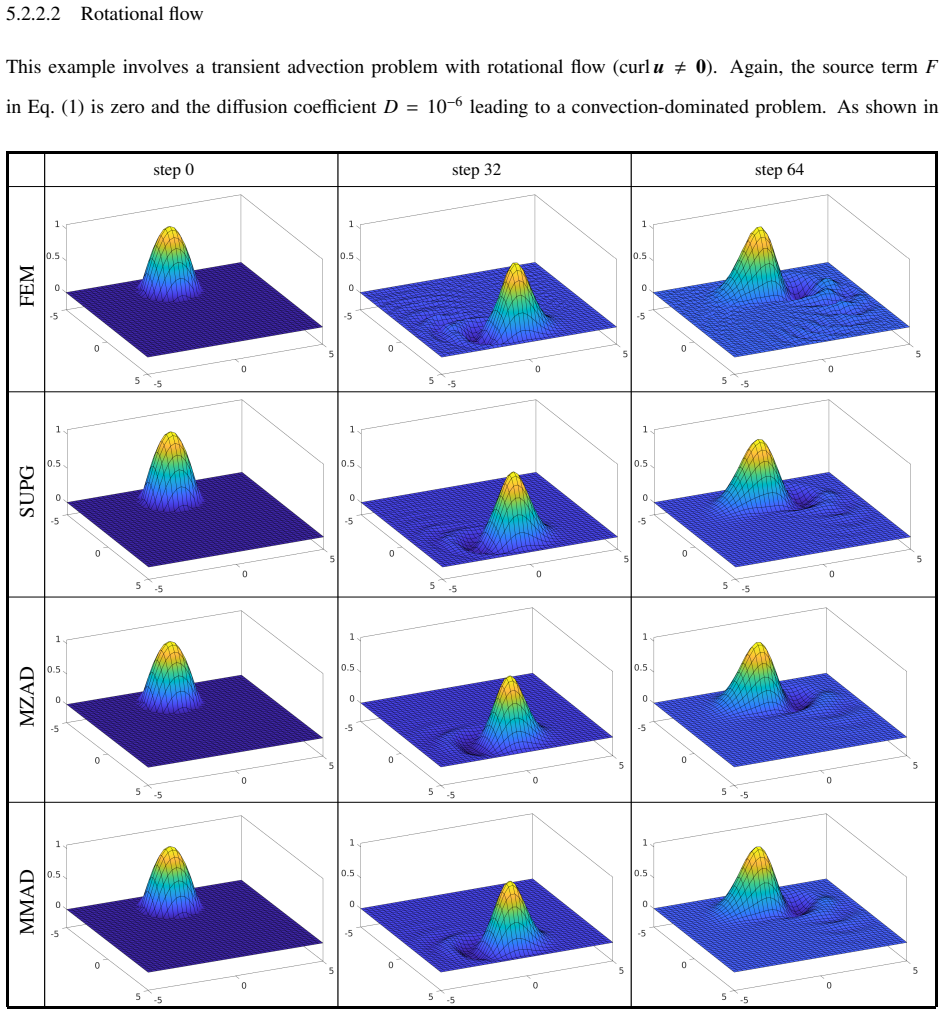
- In transient advection benchmarks, MMAD maintains the amplitude of transported hills better than the other tested schemes, while SUPG is reported to over-damp the hill height.
- The coupled equal-order formulation is well-posed and first-order convergent when H, K, and A are positive-definite, and the stated error bound covers the pure-advection limit as well.
- The modelling error between the original convection-diffusion solution and the MMAD solution is controlled by H through the bound β0/M0 = Hmax/k, so the amount of added numerical diffusion can be tuned by choosing H.
- Because the scheme uses equal-order P1/P1 approximations with no extra mesh compatibility condition, it can be implemented in existing finite-element codes by adding one auxiliary vector field.
Reading between the lines
- Inference: The coercivity proof requires positive-definite H, K, and A, but the implemented H = k̄ (û ⊗ û) is only positive semidefinite and the pure-advection test takes K = A = 0; turning the empirically observed stability in that regime into a theorem would require an inf-sup or semidefinite-coercivity argument.
- Inference: The streamline tensor H resembles a directional-diffusion operator, so a natural extension is to replace the flow direction û by the solution-gradient direction near layers, yielding a micromorphic discontinuity-capturing scheme that could combine SUPG-like accuracy with sharper monotone layers.
- Inference: Because the auxiliary field lives in the same H1 space and uses equal-order elements, MMAD could serve as a plug-in stabilization for coupled problems such as thermofluid flow, though the paper does not report such an application.
- Inference: A systematic mesh-refinement study comparing MMAD with SUPG under separately tuned stabilization parameters would test whether the reported accuracy advantage persists as h tends to zero or is specific to the fixed meshes and benchmark settings used here.
Editorial analysis
A structured set of objections, weighed in public.
Referee Report
Summary. The paper proposes a micromorphic-based artificial diffusion (MMAD) method for convection-diffusion problems. An auxiliary gradient-like field g is introduced, and the formulation adds stabilization terms involving (nabla phi - g), g, and nabla g through tensors H, K, and A. The authors prove coercivity and continuity of the discrete bilinear form under positive-definiteness assumptions on H, K, and A, derive an O(h) error estimate and a modelling-error bound, and then compare MMAD with standard FEM, SUPG, and MZAD on one- and two-dimensional steady and transient benchmarks. The abstract and Section 6 claim that well-posedness and convergence hold also in the pure-advection limit and that the method outperforms established approaches generally.
Significance. MMAD is an attractive extension of MZAD: the formulation is simple, uses equal-order conforming elements, and in the reported benchmarks it consistently gives smaller L2 and maximum errors than SUPG and MZAD, and it better preserves the amplitude of transported hills. The derivation is transparent and the numerical study is fairly systematic. The significance is conditional, however, because the pure-advection well-posedness claim is not covered by the proof, the actual parameter choice in that limit makes the discrete system singular, and the modelling-error bound degenerates as the diffusivity tends to zero. If the theory is repaired or the claims are restricted to positive diffusivity, the method is a useful contribution.
major comments (3)
- [Sections 4.1, 4.3, 6] Section 4.1 establishes coercivity of the discrete bilinear form in Eq. (22) using Eqs. (27)-(32), which require H, K, and A to be symmetric positive definite with positive constants H0, K0, and A0. Section 4.3 then takes H = kbar uhat tensor uhat, which is only positive semidefinite, and for pure advection sets e_k = 0, i.e. K = 0 and A = 0; the text itself states that these choices do not meet the sufficient conditions for well-posedness. This gap is load-bearing: for u = (1,0), k = 0, K = A = 0, setting delta g = (0, delta g_y) in Eq. (22) gives B((phi,g),(0,delta g_y)) = 0 for every delta g_y, so the component g_y is undetermined and the discrete matrix is singular. The numerical examples do not test the claimed limit: all 'pure advection' examples use D = 10^-6, so e_k = sgn(D) = 1 and K and A are identity tensors. Consequently the Section 6 claim that the formulation is 'stable and convergent also in the pure advection limit' is not established and is contradicted by the stated parameter choice.
- [Section 4.2, Eq. (44)] The modelling-error bound in Eq. (44) degenerates in the advective limit. With M0 = k and beta0 = Hmax, Eq. (44) gives ||phi - phi0||_Phi <= (Hmax/M0) ||(phi,g)||_hatPhi. In the pure-advection limit k -> 0, the SUPG-type stabilization in Section 4.3 gives Hmax = O(h |u|), independent of k, and no scaling Hmax = O(k) is specified. The right-hand side therefore diverges, and the statement in Section 4.2 that the modelling error 'can be controlled in the advective limit through an appropriate choice for H' is not supported. This undermines the claimed theoretical convergence in the limit rather than merely changing a constant.
- [Sections 3.1 and 4] The analysis assumes homogeneous Dirichlet boundary conditions on all of partial B, but the continuous pure-advection problem (k = 0) with phi = 0 on the entire boundary is overdetermined for general data: for u = (1,0) on a rectangle, both inflow and outflow conditions are imposed. The numerical pure-advection examples use Neumann conditions on parts of the boundary, so there is a mismatch between the analysis setting and the computations. The paper should define precisely what is meant by the 'pure-advection limit' before claiming well-posedness or convergence in that limit.
minor comments (6)
- [Section 4.3] The same symbol k is used for the physical diffusivity in Eq. (1) and for the SUPG stabilization parameter in Section 4.3; use a distinct symbol, such as tau or kbar, to avoid confusion.
- [Section 5.3 and Fig. 12] The caption of Fig. 12 states that the conduction coefficient is k = 0.05, while the text states D = 10^-6; these values should be reconciled through the relation in Eq. (1).
- [Eq. (45)] Equation (45) is incomplete: after combining Eq. (44) and Eq. (36), the total error should be bounded by a term of order Hmax/M0 times the hatPhi-norm plus an O(h) approximation term, not by beta0/M0 alone.
- [Eq. (34)] The continuity estimate in Eq. (34) bounds ||delta phi||_L2 by ||delta hatphi||_hatPhi without stating a Poincare constant; the constant m in Eq. (35) may need a factor if the domain is not of unit size.
- [Abstract and Section 6] The phrase 'outperforms established approaches in general' is stronger than what the fixed set of benchmark meshes and problems supports; it should be qualified to the problems considered.
- [Eq. (47)] The SUPG parameter in Eq. (47) is undefined when D = 0; the limit alpha_i -> infinity giving kbar -> sum_i u_i h_i / 2 should be stated when discussing the pure-advection setting.
Circularity Check
No significant circularity: the MMAD stabilization is not fitted to benchmark errors, the accuracy comparisons are against exact solutions, and the only flagged limitation is an acknowledged proof gap, not a circular step.
full rationale
The derivation chain is self-contained. The stabilization tensor is chosen a priori as H = kbar * uhat (x) uhat with the standard SUPG parameter of Eq. (47), and K = A = 0 or K = A = I according to ek = sgn(D); these parameters are not tuned to the numerical errors reported in Tables 2-10. The comparisons measure the discretized MMAD solution against exact or analytical solutions, so the claimed accuracy is computed, not fitted. The auxiliary field g is eliminated consistently through the coupled equations (20), and the bilinear form B in Eq. (22) is not a restatement of any target quantity. The paper cites its own MZAD method [37], but only as motivation and as a comparison method; the coercivity and error analysis in Section 4 does not depend on [37]. The paper explicitly flags a genuine limitation in Section 4.3: 'These choices do not meet the sufficient conditions for well-posedness, but as will be seen, all lead to stable and accurate numerical solutions.' That means the pure-advection regime (k=0, K=A=0, H positive semidefinite) lies outside the Section 4.1 coercivity proof, and the numerical examples use D=10^-6 rather than D=0. This is a correctness or robustness gap, not a circularity: the claim is unproved rather than equivalent to its inputs. No equation in the paper reduces to a fit or to a self-citation chain.
Assumptions & free parameters
free parameters (3)
- stabilization parameter k_bar =
k_bar = sum_i u_i h_i gamma_i / 2, with gamma_i = coth(alpha_i) - 1/alpha_i and alpha_i = u_i h_i / (2D)
- micromorphic tensor scalar e_k for K and A =
e_k = sgn(D): 1 for D > 0, 0 for pure advection
- time step size for transient examples =
not reported
assumptions (4)
- domain assumption The velocity field is divergence-free and the discrete solution vanishes on the whole boundary, so the convective term contributes zero to the coercivity estimate.
- ad hoc to paper The tensors H, K, A are symmetric positive definite with positive constants H0, K0, A0.
- ad hoc to paper The micromorphic potential Psi_MM, with quadratic terms in (nabla_phi - g), g, and nabla_g, produces the correct stabilization mechanism.
- standard math Céa's lemma and Lax-Milgram apply once coercivity and continuity are established, giving the O(h) finite element error estimate.
invented entities (1)
-
micromorphic-type auxiliary gradient field g
Cite this review
Pith. "Pith review of A micromorphic-based artificial diffusion method for stabilized finite element approximation of convection-diffusion problems." pith.science (2026). https://pith.science/paper/3T6E4FXF
@misc{pith2026250614800,
  author       = {Pith},
  title        = {Pith review of: A micromorphic-based artificial diffusion method for stabilized finite element approximation of convection-diffusion problems},
  year         = {2026},
  howpublished = {\url{https://pith.science/paper/3T6E4FXF}},
  note         = {Machine review of arXiv:2506.14800}
}
read the original abstract
We present a novel artificial diffusion method to circumvent the instabilities associated with the standard finite element approximation of convection-diffusion equations. Motivated by the micromorphic approach, we introduce an auxiliary variable, which is related to the gradient of the field of interest, and which leads to a coupled problem. Conditions for well-posedness of the resulting formulation are established. We carry out a comprehensive numerical study to compare the proposed methodology against some well-established approaches in one- and two-dimensional settings. The proposed method outperforms established approaches in general in approximating accurately the solutions to pertinent and challenging problems.
Figures


Figures from the paper (9 more)



Reference graph
Works this paper leans on
-
[1]
I. Christie, D. F. Gri ffiths, A. R. Mitchell, O. C. Zienkiewicz, Finite element methods for second order di fferential equations with significant first derivatives, International Journal for Numerical Methods in Engineering 10 (1976) 1389–1396
work page 1976
-
[2]
J. C. Heinrich, P. S. Huyakorn, O. C. Zienkiewicz, A. R. Mitchell, An ‘upwind’ finite element scheme for two-dimensional convective transport equation, International Journal for Numerical Methods in Engineering 11 (1977) 131–143
work page 1977
-
[3]
C. Johnson, U. N ¨avert, J. Pitk¨aranta, Finite element methods for linear hyperbolic problems, Computer Methods in Applied Mechanics and Engineering 45 (1984) 285–312
work page 1984
-
[4]
P. M. Gresho, R. L. Lee, Don’t suppress the wiggles-They’re telling you something!, Computers and Fluids 9 (1981) 223–253
work page 1981
-
[5]
A. N. Brooks, T. J. R. Hughes, Streamline upwind /Petrov-Galerkin formulations for convection dominated flows with particular emphasis on the incompressible Navier-Stokes equations., Computer Methods in Applied Mechanics and Engineering 32 (1982) 199–259
work page 1982
-
[6]
T. J. R. Hughes, A simple scheme for developing ‘upwind’ finite elements, International Journal for Numerical Methods in Engineering 12 (1978) 1359–1365
work page 1978
-
[7]
T. J. R. Hughes, A theoretical framework for Petrov-Galerkin methods with discontinuous weighting functions: Application to the streamline- upwind procedure, in: R. H. Gallagher, D. H. Norrie, J. T. Oden, O. C. Zienkiewicz (Eds.), Finite element in fluids, John Wiley, 1982, Ch. 3
work page 1982
-
[8]
E. Burman, Consistent SUPG-method for transient transport problems: Stability and convergence, Computer Methods in Applied Mechanics and Engineering 199 (2010) 1114–1123
work page 2010
Show all 42 references
-
[9]
T. J. R. Hughes, M. Mallet, A new finite element formulation for computational fluid dynamics: IV . A discontinuity-capturing operator for multidimensional advective-diffusive systems, Computer Methods in Applied Mechanics and Engineering 58 (1986) 329–336
1986
-
[10]
T. J. R. Hughes, M. Mallet, A. Mizukami, A new finite element formulation for computational fluid dynamics: II. Beyond SUPG, Computer Methods in Applied Mechanics and Engineering 54 (1986) 341–355
1986
-
[11]
Knopp, G
T. Knopp, G. Lube, G. Rapin, Stabilized finite element methods with shock capturing for advection-di ffusion problems, Computer Methods in Applied Mechanics and Engineering 191 (2002) 2997–3013
2002
-
[12]
P. A. B. De Sampaio, A. L. G. A. Coutinho, A natural derivation of discontinuity capturing operator for convection-di ffusion problems, Computer Methods in Applied Mechanics and Engineering 190 (2001) 6291–6308. 29
2001
-
[13]
R. Codina, A discontinuity-capturing crosswind-dissipation for the finite element solution of the convection-di ffusion equation, Computer Methods in Applied Mechanics and Engineering 110 (1993) 325–342
1993
-
[14]
T. J. R. Hughes, Multiscale phenomena: Green’s functions, the Dirichlet-to-Neumann formulation, subgrid scale models, bubbles and the origins of stabilized methods, Computer Methods in Applied Mechanics and Engineering 127 (1995) 387–401
1995
-
[15]
T. J. R. Hughes, G. R. Feij ´oo, L. Mazzei, J. B. Quincy, The variational multiscale method - A paradigm for computational mechanics, Computer Methods in Applied Mechanics and Engineering 166 (1998) 3–24
1998
-
[16]
Bu ffa, T
A. Bu ffa, T. J. R. Hughes, G. Sangalli, Analysis of a multiscale discontinuous Galerkin method for convection-di ffusion problems, SIAM Journal on Numerical Analysis 44 (2006) 1420–1440
2006
-
[17]
V . John, S. Kaya, Finite element error analysis of a variational multiscale method for the Navier-Stokes equations, Advances in Computational Mathematics 28 (2008) 43–61
2008
-
[18]
Layton, A connection between subgrid scale eddy viscosity and mixed methods, Applied Mathematics and Computation 133 (2002) 147–157
W. Layton, A connection between subgrid scale eddy viscosity and mixed methods, Applied Mathematics and Computation 133 (2002) 147–157
2002
-
[19]
V . John, S. Kaya, W. Layton, A two-level variational multiscale method for convection-dominated convection-diffusion equations, Computer Methods in Applied Mechanics and Engineering 195 (2006) 4594–4603
2006
-
[20]
Z. J. Chen, Z. Y . Li, W. L. Xie, X. H. Wu, A two-level variational multiscale meshless local Petrov–Galerkin (VMS-MLPG) method for convection-diffusion problems with large Peclet number, Computers and Fluids 164 (2018) 73–82
2018
-
[21]
B. Du, H. Su, X. Feng, Two-level variational multiscale method based on the decoupling approach for the natural convection problem, International Communications in Heat and Mass Transfer 61 (2015) 128–139
2015
-
[22]
Knobloch, G
P. Knobloch, G. Lube, Local projection stabilization for advection-di ffusion-reaction problems: One-level vs. two-level approach, Applied Numerical Mathematics 59 (2009) 2891–2907
2009
-
[23]
C ¸ ibik, S
A. C ¸ ibik, S. Kaya, A projection-based stabilized finite element method for steady-state natural convection problem, Journal of Mathematical Analysis and Applications 381 (2011) 469–484
2011
-
[24]
G. Matthies, Local projection stabilisation for higher order discretisations of convection-di ffusion problems on Shishkin meshes, Advances in Computational Mathematics 30 (2009) 315–337
2009
-
[25]
Johnson, J
C. Johnson, J. Pitkaranta, An analysis of the discontinuous Galerkin method for a scalar hyperbolic equation, Mathematics of Computation 46 (1986) 1–26
1986
-
[26]
Cockburn, Discontinuous Galerkin methods for convection-dominated problems, in: High-order methods for computational physics, Springer, 1999, pp
B. Cockburn, Discontinuous Galerkin methods for convection-dominated problems, in: High-order methods for computational physics, Springer, 1999, pp. 69—-224
1999
-
[27]
T. J. R. Hughes, L. P. Franca, G. M. Hulbert, A new finite element formulation for computational fluid dynamics: VIII. The galerkin /least- squares method for advective-diffusive equations, Computer Methods in Applied Mechanics and Engineering 73 (1989) 173–189
1989
-
[28]
Pironneau, J
O. Pironneau, J. Liou, T. Tezduyar, Characteristic-Galerkin and Galerkin / least-squares space-time formulations for the advection- diffusion equation with time-dependent domains, Computer Methods in Applied Mechanics and Engineering 100 (1992) 117–141
1992
-
[29]
Burman, M
E. Burman, M. A. Fern ´andez, Finite element methods with symmetric stabilization for the transient convection-di ffusion-reaction equation, Computer Methods in Applied Mechanics and Engineering 198 (2009) 2508–2519
2009
-
[30]
J. L. Guermond, Stabilization of Galerkin approximations of transport equations by subgrid modeling, Mathematical Modelling and Numer- ical Analysis 33 (1999) 1293–1316
1999
-
[31]
R. Codina, Stabilization of incompressibility and convection through orthogonal sub-scales in finite element methods, Computer Methods in Applied Mechanics and Engineering 190 (2000) 1579–1599
2000
-
[32]
L. P. Franca, A. Nesliturk, M. Stynes, On the stability of residual-free bubbles for convection-di ffusion problems and their approximation by 30 a two-level finite element method, Computer Methods in Applied Mechanics and Engineering 166 (1998) 35–49
1998
-
[33]
Brezzi, T
F. Brezzi, T. J. R. Hughes, L. D. Marini, A. Russo, E. Suli, A priori error analysis of residual-free bubbles for advection-di ffusion problems, SIAM Journal on Numerical Analysis 36 (1999) 1933–1948
1999
-
[34]
Donea, A Taylor–Galerkin method for convective transport problems, International Journal for Numerical Methods in Engineering 20 (1984) 101–119
J. Donea, A Taylor–Galerkin method for convective transport problems, International Journal for Numerical Methods in Engineering 20 (1984) 101–119
1984
-
[35]
Taylor, P
C. Taylor, P. Hood, A numerical solution of the Navier-Stokes equations using the finite element technique, Computers and Fluids 1 (1973) 73–100
1973
-
[36]
M. A. Case, V . J. Ervin, A. Linke, G. R. Rebholz, A connection between Scott–V ogelius and grad-div stabilized Taylor–Hood FE approxima- tions of the Navier–Stokes equations, SIAM Journal on Mathematical Analysis 49 (2011) 1461–1481
2011
-
[37]
Firooz, B
S. Firooz, B. D. Reddy, V . Zaburdaev, P. Steinmann, Mean zero artificial di ffusion for stable finite element approximation of convection in cellular aggregate formation, Computer Methods in Applied Mechanics and Engineering 419 (2024) 116649
2024
-
[38]
Forest, Micromorphic approach for gradient elasticity, viscoplasticity, and damage, Journal of Engineering Mechanics 135 (2009) 117–131
S. Forest, Micromorphic approach for gradient elasticity, viscoplasticity, and damage, Journal of Engineering Mechanics 135 (2009) 117–131
2009
-
[39]
S. Forest, Nonlinear regularization operators as derived from the micromorphic approach to gradient elasticity, viscoplasticity and damage, Proceedings of the Royal Society A: Mathematical, Physical and Engineering Sciences 472 (2016) 20150755
2016
-
[40]
Forest, K
S. Forest, K. Sab, Finite-deformation second-order micromorphic theory and its relations to strain and stress gradient models, Mathematics and Mechanics of Solids 25 (2020) 1429–1449
2020
-
[41]
A. N. Brooks, A Petrov-Galerkin Finite Element Formulation for Convection Dominated Flows, Ph.D. thesis, California Institute of Technol- ogy (1981)
1981
-
[42]
B. D. Reddy, Introductory Functional Analysis: with Applications to Boundary Value Problems and Finite Elements, Springer Science and Business Media, 1998. 31
1998
Reviewed August 7, 2026 · model on record in the stance chip above.
Discussion (0). Sign in to comment.