REVIEW 5 major objections 5 minor 15 references
On the dynamical evolution of randomness Part B: Geometrisation and the origin of convergence in LLN
T0 review · 5 major / 5 minor · reviewed 2026-08-07 · deepseek-v4-flash
Pith's one-line read Law of Large Numbers is derived, not assumed, from rotating outcome vectors.
desk verdict A dynamical re-description of the LLN that mistakes its own assumptions for a derivation; the geometry is pretty but the load-bearing step is unproved and the feedback is engineered. read the letter →
The pith
A machine-rendered reading of the paper's core claim, the machinery that carries it, and where it could break.
The reading
What carries the argument
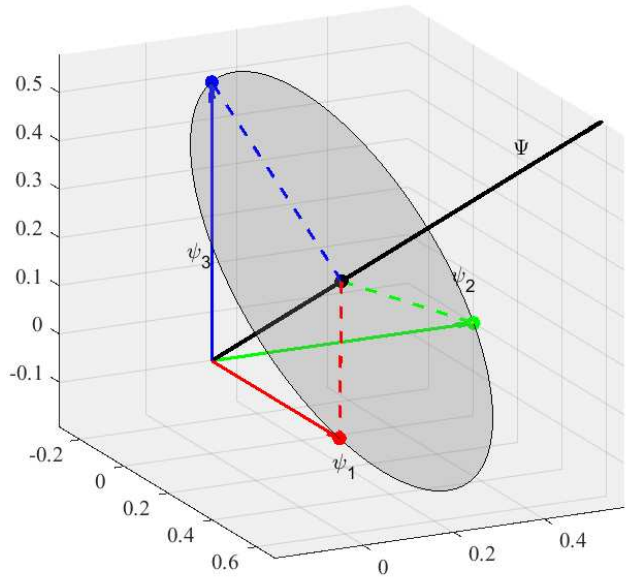
The central machinery is a rotational state-vector model of an experiment: an $n$-outcome experiment is the vector $\lvert \Psi\rangle$, a trial is a rotation $R(\theta)$ (built from Rodrigues' formula) that aligns one basis state with a fixed "reality axis" $\mathrm{RA}$, and the outcome is the sector of the disc $D_n$ that meets $\mathrm{RA}$ at that trial. Randomness enters through an unpredictable angular shift $\delta\theta_r$ between trials, generated by neglected microscopic deviations in initial conditions. The $\Lambda$-entropy $\Lambda_\sigma = \prod_{i=1}^{n} L_i$ serves as the paper's diagnostic of empirical randomness and converges to $\Lambda_\sigma^0$. The load-bearing step is the asserted "obvious kinematical conclusion" $\lvert m_k - m_i\rvert = c\,\lvert \Delta(\theta_k,\theta_i)\rvert$, which converts angular proximity on the disc into frequency proximity and is the step from which the equalization $m_i = m_k$ follows.
What would settle it
Run the model's simulation with feedback switched off ($\alpha = \beta = 1$) and check whether $\lvert m_k - m_i\rvert = c\,\lvert \Delta(\theta_k,\theta_i)\rvert$ still holds for long sequences; if it fails in the unbiased simulation, the kinematic claim is false. Alternatively, take a long real sequence of an $n$-outcome experiment, such as die rolls, and compute the correlation between frequency differences and sector angular distances; genuine i.i.d. data should show no such proportionality.
Extended reading notes
Core claim
The paper's central claim is that LLN convergence is an implication of the dynamical mechanics of the random experiment, not a statistical postulate. A random experiment is represented as a state vector $\lvert \Psi\rangle = \sum_{i=1}^{n}\sqrt{P_i}\,\lvert \varphi_i\rangle$ in an $n$-dimensional outcome space; each trial is a Rodrigues rotation of this vector about its own axis, and the expressed outcome is the basis component aligned with the reality axis $\mathrm{RA}$. Randomness is attributed to small, unmeasured fluctuations in initial conditions that add a random angular step $\delta\theta_r$ at every trial, so the sector of the disc $D_n$ that meets $\mathrm{RA}$ is unpredictable. The paper then asserts the kinematic relation $\lvert m_k - m_i\rvert = c\,\lvert \Delta(\theta_k,\theta_i)\rvert$ between outcome frequencies and sector separation, uses it to argue that as one frequency grows without bound all frequencies must equalize, and concludes that $L_i \to P_i$ and $\Lambda_\sigma \to \Lambda_\sigma^0$ in the large-$m$ limit. The same framework predicts transient fluctuations and a memory bias, parameterized by $\alpha$ and $\beta$, that favors underrepresented outcomes.
Load-bearing premise
The derivation rests on the asserted "obvious kinematical conclusion" $\lvert m_k - m_i\rvert = c\,\lvert \Delta(\theta_k,\theta_i)\rvert$, which says that outcome frequencies are proportional to angular distance between sectors; the paper gives no derivation or data for this step, and without it the conclusion that all frequencies must equalize does not follow.
Editorial extensions
If this is right
- In the large-trial limit, the model recovers classical LLN behavior: empirical probabilities converge to $1/n$ and the $\Lambda$-entropy converges to its ideal value, without assuming i.i.d. trials as a postulate.
- In the early regime, the model predicts transient fluctuations, geometric asymmetries in sector angles, and slower convergence for larger numbers of outcomes $n$, effects absent from standard i.i.d. descriptions.
- The growth rate of each outcome frequency depends on the growth rates of the others, so successive trials are coupled; outcomes with lower empirical frequency are favored through the $\alpha/\beta$ bias mechanism.
- The framework's dynamics are claimed to be orthogonal to theoretical probability: the empirical evolution and convergence are driven by unmeasured fluctuations and feedback, not by the probabilities $P_i$ themselves.
- The construction is intended to extend to biased distributions, adaptive feedback processes, and systems where memory and recurrence matter, such as quantum or biological systems.
Reading between the lines
- An unstated consequence: the asserted universal proportionality $\lvert m_k - m_i\rvert = c\,\lvert \Delta(\theta_k,\theta_i)\rvert$ could be tested directly on any long sequence of coin flips, die rolls, or Monte Carlo draws; observing it in genuinely independent data would be strong evidence for the kinematic step.
- Because $\alpha$ and $\beta$ are free feedback parameters, the model's convergence could in principle be an artifact of the imposed bias rather than of the rotation kinematics; running the same simulation with $\alpha = \beta = 1$ (no feedback) would isolate which element produces convergence.
- The paper's claim that randomness originates in neglected initial-condition fluctuations points toward a connection with deterministic chaos and decoherence that the paper does not develop; if taken seriously, it predicts that experiments with better-controlled initial conditions should show reduced randomness and faster convergence.
- A testable extension: the claimed entanglement between successive outcomes implies serial correlations in outcome sequences that should decrease as $\alpha, \beta \to 1$; this can be checked with the paper's own code by comparing correlation functions across feedback orders.
Editorial analysis
A structured set of objections, weighed in public.
Referee Report
Summary. This paper proposes a dynamical, geometric framework intended to explain the Law of Large Numbers (LLN) as an emergent consequence of repeated random experiments. The author models a random experiment as a vector in outcome space, represents trials as rotations of an outcome disc D_n, and introduces 'microscopic deviations' as random angular shifts. Empirical frequencies are argued to converge to theoretical probabilities through a proportionality between outcome-frequency differences and angular sector distances, with an additional feedback mechanism that biases sector angles toward under-expressed outcomes. The paper claims to provide a mechanistic foundation for probability and LLN, moving beyond the usual i.i.d. postulate.
Significance. If the central claim were correct, the paper would offer a genuinely novel perspective: convergence in LLN as a mechanical consequence of repeated rotation, rather than an axiom or a theorem about i.i.d. sequences. The paper also provides reproducible MATLAB code and simulation figures for the feedback mechanism, which is a strength. However, the significance is conditional on the soundness of the derivation, and the load-bearing steps are not established. The paper does not engage with the modern probabilistic literature on LLN beyond classical references, and its proposed 'entanglement between successive trials' would, if true, constitute a strong rejection of the independence assumption; but the arguments presented are insufficient to support such a claim. The simulations are illustrative but do not provide quantitative validation of the claimed convergence mechanism.
major comments (5)
- [Eq. (11)] Equation (11) defines the empirical probability as L_i = m_i / n, where n is the number of outcomes; but earlier, Eq. (1) defines L_i = m_i / m, and Eq. (2) requires the sum over i of L_i to equal 1. With the definition in Eq. (11), the sum over i would be m_i·n / n = m, not 1, except in special cases. This notational inconsistency is not harmless: Section 2 repeatedly uses L_i as if it were the empirical frequency normalised by the number of trials, so the reader cannot infer a correct definition. The index set 'i ∈ [1, m]' in the text following Eq. (11) is also inconsistent with the outcome index i ∈ [1, n].
- [Eq. (31)] The limit statement 'lim_{m→∞} ∑_{k≠i} (L_k/L_i) (dm_i/dm) = 1' is not derived. In this limit, L_k / L_i → 1 for each k, but ∑_{k≠i} dm_i/dm = (n−1) dm_i/dm, which is not generally 1. The substitution of the sum over k of dm_i/dm by 1 confuses the trial increment (which is 1 for exactly one outcome per trial) with the derivative dm_i/dm, which is not a probability mass function. This step is load-bearing for Eq. (32) and is not justified.
- [Eq. (32)] The assertion that the indeterminate form E = lim_{m→∞} m_k d(ln Λ_σ)/dm can only take values in {0, 1} is not justified. The argument that 'at each trial the outcome frequencies can increase either by 1 or remain the same' applies to the discrete increment Δm_i, not to the continuous derivative dm_i/dm that appears in Eq. (32). Moreover, the indeterminate form ∞ × 0 is not resolved; it is merely declared to belong to a finite set. The subsequent conclusion in Eq. (33), that m_i − m_k becomes truly random, rests on this unresolved limit.
- [Eq. (53)] Equation (53) is the central step of the paper: |m_k − m_i| = c |Δ(θ_k, θ_i)|. This is presented as an 'obvious kinematical conclusion', but no derivation is given. In the model, Δ(θ_k, θ_i) is fixed by the sector structure of the disc, whereas m_k − m_i is a random variable that fluctuates from run to run; for independent trials with equal probabilities, the typical difference is of order √m, not a deterministic linear function of sector separation. The analogy with a jumper landing on segments does not establish the proportionality. Because this equation is used in Eqs. (54)–(56) to conclude m_i = m_k in the limit, the claimed derivation of LLN collapses if Eq. (53) is not proven. Moreover, Eq. (55) appears to drop the factor c and misstates the relationship; the algebra between Eqs. (54) and (56) is not correct as written.
- [Section 5, Eqs. (58)–(59)] The feedback mechanism in Eqs. (58)–(59) is introduced to make under-expressed outcomes more likely to be expressed: the sector angle of an expressed outcome is reduced by factor α < 1, and the removed angular measure is distributed equally among all other sectors, which increases their future chance of being aligned with the reality axis. This directly enforces the equalisation of frequencies that the paper claims to derive as an emergent consequence. The convergence observed in Figures 8–11 is therefore a built-in feature of the model, not an independent dynamical result. The paper does not quantify the contribution of the feedback to convergence versus the alleged kinematical effect of Eq. (53).
minor comments (5)
- [Eq. (6)] The limit statement 'lim_{n→∞} (1/n)^m ≈ (1/m)^n, ∀ m,n > 0' is dimensionally inconsistent and does not hold for finite m,n; it appears to be a heuristic that is neither derived nor used in the rest of the paper.
- [Eqs. (13)–(14) and surrounding text] The paper uses 'n' both for the number of outcomes and, in several places, as the number of trials or as a limit index (e.g., 'lim_{n→∞}' in Section 2 and Eq. (33), where the intended limit is m → ∞). This notational confusion makes it difficult to follow which limit is being taken.
- [Eq. (32)] The references to 'equation (??)' in the text around Eq. (32) are unresolved placeholders; please replace them with the intended equation numbers.
- [Section 5, Eq. (58)] The variable 'β_{ki}' is used in the definition of the bias but is never defined; in Eq. (59), 'β_k' is defined only for a single index. Please clarify the index structure.
- [Typos] There are several typographical errors, including 'who's' instead of 'whose' in the paragraph before Eq. (57) and 'Rodriguez' instead of 'Rodrigues' in the reference to Eq. (40).
Circularity Check
The claimed derivation of the Law of Large Numbers is not emergent: the equalization of frequencies is inserted via Eq. (53) and via the feedback bias of Section 5, then read back out as a 'prediction'.
-
self definitional
[Section 4, Eq. (53)-(56)]
"It is then an obvious kinematical conclusion that |mk −mi| ∝ | ∆( θk,θ i)|, ⇒ |mk −mi| =c|∆( θk,θ i)|, (53) where ∆( θk,θ i) represents the distance between the sectors i and k and c is some constant."
The proportionality is asserted as an 'obvious kinematical conclusion' rather than derived from the rotation dynamics. It assumes that the difference in outcome frequencies stays bounded by a constant independent of the number of trials. Equations (54)-(56) then divide by mk, let mk tend to infinity, and conclude mi = mk. The conclusion is already contained in the premise: bounded frequency differences are precisely the convergence that LLN asserts. For the independent stochastic processes the model claims to describe, |mk − mi| typically grows like sqrt(m), so the assumption is not a consequence of the model; it is the target result restated as an input.
-
self definitional
[Section 5, after Eq. (57)]
"As the experiment proceeds, in order to show the modification in the preference of outcomes, such that Li tends towards Pi as j increases, a bias must be introduced in the sectors associated with each outcome."
This sentence states the design goal: make Li tend to Pi. The mechanism that follows, θi → αθi for the expressed sector and βkiθk for non-expressed sectors with α = 1 − 1/nq and βk = θi(1−α)/(θk(n−1)) + 1, shrinks the sector of the outcome that just occurred and enlarges all others. That is a direct implementation of frequency equalization, favoring under-expressed outcomes. The paper presents the resulting convergence of Li to Pi as an emergent phenomenon, but the convergence is installed by construction in the feedback definition. The LLN conclusion is an input to the model, not an output.
1 more flagged steps
-
self citation load bearing
[Section 5, paragraph after Eqs. (58)-(59); Eq. (7) from Ref. [13]]
"From equation (7) it is clear that a feedback is presented to the evolution of the outcome frequencies (mi), which is based on the memory of the existing empirical probabilities Li,k . This means that nature prefers the ith outcome if its empirical probability Li is lesser than that of other outcomes."
The central feedback premise — that nature prefers low-frequency outcomes — is justified by Eq. (7), taken from the authors' own prior preprint [13] (Lobo and Arumugam). That equation already contains the same convergence behavior: as mk decreases, the growth rate dmk/dm increases. The present paper uses that self-cited mean-reversion result as the physical basis for the bias mechanism, and then claims LLN convergence as a derived consequence. The load-bearing support is a self-citation whose content is equivalent to the effect being explained, so the derivation is not independent of the conclusion.
full rationale
The paper advertises a dynamical derivation of LLN, but the convergence is supplied by the model in two places. Eq. (53) simply asserts that frequency differences are proportional to fixed angular separations, which already implies equal frequencies in the large-m limit; no stochastic or mechanical derivation is given. Section 5 then defines feedback parameters explicitly 'in order to show' that Li tends to Pi, making under-expressed outcomes more likely and thereby building convergence into the update rule. The justification for this preference is imported from the authors' prior self-cited work. The rotation geometry and Λ-entropy algebra do not provide an independent derivation; they repackage the equalization assumption. The central result is therefore effectively equivalent to its inputs.
Assumptions & free parameters
free parameters (3)
- q (feedback order) =
1, 2, 5, and infinity in simulations
- c (proportionality constant in Eq. 53) =
unspecified
- Sector bias parameters alpha and beta (Eq. 59) =
alpha = 1 - 1/n^q; beta = theta_i(1-alpha)/(theta_k(n-1)) + 1
assumptions (5)
- ad hoc to paper The 'kinematical conclusion' |m_k - m_i| ∝ |k - i| for outcome sectors on the disc, used in Eq. (53).
- ad hoc to paper Microscopic deviations in initial conditions produce random angular shifts delta_theta_r that are the sole source of randomness.
- ad hoc to paper The feedback bias in Eqs. (58)-(59) determines how sector angles evolve and makes under-represented outcomes preferred.
- standard math Standard LLN and the ergodic/Poincare recurrence principle justify equal limiting frequencies in finite outcome spaces.
- ad hoc to paper In the large-n limit, the identity sum_{k neq i} (L_k/L_i)(dm_i/dm) = 1 in Eq. (31).
invented entities (2)
-
Reality Axis (RA)
-
Outcome disc D_n
Cite this review
Pith. "Pith review of On the dynamical evolution of randomness Part B: Geometrisation and the origin of convergence in LLN." pith.science (2026). https://pith.science/paper/W2VEAS7H
@misc{pith2026250614804,
  author       = {Pith},
  title        = {Pith review of: On the dynamical evolution of randomness Part B: Geometrisation and the origin of convergence in LLN},
  year         = {2026},
  howpublished = {\url{https://pith.science/paper/W2VEAS7H}},
  note         = {Machine review of arXiv:2506.14804}
}
read the original abstract
In classical probability theory, the convergence of empirical frequencies to theoretical probabilities: as captured by the Law of Large Numbers (LLN): is treated as axiomatic and emergent from statistical assumptions such as independence and identical distribution. In this work, a novel dynamical framework is constructed in which convergence arises as a consequence of structured evolution in outcome space, rather than a statistical postulate. Through this formalism, statistical convergence is derived dynamically, revealing an internal structure to randomness and exposing entanglement between successive trials. The system recovers classical LLN behaviour in the large-number limit, while predicting deviations, transient fluctuations, and geometric asymmetries in the early regime. This work inaugurates a new paradigm: dynamical probability mechanics: in which randomness is modelled not as a sequence of disconnected stochastic events, but as a physically structured, feedback-driven process. The theory provides a novel explanatory layer beneath statistical laws and opens pathways toward a mechanistic foundation of probability itself.
Figures


Figures from the paper (8 more)


Reference graph
Works this paper leans on
-
[1]
Bernoulli’s law of large number s,
E. Bolthausen and M. V. W¨ uthrich, “Bernoulli’s law of large number s,” 2013
work page 2013
-
[2]
A. N. Kolmogorov, Foundations of the theory of probability . Chelsea Pub. Co, 1933
work page 1933
-
[3]
Bernoulli’s law of large numbers and the strong law o f large numbers,
D. M. Chibisov, “Bernoulli’s law of large numbers and the strong law o f large numbers,” Theory of Probability and its Applications , vol. 60, no. 2, 2016
work page 2016
-
[4]
The difficult birth of stochastics: Jacob Bernou lli’s Ars Conjectandi (1713),
M. Mattm¨ uller, “The difficult birth of stochastics: Jacob Bernou lli’s Ars Conjectandi (1713),” Historia Mathematica, vol. 41, no. 3, 2014
work page 2014
-
[5]
On convergence in necessity and its laws of large num bers,
P. Ter´ an, “On convergence in necessity and its laws of large num bers,” Advances in Soft Computing , vol. 48, 2008
work page 2008
-
[6]
A quantitative weak law of large numbers and its applicat ion to the delta method,
M. Weba, “A quantitative weak law of large numbers and its applicat ion to the delta method,” Mathematical Methods of Statistics , vol. 18, no. 1, 2009
work page 2009
-
[7]
Some applications of the law of large numbers,
J. A. Goldstein, “Some applications of the law of large numbers,” Boletim da Sociedade Brasileira de Matem´ atica, vol. 6, no. 1, 1975
work page 1975
-
[8]
Applications of strong laws of large numbers,
J. Dedecker, P. Doukhan, G. Lang, L. R. Jos´ e Rafael, S. Louh ichi, and C. Prieur, “Applications of strong laws of large numbers,” in Weak Dependence: With Examples and Applications , 2007
work page 2007
Show all 15 references
-
[9]
A general law of large numbers, wit h applications,
P. Ter´ an and I. Molchanov, “A general law of large numbers, wit h applications,” Advances in Soft Computing, vol. 37, 2006
2006
-
[10]
A version of the Law of Large Numbers and applica tions,
A. Shirikyan, “A version of the Law of Large Numbers and applica tions,” 2003
2003
-
[11]
A general method to the strong law of large numbers and its applica- tions,
S. Yang, C. Su, and K. Yu, “A general method to the strong law of large numbers and its applica- tions,” Statistics and Probability Letters , vol. 78, no. 6, 2008
2008
-
[12]
Laws of Large Numbers: Applications,
J. W. Kay, “Laws of Large Numbers: Applications,” in Wiley StatsRef: Statistics Reference Online , 2014
2014
-
[13]
On the perceptions of empirical ran domness of an experiment: Ex- tending the Golden Theorem,
A. Lobo and S. Arumugam, “On the perceptions of empirical ran domness of an experiment: Ex- tending the Golden Theorem,” arXiv preprint arXiv:2502.13978 , 2025
2025 arXiv
-
[14]
O. Rodrigues, “Des lois g´ eom´ etriques qui r´ egissent les d´ ep lacements d’un syst` eme solide dans l’espace, et de la variation des coordonn´ ees provenant de ce s d´ eplacements consid´ er´ es ind´ ependamment des causes qui peuvent les produire,” Journal de Math´ ematiq...
-
[15]
An Historical Note on Finite Rotation s,
H. Cheng and K. C. Gupta, “An Historical Note on Finite Rotation s,” Journal of Applied Mechanics , vol. 56, pp. 139–145, 3 1989. 18
1989
Reviewed August 7, 2026 · model on record in the stance chip above.
Discussion (0). Sign in to comment.