REVIEW 5 major objections 6 minor 12 references
A Hybrid ConvNeXt-EfficientNet AI Solution for Precise Falcon Disease Detection
T0 review · 5 major / 6 minor · reviewed 2026-08-07 · deepseek-v4-flash
Pith's one-line read This paper claims that concatenating ConvNeXt and EfficientNet into one classifier labels falcon endoscopy images as normal, liver disease, or aspergillosis with 98% reported test accuracy, beating the two base models by 4 and 11 points.
desk verdict New dataset and domain, but the 98% claim rests on a split protocol the paper never actually describes. read the letter →
The pith
A machine-rendered reading of the paper's core claim, the machinery that carries it, and where it could break.
The reading
What carries the argument
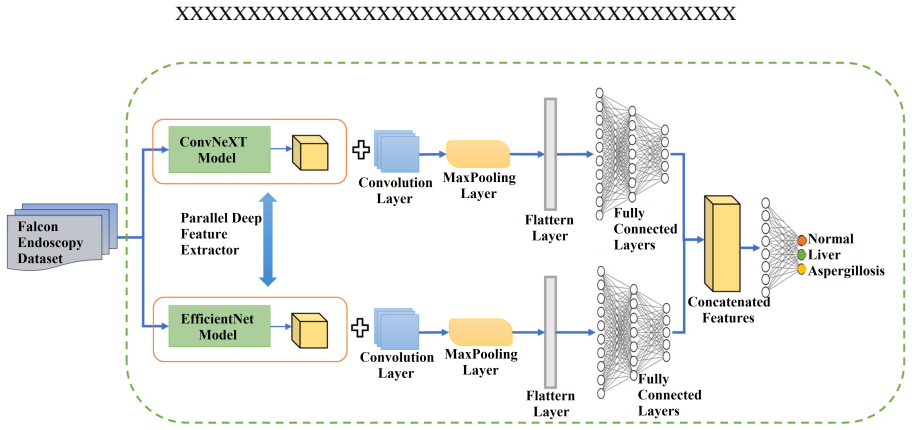
The load-bearing object is the concatenation operation itself: a model architecture whose final feature representations from ConvNeXt and from EfficientNet are merged and passed to a classifier with three output classes. The paper sets the input at 128×128 pixels and trains the joined model over 50 epochs on 80% of the data, using transfer learning to initialize the two branches. ConvNeXt supplies fine-grained visual pattern extraction; EfficientNet supplies efficient scaling and robust feature reuse. The mechanism works by letting each branch's strengths compensate for the other's weaknesses, which is why the authors expect the combined score to beat either branch alone.
What would settle it
Rebuild the model on the same 610 images using three disjoint splits—train, validation for tuning, and a test set seen only once at the end. If the test accuracy on that untouched split falls well below 98%, or no longer clearly beats ConvNeXt and EfficientNet alone, the paper's central claim fails. A cheaper check is to inspect whether any of the 126 test images used for the reported confusion matrices also appear in the 20% set described as 'internal validation.'
Extended reading notes
Core claim
The central claim is that a "concatenated AI model"—the feature outputs of ConvNeXt and EfficientNet joined into one classifier, fine-tuned on endoscopy images—classifies Normal, Liver Disease, and Aspergillosis with a reported 98% average testing accuracy, 0.97 precision, 0.98 recall, and 0.98 F1-score. Per-class results in the paper's Table I show the hybrid reaching 0.96, 0.99, and 0.98 accuracy for Normal, Liver, and Aspergillosis respectively, with the weakest per-class cell being Liver recall at 0.89 for EfficientNet and 0.83 for ConvNeXt. The authors argue this hybrid outperforms traditional diagnostic methods and the two base models on the same test images. In the authors' words, the concatenated model "achieves testing accuracies of 98%, surpassing other deep learning models considered in this study."
Load-bearing premise
The reported 98% accuracy depends on the test images being truly unseen: if the same 20% of images used to tune hyperparameters was also used to compute the final metrics, the score is not an honest estimate.
Editorial extensions
If this is right
- If the 98% accuracy holds, the model can automatically label the great majority of falcon endoscopy images as normal, liver disease, or aspergillosis without a specialist viewing each frame.
- The hybrid's gains over ConvNeXt (87%) and EfficientNet (94%) imply that combining the two feature extractors extracts information neither branch captures alone on this dataset.
- The paper's transfer-learning approach means the same two-branch architecture can be fine-tuned on new disease classes with far fewer images than training from scratch would require.
- A veterinary clinic could use the model as a screening step, flagging suspected aspergillosis or liver disease for rapid confirmatory tests.
Reading between the lines
- I would infer that this concatenation recipe is a general template for veterinary image triage, not a falcon-specific finding, but the paper only demonstrates it on one dataset from one clinic.
- I would not expect the 98% figure to transfer unchanged to images from other clinics, cameras, or lighting conditions, because the paper reports no cross-clinic evaluation.
- The clearest testable extension is to run the identical three-way split with a validation set that is never shown during hyperparameter search; if accuracy stays near 98%, the claim is solid, and if it drops, the published number was inflated by tuning on the test set.
Editorial analysis
A structured set of objections, weighed in public.
Referee Report
Summary. The paper proposes a hybrid deep-learning model that concatenates features from ConvNeXt and EfficientNet to classify falcon endoscopy images into three classes: Normal, Liver Disease, and Aspergillosis. The authors report an average test accuracy of 98% for the hybrid model, compared with 87% for ConvNeXt and 94% for EfficientNet, using a dataset of 610 images from the Sharjah Falcon Clinic. The manuscript includes training curves, confusion matrices, and an ROC curve, and concludes that the concatenated model surpasses both individual architectures and traditional diagnostic methods.
Significance. If the reported accuracy were obtained on a genuinely held-out test set, this would be a modest but useful application of transfer learning to a niche veterinary imaging problem. The comparison against two strong baselines is a reasonable starting point, and the paper gives credit for reporting confusion matrices and training curves. However, the claimed 4-point improvement over EfficientNet rests on a small, single-split, closed dataset with no statistical analysis, and the evaluation protocol is ambiguous. The architectural contribution is also incremental, reusing the concatenation scheme from the authors' prior brain-tumor classification work [2]. The current significance is therefore unverified and largely empirical.
major comments (5)
- [Section III-A and Section IV] The evaluation protocol is ambiguous: the pseudocode in Section III-A describes only a training (80%) and testing (20%) split, while Section IV states that the remaining 20% is used for internal validation and that hyperparameter fine-tuning was executed using the validation set. No separate held-out test set is ever described. If the same 20% of images was used both to tune hyperparameters and to compute the test metrics in Table I, the 98% figure is not an unbiased estimate of generalization, and the comparison against ConvNeXt and EfficientNet is not a fair test.
- [Section IV-B] There is an internal inconsistency in the number of test images: 20% of the stated 610 images is 122, but Section IV-B says the confusion matrices are based on 126 test images. The paper does not explain where the extra four images come from or whether the split was not exactly 80/20. This discrepancy undermines the split accounting and makes the reported metrics unverifiable.
- [Table I and Section IV-A] The Accuracy column in Table I lists per-class accuracy values and an average, but the manuscript never defines per-class accuracy or states whether the average is a macro average. Equation (1) defines only overall accuracy. Without a precise definition and without the underlying per-class counts, the reported average of 0.98 cannot be checked from the confusion matrices.
- [Abstract and Conclusion] The claim that the hybrid model outperforms traditional diagnostic methods is unsupported by the experiments: the study compares only ConvNeXt and EfficientNet and includes no traditional diagnostic modalities such as veterinarian interpretation, radiography, or laboratory tests. This overclaim should be removed or supported by a direct comparative experiment.
- [Section IV] No error bars, confidence intervals, or repeated-run statistics are reported for any of the models. With a single 80/20 split and only 610 images, the difference between 0.98 and 0.94 may be within run-to-run variability, so the claimed superiority of the proposed model over EfficientNet is not statistically established.
minor comments (6)
- [Section I] There are typographical issues with quotation marks in the abstract and introduction, such as "Normal'", "Liver Disease'", and "'Aspergillosis'", where opening quotes are missing.
- [Section IV-B] The text says "Figure 4 and 5" and "Figure 6 show"; the first should be "Figures 4 and 5" and the second should be "Figure 6 shows".
- [Equation (4)] The word "Specificity" is misspelled as "Specif icity" in Equation (4).
- [Section IV] The paper states that each of the three classes contains 203 images, which sums to 609, but the total dataset is stated as 610 images; the remaining image is not accounted for.
- [Fig. 2 and Section III-A] The block diagram is not accompanied by a layer-wise description of the concatenation, such as how the ConvNeXt and EfficientNet features are fused and which dense layers follow the concatenation; specifying this would improve reproducibility.
- [Reference [2]] Reference [2] is the authors' own prior paper on a similar concatenated architecture for brain-tumor classification; the manuscript should state explicitly what is new in the present work beyond applying that architecture to a different dataset.
Circularity Check
No circular derivation: the reported accuracy is an empirical measurement on falcon images, not a quantity forced by the paper's equations or by the self-cited hybrid-architecture paper.
full rationale
The paper makes no first-principles derivation: it trains a concatenation of pretrained ConvNeXt and EfficientNet features on 610 falcon endoscopy images and reports measured accuracy, precision, recall, and F1. The proposed model's superiority is an empirical comparison against two baselines on the same task, not a consequence of the definitions. The only self-citation is [2], the authors' earlier brain-tumor classification paper, which motivates reusing the concatenation ansatz; it is not invoked as a uniqueness theorem or as proof that the falcon result must hold, and the current falcon dataset is independent of that prior work. The 80/20 split language (pseudocode says training/testing; Section IV says training/internal validation with hyperparameter tuning on the validation set) and the mismatch between 122 and 126 test images raise a possible data-leakage or reproducibility concern, but no quoted equation renders the test accuracy equal to the validation accuracy by construction. Under the stated rules, evaluation-bias concerns are correctness risks, not circularity; therefore no circular step is identified.
Assumptions & free parameters
free parameters (4)
- Input image resolution =
128x128
- Batch size =
5
- Training epochs =
50
- Train/test split ratio =
80/20
assumptions (4)
- domain assumption Endoscopy images are correctly labeled as Normal, Liver, or Aspergillosis.
- domain assumption Pretrained ImageNet features are transferable to falcon endoscopy images.
- domain assumption The 80/20 random split produces an independent test set.
- standard math Standard classification metrics (Equations 1-5) are appropriate for this dataset.
Cite this review
Pith. "Pith review of A Hybrid ConvNeXt-EfficientNet AI Solution for Precise Falcon Disease Detection." pith.science (2026). https://pith.science/paper/EVEP4VNH
@misc{pith2026250614816,
  author       = {Pith},
  title        = {Pith review of: A Hybrid ConvNeXt-EfficientNet AI Solution for Precise Falcon Disease Detection},
  year         = {2026},
  howpublished = {\url{https://pith.science/paper/EVEP4VNH}},
  note         = {Machine review of arXiv:2506.14816}
}
read the original abstract
Falconry, a revered tradition involving the training and hunting with falcons, requires meticulous health surveillance to ensure the health and safety of these prized birds, particularly in hunting scenarios. This paper presents an innovative method employing a hybrid of ConvNeXt and EfficientNet AI models for the classification of falcon diseases. The study focuses on accurately identifying three conditions: Normal, Liver Disease and 'Aspergillosis'. A substantial dataset was utilized for training and validating the model, with an emphasis on key performance metrics such as accuracy, precision, recall, and F1-score. Extensive testing and analysis have shown that our concatenated AI model outperforms traditional diagnostic methods and individual model architectures. The successful implementation of this hybrid AI model marks a significant step forward in precise falcon disease detection and paves the way for future developments in AI-powered avian healthcare solutions.
Figures


Figures from the paper (2 more)


Reference graph
Works this paper leans on
-
[2]
A. Panthakkan, S. Anzar, and W. Mansoor, ``Unleashing the power of efficientnet-convnext concatenation for brain tumor classification,'' in 2023 15th Biomedical Engineering International Conference (BMEiCON). 1em plus 0.5em minus 0.4em IEEE, 2023, pp. 1--5
work page 2023
-
[1]
D. Fischer, L. Van Waeyenberghe, C. Cray, M. Gross, E. Usleber, F. Pasmans, A. Martel, and M. Lierz, ``Comparison of diagnostic tools for the detection of aspergillosis in blood samples of experimentally infected falcons,'' Avian Diseases, vol. 58, no. 4, pp. 587--598, 2014
work page 2014
- [3]
-
[4]
M. A. A. Hemeiri, A. A. de la Torre, K. Mohteshamuddin, B. A. Degafa, and G. Ameni, ``Retrospective study on the health problems of falcons in al ain, united arab emirates,'' bioRxiv, pp. 2021--02, 2021
work page 2021
-
[5]
A. F. Alrefaei, ``Molecular detection and genetic characterization of trichomonas gallinae in falcons in saudi arabia,'' Plos one, vol. 15, no. 10, p. e0241411, 2020
work page 2020
-
[6]
W. Tarello, ``Etiologic agents and diseases found associated with clinical aspergillosis in falcons,'' International Journal of Microbiology, vol. 2011, 2011
work page 2011
-
[7]
M. M \"u ller, J. Kinne, R. Schuster, and J. Walochnik, ``Outbreak of microsporidiosis caused by enterocytozoon bieneusi in falcons,'' Veterinary parasitology, vol. 152, no. 1-2, pp. 67--78, 2008
work page 2008
-
[8]
M. A. Mohamed et al., ``Radiographic imaging, endoscopy and haematological profile as indispensable diagnostic tools in falcon health and disease,'' Ph.D. dissertation, Sudan University of Science and Technology, 2014
work page 2014
Show all 12 references
-
[9]
Sadeghi, A
M. Sadeghi, A. Banakar, S. Minaei, M. Orooji, A. Shoushtari, and G. Li, ``Early detection of avian diseases based on thermography and artificial intelligence,'' Animals, vol. 13, no. 14, p. 2348, 2023
2023
-
[10]
J. Zhou, A. H. Gandomi, F. Chen, and A. Holzinger, ``Evaluating the quality of machine learning explanations: A survey on methods and metrics,'' Electronics, vol. 10, no. 5, p. 593, 2021
2021
-
[11]
Kopka and P
H. Kopka and P. W. Daly, A Guide to , 3rd ed. 1em plus 0.5em minus 0.4em Harlow, England: Addison-Wesley, 1999
1999
-
[12]
11em plus .33em minus .07em 4000 4000 100 4000 4000 500 `\.=1000 = #1 \@IEEEnotcompsoconly \@IEEEcompsoconly #1 * [1] 0pt [0pt][0pt] #1 * \| ** #1 \@IEEEauthorblockNstyle \@IEEEauthorblockAstyle \@IEEEcompsocnotconfonly \@IEEEauthordefaulttextstyle \@IEEEcompsocnotconfonly \@I...
Reviewed August 7, 2026 · model on record in the stance chip above.
Discussion (0). Sign in to comment.