REVIEW 4 major objections 5 minor 40 references
DisProtEdit: Exploring Disentangled Representations for Multi-Attribute Protein Editing
T0 review · 4 major / 5 minor · reviewed 2026-08-07 · deepseek-v4-flash
Pith's one-line read DisProtEdit claims that separating structure from function in a protein's latent representation lets text prompts edit either attribute alone or both together, with up to 61.7% success on simultaneous edits.
desk verdict Useful disentanglement framework and dataset for text-guided protein editing, but the oracle-based success rates are not yet convincing. read the letter →
The pith
A machine-rendered reading of the paper's core claim, the machinery that carries it, and where it could break.
The reading
What carries the argument
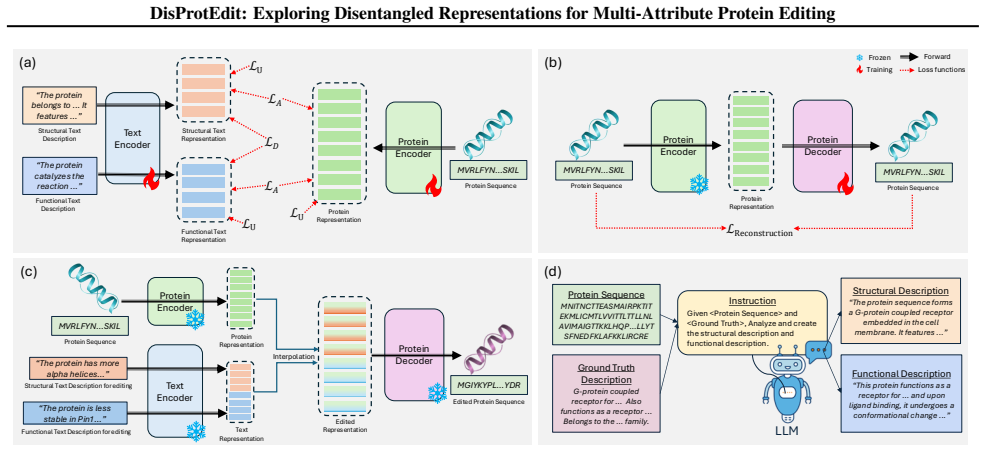
The load-bearing mechanism is a dual-channel, angularly structured latent space. Each protein sequence is aligned to the concatenation of a structural text embedding and a functional text embedding, while separate maximum mean discrepancy (MMD) terms, a kernel-based distance between distributions, pull the two text subspaces toward independent angular priors with radii $\cos\varphi$ and $\sin\varphi$ for $\varphi\in[0,\pi/2]$. At edit time, a masked spherical linear interpolation blends only the half of the embedding whose text description changed, and the unedited half is retained. The angular separation is what lets one attribute be edited without disturbing the other.
What would settle it
Apply the same editing prompts to a control that performs generic destabilizing mutations or edits the functional half without any text conditioning; if that control matches the reported both-hit success rates (up to 61.7%), the disentangled text conditioning is not responsible for the edits. A second check is to take outputs of 'structure edited, function preserved' prompts and test them with an independent functional assay or holdout predictor; if success does not track the intended attribute changes, the oracle-based evaluation is not measuring true editing.
Extended reading notes
Core claim
DisProtEdit's central claim is that structural and functional semantics can be explicitly separated in a shared protein-text embedding, and that this separation enables compositional editing from natural language. The editing procedure takes the original protein embedding, interpolates it with a new text-derived embedding in only the subspace whose description was modified, and decodes an edited sequence. The reported evidence is that single-attribute edits outperform the contrastive baseline on several structure targets, and that combined structure-function prompts reach a both-hit success rate of up to 61.7%, for example increasing alpha-helix content while lowering Pin1 stability. The learned representations also transfer to property prediction, with the best variant reaching 0.5373 Spearman correlation on fluorescence and 0.8258 on stability in the four tasks the paper evaluates.
Load-bearing premise
The results stand on the assumption that the pretrained oracle predictors used to score edited sequences (secondary-structure classifiers and the Villin and Pin1 stability predictors) give accurate, unbiased measurements of the intended attributes for model-generated sequences; the paper's own limitation section says these oracles 'may be noisy or biased, especially for out-of-distribution sequences,' and the multi-attribute benchmark has only 196 sequences.
Editorial extensions
If this is right
- Protein engineers could specify edits as sentences rather than mutation lists, changing structure or function in isolation.
- Multi-attribute editing becomes compositional: one prompt per attribute, applied to the relevant subspace, with up to 61.7% both-hit success on the paper's benchmark.
- The learned representation transfers to property prediction without task-specific alignment, matching or beating joint-embedding baselines on several tasks.
- Replacing contrastive negatives with alignment and uniformity avoids false-negative sampling issues and still produces cross-modal alignment in a single training stage.
Reading between the lines
- The strong asymmetry between increase and decrease edits (destabilization succeeds far more often than stabilization) suggests some reported edits may reflect generic sequence disruption rather than targeted attribute control, a possibility the benchmark's oracle scoring does not rule out.
- The paper never checks that a structural edit preserves function or vice versa, so the cleanest test of disentanglement is still open: measure cross-attribute preservation with independent predictors or assays on the released benchmark.
- If the disentanglement recipe generalizes, the same dual-channel scheme could be applied to other paired protein properties such as stability versus binding specificity or localization versus catalytic activity.
Editorial analysis
A structured set of objections, weighed in public.
Referee Report
Summary. The paper introduces DisProtEdit, a framework for controllable protein editing that learns disentangled representations of structural and functional properties from dual-channel text descriptions. The method uses alignment and uniformity losses to align protein and text embeddings, an MMD-based loss to encourage separation between structural and functional subspaces, and a T5 decoder to reconstruct sequences from edited latents. The authors also release SwissProtDis, a ~540k-entry dataset of protein sequences paired with LLM-decomposed structural and functional descriptions, and a 196-sample multi-attribute editing benchmark. Experiments report editing success rates for single and multi-attribute edits (both-hit up to 61.7%) and competitive TAPE benchmark results. The paper claims modular, interpretable, and controllable editing via text-guided latent interpolation.
Significance. If the claims hold, DisProtEdit would be a valuable contribution: it provides a large dual-channel dataset, a representation-learning objective tailored to protein structure/function disentanglement, and a text-interface editing mechanism that goes beyond joint-embedding baselines. The release of SwissProtDis and the multi-attribute benchmark are useful resources for the community. However, the central claims of disentanglement and controllability are not adequately supported by the current evaluation. The editing metric checks only the sign of oracle-score differences for targeted attributes, and the paper explicitly acknowledges that structural edits were not checked for functional preservation and that oracles may be biased for out-of-distribution sequences. With a small benchmark (N=196) and no confidence intervals or oracle validation, the reported success rates, especially the headline 61.7%, are fragile and may reflect oracle bias or generic degradation rather than genuine disentangled control. The TAPE results also show high sensitivity to the disentanglement weight λD (e.g., fluorescence Spearman 0.16 at λD=0.5 vs 0.54 at λD=1.0), raising concerns about robustness.
major comments (4)
- [Section 4.2, Eq. (10)] The editing success metric only counts whether the oracle-predicted scores for the targeted attributes moved in the instructed direction; it does not check whether untargeted attributes (e.g., structure when function is edited) are preserved. This is exactly the property that the 'disentangled' and 'controllable' claims require. The paper itself states in Section 5 that structural edits were not evaluated for functional preservation and vice versa. As a result, the central claim that DisProtEdit enables modular, disentangled editing is not supported by the presented evidence. Please add a preservation metric (e.g., fraction of untargeted attributes unchanged) or explicitly weaken the claims to 'targeted-attribute editing without evidence of preservation'.
- [Section 3.1, Eqs. (5), (7), (9)] The disentanglement loss and the editing mask rely on a fixed partition of the latent space into structural and functional halves, but the paper does not specify how Z_f and Z_s are extracted from the encoders or how the mask m in Eq. (9) selects the structural versus functional half. The alignment loss in Eq. (5) uses concat(z_ts, z_tf), but the order of concatenation is arbitrary and not tied to any loss term that would enforce 'the first half encodes structural semantics and the second half encodes functional semantics'. The MMD terms in Eq. (7) match Z_f and Z_s to priors X1 and X2, but the relationship between these embeddings and the halves of z_p is not defined. Without this specification, the editing mechanism and the claim of disentangled control are underspecified and cannot be reproduced.
- [Section 4.2, Tables 1 and 2] The evaluation relies on pretrained oracle predictors (secondary-structure classifiers, Villin/Pin1 stability predictors) applied to model-generated sequences that are likely out-of-distribution for those oracles. The authors acknowledge in Section 5 that these oracles 'may be noisy or biased, especially for out-of-distribution sequences,' but no calibration or validation of the oracles on generated sequences is provided. The observed asymmetry—decrease edits succeed at very high rates (−Villin up to 100%, −Pin1 up to 98.44%) while increase edits succeed rarely (+Villin ≤10.94%, +Pin1 ≤14.06%)—is consistent with generic destabilization that the authors attribute to ProteinDT but do not rule out for DisProtEdit. With only 196 samples in the multi-attribute benchmark and no confidence intervals or significance tests, the both-hit numbers (e.g., 61.7% for +α-helices, −Pin1) cannot be distinguished from oracle-driven noise. Please report confidence intervals, perform oracle validation on a held-out set of generated sequences with known properties, or re-frame the quantitative claims as preliminary.
- [Appendix D, Table 6] The example 'structural' descriptions in SwissProtDis often contain family/annotation information rather than structural properties, e.g., 'This protein belongs to the asfivirus MGF 100 family' or 'suggesting it shares structural characteristics common to this family.' If these are representative, the two text channels are not cleanly separated, and the disentanglement target may be mis-specified. This directly affects the premise of the method. Please provide a quantitative analysis of channel separation (e.g., overlap in keywords) and clarify how the LLM decomposition is validated.
minor comments (5)
- [General] Throughout the tables and text, 'α-helice' and 'β-sheet' should be 'α-helices' and 'β-sheets' for grammatical consistency; also 'DisProtEdit' vs 'DisProtE- dit' spacing in the abstract should be fixed.
- [Section 3.1, Eq. (8)] The loss notation is inconsistent: LA is defined but Eq. (8) uses LE = LA + λU LU + λD LD. Clarify whether the reconstruction loss is included in LA or trained separately; the decoder training setup in Appendix A says the decoder is trained separately, so the total training loss for the encoders should be stated explicitly.
- [Section 4.3, Table 3] The fluorescence results are highly sensitive to λD (0.1614 at λD=0.5 vs 0.5373 at λD=1.0). This instability suggests that the reported superiority of DisProtEdit on regression tasks may not be robust; please discuss or provide variance estimates.
- [References] The citation for T5 (Raffel et al., 2023) should be the original 2020 paper (or a later archival version); the current citation is misleading.
- [Section 5] The limitations section is candid and helpful, but the strength of the claims in the abstract and conclusion (e.g., 'explicitly separates semantic factors') is not aligned with the limitations. Please temper the language to match the evidence.
Circularity Check
No significant circularity: DisProtEdit is an empirical training framework whose editing claims are checked against external pretrained oracles and external benchmarks; the disentanglement objective makes separation partly by construction, but no prediction reduces to a fitted input or a self-citation chain.
full rationale
DisProtEdit is a representation-learning method, not a derivation, and I found no load-bearing circular step. The abstract's claim that the model 'explicitly separates semantic factors' is implemented directly through Eq. 7 (MMD to independent angular priors) and Eq. 8, so the separation visualized in Figures 2-4 is partly by construction; however, this is an architectural design choice, not a result claimed to be derived from the data. The headline editing numbers (Tables 1-2) are computed by Eq. 10 using pretrained oracle predictors for secondary structure and Villin/Pin1 stability; these oracles are external to the training objective, and the paper's Section 5 openly warns that they 'may be noisy or biased, especially for out-of-distribution sequences.' That is a validity limitation, not circularity. The TAPE results (Table 3) are likewise external benchmarks. Hyperparameters λU and λD are ablated, not fitted to reproduce the evaluation outcomes; reporting the best 'up to 61.7%' is selection over configurations, not a fitted parameter renamed as a prediction. The only self-citation is the ProteinDT baseline (Liu et al. 2023, with overlapping author H. Guo), which is used as a comparison baseline rather than as a load-bearing premise; no uniqueness theorem or prior result is imported to force the method. The paper's own limitations (no preservation check for cross-attribute edits, oracle bias, decoder overfitting) reduce confidence in the biological claims but do not make the derivation circular. Under the stated rubric, this is 'no significant circularity' with a minor non-load-bearing self-citation.
Assumptions & free parameters
free parameters (4)
- lambda_U (uniformity loss weight) =
0.2
- lambda_D (disentanglement loss weight) =
1.0
- alpha (slerp interpolation factor) =
0.9
- r1^2, r2^2 (angular decomposition radii) =
0.5, 0.5
assumptions (5)
- domain assumption The concatenation of structural and functional text embeddings can approximate the protein embedding (Eq. 5).
- ad hoc to paper MMD matching to angular priors enforces disentanglement between structure and function embeddings (Eq. 7).
- domain assumption GPT-4o decomposition of SwissProt annotations produces accurate, non-overlapping structure/function descriptions.
- domain assumption Oracle predictors (e.g., for alpha helices, Villin, Pin1) provide valid measures of the intended attributes for edited sequences.
- standard math Standard mathematical tools (alignment/uniformity, MMD, slerp) behave as expected in this setting.
Cite this review
Pith. "Pith review of DisProtEdit: Exploring Disentangled Representations for Multi-Attribute Protein Editing." pith.science (2026). https://pith.science/paper/LW4THN4Z
@misc{pith2026250614853,
  author       = {Pith},
  title        = {Pith review of: DisProtEdit: Exploring Disentangled Representations for Multi-Attribute Protein Editing},
  year         = {2026},
  howpublished = {\url{https://pith.science/paper/LW4THN4Z}},
  note         = {Machine review of arXiv:2506.14853}
}
read the original abstract
We introduce DisProtEdit, a controllable protein editing framework that leverages dual-channel natural language supervision to learn disentangled representations of structural and functional properties. Unlike prior approaches that rely on joint holistic embeddings, DisProtEdit explicitly separates semantic factors, enabling modular and interpretable control. To support this, we construct SwissProtDis, a large-scale multimodal dataset where each protein sequence is paired with two textual descriptions, one for structure and one for function, automatically decomposed using a large language model. DisProtEdit aligns protein and text embeddings using alignment and uniformity objectives, while a disentanglement loss promotes independence between structural and functional semantics. At inference time, protein editing is performed by modifying one or both text inputs and decoding from the updated latent representation. Experiments on protein editing and representation learning benchmarks demonstrate that DisProtEdit performs competitively with existing methods while providing improved interpretability and controllability. On a newly constructed multi-attribute editing benchmark, the model achieves a both-hit success rate of up to 61.7%, highlighting its effectiveness in coordinating simultaneous structural and functional edits.
Figures


Figures from the paper (2 more)


Reference graph
Works this paper leans on
-
[1]
J., Bambrick, J., Bodenstein, S
Abramson, J., Adler, J., Dunger, J., Evans, R., Green, T., Pritzel, A., Ronneberger, O., Willmore, L., Ballard, A. J., Bambrick, J., Bodenstein, S. W., Evans, D. A., Hung, C.-C., O’Neill, M., Reiman, D., Tunyasuvunakool, K., Wu, Z., Žemgulytė, A., Arvaniti, E., Beattie, C., Bertolli, O., Bridgland, A., Cherepanov, A., Congreve, M., Cowen-Rivers, A. I., Co...
2024
-
[2]
Scibert: Pretrained language model for scientific text
Beltagy, I., Lo, K., and Cohan, A. Scibert: Pretrained language model for scientific text. In EMNLP, 2019
work page 2019
-
[3]
Proteinbert: a universal deep-learning model of protein sequence and function
Brandes, N., Ofer, D., Peleg, Y., Rappoport, N., and Linial, M. Proteinbert: a universal deep-learning model of protein sequence and function. Bioinformatics, 38 0 (8): 0 2102--2110, 02 2022. ISSN 1367-4803. doi:10.1093/bioinformatics/btac020. URL https://doi.org/10.1093/bioinformatics/btac020
-
[4]
Broomhead, D. and Lowe, D. Multivariable functional interpolation and adaptive networks. Complex Systems, 2: 0 321--355, 1988
work page 1988
-
[5]
A simple framework for contrastive learning of visual representations, 2020
Chen, T., Kornblith, S., Norouzi, M., and Hinton, G. A simple framework for contrastive learning of visual representations, 2020. URL https://arxiv.org/abs/2002.05709
arXiv 2020
-
[6]
Consortium, T. U. Uniprot: the universal protein knowledgebase in 2025. Nucleic Acids Research, 53 0 (D1): 0 D609--D617, 11 2024. ISSN 1362-4962. doi:10.1093/nar/gkae1010. URL https://doi.org/10.1093/nar/gkae1010
-
[7]
Toward de novo protein design from natural language
Dai, F., Fan, Y., Su, J., Wang, C., Han, C., Zhou, X., Liu, J., Qian, H., Wang, S., Zeng, A., Wang, Y., and Yuan, F. Toward de novo protein design from natural language. bioRxiv, 2025. doi:10.1101/2024.08.01.606258. URL https://www.biorxiv.org/content/early/2025/01/24/2024.08.01.606258
-
[8]
Elnaggar, A., Heinzinger, M., Dallago, C., Rehawi, G., Wang, Y., Jones, L., Gibbs, T., Feher, T., Angerer, C., Steinegger, M., BHOWMIK, D., and Rost, B. Prottrans: Towards cracking the language of life s code through self-supervised deep learning and high performance computing. bioRxiv, 2020. doi:10.1101/2020.07.12.199554. URL https://www.biorxiv.org/cont...
Show all 40 references
-
[9]
Gemini 1.5: Unlocking multimodal understanding across millions of tokens of context, 2024
Gemini-Team. Gemini 1.5: Unlocking multimodal understanding across millions of tokens of context, 2024
2024
-
[10]
M., Rasch, M
Gretton, A., Borgwardt, K. M., Rasch, M. J., Sch\" o lkopf, B., and Smola, A. A kernel two-sample test. J. Mach. Learn. Res., 13 0 (null): 0 723–773, March 2012. ISSN 1532-4435
2012
-
[11]
R., Maire, M., and Khademi, M
Huynh, T., Kornblith, S., Walter, M. R., Maire, M., and Khademi, M. Boosting contrastive self-supervised learning with false negative cancellation, 2022. URL https://arxiv.org/abs/2011.11765
2022 arXiv
-
[12]
B., Baranov, M., Costello, Z., Barber, K
Ingraham, J. B., Baranov, M., Costello, Z., Barber, K. W., Wang, W., Ismail, A., Frappier, V., Lord, D. M., Ng-Thow-Hing, C., Van Vlack, E. R., Tie, S., Xue, V., Cowles, S. C., Leung, A., Rodrigues, J. a. V., Morales-Perez, C. L., Ayoub, A. M., Green, R., Puentes, K., Oplinger...
2023 doi
-
[13]
Jumper, J., Evans, R., Pritzel, A., Green, T., Figurnov, M., Ronneberger, O., Tunyasuvunakool, K., Bates, R., Z \' dek, A., Potapenko, A., Bridgland, A., Meyer, C., Kohl, S. A. A., Ballard, A. J., Cowie, A., Romera-Paredes, B., Nikolov, S., Jain, R., Adler, J., Back, T., Peter...
2021
-
[14]
Kingma, D. P. and Ba, J. Adam: A method for stochastic optimization, 2017. URL https://arxiv.org/abs/1412.6980
2017 arXiv
-
[15]
Li, T., Guo, H., Grazioli, F., Gerstein, M., and Min, M. R. Disentangled wasserstein autoencoder for t-cell receptor engineering, 2023. URL https://arxiv.org/abs/2210.08171
2023 arXiv
-
[16]
Mind the gap: Understanding the modality gap in multi-modal contrastive representation learning
Liang, W., Zhang, Y., Kwon, Y., Yeung, S., and Zou, J. Mind the gap: Understanding the modality gap in multi-modal contrastive representation learning. In NeurIPS, 2022. URL https://openreview.net/forum?id=S7Evzt9uit3
2022
-
[17]
Pre-training molecular graph representation with 3d geometry
Liu, S., Wang, H., Liu, W., Lasenby, J., Guo, H., and Tang, J. Pre-training molecular graph representation with 3d geometry. In International Conference on Learning Representations, 2022. URL https://openreview.net/forum?id=xQUe1pOKPam
2022
-
[18]
A text-guided protein design framework
Liu, S., Li, Y., Li, Z., Gitter, A., Zhu, Y., Lu, J., Xu, Z., Nie, W., Ramanathan, A., Xiao, C., Tang, J., Guo, H., and Anandkumar, A. A text-guided protein design framework. arXiv preprint arXiv:2302.04611, 2023
2023 arXiv
-
[19]
Causal effect inference with deep latent-variable models, 2017 a
Louizos, C., Shalit, U., Mooij, J., Sontag, D., Zemel, R., and Welling, M. Causal effect inference with deep latent-variable models, 2017 a . URL https://arxiv.org/abs/1705.08821
2017 arXiv
-
[20]
The variational fair autoencoder, 2017 b
Louizos, C., Swersky, K., Li, Y., Welling, M., and Zemel, R. The variational fair autoencoder, 2017 b . URL https://arxiv.org/abs/1511.00830
2017 arXiv
-
[21]
Y.-C., Yuan, L., and Tian, Y
Lv, L., Lin, Z., Li, H., Liu, Y., Cui, J., Chen, C. Y.-C., Yuan, L., and Tian, Y. Prollama: A protein large language model for multi-task protein language processing. arXiv preprint arXiv:2402.16445, 2024
2024 arXiv
-
[22]
Ma, Z., Fan, C., Wang, Z., Chen, Z., Lin, X., Li, Y., Feng, S., Zhang, J., Cao, Z., and Gao, Y. Q. Prottex: Structure-in-context reasoning and editing of proteins with large language models, 2025. URL https://arxiv.org/abs/2503.08179
2025 arXiv
-
[23]
S., Anand, N., Eguchi, R
Madani, A., McCann, B., Naik, N., Keskar, N. S., Anand, N., Eguchi, R. R., Huang, P.-S., and Socher, R. Progen: Language modeling for protein generation, 2020. URL https://arxiv.org/abs/2004.03497
2020 arXiv
-
[24]
Mathieu, E., Rainforth, T., Siddharth, N., and Teh, Y. W. Disentangling disentanglement in variational autoencoders, 2019. URL https://arxiv.org/abs/1812.02833
2019 arXiv
-
[25]
Umap: Uniform manifold approximation and projection
McInnes, L., Healy, J., Saul, N., and Grossberger, L. Umap: Uniform manifold approximation and projection. The Journal of Open Source Software, 3 0 (29): 0 861, 2018
2018
-
[26]
Colabfold: making protein folding accessible to all
Mirdita, M., Sch \"u tze, K., Moriwaki, Y., Heo, L., Ovchinnikov, S., and Steinegger, M. Colabfold: making protein folding accessible to all. Nature Methods, 19 0 (6): 0 679--682, Jun 2022. ISSN 1548-7105. doi:10.1038/s41592-022-01488-1. URL https://doi.org/10.1038/s41592-022-01488-1
2022 doi
-
[27]
N., Naik, N., and Madani, A
Nijkamp, E., Ruffolo, J., Weinstein, E. N., Naik, N., and Madani, A. Progen2: Exploring the boundaries of protein language models, 2023. URL https://openreview.net/forum?id=ZOn4HXehSJ6
2023
-
[28]
Gpt-4 technical report, 2023
OpenAI. Gpt-4 technical report, 2023
2023
-
[29]
A., Zhang, R., and Zhu, J.-Y
Park, T., Efros, A. A., Zhang, R., and Zhu, J.-Y. Contrastive learning for unpaired image-to-image translation, 2020. URL https://arxiv.org/abs/2007.15651
2020 arXiv
-
[30]
Raffel, C., Shazeer, N., Roberts, A., Lee, K., Narang, S., Matena, M., Zhou, Y., Li, W., and Liu, P. J. Exploring the limits of transfer learning with a unified text-to-text transformer, 2023. URL https://arxiv.org/abs/1910.10683
2023 arXiv
-
[31]
Rao, R., Bhattacharya, N., Thomas, N., Duan, Y., Chen, X., Canny, J., Abbeel, P., and Song, Y. S. Evaluating protein transfer learning with tape. In Advances in Neural Information Processing Systems, 2019
2019
-
[32]
L., Ma, J., and Fergus, R
Rives, A., Meier, J., Sercu, T., Goyal, S., Lin, Z., Liu, J., Guo, D., Ott, M., Zitnick, C. L., Ma, J., and Fergus, R. Biological structure and function emerge from scaling unsupervised learning to 250 million protein sequences. PNAS, 2019. doi:10.1101/622803. URL https://www....
2019 doi
-
[33]
Contrastive learning with hard negative samples, 2021
Robinson, J., Chuang, C.-Y., Sra, S., and Jegelka, S. Contrastive learning with hard negative samples, 2021. URL https://arxiv.org/abs/2010.04592
2021 arXiv
-
[34]
Representation learning with contrastive predictive coding, 2019
van den Oord, A., Li, Y., and Vinyals, O. Representation learning with contrastive predictive coding, 2019. URL https://arxiv.org/abs/1807.03748
2019 arXiv
-
[35]
and Isola, P
Wang, T. and Isola, P. Understanding contrastive representation learning through alignment and uniformity on the hypersphere. In International Conference on Machine Learning, pp.\ 9929--9939. PMLR, 2020
2020
-
[36]
L., Juergens, D., Bennett, N
Watson, J. L., Juergens, D., Bennett, N. R., Trippe, B. L., Yim, J., Eisenach, H. E., Ahern, W., Borst, A. J., Ragotte, R. J., Milles, L. F., Wicky, B. I. M., Hanikel, N., Pellock, S. J., Courbet, A., Sheffler, W., Wang, J., Venkatesh, P., Sappington, I., Torres, S. V., Lauko,...
2023
-
[37]
Mind the class weight bias: Weighted maximum mean discrepancy for unsupervised domain adaptation, 2017
Yan, H., Ding, Y., Li, P., Wang, Q., Xu, Y., and Zuo, W. Mind the class weight bias: Weighted maximum mean discrepancy for unsupervised domain adaptation, 2017. URL https://arxiv.org/abs/1705.00609
2017 arXiv
-
[38]
Multi-modal clip-informed protein editing, 2024
Yin, M., Zhou, H., Zhu, Y., Lin, M., Wu, Y., Wu, J., Xu, H., Hsieh, C.-Y., Hou, T., Chen, J., and Wu, J. Multi-modal clip-informed protein editing, 2024. URL https://arxiv.org/abs/2407.19296
2024 arXiv
-
[39]
Ontoprotein: Protein pretraining with gene ontology embedding
Zhang, N., Bi, Z., Liang, X., Cheng, S., Hong, H., Deng, S., Zhang, Q., Lian, J., and Chen, H. Ontoprotein: Protein pretraining with gene ontology embedding. In International Conference on Learning Representations, 2022. URL https://openreview.net/forum?id=yfe1VMYAXa4
2022
-
[40]
write newline
" write newline "" before.all 'output.state := FUNCTION n.dashify 't := "" t empty not t #1 #1 substring "-" = t #1 #2 substring "--" = not "--" * t #2 global.max substring 't := t #1 #1 substring "-" = "-" * t #2 global.max substring 't := while if t #1 #1 substring * t #2 gl...
Reviewed August 7, 2026 · model on record in the stance chip above.
Discussion (0). Sign in to comment.