REVIEW 5 major objections 5 minor 71 references
Enhancing point cloud analysis via neighbor aggregation correction based on cross-stage structure correlation
T0 review · 5 major / 5 minor · reviewed 2026-08-15 · deepseek-v4-flash
Pith's one-line read A neighbor-aggregation correction based on cross-stage structure correlation improves point cloud segmentation and classification accuracy.
desk verdict A plausible new PointNet++ aggregation module with coherent ablations, but an unrelated 'Limitations' section pasted into the manuscript means the numbers need code verification before anyone should trust them. read the letter →
The pith
A machine-rendered reading of the paper's core claim, the machinery that carries it, and where it could break.
The reading
What carries the argument
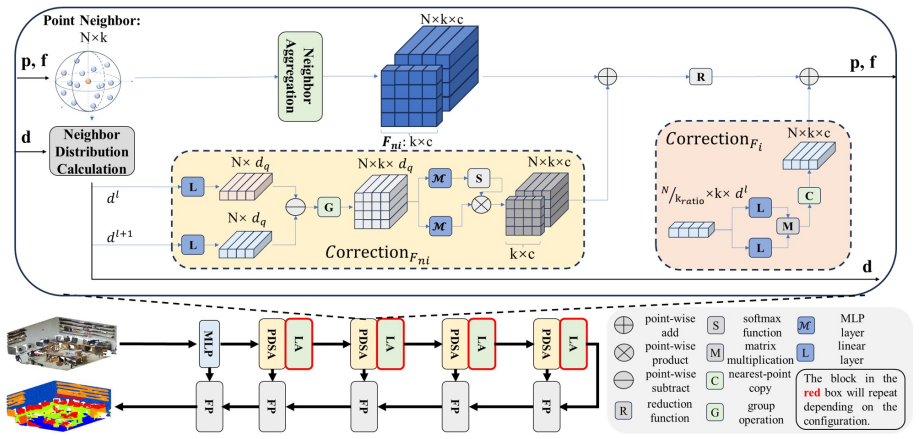
The load-bearing mechanism is the Point-Distribution Set Abstraction (PDSA) module, built on a Lightweight Cross-stage Structure Descriptor (LCSD). The LCSD encodes, for each point, the distribution of its neighbors across eight spatial octants, with distance-aware relative weights and a dimension-reducing linear layer that lets the descriptor be propagated across stages. CDIP (correction for denoising irrelevant points) uses the difference between the next-stage neighbor descriptor and each point's descriptor, in a cross-attention-inspired formulation, to compute an attention weight and a structural code added into the neighbor feature matrix, thus reducing its per-channel variance. CICS (correction for improving class separability) applies global self-attention to the descriptor to pull in long-range context; to keep cost down, a key-point selection mechanism ranks points by aggregated attention weight and computes the global correction only at those points, copying it to the rest of the neighbor. The paper's Eq. (7) summarizes the combined correction: pooled neighbor features are corrected both inside the neighbor matrix and at the pooled output.
What would settle it
Run a capacity-matched ablation: replace CDIP with an additive correction of equal parameter and flop budget that does not reduce neighbor-feature variance, keeping LCSD and CICS fixed, and measure S3DIS mIoU. If the variance-reducing version does not beat the capacity-matched alternative, the paper's stated mechanism is not what drives the gain. A complementary check is to compute a conventional Rademacher or Gaussian complexity bound for a randomly initialized shared-MLP aggregation block on a fixed neighborhood and test whether the min-max quantity in Eq. (4) predicts observed generalization across neighborhoods with different feature variance.
Extended reading notes
Core claim
On the paper's own terms, the central claim is that neighbor aggregation in point cloud networks can be improved by correcting the distribution of aggregated features in high-dimensional space using a cross-stage structure descriptor, rather than by refining low-dimensional geometric descriptions. The PDSA module operationalizes this: a lightweight descriptor aggregates octant-wise distribution features of each neighborhood with distance-aware weights across network stages; the CDIP operation compares each neighbor's descriptor with the next-stage neighbor descriptor to generate attention weights and structural codes that reduce the variance of the neighbor feature matrix; and the CICS operation applies a global self-attention over the descriptor, restricted to automatically selected key points, to sharpen class separability. The paper reports that a network composed entirely of PDSA modules (PD-base-XL) reaches 71.2 percent mIoU and 91.0 percent OA on S3DIS Area 5 with 12.5 million parameters, and that adding PDSA to the PointVector baseline (PD-vp-XL) reaches 73.4 percent mIoU and 91.8 percent OA. These numbers are presented as evidence that distribution correction during aggregation generalizes across baselines and tasks.
Load-bearing premise
The load-bearing premise is that reducing the Euclidean spread of neighbor-point features inside each aggregated neighborhood is what improves generalization (Eq. 4); if that bound is not valid for shared-MLP aggregation, the theoretical motivation for the CDIP correction is unsupported, even though the module could still work empirically.
Editorial extensions
If this is right
- Replacing standard Set Abstraction modules with PDSA improves S3DIS semantic segmentation: PD-base-XL reports 71.2 percent mIoU and 91.0 percent OA with 12.5M parameters, versus 63.6 percent mIoU for the PointNet++(OP) baseline, and PD-vp-XL reports 73.4 percent mIoU and 91.8 percent OA, above the PointVector-XL baseline.
- The ablation attributes the gain mainly to CDIP, which adds 5.1 percent mIoU over the PointNet++ baseline; the distance-aware weight in the LCSD adds 1.1 percent, and CICS adds 1.4 percent.
- The module generalizes to classification: PD-S reaches 87.3 percent OA and 85.5 percent mAcc on ScanObjectNN, and 93.1 percent OA and 90.4 percent mAcc on ModelNet40 with 2.5M parameters.
- Using PDSA in the local-aggregation block of an existing baseline (PointVector) improves that baseline by 0.8 percent mIoU and 1.1 percent OA, suggesting the correction is modular rather than tied to one architecture.
- Because PDSA compares each point with the overall neighbor distribution rather than pairwise point similarities, it is designed to handle the irregular neighborhoods produced by K-NN or ball-query grouping.
Reading between the lines
- Editorial inference: because the LCSD is an octant histogram with distance weights, it is aligned to the global coordinate axes; on rotation-augmented or orientation-varied inputs the descriptor itself rotates, so a testable extension is to make the descriptor rotation-invariant by canonicalizing the octants with a local frame and see whether the reported gains persist.
- Editorial inference: the key-point mechanism selects points by aggregated attention weights, so in highly class-imbalanced scenes the selected key points may under-represent rare classes; a class-balanced key-point sampling variant would test whether the CICS correction has a class-bias failure mode.
- Editorial inference: the theoretical motivation for CDIP is not tightly established, since the cited Gaussian-complexity bound is not reproduced for shared-MLP aggregation; the empirical gains could in principle come from the added capacity of the attention-style correction rather than from variance reduction, and a capacity-matched ablation would separate these.
- Editorial note on the manuscript text: the appended 'Limitations' paragraph concerns an unrelated ASCD/FlashAttention/hallucination-mitigation mechanism, not the PDSA point-cloud method, so it should not be read as a stated limitation of the claims here.
Signed reviews
Editorial analysis
A structured set of objections, weighed in public.
Referee Report
Summary. The paper proposes Point-Distribution Set Abstraction (PDSA), a drop-in replacement for the Set Abstraction module in PointNet++-style architectures for point cloud analysis. The method introduces a lightweight cross-stage structure descriptor (LCSD) based on octant distributions with distance weights, and two correction operations applied during neighbor aggregation: CDIP, which re-weights neighbor features to suppress irrelevant points, and CICS, which applies a global self-attention mechanism over descriptors, approximated by a key-point selection scheme, to improve class separability. The authors build two network families, PD-base and PD-vp, on top of the OpenPoint/PointNeXt and PointVector baselines, and evaluate on S3DIS semantic segmentation, ScanObjectNN and ModelNet40 classification, along with ablations and visualizations. The main empirical claim is that PD-base-XL outperforms PointNet++(OP) by 7.6% mIoU and 2.7% OA, and PointNeXt-XL by 0.7% mIoU and 0.4% OA, at roughly 70% fewer parameters, and that PD-vp-XL outperforms PointVector-XL by 0.8% mIoU and 1.1% OA.
Significance. If the empirical results are reproducible, the paper makes a useful and falsifiable contribution: a parameter-efficient neighbor-aggregation correction that is shown to improve several modern point cloud baselines, with a decomposed ablation study isolating CDIP, the distance weight, and CICS. The central idea of correcting the high-dimensional feature distribution via a lightweight structural descriptor, rather than adding high-dimensional geometric encodings, is plausible and worth testing, and the paper includes an explicit code/weights link, which is a strength. However, the significance of the contribution is currently limited by an unsupported theoretical premise in Eq. (4), an internally incoherent final section, absent variance reporting on small performance margins, and an underspecified key-point mechanism. These issues must be resolved before the central claims can be accepted.
major comments (5)
- [Limitations (final section before References)] The final section, titled 'Limitations', describes an 'ASCD' method that dynamically modifies the attention matrix at inference time, its incompatibility with FlashAttention, hallucination-mitigation behavior, and distillation of a steering signal into native attention via KL divergence. None of these concepts appears in the proposed PDSA/LCSD/CDIP/CICS pipeline; the only occurrence of 'ACSD' is in Sec. 3.3.1, where it is evidently a typo for LCSD. This is not a cosmetic issue: the section reports limitations of a different research artifact, so the manuscript's text cannot be attributed to the point cloud method whose experiments appear in Tables 1-6. I ask the authors to replace this section with a genuine discussion of PDSA's limitations and to provide the released code and weights so that the reported numbers can be independently checked.
- [Sec. 3.2.1, Eq. (4)] Eq. (4) is presented as an upper bound on the Gaussian complexity of the neighbor aggregation network, attributed to references [24,47]. As written, the expression is not a valid bound: the min/max quantifiers have no declared optimization variable, the sum over j is indexed in the same expression that quantifies over p_j, the quantity depends only on input and feature coordinates rather than on the hypothesis class of the shared MLP, and neither [24] nor [47] derives this bound. Since the CDIP correction is motivated by the claim that reducing this quantity improves generalization, Eq. (4) is load-bearing. Please replace it with a correct and citable complexity bound for the 1x1-convolution aggregation used here, or explicitly reframe CDIP as a heuristic denoising operation, so that the generalization argument is not based on an invalid formula.
- [Sec. 4.2 and Table 2] The text reports 'improvements of 19.1% OA, 22.1% mAcc and 3.9% OA, 4.2% mAcc on ScanObjectNN and ModelNet40 datasets respectively' compared with PointNet++. Table 2 gives PointNet++ 77.9% OA / 75.4% mAcc on ScanObjectNN and 91.9% OA on ModelNet40, so the actual deltas for PD-S are +9.4 OA, +10.1 mAcc, and +1.2 OA; the 3.9/4.2 values are the deltas with respect to PointNet, not PointNet++. Please correct the text or the table and verify that every numeric comparison in the paper is consistent with the corresponding table.
- [Tables 1-6 (experimental protocol)] All experiments are reported as single runs without standard deviations or the number of seeds. Several headline claims are small margins that in this field are comparable to seed-level noise: PD-base-XL over PointNeXt-XL by +0.7 mIoU / +0.4 OA, PD-vp-XL over PointVector-XL by +0.8 mIoU / +1.1 OA, and the ablation step from CDIP+D_w to CDIP+D_w+CICS by +1.4 mIoU. Please report mean and standard deviation over at least three seeds for the main tables and ablations, and release the exact training and evaluation scripts so that the claimed improvements can be verified.
- [Sec. 3.3.3 and Sec. 4] The key-point mechanism is an essential part of CICS's efficiency story, but the paper never specifies the selection algorithm: it refers to 'statistical aggregates of attention weights' and 'ranking-based thresholding' without defining the statistic, the threshold, or the resulting key-point ratio. Moreover, no runtime, memory, or FLOPs comparison is presented anywhere in the experiments; the paper reports only parameter counts. The claim that key-point selection 'optimizes the computational overhead' is therefore not empirically supported. Please give a precise algorithm and complexity analysis, and report measured training/inference time and memory for PD-base-XL with and without the key-point mechanism.
minor comments (5)
- [Sec. 3.3.1] The descriptor is introduced as 'ACSD' but is referred to as LCSD everywhere else; please use a single acronym consistently throughout the paper.
- [Table 5] Table 5 is difficult to read: the check-mark columns are not aligned in the typeset text, and the text says B3 and B4 gain 0.6% and 0.9% from Dw, but those deltas do not follow from the displayed B1/B2 values. Please redraw the table and reconcile the stated deltas with the numbers shown.
- [Sec. 4.2] Please fix the typo 'PoinNet++' in the text, the citation 'PointNet++ [[35]]', and the misspelled dataset name 'ScanObjecNN'.
- [Figure 5] Figure 5 is referenced in the text ('Figure 5: Illustration of the network architecture') but is not present in the submitted version; please ensure the PDF contains all figures.
- [Sec. 3.2] The notation Correct(·) is used in Eqs. (5)-(7) before the arguments r_v and r_g are defined in Sec. 3.3; consider reordering or defining these symbols earlier to improve readability.
Circularity Check
No circular derivation found: PDSA gains are measured against external baselines, though the manuscript has serious non-circular coherence and attribution problems.
full rationale
The derivation of PDSA is self-contained with respect to its empirical claims. The reported gains in Tables 1 and 2 are comparisons against external baselines (PointNet++, PointNeXt, PointVector, etc.) on S3DIS, ScanObjectNN, and ModelNet40, and no target metric is defined in terms of LCSD, CDIP, or CICS. CDIP and CICS are heuristic corrections built on a hand-crafted octant descriptor; their motivation cites [24,47] for Eq. (4), but that equation is malformed and not needed to define the module, so it is an unsupported premise rather than a circular input. Hyperparameters such as the LCSD compression dimension are selected by ablation on the same benchmark (Sec. 4.3, Table 6), which is standard tuning, not a fitted parameter renamed as a prediction. I find no step in which a claimed prediction is equivalent by construction to the fitted inputs, and no self-citation chain carries the argument. Two serious non-circular concerns should be flagged explicitly. First, Eq. (4) in Sec. 3.2.1, attributed to [24,47], is malformed as written and does not correspond to a standard Gaussian complexity bound, so the theoretical motivation for CDIP is not established. Second, the 'Limitations' section (final section before the references) discusses an unrelated ASCD/FlashAttention hallucination-mitigation method: 'A key limitation of ASCD is its incompatibility with FlashAttention... the model would internalise the hallucination-mitigation behaviour.' ASCD is never defined in the paper and none of these concepts appear in the PDSA/LCSD/CDIP/CICS method. That incoherence undermines the manuscript's reliability and auditability, but it is a correctness/reproducibility problem, not a circularity in the derivation chain.
Assumptions & free parameters
free parameters (5)
- initial LCSD dimension d^0 =
8
- per-layer descriptor compression dimension =
3
- distance weight radius =
grouping radius (unspecified)
- key point selection threshold and count =
not specified
- number of octants =
8
assumptions (4)
- ad hoc to paper Eq. (4) states an upper bound on Gaussian complexity of the neighbor aggregation network as a min-max Euclidean row distance of the neighbor feature matrix, and reducing this distance improves generalization.
- domain assumption Point clouds are non-Euclidean manifold data where local relative coordinates cannot accurately characterize high-dimensional feature distributions, motivating global correction.
- domain assumption The octant distribution descriptor LCSD, computed via distance-weighted aggregation, preserves enough geometric correlation to distinguish irrelevant points and improve feature separability across stages.
- ad hoc to paper Key point selection by ranking aggregated attention weights preserves global context for class separability in large scenes.
invented entities (1)
-
Lightweight Cross-stage Structure Descriptor (LCSD/ACSD)
Cite this review
Pith. "Pith review of Enhancing point cloud analysis via neighbor aggregation correction based on cross-stage structure correlation." pith.science (2026). https://pith.science/paper/TPKRZA4B
@misc{pith2026250615160,
  author       = {Pith},
  title        = {Pith review of: Enhancing point cloud analysis via neighbor aggregation correction based on cross-stage structure correlation},
  year         = {2026},
  howpublished = {\url{https://pith.science/paper/TPKRZA4B}},
  note         = {Machine review of arXiv:2506.15160}
}
read the original abstract
Point cloud analysis is the cornerstone of many downstream tasks, among which aggregating local structures is the basis for understanding point cloud data. While numerous works aggregate neighbor using three-dimensional relative coordinates, there are irrelevant point interference and feature hierarchy gap problems due to the limitation of local coordinates. Although some works address this limitation by refining spatial description though explicit modeling of cross-stage structure, these enhancement methods based on direct geometric structure encoding have problems of high computational overhead and noise sensitivity. To overcome these problems, we propose the Point Distribution Set Abstraction module (PDSA) that utilizes the correlation in the high-dimensional space to correct the feature distribution during aggregation, which improves the computational efficiency and robustness. PDSA distinguishes the point correlation based on a lightweight cross-stage structural descriptor, and enhances structural homogeneity by reducing the variance of the neighbor feature matrix and increasing classes separability though long-distance modeling. Additionally, we introducing a key point mechanism to optimize the computational overhead. The experimental result on semantic segmentation and classification tasks based on different baselines verify the generalization of the method we proposed, and achieve significant performance improvement with less parameter cost. The corresponding ablation and visualization results demonstrate the effectiveness and rationality of our method. The code and training weight is available at: https://github.com/AGENT9717/PointDistribution
Figures


Figures from the paper (4 more)



Reference graph
Works this paper leans on
-
[24]
Xingyi Li, Fuxin Li, Xiaoli Fern, and Raviv Raich
-
[47]
Wenxuan Wu, Li Fuxin, and Qi Shan. 2023. Point- convformer: Revenge of the point-based convolu- tion. InProceedings of the IEEE/CVF Conference on Computer Vision and Pattern Recognition, pages 21802–21813
work page 2023
-
[1]
Iro Armeni, Ozan Sener, Amir R Zamir, Helen Jiang, Ioannis Brilakis, Martin Fischer, and Silvio Savarese
-
[2]
Peter L Bartlett and Shahar Mendelson. 2002. Rademacher and gaussian complexities: Risk bounds and structural results.Journal of Machine Learning Research, 3(Nov):463–482
work page 2002
-
[3]
Alexandre Boulch. 2020. Convpoint: Continuous convolutions for point cloud processing.Computers & Graphics, 88:24–34
work page 2020
-
[4]
Alexandre Boulch, Bertrand Le Saux, Nicolas Aude- bert, and 1 others. 2017. Unstructured point cloud semantic labeling using deep segmentation networks. 3dor@ eurographics, 3:1–8. 14
work page 2017
-
[5]
Y-Lan Boureau, Jean Ponce, and Yann LeCun. 2010. A theoretical analysis of feature pooling in visual recognition. InProceedings of the 27th international conference on machine learning (ICML-10), pages 111–118
work page 2010
-
[6]
Lifang Chen and Qian Zhang. 2023. Ddgcn: graph convolution network based on direction and dis- tance for point cloud learning.The visual computer, 39(3):863–873
work page 2023
Show all 71 references
-
[7]
Xiaozhi Chen, Huimin Ma, Ji Wan, Bo Li, and Tian Xia. 2017. Multi-view 3d object detection network for autonomous driving. InProceedings of the IEEE conference on Computer Vision and Pattern Recogni- tion, pages 1907–1915
2017
-
[8]
Alireza Dehghanpour, Zahra Sharifi, and Masoud Dehyadegari. 2024. Point cloud downsampling based on the transformer features.The Visual Computer, pages 1–10
2024
-
[9]
Xin Deng, WenYu Zhang, Qing Ding, and Xin- Ming Zhang. 2023. Pointvector: a vector represen- tation in point cloud analysis. InProceedings of the IEEE/CVF Conference on Computer Vision and Pattern Recognition, pages 9455–9465
2023
-
[10]
2017.LiDAR remote sensing and applications
Pinliang Dong and Qi Chen. 2017.LiDAR remote sensing and applications. CRC Press
2017
-
[11]
Lunhao Duan, Shanshan Zhao, Nan Xue, Ming- ming Gong, Gui-Song Xia, and Dacheng Tao. 2024. Condaformer: Disassembled transformer with local structure enhancement for 3d point cloud understand- ing.Advances in Neural Information Processing Systems, 36
2024
-
[12]
Meng-Hao Guo, Jun-Xiong Cai, Zheng-Ning Liu, Tai-Jiang Mu, Ralph R Martin, and Shi-Min Hu. 2021. Pct: Point cloud transformer.Computational Visual Media, 7:187–199
2021
-
[13]
Yulan Guo, Hanyun Wang, Qingyong Hu, Hao Liu, Li Liu, and Mohammed Bennamoun. 2020. Deep learning for 3d point clouds: A survey.IEEE trans- actions on pattern analysis and machine intelligence, 43(12):4338–4364
2020
-
[14]
Jiawei Han, Kaiqi Liu, Wei Li, and Guangzhi Chen
-
[15]
Xu Han, Zhen Dong, and Bisheng Yang. 2021. A point-based deep learning network for semantic seg- mentation of mls point clouds.ISPRS Journal of Photogrammetry and Remote Sensing, 175:199–214
2021
-
[16]
Shuting He, Henghui Ding, Xudong Jiang, and Bi- han Wen. 2025. Segpoint: Segment any point cloud via large language model. InEuropean Conference on Computer Vision, pages 349–367. Springer
2025
-
[17]
Yunqian He, Guihua Xia, Hongchao Feng, and Zhe Wang. 2023. Pctp: point cloud transformer pooling block for points set abstraction structure.The Visual Computer, 39(11):5669–5681
2023
-
[18]
Qingyong Hu, Bo Yang, Linhai Xie, Stefano Rosa, Yulan Guo, Zhihua Wang, Niki Trigoni, and Andrew Markham. 2020. Randla-net: Efficient semantic seg- mentation of large-scale point clouds. InProceedings of the IEEE/CVF conference on computer vision and pattern recognition, pages...
2020
-
[19]
Junjie Huang, Guan Huang, Zheng Zhu, Yun Ye, and Dalong Du. 2021. Bevdet: High-performance multi-camera 3d object detection in bird-eye-view. arXiv preprint arXiv:2112.11790
2021 arXiv
-
[20]
Asako Kanezaki, Yasuyuki Matsushita, and Yoshi- fumi Nishida. 2018. Rotationnet: Joint object cat- egorization and pose estimation using multiviews from unsupervised viewpoints. InProceedings of the IEEE conference on computer vision and pattern recognition, pages 5010–5019
2018
-
[21]
Ahmad Karambakhsh, Bin Sheng, Ping Li, Huat- ing Li, Jinman Kim, Younhyun Jung, and CL Philip Chen. 2022. Sparsevoxnet: 3-d object recognition with sparsely aggregation of 3-d dense blocks.IEEE Transactions on Neural Networks and Learning Sys- tems, 35(1):532–546
2022
-
[22]
Loic Landrieu and Martin Simonovsky. 2018. Large-scale point cloud semantic segmentation with superpoint graphs. InProceedings of the IEEE con- ference on computer vision and pattern recognition, pages 4558–4567
2018
-
[23]
Rongkang Li, Yumeng Zhang, Dongmei Niu, Guangchao Yang, Numan Zafar, Caiming Zhang, and Xiuyang Zhao. 2021. Pointvgg: Graph convolutional network with progressive aggregating features on point clouds.Neurocomputing, 429:187–198
2021
-
[25]
Yangyan Li, Rui Bu, Mingchao Sun, Wei Wu, Xin- han Di, and Baoquan Chen. 2018. Pointcnn: Convo- lution on x-transformed points.Advances in neural information processing systems, 31
2018
-
[26]
Yong Li, Zhenqin Ye, Xingwen Huang, Yubin HeLi, and Feng Shuang. 2025. Lcl_fda: Local context learning and full-level decoder aggregation network for large-scale point cloud semantic segmentation. Neurocomputing, 621:129321
2025
-
[27]
Haojia Lin, Xiawu Zheng, Lijiang Li, Fei Chao, Shanshan Wang, Yan Wang, Yonghong Tian, and Rongrong Ji. 2023. Meta architecture for point cloud analysis. InProceedings of the IEEE/CVF Confer- ence on Computer Vision and Pattern Recognition, pages 17682–17691. 15
2023
-
[28]
Ze Liu, Han Hu, Yue Cao, Zheng Zhang, and Xin Tong. 2020. A closer look at local aggregation op- erators in point cloud analysis. InComputer Vision– ECCV 2020: 16th European Conference, Glasgow, UK, August 23–28, 2020, Proceedings, Part XXIII 16, pages 326–342. Springer
2020
-
[29]
Daniel Maturana and Sebastian Scherer. 2015. V oxnet: A 3d convolutional neural network for real- time object recognition. In2015 IEEE/RSJ interna- tional conference on intelligent robots and systems (IROS), pages 922–928. IEEE
2015
-
[31]
Bohao Peng, Xiaoyang Wu, Li Jiang, Yukang Chen, Hengshuang Zhao, Zhuotao Tian, and Jiaya Jia. 2024. Oa-cnns: Omni-adaptive sparse cnns for 3d semantic segmentation. InProceedings of the IEEE/CVF Con- ference on Computer Vision and Pattern Recognition, pages 21305–21315
2024
-
[32]
Oddy Virgantara Putra, Kohichi Ogata, Eko Mulyanto Yuniarno, and Mauridhi Hery Purnomo. 2025. Adacrossnet: Adaptive dynamic loss weighting for cross-modal contrastive point cloud learning.International Journal of Intelligent Engineering & Systems, 18(1)
2025
-
[33]
Charles R Qi, Hao Su, Kaichun Mo, and Leonidas J Guibas. 2017. Pointnet: Deep learning on point sets for 3d classification and segmentation. InProceed- ings of the IEEE conference on computer vision and pattern recognition, pages 652–660
2017
-
[34]
Charles Ruizhongtai Qi, Li Yi, Hao Su, and Leonidas J Guibas. 2017. Pointnet++: Deep hier- archical feature learning on point sets in a metric space.Advances in neural information processing systems, 30
2017
-
[35]
Guocheng Qian, Yuchen Li, Houwen Peng, Jinjie Mai, Hasan Hammoud, Mohamed Elhoseiny, and Bernard Ghanem. 2022. Pointnext: Revisiting point- net++ with improved training and scaling strategies. Advances in neural information processing systems, 35:23192–23204
2022
-
[36]
Haibo Qiu, Baosheng Yu, Yixin Chen, and Dacheng Tao. 2023. Pointhr: Exploring high-resolution ar- chitectures for 3d point cloud segmentation.arXiv preprint arXiv:2310.07743
2023 arXiv
-
[37]
Damien Robert, Hugo Raguet, and Loic Landrieu
-
[38]
Mark Sandler, Andrew Howard, Menglong Zhu, An- drey Zhmoginov, and Liang-Chieh Chen. 2018. Mo- bilenetv2: Inverted residuals and linear bottlenecks. InProceedings of the IEEE conference on computer vision and pattern recognition, pages 4510–4520
2018
-
[39]
Shuofeng Sun, Yongming Rao, Jiwen Lu, and Haibin Yan. 2024. X-3d: Explicit 3d structure mod- eling for point cloud recognition. InProceedings of the IEEE/CVF Conference on Computer Vision and Pattern Recognition, pages 5074–5083
2024
-
[40]
Hugues Thomas, Charles R Qi, Jean-Emmanuel Deschaud, Beatriz Marcotegui, François Goulette, and Leonidas J Guibas. 2019. Kpconv: Flexible and deformable convolution for point clouds. InProceed- ings of the IEEE/CVF international conference on computer vision, pages 6411–6420
2019
-
[41]
In2024 International Confer- ence on 3D Vision (3DV), pages 179–189
Scalable 3d panoptic segmentation as super- point graph clustering. In2024 International Confer- ence on 3D Vision (3DV), pages 179–189. IEEE
-
[42]
Fei Wang, Xing Zhang, Yong Jiang, Li Kong, and Xiaotong Wei. 2020. Patchcnn: An explicit convo- lution operator for point clouds perception.IEEE Geoscience and Remote Sensing Letters, 18(4):726– 730
2020
-
[43]
Jinyang Wang, Xuequan Lu, Mohammed Ben- namoun, and Bin Sheng. 2025. Non-rigid point cloud registration via anisotropic hybrid field harmoniza- tion.IEEE Transactions on Pattern Analysis and Machine Intelligence
2025
-
[44]
Lei Wang, Yuchun Huang, Yaolin Hou, Shenman Zhang, and Jie Shan. 2019. Graph attention convolu- tion for point cloud semantic segmentation. InPro- ceedings of the IEEE/CVF conference on computer vision and pattern recognition, pages 10296–10305
2019
-
[45]
Mikaela Angelina Uy, Quang-Hieu Pham, Binh- Son Hua, Thanh Nguyen, and Sai-Kit Yeung. 2019. Revisiting point cloud classification: A new bench- mark dataset and classification model on real-world data. InProceedings of the IEEE/CVF international conference on computer vision, ...
2019
-
[46]
Kevin Tirta Wijaya, Dong-Hee Paek, and Seung- Hyun Kong. 2024. Advanced feature learning on point clouds using multi-resolution features and learn- able pooling.Remote Sensing, 16(11):1835
2024
-
[48]
Wenxuan Wu, Zhongang Qi, and Li Fuxin. 2019. Pointconv: Deep convolutional networks on 3d point clouds. InProceedings of the IEEE/CVF Conference on computer vision and pattern recognition, pages 9621–9630. 16
2019
-
[49]
Yue Wang, Yongbin Sun, Ziwei Liu, Sanjay E Sarma, Michael M Bronstein, and Justin M Solomon
-
[50]
Xiaoyang Wu, Yixing Lao, Li Jiang, Xihui Liu, and Hengshuang Zhao. 2022. Point transformer v2: Grouped vector attention and partition-based pooling. Advances in Neural Information Processing Systems, 35:33330–33342
2022
-
[51]
Zhirong Wu, Shuran Song, Aditya Khosla, Fisher Yu, Linguang Zhang, Xiaoou Tang, and Jianxiong Xiao. 2015. 3d shapenets: A deep representation for volumetric shapes. InProceedings of the IEEE con- ference on computer vision and pattern recognition, pages 1912–1920
2015
-
[52]
Zhiyong Xiao, Yukun Chen, Xinlei Zhou, Ming- wei He, Li Liu, Feng Yu, and Minghua Jiang. 2024. Human action recognition in immersive virtual re- ality based on multi-scale spatio-temporal attention network.Computer Animation and Virtual Worlds, 35(5):e2293
2024
-
[53]
Mutian Xu, Runyu Ding, Hengshuang Zhao, and Xiaojuan Qi. 2021. Paconv: Position adaptive con- volution with dynamic kernel assembling on point clouds. InProceedings of the IEEE/CVF conference on computer vision and pattern recognition, pages 3173–3182
2021
-
[54]
Xiaoyang Wu, Li Jiang, Peng-Shuai Wang, Zhi- jian Liu, Xihui Liu, Yu Qiao, Wanli Ouyang, Tong He, and Hengshuang Zhao. 2024. Point transformer v3: Simpler faster stronger. InProceedings of the IEEE/CVF Conference on Computer Vision and Pat- tern Recognition, pages 4840–4851
2024
-
[55]
Ziyin Zeng, Huan Qiu, Jian Zhou, Zhen Dong, Jin- sheng Xiao, and Bijun Li. 2024. Pointnat: Large scale point cloud semantic segmentation via neigh- bor aggregation with transformer.IEEE Transactions on Geoscience and Remote Sensing
2024
-
[57]
Gang Zhang, Junnan Chen, Guohuan Gao, Jianmin Li, Si Liu, and Xiaolin Hu. 2024. Safdnet: A simple and effective network for fully sparse 3d object de- tection. InProceedings of the IEEE/CVF Conference on Computer Vision and Pattern Recognition, pages 14477–14486
2024
-
[58]
Gang Zhang, Chen Junnan, Guohuan Gao, Jianmin Li, and Xiaolin Hu. 2024. Hednet: A hierarchical encoder-decoder network for 3d object detection in point clouds.Advances in Neural Information Pro- cessing Systems, 36
2024
-
[59]
LIU Yujie, SUN Xiaorui, SHAO Wenbin, and YUAN Yafu. 2024. S2anet: Combining local spectral and spatial point grouping for point cloud processing. Virtual Reality & Intelligent Hardware, 6(4):267– 279
2024
-
[60]
Renrui Zhang, Liuhui Wang, Ziyu Guo, Yali Wang, Peng Gao, Hongsheng Li, and Jianbo Shi. 2023. Parameter is not all you need: Starting from non- parametric networks for 3d point cloud analysis. arXiv preprint arXiv:2303.08134
2023 arXiv
-
[61]
Tao Zhang, Xiangtai Li, Haobo Yuan, Shunping Ji, and Shuicheng Yan. 2024. Point could mamba: Point cloud learning via state space model.arXiv preprint arXiv:2403.00762
2024 arXiv
-
[62]
Wenjing Zhang, Songzhi Su, Beizhan Wang, Qingqi Hong, and Li Sun. 2020. Local k-nns pattern in omni- direction graph convolution neural network for 3d point clouds.Neurocomputing, 413:487–498
2020
-
[63]
Hengshuang Zhao, Li Jiang, Jiaya Jia, Philip HS Torr, and Vladlen Koltun. 2021. Point transformer. InProceedings of the IEEE/CVF international con- ference on computer vision, pages 16259–16268
2021
-
[64]
Min Zhang, Haoxuan You, Pranav Kadam, Shan Liu, and C-C Jay Kuo. 2020. Pointhop: An ex- plainable machine learning method for point cloud classification.IEEE Transactions on Multimedia, 22(7):1744–1755
2020
-
[65]
Haoran Zhou, Yidan Feng, Mingsheng Fang, Mingqiang Wei, Jing Qin, and Tong Lu. 2021. Adap- tive graph convolution for point cloud analysis. In Proceedings of the IEEE/CVF international confer- ence on computer vision, pages 4965–4974
2021
-
[66]
Junjie Zhou, Yongping Xiong, Chinwai Chiu, Fangyu Liu, and Xiangyang Gong. 2023. Sat: size- aware transformer for 3d point cloud semantic seg- mentation.arXiv preprint arXiv:2301.06869
2023 arXiv
-
[67]
Jian Zhu, Jianrong Yan, Jiebin Huang, Yongwei Nie, Bin Sheng, and Tong Yee Lee. 2025. Sgg-nets: Generic rotation-invariant plugin networks for point cloud analysis.IEEE Transactions on Multimedia
2025
-
[68]
Xiaoqiang Zhu, Xinsheng Yao, Junjie Zhang, Mengyao Zhu, Lihua You, Xiaosong Yang, Jianjun Zhang, He Zhao, and Dan Zeng. 2024. Tmsdnet: Transformer with multi-scale dense network for sin- gle and multi-view 3d reconstruction.Computer Ani- mation and Virtual Worlds, 35(1):e2201. 17
2024
-
[69]
Junhao Zhao, Weijie Huang, Hai Wu, Chenglu Wen, Bo Yang, Yulan Guo, and Cheng Wang. 2023. Se- manticflow: Semantic segmentation of sequential lidar point clouds from sparse frame annotations. IEEE Transactions on Geoscience and Remote Sens- ing, 61:1–11
2023
-
[2016]
InProceedings of the IEEE conference on computer vision and pattern recognition, pages 1534– 1543
3d semantic parsing of large-scale indoor spaces. InProceedings of the IEEE conference on computer vision and pattern recognition, pages 1534– 1543
-
[2017]
InInternational Conference on Learning Rep- resentations
Filter shaping for convolutional neural net- works. InInternational Conference on Learning Rep- resentations
-
[2019]
Dynamic graph cnn for learning on point clouds.ACM Transactions on Graphics (tog), 38(5):1–12
-
[2024]
InEuropean Conference on Computer Vision, pages 255–272
Subspace prototype guidance for mitigating class imbalance in point cloud semantic segmentation. InEuropean Conference on Computer Vision, pages 255–272. Springer
Reviewed August 15, 2026 · model on record in the stance chip above.
Discussion (0). Continue with ORCID to comment.