REVIEW 3 major objections 4 minor 49 references
Contribution of expert aggregation to temperature prediction part i
T0 review · 3 major / 4 minor · reviewed 2026-08-15 · deepseek-v4-flash
Pith's one-line read Online expert aggregation matches the best fixed model blend for temperature forecasts.
desk verdict The paper's oracle-matching claim is undermined by a table inconsistency, but the study is worth a serious referee. read the letter →
The pith
A machine-rendered reading of the paper's core claim, the machinery that carries it, and where it could break.
The reading
What carries the argument
The machinery is convex online aggregation with regret guarantees. At each step the forecast is $\hat y_t = \sum_i w_{i,t}x_{i,t}$ with weights in the simplex, updated only from past losses, and the square loss $\ell(x,y)=(x-y)^2$ is used throughout. The gradient trick replaces the loss by its linearization $\nabla\ell_t(\hat y_t)\cdot q = \ell_t'(\hat y_t)\sum_i q_i x_{i,t}$, letting the aggregations compete against any fixed convex combination of experts rather than only the best single expert. The second-order algorithms (BOA, MLpol, MLprod) use the excess loss $\ell_{i,t}^{\mathrm{exc}} = \ell_t(\delta_i)-\sum_j w_{j,t}\ell_t(\delta_j)$ and the variance of past losses to set per-expert learning rates, which is what makes them adaptive without knowing $T$ or loss bounds in advance. A squared-error decomposition into the experts' mean error minus their diversity motivates adding the biased PEARP quantile experts.
What would settle it
Re-run the four aggregations on a temporal holdout (for instance, the final year of the dataset) or bootstrap the RMSE distribution across stations and lead times: if BOA and MLpol no longer tie the best fixed convex combination within sampling error, or if the aggregations no longer beat the best single expert, the central claim fails.
Extended reading notes
Core claim
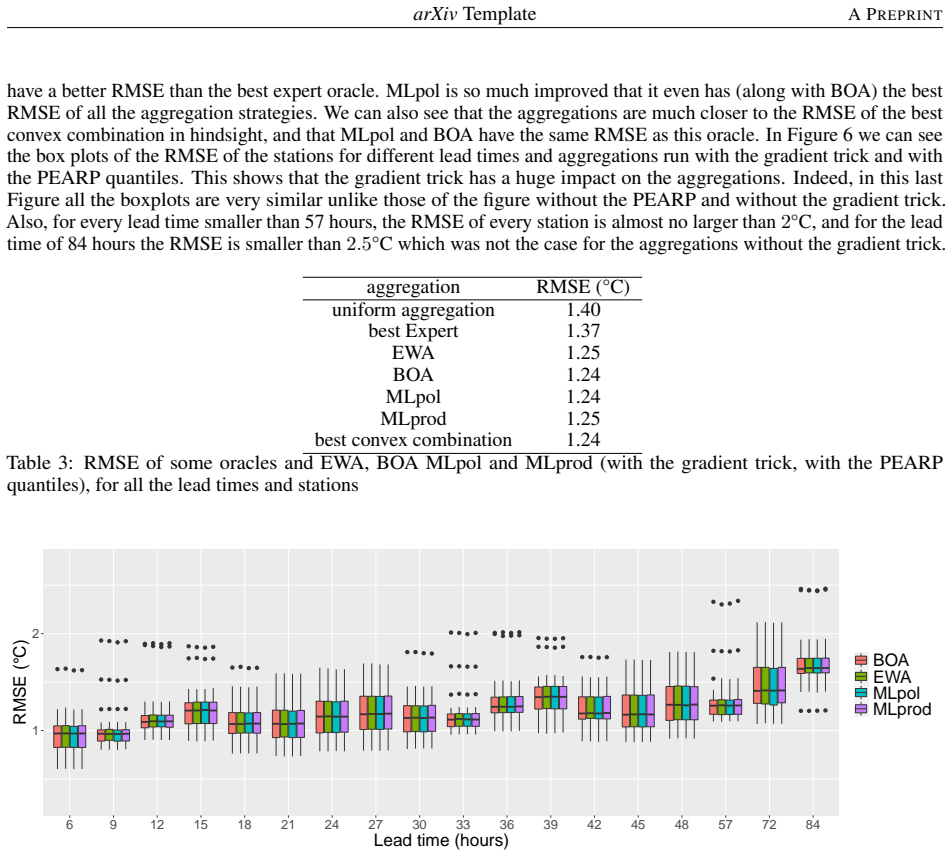
The paper's central claim is that online expert aggregation, a framework designed for worst-case adversarial prediction, transfers to deterministic temperature forecasting, even when the experts are already post-processed forecasts whose errors are nearly random. On a dataset of 33 stations in France from March 2020 to September 2023 at lead times 6 to 96 hours, the paper reports that EWA, BOA, MLprod, and MLpol, run with the gradient trick and five post-processed PEARP quantiles as additional experts, all achieve RMSEs between 1.24 and 1.25 degrees Celsius. That is below the best single expert (1.37), the uniform average (1.40–1.41), and the National Blend of Models baseline; BOA and MLpol land exactly on the RMSE of the best fixed convex combination of experts computed in hindsight, 1.24, without knowing that combination during the forecast. The paper further argues that second-order aggregations are better suited than EWA to this non-adversarial setting, and that adding deliberately biased quantile experts helps the hindsight oracles but is hard for the online rules to exploit in real time.
Load-bearing premise
The load-bearing premise is that one pooled RMSE number per method, computed on the same data used to define the oracles, is a stable basis for comparing forecast methods; without confidence intervals or a temporal holdout, the small reported gaps and the equality with the hindsight-optimal mix could be in-sample artifacts.
Editorial extensions
If this is right
- Operational temperature guidance can be improved by roughly 0.12 to 0.13 degrees Celsius RMSE over the best single model simply by running an online reweighting scheme on forecasts that already exist.
- Because the aggregations are online and adaptive, they can keep working across NWP model upgrades without retraining, which the paper notes is a weakness of neural-network post-processing.
- With the gradient trick and quantile experts, BOA and MLpol recover the RMSE of the hindsight-optimal fixed convex combination (1.24), so the oracle is reachable without knowing the optimal weights in advance.
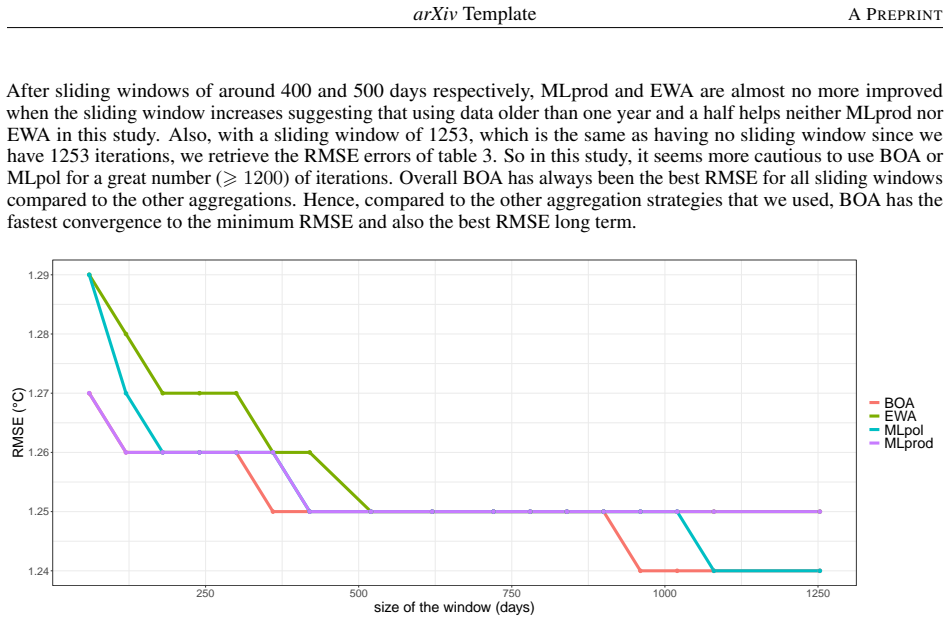
- For short evaluation periods (under roughly 250 iterations) BOA and MLprod are the fastest learners; for long periods BOA is the most consistent of the four strategies.
- Sliding windows make the weights visibly more reactive, but for BOA and MLpol they cost about 0.01 degrees Celsius in RMSE (1.25 vs 1.24), so reactivity and average score are in tension.
Reading between the lines
- If the equality between BOA and MLpol and the hindsight-optimal combination survives a genuine out-of-sample test, it would suggest that static weight optimization has little to add over online rules for this class of forecasts.
- Because the aggregation rules require only a convex loss, a testable extension is probabilistic aggregation with a proper scoring rule such as the continuous ranked probability score (CRPS); the paper demonstrates deterministic square loss only.
- The Chamonix December 2022 episode shows a concrete failure mode: cumulative-loss weights are too slow to promote experts that are good only during a short cold spell. A direct test of tracking-the-best-sequence or sleeping-expert aggregations would show whether reactivity can be restored without the sliding-window RMSE penalty.
Signed reviews
Editorial analysis
A structured set of objections, weighed in public.
Referee Report
Summary. The paper proposes the use of online expert aggregation algorithms (EWA, BOA, MLprod, MLpol) for deterministic 2-meter temperature forecasting, combining raw and post-processed NWP forecasts (AROME, ARPEGE, IFS/CEP) with quantiles of the post-processed PEARP ensemble. Experiments are run on 33 French stations and lead times from 6 to 96 hours, with one aggregation per station and lead time. The paper reports RMSE improvements over the best single expert and the uniform average, and claims that, when the gradient trick is used, BOA and MLpol attain the same RMSE as the best fixed convex combination of experts in hindsight. A sliding-window variant is also studied to improve reactivity to biased experts.
Significance. If the central claim holds, the paper makes a useful applied contribution: it demonstrates that online, adaptive aggregation can reproduce the hindsight-optimal fixed mix of operational deterministic temperature forecasts without knowing that mix in advance, and that this is achieved with simple algorithms and no retraining. The paper has clear strengths: it uses a real multi-station, multi-lead-time operational dataset; it compares several state-of-the-art aggregation strategies; it provides a detailed discussion of their regret bounds and practical behavior; and it makes the data available on GitHub. The main caveat is that the empirical support is currently only in the form of two-decimal point estimates, and one of the key tables appears internally inconsistent, so the headline equality between the online algorithms and the oracle is not yet established.
major comments (3)
- [Section 3, Tables 1–3 and Figure 8] The rows for the best convex combination and the uniform aggregation are not invariant under the gradient trick, although they must be. Table 2 (without the gradient trick, with PEARP quantiles) reports a best convex combination of 1.23°C and a uniform aggregation of 1.41°C; Table 3 (with the gradient trick, with PEARP quantiles) reports 1.24°C and 1.40°C for the same expert set. The best fixed convex combination minimizes cumulative squared error over the simplex and is independent of how the aggregation weights are updated, and the uniform aggregation is the fixed weight vector 1/N, so neither value can change between the two tables. If the oracle in Table 3 was instead computed using the linearized loss from the gradient trick, that is a different benchmark and must be stated explicitly. Otherwise one of the two tables is incorrect. Since the paper's central claim that BOA and MLpol 'have the same RMSE as this oracle' rests on the 1.24°C equality in Table 3, this inconsistency must be resolved before the claim can be evaluated.
- [Abstract] All RMSE comparisons are point estimates pooled over stations and lead times, reported to two decimal places, with no confidence intervals, standard errors, or significance tests. Differences of 0.01°C (for example, 1.25 vs. 1.24) are interpreted as meaningful, and the text states that 'BOA has always been the best RMSE for all sliding windows' on the basis of such differences. The authors should add uncertainty quantification, for example by bootstrap over stations and lead times or by paired forecast-error tests. They should also state explicitly that the best convex combination oracle is computed on the same evaluation period used for the online algorithms; if so, the equality with BOA and MLpol should be framed as a comparison with an in-sample hindsight benchmark rather than as an out-of-sample claim.
- [Section 3, Data and Figure 3] The abstract claims that the proposed methods 'show that they outperform the National Blend of Models,' but the National Blend of Models is never defined, described, or analyzed anywhere in Sections 3 or 4, and no corresponding row or table is provided. This claim is therefore unsupported by the manuscript as written. The authors should either add the NBM comparison and describe the data used for it, or remove the claim from the abstract and introduction.
minor comments (4)
- [Section 3, Data and Figure 3] The lead-time description is inconsistent: the text lists the additional lead times as 57, 72 and 96 hours, while Figures 3, 5 and 6 and the discussion use an 84-hour lead time. Please align the data description with the figures and the text.
- [Figure captions] The captions of Figure 7 and Figure 9 contain the typo 'Weigths' instead of 'Weights', and the caption of Table 1 says 'MLpod' instead of 'MLprod'.
- [Section 3, Sliding Window] The notation for the sliding window is ambiguous: replacing a cumulative sum $X_t = \sum_{s=1}^t x_s$ by $X_t = \sum_{s=t-w}^t x_s$ is understandable, but the accompanying text 'each variable of the form $X_t = \min(x_s, 1 \le s \le t)$ by $X_t = \min(x_s, t-w \le s \le t)$' is not written in standard notation and should be clarified.
- [General presentation] The manuscript contains duplicated passages: the discussion of the Chamonix weights appears twice around Figure 7 and Figure 9, and the conclusion text is repeated near the end of the file. These duplicates should be removed.
Circularity Check
No significant circularity: the evaluation compares online algorithms to hindsight oracles, and no fitted parameter is renamed as a prediction.
full rationale
The paper's derivation chain is self-contained and not circular. The aggregation algorithms EWA, BOA, MLprod, and MLpol are run online with adaptive learning rates, and the RMSE values in Tables 1-3 are cumulative losses over the test sequence rather than fitted constants. The 'best expert' and 'best convex combination' oracles are hindsight benchmarks computed from the same expert predictions and observations, but they are not inputs to the algorithms; comparing online performance to a hindsight oracle is the standard, non-circular evaluation protocol for expert aggregation. The only self-citations are to Wintenberger's published BOA regret-bound work and to co-authored post-processing references, which are external published results rather than assumptions that already contain the temperature-prediction outcome. The inconsistency between Tables 2 and 3 in the oracle and uniform-aggregation RMSEs (1.23 vs 1.24 and 1.41 vs 1.40) is a numerical or reporting concern that the authors should resolve, but it does not exhibit a reduction of the claimed prediction to its inputs: even if the oracle were redefined to a linearized-loss oracle, the paper would need to state that, and the algorithms' updates do not use the oracle. No circular step is exhibited.
Assumptions & free parameters
free parameters (1)
- sliding window size w =
60 to 1253 days, scanned
assumptions (3)
- standard math The regret bounds for EWA, MLprod, MLpol and BOA quoted in Section 2 are correct and applicable.
- domain assumption Losses used by MLprod and MLpol satisfy the boundedness conditions required by their regret bounds.
- domain assumption The atmosphere behaves more like a stochastic process than an adversary.
invented entities (1)
-
None
Cite this review
Pith. "Pith review of Contribution of expert aggregation to temperature prediction part i." pith.science (2026). https://pith.science/paper/ZLQYP3ES
@misc{pith2026250615217,
  author       = {Pith},
  title        = {Pith review of: Contribution of expert aggregation to temperature prediction part i},
  year         = {2026},
  howpublished = {\url{https://pith.science/paper/ZLQYP3ES}},
  note         = {Machine review of arXiv:2506.15217}
}
read the original abstract
Many Numerical Weather Prediction models and their associated Post-Processed Models are available. Combining all of these predictions in an optimal way is however not straightforward. This can be achieved thanks to Expert Aggregation (EA) which has many advantages, such as being online, being adaptive to model changes and having theoretical guarantees. In this paper, we propose a method for making deterministic temperature predictions with EA. We used Exponentially Weighted Average, MLprod and MLpol and Bernstein Online Aggregation. Hence, we combine and outperform the forecasts of the raw and post-processed Integrated Forecasting System (IFS), forecasts of Application of Research to Operations at Mesoscale (AROME), Action de Recherche Petite Echelle Grande Echelle (ARPEGE) and quantiles of the post processed Pr{\'e}vision d'Ensemble ARPEGE (PEARP). We also compare the different EA strategies in various settings and show that they outperform the National Blend of Models. Finally, we discuss certain limitations.
Figures


Figures from the paper (6 more)




Reference graph
Works this paper leans on
-
[1]
Prediction, Learning , and Games
Nicolo Cesa-Bianchi and Gabor Lugosi. Prediction, Learning , and Games . Cambridge University Press, March 2006. ISBN 978-1-139-45482-7. Google-Books-ID: zDnRBlazhfYC
2006
-
[2]
A Second -order Bound with Excess Losses
Pierre Gaillard, Gilles Stoltz, and Tim van Erven. A Second -order Bound with Excess Losses . Conference on Learning Theory. PMLR., page 21, 2014
2014
-
[3]
Stochastic online convex optimization
Olivier Wintenberger. Stochastic online convex optimization. Application to probabilistic time series forecasting. Electronic Journal of Statistics, 18 0 (1): 0 429--464, January 2024. ISSN 1935-7524, 1935-7524. doi:10.1214/23-EJS2208. URL https://projecteuclid.org/journals/electronic-journal-of-statistics/volume-18/issue-1/Stochastic-online-convex-optimi...
-
[4]
Y. Seity, P. Brousseau, S. Malardel, G. Hello, P. Bénard, F. Bouttier, C. Lac, and V. Masson. The AROME - France Convective - Scale Operational Model . Monthly Weather Review, 139 0 (3): 0 976--991, March 2011. ISSN 1520-0493, 0027-0644. doi:10.1175/2010MWR3425.1. URL https://journals.ametsoc.org/view/journals/mwre/139/3/2010mwr3425.1.xml. Publisher: Amer...
-
[5]
Michael Baldauf, Axel Seifert, Jochen Förstner, Detlev Majewski, Matthias Raschendorfer, and Thorsten Reinhardt. Operational Convective - Scale Numerical Weather Prediction with the COSMO Model : Description and Sensitivities . Monthly Weather Review, 139 0 (12): 0 3887--3905, December 2011. ISSN 1520-0493, 0027-0644. doi:10.1175/MWR-D-10-05013.1. URL htt...
-
[6]
M. Déqué, C. Dreveton, A. Braun, and D. Cariolle. The ARPEGE / IFS atmosphere model: a contribution to the French community climate modelling. Climate Dynamics, 10 0 (4): 0 249--266, September 1994. ISSN 1432-0894. doi:10.1007/BF00208992. URL https://doi.org/10.1007/BF00208992
-
[7]
The quiet revolution of numerical weather prediction
Peter Bauer, Alan Thorpe, and Gilbert Brunet. The quiet revolution of numerical weather prediction. Nature, 525 0 (7567): 0 47--55, September 2015. ISSN 1476-4687. doi:10.1038/nature14956. URL https://www.nature.com/articles/nature14956. Number: 7567 Publisher: Nature Publishing Group
-
[8]
L. Descamps, C. Labadie, A. Joly, E. Bazile, P. Arbogast, and P. Cébron. PEARP , the Météo - France short-range ensemble prediction system. Quarterly Journal of the Royal Meteorological Society, 141 0 (690): 0 1671--1685, 2015. ISSN 1477-870X. doi:10.1002/qj.2469. URL https://onlinelibrary.wiley.com/doi/abs/10.1002/qj.2469. \_eprint: https://onlinelibrary...
Show all 49 references
-
[9]
Hamill and Stephen J
Thomas M. Hamill and Stephen J. Colucci. Verification of Eta – RSM Short - Range Ensemble Forecasts . Monthly Weather Review, 125 0 (6): 0 1312--1327, June 1997. ISSN 1520-0493, 0027-0644. doi:10.1175/1520-0493(1997)125<1312:VOERSR>2.0.CO;2. URL https://journals.ametsoc.org/vi...
1997 doi
-
[10]
Edward N. Lorenz. Deterministic Nonperiodic Flow . Journal of the Atmospheric Sciences, 20 0 (2): 0 130--141, March 1963. ISSN 0022-4928, 1520-0469. doi:10.1175/1520-0469(1963)020<0130:DNF>2.0.CO;2. URL https://journals.ametsoc.org/view/journals/atsc/20/2/1520-0469_1963_020_01...
1963 doi
-
[11]
Holton and D
James R. Holton and D. O. Staley. An Introduction to Dynamic Meteorology . American Journal of Physics, 41 0 (5): 0 752--754, 2013. ISSN 0002-9505. doi:10.1119/1.1987371. URL https://doi.org/10.1119/1.1987371
2013 doi
-
[12]
Predictability of large-scale atmospheric motions: Lyapunov exponents and error dynamics
Stéphane Vannitsem. Predictability of large-scale atmospheric motions: Lyapunov exponents and error dynamics. Chaos: An Interdisciplinary Journal of Nonlinear Science, 27 0 (3): 0 032101, March 2017. ISSN 1054-1500. doi:10.1063/1.4979042. URL https://doi.org/10.1063/1.4979042
2017 doi
-
[13]
Stéphane Vannitsem, John Bjørnar Bremnes, Jonathan Demaeyer, Gavin R. Evans, Jonathan Flowerdew, Stephan Hemri, Sebastian Lerch, Nigel Roberts, Susanne Theis, Aitor Atencia, Zied Ben Bouallègue, Jonas Bhend, Markus Dabernig, Lesley De Cruz, Leila Hieta, Olivier Mestre, Lionel ...
2021
-
[14]
From research to applications – examples of operational ensemble post-processing in France using machine learning
Maxime Taillardat and Olivier Mestre. From research to applications – examples of operational ensemble post-processing in France using machine learning. Nonlinear Processes in Geophysics, 27 0 (2): 0 329--347, May 2020. ISSN 1023-5809. doi:10.5194/npg-27-329-2020. URL https://...
2020 doi
-
[15]
Neural Networks for Postprocessing Ensemble Weather Forecasts
Stephan Rasp and Sebastian Lerch. Neural Networks for Postprocessing Ensemble Weather Forecasts . Monthly Weather Review, 146 0 (11): 0 3885--3900, November 2018. ISSN 1520-0493, 0027-0644. doi:10.1175/MWR-D-18-0187.1. URL https://journals.ametsoc.org/view/journals/mwre/146/11...
2018 doi
-
[16]
Pangu- Weather : A 3D High - Resolution Model for Fast and Accurate Global Weather Forecast , November 2022
Kaifeng Bi, Lingxi Xie, Hengheng Zhang, Xin Chen, Xiaotao Gu, and Qi Tian. Pangu- Weather : A 3D High - Resolution Model for Fast and Accurate Global Weather Forecast , November 2022. URL http://arxiv.org/abs/2211.02556. arXiv:2211.02556 [physics]
2022 arXiv
-
[17]
FourCastNet : A Global Data -driven High -resolution Weather Model using Adaptive Fourier Neural Operators , February 2022
Jaideep Pathak, Shashank Subramanian, Peter Harrington, Sanjeev Raja, Ashesh Chattopadhyay, Morteza Mardani, Thorsten Kurth, David Hall, Zongyi Li, Kamyar Azizzadenesheli, Pedram Hassanzadeh, Karthik Kashinath, and Animashree Anandkumar. FourCastNet : A Global Data -driven Hig...
2022 arXiv
-
[18]
GraphCast : Learning skillful medium-range global weather forecasting, December 2022
Remi Lam, Alvaro Sanchez-Gonzalez, Matthew Willson, Peter Wirnsberger, Meire Fortunato, Alexander Pritzel, Suman Ravuri, Timo Ewalds, Ferran Alet, Zach Eaton-Rosen, Weihua Hu, Alexander Merose, Stephan Hoyer, George Holland, Jacklynn Stott, Oriol Vinyals, Shakir Mohamed, and P...
2022 arXiv
-
[19]
Gupta, and Aditya Grover
Tung Nguyen, Johannes Brandstetter, Ashish Kapoor, Jayesh K. Gupta, and Aditya Grover. ClimaX : A foundation model for weather and climate, February 2023. URL http://arxiv.org/abs/2301.10343. arXiv:2301.10343 [cs]
2023 arXiv
-
[20]
FengWu : Pushing the Skillful Global Medium -range Weather Forecast beyond 10 Days Lead , April 2023
Kang Chen, Tao Han, Junchao Gong, Lei Bai, Fenghua Ling, Jing-Jia Luo, Xi Chen, Leiming Ma, Tianning Zhang, Rui Su, Yuanzheng Ci, Bin Li, Xiaokang Yang, and Wanli Ouyang. FengWu : Pushing the Skillful Global Medium -range Weather Forecast beyond 10 Days Lead , April 2023. URL ...
2023
-
[21]
Simon Lang, Mihai Alexe, Matthew Chantry, Jesper Dramsch, Florian Pinault, Baudouin Raoult, Mariana C. A. Clare, Christian Lessig, Michael Maier-Gerber, Linus Magnusson, Zied Ben Bouallègue, Ana Prieto Nemesio, Peter D. Dueben, Andrew Brown, Florian Pappenberger, and Florence ...
2024 arXiv
-
[22]
Elizabeth E. Ebert. Ability of a Poor Man 's Ensemble to Predict the Probability and Distribution of Precipitation . Monthly Weather Review, 129 0 (10): 0 2461--2480, October 2001. ISSN 1520-0493, 0027-0644. doi:10.1175/1520-0493(2001)129<2461:AOAPMS>2.0.CO;2. URL https://jour...
2001 doi
-
[23]
Mylne, Ruth E
Kenneth R. Mylne, Ruth E. Evans, and Robin T. Clark. Multi-model multi-analysis ensembles in quasi-operational medium-range forecasting. Quarterly Journal of the Royal Meteorological Society, 128 0 (579): 0 361--384, 2002. ISSN 1477-870X. doi:10.1256/00359000260498923. URL htt...
2002 doi
-
[24]
Agrégation séquentielle de prédicteurs: méthodologie générale et applications à la prévision de la qualité de l’air et à celle de la consommation électrique
Gilles Stoltz. Agrégation séquentielle de prédicteurs: méthodologie générale et applications à la prévision de la qualité de l’air et à celle de la consommation électrique. Journal de la Société française de Statistique, 151 0 (2): 0 66--106, 2010
2010
-
[25]
Aggregating Strategies
Vladimir Vovk. Aggregating Strategies . Proceedings of the 3rd Annual Workshop on Computational Learning Theory, 1990
1990
-
[26]
Littlestone and M
N. Littlestone and M. K. Warmuth. The Weighted Majority Algorithm . Information and Computation, 108 0 (2): 0 212--261, February 1994. ISSN 0890-5401. doi:10.1006/inco.1994.1009. URL https://www.sciencedirect.com/science/article/pii/S0890540184710091
1994
-
[27]
Koolen, and Dirk van der Hoeven
Tim van Erven, Wouter M. Koolen, and Dirk van der Hoeven. MetaGrad : Adaptation using Multiple Learning Rates in Online Learning , August 2021. URL http://arxiv.org/abs/2102.06622. Number: arXiv:2102.06622 arXiv:2102.06622 [cs, stat]
2021 arXiv
-
[28]
Second-order quantile methods for experts and combinatorial games
Wouter M Koolen and Tim Van Erven. Second-order quantile methods for experts and combinatorial games. In Conference on Learning Theory, pages 1155--1175. PMLR, 2015
2015
-
[29]
Optimal Learning with Bernstein Online Aggregation
Olivier Wintenberger. Optimal Learning with Bernstein Online Aggregation . Machine Learning, 106 0 (1): 0 119--141, 2017
2017
-
[30]
Ozone ensemble forecast with machine learning algorithms
Vivien Mallet, Gilles Stoltz, and Boris Mauricette. Ozone ensemble forecast with machine learning algorithms. Journal of Geophysical Research: Atmospheres, 114 0 (D5), 2009. ISSN 2156-2202. doi:https://doi.org/10.1029/2008JD009978. URL https://agupubs.onlinelibrary.wiley.com/d...
2009 doi
-
[31]
Forecasting electricity consumption by aggregating specialized experts
Marie Devaine, Pierre Gaillard, Yannig Goude, and Gilles Stoltz. Forecasting electricity consumption by aggregating specialized experts. Machine Learning, 90 0 (2): 0 231--260, February 2013. ISSN 1573-0565. doi:10.1007/s10994-012-5314-7. URL https://doi.org/10.1007/s10994-012-5314-7
2013 doi
-
[32]
Contributions à l’agrégation séquentielle robuste d’experts : Travaux sur l’erreur d’approximation et la prévision en loi
Pierre Gaillard. Contributions à l’agrégation séquentielle robuste d’experts : Travaux sur l’erreur d’approximation et la prévision en loi. Applications à la prévision pour les marchés de l’énergie. phdthesis, Université Paris Sud - Paris XI, July 2015. URL https://tel.archive...
2015
-
[33]
Fundamentals and exchange rate forecastability with simple machine learning methods
Christophe Amat, Tomasz Michalski, and Gilles Stoltz. Fundamentals and exchange rate forecastability with simple machine learning methods. Journal of International Money and Finance, 88: 0 1--24, November 2018. ISSN 0261-5606. doi:10.1016/j.jimonfin.2018.06.003. URL http://www...
2018 doi
-
[34]
Expert Aggregation for Financial Forecasting
Carl Remlinger, Clémence Alasseur, Marie Brière, and Joseph Mikael. Expert Aggregation for Financial Forecasting . The Journal of Finance and Data Science, page 100108, November 2023. ISSN 2405-9188. doi:10.1016/j.jfds.2023.100108. URL https://www.sciencedirect.com/science/art...
2023
-
[35]
Sequential model aggregation for production forecasting
Raphaël Deswarte, Véronique Gervais, Gilles Stoltz, and Sébastien Da Veiga. Sequential model aggregation for production forecasting. Computational Geosciences, 23 0 (5): 0 1107--1124, October 2019. ISSN 1573-1499. doi:10.1007/s10596-019-09872-1. URL https://doi.org/10.1007/s10...
2019 doi
-
[36]
Thorey, C
J. Thorey, C. Chaussin, and V. Mallet. Ensemble forecast of photovoltaic power with online CRPS learning. International Journal of Forecasting, 34 0 (4): 0 762--773, October 2018. ISSN 0169-2070. doi:10.1016/j.ijforecast.2018.05.007. URL https://www.sciencedirect.com/science/a...
2018 doi
-
[37]
CRPS -based online learning for nonlinear probabilistic forecast combination
Dennis van der Meer, Pierre Pinson, Simon Camal, and Georges Kariniotakis. CRPS -based online learning for nonlinear probabilistic forecast combination. International Journal of Forecasting, January 2024. ISSN 0169-2070. doi:10.1016/j.ijforecast.2023.12.005. URL https://www.sc...
2024 doi
-
[38]
Sequential aggregation of probabilistic forecasts— Application to wind speed ensemble forecasts
Michaël Zamo, Bell Lilianne, and Mestre Olivier. Sequential aggregation of probabilistic forecasts— Application to wind speed ensemble forecasts. Journal of the Royal Statistical Society: Series C (Applied Statistics) - Wiley Online Library, 2021. URL https://rss.onlinelibrary...
2021 doi
-
[39]
Thorey, V
J. Thorey, V. Mallet, and P. Baudin. Online learning with the Continuous Ranked Probability Score for ensemble forecasting. Quarterly Journal of the Royal Meteorological Society, 143 0 (702): 0 521--529, 2017. ISSN 1477-870X. doi:10.1002/qj.2940. URL https://onlinelibrary.wile...
2017 doi
-
[40]
Boosting diversity in regression ensembles
Mathias Bourel, Jairo Cugliari, Yannig Goude, and Jean-Michel Poggi. Boosting diversity in regression ensembles. Statistical Analysis and Data Mining: The ASA Data Science Journal, 17 0 (1): 0 e11654, 2024. ISSN 1932-1872. doi:10.1002/sam.11654. URL https://onlinelibrary.wiley...
2024 doi
-
[41]
Learning the Learning Rate for Prediction with Expert Advice
Wouter M Koolen, Tim van Erven, and Peter Grünwald. Learning the Learning Rate for Prediction with Expert Advice . In Advances in Neural Information Processing Systems , volume 27. Curran Associates, Inc., 2014. URL https://proceedings.neurips.cc/paper/2014/hash/3f67fd97162d20...
2014
-
[42]
Adaptive and Self - Confident On - Line Learning Algorithms
Peter Auer, Nicolò Cesa-Bianchi, and Claudio Gentile. Adaptive and Self - Confident On - Line Learning Algorithms . Journal of Computer and System Sciences, 64 0 (1): 0 48--75, February 2002. ISSN 0022-0000. doi:10.1006/jcss.2001.1795. URL https://www.sciencedirect.com/science...
2002
-
[43]
Improved second-order bounds for prediction with expert advice
Nicolò Cesa-Bianchi, Yishay Mansour, and Gilles Stoltz. Improved second-order bounds for prediction with expert advice. Machine Learning, 66 0 (2): 0 321--352, March 2007. ISSN 1573-0565. doi:10.1007/s10994-006-5001-7. URL https://doi.org/10.1007/s10994-006-5001-7
2007 doi
-
[44]
Kalman recursions Aggregated Online
Eric Adjakossa, Yannig Goude, and Olivier Wintenberger. Kalman recursions Aggregated Online . Statistical Papers, March 2023. ISSN 1613-9798. doi:10.1007/s00362-023-01410-7. URL https://doi.org/10.1007/s00362-023-01410-7
2023 doi
-
[45]
Progressive mixture rules are deviation suboptimal
Jean-yves Audibert. Progressive mixture rules are deviation suboptimal. In Advances in Neural Information Processing Systems , volume 20. Curran Associates, Inc., 2007. URL https://proceedings.neurips.cc/paper/2007/hash/ef575e8837d065a1683c022d2077d342-Abstract.html
2007
-
[46]
Opera: Online Prediction by Expert Aggregation , 2016
Pierre Gaillard and Yannig Goude. Opera: Online Prediction by Expert Aggregation , 2016. URL http://pierre.gaillard.me/opera.html
2016
-
[47]
Mark Herbster and Manfred K. Warmuth. Tracking the Best Expert . Machine Learning, 32 0 (2): 0 151--178, August 1998. ISSN 1573-0565. doi:10.1023/A:1007424614876. URL https://doi.org/10.1023/A:1007424614876
1998 doi
-
[48]
Efficient tracking of a growing number of experts
Jaouad Mourtada and Odalric-Ambrym Maillard. Efficient tracking of a growing number of experts. arXiv:1708.09811 [cs, stat], August 2017. URL http://arxiv.org/abs/1708.09811. arXiv: 1708.09811
2017 arXiv
-
[49]
Schapire, Yoram Singer, and Manfred K
Yoav Freund, Robert E. Schapire, Yoram Singer, and Manfred K. Warmuth. Using and combining predictors that specialize. In Proceedings of the twenty-ninth annual ACM symposium on Theory of computing , STOC '97, pages 334--343, New York, NY, USA, May 1997. Association for Comput...
1997
Reviewed August 15, 2026 · model on record in the stance chip above.
Discussion (0). Continue with ORCID to comment.