A toy model for frequency cascade in the nonlinear Schrodinger equation
Pith reviewed 2026-05-19 09:28 UTC · model grok-4.3
The pith
Discarding derivatives from a forced nonlinear Schrödinger equation yields an explicit algebraic frequency cascade that stays stable when they are restored.
A machine-rendered reading of the paper's core claim, the machinery that carries it, and where it could break.
Core claim
By discarding time and space derivatives, the forced nonlinear Schrödinger equation with constant-plus-modulated-Gaussian forcing reduces to a system whose algebraic solution exhibits an explicit frequency cascade; stability analysis shows this solution remains little affected when the derivative terms are reintroduced, potentially over long times.
What carries the argument
The algebraic reduction obtained by omitting derivatives, which turns the forced equation into a system allowing direct computation of the frequency cascade driven by the constant-plus-modulated-Gaussian term.
If this is right
- The explicit algebraic solution demonstrates a concrete mechanism for successive transfer of energy to higher frequencies.
- Stability results imply the cascade persists with only small changes when full derivative terms are restored.
- The model permits observation of the cascade over potentially long intervals without large deviation from the algebraic behavior.
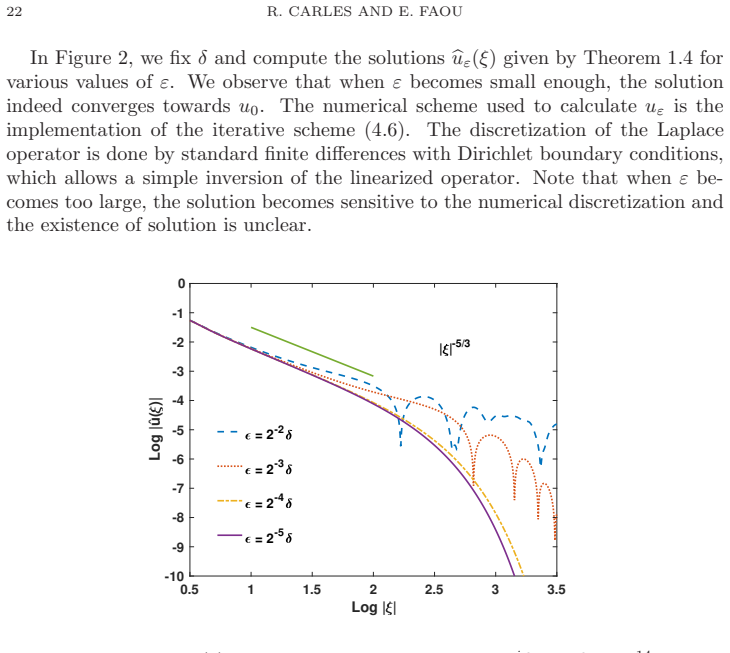
- Numerical simulations support that the derivative-free cascade approximates the dynamics of the complete equation.
Where Pith is reading between the lines
- Varying the modulation frequency or width of the Gaussian term could alter the speed or extent of the observed cascade.
- The same algebraic reduction technique might apply to other forced nonlinear wave equations to produce comparable explicit cascades.
- If the stability holds, the toy model suggests that certain external forcings can drive predictable spectral broadening even in more complete physical settings.
Load-bearing premise
The chosen forcing term of a constant plus modulated Gaussian well is representative enough to capture essential features of frequency cascades in the full nonlinear Schrödinger equation.
What would settle it
A numerical simulation of the full derivative-inclusive equation that shows the solution deviating rapidly from the algebraic cascade within short times would falsify the stability claim.
Figures



read the original abstract
We present an elementary approach to observe frequency cascade on forced nonlinear Schr{\"o}dinger equations. The forcing term (which may also appear as a potential term instead) consists of a constant term, perturbed by a modulated Gaussian well. Algebraic computations provide an explicit frequency cascade when time and space derivatives are discarded from the nonlinear Schr{\"o}dinger equation. We provide stability results, showing that when derivatives are incorporated in the model, the initial algebraic solution may be little affected, possibly over long time intervals. Numerical simulations are provided, which support the analysis.
Editorial analysis
A structured set of objections, weighed in public.
Referee Report
Summary. The manuscript introduces a toy model for frequency cascades in forced nonlinear Schrödinger equations, with a forcing term consisting of a constant plus a modulated Gaussian well. Algebraic computations in the derivative-free reduction yield an explicit frequency cascade. Stability results are stated showing that this algebraic solution persists approximately when space and time derivatives are restored, possibly over long time intervals, with numerical simulations provided in support.
Significance. If the stability results hold with quantitative control, the work supplies an elementary, fully explicit construction of a frequency cascade together with a persistence statement under the reintroduction of dispersive terms. This combination of algebraic exactness and stability analysis offers a useful benchmark and pedagogical tool for studying cascade mechanisms in nonlinear dispersive equations.
major comments (2)
- [Stability results] The stability theorem asserts that the algebraic solution is little affected when derivatives are restored, possibly over long intervals. However, the statement does not supply an explicit time scale of validity in terms of the smallness parameter measuring the strength of the derivatives or the modulation width of the Gaussian; without such a bound it is unclear whether the result addresses long-time behavior or only short-time stability.
- [Forcing term and algebraic derivation] The explicit algebraic cascade is obtained for the specific choice of constant-plus-modulated-Gaussian forcing. The manuscript does not examine whether the cascade mechanism survives under small perturbations of this forcing or under more general potentials; if the cascade is tied to the explicit iteration permitted by this choice, the stability claim may not extend beyond this special case.
minor comments (3)
- [Abstract] The abstract states that numerical simulations support the analysis but does not indicate which norms or frequency-mode amplitudes are monitored or over what range of modulation parameters the tests are performed.
- [Introduction] A short discussion relating the chosen forcing to forcings appearing in the wave-turbulence or NLS-cascade literature would help readers assess the toy model's intended scope.
- [Numerical simulations] In the numerical figures, axes labels and legends should explicitly identify the frequency modes whose amplitudes are plotted and the time interval shown.
Simulated Author's Rebuttal
We thank the referee for the positive evaluation of our manuscript and for the detailed comments, which help clarify the scope and limitations of the toy model. We address each major point below, indicating where revisions will be made to strengthen the presentation.
read point-by-point responses
-
Referee: The stability theorem asserts that the algebraic solution is little affected when derivatives are restored, possibly over long intervals. However, the statement does not supply an explicit time scale of validity in terms of the smallness parameter measuring the strength of the derivatives or the modulation width of the Gaussian; without such a bound it is unclear whether the result addresses long-time behavior or only short-time stability.
Authors: We agree that an explicit time scale would make the result more precise. The stability analysis proceeds via perturbative estimates in which the small parameter ε controls the strength of the restored derivatives (and is tied to the Gaussian modulation width). The current theorem statement indicates persistence over long intervals without quantifying the dependence on ε. In the revised manuscript we will add a remark (or modify the theorem) to state that the approximation holds on time intervals of length at least T ≳ ε^{-1/2} (or the precise power obtained from the estimates), thereby clarifying that the result is not merely short-time stability. revision: yes
-
Referee: The explicit algebraic cascade is obtained for the specific choice of constant-plus-modulated-Gaussian forcing. The manuscript does not examine whether the cascade mechanism survives under small perturbations of this forcing or under more general potentials; if the cascade is tied to the explicit iteration permitted by this choice, the stability claim may not extend beyond this special case.
Authors: The forcing is deliberately chosen so that the derivative-free equation admits an explicit, algebraically computable frequency cascade by direct iteration. The manuscript presents this construction as a toy model whose purpose is to supply a fully explicit benchmark rather than a general theory. We do not claim that the identical cascade persists under arbitrary perturbations of the forcing; the stability statement is likewise specific to the given potential. We will add a short paragraph in the introduction and conclusion underscoring the toy-model character of the example and noting that it is intended to illustrate the mechanism in a transparent setting, leaving extensions to more general forcings for future work. revision: partial
Circularity Check
No significant circularity in algebraic toy-model derivation
full rationale
The paper constructs an explicit frequency cascade via direct algebraic iteration on a deliberately chosen forcing term (constant plus modulated Gaussian well) in the derivative-free toy model. This is a forward computation from the selected inputs rather than any reduction of the cascade result back to a fitted parameter, self-definition, or load-bearing self-citation. Stability statements when derivatives are restored are presented as perturbative analysis around the explicit algebraic solution, without invoking uniqueness theorems or ansatzes from prior author work. The model is self-contained as an elementary example; the representativeness assumption for full NLS is stated as a modeling choice, not derived circularly from the result itself.
Axiom & Free-Parameter Ledger
free parameters (1)
- modulation and width parameters of the Gaussian perturbation
axioms (1)
- domain assumption The derivative-free forced NLS with the given forcing admits an explicit algebraic solution exhibiting frequency cascade.
Reference graph
Works this paper leans on
-
[1]
N. Ben Abdallah, F. Castella, and F. M´ ehats. Time averaging for the strongly confined nonlin- ear Schr¨ odinger equation, using almost periodicity.J. Differential Equations , 245(1):154–200, 2008
work page 2008
-
[2]
T. Buckmaster, P. Germain, Z. Hani, and J. Shatah. Onset o f the wave turbulence description of the longtime behavior of the nonlinear Schr¨ odinger equa tion. Invent. Math. , 225(3):787– 855, 2021
work page 2021
- [3]
-
[4]
C. Collot and P. Germain. On the derivation of the homogen eous kinetic wave equation. Commun. Pure Appl. Math. , 78(4):856–909, 2025
work page 2025
-
[5]
Y. Deng and Z. Hani. Full derivation of the wave kinetic eq uation. Invent. Math. , 233(2):543– 724, 2023
work page 2023
-
[6]
R. Grande and Z. Hani. Rigorous derivation of damped-dri ven wave turbulence theory. Preprint, arXiv:2407.10711 [math.AP] (2024), 2024
-
[7]
B. Helffer. Th´ eorie spectrale pour des op´ erateurs globalement ellip tiques, volume 112 of Ast´ erisque. Soci´ et´ e Math´ ematique de France, Paris, 1984. With an English summary
work page 1984
-
[8]
H¨ ormander.The analysis of linear partial differential operators
L. H¨ ormander.The analysis of linear partial differential operators. I . Classics in Mathematics. Springer-Verlag, Berlin, 2003. Distribution theory and Fo urier analysis, Reprint of the second (1990) edition
work page 2003
-
[9]
A. N. Kolmogoroff. The local structure of turbulence in in compressible viscous fluid for every large Reynold’s numbers. C. R. (Dokl.) Acad. Sci. URSS, n. Ser. , 30:301–305, 1941
work page 1941
-
[10]
A. N. Kolmogoroff. On degeneration of isotropic turbule nce in an incompressible viscous liquid. C. R. (Dokl.) Acad. Sci. URSS, n. Ser. , 31:538–540, 1941
work page 1941
-
[11]
A. N. Kolmogorov. Dissipation of energy in the locally i sotropic turbulence. C. R. (Dokl.) Acad. Sci. URSS, n. Ser. , 32:16–18, 1941
work page 1941
-
[12]
S. B. Kuksin. On turbulence in nonlinear Schr¨ odinger e quations. Geom. Funct. Anal. , 7(4):783–822, 1997
work page 1997
-
[13]
A. J. Majda, D. W. McLaughlin, and E. G. Tabak. A one-dime nsional model for dispersive wave turbulence. J. Nonlinear Sci. , 7(1):9–44, 1997
work page 1997
- [14]
-
[15]
T. Tao. Nonlinear dispersive equations , volume 106 of CBMS Regional Conference Series in Mathematics. Published for the Conference Board of the Mathematical Sci ences, W ashington, DC, 2006. Local and global analysis. 24 R. CARLES AND E. F AOU
work page 2006
-
[16]
V. E. Zakharov. Kolmogorov spectra in weak turbulence p roblems. In A. A. Galeev and R. N. Sudan, editors, Basic Plasma Physics , volume 2 of Handbook Plasma Physics , pages 3–36. North-Holland Publishing Company, Amsterdam, 1984
work page 1984
-
[17]
V. E. Zakharov, V. S. L’vov, and G. Falkovich. Kolmogorov spectra of turbulence I. Wave turbulence. Berlin: Springer-Verlag, 1992. Univ Rennes, CNRS, IRMAR - UMR 6625, F-35000 Rennes, France Email address : Remi.Carles@math.cnrs.fr Email address : Erwan.Faou@inria.fr
work page 1992
discussion (0)
Sign in with ORCID, Apple, or X to comment. Anyone can read and Pith papers without signing in.