REVIEW 4 major objections 6 minor 37 references
When Model Knowledge meets Diffusion Model: Diffusion-assisted Data-free Image Synthesis with Alignment of Domain and Class
T0 review · 4 major / 6 minor · reviewed 2026-08-15 · deepseek-v4-flash
Pith's one-line read A frozen text-to-image diffusion model, guided by a classifier's batch-norm statistics and one optimized class token, can generate proxy images close to the true training distribution, achieving state-of-the-art data-free distillation and…
desk verdict The method and results are strong, but the DDIM update in Eqs. 7/12 is non-standard and, without code, the paper is not reproducible as written. read the letter →
The pith
A machine-rendered reading of the paper's core claim, the machinery that carries it, and where it could break.
The reading
What carries the argument
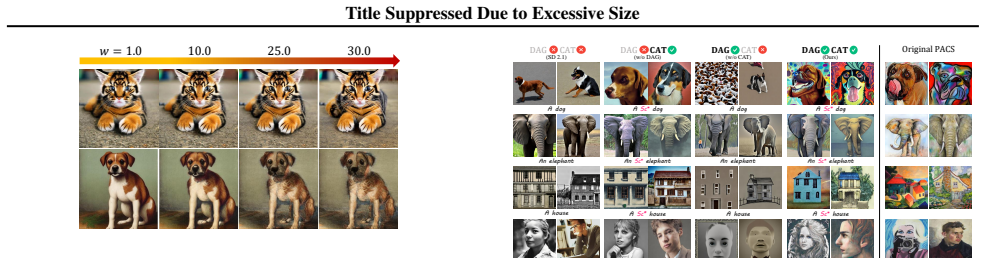
Two mechanisms carry the argument. Domain Alignment Guidance (DAG) is a per-step latent correction applied during diffusion sampling: the decoded image $\hat{x}_t = D(z_t)$ is passed through the frozen classifier, the squared error between its layer-wise feature statistics and the classifier's batch-norm running statistics, $\mathcal{L}_{BN}(\hat{x}_t) = \sum_{l=1}^{L} \big( \|\mu_l(\hat{x}_t) - \mu_l\|^2 + \|\sigma_l^2(\hat{x}_t) - \sigma_l^2\|^2 \big)$, is differentiated with respect to the latent, and the update $\tilde{z}_t = z_t - \eta \nabla_{z_t} \mathcal{L}_{BN}(D(z_t))$ is folded into the Classifier-Free Guidance sampling loop. The Class Alignment Token (CAT) is a single learnable pseudo-word embedding $v_c$ inserted into the prompt 'A/An $\{S_c\}$ {class label}'; only this $1 \times 784$ embedding vector is optimized, via cross-entropy loss from the classifier on the final image, with gradient skipping to the last diffusion step to keep memory bounded. DAG supplies the domain direction and CAT supplies the class direction; the work claims each is necessary, since vanilla Stable Diffusion lacks the domain signal and class-only guidance drifts across domains.
What would settle it
Train a classifier on a domain whose per-layer feature statistics are deliberately matched to a different visual domain (e.g., renormalize a sketch dataset so its layer-wise means and variances coincide with a color-photo dataset at every batch-norm layer), then run DDIS against it: if the generated images follow the statistics rather than the actual content, the BN-statistics premise is doing the work, and if they follow neither domain, the guidance signal is too weak to matter. A more direct check is to apply DDIS to a model without batch-norm layers, such as a GroupNorm-based ResNet or a vision transformer trained on the same data, and observe whether the domain-alignment benefit disappears as the paper's Section 5 limitation implies it should.
Extended reading notes
Core claim
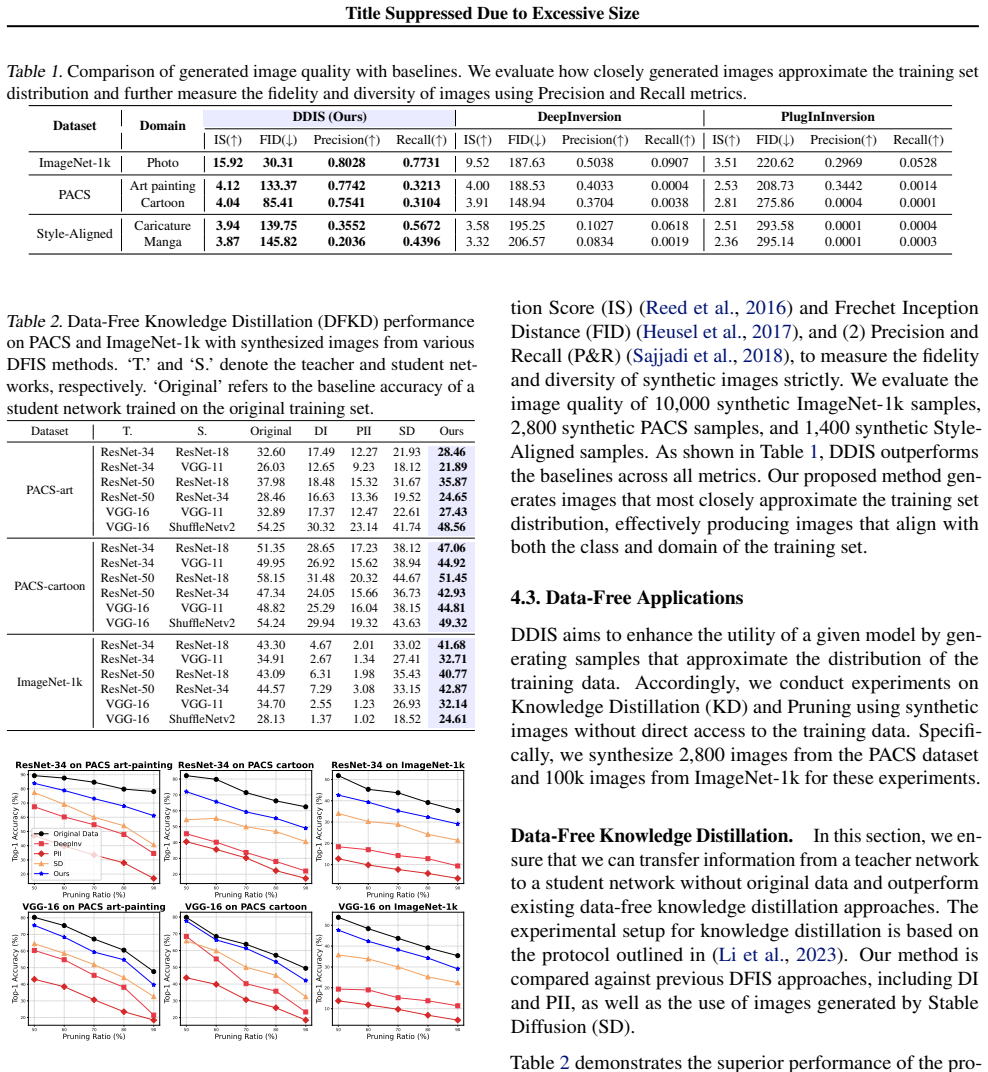
The central claim, stated on the paper's own terms, is that a pre-trained text-to-image diffusion model can serve as the missing natural-image prior for data-free image synthesis, and that aligning the generated images to the given classifier's internal statistics at both the domain and class level closes the distribution gap that prior DFIS methods leave open. DAG rewrites the unconditional score $\nabla_{z_t} \log p(z_t)$ as a conditional score $\nabla_{z_t} \log p(z_t \mid \mu, \sigma^2)$, where the conditioning comes from the Bayes-factor gradient of a batch-norm-statistics matching loss $\mathcal{L}_{BN}$; CAT adds a per-class learnable pseudo-word embedding to the prompt and optimizes it with cross-entropy loss backpropagated through the final denoising step. The paper reports that DDIS beats DeepInversion and PlugInInversion on every evaluated metric across ImageNet-1k and PACS/Style-Aligned domains, and that data-free knowledge distillation with DDIS synthetic data lands within roughly 1 to 4 accuracy points of training the student on the original data (e.g., 41.68 versus 43.30 top-1 for ResNet-34 to ResNet-18 on ImageNet-1k), with pruned-model fine-tuning superior to all baselines at every pruning ratio.
Load-bearing premise
DAG assumes the running mean and variance stored in every batch-normalization layer of the frozen classifier are a sufficient summary of the training domain, so that minimizing the squared gap between generated-image statistics and those running statistics at every diffusion step pulls the latent toward the true training distribution; if those statistics do not encode the domain, the guidance term supplies a wrong or noisy signal, and the paper's own limitation that DAG only works for batch-norm models exposes exactly this dependence.
Editorial extensions
If this is right
- A surrogate training set for a pretrained classifier can be synthesized from Stable Diffusion plus batch-norm statistics alone: on ImageNet-1k, DDIS reports FID 30.31 versus 187.63 for DeepInversion and 220.62 for PlugInInversion, with distillation accuracy within about 1.6 points of the original-data baseline for ResNet-34 to ResNet-18.
- Data-free knowledge distillation becomes practical on non-photographic domains: DDIS is the first DFIS method to handle art-painting, cartoon, manga, and caricature domains, where prior methods produce near-random images (e.g., precision below 0.01 on cartoon and manga).
- The CAT embedding resolves lexical ambiguity in class names: classes like 'tiger cat', 'beach wagon', and 'mail bag' are generated correctly even though the bare class label misleads Stable Diffusion, because the optimized token pins down the intended concept.
- Pruned models can be fine-tuned without original data: DDIS synthetic samples beat all baselines across 50-90 percent pruning ratios on ImageNet and PACS for both ResNet-34 and VGG-16.
- Generation is cheap after the per-class token is found: optimizing one $1 \times 784$ embedding takes about 7.5 minutes per class and is reused for unlimited sampling, reducing the total iterations for 100k ImageNet images from 8,000K (DeepInversion) and 1,120K (PlugInInversion) to 30K.
Reading between the lines
- A testable extension of the paper's own logic: the DAG mechanism is not tied to batch normalization in principle, since any differentiable statistic of the frozen model's feature maps (GroupNorm moments, Gram matrices, attention statistics) could carry the domain signal; whether non-BN architectures can be steered the same way is open, and the paper's Section 5 confirms DAG currently cannot handle
- The same $\mathcal{L}_{BN}$ alignment could double as a domain-shift probe: if DAG genuinely pulls latents toward the training domain, the residual loss value during sampling measures how far a prompt's output domain sits from the classifier's domain, which could serve label-free test-time adaptation or out-of-distribution detection.
- The paper's ablation implies the diffusion prior alone is not the source of the gains: vanilla SD distillation accuracy is 33.02 versus 41.68 with DDIS on ImageNet (ResNet-34 to ResNet-18), suggesting the alignment terms, not the generative model, are the differentiator; a cheaper generative prior matched with DAG might reach similar results.
- The early-stopping rule (70 percent batch accuracy) and single-seed CAT optimization likely under-sample intra-class variance, so the reported Recall values (0.32-0.77) could improve by optimizing the token over multiple seeds or adding a diversity regularizer without changing the method's core.
Signed reviews
Editorial analysis
A structured set of objections, weighed in public.
Referee Report
Summary. The paper proposes DDIS, a data-free image synthesis method that combines a frozen text-to-image diffusion model (Stable Diffusion 2.1) with two alignment mechanisms: Domain Alignment Guidance (DAG), which steers diffusion latents so that feature statistics of decoded images match the running Batch Normalization statistics of a pretrained classifier, and a Class Alignment Token (CAT), a pseudo-word embedding optimized with cross-entropy loss against the classifier. The method is evaluated on PACS art/cartoon, Style-Aligned manga/caricature, and ImageNet-1k using IS, FID, Precision, Recall, and on downstream data-free knowledge distillation and pruning. The paper claims state-of-the-art DFIS performance and that CAT resolves lexical ambiguity of class labels.
Significance. If the method works as described, it offers a practical recipe for synthesizing proxy training data from only a frozen pretrained classifier plus an off-the-shelf text-to-image model; the downstream DFKD and pruning accuracies on real test sets are externally grounded and not circular. The first systematic extension of DFIS to non-photo domains (art, cartoon, manga, caricature) is a useful contribution. The main empirical results are, however, currently not reproducible from the paper because the sampling update is invalid as written, and the theoretical framing of DAG conflates a heuristic loss with a likelihood. These issues are load-bearing and must be resolved before the empirical claims can be accepted.
major comments (4)
- [Section 3.1, Eq. (7); Algorithm 1, line 8] The sampling update in Eq. (7) and Algorithm 1 is not a valid reverse-diffusion step. Standard DDIM predicts the clean latent as (z_t - sqrt(1 - alpha_bar_t) * eps) / sqrt(alpha_bar_t), whereas the paper writes z_t + (1 - alpha_bar_t) * eps in the numerator and multiplies the additional epsilon term by (1 - alpha_bar_t) instead of sqrt(1 - alpha_bar_t). Taken literally, the plus sign adds the predicted noise at early timesteps and should corrupt the sample. Eq. (2) for the DDPM posterior mean is also nonstandard. Since no code is released, the images behind Tables 1 and 2 cannot be reproduced as written. The authors should correct Eq. (2), Eq. (7), and Algorithm 1 (including the index error involving epsilon_{t+1}), or release code so the actual sampling procedure can be verified.
- [Section 3.3, Eqs. (8)-(10)] The score factorization p(z_t | mu, sigma^2) proportional to p(z_t) p(mu, sigma^2 | z_t) is not well-defined: mu and sigma^2 are the fixed running statistics of the pretrained BN layers, constants rather than random variables generated by z_t, so log p(mu, sigma^2 | z_t) has no probabilistic meaning. Replacing that term with the gradient of L_BN therefore makes DAG a heuristic, not a likelihood-based guidance. This would be acceptable if the paper explicitly stated the heuristic status and gave evidence that BN running statistics are a sufficient summary of the training domain, but the current derivation overclaims. Section 5's concession that DAG only applies to BN models does not repair the logical gap in the factorization.
- [Appendix A.2; Tables 5-7] The DAG hyperparameters lambda_BN and s_g are selected using the confidence score of generated images (Appendix A.2), and several appendix design-choice evaluations use classifier confidence as the success metric (Tables 5-7). Because the CAT is also optimized against the same classifier, the reported improvements may partly reflect fitting the classifier's own confidence rather than fidelity to the true training distribution. In addition, the main quantitative tables report single runs with no seeds. Please report means and standard deviations over multiple seeds, and either fix DAG hyperparameters a priori or validate the final choice on a criterion that does not use the classifier's own confidence.
- [Table 2; Figure 6] The claim of state-of-the-art performance in data-free applications is only supported by comparisons with DI, PII, and unguided SD. Table 2 does not include established data-free knowledge distillation baselines such as DAFL, ZSKD, or DFAD, and Figure 6 similarly compares only the same DFIS sources for pruning. The state-of-the-art claim should be restricted to the compared DFIS baselines, or the comparison set should be expanded to include representative DFKD and data-free pruning methods.
minor comments (6)
- [Algorithm 1, line 4] The update on line 4 uses epsilon_{t+1} before it is introduced; line 3 defines epsilon_t. Please make the index bookkeeping consistent.
- [Algorithm 2, line 13] The return set {x_hat_0^1, ..., x_hat_0^C} is not produced by the loop as written, because x_hat_0 is overwritten each iteration; either store per-class outputs or rephrase the pseudocode.
- [Section 3.4; Figure 1] The prompt template is given as 'A/An {S_c} {class label}' in the text, while Figure 1 shows 'A photo of S_c tiger cat'; please specify the exact prompt format used in the experiments.
- [Table 3] The row labels 'SD w/o DAG' and 'SD w/o CAT' appear swapped relative to the check marks, since the row labeled 'SD w/o DAG' has a check in the DAG column; please relabel or add a clarifying note.
- [Figure 7] The parameter w and the procedure for re-weighting the CAT embedding via the cross-attention map are not defined; please add a formal definition.
- [Abstract and Introduction] The claim of being 'the first' Diffusion-assisted DFIS method should be qualified by an explicit literature check; if no prior work exists, state that directly with the search scope.
Circularity Check
Core SOTA claim rests on external FID and KD/pruning benchmarks and is not circular; however, the appendix's class-alignment validations reduce to the same classifier-confidence signal used to fit CAT and tune DAG.
-
fitted input called prediction
[Section 3.4 (Eq. 13); Appendix C.4 (Tables 5-7)]
"Specifically, we compute the C.E. loss only for the final image ˆx0 obtained through the DAG-based diffusion sampling process up to the final time step, as this image closely resembles the distribution observed by the classifier. (i.e. p(x)≈p( ˆx0)). Thus, even without access to the training set or additional training processes, we can capture the class-specific attribute by optimizing only the CAT embedding."
The CAT embedding is the fitted parameter: it is optimized by gradient descent on the classifier's cross-entropy loss LCE(f(ˆx0;θ*),c). The appendix then validates CAT by reporting the classifier's 'Avg. Confidence' on the generated images (Tables 5-7). Since confidence is monotonically related to the very CE objective used for fitting, a successfully optimized embedding is assured to score high on this metric; the evaluation is not probing whether the CAT captured unseen training-set semantics. The main FID and KD/pruning results are external and remain independent, so the circularity is partial and confined to the internal class-alignment validation.
-
fitted input called prediction
[Appendix A.2 (Detail of η in DAG)]
"Users can adjust these two parameters as needed, with the selection of hyperparameters guided by the generated images’ confidence score."
The DAG hyperparameters λBN and sg are chosen by maximizing the generated images' classifier confidence. Confidence is also the metric used in Appendix C.4 to compare CAT design choices and to argue that the method captures class information. Thus the hyperparameter search and the internal success metric share the same classifier-output signal, so those internal comparisons are tuned to the metric rather than independently confirming it. This does not affect the external FID/IS/Precision-Recall or KD/pruning comparisons, which use held-out original data or downstream tasks.
full rationale
The paper's headline empirical claims are not circular: the ranking over DFIS methods in Tables 1-2 and the pruning curves are evaluated against real training-set statistics (FID, IS, Precision/Recall) and downstream student/pruned-model accuracy, neither of which is optimized by the method. DAG is a proposed loss (BN-statistic matching) and CAT is a proposed fit; the main derivation does not rename a known result or import a load-bearing uniqueness theorem from the authors' prior work. However, two internal validation loops are self-referential: CAT is fitted with classifier cross-entropy and then scored by classifier confidence, and the DAG scaling factors are selected using the same confidence signal. These make the appendix's class-alignment evaluations circular, though the external benchmarks keep the central SOTA claim independently grounded.
Assumptions & free parameters
free parameters (6)
- lambda_BN (DAG gradient flow scale) =
0.01
- s_g (DAG guidance scale) =
20
- CFG scale =
15
- CAT embedding learning rate =
0.005
- CAT early-stopping accuracy threshold =
0.7
- Diffusion sampling steps T =
30
assumptions (5)
- domain assumption BatchNorm running statistics encode the domain and distributional knowledge of the classifier's training set.
- domain assumption Stable Diffusion 2.1 provides a natural-image prior whose support overlaps the target training domain closely enough for BN-stat guidance and token optimization to correct domain and class discrepancies.
- domain assumption p(x) approximately equals p(hat x0) at the final denoising step, so optimizing the CAT embedding with CE loss on the final image and gradient skipping is a valid signal.
- standard math CFG and score guidance update formulas from DDPM and score-based SDEs are correct and directly applicable in latent space as used in Equations 6-12.
- ad hoc to paper A single newly added pseudo-word embedding can absorb class-specific semantics without fine-tuning the diffusion model.
invented entities (1)
-
Class Alignment Token (CAT)
Cite this review
Pith. "Pith review of When Model Knowledge meets Diffusion Model: Diffusion-assisted Data-free Image Synthesis with Alignment of Domain and Class." pith.science (2026). https://pith.science/paper/ZEUUODE3
@misc{pith2026250615381,
  author       = {Pith},
  title        = {Pith review of: When Model Knowledge meets Diffusion Model: Diffusion-assisted Data-free Image Synthesis with Alignment of Domain and Class},
  year         = {2026},
  howpublished = {\url{https://pith.science/paper/ZEUUODE3}},
  note         = {Machine review of arXiv:2506.15381}
}
read the original abstract
Open-source pre-trained models hold great potential for diverse applications, but their utility declines when their training data is unavailable. Data-Free Image Synthesis (DFIS) aims to generate images that approximate the learned data distribution of a pre-trained model without accessing the original data. However, existing DFIS meth ods produce samples that deviate from the training data distribution due to the lack of prior knowl edge about natural images. To overcome this limitation, we propose DDIS, the first Diffusion-assisted Data-free Image Synthesis method that leverages a text-to-image diffusion model as a powerful image prior, improving synthetic image quality. DDIS extracts knowledge about the learned distribution from the given model and uses it to guide the diffusion model, enabling the generation of images that accurately align with the training data distribution. To achieve this, we introduce Domain Alignment Guidance (DAG) that aligns the synthetic data domain with the training data domain during the diffusion sampling process. Furthermore, we optimize a single Class Alignment Token (CAT) embedding to effectively capture class-specific attributes in the training dataset. Experiments on PACS and Ima geNet demonstrate that DDIS outperforms prior DFIS methods by generating samples that better reflect the training data distribution, achieving SOTA performance in data-free applications.
Figures


Figures from the paper (18 more)




Reference graph
Works this paper leans on
-
[1]
write newline
" write newline "" before.all 'output.state := FUNCTION n.dashify 't := "" t empty not t #1 #1 substring "-" = t #1 #2 substring "--" = not "--" * t #2 global.max substring 't := t #1 #1 substring "-" = "-" * t #2 global.max substring 't := while if t #1 #1 substring * t #2 global.max substring 't := if while FUNCTION format.date year duplicate empty "emp...
-
[2]
and Nichol, A
Dhariwal, P. and Nichol, A. Diffusion models beat gans on image synthesis. Advances in neural information processing systems, 34: 0 8780--8794, 2021
2021
-
[3]
H., Chechik, G., and Cohen-Or, D
Gal, R., Alaluf, Y., Atzmon, Y., Patashnik, O., Bermano, A. H., Chechik, G., and Cohen-Or, D. An image is worth one word: Personalizing text-to-image generation using textual inversion. arXiv preprint arXiv:2208.01618, 2022
arXiv 2022
-
[4]
Plug-in inversion: Model-agnostic inversion for vision with data augmentations
Ghiasi, A., Kazemi, H., Reich, S., Zhu, C., Goldblum, M., and Goldstein, T. Plug-in inversion: Model-agnostic inversion for vision with data augmentations. 2022
work page 2022
-
[5]
Battle of the backbones: A large-scale comparison of pretrained models across computer vision tasks
Goldblum, M., Souri, H., Ni, R., Shu, M., Prabhu, V., Somepalli, G., Chattopadhyay, P., Ibrahim, M., Bardes, A., Hoffman, J., et al. Battle of the backbones: A large-scale comparison of pretrained models across computer vision tasks. Advances in Neural Information Processing Systems, 36, 2024
2024
-
[6]
Deep residual learning for image recognition
He, K., Zhang, X., Ren, S., and Sun, J. Deep residual learning for image recognition. In Proceedings of the IEEE conference on computer vision and pattern recognition, pp.\ 770--778, 2016
2016
-
[7]
Style aligned image generation via shared attention
Hertz, A., Voynov, A., Fruchter, S., and Cohen-Or, D. Style aligned image generation via shared attention. In Proceedings of the IEEE/CVF Conference on Computer Vision and Pattern Recognition, pp.\ 4775--4785, 2024
work page 2024
-
[8]
Gans trained by a two time-scale update rule converge to a local nash equilibrium
Heusel, M., Ramsauer, H., Unterthiner, T., Nessler, B., and Hochreiter, S. Gans trained by a two time-scale update rule converge to a local nash equilibrium. Advances in neural information processing systems, 30, 2017
2017
Show all 37 references
-
[9]
and Salimans, T
Ho, J. and Salimans, T. Classifier-free diffusion guidance. arXiv preprint arXiv:2207.12598, 2022
2022 arXiv
-
[10]
Denoising diffusion probabilistic models
Ho, J., Jain, A., and Abbeel, P. Denoising diffusion probabilistic models. Advances in neural information processing systems, 33: 0 6840--6851, 2020
2020
-
[11]
C., and Liu, Z
Huang, Z., Wu, T., Jiang, Y., Chan, K. C., and Liu, Z. Reversion: Diffusion-based relation inversion from images. In SIGGRAPH Asia 2024 Conference Papers, pp.\ 1--11, 2024
2024
-
[12]
and Szegedy, C
Ioffe, S. and Szegedy, C. Batch normalization: Accelerating deep network training by reducing internal covariate shift. In International conference on machine learning, pp.\ 448--456. pmlr, 2015
2015
-
[13]
Difference inversion: Interpolate and isolate the difference with token consistency for image analogy generation
Kim, H., Kim, D., and Kim, S. Difference inversion: Interpolate and isolate the difference with token consistency for image analogy generation. In Proceedings of the Computer Vision and Pattern Recognition Conference, pp.\ 18250--18259, 2025
2025
-
[14]
Naturalinversion: Data-free image synthesis improving real-world consistency
Kim, Y., Park, D., Kim, D., and Kim, S. Naturalinversion: Data-free image synthesis improving real-world consistency. In Proceedings of the AAAI Conference on Artificial Intelligence, volume 36, pp.\ 1201--1209, 2022
2022
-
[15]
Li, D., Yang, Y., Song, Y.-Z., and Hospedales, T. M. Deeper, broader and artier domain generalization. In Proceedings of the IEEE international conference on computer vision, pp.\ 5542--5550, 2017
2017
-
[16]
Is synthetic data from diffusion models ready for knowledge distillation? arXiv preprint arXiv:2305.12954, 2023
Li, Z., Li, Y., Zhao, P., Song, R., Li, X., and Yang, J. Is synthetic data from diffusion models ready for knowledge distillation? arXiv preprint arXiv:2305.12954, 2023
2023 arXiv
-
[17]
Ttn: A domain-shift aware batch normalization in test-time adaptation
Lim, H., Kim, B., Choo, J., and Choi, S. Ttn: A domain-shift aware batch normalization in test-time adaptation. arXiv preprint arXiv:2302.05155, 2023
2023 arXiv
-
[18]
Learning efficient convolutional networks through network slimming
Liu, Z., Li, J., Shen, Z., Huang, G., Yan, S., and Zhang, C. Learning efficient convolutional networks through network slimming. In Proceedings of the IEEE international conference on computer vision, pp.\ 2736--2744, 2017
2017
-
[19]
Rethinking the value of network pruning
Liu, Z., Sun, M., Zhou, T., Huang, G., and Darrell, T. Rethinking the value of network pruning. arXiv preprint arXiv:1810.05270, 2018
2018 arXiv
-
[20]
J., Micorek, J., Possegger, H., and Bischof, H
Mirza, M. J., Micorek, J., Possegger, H., and Bischof, H. The norm must go on: Dynamic unsupervised domain adaptation by normalization. In Proceedings of the IEEE/CVF conference on computer vision and pattern recognition, pp.\ 14765--14775, 2022
2022
-
[21]
Deepdream-a code example for visualizing neural networks
Mordvintsev, A., Olah, C., and Tyka, M. Deepdream-a code example for visualizing neural networks. Google Research, 2 0 (5), 2015
2015
-
[22]
Pytorch: An imperative style, high-performance deep learning library
Paszke, A., Gross, S., Massa, F., Lerer, A., Bradbury, J., Chanan, G., Killeen, T., Lin, Z., Gimelshein, N., Antiga, L., et al. Pytorch: An imperative style, high-performance deep learning library. Advances in neural information processing systems, 32, 2019
2019
-
[23]
Generative adversarial text to image synthesis
Reed, S., Akata, Z., Yan, X., Logeswaran, L., Schiele, B., and Lee, H. Generative adversarial text to image synthesis. In International conference on machine learning, pp.\ 1060--1069. PMLR, 2016
2016
-
[24]
Imagenet-21k pretraining for the masses
Ridnik, T., Ben-Baruch, E., Noy, A., and Zelnik-Manor, L. Imagenet-21k pretraining for the masses. arXiv preprint arXiv:2104.10972, 2021
2021 arXiv
-
[25]
High-resolution image synthesis with latent diffusion models
Rombach, R., Blattmann, A., Lorenz, D., Esser, P., and Ommer, B. High-resolution image synthesis with latent diffusion models. In Proceedings of the IEEE/CVF conference on computer vision and pattern recognition, pp.\ 10684--10695, 2022
2022
-
[26]
Imagenet large scale visual recognition challenge
Russakovsky, O., Deng, J., Su, H., Krause, J., Satheesh, S., Ma, S., Huang, Z., Karpathy, A., Khosla, A., Bernstein, M., et al. Imagenet large scale visual recognition challenge. International journal of computer vision, 115 0 (3): 0 211--252, 2015
2015
-
[27]
L., Ghasemipour, K., Gontijo Lopes, R., Karagol Ayan, B., Salimans, T., et al
Saharia, C., Chan, W., Saxena, S., Li, L., Whang, J., Denton, E. L., Ghasemipour, K., Gontijo Lopes, R., Karagol Ayan, B., Salimans, T., et al. Photorealistic text-to-image diffusion models with deep language understanding. Advances in neural information processing systems, 35...
2022
-
[28]
S., Bachem, O., Lucic, M., Bousquet, O., and Gelly, S
Sajjadi, M. S., Bachem, O., Lucic, M., Bousquet, O., and Gelly, S. Assessing generative models via precision and recall. arXiv preprint arXiv:1806.00035, 2018
2018 arXiv
-
[29]
V., Fan, H., Aggarwal, V., Adcock, A., Joulin, A., Doll \'a r, P., Feichtenhofer, C., Girshick, R., et al
Singh, M., Duval, Q., Alwala, K. V., Fan, H., Aggarwal, V., Adcock, A., Joulin, A., Doll \'a r, P., Feichtenhofer, C., Girshick, R., et al. The effectiveness of mae pre-pretraining for billion-scale pretraining. In Proceedings of the IEEE/CVF International Conference on Comput...
2023
-
[30]
Deep unsupervised learning using nonequilibrium thermodynamics
Sohl-Dickstein, J., Weiss, E., Maheswaranathan, N., and Ganguli, S. Deep unsupervised learning using nonequilibrium thermodynamics. In International conference on machine learning, pp.\ 2256--2265. PMLR, 2015
2015
-
[31]
P., Kumar, A., Ermon, S., and Poole, B
Song, Y., Sohl-Dickstein, J., Kingma, D. P., Kumar, A., Ermon, S., and Poole, B. Score-based generative modeling through stochastic differential equations. arXiv preprint arXiv:2011.13456, 2020
2011 arXiv
-
[32]
H., and Phung, D
Tran, M.-T., Le, T., Le, X.-M., Harandi, M., Tran, Q. H., and Phung, D. Nayer: Noisy layer data generation for efficient and effective data-free knowledge distillation. In Proceedings of the IEEE/CVF Conference on Computer Vision and Pattern Recognition, pp.\ 23860--23869, 2024
2024
-
[33]
Tent: Fully test-time adaptation by entropy minimization
Wang, D., Shelhamer, E., Liu, S., Olshausen, B., and Darrell, T. Tent: Fully test-time adaptation by entropy minimization. arXiv preprint arXiv:2006.10726, 2020
2006 arXiv
-
[34]
De-confounded data-free knowledge distillation for handling distribution shifts
Wang, Y., Yang, D., Chen, Z., Liu, Y., Liu, S., Zhang, W., Zhang, L., and Qi, L. De-confounded data-free knowledge distillation for handling distribution shifts. In Proceedings of the IEEE/CVF Conference on Computer Vision and Pattern Recognition, pp.\ 12615--12625, 2024
2024
-
[35]
Huggingface's transformers: State-of-the-art natural language processing
Wolf, T. Huggingface's transformers: State-of-the-art natural language processing. arXiv preprint arXiv:1910.03771, 2019
1910 arXiv
-
[36]
N., and Feng, S
Wu, Y., Chi, Z., Wang, Y., Plataniotis, K. N., and Feng, S. Test-time domain adaptation by learning domain-aware batch normalization. In Proceedings of the AAAI Conference on Artificial Intelligence, volume 38, pp.\ 15961--15969, 2024
2024
-
[37]
M., Li, Z., Mallya, A., Hoiem, D., Jha, N
Yin, H., Molchanov, P., Alvarez, J. M., Li, Z., Mallya, A., Hoiem, D., Jha, N. K., and Kautz, J. Dreaming to distill: Data-free knowledge transfer via deepinversion. In Proceedings of the IEEE/CVF Conference on Computer Vision and Pattern Recognition, pp.\ 8715--8724, 2020
2020
Reviewed August 15, 2026 · model on record in the stance chip above.
Discussion (0). Continue with ORCID to comment.