Partitioning for Intrinsic Model Inversion Resistance in Collaborative Inference
Pith reviewed 2026-05-21 23:47 UTC · model grok-4.3
The pith
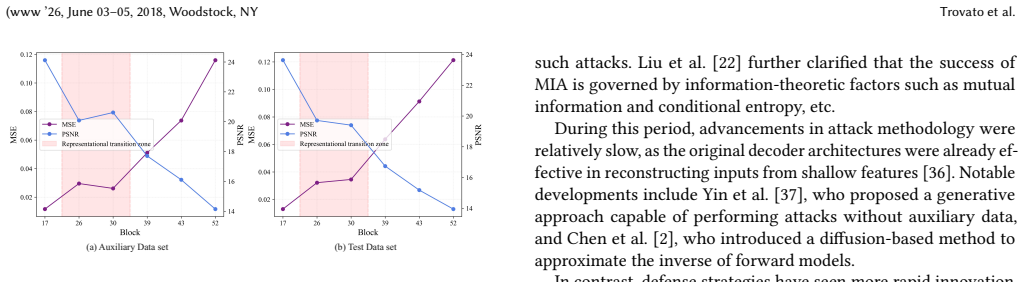
Model partitioning at the Golden Partition Zone yields intrinsic resistance to inversion attacks by marking a representational transition that sharply raises reconstruction error.
A machine-rendered reading of the paper's core claim, the machinery that carries it, and where it could break.
Core claim
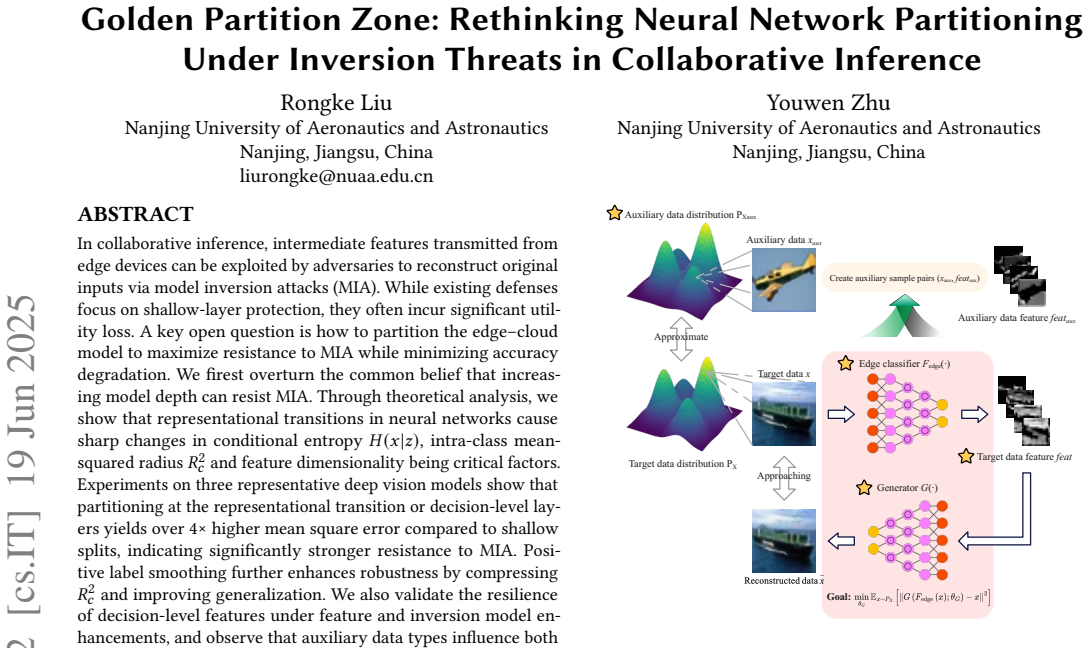
Intrinsic resistance to model inversion arises when partitioning crosses a representational transition marked by an abrupt rise in the lower bound of H(X|Z); at this point the decisive variance term shifts from global variance to the intra-class mean-squared radius R_c², which supplies an R_c²-based criterion to locate the Golden Partition Zone (GPZ) and thereby achieves intrinsic MIA resistance without added perturbation.
What carries the argument
The Golden Partition Zone (GPZ), the layer range identified by the R_c² criterion where the entropy bound's variance term transitions to intra-class mean-squared radius, which carries the argument that this transition is necessary for intrinsic resistance.
If this is right
- Partitioning at the GPZ produces more than 4x higher reconstruction MSE than shallow splits across four vision models.
- Under entropy and inversion-model enhancements, decision-level representations supply 66 percent stronger resistance than feature-level representations.
- R_c² evolves during training and can be steered by controlling label distribution, described as the Neural Vortex.
- Data type shifts both the location of the transition boundary and the resulting reconstruction difficulty.
Where Pith is reading between the lines
- The R_c² criterion could be turned into an automatic layer-selection tool that practitioners run once per architecture and dataset to pick safe split points.
- If similar entropy-bound transitions exist for membership inference or attribute inference, the same partitioning logic might protect against those attacks without extra mechanisms.
- Controlling R_c² through label distribution during training opens the possibility of training models whose GPZ occurs at a predetermined depth chosen for deployment constraints.
Load-bearing premise
An abrupt rise in the lower bound of H(X|Z) marks a necessary representational transition for intrinsic resistance and can be located reliably by the R_c² criterion.
What would settle it
Partitioning at the GPZ identified by the R_c² criterion fails to produce substantially higher reconstruction MSE than nearby splits, or the conditional-entropy lower bound shows no abrupt rise at that location.
Figures



read the original abstract
In collaborative inference (CI), transmitting intermediate representations $Z$ from edge devices enables model inversion attacks (MIA) that reconstruct the original inputs $X$, while existing defenses mainly perturb shallow-layer $Z$ at the cost of utility. We instead ask where an edge-cloud model should be partitioned to obtain intrinsic resistance to MIA. We challenge the intuition that depth is the driver of MIA resistance, and show that depth is sufficient only insofar as it enables a representational transition; this transition is necessary for intrinsic resistance and is marked by an abrupt rise in the lower bound of $H(X|Z)$. Correspondingly, the decisive variance term in the entropy bound shifts from a global variance to the intra-class mean-squared radius $R_c^2$ rather than dimensionality alone, yielding an $R_c^2$-based criterion to locate the transition zone, or identify it post hoc from MIA outcomes, which we term the Golden Partition Zone (GPZ). We further explain how $R_c^2$ evolves during training and show that it can be controlled through the label distribution; we refer to this controllable dynamic behavior as the Neural Vortex, an analysis-backed explanatory concept. Across four representative deep vision models, partitioning at the GPZ yields more than 4x higher reconstruction MSE compared to shallow splits; under entropy and inversion-model enhancements, decision-level representations provide 66 percent stronger resistance than feature-level ones, and we further observe that data type affects both the transition boundary and reconstruction.
Editorial analysis
A structured set of objections, weighed in public.
Referee Report
Summary. The paper claims that in collaborative inference, model partitioning should target a 'Golden Partition Zone' (GPZ) where an abrupt rise in the lower bound of H(X|Z) occurs; this transition, rather than depth per se, is necessary for intrinsic MIA resistance. The transition is located via an R_c² criterion derived from the entropy bound's variance term shifting from global variance to intra-class mean-squared radius R_c². The authors introduce the 'Neural Vortex' to describe controllable R_c² dynamics under label distribution changes. Experiments across four vision models show GPZ partitioning yields >4x higher reconstruction MSE than shallow splits, with decision-level representations providing 66% stronger resistance under entropy/inversion enhancements; data type also affects the boundary.
Significance. If the result holds, the work supplies a principled, entropy-bound criterion for choosing split points that deliver intrinsic privacy in edge-cloud inference without utility-damaging perturbations. By reframing depth as merely enabling a representational transition marked by the R_c² shift, and by showing label-distribution control over this quantity, the paper offers both explanatory insight and a practical lever for privacy-utility trade-offs in distributed ML. The consistent experimental gains across models lend weight to the approach within information-theoretic privacy research.
major comments (2)
- [Abstract] Abstract, paragraph on variance term shift: the allowance to 'identify [the GPZ] post hoc from MIA outcomes' renders the R_c² criterion potentially circular. The central claim requires that the abrupt rise in the lower bound of H(X|Z) marks a necessary transition that can be located independently via the entropy-derived R_c² shift; post-hoc identification from the very MIA results the method aims to resist makes the criterion descriptive rather than predictive and undermines the necessity argument.
- [Section deriving R_c² from entropy bound] Derivation of R_c² criterion (variance term shift): the link between the entropy lower bound and the global-to-intra-class radius transition must be shown to yield an a-priori computable locator. If the experiments first measure reconstruction MSE at candidate splits and only then verify R_c² alignment, the evidence supports correlation but not the stronger claim that the transition is necessary and independently detectable from the bound alone.
minor comments (2)
- The 'Neural Vortex' is presented as an analysis-backed explanatory concept; a concise mathematical characterization or pseudocode for how label distribution modulates R_c² would improve reproducibility.
- Notation for the conditional entropy lower bound and the R_c² term should be introduced with explicit equation numbers and cross-referenced in the experimental sections.
Simulated Author's Rebuttal
We thank the referee for the constructive comments on our work. We address the concerns regarding the potential circularity of the R_c² criterion and the need for demonstrating its a priori computability. Revisions have been made to clarify these aspects in the manuscript.
read point-by-point responses
-
Referee: [Abstract] Abstract, paragraph on variance term shift: the allowance to 'identify [the GPZ] post hoc from MIA outcomes' renders the R_c² criterion potentially circular. The central claim requires that the abrupt rise in the lower bound of H(X|Z) marks a necessary transition that can be located independently via the entropy-derived R_c² shift; post-hoc identification from the very MIA results the method aims to resist makes the criterion descriptive rather than predictive and undermines the necessity argument.
Authors: We appreciate this observation. The R_c² criterion is computed a priori from the entropy bound using the class-conditional variance of the intermediate representations Z, which does not require any MIA experiments. The post hoc identification from MIA outcomes is mentioned as an additional means to verify the GPZ in experimental settings but is not the primary method for locating it. We have revised the abstract to remove any ambiguity and explicitly state that the GPZ is located using the R_c² shift derived from the bound, with post-hoc serving only for corroboration. This preserves the predictive and independent nature of the criterion. revision: yes
-
Referee: [Section deriving R_c² from entropy bound] Derivation of R_c² criterion (variance term shift): the link between the entropy lower bound and the global-to-intra-class radius transition must be shown to yield an a-priori computable locator. If the experiments first measure reconstruction MSE at candidate splits and only then verify R_c² alignment, the evidence supports correlation but not the stronger claim that the transition is necessary and independently detectable from the bound alone.
Authors: We agree that stronger evidence for the a priori nature is needed. In the revised version, we have elaborated the derivation to provide a clear algorithm for computing the R_c² values at each layer using only the model's forward passes and label information, independent of any inversion attack. The experimental section has been updated to describe that candidate partitions are first selected based on the R_c² transition point, and then MIA performance is evaluated to demonstrate the resistance. Additional analysis has been included to show the alignment without relying on post-selection of splits based on MSE. revision: yes
Circularity Check
R_c² criterion may locate GPZ only post-hoc from MIA results rather than predictively from the entropy bound alone
specific steps
-
fitted input called prediction
[Abstract]
"yielding an R_c²-based criterion to locate the transition zone, or identify it post hoc from MIA outcomes, which we term the Golden Partition Zone (GPZ)."
The R_c² criterion is presented as derived from the shift in the variance term of the entropy bound to locate the GPZ for intrinsic resistance. Allowing post-hoc identification from MIA outcomes means the zone can be chosen based on observed reconstruction MSE, making the reported performance advantage (partitioning at GPZ yields >4x higher MSE) a fitted description of the data rather than an a-priori prediction from the bound.
full rationale
The paper derives an R_c² criterion from the entropy lower bound on H(X|Z) to mark a representational transition claimed necessary for intrinsic MIA resistance. However, the abstract explicitly permits identifying the resulting Golden Partition Zone post hoc from MIA outcomes. This creates a partial circularity because the zone used to demonstrate >4x MSE improvement can be selected using the resistance metric itself, reducing the claim that the transition (and thus depth-enabled resistance) is independently located by the bound-derived criterion. The central experiments still report concrete MSE gains across models, so the circularity is partial rather than total.
Axiom & Free-Parameter Ledger
free parameters (1)
- transition threshold on H(X|Z) rise
axioms (1)
- standard math The lower bound on conditional entropy H(X|Z) is dominated by a variance term that can be expressed as intra-class mean-squared radius R_c² after a representational transition.
invented entities (2)
-
Golden Partition Zone (GPZ)
no independent evidence
-
Neural Vortex
no independent evidence
Lean theorems connected to this paper
-
IndisputableMonolith/Cost/FunctionalEquation.leanwashburn_uniqueness_aczel unclear?
unclearRelation between the paper passage and the cited Recognition theorem.
we derive a lower bound on the conditional entropy H(x|z), and show that it undergoes a sharp increase when the representation shifts from feature-level to decision-level... key quantity we can influence is R_c²
-
IndisputableMonolith/Foundation/AbsoluteFloorClosure.leanabsolute_floor_iff_bare_distinguishability unclear?
unclearRelation between the paper passage and the cited Recognition theorem.
Lemma 3.2 (Maximum Entropy Principle for Fixed Covariance)
What do these tags mean?
- matches
- The paper's claim is directly supported by a theorem in the formal canon.
- supports
- The theorem supports part of the paper's argument, but the paper may add assumptions or extra steps.
- extends
- The paper goes beyond the formal theorem; the theorem is a base layer rather than the whole result.
- uses
- The paper appears to rely on the theorem as machinery.
- contradicts
- The paper's claim conflicts with a theorem or certificate in the canon.
- unclear
- Pith found a possible connection, but the passage is too broad, indirect, or ambiguous to say the theorem truly supports the claim.
Reference graph
Works this paper leans on
-
[1]
Bardia Azizian and Ivan V. Bajić. 2024. Privacy-Preserving Autoencoder for Collaborative Object Detection. IEEE Transactions on Image Processing 33 (2024), 4937–4951
work page 2024
-
[2]
Dake Chen, Shiduo Li, Yuke Zhang, Chenghao Li, Souvik Kundu, and Peter A Beerel. 2024. DIA: Diffusion based Inverse Network Attack on Collaborative Inference. In Proceedings of the IEEE/CVF Conference on Computer Vision and Pattern Recognition. 124–130
work page 2024
-
[3]
Ting Chen, Simon Kornblith, Mohammad Norouzi, and Geoffrey Hinton. 2021. Attention as a convolutional layer. In Proceedings of the IEEE/CVF International Conference on Computer Vision . 979–988
work page 2021
-
[4]
Tarin Clanuwat, Mikel Bober-Irizar, Asanobu Kitamoto, Alex Lamb, Kazuaki Yamamoto, and David Ha. 2018. Deep learning for classical japanese literature. arXiv preprint arXiv:1812.01718 (2018)
work page internal anchor Pith review Pith/arXiv arXiv 2018
-
[5]
Gregory Cohen, Saeed Afshar, Jonathan Tapson, and Andre Van Schaik. 2017. EMNIST: Extending MNIST to handwritten letters. In 2017 international joint conference on neural networks (IJCNN) . IEEE, 2921–2926
work page 2017
-
[6]
James W Cooley and John W Tukey. 1965. An algorithm for the machine cal- culation of complex Fourier series. Mathematics of computation 19, 90 (1965), 297–301
work page 1965
-
[7]
Thomas M Cover and Joy A Thomas. 2006. Elements of Information Theory . John Wiley & Sons
work page 2006
-
[8]
Tim Dierks and Eric Rescorla. 2008. The transport layer security (TLS) protocol version 1.2. Technical Report
work page 2008
-
[9]
Shiwei Ding, Lan Zhang, Miao Pan, and Xiaoyong Yuan. 2024. PATROL: Privacy- oriented pruning for collaborative inference against model inversion attacks. In Proceedings of the IEEE/CVF Winter Conference on Applications of Computer Vision . 4716–4725
work page 2024
-
[10]
Alexey Dosovitskiy, Lucas Beyer, Alexander Kolesnikov, Dirk Weissenborn, Xi- aohua Zhai, Thomas Unterthiner, Mostafa Dehghani, Matthias Minderer, Georg Heigold, Sylvain Gelly, et al. 2020. An image is worth 16x16 words: Transformers for image recognition at scale. arXiv preprint arXiv:2010.11929 (2020)
work page internal anchor Pith review Pith/arXiv arXiv 2020
- [11]
-
[12]
Apple Security Engineering and Architecture. 2024. Private Cloud Compute: A new frontier for AI privacy in the cloud . Retrieved June 10, 2024 from https: //security.apple.com/blog/private-cloud-compute
work page 2024
-
[13]
Godfrey Harold Hardy, John Edensor Littlewood, and George Pólya. 1952. In- equalities. Cambridge university press
work page 1952
-
[14]
Kaiming He, Xiangyu Zhang, Shaoqing Ren, and Jian Sun. 2015. Delving deep into rectifiers: Surpassing human-level performance on imagenet classification. In Proceedings of the IEEE international conference on computer vision . 1026–1034
work page 2015
-
[15]
Kaiming He, Xiangyu Zhang, Shaoqing Ren, and Jian Sun. 2016. Deep residual learning for image recognition. In Proceedings of the IEEE conference on computer vision and pattern recognition . 770–778
work page 2016
-
[16]
Zecheng He, Tianwei Zhang, and Ruby B Lee. 2019. Model inversion attacks against collaborative inference. In Proceedings of the 35th Annual Computer Secu- rity Applications Conference. 148–162
work page 2019
-
[17]
Jie Hu, Li Shen, and Gang Sun. 2018. Squeeze-and-excitation networks. In Pro- ceedings of the IEEE Conference on Computer Vision and Pattern Recognition . 7132– 7141
work page 2018
-
[18]
Edwin T Jaynes. 1957. Information theory and statistical mechanics. Physical review 106, 4 (1957), 620
work page 1957
-
[19]
Alex Krizhevsky and Geoffrey Hinton. 2009. Learning multiple layers of features from tiny images. 0 (2009)
work page 2009
-
[20]
Yann LeCun. 1998. The MNIST database of handwritten digits. http://yann. lecun. com/exdb/mnist/ (1998)
work page 1998
-
[21]
Rongke Liu, Dong Wang, Yizhi Ren, Zhen Wang, Kaitian Guo, Qianqian Qin, and Xiaolei Liu. 2024. Unstoppable attack: Label-only model inversion via conditional diffusion model. IEEE Transactions on Information Forensics and Security (2024)
work page 2024
-
[22]
Rongke Liu, Youwen Zhu, Dong Wang, Gaoning Pan, Xingyu He, and Weizhi Meng. 2025. How Breakable Is Privacy: Probing and Resisting Model Inversion Attacks in Collaborative Inference. arXiv e-prints, Article arXiv:2501.00824 (Jan. 2025), arXiv:2501.00824 pages. arXiv:2501.00824 [cs.CR] doi:10.48550/arXiv.2501. 00824
-
[23]
Ze Liu, Yutong Lin, Yue Cao, Han Hu, Yixuan Wei, Zheng Zhang, Stephen Lin, and Baining Guo. 2021. Swin transformer: Hierarchical vision transformer us- ing shifted windows. In Proceedings of the IEEE/CVF international conference on computer vision. 10012–10022
work page 2021
-
[24]
Ziwei Liu, Ping Luo, and Xiaogang Wang. 2015. Deep learning face attributes in the wild. In Proceedings of the IEEE international conference on computer vision . 3730–3738
work page 2015
-
[25]
Hong-Wei Ng and Stefan Winkler. 2014. A data-driven approach to cleaning large face datasets. In 2014 IEEE international conference on image processing (ICIP) . IEEE, 343–347
work page 2014
-
[26]
Chao Peng, Xiangyu Zhang, Gang Yu, Guiming Luo, and Jian Sun. 2017. Large kernel matters–improve semantic segmentation by global convolutional network. In Proceedings of the IEEE conference on computer vision and pattern recognition . 4353–4361
work page 2017
-
[27]
Yuben Qu, Hao Sun, and Chao Dong. 2024. Elastic Collaborative Edge Intelligence for UAV Swarm: Architecture, Challenges, and Opportunities. IEEE Communica- tions Magazine 62, 1 (2024), 62–68
work page 2024
-
[28]
Claude E Shannon. 1948. A mathematical theory of communication. The Bell system technical journal 27, 3 (1948), 379–423
work page 1948
-
[29]
Nir Shlezinger and Ivan V Bajić. 2022. Collaborative inference for AI-empowered IoT devices. IEEE Internet of Things Magazine 5, 4 (2022), 92–98
work page 2022
-
[30]
Karen Simonyan and Andrew Zisserman. 2014. Very deep convolutional networks for large-scale image recognition. arXiv preprint arXiv:1409.1556 (2014)
work page internal anchor Pith review Pith/arXiv arXiv 2014
- [31]
-
[32]
Laurens Van der Maaten and Geoffrey Hinton. 2008. Visualizing data using t-SNE. Journal of machine learning research 9, 11 (2008)
work page 2008
-
[33]
Ashish Vaswani, Noam Shazeer, Niki Parmar, Jakob Uszkoreit, Llion Jones, Aidan N Gomez, Lukasz Kaiser, and Illia Polosukhin. 2017. Attention is all you need. In Advances in Neural Information Processing Systems . 5998–6008
work page 2017
- [34]
-
[35]
Song Xia, Yi Yu, Wenhan Yang, Meiwen Ding, Zhuo Chen, Ling-Yu Duan, Alex C Kot, and Xudong Jiang. 2025. Theoretical Insights in Model Inversion Robustness and Conditional Entropy Maximization for Collaborative Inference Systems. In Proceedings of the Computer Vision and Pattern Recognition Conference. 8753–8763
work page 2025
-
[36]
Ziqi Yang, Jiyi Zhang, and Ee-Chien Chang. 2019. Neural network inversion in adversarial setting via background knowledge alignment. In Proceedings of the 2019 ACM SIGSAC Conference on Computer and Communications Security . 225–240
work page 2019
-
[37]
Yupeng Yin, Xianglong Zhang, Huanle Zhang, Feng Li, Yue Yu, Xiuzhen Cheng, and Pengfei Hu. 2023. Ginver: Generative model inversion attacks against collab- orative inference. In Proceedings of the ACM Web Conference 2023 . 2122–2131
work page 2023
-
[38]
Yuheng Zhang, Ruoxi Jia, Hengzhi Pei, Wenxiao Wang, Bo Li, and Dawn Song
-
[39]
In Proceedings of the IEEE/CVF conference on computer vision and pattern recognition
The secret revealer: Generative model-inversion attacks against deep neural networks. In Proceedings of the IEEE/CVF conference on computer vision and pattern recognition. 253–261
-
[40]
Zeping Zhang, Xiaowen Wang, Jie Huang, and Shuaishuai Zhang. 2023. Anal- ysis and utilization of hidden information in model inversion attacks. IEEE Transactions on Information Forensics and Security 18 (2023), 4449–4462. Golden Partition Zone: Rethinking Neural Network Partitioning Under Inversion Threats in Collaborative Inference (www ’26, June 03–05, ...
work page 2023
discussion (0)
Sign in with ORCID, Apple, or X to comment. Anyone can read and Pith papers without signing in.