REVIEW 4 major objections 5 minor 22 references
Targeted Lexical Injection: Unlocking Latent Cross-Lingual Alignment in Lugha-Llama via Early-Layer LoRA Fine-Tuning
T0 review · 4 major / 5 minor · reviewed 2026-08-15 · deepseek-v4-flash
Pith's one-line read Fine-tuning on a single early layer of Lugha-Llama with a contrastive objective raises final-layer Swahili–English word similarity by 28%, including for words never seen during training.
desk verdict A novel early-layer LoRA fine-tuning idea for low-resource lexical alignment, but the pilot scan contradicts its own evaluation baseline, so the central claim doesn't hold as written. read the letter →
The pith
A machine-rendered reading of the paper's core claim, the machinery that carries it, and where it could break.
The reading
What carries the argument
The central object is Targeted Lexical Injection (TLI): LoRA adapters of rank 16 with alpha 32 and dropout 0.05 on the query and value projections, trained with an in-batch triplet margin loss (margin 0.4) on length-normalized, mean-pooled embeddings extracted from Layer 2. The loss pulls each Swahili anchor toward its English translation and pushes it away from the hardest in-batch negative. Because the contrastive pressure is applied at the layer where alignment is already near-perfect, the LoRA updates teach the network to carry that alignment forward to the final output layer, which the paper argues is why trained and unseen pairs improve by nearly the same amount.
What would settle it
Measure the average cosine similarity of, say, 100 randomly paired Swahili and English words that are not translations at Layer 2 of the base model. If that average is close to 1, then the pilot's 0.99998 does not demonstrate translation-specific alignment, and the paper's explanation for TLI's gains loses its foundation.
Extended reading notes
Core claim
Lugha-Llama-8B-wura already contains strong cross-lingual lexical alignment early in its computation: in the paper's pilot scan, average cosine similarity between Swahili–English translation pairs at Layer 2 is 0.99998, while the same pairs reach only around 0.32 at the final layer. The paper proposes Targeted Lexical Injection (TLI), which fine-tunes LoRA adapters using a contrastive objective on Layer 2 embeddings rather than on output embeddings. After TLI, final-layer mean cosine similarity increases from 0.3211 to 0.4113 on 623 trained pairs and from 0.3143 to 0.4033 on 63 unseen control pairs, gains of about 28% in both settings with tiny p-values. The paper interprets this as TLI strengthening the model's ability to preserve and propagate its pre-existing early-layer alignment to the output, rather than memorizing the training pairs.
Load-bearing premise
The load-bearing premise is that the near-perfect Layer 2 cosine similarity (0.99998) reflects genuine translation-specific semantic alignment, rather than the geometric accident that all early-layer word embeddings point in nearly the same direction.
Editorial extensions
If this is right
- Trained-pair output alignment improves from 0.3211 to 0.4113 mean cosine similarity (+28.08%, p < 1.33 × 10⁻²⁴⁰).
- Unseen control pairs improve from 0.3143 to 0.4033 (+28.32%, p < 7.17 × 10⁻²⁷), so the effect is not limited to memorized vocabulary.
- The method needs only a few hundred word pairs and LoRA adapters, making it parameter-efficient and data-efficient for low-resource languages.
- The paper's interpretation implies TLI refines the propagation of internal alignments, so downstream tasks that rely on lexical equivalence could benefit without retraining on parallel corpora.
Reading between the lines
- Editorial inference: the optimal target layer is likely not fixed at Layer 2 across architectures and language pairs, so a layerwise similarity scan like the pilot could become a routine preliminary step for similar interventions.
- Editorial inference: if the near-perfect Layer 2 similarity is partly an artifact of anisotropic embedding geometry, the 28% output gain might be explained by a global reshaping of the embedding space rather than by unlocking semantic knowledge; the method could still be useful, but for a different reason.
- Editorial inference: a direct test of the generalization story would be to check whether post-TLI output embeddings approximately preserve Layer 2 angles; if the adapters truly improve propagation, a near-linear angle-preserving mapping between layers should emerge.
- Editorial inference: word-pair cosine similarity is an isolated lexical measure, so the practical value of TLI would be better established by measuring downstream translation or cross-lingual retrieval before and after the intervention.
Signed reviews
Editorial analysis
A structured set of objections, weighed in public.
Referee Report
Summary. The paper proposes Targeted Lexical Injection (TLI), a LoRA-based fine-tuning method for Lugha-Llama-8B-wura that aims to improve output-level Swahili-English lexical alignment. A pilot scan of layerwise cosine similarities on a curated set of 686 word pairs identifies Layer 2 as having near-perfect average similarity (0.99998), while the final layer shows much lower similarity. TLI then trains LoRA adapters with an in-batch triplet contrastive loss applied to Layer 2 embeddings and reports that mean cosine similarity at the final layer increases from 0.3211 to 0.4113 for 623 trained pairs and from 0.3143 to 0.4033 for 63 control pairs. The paper interprets these gains as evidence that the model possesses latent early-layer alignment that TLI helps preserve and propagate to the output.
Significance. If the empirical claims were reliable, the paper would make a useful, parameter-efficient contribution to adapting LLMs to low-resource languages and to understanding layerwise cross-lingual representations. The core idea is clear, the quantitative reporting is detailed, and the intention to test generalization with a held-out control set is sensible. However, the central evidence currently contains an internal contradiction and a circularity in layer selection, and the proposed mechanism is not tested against plausible alternative explanations. As it stands, the paper does not establish the claimed latent-alignment phenomenon or the mechanism by which TLI is said to improve output-level alignment.
major comments (4)
- [§3.2, §4.1, Table 1] Section 3.2 reports that the pilot layer scan on the Section 3.3 curated set gives an average cosine similarity of 0.9876 at Layer 31, but Section 4.1 and Table 1 report the Pre-TLI baseline at Layer 31 as 0.3211 on the 623 trained pairs and 0.3143 on the 63 control pairs. The extraction procedures are described identically (mean pooling, L2 normalization, cosine similarity), and the pilot is stated to use the same curated set, so these numbers cannot both be correct for the same model, layer, and set. The caveat in Section 3.2 that the Layer 31 pilot value "may reflect the specific conditions or word subset used" is ad hoc and contradicts the stated use of the Section 3.3 set. Because the Layer 2 value of 0.99998 comes from the same scan, this contradiction undermines the central claim that the model possesses near-perfect latent alignment at Layer 2 and therefore also the choice of TARGET_LAYER.
- [§3.2, §3.3] TARGET_LAYER=2 was selected from a pilot scan that uses "the curated set described in Section 3.3," which is the full set of 686 pairs later split into 623 training pairs and 63 control pairs. Because the 63 control pairs contributed to the layer-selection decision, the claim in Sections 4.2 and 5.1 that TLI generalizes to "unseen" control pairs is not independent. The control pairs were unseen during LoRA training, but they were not unseen during the design step that chose the target layer. The layer selection should be rerun on the training split only, with the control split held out from all design decisions.
- [§3.2] The pilot scan reports only similarities between Swahili-English translation pairs at each layer, with no comparison to unrelated Swahili-English pairs. The near-perfect average at Layer 2 (0.99998) is therefore not sufficient evidence of semantic alignment: if all token embeddings in early residual-stream layers occupy a narrow cone or an effectively low-dimensional subspace, translation pairs and random pairs alike could show cosine similarities close to 1. The paper needs to report non-translation-pair similarities at Layer 2, and ideally embedding norms or effective rank, before the "latent lexical alignment" claim can be accepted.
- [§5.2, §5.3] The paper's mechanistic interpretation is that TLI works because it targets Layer 2 specifically, but no ablation compares TLI with LoRA/contrastive training on other layers (for example, Layer 31) or with a standard fine-tuning objective. Without such baselines, the observed improvement at the output layer could be a generic effect of contrastive LoRA fine-tuning rather than evidence that the model's early-layer alignment is being preserved and propagated. This should be tested before the proposed mechanism is stated as established.
minor comments (5)
- [Appendix 7.1] The appendix says that details of the contrastive loss implementation "would typically be provided here" and refers to a conceptual implementation, but no code, script, or repository link is included. Since the paper's quantitative results are central, the actual training script or a link to it should be provided.
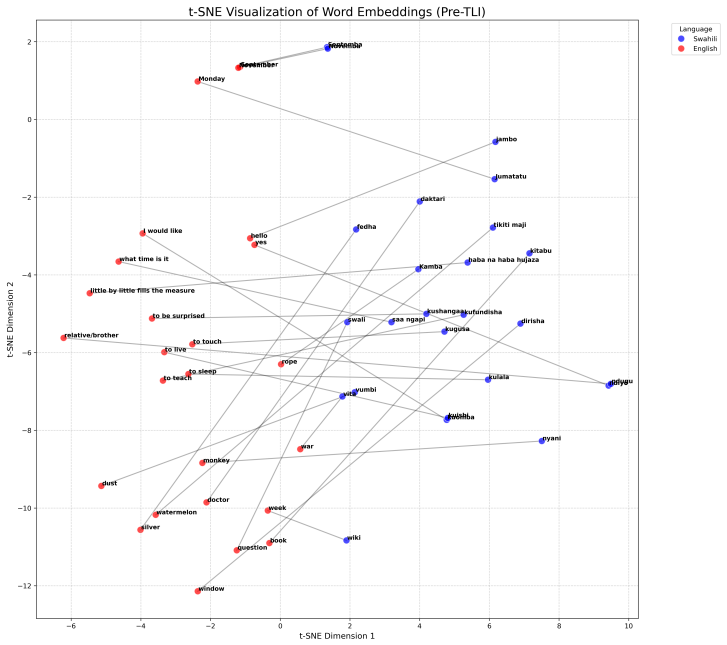
- [Figures 2 and 3] The t-SNE visualizations are described with qualitative terms such as "loosely grouped," "diffuse," and "visibly much closer," without a quantitative link to the reported average improvements; t-SNE is stochastic and can exaggerate perceived structure, so the figures should be interpreted with caution or supplemented with quantitative embedding-space diagnostics.
- [§3.3] The procedure for splitting the 686 curated pairs into 623 training and 63 control pairs is not described, and no randomization seed or selection criterion is reported, so the split is not reproducible.
- [References] The citation for the SimCLR method is given as "Chen, T., K. S. N. M. and Hinton, G. (2020)"; this should be corrected to Chen, Kornblith, Norouzi, and Hinton (2020).
- [§3.4] Equation (1) defines the triplet margin loss, but the margin value and the use of L2-normalized embeddings are mentioned only in the surrounding text; stating them directly inside or immediately below the equation would improve clarity.
Circularity Check
Control 'unseen' pairs co-selected TARGET_LAYER; the pilot's Layer 31 value (0.9876) also contradicts the Layer 31 baseline (0.3211), so the generalization claim is not independent.
-
fitted input called prediction
[Section 3.2 'Identifying the Optimal Pre-existing Alignment Layer (Pilot Study)'; Section 3.3 'Word Pair Curation'; Section 4.2 'Impact of TLI on Lexical Alignment']
"Section 3.2: 'A curated set of Swahili-English word pairs (described in Section 3.3) was used for this initial scan.' Section 3.3: 'Control Set: 63 pairs ... entirely unseen during TLI fine-tuning, used to evaluate the generalization capabilities of the TLI method.' Section 4.2: 'the 63 control word pairs, which were not seen during TLI fine-tuning, exhibited a comparable improvement.'"
The hyperparameter TARGET_LAYER=2 was chosen by a pilot scan over the full 686-pair set described in Section 3.3, which includes the 63 pairs later designated as control/unseen. The paper then reports the +28.32% control-set improvement as evidence that TLI generalizes to unseen vocabulary. But those pairs were not unseen for the layer-selection step: their internal Layer 2 similarity co-determined the layer at which the contrastive loss was applied. The control result is therefore a fitted-input prediction, not an independent test of generalization; the 'control' label is accurate only with respect to TLI fine-tuning, not with respect to the design of the intervention.
full rationale
The main circularity is in the layer-selection protocol. TARGET_LAYER=2 is presented as 'empirically identified' from a pilot scan, but the scan used the full 686-pair set described in Section 3.3, before the split into 623 trained and 63 control pairs. Those 63 pairs are later called 'unseen' and their +28.32% improvement is offered as evidence that TLI generalizes. Because the control pairs influenced the choice of the very layer at which the contrastive loss operates, the control result is a fitted-input prediction rather than an independent test: the labels 'unseen' and 'generalization' are not accurate for the layer-selection step. Separately, the paper's own numbers contain an unresolved contradiction: the pilot reports Layer 31 average similarity of 0.9876 on the Section 3.3 set, while Table 1 reports the Pre-TLI Layer 31 baseline as 0.3211/0.3143 on the same layer and, nominally, the same set. The paper's caveat that the pilot value 'may reflect the specific conditions or word subset used' is ad hoc, since Section 3.2 explicitly uses the Section 3.3 set. This contradiction is a correctness risk rather than an additional circular step, but it further weakens the derivation: the 'latent alignment at Layer 2 vs output 0.32' contrast is not established by comparable measurements. The post-TLI trained-pair improvements are not circular by themselves, since the loss is applied to Layer 2, not directly to the output layer; but the headline generalization claim is contaminated by the pilot's use of the control pairs. No load-bearing self-citation or imported uniqueness theorem appears in the paper, so the circularity is confined to the layer-selection/evaluation overlap.
Assumptions & free parameters
free parameters (9)
- TARGET_LAYER =
2
- margin =
0.4
- LoRA rank =
16
- LoRA alpha =
32
- LoRA dropout =
0.05
- learning_rate =
2e-4
- epochs =
5
- batch_size =
8
- warmup_steps =
50
assumptions (3)
- ad hoc to paper High cosine similarity between Swahili and English embeddings at Layer 2 indicates semantic lexical alignment.
- domain assumption The pilot scan and the final evaluation use compatible embedding extraction so that Layer 31 values are comparable.
- domain assumption The final output layer's cosine similarity is the appropriate interface for measuring lexical alignment for downstream tasks.
Cite this review
Pith. "Pith review of Targeted Lexical Injection: Unlocking Latent Cross-Lingual Alignment in Lugha-Llama via Early-Layer LoRA Fine-Tuning." pith.science (2026). https://pith.science/paper/A7PA4CSB
@misc{pith2026250615415,
  author       = {Pith},
  title        = {Pith review of: Targeted Lexical Injection: Unlocking Latent Cross-Lingual Alignment in Lugha-Llama via Early-Layer LoRA Fine-Tuning},
  year         = {2026},
  howpublished = {\url{https://pith.science/paper/A7PA4CSB}},
  note         = {Machine review of arXiv:2506.15415}
}
read the original abstract
Large Language Models (LLMs) have demonstrated remarkable capabilities, yet their performance in low-resource languages (LRLs), such as Swahili, often lags due to data scarcity and underrepresentation in pre-training. A key challenge is achieving robust cross-lingual lexical alignment, crucial for tasks like translation and cross-lingual information retrieval. This paper introduces Targeted Lexical Injection (TLI), a novel and efficient fine-tuning approach. We first demonstrate that Lugha-Llama-8B-wura, a Swahili-centric LLM, exhibits strong, near-perfect lexical alignment for Swahili-English word pairs in its early internal layers (specifically Layer 2, with ~0.99998 average cosine similarity based on a pilot study), a capability not fully reflected in its final output representations (baseline ~0.32 similarity on our evaluation set). TLI leverages this insight by using Low-Rank Adaptation (LoRA) and a contrastive learning objective to fine-tune the model, specifically targeting embeddings from this empirically identified optimal early layer. Our experiments show that TLI significantly improves the output-level lexical alignment for 623 trained Swahili-English word pairs, increasing average cosine similarity from 0.3211 to 0.4113 (+28.08%, p < 1.33 x 10^-240). More importantly, these improvements generalize remarkably well to 63 unseen control word pairs, with similarity increasing from 0.3143 to 0.4033 (+28.32%, p < 7.17 x 10^-27). These findings suggest TLI enhances the model's ability to preserve and propagate its inherent early-layer cross-lingual knowledge, offering a parameter-efficient and effective strategy for improving lexical alignment in LRL-focused LLMs.
Figures


Reference graph
Works this paper leans on
-
[1]
I., Abbott, J., Neubig, G., Dione, P
Adelani, D. I., Abbott, J., Neubig, G., Dione, P. A., Ahia, O., Ogayo, P., Aremu, O., Cashman, C., Gitau, C., Alabi, J., et al. (2021). Masakhane: A machine translation benchmark for African languages. In Findings of the Association for Computational Linguistics: EMNLP 2021 , pages 200--217
work page 2021
-
[2]
Artetxe, M., Ruder, S., and Yogatama, D. (2019). On the cross-lingual transferability of monolingual representations. arXiv preprint arXiv:1910.11856 . Published at ACL 2020
arXiv 2019
-
[3]
Chen, T., K. S. N. M. and Hinton, G. (2020). A simple framework for contrastive learning of visual representations. In International conference on machine learning , pages 1597--1607. PMLR
work page 2020
-
[4]
Conneau, A., Khandelwal, K., Goyal, N., Chaudhary, V., Wenzek, G., Guzm \'a n, F., Grave, E., Ott, M., Zettlemoyer, L., and Stoyanov, V. (2019). Unsupervised cross-lingual representation learning at scale. arXiv preprint arXiv:1911.02116 . Referred to as XLM/XLM-R
arXiv 2019
-
[5]
Dettmers, T., Lewis, M., Belkada, Y., and Zettlemoyer, L. (2022). LLM.int8() : 8-bit matrix multiplication for transformers at scale. arXiv preprint arXiv:2208.07339
arXiv 2022
-
[6]
Devlin, J., Chang, M.-W., Lee, K., and Toutanova, K. (2018). BERT : Pre-training of deep bidirectional transformers for language understanding. arXiv preprint arXiv:1810.04805 . Published at NAACL 2019
arXiv 2018
-
[7]
Hadsell, R., Chopra, S., and LeCun, Y. (2006). Dimensionality reduction by learning an invariant mapping. In 2006 IEEE Computer Society Conference on Computer Vision and Pattern Recognition (CVPR'06) , volume 2, pages 1735--1742. IEEE
work page 2006
-
[8]
J., Shen, Y., Wallis, P., Allen-Zhu, Z., Li, Y., Wang, S., Wang, L., and Chen, W
Hu, E. J., Shen, Y., Wallis, P., Allen-Zhu, Z., Li, Y., Wang, S., Wang, L., and Chen, W. (2021). LoRA : Low-rank adaptation of large language models. arXiv preprint arXiv:2106.09685 . Published at ICLR 2022
arXiv 2021
Show all 22 references
-
[9]
Joshi, P., Santy, S., Budhiraja, A., Bali, K., and Choudhury, M. (2020). The state and fate of linguistic diversity and inclusion in the NLP world. arXiv preprint arXiv:2004.09095
2020 arXiv
-
[10]
Lauscher, A., Ravishankar, V., Vuli \'c , I., and Ponzetto, S. P. (2020). From zero to hero: On the limitations of zero-shot cross-lingual transfer with multilingual transformers. In Proceedings of the 2020 Conference on Empirical Methods in Natural Language Processing (EMNLP)...
2020
-
[11]
and Hutter, F
Loshchilov, I. and Hutter, F. (2017). Decoupled weight decay regularization. arXiv preprint arXiv:1711.05101 . Published at ICLR 2019
2017 arXiv
-
[12]
Lugha-llama-8b-wura
Lugha Factory (2023). Lugha-llama-8b-wura. https://huggingface.co/LughaFactory/Lugha-Llama-8B-wura
2023
-
[13]
V., and Sutskever, I
Mikolov, T., Le, Q. V., and Sutskever, I. (2013). Exploiting similarities among languages for machine translation. arXiv preprint arXiv:1309.4168
2013 arXiv
-
[14]
Pan, X., Zhang, B., Geng, S., Jiang, H., and Zhao, T. (2021). MCONVERT : A contrastive learning framework for multilingual text representations. In Findings of the Association for Computational Linguistics: EMNLP 2021 , pages 4338--4349
2021
-
[15]
Pires, T., Schlinger, E., and Garrette, D. (2019). How multilingual is multilingual BERT ? arXiv preprint arXiv:1906.01502
2019 arXiv
-
[16]
Rogers, A., Kovaleva, O., and Rumshisky, A. (2020). A primer in BERT ology: What we know about how BERT works. Transactions of the Association for Computational Linguistics , 8:843--866
2020
-
[17]
H., Mazula, R.-M., Kawambwa, S
Sim, G. H., Mazula, R.-M., Kawambwa, S. J., Manda, C. L., and van Genabith, J. (2022). SAWA : A swahili-english parallel corpus for machine translation. In Proceedings of the Language Resources and Evaluation Conference (LREC) , pages 6916--6923, Marseille, France
2022
-
[18]
L., Turban, D
Smith, S. L., Turban, D. H. P., Hamblin, S., and Hammerla, N. Y. (2017). Offline bilingual word vectors, orthogonal transformations and the inverted softmax. arXiv preprint arXiv:1702.03859
2017 arXiv
-
[19]
Tenney, I., Das, D., and Pavlick, E. (2019). BERT rediscovers the classical NLP pipeline. arXiv preprint arXiv:1905.05950 . Published at ACL 2019
2019 arXiv
-
[20]
Wang, Z.-q., Zhang, Z.-h., Zhang, Y.-x., and Yu, Y. (2022). Cross-lingual contrastive learning for fine-grained text sentiment analysis. In Proceedings of the 60th Annual Meeting of the Association for Computational Linguistics (Volume 1: Long Papers) , pages 184--194
2022
-
[21]
and Dredze, M
Wu, S. and Dredze, M. (2019). Beto, bentz, and berto: The surprising cross-lingual effectiveness of BERT . arXiv preprint arXiv:1904.09077
2019 arXiv
-
[22]
Xing, C., Wang, D., Liu, C., and Su, J. (2015). Normalized word embedding and orthogonal transform for bilingual word translation. In Proceedings of the 2015 Conference of the North American Chapter of the Association for Computational Linguistics: Human Language Technologies ...
2015
Reviewed August 15, 2026 · model on record in the stance chip above.
Discussion (0). Continue with ORCID to comment.