REVIEW 3 major objections 5 minor 57 references
Error-detected coherence metrology of a dual-rail encoded fixed-frequency multimode superconducting qubit
T0 review · 3 major / 5 minor · reviewed 2026-08-15 · deepseek-v4-flash
Pith's one-line read A fixed-frequency multimode superconducting qubit encodes a dual-rail logical qubit whose detected bit-flip and phase-flip rates are 48x and 11x below the physical modes.
desk verdict A plausible and well-executed fixed-frequency dual-rail erasure demo, but missing readout-confusion numbers leave the headline 48x/11x coherence improvements unproven. read the letter →
The pith
A machine-rendered reading of the paper's core claim, the machinery that carries it, and where it could break.
The reading
What carries the argument
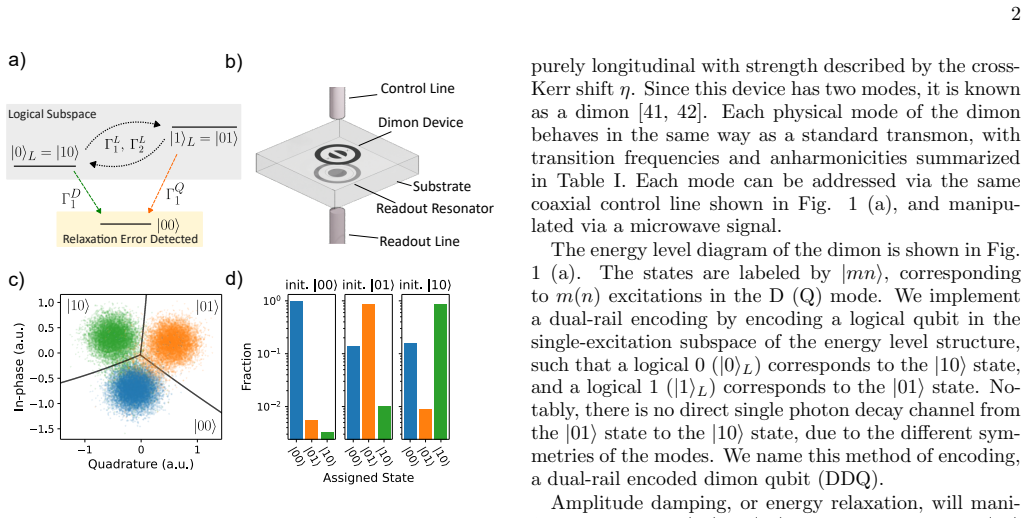
The central mechanism is a dual-rail encoding inside a dimon, a three-island, two-junction superconducting device with two transmonlike modes, $D$ and $Q$. The logical states $|0\rangle_L = |10\rangle$ and $|1\rangle_L = |01\rangle$ have different electric-field symmetries, so there is no direct single-photon transition between them; amplitude damping therefore exits the logical subspace to the ground state $|00\rangle$. A readout tone placed between the two dispersive resonances produces three separable Gaussian clouds, and a Gaussian mixture model assigns each shot to $|00\rangle$, $|01\rangle$, or $|10\rangle$. Eq. (3) renormalizes the surviving logical populations, converting a raw decay measurement into an error-detected coherence measurement. This combination—symmetry-forbidden logical leakage, three-state readout, and postselection—is what carries the reported $T_1^L$ and $T_{2E}^L$ improvements.
What would settle it
Retrain the GMM classifier on a different readout drive frequency or with a stricter $|00\rangle$ rejection threshold and remeasure the logical bit-flip decay: if $T_1^L$ shifts, readout misclassification is biasing the reported suppression. Independently, search spectroscopically for any transition between $|01\rangle$ and $|10\rangle$; observing direct coupling between the logical states would break the symmetry argument and invalidate the erasure interpretation.
Extended reading notes
Core claim
The central discovery is that the two single-excitation states of the dimon form a dual-rail code with no direct single-photon decay channel between them, so energy relaxation from either logical state lands in $|00\rangle$ and is heralded by the end-of-line readout. After discarding those heralded events, the logical subspace exhibits median $T_1^L = 3.12$ ms and $T_{2E}^L = 0.76$ ms, i.e. bit-flip and phase-flip rates suppressed by factors of 48 and 11 relative to the constituent $D$ and $Q$ modes, with Ramsey coherence improved by about 4x. The erasure rate closely tracks the physical $T_1$ fluctuations, confirming that the detected leakage is ordinary amplitude damping. The same numbers reproduce on three devices with mode detunings from 0.76–1.05 GHz, showing the improvement is architectural rather than sample-specific.
Load-bearing premise
The protocol assumes that relaxation from either logical state always goes to the empty $|00\rangle$ state, never directly between $|01\rangle$ and $|10\rangle$, and that the three-state readout separates $|00\rangle$ from the logical states well enough that postselection removes essentially all amplitude-damping events.
Editorial extensions
If this is right
- A fixed-frequency multimode transmon can act as an erasure-converted logical qubit with all-microwave control and no flux or galvanic-coupling overhead.
- The error-detected suppression is stable over 50-hour runs on three separate devices, so it is not a one-sample coincidence.
- Because the logical subspace cancels common-mode frequency noise, comparing logical and physical Ramsey or Hahn-echo decays gives a per-device estimate of the common versus differential noise budget.
- The erasure rate follows the physical $T_1$ fluctuations, so raising physical mode relaxation times directly lowers the postselection overhead of this logical protocol.
Reading between the lines
- The paper measures only end-of-line detection; a natural extension would be a mid-circuit erasure check, which would turn the postselected memory into a repeat-until-success primitive whose overhead is set by the measured erasure rate.
- The observed Ramsey improvement on Q2 (~4.5x) exceeds the photon-shot-noise-only estimate from Eq. (7) (~1–2x), suggesting that other common-mode noise is dominant; sweeping the readout photon number while tracking $T_{2E}^L$ would test this separation directly.
- If junction-asymmetry noise is the limiting differential source, then fabricating devices with $r = E_{J1}/E_{J2}$ closer to unity, or post-processing the junctions, should raise $T_{2E}^L$; the paper's tabulated $r$ values make this a quantitative prediction across Q1–Q3.
Signed reviews
Editorial analysis
A structured set of objections, weighed in public.
Referee Report
Summary. This manuscript reports a dual-rail logical qubit encoded in the single-excitation subspace of a fixed-frequency two-mode multimode transmon ('dimon'), with logical states |01> and |10> and an end-of-line readout that classifies the |00> state as an erasure. By postselecting on non-erasure shots, the authors extract effective logical bit-flip and phase-flip rates and report improvements over the physical mode coherence times: median T_L1 = 3.12 ms (48x), T_L2E = 0.76 ms (11x), and T_L2R = 0.07 ms (4x), based on roughly 50-hour interleaved measurements on three devices. Section II describes the device, Hamiltonian, and three-state GMM readout; Section III defines the coherence metrics and postselection; Section IV presents noise analysis via Allan deviation and spectral density, attributing the observed logical coherence improvement to suppression of common-mode dephasing sources while retaining sensitivity to differential noise.
Significance. If the reported rates are correct, this is a significant step for erasure-conversion hardware: a flux-free, fixed-frequency, three-island transmon provides all-microwave dual-rail encoding with detectable amplitude-damping errors in a compact coaxial architecture, with repeatability across three devices. The long time series, interleaved measurements, and bootstrap bounds are notable strengths, as is the explicit stability analysis over 50 hours. However, the headline improvements depend on the three-state GMM readout being nearly confusion-free and on the definition of the short-time logical error rates; without a confusion matrix and a clearer fitting model, the central claim is not yet fully established. The work is of high interest to the superconducting-qubit and quantum-error-correction communities, but requires additional readout and fit characterization.
major comments (3)
- [Section III, Eq. (3) and Fig. 1(c)] The postselection in Eq. (3) is valid only if the GMM classifier separates |00> from the logical states with negligible error, but the manuscript reports no confusion matrix or readout fidelity for the three-state classifier. Because the erasure population grows approximately as Gamma_erasure * t with Gamma_erasure ~ 13-17 kHz, a fraction epsilon of |00> shots misclassified as |01> or |10> contributes an apparent bit-flip rate of order epsilon * Gamma_erasure. For the reported median T_L1 = 3.12 ms (Gamma_L1 ~ 0.32 kHz), epsilon of a few percent is sufficient to produce the claimed 48x bit-flip improvement even if the true logical bit-flip rate were zero, and the overlapping distributions in Fig. 1(c) make such confusion non-negligible. The authors should report the full confusion matrix for the EOL readout, including |00>->|01>, |00>->|10>, and |01><->|10> misclassification probabilities, and show that the extracted logical rates are stable under an upper bound on these probabilities.
- [Section III and Fig. 2(d)-(f)] The logical T_L1 and T_L2E values are obtained by fitting a linear slope with constant offset to data over the first 30 microseconds, whereas the physical coherence times are extracted from exponential fits. The manuscript does not report fit residuals, uncertainties, or a model justifying the linear approximation over this window; if the true short-time logical bit-flip probability is quadratic in time (as expected when a bit flip requires relaxation followed by re-excitation), the fitted slope depends on the chosen window length. This makes the reported 'logical error rate' not directly comparable to the physical decay rates. Please provide the fits with residuals, a stability test of the extracted rates under varying the fit window (e.g., 10, 20, and 40 microseconds), and, if possible, fits to the expected short-time functional form.
- [Section II, 'no direct single photon decay channel'] The statement that there is no direct single-photon decay channel from |01> to |10> due to the different symmetries of the modes is load-bearing for the logical bit-flip model, since any direct |01><->|10> matrix element would contribute a first-order bit-flip rate. The manuscript gives no derivation or reference for the vanishing of this matrix element. Please provide a quantitative symmetry argument (or a citation) showing that the relaxation coupling operator has zero matrix element between |01> and |10>, or bound the residual direct transfer rate experimentally, for example by preparing |01> and measuring the |10> population in the absence of re-excitation.
minor comments (5)
- [Eq. (3)] There is a typographical error in the denominators of Eq. (3): 'P (|01))' should read 'P (|01>).'
- [Section III, paragraph on erasure rate] The sentence 'The erasure rate is a important metric' should read 'an important metric.'
- [Fig. 2 caption] The caption says 'Y-axis in (d) showing difference'; this should be 'shows the difference' for grammatical completeness.
- [Section IV, Eq. (7)] Equation (7) is introduced without derivation or a reference; please provide a derivation sketch or citation so that the dephasing ratio can be checked.
- [Section IV, text near Fig. 4(i)] The units of the noise amplitudes A and B should be stated explicitly when the fit model sigma_delta_f(tau) = (B/2)^{1/2} tau^{-1/2} + (2 ln 2 A)^{1/2} is introduced.
Circularity Check
No significant circularity: the dual-rail coherence improvements are measured against independent physical benchmarks, with no fitted parameter forced to produce the claimed ratios.
full rationale
The paper's central quantitative claims are experimental comparisons between postselected logical-subspace coherence times and independently measured physical-mode coherence times on the same devices. Equation (3) defines the error-detected logical populations by renormalizing over the |01> and |10> classifications; this is the erasure-detection protocol under test, not a hidden input. The reported T_L1=3.12 ms, T_L2E=0.76 ms, and T_L2R=0.07 ms are extracted from fits to time traces (linear slope over 30 microseconds for bit/phase flip, exponential for Ramsey), and the physical T1, T2E, and T2R are conventional measurements listed in Table I. None of these fits contains the 48x/11x/4x ratios as parameters; the ratios are computed afterwards from the medians. The theoretical photon-shot-noise dephasing estimate in Eq. (7) is an independent formula using measured chi and kappa parameters, and the paper explicitly notes that the measured Ramsey improvement (~4.5x) exceeds the Eq. (7) prediction (1-2x), which is inconsistent with fitting-to-conclusion. Self-citations to earlier work by the same group (refs. [29], [34], and [40]) support the device architecture and fabrication methods but are not used to justify the coherence-improvement claim. The readout-confusion scenario raised by the skeptic is a possible calibration or validity bias that could affect the absolute logical error rates, but it is not a circular reduction of the measured coherence to an input of the measurement, so it does not raise the circularity score.
Assumptions & free parameters
free parameters (5)
- Logical coherence times T_L1, T_L2E, T_L2R from short-window fits =
T_L1 median 3.12 ms; T_L2E median 0.76 ms; T_L2R median 0.07 ms
- Junction energy ratio r =
0.963 (Q1), 0.959 (Q2), 0.931 (Q3)
- Noise model amplitude A =
5.9e5 Hz^2 (logical), 3.5e5 Hz^2 (D), 2.0e5 Hz^2 (Q)
- White noise amplitude B =
0.5e6 Hz^2/Hz (logical), 1.3e6 Hz^2/Hz (D and Q)
- Erasure time constant T_erasure =
Not tabulated
assumptions (6)
- domain assumption The dimon's two modes have no direct single-photon transition between |01> and |10> because of their different symmetries.
- domain assumption Every amplitude-damping event from the logical subspace lands in |00>.
- domain assumption The GMM classifier trained on 10k shots correctly separates |00>, |01>, and |10> sufficiently for renormalized logical populations.
- ad hoc to paper Short-time logical decay is linear up to 30 microseconds.
- domain assumption The dispersive approximation for resonator coupling holds, yielding Eq. (2) and the dephasing ratio Eq. (7).
- domain assumption Noise sources can be separated into common and differential classes for the two modes.
Cite this review
Pith. "Pith review of Error-detected coherence metrology of a dual-rail encoded fixed-frequency multimode superconducting qubit." pith.science (2026). https://pith.science/paper/IWLNQ3NB
@misc{pith2026250615420,
  author       = {Pith},
  title        = {Pith review of: Error-detected coherence metrology of a dual-rail encoded fixed-frequency multimode superconducting qubit},
  year         = {2026},
  howpublished = {\url{https://pith.science/paper/IWLNQ3NB}},
  note         = {Machine review of arXiv:2506.15420}
}
read the original abstract
Amplitude damping is a dominant source of error in high performance quantum processors. A promising approach in quantum error correction is erasure error conversion, where errors are converted into detectable leakage states. Dual-rail encoding has been shown as a candidate for the conversion of amplitude-damping errors; with unique sensitivities to noise and decoherence sources. Here we present a dual-rail encoding within a single fixed-frequency superconducting multimode transmon qubit. The three island, two junction device comprises two transmonlike modes with a detuning of 0.75-1 GHz, in a coaxial circuit QED architecture. We show the logical bit-flip and phase-flip error rates are more than one order of magnitude lower than the physical error rates, and demonstrate stability and repeatability of the architecture through an extended measurement of three such devices. Finally, we discuss how the error-detected subspace can be used for investigations into the fundamentals of noise and decoherence in fixed-frequency transmon qubits.
Figures


Figures from the paper (2 more)


Reference graph
Works this paper leans on
-
[1]
Siddiqi, Engineering high-coherence superconducting qubits, Nature Reviews Materials 6, 875 (2021)
I. Siddiqi, Engineering high-coherence superconducting qubits, Nature Reviews Materials 6, 875 (2021)
2021
-
[2]
C. E. Murray, Material matters in superconducting qubits, Materials Science and Engineering: R: Reports 146, 100646 (2021)
2021
-
[3]
V. E. Manucharyan, J. Koch, L. I. Glazman, and M. H. Devoret, Fluxonium: Single Cooper-Pair Circuit Free of Charge Offsets, Science 326, 113 (2009). 8 TABLE I. Device Parameters Parameter Q1 Q2 Q3 LC Resonator FrequencyωR/2π [GHz] 9.997 10.436 10.432 Linewidth κR/2π [MHz] 0.81 1.01 0.79 Dispersive Shift 2χDR/2π [MHz] 1.42 1.63 1.33 Dispersive Shift 2χQR/2...
work page 2009
-
[4]
L. B. Nguyen, Y.-H. Lin, A. Somoroff, R. Mencia, N. Grabon, and V. E. Manucharyan, High-Coherence Fluxonium Qubit, Physical Review X 9, 041041 (2019)
2019
-
[5]
Somoroff, Q
A. Somoroff, Q. Ficheux, R. A. Mencia, H. Xiong, R. Kuzmin, and V. E. Manucharyan, Millisecond coher- ence in a superconducting qubit, Phys. Rev. Lett. 130, 267001 (2023)
2023
-
[6]
M. D. Reed, B. R. Johnson, A. A. Houck, L. DiCarlo, J. M. Chow, D. I. Schuster, L. Frunzio, and R. J. Schoelkopf, Fast reset and suppressing spontaneous emis- sion of a superconducting qubit, Applied Physics Letters 96, 203110 (2010)
2010
-
[7]
E. A. Sete, J. M. Martinis, and A. N. Korotkov, Quan- tum theory of a bandpass Purcell filter for qubit readout, Physical Review A 92, 012325 (2015)
2015
-
[8]
N. T. Bronn, E. Magesan, N. A. Masluk, J. M. Chow, J. M. Gambetta, and M. Steffen, Reducing Sponta- neous Emission in Circuit Quantum Electrodynamics by a Combined Readout/Filter Technique, IEEE Transac- tions on Applied Superconductivity 25, 1 (2015)
work page 2015
Show all 57 references
-
[9]
N. T. Bronn, Y. Liu, J. B. Hertzberg, A. D. C´ orcoles, A. A. Houck, J. M. Gambetta, and J. M. Chow, Broad- band filters for abatement of spontaneous emission in cir- cuit quantum electrodynamics, Applied Physics Letters 107, 172601 (2015)
2015
-
[10]
Sunada, S
Y. Sunada, S. Kono, J. Ilves, S. Tamate, T. Sugiyama, Y. Tabuchi, and Y. Nakamura, Fast Readout and Reset of a Superconducting Qubit Coupled to a Resonator with an Intrinsic Purcell Filter, Physical Review Applied 17, 044016 (2022)
2022
-
[11]
A. M. Steane, Simple quantum error-correcting codes, Phys. Rev. A 54, 4741 (1996)
1996
-
[12]
Shor, Fault-tolerant quantum computation, in Pro- ceedings of 37th Conference on Foundations of Computer Science (1996) pp
P. Shor, Fault-tolerant quantum computation, in Pro- ceedings of 37th Conference on Foundations of Computer Science (1996) pp. 56–65
1996
-
[13]
A. G. Fowler, M. Mariantoni, J. M. Martinis, and A. N. Cleland, Surface codes: Towards practical large-scale quantum computation, Phys. Rev. A 86, 032324 (2012)
2012
-
[14]
Bravyi, A
S. Bravyi, A. W. Cross, J. M. Gambetta, D. Maslov, P. Rall, and T. J. Yoder, High-threshold and low- overhead fault-tolerant quantum memory, Nature 627, 778 (2024)
2024
-
[15]
Acharya, I
R. Acharya, I. Aleiner, R. Allen, T. I. Andersen, M. Ans- mann, F. Arute, K. Arya, A. Asfaw, J. Atalaya, R. Bab- bush, D. Bacon, J. C. Bardin, J. Basso, A. Bengtsson, S. Boixo, G. Bortoli, A. Bourassa, J. Bovaird, L. Brill, M. Broughton, B. B. Buckley, D. A. Buell, T. Burger, ...
2023
-
[16]
Acharya, D
R. Acharya, D. A. Abanin, L. Aghababaie-Beni, I. Aleiner, T. I. Andersen, M. Ansmann, F. Arute, K. Arya, A. Asfaw, N. Astrakhantsev, J. Atalaya, R. Babbush, D. Bacon, B. Ballard, J. C. Bardin, J. Bausch, A. Bengtsson, A. Bilmes, S. Blackwell, S. Boixo, G. Bortoli, A. Bourassa,...
2025
-
[17]
Y. Wu, S. Kolkowitz, S. Puri, and J. D. Thompson, Era- sure conversion for fault-tolerant quantum computing in alkaline earth Rydberg atom arrays, Nature Communi- cations 13, 4657 (2022)
2022
-
[18]
Kubica, A
A. Kubica, A. Haim, Y. Vaknin, H. Levine, F. Brand˜ ao, and A. Retzker, Erasure Qubits: Overcoming the ${T}{1}$ Limit in Superconducting Circuits, Physical Review X 13, 041022 (2023)
2023
-
[19]
S. Gu, A. Retzker, and A. Kubica, Fault-tolerant quan- tum architectures based on erasure qubits, Phys. Rev. Res. 7, 013249 (2025)
2025
-
[20]
S. Gu, Y. Vaknin, A. Retzker, and A. Kubica, Optimizing quantum error correction protocols with erasure qubits (2024), arXiv:2408.00829 [quant-ph]
2024
-
[21]
Sahay, J
K. Sahay, J. Jin, J. Claes, J. D. Thompson, and S. Puri, High-Threshold Codes for Neutral-Atom Qubits with Biased Erasure Errors, Physical Review X 13, 041013 (2023)
2023
-
[22]
Chang, S
K. Chang, S. Singh, J. Claes, K. Sahay, J. Teoh, and S. Puri, Surface Code with Imperfect Erasure Checks (2024), arXiv:2408.00842 [quant-ph]
2024 arXiv
-
[23]
J. D. Teoh, P. Winkel, H. K. Babla, B. J. Chapman, J. Claes, S. J. de Graaf, J. W. O. Garmon, W. D. Kalfus, Y. Lu, A. Maiti, K. Sahay, N. Thakur, T. Tsun- oda, S. H. Xue, L. Frunzio, S. M. Girvin, S. Puri, and R. J. Schoelkopf, Dual-rail encoding with superconduct- ing cavitie...
2023
-
[24]
K. S. Chou, T. Shemma, H. McCarrick, T.-C. Chien, J. D. Teoh, P. Winkel, A. Anderson, J. Chen, J. C. Cur- tis, S. J. de Graaf, J. W. O. Garmon, B. Gudlewski, W. D. Kalfus, T. Keen, N. Khedkar, C. U. Lei, G. Liu, P. Lu, Y. Lu, A. Maiti, L. Mastalli-Kelly, N. Mehta, S. O. Mundha...
2024
-
[25]
Koottandavida, I
A. Koottandavida, I. Tsioutsios, A. Kargioti, C. R. Smith, V. R. Joshi, W. Dai, J. D. Teoh, J. C. Curtis, L. Frunzio, R. J. Schoelkopf, and M. H. Devoret, Erasure detection of a dual-rail qubit encoded in a double-post superconducting cavity, Phys. Rev. Lett. 132, 180601 (2024)
2024
-
[26]
S. J. de Graaf, S. H. Xue, B. J. Chapman, J. D. Teoh, T. Tsunoda, P. Winkel, J. W. O. Garmon, K. M. Chang, L. Frunzio, S. Puri, and R. J. Schoelkopf, A mid- circuit erasure check on a dual-rail cavity qubit using the joint-photon number-splitting regime of circuit QED, npj Qua...
2025
-
[27]
Levine, A
H. Levine, A. Haim, J. Hung, N. Alidoust, M. Kalaee, L. DeLorenzo, E. Wollack, P. Arrangoiz-Arriola, A. Kha- lajhedayati, R. Sanil, H. Moradinejad, Y. Vaknin, A. Ku- bica, D. Hover, S. Aghaeimeibodi, J. Alcid, C. Baek, J. Barnett, K. Bawdekar, P. Bienias, H. Carson, C. Chen, L...
2024
-
[28]
J. Koch, T. M. Yu, J. Gambetta, A. A. Houck, D. I. Schuster, J. Majer, A. Blais, M. H. Devoret, S. M. Girvin, and R. J. Schoelkopf, Charge-insensitive qubit design de- rived from the cooper pair box, Phys. Rev. A 76, 042319 (2007)
2007
-
[29]
Wills, G
J. Wills, G. Campanaro, S. Cao, S. Fasciati, P. Leek, and B. Vlastakis, Spatial Charge Sensitivity in a Multi- mode Superconducting Qubit, Physical Review Applied 17, 024058 (2022)
2022
-
[30]
S. J. Srinivasan, A. J. Hoffman, J. M. Gambetta, and 11 A. A. Houck, Tunable Coupling in Circuit Quantum Electrodynamics Using a Superconducting Charge Qubit with a $V$-Shaped Energy Level Diagram, Physical Re- view Letters 106, 083601 (2011)
2011
-
[31]
A. J. Hoffman, S. J. Srinivasan, J. M. Gambetta, and A. A. Houck, Coherent control of a superconducting qubit with dynamically tunable qubit-cavity coupling, Phys. Rev. B 84, 184515 (2011)
2011
-
[32]
Zhang, Y
G. Zhang, Y. Liu, J. J. Raftery, and A. A. Houck, Sup- pression of photon shot noise dephasing in a tunable cou- pling superconducting qubit, npj Quantum Information 3, 1 (2017)
2017
-
[33]
Finck, S
A. Finck, S. Carnevale, D. Klaus, C. Scerbo, J. Blair, T. McConkey, C. Kurter, A. Carniol, G. Keefe, M. Kumph, and O. Dial, Suppressed Crosstalk between Two-Junction Superconducting Qubits with Mode- Selective Exchange Coupling, Physical Review Applied 16, 054041 (2021)
2021
-
[34]
J. F. Wills, Multi-mode coaxial transmon qubits for quan- tum computing and sensing, Phd thesis, University of Ox- ford (2022)
2022
-
[35]
K. Heya, T. Phung, M. Malekakhlagh, R. Steiner, M. Turchetti, W. Shanks, J. Mamin, W.-S. Lu, Y. P. Kandel, N. Sundaresan, and J. Orcutt, Ran- domized benchmarking of a high-fidelity remote CNOT gate over a meter-scale microwave interconnect (2025), arXiv:2502.15034 [quant-ph]
2025
-
[36]
R. Li, K. Kubo, Y. Ho, Z. Yan, Y. Nakamura, and H. Goto, Realization of High-Fidelity CZ Gate Based on a Double-Transmon Coupler, Physical Review X 14, 041050 (2024)
2024
-
[37]
Dassonneville, T
R. Dassonneville, T. Ramos, V. Milchakov, L. Planat, E. Dumur, F. Foroughi, J. Puertas, S. Leger, K. Bharad- waj, J. Delaforce, C. Naud, W. Hasch-Guichard, J. J. Garcia-Ripoll, N. Roch, and O. Buisson, Fast High- Fidelity Quantum Nondemolition Qubit Readout via a Nonperturbati...
2020
-
[38]
Rahamim, T
J. Rahamim, T. Behrle, M. J. Peterer, A. Patterson, P. A. Spring, T. Tsunoda, R. Manenti, G. Tancredi, and P. J. Leek, Double-sided coaxial circuit QED with out-of-plane wiring, Applied Physics Letters 110, 222602 (2017)
2017
-
[39]
Patterson, J
A. Patterson, J. Rahamim, T. Tsunoda, P. Spring, S. Je- bari, K. Ratter, M. Mergenthaler, G. Tancredi, B. Vlas- takis, M. Esposito, and P. Leek, Calibration of a Cross- Resonance Two-Qubit Gate Between Directly Coupled Transmons, Physical Review Applied 12, 064013 (2019)
2019
-
[40]
P. A. Spring, S. Cao, T. Tsunoda, G. Campanaro, S. Fas- ciati, J. Wills, M. Bakr, V. Chidambaram, B. Shteynas, L. Carpenter, P. Gow, J. Gates, B. Vlastakis, and P. J. Leek, High coherence and low cross-talk in a tileable 3D integrated superconducting circuit architecture, Scie...
2022
-
[41]
Hazra, K
S. Hazra, K. V. Salunkhe, A. Bhattacharjee, G. Both- ara, S. Kundu, T. Roy, M. P. Patankar, and R. Vijay, Engineering cross resonance interaction in multi-modal quantum circuits, Applied Physics Letters 116, 152601 (2020)
2020
-
[42]
Hazra, W
S. Hazra, W. Dai, T. Connolly, P. Kurilovich, Z. Wang, L. Frunzio, and M. Devoret, Benchmarking the Readout of a Superconducting Qubit for Repeated Measurements, Physical Review Letters 134, 100601 (2025)
2025
-
[43]
Acharya, R
N. Acharya, R. Armstrong, Y. Balaji, K. G. Craw- ford, J. C. Gates, P. C. Gow, O. W. Kennedy, R. D. Pothuraju, K. Shahbazi, and C. D. Shelly, Integration of through-sapphire substrate machining with supercon- ducting quantum processors (adv. mater. 9/2025), Ad- vanced Material...
2025
-
[44]
S. E. de Graaf, L. Faoro, L. B. Ioffe, S. Mahashabde, J. J. Burnett, T. Lindstr¨ om, S. E. Kubatkin, A. V. Danilov, and A. Y. Tzalenchuk, Two-level systems in supercon- ducting quantum devices due to trapped quasiparticles, Science Advances 6, eabc5055 (2020)
2020
-
[45]
M¨ uller, J
C. M¨ uller, J. H. Cole, and J. Lisenfeld, Towards under- standing two-level-systems in amorphous solids: insights from quantum circuits, Reports on Progress in Physics 82, 124501 (2019)
2019
-
[46]
Ku and C
L.-C. Ku and C. C. Yu, Decoherence of a Josephson qubit due to coupling to two-level systems, Physical Review B 72, 024526 (2005)
2005
-
[47]
Thorbeck, A
T. Thorbeck, A. Eddins, I. Lauer, D. T. McClure, and M. Carroll, Two-Level-System Dynamics in a Supercon- ducting Qubit Due to Background Ionizing Radiation, PRX Quantum 4, 020356 (2023)
2023
-
[48]
Carroll, S
M. Carroll, S. Rosenblatt, P. Jurcevic, I. Lauer, and A. Kandala, Dynamics of superconducting qubit relax- ation times, npj Quantum Information 8, 1 (2022)
2022
-
[49]
Schl¨ or, J
S. Schl¨ or, J. Lisenfeld, C. M¨ uller, A. Bilmes, A. Schnei- der, D. P. Pappas, A. V. Ustinov, and M. Weides, Corre- lating Decoherence in Transmon Qubits: Low Frequency Noise by Single Fluctuators, Physical Review Letters 123, 190502 (2019)
2019
-
[50]
J. B. Hertzberg, E. J. Zhang, S. Rosenblatt, E. Mage- san, J. A. Smolin, J.-B. Yau, V. P. Adiga, M. Sandberg, M. Brink, J. M. Chow, and J. S. Orcutt, Laser-annealing Josephson junctions for yielding scaled-up superconduct- ing quantum processors, npj Quantum Information 7, 129 (2021)
2021
-
[51]
D. P. Pappas, M. Field, C. J. Kopas, J. A. Howard, X. Wang, E. Lachman, J. Oh, L. Zhou, A. Gold, G. M. Stiehl, K. Yadavalli, E. A. Sete, A. Bestwick, M. J. Kramer, and J. Y. Mutus, Alternating-bias assisted an- nealing of amorphous oxide tunnel junctions, Communi- cations Mate...
2024
-
[52]
Balaji, N
Y. Balaji, N. Acharya, R. Armstrong, K. G. Crawford, S. Danilin, T. Dixon, O. W. Kennedy, R. D. Pothuraju, K. Shahbazi, and C. D. Shelly, Electron-beam annealing of Josephson junctions for frequency tuning of quantum processors (2024), arXiv:2402.17395 [quant-ph]
2024 arXiv
-
[53]
O. W. Kennedy, J. H. Cole, and C. D. Shelly, Tuning of Josephson junctions – the effects of depinning physics (2025), arXiv:2502.18304 [quant-ph]
2025
-
[54]
J. J. Burnett, A. Bengtsson, M. Scigliuzzo, D. Niepce, M. Kudra, P. Delsing, and J. Bylander, Decoherence benchmarking of superconducting qubits, npj Quantum Information 5, 54 (2019)
2019
-
[55]
Gupta, V
B. Gupta, V. Joshi, U. Kandpal, P. Mandayam, N. Gheeraert, and S. Dhomkar, Expedited Noise Spec- troscopy of Transmon Qubits (2025), arXiv:2502.00679 [quant-ph]
2025 arXiv
-
[56]
D. F. Wise, J. J. Morton, and S. Dhomkar, Using Deep Learning to Understand and Mitigate the Qubit Noise Environment, PRX Quantum 2, 010316 (2021)
2021
-
[57]
Krantz, M
P. Krantz, M. Kjaergaard, F. Yan, T. P. Orlando, S. Gus- tavsson, and W. D. Oliver, A quantum engineer’s guide to superconducting qubits, Applied Physics Reviews 6, 021318 (2019)
2019
Reviewed August 15, 2026 · model on record in the stance chip above.
Discussion (0). Continue with ORCID to comment.