REVIEW 3 major objections 6 minor 76 references
Time-dependent density estimation using binary classifiers
T0 review · 3 major / 6 minor · reviewed 2026-08-15 · deepseek-v4-flash
Pith's one-line read The paper proposes a classifier whose pre-activation estimates the time derivative of the log-density, yielding an explicit, path-independent estimate of a time-dependent density from sample paths.
desk verdict A genuinely new and mathematically sound method for time-dependent density estimation; the main issues are empirical reproducibility and the anchor on a known initial density. read the letter →
The pith
A machine-rendered reading of the paper's core claim, the machinery that carries it, and where it could break.
The reading
What carries the argument
The load-bearing object is the time-dependent classifier $d_\theta(x,t,\Delta t)=\sigma(f_\theta(x,t)\Delta t)$, where $\sigma$ is the sigmoid and the network output is multiplied by the time gap $\Delta t$. That multiplication is what keeps the classifier meaningful as $\Delta t\to0$ and makes the pre-activation $f_\theta$ an estimator of $\partial \log\rho_t/\partial t$ rather than merely a logit. The Brier loss over time-adjacent densities pins the classifier to the density ratio $\rho_{t_j}/(\rho_{t_{j-1}}+\rho_{t_j})$; the telescoping sum of $f_*$ then reconstructs the log-density. For the static case the same machinery runs on the linear stochastic interpolant $X_t=(1-t)X_0+tX_1$, so the network learns the log-density evolution along an artificial bridge instead of an observed physical process.
What would settle it
For an Ornstein-Uhlenbeck process with closed-form Gaussian density, estimate $f_*$ from sample paths at several values of $\Delta t$ and compare $f_*(x,\bar t_j)$ with $\partial \log\rho_t/\partial t$ at the midpoint; the second-order claim in Eq. (24) predicts the error scales as $\Delta t^2$, so a visibly different scaling would falsify it.
Extended reading notes
Core claim
The paper's central claim is that the special classifier $d_\theta(x,t,\Delta t)=\sigma(f_\theta(x,t)\Delta t)$, trained with the Brier loss in Eq. (8), has a stationary point satisfying $\log(\rho_{t_j}/\rho_{t_{j-1}})=f_*(x,\bar t_j)\Delta t$, where $\bar t_j$ is the midpoint of the time interval. Since the left side is a centered difference, $f_*$ approximates the partial time derivative of the log-density with error $O(\Delta t^2)$. Summing these quantities over successive time intervals gives Eq. (19): $\log\rho_{t_{j'}}(x)=\log\rho_0(x)+\sum_{j=1}^{j'} f_*(x,\bar t_j)\Delta t$, which requires no pathwise integration and can be evaluated in parallel. For static density estimation, a stochastic interpolant creates a synthetic process from a tractable latent density to the data density, and the score $\nabla_x\log\rho$ follows by automatic differentiation, enabling gradient-based MCMC sampling and outlier detection by ranking $-\log\rho$.
Load-bearing premise
The load-bearing premise is that the density at some anchor time, typically $\rho_0$, is known and can be evaluated exactly, because every estimated density is built by adding increments to $\log\rho_0$; if only samples from $\rho_0$ are available, the method as presented needs the stated relaxation and cannot directly return normalized densities.
Editorial extensions
If this is right
- Given observed time-slices of a stochastic process and an evaluable initial density, the method returns $\rho_t(x)$ at any $x,t$ by a simple sum, with no knowledge of drift or diffusion terms.
- The same trained network yields the score function $\nabla_x\log\rho_t$ by automatic differentiation, so gradient-based MCMC can draw new samples from the estimated density.
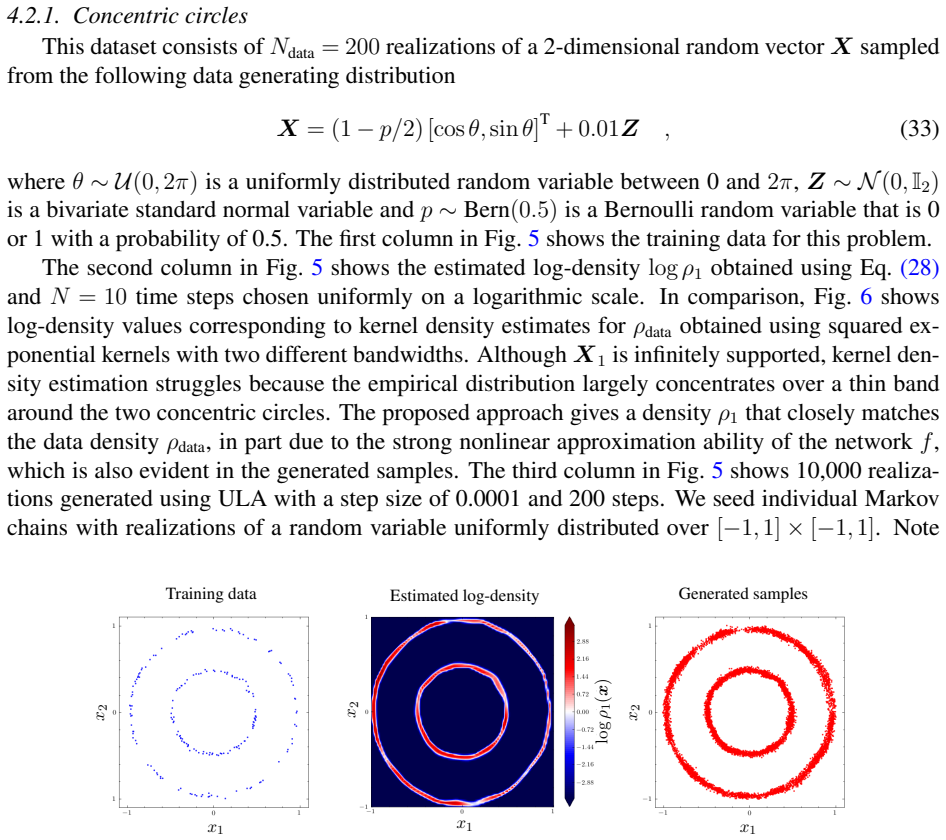
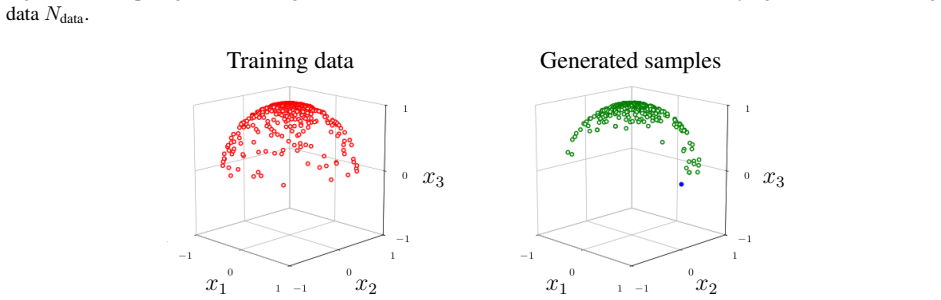
- Using a stochastic interpolant, the method performs static density estimation from iid samples, including multimodal densities, disconnected supports, and distributions concentrated near low-dimensional manifolds.
- Because the density is explicit, ranking $-\log\rho$ gives an unsupervised rarity and outlier score; on image-embedding benchmarks the paper reports rare-event detection competitive with or better than a current likelihood-based outlier-detection baseline.
- As a corollary of Eq. (19), forward and reverse KL divergences between $\rho_0$ and later densities can be estimated from expectations of $f_*$, even when the densities can only be sampled, not evaluated.
Reading between the lines
- A natural extension, not pursued in the paper, is to treat the time gaps $\Delta t_j$ as nonuniform and replace the midpoint sum by higher-order quadrature; Eq. (19) would then remain valid with error reduced beyond $O(\Delta t^2)$.
- Because $f_\theta$ is an unconstrained vector-to-scalar network, the density estimator can be composed with any fixed feature extractor; this suggests a cheap route to conditional densities by adding conditioning variables to the network input, which would be useful for Bayesian experimental design.
- The stochastic-interpolant path is arbitrary, and the paper notes manifold-constrained interpolants may help; a testable prediction is that such interpolants would improve the high-dimensional manifold results where accuracy degrades for larger ambient dimension.
- The KL-divergence formulas in Remark 4 could be used to estimate expected information gains in inverse problems without evaluating either density pointwise, a direction the paper leaves open.
Signed reviews
Editorial analysis
A structured set of objections, weighed in public.
Referee Report
Summary. The manuscript proposes a direct estimator of a time-dependent probability density rho_t(x) from sample paths, assuming that the initial density rho_0 is known and analytically evaluable. The core object is a time-dependent binary classifier d_theta(x,t,Delta t) = sigma(f_theta(x,t) Delta t), trained with a Brier-score loss that contrasts samples drawn at neighboring time instants t_{j-1} and t_j. The authors show that the stationary point of this loss satisfies log(rho_{t_j}/rho_{t_{j-1}}) = f^*(x, \bar{t}_j) Delta t_j, so that f^* is a second-order accurate approximation of the partial time derivative of log rho_t at the midpoints. Summing these increments telescopes to log rho_{t_{j'}} - log rho_0, giving a path-independent formula for the log-density at any time and point. The method is then adapted to static density estimation via stochastic interpolants, used for sample generation with gradient-based MCMC, and applied to outlier detection. Numerical experiments cover Duffing and hysteretic oscillators, low- and high-dimensional generative-modeling benchmarks, and ADBench rare-event tasks.
Significance. If the results hold, the paper offers a practical and conceptually clean addition to the density-estimation toolbox: explicit log-density values at arbitrary (x,t) by a simple sum, no invertibility constraints on the network, and no path-wise ODE integration for density evaluation. The central derivation is sound: the Brier-loss stationary point is derived, not assumed, and the telescoping summation is exact, so the method is not circular. The interpretation of f^* as an O(Delta t^2) approximation to the partial time derivative is credible for smooth densities. Strengths include the architectural flexibility of a non-invertible classifier, the exact telescoping identity, and a broad set of experiments spanning nonlinear oscillators, manifold-supported data, and anomaly detection. The principal caveats are the reliance on the known initial density, which is acknowledged, and several internal inconsistencies in the experimental description that currently make the empirical claims hard to verify.
major comments (3)
- [Section 2.2.5, Eq. (19)] The summation in Eq. (19) uses f^*(x,t_j), whereas Eq. (18) and the derivation leading to it use f^*(x,\bar{t}_j), the midpoint of [t_{j-1},t_j]. If Eq. (19) is implemented as printed, the second-order accuracy established in Eqs. (23)-(24) is lost, and the density reconstruction is inconsistent with Eq. (18). Please correct the time argument in Eq. (19) and in the accompanying sentence.
- [Sections 4.1.1 and 4.1.2] The time-discretization parameters are internally inconsistent. Section 4.1.1 states t_j = j Delta t with Delta t = 0.1, N = 160, t_N = 0.8, and j in {1,...,120}; these conditions cannot all hold, since 0.8/0.1 = 8 and the index range is 120, not 160. Section 4.1.2 similarly reports N = 160 over [0,0.8] with a constant Delta t = 0.1, which implies N = 8. Because Table 1 and Figures 3-4 are the main evidence for the time-dependent density claims, the training schedule must be stated unambiguously and consistently.
- [Section 2.1 (iii) and Eqs. (18)-(19)] Since every reconstructed density has the form log rho_0 plus a sum of learned increments, any misspecification or evaluation error in the assumed initial density propagates unchanged into the reconstructed density at every later time. The manuscript explicitly assumes rho_0 is known and analytic, and Remark 3 discusses relaxation, but it provides no sensitivity analysis or experiment in which rho_0 is slightly perturbed or estimated from samples. Please add an explicit sensitivity discussion or a small numerical experiment quantifying this propagation.
minor comments (6)
- [Equation (9) and Section 4.1.1] The notation N_j for the number of observations at time t_j conflicts with the use of N for the number of time intervals in Section 4.1.1; please rename one of them and define N_j explicitly.
- [Section 2.2.2] The definition of epsilon = max_j Delta t_j with j in {0,...,N_t-1} is inconsistent with the rest of the paper, where Delta t_j = t_j - t_{j-1} for j >= 1; please reindex for consistency.
- [Section 4.2] The phrase 'time steps chosen uniformly on a logarithmic scale' is ambiguous; please state the exact formula, e.g., t_j = (j/N)^p or t_j = exp(a + b j/N), and specify the parameters used.
- [Tables 2 and 3] Table 3 reports OT distance 0.081 for N = 10 with uniformly spaced steps, while Table 2 reports 0.065 for N = 10 with logarithmically spaced steps; the captions should state the spacing scheme explicitly for each table so the comparison in the text is reproducible.
- [Tables 1, 3, 5, 6, and 7] The tables report point estimates without repeated-run uncertainty or standard errors. Given the stochasticity of network training and MCMC sampling, please report means and standard deviations over independent runs, or at least state the number of seeds used.
- [General] No code or data release is mentioned. Releasing the training and sampling code would substantially improve reproducibility, particularly given the parameter inconsistencies noted above.
Circularity Check
No significant circularity: the classifier log-odds identity is derived from the Brier loss, and the density reconstruction is a telescoping sum anchored at the externally supplied ρ0.
full rationale
The paper's central derivation is self-contained rather than circular. In Section 2.2.4 the Brier loss in Eq. (8) is minimized via a pointwise variation; the stationary point gives d*(x, tbar_j, Δt_j)=ρ_{t_j}/(ρ_{t_{j-1}}+ρ_{t_j}), and with the definition d=σ(fΔt) this yields log(ρ_{t_j}/ρ_{t_{j-1}})=f*(x,tbar_j)Δt_j (Eqs. (10) and (15)). This is a derived optimality condition, not an assumed output. Summing these increments telescopes to logρ_{t_{j'}}(x)-logρ_0(x)=Σ_{j=1}^{j'} f*(x,tbar_j)Δt_j (Eq. (19)), with ρ_0 the only externally supplied object; no learned quantity is reintroduced as an input to define itself. The 'second-order approximation' claim (Eqs. (23)-(24)) is Taylor's theorem applied to the same identity, so it is an interpretation of the derived finite-difference identity, not a fitted prediction disguised as a result. The method is explicitly an adaptation of noise-contrastive estimation (Remark 1: 'The loss function we propose is a time-dependent adaptation of Noise Contrastive Estimation (NCE)'), which is external grounding rather than circularity. Self-citations ([7], [26], [55], [75]) appear only as background, implementation details, or comparison baselines and are not load-bearing; in particular, Appendix A2's use of [75] for Fourier-feature time embedding is a routine implementation choice. Numerical claims are checked against external KDE, diffusion-model, and ADBench baselines, so they are not forced by the construction. One non-circular reproducibility flaw exists: Section 4.1.1 states t_j=jΔt with Δt=0.1 while also giving N=160 and t_N=0.8, which is arithmetically inconsistent; this affects reproducibility and should be corrected, but it does not bear on circularity.
Assumptions & free parameters
free parameters (3)
- Time discretization schedule (N, linear vs logarithmic) =
N=10; N=20; N=50; log schedule
- MCMC sampling hyperparameters (step size, steps, burn-in) =
ULA 0.0001/200; ULA 1e-5/1000; HMC 0.001/100/500
- Network architecture and training hyperparameters =
3x512; 3x256 (2D); 4x256 (manifold/20D); 4800-1200-300 (CIFAR/FMNIST)
assumptions (4)
- domain assumption Initial density rho_0 is known and pointwise evaluable.
- domain assumption Each marginal density rho_t is positive and supported on R^n.
- ad hoc to paper The neural network class can represent the population minimizer of the Brier loss closely enough at arbitrary x.
- domain assumption In static density estimation, X0 and X1 are independent in the stochastic interpolant.
Cite this review
Pith. "Pith review of Time-dependent density estimation using binary classifiers." pith.science (2026). https://pith.science/paper/DHUWBD4M
@misc{pith2026250615505,
  author       = {Pith},
  title        = {Pith review of: Time-dependent density estimation using binary classifiers},
  year         = {2026},
  howpublished = {\url{https://pith.science/paper/DHUWBD4M}},
  note         = {Machine review of arXiv:2506.15505}
}
read the original abstract
We propose a data-driven method to learn the time-dependent probability density of a multivariate stochastic process from sample paths, assuming that the initial probability density is known and can be evaluated. Our method uses a novel time-dependent binary classifier trained using a contrastive estimation-based objective that trains the classifier to discriminate between realizations of the stochastic process at two nearby time instants. Significantly, the proposed method explicitly models the time-dependent probability distribution, which means that it is possible to obtain the value of the probability density within the time horizon of interest. Additionally, the input before the final activation in the time-dependent classifier is a second-order approximation to the partial derivative, with respect to time, of the logarithm of the density. We apply the proposed approach to approximate the time-dependent probability density functions for systems driven by stochastic excitations. We also use the proposed approach to synthesize new samples of a random vector from a given set of its realizations. In such applications, we generate sample paths necessary for training using stochastic interpolants. Subsequently, new samples are generated using gradient-based Markov chain Monte Carlo methods because automatic differentiation can efficiently provide the necessary gradient. Further, we demonstrate the utility of an explicit approximation to the time-dependent probability density function through applications in unsupervised outlier detection. Through several numerical experiments, we show that the proposed method accurately reconstructs complex time-dependent, multi-modal, and near-degenerate densities, scales effectively to moderately high-dimensional problems, and reliably detects rare events among real-world data.
Figures


Figures from the paper (15 more)





Reference graph
Works this paper leans on
-
[1]
J. Han, A. Jentzen, W. E, Solving high-dimensional partial differential equations using deep learning, Proceed- ings of the National Academy of Sciences 115 (2018) 8505–8510
work page 2018
-
[2]
H. Cho, D. Venturi, G. E. Karniadakis, Numerical methods for high-dimensional probability density function equations, Journal of Computational Physics 305 (2016) 817–837
work page 2016
-
[3]
C. Soize, An overview on uncertainty quantification and probabilistic learning on manifolds in multiscale mechanics of materials, Mathematics and Mechanics of Complex Systems 11 (2023) 87–174
work page 2023
- [4]
- [5]
-
[6]
T. A. El Moselhy, Y . M. Marzouk, Bayesian inference with optimal maps, Journal of Computational Physics 231 (2012) 7815–7850
work page 2012
-
[7]
Dasgupta, H
A. Dasgupta, H. Ramaswamy, J. Murgoitio-Esandi, K. Y . Foo, R. Li, Q. Zhou, B. F. Kennedy, A. A. Oberai, Conditional score-based diffusion models for solving inverse elasticity problems, Computer Methods in Applied Mechanics and Engineering 433 (2025) 117425
2025
-
[8]
A. Dasgupta, E. A. Johnson, REIN: Reliability estimation via importance sampling with normalizing flows, Reliability Engineering & System Safety 242 (2024) 109729
work page 2024
Show all 76 references
-
[9]
K. P. Murphy, Probabilistic machine learning: An introduction, MIT press, 2022
2022
-
[10]
K. P. Murphy, Probabilistic machine learning: Advanced topics, MIT press, 2023
2023
-
[11]
Sugiyama, T
M. Sugiyama, T. Suzuki, T. Kanamori, Density ratio estimation in machine learning, Cambridge University Press, 2012
2012
-
[12]
C. A. Garcia, A. Otero, P. Felix, J. Presedo, D. G. Marquez, Nonparametric estimation of stochastic differential equations with sparse Gaussian processes, Physical Review E 96 (2017) 022104
2017
-
[13]
Ruttor, P
A. Ruttor, P. Batz, M. Opper, Approximate Gaussian process inference for the drift function in stochastic differential equations, Advances in Neural Information Processing Systems 26 (2013). 32 Figure B1. Top fifty outliers from the dataset that is part of the CIFAR10 collecti...
2013
-
[14]
Gonz ´alez-Garc´ıa, R
R. Gonz ´alez-Garc´ıa, R. Rico-Mart `ınez, I. G. Kevrekidis, Identification of distributed parameter systems: A neural net based approach, Computers & chemical engineering 22 (1998) S965–S968
1998
-
[15]
S. L. Brunton, J. L. Proctor, J. N. Kutz, Discovering governing equations from data by sparse identification of nonlinear dynamical systems, Proceedings of the National Academy of Sciences 113 (2016) 3932–3937
2016
-
[16]
A. N. Riseth, J. P. Taylor-King, Operator fitting for parameter estimation of stochastic differential equations, arXiv preprint arXiv:1709.05153 (2017)
2017 arXiv
-
[17]
M. Dai, T. Gao, Y . Lu, Y . Zheng, J. Duan, Detecting the maximum likelihood transition path from data of stochastic dynamical systems, Chaos: An Interdisciplinary Journal of Nonlinear Science 30 (2020)
2020
-
[18]
L. Yang, C. Daskalakis, G. E. Karniadakis, Generative ensemble regression: Learning particle dynamics from observations of ensembles with physics-informed deep generative models, SIAM Journal on Scientific Comput- ing 44 (2022) B80–B99
2022
-
[19]
Wasserman, All of nonparametric statistics, Springer Science & Business Media, 2006
L. Wasserman, All of nonparametric statistics, Springer Science & Business Media, 2006
2006
-
[20]
K ¨othe, A review of change of variable formulas for generative modeling, arXiv preprint arXiv:2308.02652 (2023)
U. K ¨othe, A review of change of variable formulas for generative modeling, arXiv preprint arXiv:2308.02652 (2023)
2023 arXiv
-
[21]
L. Yang, D. Zhang, G. E. Karniadakis, Physics-informed generative adversarial networks for stochastic differ- ential equations, SIAM Journal on Scientific Computing 42 (2020) A292–A317
2020
-
[22]
G ¨uler, A
B. G ¨uler, A. Laignelet, P. Parpas, Towards robust and stable deep learning algorithms for forward backward stochastic differential equations, arXiv preprint arXiv:1910.11623 (2019)
2019 arXiv
-
[23]
C. Beck, S. Becker, P. Grohs, N. Jaafari, A. Jentzen, Solving the Kolmogorov PDE by means of deep learning, Journal of Scientific Computing 88 (2021) 1–28
2021
-
[24]
X. Chen, L. Yang, J. Duan, G. E. Karniadakis, Solving inverse stochastic problems from discrete particle obser- vations using the Fokker–Planck equation and physics-informed neural networks, SIAM Journal on Scientific Computing 43 (2021) B811–B830
2021
-
[25]
Y . Lu, R. Maulik, T. Gao, F. Dietrich, I. G. Kevrekidis, J. Duan, Learning the temporal evolution of multivariate densities via normalizing flows, Chaos: An Interdisciplinary Journal of Nonlinear Science 32 (2022)
2022
-
[26]
Dasgupta, D
A. Dasgupta, D. V . Patel, D. Ray, E. A. Johnson, A. A. Oberai, A dimension-reduced variational approach for solving physics-based inverse problems using generative adversarial network priors and normalizing flows, Computer Methods in Applied Mechanics and Engineering 420 (202...
2024
-
[27]
Gutmann, A
M. Gutmann, A. Hyv ¨arinen, Noise-contrastive estimation: A new estimation principle for unnormalized statis- tical models, in: Proceedings of the Thirteenth International Conference on Artificial Intelligence and Statistics, JMLR Workshop and Conference Proceedings, 2010, pp. 297–304
2010
-
[28]
Rhodes, K
B. Rhodes, K. Xu, M. U. Gutmann, Telescoping density-ratio estimation, Advances in Neural Information Processing Systems 33 (2020) 4905–4916
2020
-
[29]
Tsimpos, Z
P. Tsimpos, Z. Ren, J. Zech, Y . Marzouk, Optimal scheduling of dynamic transport, arXiv preprint arXiv:2504.14425 (2025)
2025 arXiv
-
[30]
Lipman, R
Y . Lipman, R. T. Chen, H. Ben-Hamu, M. Nickel, M. Le, Flow matching for generative modeling, arXiv preprint arXiv:2210.02747 (2022)
2022 arXiv
-
[31]
R. T. Chen, Y . Rubanova, J. Bettencourt, D. K. Duvenaud, Neural ordinary differential equations, Advances in neural information processing systems 31 (2018)
2018
-
[32]
Grathwohl, R
W. Grathwohl, R. T. Chen, J. Bettencourt, I. Sutskever, D. Duvenaud, FFJORD: Free-form continuous dynamics for scalable reversible generative models, arXiv preprint arXiv:1810.01367 (2018)
2018 arXiv
-
[33]
Onken, S
D. Onken, S. W. Fung, X. Li, L. Ruthotto, OT-Flow: Fast and accurate continuous normalizing flows via optimal transport, in: Proceedings of the AAAI Conference on Artificial Intelligence, volume 35, 2021, pp. 9223–9232
2021
-
[34]
X. Su, J. Song, C. Meng, S. Ermon, Dual diffusion implicit bridges for image-to-image translation, arXiv preprint arXiv:2203.08382 (2022)
2022 arXiv
-
[35]
M. S. Albergo, E. Vanden-Eijnden, Building normalizing flows with stochastic interpolants, arXiv preprint arXiv:2209.15571 (2022)
2022 arXiv
-
[36]
M. S. Albergo, N. M. Boffi, E. Vanden-Eijnden, Stochastic interpolants: A unifying framework for flows and diffusions, arXiv preprint arXiv:2303.08797 (2023)
2023 arXiv
-
[37]
X. Liu, C. Gong, Q. Liu, Flow straight and fast: Learning to generate and transfer data with rectified flow, arXiv preprint arXiv:2209.03003 (2022). 35
2022 arXiv
-
[38]
Liu, Rectified flow: A marginal preserving approach to optimal transport, arXiv preprint arXiv:2209.14577 (2022)
Q. Liu, Rectified flow: A marginal preserving approach to optimal transport, arXiv preprint arXiv:2209.14577 (2022)
2022 arXiv
-
[39]
Pavon, G
M. Pavon, G. Trigila, E. G. Tabak, The data-driven Schr ¨odinger Bridge, Communications on Pure and Applied Mathematics 74 (2021) 1545–1573
2021
-
[40]
De Bortoli, J
V . De Bortoli, J. Thornton, J. Heng, A. Doucet, Diffusion Schr ¨odinger Bridge with applications to score-based generative modeling, Advances in Neural Information Processing Systems 34 (2021) 17695–17709
2021
-
[41]
Chen, G.-H
T. Chen, G.-H. Liu, E. A. Theodorou, Likelihood training of Schr ¨odinger bridge using forward-backward sdes theory, arXiv preprint arXiv:2110.11291 (2021)
2021 arXiv
-
[42]
Pooladian, J
A.-A. Pooladian, J. Niles-Weed, Plug-in estimation of schr\” odinger Bridges, arXiv preprint arXiv:2408.11686 (2024)
2024 arXiv
-
[43]
Duvenaud, J
D. Duvenaud, J. Wang, J. Jacobsen, K. Swersky, M. Norouzi, W. Grathwohl, Your classifier is secretly an energy based model and you should treat it like one, in: International Conference on Learning Representations, 2020
2020
-
[44]
Ferrer, Analysis and comparison of classification metrics, arXiv preprint arXiv:2209.05355 (2022)
L. Ferrer, Analysis and comparison of classification metrics, arXiv preprint arXiv:2209.05355 (2022)
2022 arXiv
-
[45]
Ruder, An overview of gradient descent optimization algorithms, arXiv preprint arXiv:1609.04747 (2016)
S. Ruder, An overview of gradient descent optimization algorithms, arXiv preprint arXiv:1609.04747 (2016)
2016 arXiv
-
[46]
Soize, R
C. Soize, R. Ghanem, Data-driven probability concentration and sampling on manifold, Journal of Computa- tional Physics 321 (2016) 242–258
2016
-
[47]
Kapusniak, P
K. Kapusniak, P. Potaptchik, T. Reu, L. Zhang, A. Tong, M. Bronstein, J. Bose, F. Di Giovanni, Metric flow matching for smooth interpolations on the data manifold, Advances in Neural Information Processing Systems 37 (2024) 135011–135042
2024
-
[48]
A. G. Baydin, B. A. Pearlmutter, A. A. Radul, J. M. Siskind, Automatic differentiation in machine learning: A survey, Journal of machine learning research 18 (2018) 1–43
2018
-
[49]
Girolami, B
M. Girolami, B. Calderhead, Riemann Manifold Langevin and Hamiltonian Monte Carlo methods, Journal of the Royal Statistical Society Series B: Statistical Methodology 73 (2011) 123–214
2011
-
[50]
G. A. Gottwald, F. Li, Y . Marzouk, S. Reich, Stable generative modeling using schr ¨odinger Bridges, arXiv preprint arXiv:2401.04372 (2024)
2024 arXiv
-
[51]
Goodfellow, J
I. Goodfellow, J. Pouget-Abadie, M. Mirza, B. Xu, D. Warde-Farley, S. Ozair, A. Courville, Y . Bengio, Gener- ative Adversarial Networks, Communications of the ACM 63 (2020) 139–144
2020
-
[52]
Kobyzev, S
I. Kobyzev, S. J. Prince, M. A. Brubaker, Normalizing flows: An introduction and review of current methods, IEEE transactions on pattern analysis and machine intelligence 43 (2020) 3964–3979
2020
-
[53]
Lipman, M
Y . Lipman, M. Havasi, P. Holderrieth, N. Shaul, M. Le, B. Karrer, R. T. Chen, D. Lopez-Paz, H. Ben-Hamu, I. Gat, Flow matching guide and code, arXiv preprint arXiv:2412.06264 (2024)
2024 arXiv
-
[54]
Y . Song, J. Sohl-Dickstein, D. P. Kingma, A. Kumar, S. Ermon, B. Poole, Score-based generative modeling through stochastic differential equations, arXiv preprint arXiv:2011.13456 (2020)
2020 arXiv
-
[55]
Dasgupta, A
A. Dasgupta, A. M. da Cunha, A. Fardisi, M. Aminy, B. Binder, B. Shaddy, A. A. Oberai, Unifying and extend- ing diffusion models through PDEs for solving inverse problems, arXiv preprint arXiv:2504.07437 (2025)
2025 arXiv
-
[56]
Y . Song, D. P. Kingma, How to train your energy-based models, arXiv preprint arXiv:2101.03288 (2021)
2021 arXiv
-
[57]
Y . Du, S. Li, J. Tenenbaum, I. Mordatch, Improved contrastive divergence training of energy-based models, arXiv preprint arXiv:2012.01316 (2020)
2020 arXiv
-
[58]
R. Gao, E. Nijkamp, D. P. Kingma, Z. Xu, A. M. Dai, Y . N. Wu, Flow contrastive estimation of energy-based models, in: Proceedings of the IEEE/CVF Conference on Computer Vision and Pattern Recognition, 2020, pp. 7518–7528
2020
-
[59]
Tabandeh, N
A. Tabandeh, N. Sharma, L. Iannacone, P. Gardoni, Numerical solution of the Fokker–Planck equation using physics-based mixture models, Computer Methods in Applied Mechanics and Engineering 399 (2022) 115424
2022
-
[60]
Ueda, Randomly transitional phenomena in the system governed by duffing’s equation, Journal of Statistical Physics 20 (1979) 181–196
Y . Ueda, Randomly transitional phenomena in the system governed by duffing’s equation, Journal of Statistical Physics 20 (1979) 181–196
1979
-
[61]
M. A. Hammad, A. H. Salas, S. El-Tantawy, New method for solving strong conservative odd parity nonlinear oscillators: applications to plasma physics and rigid rotator, AIP Advances 10 (2020)
2020
-
[62]
B. W. Silverman, Density estimation for statistics and data analysis, Routledge, 2018
2018
-
[63]
Ismail, F
M. Ismail, F. Ikhouane, J. Rodellar, The hysteresis Bouc-Wen model: A survey, Archives of computational methods in engineering 16 (2009) 161–188
2009
-
[64]
Wen, Method for random vibration of hysteretic systems, Journal of the engineering mechanics division 36 102 (1976) 249–263
Y .-K. Wen, Method for random vibration of hysteretic systems, Journal of the engineering mechanics division 36 102 (1976) 249–263
1976
-
[65]
Wen, Equivalent linearization for hysteretic systems under random excitation (1980)
Y . Wen, Equivalent linearization for hysteretic systems under random excitation (1980)
1980
-
[66]
Cuturi, Sinkhorn distances: Lightspeed computation of optimal transport, Advances in neural information processing systems 26 (2013)
M. Cuturi, Sinkhorn distances: Lightspeed computation of optimal transport, Advances in neural information processing systems 26 (2013)
2013
-
[67]
M. D. Hoffman, A. Gelman, The No-U-Turn sampler: Adaptively setting path lengths in Hamiltonian Monte Carlo, J. Mach. Learn. Res. 15 (2014) 1593–1623
2014
-
[68]
A. D. Cobb, hamiltorch: A PyTorch-based library for Hamiltonian Monte Carlo, in: Proceedings of Cyber- Physical Systems and Internet of Things, 2023, pp. 114–115
2023
-
[69]
S. Han, X. Hu, H. Huang, M. Jiang, Y . Zhao, ADBench: Anomaly Detection Benchmark, Advances in neural information processing systems 35 (2022) 32142–32159
2022
-
[70]
Krizhevsky, G
A. Krizhevsky, G. Hinton, et al., Learning multiple layers of features from tiny images, Technical Report, Toronto, ON, Canada, 2009
2009
-
[71]
H. Xiao, K. Rasul, R. V ollgraf, Fashion-MNIST: A novel image dataset for benchmarking machine learning algorithms, arXiv preprint arXiv:1708.07747 (2017)
2017 arXiv
-
[72]
N. Mu, J. Gilmer, MNIST-C: A robustness benchmark for computer vision, arXiv preprint arXiv:1906.02337 (2019)
2019 arXiv
-
[73]
D. Kim, J. Hwang, J. Lee, K. Kim, Y . Kim, ODIM: Outlier detection via likelihood of under-fitted generative models, arXiv preprint arXiv:2301.04257 (2023)
2023 arXiv
-
[74]
Tancik, P
M. Tancik, P. Srinivasan, B. Mildenhall, S. Fridovich-Keil, N. Raghavan, U. Singhal, R. Ramamoorthi, J. Barron, R. Ng, Fourier features let networks learn high frequency functions in low dimensional domains, Advances in neural information processing systems 33 (2020) 7537–7547
2020
-
[75]
Baptista, A
R. Baptista, A. Dasgupta, N. B. Kovachki, A. Oberai, A. M. Stuart, Memorization and regularization in genera- tive diffusion models, arXiv preprint arXiv:2501.15785 (2025)
2025 arXiv
-
[76]
Virtanen, R
P. Virtanen, R. Gommers, T. E. Oliphant, M. Haberland, T. Reddy, D. Cournapeau, E. Burovski, P. Peterson, W. Weckesser, J. Bright, S. J. van der Walt, M. Brett, J. Wilson, K. J. Millman, N. Mayorov, A. R. J. Nelson, E. Jones, R. Kern, E. Larson, C. J. Carey,˙I. Polat, Y . Feng...
2020
Reviewed August 15, 2026 · model on record in the stance chip above.
Discussion (0). Continue with ORCID to comment.