REVIEW 4 major objections 8 minor 43 references
Dark Matter Surrounded Quartic Square-root Horndeski Black Hole: Thermodynamics, Optical Properties and Quasinormal Oscillations
T0 review · 4 major / 8 minor · reviewed 2026-08-15 · deepseek-v4-flash
Pith's one-line read Comparing the predicted shadow with the measured Sgr A* image forces the Horndeski and perfect-fluid dark-matter parameters to be tiny, leaving general relativity as the effective description near the photon sphere.
desk verdict Standard toolkit applied to an asserted metric: the combined Horndeski–PFDM spacetime is never shown to solve the field equations, and the EHT bounds contain sign errors that contradict the paper's own tables. read the letter →
The pith
A machine-rendered reading of the paper's core claim, the machinery that carries it, and where it could break.
The reading
What carries the argument
The load-bearing object is the combined lapse function $f(r)=1-\frac{2M}{r}-\frac{\beta^2}{2\eta r^2}+\frac{b}{r}\ln(r/b)$ for the quartic square-root Horndeski black hole immersed in perfect-fluid dark matter. Everything else flows from this function: the Hawking temperature $T=f'(r_h)/(4\pi)$, the specific heat $C$, the Helmholtz free energy $F$, the photon-sphere equation $f'(r_p)r_p-2f(r_p)=0$, the shadow radius $r_s=r_p/\sqrt{f(r_p)}$, and the scalar-field effective potential used in the sixth-order WKB quasinormal-mode calculation. The paper's parameter bounds come from combining the shadow-radius formula with the observed fractional deviation $\delta$.
What would settle it
Substitute the combined lapse function $f(r)=1-\frac{2M}{r}-\frac{\beta^2}{2\eta r^2}+\frac{b}{r}\ln(r/b)$ and a scalar-field profile into the Horndeski field equations together with the perfect-fluid dark-matter energy-momentum tensor. If the equations are not satisfied identically for some $(\beta,\eta,b)$, the combined metric is not a solution of the theory and the shadow-based bounds do not constrain Horndeski gravity.
Extended reading notes
Core claim
The paper's central claim is that the combined metric $f(r)=1-\frac{2M}{r}-\frac{\beta^2}{2\eta r^2}+\frac{b}{r}\ln(r/b)$ produces observable signatures that current shadow measurements can already bound. Solving the photon-sphere condition $f'(r_p)r_p-2f(r_p)=0$ and using $r_s=r_p/\sqrt{f(r_p)}$, the paper compares $r_s/M$ with the $1\sigma$ interval $4.55 \lesssim r_s/M \lesssim 5.22$ derived from the fractional shadow deviation $\delta=-0.060 \pm 0.065$. This comparison forces $\beta<-0.5929$, $\eta<-0.3263$, and $b<0.01059$ at $1\sigma$ (with looser $2\sigma$ bounds), implying that any perfect-fluid dark-matter component is negligible within a few gravitational radii of Sgr A* and any Horndeski-induced departure from Schwarzschild is sub-percent. At the same time, the thermodynamic analysis shows the black hole is locally stable for small horizons but globally unstable, with no Hawking-Page transition.
Load-bearing premise
The paper assumes that adding the Horndeski term and the dark-matter term in the metric yields an exact solution of the theory's field equations; if the combined spacetime is not a genuine solution, the thermodynamic, shadow, and ringing results describe a metric the theory does not admit.
Editorial extensions
If this is right
- If the bounds hold, any spherically symmetric dark-matter halo around Sgr A* has negligible gravitational backreaction inside the photon sphere, so current shadow measurements cannot distinguish it from vacuum.
- The Horndeski couplings are pinned to a narrow window near the Schwarzschild limit, so future improvements in shadow resolution will either shrink the window further or reveal a deviation.
- In this model, black holes with small horizons are locally thermodynamically stable but never globally preferred, and no Hawking-Page phase transition occurs.
- Quasinormal-mode oscillation frequencies and damping rates move in opposite directions with $\beta$ and $\eta$, while both grow with the dark-matter parameter $b$, giving a potential ringdown signature for modified gravity.
Reading between the lines
- A direct field-equation check of the combined ansatz would promote the quoted bounds from constraints on a metric template to constraints on Horndeski gravity itself.
- The same shadow-comparison pipeline applied to the M87* image or to future higher-resolution Galactic-center data would tighten the bounds, since each parameter enters the shadow radius monotonically.
- A rotating version of the metric would turn the circular shadow into an oval, letting shape measurements break the degeneracy among $\beta$, $\eta$, and $b$.
- In the eikonal limit the quasinormal frequencies should match the photon-sphere orbital frequency and Lyapunov exponent, so checking that correspondence would connect the WKB table to the geodesic analysis.
Signed reviews
Editorial analysis
A structured set of objections, weighed in public.
Referee Report
Summary. The manuscript studies the static spherically symmetric metric f(r)=1-2M/r-β²/(2ηr²)+(b/r)ln(r/b), presented as a quartic square-root Horndeski black hole immersed in perfect-fluid dark matter (PFDM), with parameters β, η, and b. It computes the Hawking temperature, ADM mass, specific heat, entropy, and free energy; analyzes null geodesics and the photon sphere; computes the shadow radius and compares it with Keck/VLTI-based EHT constraints on Sgr A* to obtain 1σ and 2σ bounds on β, η, and b; and calculates scalar quasinormal frequencies using sixth-order WKB approximation. The central claims are that small-horizon black holes are locally stable but never globally preferred, that increasing β and b enlarges the photon sphere and shadow while increasing η mildly shrinks them, and that EHT shadow observations require the Horndeski and PFDM parameters to be very small, leaving general relativity as the effective description near the photon sphere.
Significance. If the combined metric in Eq. (8) were a genuine exact solution of the Horndeski field equations with a PFDM source, the paper would provide a useful connection between modified gravity, dark matter, and EHT observations. The analysis is largely transparent: explicit expressions for thermodynamic quantities, a table of critical impact parameters and photon radii, a table of WKB frequencies, and an external comparison to EHT data with no parameter fitting, so the constraints are not circular. The quantitative shadow and QNM tables are in principle reproducible. However, the significance is fully conditional on the existence of the claimed solution and on resolving the internal inconsistencies in the thermodynamics, in the parameter-bound derivation, and in the reported parameter trends, each of which is problematic in the current text.
major comments (4)
- [II, Eq. (8)] The combined metric is asserted without derivation. Equation (6) is cited to [5] for the pure Horndeski solution, and the PFDM term is introduced by invoking [27], a general-relativistic PFDM paper. In a scalar-tensor theory, adding a matter source changes both the metric and the scalar-field equations; the scalar profile that solves the pure Horndeski system is not shown to survive, and no new profile is supplied. The authors need to demonstrate explicitly that f(r) in Eq. (8), together with a specified scalar profile and the PFDM stress tensor (7), satisfies the full Horndeski field equations, or provide a derivation from an existing exact solution. Until this is done, the thermodynamic quantities, the shadow and photon-sphere results in Tables I-V, and the QNM frequencies describe an arbitrary metric rather than the claimed Horndeski-PFDM theory.
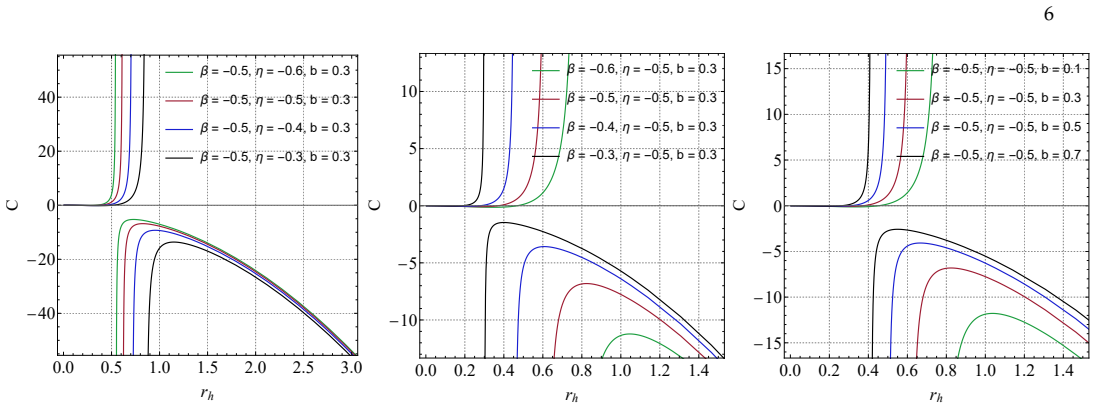
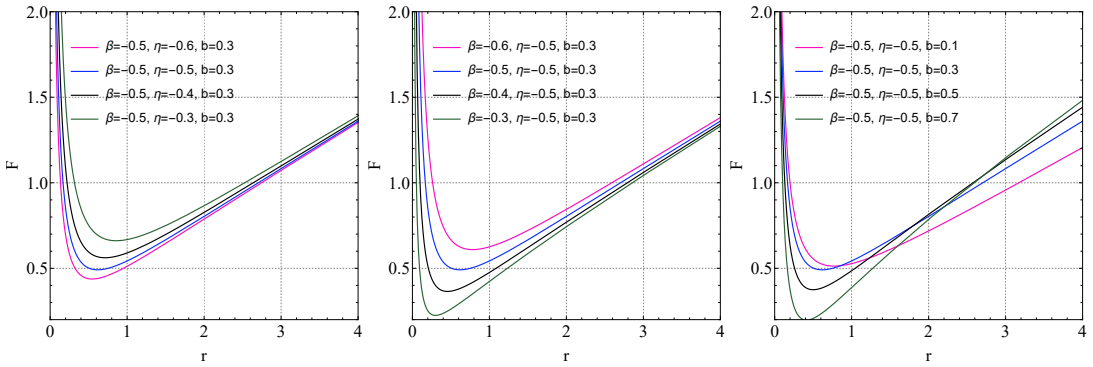
- [III, Eqs. (13)-(14)] The entropy and the free energy are mutually inconsistent. Eq. (13) states S_BH = π r_h²/4, but the Helmholtz free energy in Eq. (14) follows from F = M - T S only if S_BH = π r_h², which is also the horizon area/4. With the stated value, Eq. (14) would have a different coefficient of β²/(η r_h), namely -9/32 instead of -3/8. This internal inconsistency affects the thermodynamic stability analysis and the claim that no Hawking-Page transition occurs (Fig. 5 and Section VII). The authors should correct Eq. (13) and verify all subsequent thermodynamic expressions.
- [V.A, Fig. 14 and Table I] The quoted 1σ bounds β < -0.5929, η < -0.3263, b < 0.01059 are not consistent with the text's conclusion that the parameters are very small, and their inequality directions appear to conflict with the data presented. Table I shows that, with the fixed values used in Fig. 14, the critical impact parameter is far below the EHT 1σ window (4.55M to 5.22M): for example, b_crit = 3.39M for (β,η,b) = (-0.5,-0.5,0.3). The bound β < -0.5929 permits β = -0.7, -0.8, for which the shadow is even smaller, so as written it does not confine the model to the EHT-allowed region. In addition, β²/(2|η|) evaluated at the quoted 1σ limits is about 0.54, not the 0.06 stated near Eq. (45). The authors should display the curves r_s/M versus each parameter over a range that actually enters the EHT band and quote the inequalities in the correct direction.
- [Table I vs. abstract and Section VII] The claimed monotonic dependence of the shadow on the model parameters is opposite to the values in Table I. For fixed β = -0.5, η = -0.5, increasing b from 0.1 to 0.7 decreases b_crit from 4.09145 to 3.06305; for fixed η = -0.5, b = 0.3, increasing |β| from 0.3 to 0.6 decreases b_crit from 3.56247 to 3.26334. The abstract states that increases in the dark matter parameter b enlarge the shadow, and Section VII states that 'increasing |β| or b consistently enlarges the critical impact parameter and photon sphere radius'. These statements are contradicted by the paper's own Table I. The qualitative summary of the geodesic and shadow results must be corrected, or the table and figures must be recomputed.
minor comments (8)
- [II, Eq. (3)] The sentence 'where η and β' is incomplete; it should state that they are constants and specify the sign condition required for a real scalar-field solution.
- [III, Eq. (13)] The text says the entropy follows the usual Bekenstein-Hawking form, but writes π r_h²/4; the horizon area/4 is π r_h², so the factor must be corrected.
- [Table V] The table and the surrounding text use 'η1' and 'β1' where η and β are meant; these should be renamed for clarity.
- [Fig. 3] In the first panel of Fig. 3, the legend lists β = -0.5, η = -0.5 twice and does not show a distinct η = -0.4 curve; the legend should be checked.
- [Fig. 14] The axis labels in Fig. 14 appear garbled in the compiled text, with missing symbols such as η, β, and b; the figure should be regenerated.
- [V.A] The phrase 'upper bounds' is misleading, because β < -0.5929 and η < -0.3263 are lower bounds on |β| and |η|, not upper bounds on the parameters; the wording should be reconciled with the actual inequalities.
- [VII] The conclusion's 'sub-percent departure' statement is inconsistent with the stated β²/(2|η|) ≲ 0.06, which corresponds to a six-percent correction; the numbers should be reconciled.
- [References] References [2] and [21] mix arXiv identifiers and DOIs with journal information; the reference list should be cleaned up.
Circularity Check
No significant circularity: the paper's predictions follow from an adopted metric and are benchmarked against external EHT data.
full rationale
The manuscript computes thermodynamic quantities, photon-sphere and shadow radii, and quasinormal-mode frequencies directly from the adopted lapse function in Eq. (8), which is imported from prior work by Babichev et al. and Xu et al. rather than re-derived here. Importing a solution ansatz is an assumption and a correctness risk, but it is not circular: the paper does not define any predicted quantity in terms of itself, and no parameter is fitted to the quantity it later claims to predict. The EHT Keck/VLTI shadow constraints are an external benchmark, not an output of the model, and the parameter intervals quoted in Section V are obtained by inverting the model's shadow formula against that external data. The references to Horndeski and PFDM solutions are not self-citations and are not used to forbid alternative models; they supply the starting metric. Similarly, the WKB quasinormal-mode calculation is a standard, independent method applied to the same metric, and the reported relative errors are internal convergence checks rather than circular validation. No self-definitional step, fitted-input-called-prediction step, or load-bearing self-citation chain can be exhibited from the text, so a non-circularity score of 0 is appropriate.
Assumptions & free parameters
free parameters (3)
- β
- η
- b
assumptions (3)
- ad hoc to paper The combined metric f(r)=1-2M/r - β²/(2ηr²)+(b/r)ln(r/b) is an exact solution of the Horndeski field equations with PFDM energy-momentum tensor.
- domain assumption The entropy is given by the Bekenstein-Hawking area law S=A/4.
- domain assumption The 6th-order WKB approximation is accurate for the scalar QNM frequencies.
Cite this review
Pith. "Pith review of Dark Matter Surrounded Quartic Square-root Horndeski Black Hole: Thermodynamics, Optical Properties and Quasinormal Oscillations." pith.science (2026). https://pith.science/paper/5TQ3JGFS
@misc{pith2026250615763,
  author       = {Pith},
  title        = {Pith review of: Dark Matter Surrounded Quartic Square-root Horndeski Black Hole: Thermodynamics, Optical Properties and Quasinormal Oscillations},
  year         = {2026},
  howpublished = {\url{https://pith.science/paper/5TQ3JGFS}},
  note         = {Machine review of arXiv:2506.15763}
}
abstract
In this work, we study a special form of Horndeski solutions, viz. quartic "square-root" Horndeski black hole immersed in a perfect-fluid dark-matter halo, by examining its thermodynamics, null geodesic shape, optical shadow, and quasinormal ringdown spectrum. The model is characterized by three parameters, namely $\beta$, $\eta$ (non-minimal Horndeski coupling parameters), and $b$ (perfect fluid dark matter parameter), which collectively determine horizon properties and observational effects. To study thermodynamic stability, we used the specific heat and free energy arguments, with which we demonstrated that small horizon states are locally stable but are never globally preferred. Analytic solutions of null geodesics reveal the radius of the photon sphere and the critical impact parameter, proving that increases in the dark matter parameters and the Horndeski parameter $\beta$ enlarge both the photon sphere and the subsequent shadow, whereas increase in the Horndeski coupling $\eta$ causes a mild diminishing in the shadow radius. Numerical ray tracing verifies these qualitative trends in the apparent shadow. Using the 6$^{th}$ - order WKB approximation method, we also calculate the scalar quasinormal modes and determine that oscillation frequencies and damping rates behave oppositely according to the sign and magnitude of each parameter. By comparing the shadow radius with the recent Event Horizon Telescope constraints on the Sgr A*, we find a narrow window of parameter space that agrees with observed data. In other words, the coupling parameters should be very small. These measurements restrict modified gravity impacts within realistic astrophysical contexts.
Figures


Figures from the paper (15 more)


Reference graph
Works this paper leans on
-
[5]
E. Babichev, C. Charmousis, and N. Lecoeur, Exact Black Hole Solutions in Higher Order Scalar Tensor Theories, in Compact Objects in the Universe (2024) pp. 3–37
work page 2024
-
[27]
Z. Xu, X. Hou, and J. Wang, Kerr–anti-de Sitter/de Sitter black hole in perfect fluid dark matter background, Clas- sical Quantum Gravity 35, 115003 (2018)
work page 2018
-
[1]
B. P . Abbott, R. Abbott, R. Adhikari, et al. , LIGO: the Laser Interferometer Gravitational-Wave Observa- tory, Rep. Prog. Phys.72, 076901 (2009). 19 ● Reω(l=1) ■ Reω(l=2) ◆ Reω(l=3) ● ● ● ● ■ ■ ■ ■ ◆ ◆ ◆ ◆ -0.60 -0.55 -0.50 -0.45 -0.40 -0.35 -0.30 0.4 0.6 0.8 1.0 1.2 η Reω ● Imω(l=1) ■ Imω(l=2) ◆ Imω(l=3) ● ● ● ● ■ ■ ■ ■ ◆ ◆ ◆ ◆ -0.60 -0.55 -0.50 -0.45 ...
work page 2009
-
[2]
The LIGO Scientific Collaboration and The Virgo Collab- oration, GW170817: Observation of Gravitational Waves from a Binary Neutron Star Inspiral, arXiv 10.1103/Phys- RevLett.119.161101 (2017), 1710.05832
arXiv 2017
-
[3]
LIGO Scientific Collaboration and Virgo Collaboration, B. P . Abbott, R. Abbott, et al. , GW170814: A Three- Detector Observation of Gravitational Waves from a Bi- nary Black Hole Coalescence, Phys. Rev. Lett. 119, 141101 (2017)
work page 2017
-
[4]
Lovelock, The Einstein Tensor and Its Generalizations, J
D. Lovelock, The Einstein Tensor and Its Generalizations, J. Math. Phys. 12, 498 (1971)
work page 1971
-
[6]
M. Minamitsuji, K. Takahashi, and S. Tsujikawa, Linear stability of black holes in shift-symmetric Horndeski the- ories with a time-independent scalar field, Phys. Rev. D 105, 104001 (2022)
work page 2022
-
[7]
A. Bakopoulos, N. Chatzifotis, and T. Nakas, Compact objects with primary hair in shift and parity symmet- ric beyond Horndeski gravities, Phys. Rev. D 110, 024044 (2024)
work page 2024
Show all 43 references
-
[8]
Baake, A
O. Baake, A. Cisterna, M. Hassaine, et al., Endowing black holes with beyond-Horndeski primary hair: An exact solution framework for scalarizing in every dimension, Phys. Rev. D 109, 064024 (2024)
2024
-
[9]
Bakopoulos, C
A. Bakopoulos, C. Charmousis, P . Kanti,et al., Black holes with primary scalar hair, Phys. Rev. D 109, 024032 (2024)
2024
-
[10]
Babichev, C
E. Babichev, C. Charmousis, and A. Lehébel, Asymptoti- cally flat black holes in Horndeski theory and beyond, J. Cosmol. Astropart. Phys. 2017 (04), 027
2017
-
[11]
R. K. Walia, S. D. Maharaj, and S. G. Ghosh, Rotating black holes in Horndeski gravity: thermodynamic and gravita- tional lensing, Eur. Phys. J. C 82, 1 (2022)
2022
-
[12]
D. D. Doneva and S. S. Yazadjiev, New Gauss-Bonnet Black Holes with Curvature-Induced Scalarization in Extended Scalar-Tensor Theories, Phys. Rev. Lett. 120, 131103 (2018). 20 ● Reω(l=1) ■ Reω(l=2) ◆ Reω(l=3) ● ● ● ● ■ ■ ■ ■ ◆ ◆ ◆ ◆ 0.1 0.2 0.3 0.4 0.5 0.6 0.7 0.4 0.6 0.8 1.0 ...
2018
-
[13]
P . V . P . Cunha, C. A. R. Herdeiro, E. Radu,et al., Shadows of Kerr Black Holes with Scalar Hair, Phys. Rev. Lett.115, 211102 (2015)
2015
-
[14]
Bakopoulos, T
A. Bakopoulos, T. Karakasis, and E. Papantonopoulos, Thermodynamics of stealth black holes, Phys. Rev. D111, 024065 (2025)
2025
-
[15]
Charmousis, M
C. Charmousis, M. Crisostomi, R. Gregory, et al. , Rotat- ing black holes in higher order gravity, Phys. Rev. D 100, 084020 (2019)
2019
-
[16]
Mironov, V
S. Mironov, V . Rubakov, and V . Volkova, More about stable wormholes in beyond Horndeski theory, Classical Quantum Gravity 36, 135008 (2019)
2019
-
[17]
Chatzifotis, E
N. Chatzifotis, E. Papantonopoulos, and C. Vlachos, Dis- formal transition of a black hole to a wormhole in scalar- tensor Horndeski theory, Phys. Rev. D105, 064025 (2022)
2022
-
[18]
Vlachos, E
C. Vlachos, E. Papantonopoulos, and K. Destounis, Echoes of compact objects in scalar-tensor theories of gravity, Phys. Rev. D103, 044042 (2021)
2021
-
[19]
Brihaye and Y
Y. Brihaye and Y. Verbin, Scalarized compact objects in a vector-tensor Horndeski gravity, Phys. Rev. D102, 124021 (2020)
2020
-
[20]
Cardoso, E
V . Cardoso, E. Franzin, A. Maselli, et al. , Testing strong- field gravity with tidal Love numbers, Phys. Rev. D 95, 084014 (2017)
2017
- [21]
-
[22]
Sekhmani, S
Y. Sekhmani, S. K. Maurya, M. K. Jasim, et al. , Ther- modynamics and phase transition of anti de Sitter black holes with ModMax nonlinear electrodynamics and per- fect fluid dark matter, Eur. Phys. J. C85, 1 (2025)
2025
-
[23]
R. A. Hennigar and R. B. Mann, Reentrant Phase Transi- tions and van der Waals Behaviour for Hairy Black Holes, Entropy 17, 8056 (2015)
2015
-
[24]
D.-C. Zou, Y. Liu, B. Wang, et al., Thermodynamics of ro- tating black holes with scalar hair in three dimensions, Phys. Rev. D 90, 104035 (2014)
2014
-
[25]
R. T. Cavalcanti, K. d. S. Alves, and J. M. Hoff da Silva, Near-Horizon Thermodynamics of Hairy Black Holes from Gravitational Decoupling, Universe 8, 363 (2022)
2022
-
[26]
Kobayashi, Horndeski theory and beyond: a review, Rep
T. Kobayashi, Horndeski theory and beyond: a review, Rep. Prog. Phys. 82, 086901 (2019)
2019
-
[28]
A. Das, A. Saha, and S. Gangopadhyay, Study of circu- lar geodesics and shadow of rotating charged black hole surrounded by perfect fluid dark matter immersed in plasma, Classical Quantum Gravity 39, 075005 (2022)
2022
-
[29]
Akiyama, A
Event Horizon Telescope Collaboration, K. Akiyama, A. Alberdi, et al., First Sagittarius A∗ Event Horizon Tele- scope Results. I. The Shadow of the Supermassive Black Hole in the Center of the Milky Way, Astrophys. J. Lett. 930, L12 (2022)
2022
-
[30]
Perlick and O
V . Perlick and O. Yu. Tsupko, Calculating black hole shad- ows: Review of analytical studies, Phys. Rep. 947, 1 (2022)
2022
-
[31]
Vagnozzi, R
S. Vagnozzi, R. Roy, Y.-D. Tsai, et al. , Horizon-scale tests of gravity theories and fundamental physics from the Event Horizon Telescope image of Sagittarius A ∗, Clas- sical Quantum Gravity 40, 165007 (2023)
2023
-
[32]
T. Do, A. Hees, A. Ghez, et al., Relativistic redshift of the star S0-2 orbiting the Galactic Center supermassive black hole, Science 365, 664 (2019)
2019
-
[33]
Abuter, A
R. Abuter, A. Amorim, M. Bauböck, et al., Detection of the Schwarzschild precession in the orbit of the star S2 near the Galactic centre massive black hole, Astron. Astrophys. 636, L5 (2020)
2020
-
[34]
Fernando and J
S. Fernando and J. Correa, Quasinormal modes of the Bardeen black hole: Scalar perturbations, Phys. Rev. D86, 064039 (2012)
2012
-
[35]
Jusufi, Quasinormal modes of black holes surrounded by dark matter and their connection with the shadow ra- dius, Phys
K. Jusufi, Quasinormal modes of black holes surrounded by dark matter and their connection with the shadow ra- dius, Phys. Rev. D 101, 084055 (2020). 21
2020
-
[36]
B. F. Schutz and C. M. Will, Black hole normal modes - A semianalytic approach, Astrophys. J. 291, L33 (1985)
1985
-
[37]
Zettili, Quantum Mechanics: Concepts and Applications, 3rd Edition (2022)
N. Zettili, Quantum Mechanics: Concepts and Applications, 3rd Edition (2022)
2022
-
[38]
D. J. Griffiths and D. F. Schroeter, Introduction to Quantum Mechanics (2018)
2018
-
[39]
Iyer, Black-hole normal modes: A WKB approach
S. Iyer, Black-hole normal modes: A WKB approach. II. Schwarzschild black holes, Phys. Rev. D 35, 3632 (1987)
1987
-
[40]
Iyer and C
S. Iyer and C. M. Will, Black-hole normal modes: A WKB approach. I. Foundations and application of a higher- order WKB analysis of potential-barrier scattering, Phys. Rev. D 35, 3621 (1987)
1987
-
[41]
R. A. Konoplya, Quasinormal behavior of the D- dimensional Schwarzschild black hole and the higher or- der WKB approach, Phys. Rev. D68, 024018 (2003)
2003
-
[42]
R. A. Konoplya, Quasinormal modes in higher-derivative gravity: Testing the black hole parametrization and sensi- tivity of overtones, Phys. Rev. D 107, 064039 (2023)
2023
-
[43]
R. A. Konoplya, A. Zhidenko, and A. F. Zinhailo, Higher order WKB formula for quasinormal modes and grey- body factors: recipes for quick and accurate calculations, Classical Quantum Gravity 36, 155002 (2019)
2019
Reviewed August 15, 2026 · model on record in the stance chip above.
Discussion (0). Continue with ORCID to comment.