REVIEW 4 major objections 4 minor 67 references
Decoupling Neutrino Magnetic Moment from Mass with $SU(2)_L$ Invariance
T0 review · 4 major / 4 minor · reviewed 2026-08-06 · deepseek-v4-flash
Pith's one-line read This paper claims a class of one-loop models can generate neutrino magnetic moments while the associated mass term vanishes exactly, because the mass diagram closes on a trace of traceless SU(2)_L generators.
desk verdict A genuinely new SU(2)_L trick for decoupling neutrino magnetic moment from mass, but the Dirac model runs into its own quoted RGE bound and the draft is too unfinished to support the advertised sensitivities. read the letter →
The pith
A machine-rendered reading of the paper's core claim, the machinery that carries it, and where it could break.
The reading
What carries the argument
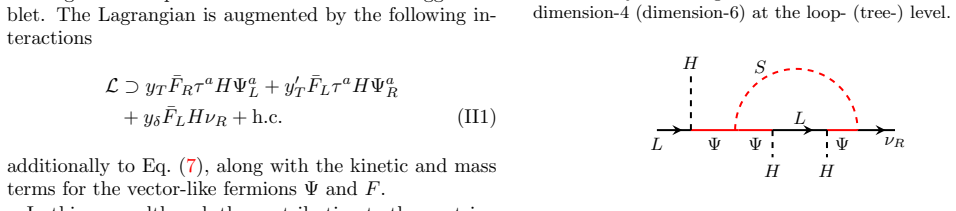
The load-bearing object is the 'bridge topology': a one-loop diagram in which the external neutrino line attaches to a heavy fermion Ψ in the adjoint of SU(2)_L, and the loop closes through a scalar S and fermion F in the same SU(2)_L representation. The mechanism is encoded in two trace identities: the mass diagram and the hypercharge diagram vanish because they are proportional to Tr[T^a] = 0, while the W³ diagram survives because it is proportional to Tr[T^a_R $T^{3}$_R] = T(R) $δ^{{a3}}$, where T(R) is the Dynkin index of the representation. This single group-theoretic selection rule is what decouples the dipole operator from the mass operator.
What would settle it
Compute the two-loop or RGE-induced neutrino mass by running the Wilson coefficient CνW from the new-physics scale Λ ≈ 1 TeV down to the electroweak scale and inserting the resulting CνH into the mass operator. If, for a magnetic moment of $10^{-12}$ μB, this running produces a neutrino mass above the KATRIN bound of 0.45 eV, then the proposed decoupling is not realized and the Dirac mechanism is falsified.
Extended reading notes
Core claim
The central claim is that the tight correlation between neutrino magnetic moment and neutrino mass, mν ~ (μν/μB)(Λ²/2me), can be broken by a group-theoretic selection rule. In the one-loop 'bridge' topology, the neutrino connects to the loop through a heavy vector-like fermion, and the scalar and fermion inside the loop share the same SU(2)_L representation. The mass diagram, obtained by removing the external gauge-boson leg, is proportional to the trace of an SU(2)_L generator and therefore vanishes exactly, irrespective of representation. The magnetic moment diagram survives only when the gauge boson is the neutral SU(2)_L field W³, through the identity Tr[T^a_R $T^{3}$_R] = T(R) $δ^{{a3}}$, which explains why the photon admixture yields a nonzero dipole while the hypercharge Bμ contribution is also killed by the same trace. Explicit UV completions with a triplet fermion and triplet scalar realize this for Dirac neutrinos, and a vector-like singlet replacement realizes it for Majorana neutrinos; the authors demonstrate that the leading mass operators vanish while the dipole Wilson coefficients are generated at one loop.
Load-bearing premise
The advertised observable magnetic moments, especially for Dirac neutrinos, must survive the universal renormalization-group mixing that turns the dipole operator into a mass operator; if the mixing bound from [53] is correct, the Dirac claim collapses and even the Majorana claim is pushed toward the edge of its quoted range.
Editorial extensions
If this is right
- If the mechanism is correct, neutrino magnetic moments near 10^-12 μB can be generated at one loop with TeV-scale new particles and without fine-tuning the neutrino mass to one part in 10^7.
- The mechanism applies to both Dirac and Majorana neutrinos, with the Majorana case requiring lepton-number violation through vector-like singlet fermions and scalar mixing.
- In non-minimal extensions where the neutrino mass vanishes exactly at dimensions 5-7, Majorana magnetic moments as large as 10^-9 μB become achievable.
- The decoupling is only partial: radiative corrections induce a neutrino mass suppressed by (|yΨ| v / Λ)² relative to the naive estimate, giving a concrete handle for separating moment from mass.
- For Dirac neutrinos, the paper itself finds that renormalization-group mixing of the dipole operator into the mass operator imposes μ_Dν ≲ 10^-15 μB, which is orders of magnitude below the values quoted in the abstract.
Reading between the lines
- The same trace-selection mechanism could be transplanted to other non-Abelian gauge groups with traceless generators, potentially generating dipole moments for other fermions while suppressing their mass operators.
- A direct experimental discriminator would be the angular or kinematic pattern of neutrino scattering: a moment generated only through the W³ component may show different energy dependence than one generated through hypercharge, though this distinction is washed out below the electroweak scale.
- The renormalization-group bound cited for the Dirac case suggests that the advertised observable moments are likely out of reach unless the running is modified by additional interactions, making the Majorana case the more promising phenomenological direction.
- One could test the mechanism by searching for the companion particle content: a triplet fermion and scalar near 1 TeV would produce distinctive collider signatures such as charged-track pairs or disappearing tracks that are not present in models where the moment comes from hypercharge.
Editorial analysis
A structured set of objections, weighed in public.
Referee Report
Summary. The paper proposes an SU(2)_L mechanism to decouple neutrino magnetic moments from neutrino masses. The idea is to generate the dimension-6 dipole operator O_{\nu W} (or the dimension-7 Majorana analogue O_{LHW}) through a one-loop 'bridge' topology in which the neutrino couples to the loop via a heavy fermion in a non-doublet representation, so that the mass diagram obtained by deleting the gauge-boson leg is proportional to Tr[T^a]=0 and vanishes. Explicit UV completions are presented for Dirac and Majorana neutrinos, with benchmark parameter choices said to yield \mu_\nu \sim 10^{-12}\mu_B, within reach of future experiments. The paper also contains a topology classification in the appendices and states that the matching was performed with Matchete, with notebooks available as supplementary material.
Significance. The group-theoretic observation that Tr[T^a]=0 can kill the zero-gauge-boson limit of a loop diagram is clean and, if realized in a fully consistent model, would be a genuinely new way to suppress the mass associated with a dipole operator. The paper is also commendable for providing a topology census and for stating that numerical matching tools and notebooks are used. However, the advertised decoupling is not realized in the models actually presented: the Dirac benchmark is blocked by the paper's own quoted RGE bound, and the one-loop mass formulas in Eqs. (14) and (19) are nonzero. The central observable claim therefore fails on the manuscript's own terms, and the incomplete drafting makes the quantitative results unverifiable.
major comments (4)
- [Section III A, Eq. (14)] The central claim that the mass contribution vanishes is contradicted by the paper's own one-loop mass formula. After matching, the authors obtain C_{\nu H} = 2 C_{\nu W} |y_\Psi|^2 and m_{\rm loop}^\nu = -(\mu_\nu/\mu_B)|y_\Psi|^2 v^2/(4 m_e). This is a nonzero Dirac mass generated by the same set of couplings as the magnetic moment; it is suppressed by |y_\Psi|^2 relative to the naive estimate but it is not zero. The statement in the abstract and Section IV that the mass diagram 'vanishes' is therefore too strong: only the specific diagram with the external W leg removed vanishes, while the full model still generates a one-loop mass.
- [Section III A, RGE bound paragraph] The Dirac scenario does not deliver the advertised observable magnetic moment. The text quotes the model-independent RGE bound \mu_D^\nu \lesssim 10^{-15}\mu_B from Ref. [53] arising from mixing of O_{\nu W} into O_{\nu H} between \Lambda \sim 1 TeV and the electroweak scale, but the benchmark quoted immediately above is \mu_D^\nu \sim 10^{-12}\mu_B. This is at least three orders of magnitude above the bound, and the paper explicitly states that the setup does not escape it. No computation of the running or a cancellation mechanism is provided, so the Dirac model fails to achieve the claimed decoupling on its own terms.
- [Section III B, after Eq. (19)] The Majorana claims are internally inconsistent. The paper quotes the model-independent RGE bound \mu_M^\nu < 10^{-10}\mu_B from Refs. [54,55] and then states that in non-minimal scenarios 'larger values of the O(10^{-9}) \mu_B are achievable'. No example or argument is given for why those scenarios evade the quoted model-independent bound. Furthermore, Eq. (19) gives a nonzero Majorana mass m_{\rm loop}^\nu = -(\mu_\nu/\mu_B)|y_\Psi|^2 v^2/(8 m_e), so the claim that the mass vanishes exactly is also not established for the presented Majorana realization.
- [Equations (12) and (18)] The Wilson coefficient formulas are not in a reproducible form. In Eq. (12), the first term has the structure (couplings)/(16\pi^2 m_S^2)[1-\log(m_S^2/m_\Psi^2)] while the second term is m_\Psi^2/(m_\Psi^2-m_S^2)^2 with no coupling prefactor or common bracket; the two terms do not combine into any standard loop-function form, so the reader cannot verify the quoted magnetic-moment magnitudes. The editorial placeholders in the same sections ('need to write it properly in index form', 'We need to point out why other topologies don't work?', 'sec XX', and the missing reference '[]') reinforce that the calculation is not yet complete.
minor comments (4)
- [Throughout] The manuscript contains unfinished editorial passages, including 'As discussed in sec XX', 'need to write it properly in index form', 'We need to point out why other topologies don't work?', and 'required by electroweak precision data []'. These must be removed and the missing citation supplied.
- [Figure 1 caption] The caption of Fig. 1 ends with the incomplete instruction 'fix the alignment', which appears to be a leftover editing note rather than part of a caption.
- [Introduction and Section II] The same topology and Lagrangian paragraphs appear twice in the text with different formatting and equation numbering, which makes cross-references such as 'Eq. (3)' and 'Eq. (6)' confusing and suggests the file is not in a clean submission state.
- [Table I] Some entries in Table I are difficult to read as typeset, particularly the mass column for case (b); these numerical expressions should be rewritten with unambiguous parentheses and units.
Circularity Check
No significant circularity: the SU(2)_L trace cancellation is derived from representation theory, and the advertised magnetic moments are computed benchmark estimates, not fitted outputs.
full rationale
The central mechanism is a group-theoretic construction, not a tautology. The paper chooses S and F in the same SU(2)_L representation with the same hypercharge so that the zero-gauge-boson loop amplitude is proportional to Tr[T^a] = 0 (Eq. 9), while attaching W^3 gives Tr[T^a_R T^3_R] = T(R) delta^{a3} (Eq. 10). These identities are stated inputs derived from standard SU(2) generator properties, and the cancellation is obtained by explicit contraction of the Yukawa vertices in Eq. (8), not assumed as the desired output. The Wilson coefficients and magnetic moments in Eqs. (12), (13), (17), and (18) are then computed from the displayed Lagrangians; the benchmark choices y_delta, y_T ~ 1, y_Psi ~ 10^-3, and TeV-scale masses are inputs, not parameters fitted to reproduce a target mu_nu. The Matchete citation [62] is a tool citation for the automated matching, and the matching notebooks are provided; it is code-reproducible and not load-bearing for the physics claim. The bridge-topology context citations [58-61] are contextual and not used to justify the central result. The paper's internal tension concerning the one-loop mass in Eq. (14) and the quoted RGE bound mu^D_nu <~ 10^-15 mu_B from [53] is a scientific consistency/correctness issue, not circularity: the paper does not redefine mu_nu as that bound or fit it. No load-bearing step reduces by construction to its own input.
Assumptions & free parameters
free parameters (7)
- y_Psi =
~1e-3 (benchmark)
- y_delta =
~1 (benchmark)
- y_T =
~1 (benchmark)
- m_Psi, m_S =
~1 TeV (benchmark)
- theta_PhiH =
~0.1 (Majorana case)
- y_N =
~1 (Majorana case)
- mu =
small, mu << 1
assumptions (6)
- standard math SU(2)_L generators are traceless in any finite-dimensional representation.
- standard math The Dynkin index relation Tr[T^a T^b] = T(R) delta^{ab} holds for SU(2) representations.
- domain assumption The vector-like fermion and scalar fields with the assigned quantum numbers exist and can be integrated out at one loop, with SM gauge invariance preserved.
- domain assumption A global lepton number symmetry is imposed for Dirac neutrinos, forbidding Majorana mass terms and fixing the Yukawa structure.
- domain assumption The renormalization-group mixing from O_nuW to O_nuH follows the results of Refs. [53-55].
- ad hoc to paper The choice of adjoint representation for the bridge fermion (condition |R1 - R2| - n = 2) is a model-building selection that realizes the desired vanishing mass.
invented entities (5)
-
Psi: vector-like fermion triplet (1,3,0)
-
S: real scalar triplet (1,3,0)
-
F: additional fermion with same quantum numbers as S (several cases)
-
N: vector-like singlet (1,1,0)
-
Phi: second Higgs doublet carrying lepton number L=2
Cite this review
Pith. "Pith review of Decoupling Neutrino Magnetic Moment from Mass with $SU(2)_L$ Invariance." pith.science (2026). https://pith.science/paper/UVYHHAAS
@misc{pith2026250615777,
  author       = {Pith},
  title        = {Pith review of: Decoupling Neutrino Magnetic Moment from Mass with $SU(2)_L$ Invariance},
  year         = {2026},
  howpublished = {\url{https://pith.science/paper/UVYHHAAS}},
  note         = {Machine review of arXiv:2506.15777}
}
abstract
Standard Model extensions that yield observable neutrino magnetic moments typically also induce large neutrino masses, incompatible with experimental limits. This tension motivates the search for mechanisms that naturally decouple magnetic moments from mass generation without requiring fine-tuning. In this letter, we propose a novel mechanism for generating Dirac and Majorana neutrino magnetic moment, in which the associated mass contribution is forbidden by $SU(2)_L$ invariance. By carefully selecting the $SU(2)_L$ representations connecting the neutrino to the loop diagram, we ensure that only the effective dipole operator involving the non-Abelian part of the photon -- the neutral $SU(2)_L$ gauge boson -- is generated. Crucially, the corresponding mass diagram, obtained by removing the external gauge boson leg, vanishes. We provide explicit UV completions that implement this mechanism and yield neutrino magnetic moments within the sensitivity of current and future experiments.
Figures


Figures from the paper (3 more)


Reference graph
Works this paper leans on
-
[53]
A Neutrino With a Large Magnetic Moment and a Naturally Small Mass,
R. Barbieri and R. N. Mohapatra, “A Neutrino With a Large Magnetic Moment and a Naturally Small Mass,” Phys. Lett. B218 (1989) 225–229
work page 1989
-
[1]
Review of particle physics,
Particle Data GroupCollaboration, S. Navas et al., “Review of particle physics,” Phys. Rev. D110 no. 3, (2024) 030001
2024
-
[2]
The 2 L F ⌫ R S H B µ ,W i µ (a) L F N L S H H B µ ,W i µ (b) FIG. 1: One-loop topology for (a) Dirac and (b) Majorana magnetic moment that leads to vanishing neutrino masses. Black (red) lines represent SM (new) particles. The gauge bosons ( B µ ,W i µ ) can be attached to either scalar line S or fermion F . fix the alignment out attaching any external ga...
-
[3]
The (a) (b) FIG. 2. One-loop topology for (a) Dirac and (b) Majorana magnetic moment that leads to vanishing neutrino masses. Black (red) lines represent SM (new) particles. Ψ is a triplet of SU (2)L. The gauge bosons ( Bµ, Wi µ) can be attached to either scalar line S or fermion line F . where n is the number of Higgses attached to the ef- fective vertex...
-
[4]
Neutrino Electromagnetic Properties,
C. Giunti, K. Kouzakov, Y.-F. Li, and A. Studenikin, “Neutrino Electromagnetic Properties,” [ 2411.03122]
-
[5]
Majorana Neutrinos and Magnetic Fields,
J. Schechter and J. W. F. Valle, “Majorana Neutrinos and Magnetic Fields,” Phys. Rev. D24 (1981) 1883–1889. [Erratum: Phys.Rev.D 25, 283 (1982)]
work page 1981
-
[6]
Electromagnetic Properties of Majorana Neutrinos,
J. F. Nieves, “Electromagnetic Properties of Majorana Neutrinos,” Phys. Rev. D26 (1982) 3152
work page 1982
-
[7]
Majorana Neutrinos and their Electromagnetic Properties,
B. Kayser, “Majorana Neutrinos and their Electromagnetic Properties,” Phys. Rev. D26 (1982) 1662
work page 1982
Show all 67 references
-
[8]
CPT, CP, and c Phases and their Effects in Majorana Particle Processes,
B. Kayser, “CPT, CP, and c Phases and their Effects in Majorana Particle Processes,” Phys. Rev. D30 (1984) 1023
1984
-
[9]
Majorana versus Dirac Constraints on the Neutrino Dipole Moments,
A. de Gouvˆ ea, G. Jusino S´ anchez, P. A. N. Machado, and Z. Tabrizi, “Majorana versus Dirac Constraints on the Neutrino Dipole Moments,” [ 2209.03373]
-
[10]
The results of search for the neutrino magnetic moment in GEMMA experiment,
A. G. Beda, V. B. Brudanin, V. G. Egorov, D. V. Medvedev, V. S. Pogosov, M. V. Shirchenko, and A. S. Starostin, “The results of search for the neutrino magnetic moment in GEMMA experiment,” Adv. High Energy Phys. 2012 (2012) 350150. 8
2012
-
[11]
Limiting neutrino magnetic moments with Borexino Phase-II solar neutrino data,
Borexino Collaboration, M. Agostini et al., “Limiting neutrino magnetic moments with Borexino Phase-II solar neutrino data,” Phys. Rev. D96 no. 9, (2017) 091103, [1707.09355]
2017 arXiv
-
[12]
First upper limits on neutrino electromagnetic properties from the CONUS experiment,
CONUS Collaboration, H. Bonet et al., “First upper limits on neutrino electromagnetic properties from the CONUS experiment,” Eur. Phys. J. C82 no. 9, (2022) 813, [2201.12257]
2022 arXiv
-
[13]
Excess electronic recoil events in XENON1T,
XENON Collaboration, E. Aprile et al., “Excess electronic recoil events in XENON1T,” Phys. Rev. D 102 no. 7, (2020) 072004, [ 2006.09721]
2020 arXiv
-
[14]
Search for New Physics in Electronic Recoil Data from XENONnT,
XENON Collaboration, E. Aprile et al., “Search for New Physics in Electronic Recoil Data from XENONnT,” Phys. Rev. Lett.129 no. 16, (2022) 161805, [2207.11330]
2022 arXiv
-
[15]
First Dark Matter Search Results from the LUX-ZEPLIN (LZ) Experiment,
LZ Collaboration, J. Aalbers et al., “First Dark Matter Search Results from the LUX-ZEPLIN (LZ) Experiment,” Phys. Rev. Lett.131 no. 4, (2023) 041002, [2207.03764]
2023 arXiv
-
[16]
Detecting the neutrino magnetic moment at hadron colliders,
O. M. Boyarkin and G. G. Boyarkina, “Detecting the neutrino magnetic moment at hadron colliders,” Phys. Rev. D 90 no. 10, (2014) 105021
2014
-
[17]
Muon collider probes of Majorana neutrino dipole moments and masses,
M. Frigerio and N. Vignaroli, “Muon collider probes of Majorana neutrino dipole moments and masses,” JHEP 04 (2025) 008, [ 2409.02721]
2025 arXiv
-
[18]
Collider Prospects for the Neutrino Magnetic Moment Portal,
V. Brdar, Y.-Y. Li, S. R. Mir, and Y.-L. Wang, “Collider Prospects for the Neutrino Magnetic Moment Portal,” [2502.07024]
-
[19]
Supernova neutrino spectrum with matter and spin flavor precession effects,
A. Ahriche and J. Mimouni, “Supernova neutrino spectrum with matter and spin flavor precession effects,” JCAP 11 (2003) 004, [ astro-ph/0306433]
2003 arXiv
-
[20]
Supernova prompt neutronization neutrinos and neutrino magnetic moments,
E. K. Akhmedov and T. Fukuyama, “Supernova prompt neutronization neutrinos and neutrino magnetic moments,” JCAP 12 (2003) 007, [ hep-ph/0310119]
2003 arXiv
-
[21]
Exploiting a future galactic supernova to probe neutrino magnetic moments,
S. Jana, Y. P. Porto-Silva, and M. Sen, “Exploiting a future galactic supernova to probe neutrino magnetic moments,” JCAP 09 (2022) 079, [ 2203.01950]
2022 arXiv
-
[22]
Solarνe flux: revisiting bounds on neutrino magnetic moments and solar magnetic field,
E. Akhmedov and P. Mart ´ ınez-Mirav´ e, “Solarνe flux: revisiting bounds on neutrino magnetic moments and solar magnetic field,” JHEP 10 (2022) 144, [2207.04516]
2022 arXiv
-
[23]
Magnetic moments of astrophysical neutrinos,
J. Kopp, T. Opferkuch, and E. Wang, “Magnetic moments of astrophysical neutrinos,” JCAP 03 (2024) 043, [2212.11287]
2024 arXiv
-
[24]
Three generation study of neutrino spin flavor conversion in supernova and implication for neutrino magnetic moment,
S. Ando and K. Sato, “Three generation study of neutrino spin flavor conversion in supernova and implication for neutrino magnetic moment,” Phys. Rev. D 67 (2003) 023004, [ hep-ph/0211053]
2003 arXiv
-
[25]
Magnetar-powered neutrinos and magnetic moment signatures at IceCube,
V. Brdar, T. Cheng, H.-J. Kuan, and Y.-Y. Li, “Magnetar-powered neutrinos and magnetic moment signatures at IceCube,” JCAP 07 (2024) 026, [2312.14113]
2024 arXiv
-
[26]
Resonances of Supernova Neutrinos in Twisting Magnetic Fields,
S. Jana and Y. Porto, “Resonances of Supernova Neutrinos in Twisting Magnetic Fields,” Phys. Rev. Lett. 132 no. 10, (2024) 101005, [ 2303.13572]
2024 arXiv
-
[27]
Neutrino and axion bounds from the globular cluster M5 (NGC 5904),
N. Viaux, M. Catelan, P. B. Stetson, G. Raffelt, J. Redondo, A. A. R. Valcarce, and A. Weiss, “Neutrino and axion bounds from the globular cluster M5 (NGC 5904),” Phys. Rev. Lett.111 (2013) 231301, [1311.1669]
2013 arXiv
-
[28]
Particle-physics constraints from the globular cluster M5: Neutrino Dipole Moments,
N. Viaux, M. Catelan, P. B. Stetson, G. Raffelt, J. Redondo, A. A. R. Valcarce, and A. Weiss, “Particle-physics constraints from the globular cluster M5: Neutrino Dipole Moments,” Astron. Astrophys. 558 (2013) A12, [ 1308.4627]
2013 arXiv
-
[29]
Axion and neutrino bounds improved with new calibrations of the tip of the red-giant branch using geometric distance determinations,
F. Capozzi and G. Raffelt, “Axion and neutrino bounds improved with new calibrations of the tip of the red-giant branch using geometric distance determinations,” Phys. Rev. D102 no. 8, (2020) 083007, [2007.03694]
2020 arXiv
-
[30]
Majorana Neutrino Magnetic Moment and Neutrino Decoupling in Big Bang Nucleosynthesis,
N. Vassh, E. Grohs, A. B. Balantekin, and G. M. Fuller, “Majorana Neutrino Magnetic Moment and Neutrino Decoupling in Big Bang Nucleosynthesis,” Phys. Rev. D 92 no. 12, (2015) 125020, [ 1510.00428]
2015 arXiv
-
[31]
Neutrino magnetic moments meet precision N ef fmeasurements,
S.-P. Li and X.-J. Xu, “Neutrino magnetic moments meet precision N ef fmeasurements,” JHEP 02 (2023) 085, [2211.04669]
2023 arXiv
-
[32]
Strong cosmological constraints on the neutrino magnetic moment,
P. Carenza, G. Lucente, M. Gerbino, M. Giannotti, and M. Lattanzi, “Strong cosmological constraints on the neutrino magnetic moment,” Phys. Rev. D110 no. 2, (2024) 023510, [ 2211.10432]
2024 arXiv
-
[33]
Implications on cosmology from Dirac neutrino magnetic moments,
E. Grohs and A. B. Balantekin, “Implications on cosmology from Dirac neutrino magnetic moments,” Phys. Rev. D107 no. 12, (2023) 123502, [ 2303.06576]
2023 arXiv
-
[34]
Direct neutrino-mass measurement based on 259 days of KATRIN data,
KA TRINCollaboration, M. Aker et al., “Direct neutrino-mass measurement based on 259 days of KATRIN data,” Science 388 no. 6743, (2025) adq9592, [2406.13516]
2025
-
[35]
The Magnetic Moment of a Massive Neutrino and Neutrino Spin Rotation,
K. Fujikawa and R. Shrock, “The Magnetic Moment of a Massive Neutrino and Neutrino Spin Rotation,” Phys. Rev. Lett.45 (1980) 963
1980
-
[36]
Radiative Decays of Massive Neutrinos,
P. B. Pal and L. Wolfenstein, “Radiative Decays of Massive Neutrinos,” Phys. Rev. D25 (1982) 766
1982
-
[37]
Electromagnetic Properties and Decays of Dirac and Majorana Neutrinos in a General Class of Gauge Theories,
R. E. Shrock, “Electromagnetic Properties and Decays of Dirac and Majorana Neutrinos in a General Class of Gauge Theories,” Nucl. Phys. B206 (1982) 359–379
1982
-
[38]
Electric charge and magnetic moment of massive neutrino,
M. Dvornikov and A. Studenikin, “Electric charge and magnetic moment of massive neutrino,” Phys. Rev. D 69 (2004) 073001, [ hep-ph/0305206]
2004 arXiv
-
[39]
Electromagnetic form-factors of a massive neutrino,
M. S. Dvornikov and A. I. Studenikin, “Electromagnetic form-factors of a massive neutrino,” J. Exp. Theor. Phys. 99 (2004) 254–269, [ hep-ph/0411085]
2004 arXiv
-
[40]
Upper limit on the neutrino magnetic moment,
C. L. Cowan, F. Reines, and F. B. Harrison, “Upper limit on the neutrino magnetic moment,” Phys. Rev. 96 (1954) 1294
1954
-
[41]
Limitations on the magnetic moment and charge radius of the electron-anti-neutrino,
G. S. Vidyakin, V. N. Vyrodov, I. I. Gurevich, Y. V. Kozlov, V. P. Martemyanov, S. V. Sukhotin, V. G. Tarasenkov, E. V. Turbin, and S. K. Khakhimov, “Limitations on the magnetic moment and charge radius of the electron-anti-neutrino,” JETP Lett. 55 (1992) 206–210
1992
-
[42]
Experiment on anti-neutrino scattering by electrons at a reactor of the Rovno nuclear power plant,
A. I. Derbin, A. V. Chernyi, L. A. Popeko, V. N. Muratova, G. A. Shishkina, and S. I. Bakhlanov, “Experiment on anti-neutrino scattering by electrons at a reactor of the Rovno nuclear power plant,” JETP Lett. 57 (1993) 768–772
1993
-
[43]
Final results on the neutrino magnetic moment from the MUNU experiment,
MUNU Collaboration, Z. Daraktchieva et al., “Final results on the neutrino magnetic moment from the MUNU experiment,” Phys. Lett. B615 (2005) 153–159, [hep-ex/0502037]
2005 arXiv
-
[44]
Measurement of Nu(e)-bar -Electron Scattering Cross-Section with a CsI(Tl) Scintillating Crystal Array at the Kuo-Sheng Nuclear Power Reactor,
TEXONO Collaboration, M. Deniz et al., “Measurement of Nu(e)-bar -Electron Scattering Cross-Section with a CsI(Tl) Scintillating Crystal Array at the Kuo-Sheng Nuclear Power Reactor,” Phys. Rev. D 81 (2010) 072001, [ 0911.1597]
2010 arXiv
-
[45]
Study of electron-neutrino electron elastic scattering at LAMPF,
R. C. Allen et al., “Study of electron-neutrino electron elastic scattering at LAMPF,” Phys. Rev. D47 (1993) 11–28. 9
1993
-
[46]
Updating neutrino magnetic moment constraints,
B. C. Canas, O. G. Miranda, A. Parada, M. Tortola, and J. W. F. Valle, “Updating neutrino magnetic moment constraints,” Phys. Lett. B753 (2016) 191–198, [1510.01684]. [Addendum: Phys.Lett.B 757, 568–568 (2016)]
2016 arXiv
-
[47]
A Mechanism for large neutrino magnetic moments,
S. M. Barr, E. M. Freire, and A. Zee, “A Mechanism for large neutrino magnetic moments,” Phys. Rev. Lett.65 (1990) 2626–2629
1990
-
[48]
Large neutrino magnetic moments and the existence of singly charged scalar fields,
S. M. Barr and E. M. Freire, “Large neutrino magnetic moments and the existence of singly charged scalar fields,” Phys. Rev. D43 (1991) 2989–2998
1991
-
[49]
Comment on ‘Mechanism for large neutrino magnetic moments’,
K. S. Babu, D. Chang, W.-Y. Keung, and I. Phillips, “Comment on ‘Mechanism for large neutrino magnetic moments’,” Phys. Rev. D46 (1992) 2268–2269
1992
-
[50]
Large transition magnetic moment of the neutrino from horizontal symmetry,
K. S. Babu and R. N. Mohapatra, “Large transition magnetic moment of the neutrino from horizontal symmetry,” Phys. Rev. D42 (1990) 3778–3793
1990
-
[51]
A Model for a Large Neutrino Magnetic Transition Moment and Naturally Small Mass,
M. Leurer and N. Marcus, “A Model for a Large Neutrino Magnetic Transition Moment and Naturally Small Mass,” Phys. Lett. B237 (1990) 81–87
1990
-
[52]
M. B. Voloshin Sov. J. Nucl. Phys.48 (1988) 512
1988
-
[54]
Revisiting Large Neutrino Magnetic Moments,
M. Lindner, B. Radovˇ ci´ c, and J. Welter, “Revisiting Large Neutrino Magnetic Moments,” JHEP 07 (2017) 139, [1706.02555]
2017 arXiv
-
[55]
How magnetic is the Dirac neutrino?,
N. F. Bell, V. Cirigliano, M. J. Ramsey-Musolf, P. Vogel, and M. B. Wise, “How magnetic is the Dirac neutrino?,” Phys. Rev. Lett.95 (2005) 151802, [hep-ph/0504134]
2005 arXiv
-
[56]
From transition magnetic moments to majorana neutrino masses,
S. Davidson, M. Gorbahn, and A. Santamaria, “From transition magnetic moments to majorana neutrino masses,” Phys. Lett. B626 (2005) 151–160, [hep-ph/0506085]
2005 arXiv
-
[57]
Model independent bounds on magnetic moments of Majorana neutrinos,
N. F. Bell, M. Gorchtein, M. J. Ramsey-Musolf, P. Vogel, and P. Wang, “Model independent bounds on magnetic moments of Majorana neutrinos,” Phys. Lett. B 642 (2006) 377–383, [ hep-ph/0606248]
2006 arXiv
-
[58]
Heavy Majorana Neutrinos in the Effective Lagrangian Description: Application to Hadron Colliders,
F. del Aguila, S. Bar-Shalom, A. Soni, and J. Wudka, “Heavy Majorana Neutrinos in the Effective Lagrangian Description: Application to Hadron Colliders,” Phys. Lett. B 670 (2009) 399–402, [ 0806.0876]
2009 arXiv
-
[59]
Operators up to Dimension Seven in Standard Model Effective Field Theory Extended with Sterile Neutrinos,
Y. Liao and X.-D. Ma, “Operators up to Dimension Seven in Standard Model Effective Field Theory Extended with Sterile Neutrinos,” Phys. Rev. D96 no. 1, (2017) 015012, [ 1612.04527]
2017 arXiv
-
[60]
Naturalness and the muon magnetic moment,
N. Arkani-Hamed and K. Harigaya, “Naturalness and the muon magnetic moment,” JHEP 09 (2021) 025, [2106.01373]
2021 arXiv
-
[61]
Wilson coefficients and natural zeros from the on-shell viewpoint,
L. Delle Rose, B. von Harling, and A. Pomarol, “Wilson coefficients and natural zeros from the on-shell viewpoint,” JHEP 05 (2022) 120, [ 2201.10572]
2022 arXiv
-
[62]
A bridge to new physics: proposing new - and reviving old - explanations of aµ,
G. Guedes and P. Olgoso, “A bridge to new physics: proposing new - and reviving old - explanations of aµ,” JHEP 09 (2022) 181, [ 2205.04480]
2022 arXiv
-
[63]
Minimal model for the W -boson mass, ( g − 2)µ, h → µ+µ− and quark-mixing-matrix unitarity,
A. Crivellin, M. Kirk, and A. Thapa, “Minimal model for the W -boson mass, ( g − 2)µ, h → µ+µ− and quark-mixing-matrix unitarity,” Phys. Rev. D108 no. 3, (2023) L031702, [ 2305.03081]
2023 arXiv
-
[64]
A proof of concept for matchete: an automated tool for matching effective theories,
J. Fuentes-Mart ´ ın, M. K¨ onig, J. Pag` es, A. E. Thomsen, and F. Wilsch, “A proof of concept for matchete: an automated tool for matching effective theories,” Eur. Phys. J. C83 no. 7, (2023) 662, [ 2212.04510]
2023 arXiv
-
[65]
Minimal dark matter,
M. Cirelli, N. Fornengo, and A. Strumia, “Minimal dark matter,” Nucl. Phys. B753 (2006) 178–194, [hep-ph/0512090]
2006 arXiv
-
[66]
The Inert Doublet Model: An Archetype for Dark Matter,
L. Lopez Honorez, E. Nezri, J. F. Oliver, and M. H. G. Tytgat, “The Inert Doublet Model: An Archetype for Dark Matter,” JCAP 02 (2007) 028, [ hep-ph/0612275]
2007 arXiv
-
[67]
Models with radiative neutrino masses and viable dark matter candidates,
D. Restrepo, O. Zapata, and C. E. Yaguna, “Models with radiative neutrino masses and viable dark matter candidates,” JHEP 11 (2013) 011, [ 1308.3655]
2013 arXiv
Reviewed August 6, 2026 · model on record in the stance chip above.
Discussion (0). Sign in to comment.