REVIEW 4 major objections 8 minor 40 references
From Local Interactions to Global Operators: Scalable Gaussian Process Operator for Physical Systems
T0 review · 4 major / 8 minor · reviewed 2026-08-15 · deepseek-v4-flash
Pith's one-line read This paper proposes LoGoS-GPO, a Gaussian Process Operator that combines K-nearest-neighbor spatial kernels, Kronecker factorization, and sparse variational inference to lower operator-learning inference cost from $O(N^3 d^3)$ to $O(M^3 +…
desk verdict A promising blend of sparsification tricks for GPOs, but the central complexity claim rests on an unproven and likely invalid assumption about the inverse of the KNN-truncated kernel. read the letter →
The pith
A machine-rendered reading of the paper's core claim, the machinery that carries it, and where it could break.
The reading
What carries the argument
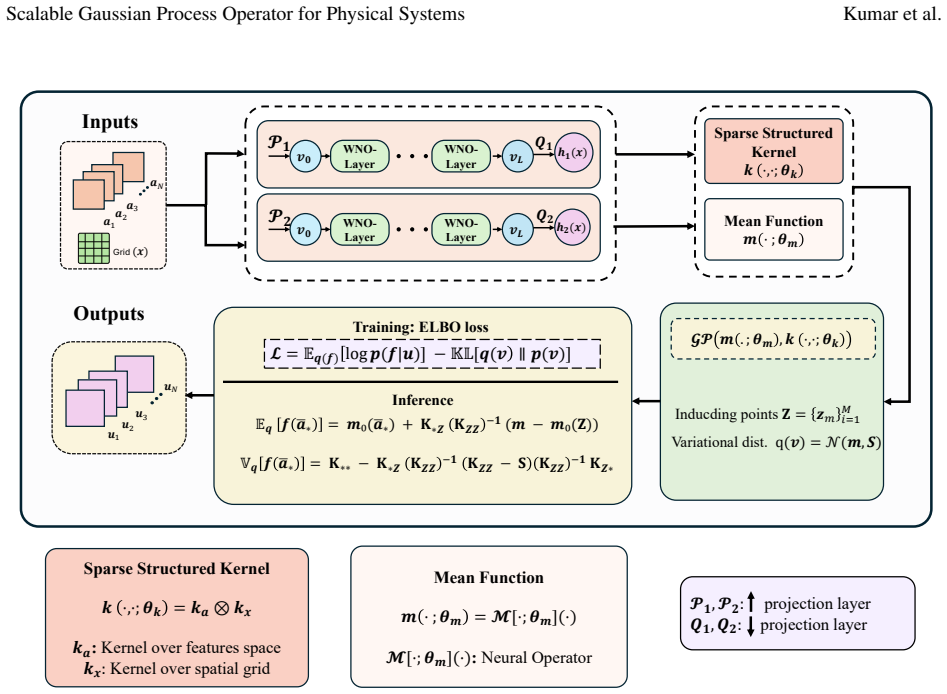
The load-bearing object is the doubly sparse covariance $K = K_a(\Phi(A),\Phi(A')) \otimes K_x(x,x')$: a Kronecker product of a parameter-space kernel evaluated on neural-operator embeddings and a spatial kernel $K_x$ truncated so each row retains only its $K$ nearest neighbors. Kronecker structure lets matrix products and inverses act on the two factors separately, and sparse variational inference with $M$ inducing points replaces the full $Nd$-dimensional posterior with a low-rank one, giving the claimed $O(M^3 + M^2B + dK^2)$ cost. The non-zero mean $m(a,x)$, produced by an enhanced wavelet neural operator, is not decorative: it carries the global, operator-aware information that the localized spatial kernel discards, and the same neural operator defines the latent space $\Phi(\cdot)$ in which the parameter-space kernel is evaluated. The paper's formal route from function-valued GP to this finite model is the probabilistic currying equivalence $G(a)(x) = f(a,x)$.
What would settle it
Compute the smallest eigenvalue of the truncated matrix $K_x$ from Eq. (13) on a uniform 1D grid with an RBF kernel and small $K$; if any eigenvalue is negative for typical lengthscales, the matrix is not a valid covariance and the posterior variance in Eq. (23b) can go negative. Separately, benchmark the inversion step's wall-clock scaling in $d$ at fixed $K$: growth like $d^2$ or $d^3$ rather than $O(dK)$ would falsify the headline complexity claim.
Extended reading notes
Core claim
The central claim is that a doubly sparse Gaussian Process Operator can match or beat exact GPO accuracy at a fraction of the cost. The proposed model writes the covariance as $K = K_a(\Phi(A),\Phi(A')) \otimes K_x(x,x')$, keeps only the $K$ nearest neighbors of each spatial grid point in $K_x$, and treats the parameter-space factor $K_a$ with sparse variational inference using $M$ inducing points. The paper states that this combination reduces inference cost from $O(N^3 d^3)$ to $O(M^3 + M^2B + dK^2)$, where $N$ is the number of training samples, $d$ the discretization size, and $B$ the mini-batch size. On four nonlinear PDE benchmarks—1D Burgers, 1D wave advection, 2D Darcy flow on a notched triangular domain, and 2D Navier–Stokes—the reported relative L2 errors are 0.86%, 0.43%, 1.38%, and 2.01%, respectively, all below the corresponding GPO and SVGP errors. A separate claim is that the enhanced wavelet neural operator, which replaces the pointwise-multiplication approximation of wavelet convolution with a true convolution integral in the wavelet domain, provides the expressive mean and latent embedding that let the sparsified kernel stay accurate.
Load-bearing premise
The load-bearing premise is that the K-nearest-neighbor-truncated spatial covariance matrix $K_x$ is still a valid covariance whose inverse can be computed in $O(dK)$ time; a sparse matrix with $K$ nonzeros per row is not generally positive definite, and its inverse is generally dense, so Eq. (20)'s use of $[K_x]^{-1}$ and the quoted $O(dK)$ inversion cost are not automatic.
Editorial extensions
If this is right
- If the complexity claim holds, GPOs become trainable at grid resolutions and sample sizes that were previously out of reach, with per-epoch time and memory growing roughly linearly in the grid size $d$ rather than cubically.
- The four benchmarks suggest that probabilistic operator learning does not have to trade uncertainty quantification for scalability: predictive intervals remain narrow on unseen inputs from the same distribution, including near the discontinuity in the wave advection case.
- The non-zero neural-operator mean is a transferable recipe: any discretization-invariant operator could supply the mean and the latent embedding, turning a deterministic neural operator into a scalable Gaussian process with uncertainty estimates.
- Replacing the pointwise-multiplication approximation in wavelet convolution with a genuine convolution integral in the wavelet domain is presented as an architectural fix that preserves multiscale locality while regaining global interactions.
- If resolution independence transfers as reported, the model offers a route to training on coarse grids and predicting on finer grids with calibrated uncertainty, which is the practical setting for parametric PDE surrogates.
Reading between the lines
- The step most worth stress-testing is the claimed $O(dK)$ inversion of the KNN-truncated spatial matrix: a sparse matrix with $K$ nonzeros per row is not guaranteed to be positive definite, and its inverse is generally dense, so the stated cost depends on an extra structural assumption the paper leaves implicit.
- The accuracy comparisons are against GPO and SVGP; a sharper test of whether sparsification costs accuracy would compare against deterministic wavelet or Fourier neural operators at the same resolution and sample budget.
- A natural extension is to make the neighbor set adaptive to kernel lengthscales or learned, which could recover long-range spatial interactions while retaining the sparse layout.
- One could probe the role of the operator-aware mean directly by ablating it: if accuracy collapses when the mean is set to zero, the expressive prior mean is doing the work that the sparse kernel alone cannot.
Signed reviews
Editorial analysis
A structured set of objections, weighed in public.
Referee Report
Summary. This paper proposes LoGoS-GPO, a sparse variational Gaussian process operator that combines a Kronecker-factorized covariance over (input-feature, spatial-grid) pairs, K-nearest-neighbor truncation of the spatial covariance, and a neural-operator mean and latent embedding. The central scaling claim in Section 3.1 is that this reduces training cost to O(M^3 + M^2B + dK^2) from O(N^3d^3) for exact inference. The method is evaluated on Burgers, wave advection, Darcy, and Navier-Stokes benchmarks, reporting relative L2 errors of 0.43%-2.01%, which are better than GPO and SVGP, together with scaling experiments in grid size and sample count. An enhanced wavelet neural operator is introduced to provide the mean function and the latent kernel embedding.
Significance. If the scalability claim were established, LoGoS-GPO would be a practically useful step toward uncertainty quantification in operator learning, and the empirical comparison against SVGP and GPO on standard PDE benchmarks is a genuine strength. The paper makes a concrete, falsifiable algorithmic proposal (KNN sparsification plus Kronecker factorization plus sparse variational inference) and reports external benchmarks rather than constructing the evaluation from its own prior outputs. However, the advertised complexity reduction rests on unproved spectral and algorithmic properties of the KNN-truncated spatial matrix, and the current derivation does not support the central claim as written. The empirical results are plausible but cannot by themselves validate the complexity model.
major comments (4)
- [§3.1, Eq. (13) and Eq. (20)] The KNN-truncated matrix K_N^x defined in Eq. (13) is not guaranteed to be symmetric, because the K-nearest-neighbor relation is not symmetric, and it is not guaranteed to be positive definite. Even for a symmetrized banded version, truncating an RBF kernel on a fine uniform grid gives a tridiagonal section whose smallest eigenvalue is approximately 1 - 2ρ, which is negative whenever the adjacent-point correlation ρ exceeds 0.5. Since Eq. (20) uses (K_N^x)^{-1} in a Kronecker inverse and Eqs. (21)-(23) treat K_N^x as a covariance, the variational objective and predictive variance are not valid as stated. The construction needs to be repaired, for example by symmetrization with a diagonal jitter or by replacing the KNN truncation with a Vecchia-style sparse precision that is guaranteed positive definite.
- [§3.1, Algorithm 1 and complexity statement] Algorithm 1 computes all pairwise distances for each grid point, so constructing K_N^x costs O(d^2) kernel evaluations and O(d^2 log d) sort time, which contradicts the stated O(d log N + dK) construction and inversion cost. Furthermore, the inverse of a sparse matrix is generally dense, and no argument is given that K_N^x admits a bounded-fill-in Cholesky factorization or that its inverse can be applied in O(dK). The overall complexity claim O(M^3 + M^2B + dK^2) is therefore not established; please specify the exact linear algebra (bandwidth, fill-in, or iterative solver) and derive the cost from the actual algorithm.
- [§3.2, Eqs. (27)-(31)] The derivation of the enhanced wavelet convolution is not self-contained. Equation (28) gives a convolution in the wavelet translation variable t, but Eq. (29) replaces it with F^{-1}[R_φ · F(Wv_j)(s,ω)] without specifying the domain of the Fourier transform, the relation between R_φ and K_φ, or how the discrete wavelet transform and FFT implementations compose. Please provide a precise statement of the transforms and variables, or give the actual computational formula used in the experiments; without this, the claimed improvement over the original WNO cannot be verified.
- [§3.1, Eq. (12)] Equation (12) asserts the separable Kronecker decomposition K = K_a ⊗ K_x, but this does not follow from the latent-space kernel in Eq. (9) unless Φ and k_ax are assumed to factorize over the input-feature and spatial coordinates. The paper should state this explicitly as a modeling assumption and indicate what class of kernels is covered; as written, the decomposition is introduced without derivation or justification.
minor comments (8)
- [§3.2, Eq. (25)] Equation (25) uses g*(ω) for the Fourier transform and integrates C_g over Ω with respect to ω; please standardize the notation (e.g., \hat g or \mathcal{F}g) and state the integration domain as the frequency axis.
- [§4.2, Eq. (34)] The periodic boundary condition u(x - π) = u(x + π) on x ∈ (0,1) is inconsistent with the stated domain; it should presumably read u(0,t) = u(1,t).
- [Table 2] The learning rates are reported in an ambiguous product notation such as '58×10^-3' and '32×10^-2'; please use standard scientific notation.
- [Algorithm 2] Algorithm 2 reuses the symbol B for both the mini-batch subset and the mini-batch size; rename one of them to avoid confusion.
- [§4.4] The text says Fig. 8 investigates sample-size variation, but Fig. 8 shows model predictions; the reference should probably be to Fig. 9b.
- [Table 3] The relative L2 error used in Table 3 is not defined; please provide the formula used to compute it.
- [§3.1 vs. §2.2] The notation for kernel hyperparameters is inconsistent: Section 2.2 defines θk = {θ_{k1}, θ_{k2}}, while Section 3.1 uses θk = {θ_{k3}, θa, θx}; please unify the notation.
- [§4, enhanced WNO] The paper claims the enhanced WNO as a contribution, but no experiment compares LoGoS-GPO using the enhanced WNO with LoGoS-GPO using the original WNO; without such an ablation, the incremental benefit of the enhanced WNO is not demonstrated.
Circularity Check
No significant circularity: the core empirical claims are tested on external PDE benchmarks against independent baselines; the sparse-kernel scalability concern is a correctness gap, not a circular reduction.
full rationale
No circular step could be exhibited with the required reduction. The construction builds on the authors' own GPO [21] and WNO [4] works, but these are prior building blocks, not the evidence for the new claims. The central scalability claim (Section 3.1) follows, at least in intention, from KNN sparsification, Kronecker structure, and sparse variational inference, and the accuracy claims are measured on held-out test functions for externally defined PDE benchmarks (e.g., the Burgers data setup of Li et al. [3], the Navier-Stokes forcing-to-vorticity task) with comparison to the independent SVGP baseline of Hensman et al. [22]. The reported L2 errors are therefore not equivalent to any fitted quantity by construction. The only self-referential element worth noting is that the 'enhanced WNO' is not ablated against the original WNO, so the marginal value of that component is not isolated; this is a missing baseline, not circularity. Similarly, the KNN-truncated K_x from Eq. (13) is not guaranteed positive definite and its inverse is generally dense, which casts doubt on the claimed O(dK)/O(dK^2) inversion cost, but an unjustified complexity claim is a correctness risk rather than a circularity. No equation in the paper reduces to its own input, and no load-bearing uniqueness or prior-result citation is used to force the conclusion.
Assumptions & free parameters
free parameters (4)
- Number of nearest neighbors K
- Number of inducing points M
- Kernel hyperparameters theta_k (lengthscales, signal variances, wavelet filter parameters)
- Neural operator mean parameters theta_m and latent embedding parameters theta_phi
assumptions (5)
- standard math The probabilistic currying theorem [33] equates the function-valued GP over operators with a vector-valued GP over augmented inputs (Eq. 6).
- domain assumption The K-nearest-neighbor truncated kernel matrix K_N^x in Eq. (13) remains a valid positive definite covariance whose inverse is available at O(dK) cost.
- standard math Fubini's theorem applies to the wavelet-convolution interchange in Eq. (28), requiring square-integrable functions and finite energy.
- domain assumption Fourier-domain elementwise multiplication implements the wavelet-domain convolution in Eqs. (29)-(30).
- domain assumption The separable Kronecker structure K = K_a ⊗ K_x in Eq. (12) adequately captures the covariance of each PDE dataset.
Cite this review
Pith. "Pith review of From Local Interactions to Global Operators: Scalable Gaussian Process Operator for Physical Systems." pith.science (2026). https://pith.science/paper/5ZPUMY6O
@misc{pith2026250615906,
  author       = {Pith},
  title        = {Pith review of: From Local Interactions to Global Operators: Scalable Gaussian Process Operator for Physical Systems},
  year         = {2026},
  howpublished = {\url{https://pith.science/paper/5ZPUMY6O}},
  note         = {Machine review of arXiv:2506.15906}
}
read the original abstract
Operator learning offers a powerful paradigm for solving parametric partial differential equations (PDEs), but scaling probabilistic neural operators such as the recently proposed Gaussian Processes Operators (GPOs) to high-dimensional, data-intensive regimes remains a significant challenge. In this work, we introduce a novel, scalable GPO, which capitalizes on sparsity, locality, and structural information through judicious kernel design. Addressing the fundamental limitation of cubic computational complexity, our method leverages nearest-neighbor-based local kernel approximations in the spatial domain, sparse kernel approximation in the parameter space, and structured Kronecker factorizations to enable tractable inference on large-scale datasets and high-dimensional input. While local approximations often introduce accuracy trade-offs due to limited kernel interactions, we overcome this by embedding operator-aware kernel structures and employing expressive, task-informed mean functions derived from neural operator architectures. Through extensive evaluations on a broad class of nonlinear PDEs - including Navier-Stokes, wave advection, Darcy flow, and Burgers' equations - we demonstrate that our framework consistently achieves high accuracy across varying discretization scales. These results underscore the potential of our approach to bridge the gap between scalability and fidelity in GPO, offering a compelling foundation for uncertainty-aware modeling in complex physical systems.
Figures


Figures from the paper (6 more)


Reference graph
Works this paper leans on
-
[1]
Lu Lu, Pengzhan Jin, and George Em Karniadakis. Deeponet: Learning nonlinear operators for identifying differential equations based on the universal approximation theorem of operators.arXiv preprint arXiv:1910.03193, 2019
arXiv 1910
-
[2]
Learning nonlinear operators via deeponet based on the universal approximation theorem of operators.Nature Machine Intelligence, 3(3):218–229, 2021
Lu Lu, Pengzhan Jin, Guofei Pang, Zhongqiang Zhang, and George Em Karniadakis. Learning nonlinear operators via deeponet based on the universal approximation theorem of operators.Nature Machine Intelligence, 3(3):218–229, 2021
2021
-
[3]
Zongyi Li, Nikola Kovachki, Kamyar Azizzadenesheli, Burigede Liu, Kaushik Bhattacharya, Andrew Stuart, and Anima Anandkumar. Fourier neural operator for parametric partial differential equations.arXiv preprint arXiv:2010.08895, 2020
arXiv 2010
-
[4]
Tapas Tripura and Souvik Chakraborty. Wavelet neural operator for solving parametric partial differential equations in computational mechanics problems.Computer Methods in Applied Mechanics and Engineering, 404:115783, 2023
2023
-
[5]
Physics informed WNO.Computer Methods in Applied Mechanics and Engineering, 418:116546, 2024
Navaneeth N., Tapas Tripura, and Souvik Chakraborty. Physics informed WNO.Computer Methods in Applied Mechanics and Engineering, 418:116546, 2024
work page 2024
-
[6]
Tapas Tripura, Akshay Thakur, and Souvik Chakraborty. Multi-fidelity wavelet neural operator surrogate model for time-independent and time-dependent reliability analysis.Probabilistic Engineering Mechanics, 77:103672, 2024
work page 2024
-
[7]
A foundational neural operator that continuously learns without forgetting, 2023
Tapas Tripura and Souvik Chakraborty. A foundational neural operator that continuously learns without forgetting, 2023
work page 2023
-
[8]
LNO: Laplace Neural Operator for Solving Differential Equations, 2023
Qianying Cao, Somdatta Goswami, and George Em Karniadakis. LNO: Laplace Neural Operator for Solving Differential Equations, 2023
work page 2023
Show all 40 references
-
[9]
Variational physics-informed neural operator (vino) for solving partial differential equations.Computer Methods in Applied Mechanics and Engineering, 437:117785, 2025
Mohammad Sadegh Eshaghi, Cosmin Anitescu, Manish Thombre, Yizheng Wang, Xiaoying Zhuang, and Timon Rabczuk. Variational physics-informed neural operator (vino) for solving partial differential equations.Computer Methods in Applied Mechanics and Engineering, 437:117785, 2025
2025
-
[10]
A wavelet neural operator based elastography for localization and quantification of tumors.Computer Methods and Programs in Biomedicine, 232:107436, 2023
Tapas Tripura, Abhilash Awasthi, Sitikantha Roy, and Souvik Chakraborty. A wavelet neural operator based elastography for localization and quantification of tumors.Computer Methods and Programs in Biomedicine, 232:107436, 2023. 17 Scalable Gaussian Process Operator for Physica...
2023
-
[11]
A physics-informed variational deeponet for predicting crack path in quasi-brittle materials.Computer Methods in Applied Mechanics and Engineering, 391:114587, March 2022
Somdatta Goswami, Minglang Yin, Yue Yu, and George Em Karniadakis. A physics-informed variational deeponet for predicting crack path in quasi-brittle materials.Computer Methods in Applied Mechanics and Engineering, 391:114587, March 2022
2022
-
[12]
Predicting crack nucleation and propagation in brittle materials using deep operator networks with diverse trunk architectures
Elham Kiyani, Manav Manav, Nikhil Kadivar, Laura De Lorenzis, and George Em Karniadakis. Predicting crack nucleation and propagation in brittle materials using deep operator networks with diverse trunk architectures. Computer Methods in Applied Mechanics and Engineering, 441:1...
2025
-
[13]
Learning bias corrections for climate models using deep neural operators, 2023
Aniruddha Bora, Khemraj Shukla, Shixuan Zhang, Bryce Harrop, Ruby Leung, and George Em Karniadakis. Learning bias corrections for climate models using deep neural operators, 2023
2023
-
[14]
Fourcastnet: A global data-driven high-resolution weather model using adaptive fourier neural operators, 2022
Jaideep Pathak, Shashank Subramanian, Peter Harrington, Sanjeev Raja, Ashesh Chattopadhyay, Morteza Mardani, Thorsten Kurth, David Hall, Zongyi Li, Kamyar Azizzadenesheli, Pedram Hassanzadeh, Karthik Kashinath, and Animashree Anandkumar. Fourcastnet: A global data-driven high-...
2022
-
[15]
Spherical neural operator network for global weather prediction.IEEE Transactions on Circuits and Systems for Video Technology, 2023
Kenghong Lin, Xutao Li, Yunming Ye, Shanshan Feng, Baoquan Zhang, Guangning Xu, and Ziye Wang. Spherical neural operator network for global weather prediction.IEEE Transactions on Circuits and Systems for Video Technology, 2023
2023
-
[16]
Variational Bayes Deep Operator Network: A data-driven Bayesian solver for parametric differential equations, 2022
Shailesh Garg and Souvik Chakraborty. Variational Bayes Deep Operator Network: A data-driven Bayesian solver for parametric differential equations, 2022
2022
-
[17]
Randomized prior wavelet neural operator for uncertainty quantification, 2023
Shailesh Garg and Souvik Chakraborty. Randomized prior wavelet neural operator for uncertainty quantification, 2023
2023
-
[18]
Approximate Bayesian neural operators: Uncertainty quantification for parametric PDEs.ArXiv, abs/2208.01565, 2022
Emilia Magnani, Nicholas Kramer, Runa Eschenhagen, Lorenzo Rosasco, and Philipp Hennig. Approximate Bayesian neural operators: Uncertainty quantification for parametric PDEs.ArXiv, abs/2208.01565, 2022
2022 arXiv
-
[19]
Kernel methods are competitive for operator learning, 2023
Pau Batlle, Matthieu Darcy, Bamdad Hosseini, and Houman Owhadi. Kernel methods are competitive for operator learning, 2023
2023
-
[20]
B-pinns: Bayesian physics-informed neural networks for forward and inverse pde problems with noisy data.Journal of Computational Physics, 425:109913, January 2021
Liu Yang, Xuhui Meng, and George Em Karniadakis. B-pinns: Bayesian physics-informed neural networks for forward and inverse pde problems with noisy data.Journal of Computational Physics, 425:109913, January 2021
2021
-
[21]
Sawan Kumar, Rajdip Nayek, and Souvik Chakraborty. Towards gaussian process for operator learning: An uncertainty aware resolution independent operator learning algorithm for computational mechanics.Computer Methods in Applied Mechanics and Engineering, 435:117664, 2025
2025
-
[22]
Gaussian processes for big data.arXiv preprint arXiv:1309.6835, 2013
James Hensman, Nicolo Fusi, and Neil D Lawrence. Gaussian processes for big data.arXiv preprint arXiv:1309.6835, 2013
2013 arXiv
-
[23]
Hierarchical nearest-neighbor gaussian process models for large geostatistical datasets.Journal of the American Statistical Association, 111(514):800–812, 2016
Abhirup Datta, Sudipto Banerjee, Andrew O Finley, and Alan E Gelfand. Hierarchical nearest-neighbor gaussian process models for large geostatistical datasets.Journal of the American Statistical Association, 111(514):800–812, 2016
2016
-
[24]
Variational nearest neighbor gaussian process
Luhuan Wu, Geoff Pleiss, and John P Cunningham. Variational nearest neighbor gaussian process. InInternational Conference on Machine Learning, pages 24114–24130. PMLR, 2022
2022
-
[25]
Actually sparse variational gaussian processes
Harry Jake Cunningham, Daniel Augusto de Souza, So Takao, Mark van der Wilk, and Marc Peter Deisenroth. Actually sparse variational gaussian processes. InInternational Conference on Artificial Intelligence and Statistics, pages 10395–10408. PMLR, 2023
2023
-
[26]
Variational fourier features for gaussian processes.Journal of Machine Learning Research, 18(151):1–52, 2018
James Hensman, Nicolas Durrande, and Arno Solin. Variational fourier features for gaussian processes.Journal of Machine Learning Research, 18(151):1–52, 2018
2018
-
[27]
Kernel interpolation for scalable structured gaussian processes (kiss-gp)
Andrew Wilson and Hannes Nickisch. Kernel interpolation for scalable structured gaussian processes (kiss-gp). InInternational conference on machine learning, pages 1775–1784. PMLR, 2015
2015
-
[28]
Scalable variational Gaussian process classifica- tion
James Hensman, Alexander Matthews, and Zoubin Ghahramani. Scalable variational Gaussian process classifica- tion. InArtificial Intelligence and Statistics, pages 351–360. PMLR, 2015
2015
-
[29]
Sparse orthogonal variational inference for gaussian processes
Jiaxin Shi, Michalis Titsias, and Andriy Mnih. Sparse orthogonal variational inference for gaussian processes. In International Conference on Artificial Intelligence and Statistics, pages 1932–1942. PMLR, 2020
1932
-
[30]
Stochastic gradient descent for gaussian processes done right.arXiv preprint arXiv:2310.20581, 2023
Jihao Andreas Lin, Shreyas Padhy, Javier Antorán, Austin Tripp, Alexander Terenin, Csaba Szepesvári, José Miguel Hernández-Lobato, and David Janz. Stochastic gradient descent for gaussian processes done right.arXiv preprint arXiv:2310.20581, 2023
-
[31]
Operator-valued kernels for learning from functional response data.Journal of Machine Learning Research, 17(20):1–54, 2016
Hachem Kadri, Emmanuel Duflos, Philippe Preux, Stéphane Canu, Alain Rakotomamonjy, and Julien Audiffren. Operator-valued kernels for learning from functional response data.Journal of Machine Learning Research, 17(20):1–54, 2016. 18 Scalable Gaussian Process Operator for Physic...
2016
-
[32]
Operator-valued bochner theorem, fourier feature maps for operator-valued kernels, and vector-valued learning.arXiv preprint arXiv:1608.05639, 2016
Ha Quang Minh. Operator-valued bochner theorem, fourier feature maps for operator-valued kernels, and vector-valued learning.arXiv preprint arXiv:1608.05639, 2016
2016 arXiv
-
[33]
Linearization turns neural operators into function-valued gaussian processes, 2024
Emilia Magnani, Marvin Pförtner, Tobias Weber, and Philipp Hennig. Linearization turns neural operators into function-valued gaussian processes, 2024
2024
-
[34]
Multi-outputs gaussian process for predicting burkina faso covid-19 spread using correlations from the weather parameters.Infectious Disease Modelling, 2022
Souleymane Zio, Bernard Lamien, Sibiri Tiemounou, Yoda Adaman, Inoussa Tougri, Mohamed Beidari, and Ouedraogo WYS Boris. Multi-outputs gaussian process for predicting burkina faso covid-19 spread using correlations from the weather parameters.Infectious Disease Modelling, 2022
2022
-
[35]
Derivation of output correlation inferences for multi-output (aka multi-task) gaussian process, 2025
Shuhei Watanabe. Derivation of output correlation inferences for multi-output (aka multi-task) gaussian process, 2025
2025
-
[36]
Alvarez, Lorenzo Rosasco, and Neil D
Mauricio A. Alvarez, Lorenzo Rosasco, and Neil D. Lawrence. Kernels for vector-valued functions: a review, 2012
2012
-
[37]
Geostatistical space-time models, stationarity, separability, and full symmetry.Monographs On Statistics and Applied Probability, 107:151, 2006
Tilmann Gneiting, Marc G Genton, and Peter Guttorp. Geostatistical space-time models, stationarity, separability, and full symmetry.Monographs On Statistics and Applied Probability, 107:151, 2006
2006
-
[38]
Springer Berlin Heidelberg, Berlin, Heidelberg, 2004
Carl Edward Rasmussen.Gaussian Processes in Machine Learning, pages 63–71. Springer Berlin Heidelberg, Berlin, Heidelberg, 2004
2004
-
[39]
Neural operator induced Gaussian process framework for probabilistic solution of parametric partial differential equations, 2024
Sawan Kumar, Rajdip Nayek, and Souvik Chakraborty. Neural operator induced Gaussian process framework for probabilistic solution of parametric partial differential equations, 2024
2024
-
[40]
Springer, 2015
Lokenath Debnath and Firdous Ahmad Shah.Wavelet transforms and their applications. Springer, 2015. 19
2015
Reviewed August 15, 2026 · model on record in the stance chip above.
Discussion (0). Continue with ORCID to comment.