REVIEW 3 major objections 6 minor 75 references
Information-computation trade-offs in non-linear transforms
T0 review · 3 major / 6 minor · reviewed 2026-08-06 · deepseek-v4-flash
Pith's one-line read Applying the LZ78 transform to any zero-order probability model yields a universal predictor that matches finite-state compressibility on every individual sequence.
desk verdict A well-written survey with a plausible but unproven LZ78 universality theorem; the appendix proof has a load-bearing gap that needs repair before the central claim can be trusted. read the letter →
The pith
A machine-rendered reading of the paper's core claim, the machinery that carries it, and where it could break.
The reading
What carries the argument
The LZ78 transform is a wrapper around a base sequential probability assignment. It builds one copy of the base SPA per node of the LZ78 prefix tree, and each copy only ever operates on the subsequence of symbols whose LZ78 context is that node; conditioning on the LZ context is what injects long memory into a zero-order model. The load-bearing structural facts are that every phrase is a previously seen phrase plus one symbol, that the number of phrases is sublinear—$C(x^n)=O(n/\log n)$—and that the average LZ78 context length grows without bound, so the transformed model effectively conditions on increasingly long prefixes.
What would settle it
Look for a sequence whose LZ78 parse contains a phrase with more than $M$ symbols at nodes whose visit count is below $M$ for some threshold $M$; if such a sequence exists, the $\epsilon/3$ decomposition in Lemma 3.12 fails as stated and the printed proof of Theorem 3.11 collapses.
Extended reading notes
Core claim
The central object is the transform $T_{LZ}\{q\} = \hat{q}$ with $\hat{q}(x_t \mid x^{t-1}) = q(x_t \mid Y\{x^{t-1}, z_c(x^{t-1})\})$, where $Y\{x^{t-1}, z\}$ is the subsequence of past symbols that were parsed at LZ78 node $z$. Theorem 3.11 states that if the base SPA $q$ satisfies $\limsup_n \max_{x^n} ( \frac{1}{n}\log \frac{1}{q(x^n)} - \mu_0(x^n) ) \le 0$, then the transformed SPA is universal: for every individual sequence, $\limsup_n \frac{1}{n} \log \frac{1}{\hat{q}(x^n)} \le \lambda(x) = \mu(x)$, the finite-state compressibility. The proof routes through two lemmas: Lemma 3.12 bounds the transformed log loss by the length-weighted zero-order costs at the LZ78 nodes, and Lemma 3.13 shows that weighted sum is asymptotically no larger than the optimal Markov log loss. The concrete instantiation is the add-gamma empirical SPA of (3.1), a Dirichlet Bayesian mixture that satisfies the hypothesis.
Load-bearing premise
The theorem's stated hypothesis is only that the base model handles zero-order statistics, but the proof as printed also depends on an unproven combinatorial fact about the LZ78 parse tree—that few symbols of any phrase sit at lightly visited nodes—and the appendix garbles the definition of that visit count, so the flagship claim cannot yet be checked from the text alone.
Editorial extensions
If this is right
- Any base SPA satisfying the zero-order condition, including the add-gamma empirical model of (3.1), produces a universal SPA under the LZ78 transform.
- Via arithmetic coding, the transformed SPA becomes a lossless compressor whose asymptotic rate on every individual sequence is no worse than the sequence's finite-state compressibility $\lambda(x)$.
- When the base model has $O(n)$ time and $O(1)$ memory, the transformed model has $O(n)$ time and $O(n/\log n)$ memory.
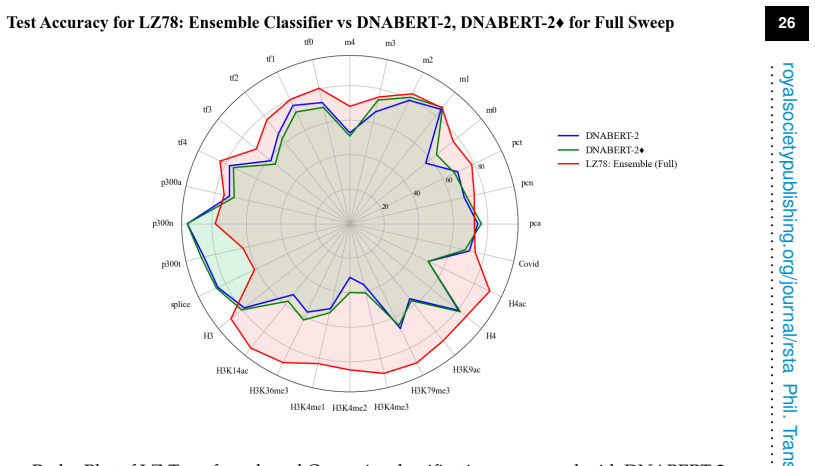
- The transform carries over to concrete tasks: classification by per-class log loss, universal discrete filtering with causal, delayed, and look-ahead estimators, and lightweight symbolic-music generation, with the empirical results reported in the paper.
Reading between the lines
- Inference: if the proof gap in Lemma 3.12 is repaired, the same wrapper argument may extend to base models that satisfy the zero-order condition only on a restricted source class, giving source-specific universality at even lower cost.
- Inference: the complexity bound $O(n/\log n)$ memory treats the tree as static; an online setting where new phrases keep being added would need to account for the memory of all node-local SPA copies, and quantifying that drift is a natural next step.
- Inference: the textual-denoising pipeline suggests a testable extension: measure the perception-distortion frontier of text-and-JPEG-conditioned generation against classical denoisers on the three noise models, using the trade-off cited in the paper rather than pixel error alone.
Editorial analysis
A structured set of objections, weighed in public.
Referee Report
Summary. The paper is a broad, three-part study of nonlinear transforms in compression and sequential modeling. Sections 1 and 2 present exploratory empirical work: a comparison of implicit neural representations (INRs) versus 2D Gaussian Splatting for image compression, and a textual transform for ultra-low-rate compression and text-guided denoising using off-the-shelf text-to-image models. Section 3 contains the paper's central theoretical contribution: the definition of an LZ78 transform T_LZ that maps any sequential probability assignment (SPA) satisfying a zero-order optimality condition into a universal SPA. Theorem 3.11 claims that if a base SPA asymptotically achieves zero-order empirical entropy on every sequence, then its LZ78 transform achieves the finite-state compressibility on every individual sequence. The paper also gives complexity bounds, connections to a known Dirichlet-mixture family, and applications to classification, universal filtering, and symbolic music generation (LZMidi).
Significance. If Theorem 3.11 is correct, it is a valuable and clean generalization of LZ78-based universal SPAs: it identifies a precise, parameter-free hypothesis on the base SPA, yields an explicit transform, and gives concrete O(n) time and O(n/log n) memory bounds for simple base models. The disclosure that the Dirichlet-mixture special case coincides with the SPA family of [48] is useful and appropriately credited. The complexity analysis and the breadth of applications (genomics classification, universal filtering, music generation) give the paper a wide potential audience. However, the proof of the flagship theorem has load-bearing gaps in Appendix A, and the proof of Theorem 4.5 in Appendix B contains an unsupported count. The empirical sections are largely descriptive and preliminary, so the main value of the paper rests on the theoretical Section 3.
major comments (3)
- [Appendix A, Lemma 3.12] The inequality direction in part A is reversed. The text reads 'for m_zt > M, xi(m_zt) > eps/3', but the definition of xi and the choice delta = eps/3 give xi(m) < eps/3 for all sufficiently large m. The subsequent bound on the T_A sum uses the wrong direction. In addition, part B defines m_z as 'the number of nodes in the sub-tree for which z is the root', which contradicts Definition 3.4 and the notation m_z = |Y{x^n,z}| used earlier in the same proof. These local errors prevent the eps/3 decomposition from being verified as printed, although the intended argument appears repairable.
- [Appendix A, Lemma 3.13] Equality (a) is not justified by Remark 3.8. The subsequence v^{m_ell}_ell consists of symbols whose LZ78 context has length ell, but when computing mu_ell(v), the length-ell contexts are the preceding ell symbols inside v, not the original LZ78 contexts of x^n. For example, for x^n=010100 the LZ78 phrases are 0,1,01,00; with ell=1 the left side of (a) equals 2*H(1/2)=2, while the right side is 0 because v=(1,0) has mu_1(v)=0 under the paper's convention that the first k symbols are free. The subsequent Jensen step therefore upper-bounds a quantity different from (*), and the claimed o(1) argument for the finite-state compressibility mu(x) does not follow from the text. Since this is the step connecting the LZ78 context-weighted zero-order term to mu(x), the proof of Theorem 3.11 is incomplete as printed.
- [Appendix B, Fact B.5] The claim that ell(z^m_t,m,t) = C_m(Y^{t-1}) + O(1) is not established and is in general false. Node z^m_t is visited only when Y^{t-1} occurs at a phrase boundary of the LZ78 parse, not at every occurrence of Y^{t-1} in the raw sequence; for i.i.d. sequences these counts can differ by a factor that grows with n. Consequently Fact B.5 and Corollary B.7, which support Theorem 4.5, need a different proof. The theorem may be true, but the argument as written does not prove it.
minor comments (6)
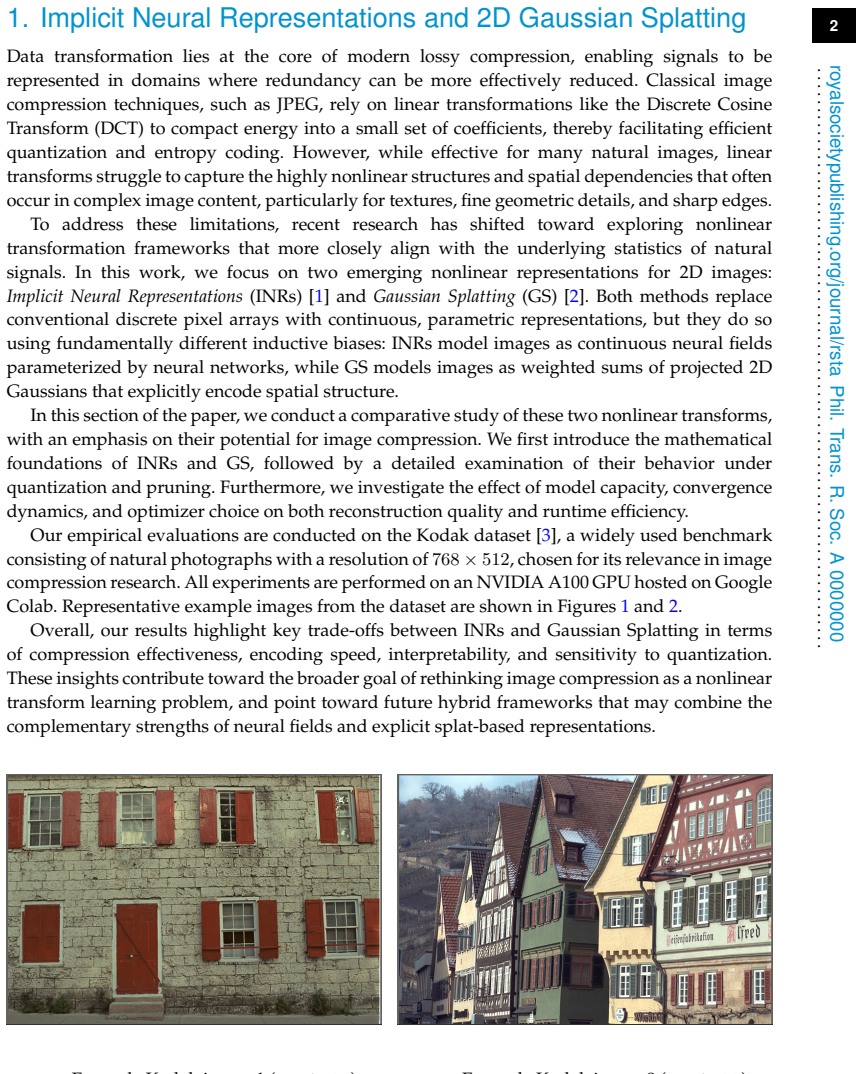
- [Section 2(c)(ii)] The word 'noie' should be 'noise' in the sentence describing the generated images.
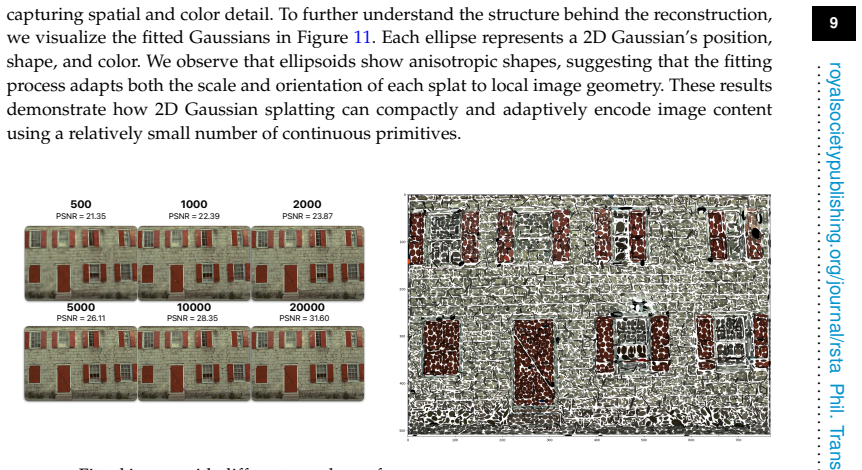
- [Section 1(b)(iv)] The caption 'Quantizing Guassian splat parameters' contains a typo: 'Guassian' should be 'Gaussian'.
- [Section 4(c)(ii)] Several typos appear in this subsection: 'micture' should be 'mixture', 'or training' should be 'For training', and 'the the precise theorem' should be 'the precise theorem'. Also, 'training time hers' should be 'training time here'.
- [Section 4(c)(ii)] In the discussion of Table 5, the baseline is called 'D3PM' in the text but 'ASD3PM' in the table and elsewhere; the notation should be made consistent.
- [References] References [57] and [73] are the same Ziv-Merhav paper and should be merged or cross-referenced; the duplicated entry should be removed.
- [Section 4(c)] The FLOP comparison mixes a measured profile of the diffusion baseline with an analytical worst-case bound for LZMidi; the text should state clearly that the two numbers are not obtained on the same basis.
Circularity Check
No significant circularity; the flagship theorem's zero-order hypothesis does not contain its finite-state universality conclusion, and the companion-work self-citations are background or example material, not load-bearing.
full rationale
The paper's central derivation is not circular. Theorem 3.11 assumes only that the base SPA asymptotically matches zero-order empirical entropy on every sequence; the conclusion is finite-state universality of the LZ78-transformed SPA, and no definition or equation identifies the two. Lemma 3.12 applies the assumption node-wise. Lemma 3.13 is meant to show the context-weighted zero-order entropy of the LZ78 parse is bounded by μ(x); this is the substantive LZ78-optimality step. The proof of Lemma 3.13 has a serious apparent gap — equality (a) would require the subsequence v^{m_ℓ}_ℓ to have the original LZ contexts as its own length-ℓ contexts, which is false in general — but a false or missing derivation is a correctness/verifiability problem, not a circular reduction. Citations to the authors' companion paper [48] for λ=μ equivalence, for Dirichlet-mixture SPAs satisfying the hypothesis, and for the LZ78-SPA family are self-citations, but they are background facts or examples, not assumptions of Theorem 3.11. The proof's remaining ingredients (C(x^n)=o(n), phrase counts) come from the external LZ78 paper [38]. The empirical sections report experiments from [51,52,53] rather than deriving their results from this paper's theorems. I therefore find no step in which a claimed prediction is equivalent by construction to its inputs; the score reflects only the minor, non-load-bearing presence of companion-work citations.
Assumptions & free parameters
free parameters (4)
- Dirichlet parameter gamma for the LZ78-SPA =
5e-5 (LZMidi); grid {0.1, 0.33, 0.5, 0.75, 1, 3, 5} (genomics)
- Sampling heuristics for LZMidi =
Temperature 0.8, top-K 8
- SIREN frequency scaling w0 =
30
- Denoising pipeline controls =
Prompt strength 8, canny control strength 0.5, JPEG quality 0-95
assumptions (6)
- standard math C(x^n)/n -> 0: the number of LZ78 phrases is sublinear in the sequence length, uniformly over individual sequences.
- standard math lambda(x) = mu(x): finite-state log loss equals the optimal Markov log loss for every individual sequence.
- domain assumption The base SPA q satisfies lim sup max_{x^n} (1/n log(1/q(x^n)) - mu_0(x^n)) <= 0.
- domain assumption Each LZ78 tree node's SPA converges to the source's conditional probabilities (Fact B.5, Corollary B.7).
- ad hoc to paper LLM captions identify noise, and text-to-image models regenerate the clean image from filtered text plus a JPEG-compressed conditioning image.
- domain assumption The observation channel is a discrete memoryless channel with invertible transition matrix Pi.
Cite this review
Pith. "Pith review of Information-computation trade-offs in non-linear transforms." pith.science (2026). https://pith.science/paper/CRFWW37E
@misc{pith2026250615948,
  author       = {Pith},
  title        = {Pith review of: Information-computation trade-offs in non-linear transforms},
  year         = {2026},
  howpublished = {\url{https://pith.science/paper/CRFWW37E}},
  note         = {Machine review of arXiv:2506.15948}
}
read the original abstract
In this work, we explore the interplay between information and computation in non-linear transform-based compression for broad classes of modern information-processing tasks. We first investigate two emerging nonlinear data transformation frameworks for image compression: Implicit Neural Representations (INRs) and 2D Gaussian Splatting (GS). We analyze their representational properties, behavior under lossy compression, and convergence dynamics. Our results highlight key trade-offs between INR's compact, resolution-flexible neural field representations and GS's highly parallelizable, spatially interpretable fitting, providing insights for future hybrid and compression-aware frameworks. Next, we introduce the textual transform that enables efficient compression at ultra-low bitrate regimes and simultaneously enhances human perceptual satisfaction. When combined with the concept of denoising via lossy compression, the textual transform becomes a powerful tool for denoising tasks. Finally, we present a Lempel-Ziv (LZ78) "transform", a universal method that, when applied to any member of a broad compressor family, produces new compressors that retain the asymptotic universality guarantees of the LZ78 algorithm. Collectively, these three transforms illuminate the fundamental trade-offs between coding efficiency and computational cost. We discuss how these insights extend beyond compression to tasks such as classification, denoising, and generative AI, suggesting new pathways for using non-linear transformations to balance resource constraints and performance.
Figures


Figures from the paper (17 more)






Reference graph
Works this paper leans on
-
[48]
2024 A Family of LZ78-based Universal Sequential Probability Assignments
Sagan N, Weissman T. 2024 A Family of LZ78-based Universal Sequential Probability Assignments
work page 2024
-
[1]
2020 Implicit Neural Representations with Periodic Activation Functions
Sitzmann V , Martel JNP , Bergman AW, Lindell DB, Wetzstein G. 2020 Implicit Neural Representations with Periodic Activation Functions
work page 2020
-
[2]
2024 GaussianImage: 1000 FPS Image Representation and Compression by 2D Gaussian Splatting
Zhang X, Ge X, Xu T, He D, Wang Y, Qin H, Lu G, Geng J, Zhang J. 2024 GaussianImage: 1000 FPS Image Representation and Compression by 2D Gaussian Splatting. InEuropean Conference on Computer Vision
work page 2024
-
[3]
1991 Kodak Dataset.http://r0k.us/graphics/kodak/
Kodak. 1991 Kodak Dataset.http://r0k.us/graphics/kodak/. Accessed: 2025-06-09
work page 1991
-
[4]
2021 COIN: COmpression with Implicit Neural representations
Dupont E, Goli ´ nski A, Alizadeh M, Teh YW, Doucet A. 2021 COIN: COmpression with Implicit Neural representations
work page 2021
-
[5]
2022 COIN++: Neural Compression Across Modalities
Dupont E, Loya H, Alizadeh M, Goli ´ nski A, Teh YW, Doucet A. 2022 COIN++: Neural Compression Across Modalities
work page 2022
-
[6]
2022 Implicit Neural Representations for Image Compression
Strümpler Y, Postels J, Yang R, van Gool L, Tombari F. 2022 Implicit Neural Representations for Image Compression
work page 2022
-
[7]
2023 COOL-CHIC: Coordinate-based Low Complexity Hierarchical Image Codec
Ladune T, Philippe P , Henry F, Clare G, Leguay T. 2023 COOL-CHIC: Coordinate-based Low Complexity Hierarchical Image Codec
work page 2023
Show all 75 references
-
[8]
2023 C3: High-performance and low- complexity neural compression from a single image or video
Kim H, Bauer M, Theis L, Schwarz JR, Dupont E. 2023 C3: High-performance and low- complexity neural compression from a single image or video
2023
-
[9]
2023 Compression with Bayesian Implicit Neural Representations
Guo Z, Flamich G, He J, Chen Z, Hernández-Lobato JM. 2023 Compression with Bayesian Implicit Neural Representations
2023
-
[10]
2024 RECOMBINER: Robust and Enhanced Compression with Bayesian Implicit Neural Representations
He J, Flamich G, Guo Z, Hernández-Lobato JM. 2024 RECOMBINER: Robust and Enhanced Compression with Bayesian Implicit Neural Representations. InThe Twelfth International Conference on Learning Representations
2024
-
[11]
2022 An Information-Theoretic Justification for Model Pruning
Isik B, Weissman T, No A. 2022 An Information-Theoretic Justification for Model Pruning
2022
-
[12]
2023 3D Gaussian Splatting for Real-Time Radiance Field Rendering
Kerbl B, Kopanas G, Leimkühler T, Drettakis G. 2023 3D Gaussian Splatting for Real-Time Radiance Field Rendering
2023
-
[13]
2025 A Survey on 3D Gaussian Splatting
Chen G, Wang W. 2025 A Survey on 3D Gaussian Splatting
2025
-
[14]
2025 3D Gaussian Splatting: Survey, Technologies, Challenges, and Opportunities.IEEE Transactions on Circuits and Systems for Video Technologypp
Bao Y, Ding T, Huo J, Liu Y, Li Y, Li W, Gao Y, Luo J. 2025 3D Gaussian Splatting: Survey, Technologies, Challenges, and Opportunities.IEEE Transactions on Circuits and Systems for Video Technologypp. 1–1. (10.1109/TCSVT.2025.3538684)
2025
-
[15]
2025 Large Images are Gaussians: High- Quality Large Image Representation with Levels of 2D Gaussian Splatting.arXiv preprint arXiv:2502.09039
Zhu L, Lin G, Chen J, Zhang X, Jin Z, Wang Z, Yu L. 2025 Large Images are Gaussians: High- Quality Large Image Representation with Levels of 2D Gaussian Splatting.arXiv preprint arXiv:2502.09039
2025 arXiv
-
[16]
2025 EigenGS Representation: From Eigenspace to Gaussian Image Space
Tai LW, Li CE, Chen CL, Tsai CJ, Chen HT, Liu TL. 2025 EigenGS Representation: From Eigenspace to Gaussian Image Space
2025
-
[17]
2025 Neural Video Compression using 2D Gaussian Splatting
Gupta L, Junejo IN. 2025 Neural Video Compression using 2D Gaussian Splatting
2025
-
[18]
2025 GSVC: Efficient Video Representation and Compression Through 2D Gaussian Splatting
Wang L, Shi Y, Ooi WT. 2025 GSVC: Efficient Video Representation and Compression Through 2D Gaussian Splatting
2025
-
[19]
2023 Toward textual transform coding.IEEE BITS the Information Theory Magazine 3, 32–40
Weissman T. 2023 Toward textual transform coding.IEEE BITS the Information Theory Magazine 3, 32–40
2023
-
[20]
2023 Text+ Sketch: Image Compression at Ultra Low Rates
Lei E, Uslu YB, Hassani H, Saeedi Bidokhti S. 2023 Text+ Sketch: Image Compression at Ultra Low Rates. InICML Workshop on Neural Compression. ICML
2023
-
[21]
InThe Twelfth International Conference on Learning Representations
Careil M, Muckley MJ, Verbeek J, Lathuilière S Towards image compression with perfect realism at ultra-low bitrates. InThe Twelfth International Conference on Learning Representations
-
[22]
2024 Semantic Image Compression Using Textual Transforms
Arikan L, Weissman T. 2024 Semantic Image Compression Using Textual Transforms. In2024 IEEE International Symposium on Information Theory Workshops (ISIT-W)pp. 1–6. (10.1109/ISIT- W61686.2024.10591763)
2024
-
[23]
2022 Txt2vid: Ultra-low bitrate compression of talking-head videos via text.IEEE Journal on Selected Areas in Communications41, 107–118
Tandon P , Chandak S, Pataranutaporn P , Liu Y, Mapuranga AM, Maes P , Weissman T, Sra M. 2022 Txt2vid: Ultra-low bitrate compression of talking-head videos via text.IEEE Journal on Selected Areas in Communications41, 107–118
2022
-
[24]
1995 Filtering random noise from deterministic signals via data compression
Natarajan B. 1995 Filtering random noise from deterministic signals via data compression. IEEE Transactions on Signal Processing43, 2595–2605. (10.1109/78.482110)
1995 doi
-
[25]
2005 The empirical distribution of rate-constrained source codes
Weissman T, Ordentlich E. 2005 The empirical distribution of rate-constrained source codes. IEEE transactions on information theory51, 3718–3733
2005
-
[26]
2002 The Kolmogorov Sampler
Donoho DL. 2002 The Kolmogorov Sampler
2002
-
[27]
2012 Denoising via MCMC-Based Lossy Compression.IEEE Transactions on Signal Processing60, 3092–3100
Jalali S, Weissman T. 2012 Denoising via MCMC-Based Lossy Compression.IEEE Transactions on Signal Processing60, 3092–3100. (10.1109/TSP .2012.2190597)
2012
-
[28]
2016 Effect of lossy compression of quality scores on variant calling.Briefings in Bioinformatics18, 183–194
Ochoa I, Hernaez M, Goldfeder R, Weissman T, Ashley E. 2016 Effect of lossy compression of quality scores on variant calling.Briefings in Bioinformatics18, 183–194. (10.1093/bib/bbw011) 39royalsocietypublishing.org/journal/rsta Phil. Trans. R. Soc. A 0000000
2016 doi
-
[29]
1992 The JPEG still picture compression standard.IEEE Transactions on Consumer Electronics38, xviii–xxxiv
Wallace G. 1992 The JPEG still picture compression standard.IEEE Transactions on Consumer Electronics38, xviii–xxxiv. (10.1109/30.125072)
1992 doi
-
[30]
1994 Ideal spatial adaptation by wavelet shrinkage.Biometrika81, 425–455
Donoho DL, Johnstone IM. 1994 Ideal spatial adaptation by wavelet shrinkage.Biometrika81, 425–455. (10.1093/biomet/81.3.425)
1994 doi
-
[31]
1995 Adapting to Unknown Smoothness via Wavelet Shrinkage
Donoho DL, Johnstone IM. 1995 Adapting to Unknown Smoothness via Wavelet Shrinkage. Journal of the American Statistical Association90, 1200–1224. (10.1080/01621459.1995.10476626)
1995
-
[32]
1995 De-noising by soft-thresholding.IEEE Transactions on Information Theory41, 613–627
Donoho DL. 1995 De-noising by soft-thresholding.IEEE Transactions on Information Theory41, 613–627. (10.1109/18.382009)
1995 doi
-
[33]
2002 JPEG2000: standard for interactive imaging.Proceedings of the IEEE90, 1336–1357
Taubman D, Marcellin M. 2002 JPEG2000: standard for interactive imaging.Proceedings of the IEEE90, 1336–1357. (10.1109/JPROC.2002.800725)
2002
-
[34]
2023 Image Denoising: The Deep Learning Revolution and Beyond—A Survey Paper.SIAM Journal on Imaging Sciences16, 1594–1654
Elad M, Kawar B, Vaksman G. 2023 Image Denoising: The Deep Learning Revolution and Beyond—A Survey Paper.SIAM Journal on Imaging Sciences16, 1594–1654. (10.1137/23M1545859)
2023 doi
-
[35]
2018 The perception-distortion tradeoff
Blau Y, Michaeli T. 2018 The perception-distortion tradeoff. InProceedings of the IEEE conference on computer vision and pattern recognitionpp. 6228–6237
2018
-
[36]
Completely Blind
Mittal A, Soundararajan R, Bovik AC. 2013 Making a “Completely Blind” Image Quality Analyzer.IEEE Signal Processing Letters20, 209–212. (10.1109/LSP .2012.2227726)
2013
-
[37]
1977 A universal algorithm for sequential data compression.IEEE Transactions on Information Theory23, 337–343
Ziv J, Lempel A. 1977 A universal algorithm for sequential data compression.IEEE Transactions on Information Theory23, 337–343. (10.1109/TIT.1977.1055714)
1977
-
[38]
1978 Compression of individual sequences via variable-rate coding.IEEE Transactions on Information Theory24, 530–536
Ziv J, Lempel A. 1978 Compression of individual sequences via variable-rate coding.IEEE Transactions on Information Theory24, 530–536. (10.1109/TIT.1978.1055934)
1978
-
[39]
2006Elements of Information Theory (Wiley Series in Telecommunications and Signal Processing)
Cover TM, Thomas JA. 2006Elements of Information Theory (Wiley Series in Telecommunications and Signal Processing). USA: Wiley-Interscience
-
[40]
1979 Arithmetic Coding.IBM Journal of Research and Development23, 149–162
Rissanen J, Langdon GG. 1979 Arithmetic Coding.IBM Journal of Research and Development23, 149–162. (10.1147/rd.232.0149)
1979 doi
-
[41]
2000 Text categorization using compression models
Frank E, Chui C, Witten I. 2000 Text categorization using compression models. InProceedings DCC 2000. Data Compression Conferencepp. 555–. (10.1109/DCC.2000.838202)
2000
-
[42]
2004 Clustering by compression
Cilibrasi R, Vitanyi P . 2004 Clustering by compression
2004
-
[43]
2024 Language Modeling Is Compression
Delétang G, Others. 2024 Language Modeling Is Compression. InProceedings of ICLR 2024
2024
-
[44]
1983 A note on the Ziv - Lempel model for compressing individual sequences (Corresp.).IEEE Transactions on Information Theory29, 284–287
Langdon G. 1983 A note on the Ziv - Lempel model for compressing individual sequences (Corresp.).IEEE Transactions on Information Theory29, 284–287. (10.1109/TIT.1983.1056645)
1983
-
[45]
1991 Gambling using a finite state machine.IEEE Transactions on Information Theory 37, 1459–1465
Feder M. 1991 Gambling using a finite state machine.IEEE Transactions on Information Theory 37, 1459–1465. (10.1109/18.133269)
1991 doi
-
[46]
1992 Universal prediction of individual sequences.IEEE Transactions on Information Theory38, 1258–1270
Feder M, Merhav N, Gutman M. 1992 Universal prediction of individual sequences.IEEE Transactions on Information Theory38, 1258–1270. (10.1109/18.144706)
1992 doi
-
[47]
2007 Universal Filtering Via Prediction.IEEE Transactions on Information Theory53, 1253–1264
Weissman T, Ordentlich E, Weinberger MJ, Somekh-Baruch A, Merhav N. 2007 Universal Filtering Via Prediction.IEEE Transactions on Information Theory53, 1253–1264. (10.1109/TIT.2007.892782)
2007
-
[49]
1972 Admissibility properties or Gilbert’s encoding for unknown source probabilities (Corresp.).IEEE Transactions on Information Theory18, 216–217
Cover T. 1972 Admissibility properties or Gilbert’s encoding for unknown source probabilities (Corresp.).IEEE Transactions on Information Theory18, 216–217. (10.1109/TIT.1972.1054738)
1972
-
[50]
1995 The context-tree weighting method: basic properties
Willems F, Shtarkov Y, Tjalkens T. 1995 The context-tree weighting method: basic properties. IEEE Transactions on Information Theory41, 653–664. (10.1109/18.382012)
1995 doi
-
[51]
2025 Genomic Data Classification via Universal Compression
Omri Y, Sagan N, Min E et al.. 2025 Genomic Data Classification via Universal Compression. https://doi.org/10.21203/rs.3.rs-6363017/v1. Preprint (Version 1) available at Research Square (10.21203/rs.3.rs-6363017/v1)
2025 doi
-
[52]
2025 Universal Discrete Filtering with Lookahead or Delay
Yan P , Jeong J, Sagan N, Weissman T. 2025 Universal Discrete Filtering with Lookahead or Delay
2025
-
[53]
2025 LZMidi: Compression-Based Symbolic Music Generation
Ding C, Gorle A, Bhattacharya S, Hasteer D, Sagan N, Weissman T. 2025 LZMidi: Compression-Based Symbolic Music Generation
2025
-
[54]
2024 Deep learning approaches in genomic analysis: A review of DNA sequence classification techniques.International Journal of Scientific Research and Engineering Trends
Kimbahune DV , Nerkar V . 2024 Deep learning approaches in genomic analysis: A review of DNA sequence classification techniques.International Journal of Scientific Research and Engineering Trends
2024
-
[55]
2019 Pharmacogenomics.Lancet394, 521–532
Roden DM, McLeod HL, Relling MV , Williams MS, Mensah GA, Peterson JF, Driest SLV . 2019 Pharmacogenomics.Lancet394, 521–532
2019
-
[56]
2024 Genomic language models: Opportunities and challenges
Benegas G, Ye C, Albors C, Li JC, Song YS. 2024 Genomic language models: Opportunities and challenges. Preprint. 40royalsocietypublishing.org/journal/rsta Phil. Trans. R. Soc. A 0000000
2024
-
[57]
1993 A measure of relative entropy between individual sequences with application to universal classification.IEEE Transactions on Information Theory39, 1270–1279
Ziv J, Merhav N. 1993 A measure of relative entropy between individual sequences with application to universal classification.IEEE Transactions on Information Theory39, 1270–1279
1993
-
[58]
2022 Genezip.https://github.com/SharonLab/GeneZip
Itai Sharon Group. 2022 Genezip.https://github.com/SharonLab/GeneZip. ISBRA 2022
2022
-
[59]
2025 Using lossless compression algorithms to improve metagenomics binning and accelerate genome taxonomic classification
Leibovich O, Meir Y, Sharon I. 2025 Using lossless compression algorithms to improve metagenomics binning and accelerate genome taxonomic classification. To appear at RECOMB 2025
2025
-
[60]
2004 On prediction using variable order Markov models
Begleiter R, El-Yaniv R, Yona G. 2004 On prediction using variable order Markov models. Journal of Artificial Intelligence Research22, 385–421
2004
-
[61]
2024 DNABERT-2: Efficient Foundation Model and Benchmark For Multi-Species Genome
Zhou Z, Ji Y, Li W, Dutta P , Davuluri R, Liu H. 2024 DNABERT-2: Efficient Foundation Model and Benchmark For Multi-Species Genome
2024
-
[62]
2015 char-RNN.https://github.com/karpathy/char-rnn
Karpathy A. 2015 char-RNN.https://github.com/karpathy/char-rnn. Accessed: 2025-06-14
2015
-
[63]
2021 Documenting large webtext corpora: A case study on the colossal clean crawled corpus
Dodge J, Sap M, Marasovi´ c A, Agnew W, Ilharco G, Groeneveld D, Mitchell M, Gardner M. 2021 Documenting large webtext corpora: A case study on the colossal clean crawled corpus. arXiv preprint arXiv:2104.08758
2021 arXiv
-
[64]
2023 TinyStories: How small can language models be and still speak coherent English?.arXiv preprint arXiv:2305.07759
Eldan R, Li Y. 2023 TinyStories: How small can language models be and still speak coherent English?.arXiv preprint arXiv:2305.07759
2023 arXiv
-
[65]
2023 Discrete Diffusion Probabilistic Models for Symbolic Music Generation
Plasser M, Peter S, Widmer G. 2023 Discrete Diffusion Probabilistic Models for Symbolic Music Generation
2023
-
[66]
2020 Encoding Musical Style with Transformer Autoencoders
Choi K, Hawthorne C, Simon I, Dinculescu M, Engel J. 2020 Encoding Musical Style with Transformer Autoencoders
2020
-
[67]
2021 Symbolic Music Generation with Diffusion Models
Mittal G, Engel J, Hawthorne C, Simon I. 2021 Symbolic Music Generation with Diffusion Models
2021
-
[68]
2018 GANs Trained by a Two Time-Scale Update Rule Converge to a Local Nash Equilibrium
Heusel M, Ramsauer H, Unterthiner T, Nessler B, Hochreiter S. 2018 GANs Trained by a Two Time-Scale Update Rule Converge to a Local Nash Equilibrium
2018
-
[69]
2017 Audio Set: An ontology and human-labeled dataset for audio events
Gemmeke JF, Ellis DPW, Freedman D, Jansen A, Lawrence W, Moore RC, Plakal M, Ritter M. 2017 Audio Set: An ontology and human-labeled dataset for audio events. In2017 IEEE International Conference on Acoustics, Speech and Signal Processing (ICASSP)pp. 776–780. (10.1109/ICASSP ....
2017
-
[70]
2017 Wasserstein GAN
Arjovsky M, Chintala S, Bottou L. 2017 Wasserstein GAN. InProceedings of the 34th International Conference on Machine Learning. PMLR
2017
-
[71]
2017 Improved Training of Wasserstein GANs
Gulrajani I, Ahmed F, Arjovsky M, Dumoulin V , Courville AC. 2017 Improved Training of Wasserstein GANs. InAdvances in Neural Information Processing Systems
2017
-
[72]
2019 Optuna: A Next-generation Hyperparameter Optimization Framework
Akiba T, Sano S, Yanase T, Ohta T, Koyama M. 2019 Optuna: A Next-generation Hyperparameter Optimization Framework
2019
-
[73]
1993 A measure of relative entropy between individual sequences with application to universal classification.IEEE Transactions on Information Theory39, 1270–1279
Ziv J, Merhav N. 1993 A measure of relative entropy between individual sequences with application to universal classification.IEEE Transactions on Information Theory39, 1270–1279. (10.1109/18.243444)
1993 doi
-
[74]
long enough
Seroussi G. 2004 Universal Types and Simulation of Individual Sequences. In Farach-Colton M, editor,LATIN 2004: Theoretical Informaticsvol. 2976Lecture Notes in Computer Sciencepp. 312–321. Springer, Berlin, Heidelberg. (10.1007/978-3-540-24698-5_35) 41royalsocietypublishing.o...
2004 doi
-
[75]
states that, for any individual sequence, C(x n) n =o(1), so (∗)≤ nX ℓ=k+1 mℓ n µk(vmℓ ℓ ) +o(1). As pointwise minimization is concave, Jensen’s inequality provides µk(xn) = min q∈Mk 1 n nX t=k+1 log 1 q(xt|xt−1) ≥min q∈Mk 1 n nX ℓ=k+1 mℓ n 1 mℓ log 1 q(vmℓ ℓ ) ! ≥ nX ℓ=k+1 mℓ...
Reviewed August 6, 2026 · model on record in the stance chip above.
Discussion (0). Sign in to comment.