REVIEW 3 major objections 5 minor 9 references
$La_3Pd_2NaO_9$: A High-Valent Insulating Palladate
T0 review · 3 major / 5 minor · reviewed 2026-08-15 · deepseek-v4-flash
Pith's one-line read The paper reports the first synthesis of the high-valent palladate La3Pd2NaO9, whose ordered Na/Pd charge pattern makes it an insulator.
desk verdict Real new phase and solid structure work; the insulating claim rests on pellet transport and is the weakest link. read the letter →
The pith
A machine-rendered reading of the paper's core claim, the machinery that carries it, and where it could break.
The reading
What carries the argument
The mechanism carrying the argument is charge ordering on the B site of a distorted perovskite: instead of a random Na/Pd mixture, Na+ and Pd4+ occupy distinct octahedral sites in a repeating two-Pd, one-Na superlattice, and the resulting periodic Coulomb potential pins carriers and opens a transport gap. The ordered model was solved by synchrotron single-crystal diffraction, fits the powder diffraction pattern, and is directly visible in atomic-resolution STEM images, so the ordering is the structural fact that explains the insulating state and the failure of topotactic reduction.
What would settle it
Contact a single crystal or a nearly fully dense sintered bar for four-probe resistivity: if the resistance drops by orders of magnitude or develops metallic temperature dependence, the intrinsic-insulator interpretation, and with it the charge-ordering-gap explanation, is falsified. An optical-conductivity measurement showing no clear gap on a single crystal would corroborate that failure.
Extended reading notes
Core claim
The core claim is that La3Pd2NaO9 is a new, homogeneous, line-compound palladate whose B-site cations are charge-ordered: palladium occupies the Pd1 and Pd2 octahedral sites, sodium preferentially occupies the Pd3 and Pd4 sites, and the sequence along the a-axis is two Pd-rich layers followed by one Na-rich layer in a monoclinic P21/c cell nine times the volume of the simple perovskite cell. Powder refinements of crystals grown under different conditions give nearly identical lattice parameters, indicating a fixed composition. XPS puts about 77% of the palladium in the +4 oxidation state, with the remainder assigned to Pd2+ and an oxygen content estimated at O8.55. The insulating transport is attributed to the ordered Na/Pd arrangement, which creates a periodic potential that localizes charge carriers; the small Curie-Weiss paramagnetism is attributed to a minor fraction of high-spin Pd2+, not to the low-spin t2g6 Pd4+ majority.
Load-bearing premise
The insulating claim rests on resistivity measured on pressed powder pellets that are only 65-73% as dense as the single crystal, so grain boundaries and porosity, rather than the intrinsic electronic structure, could account for the large resistance.
Editorial extensions
If this is right
- The high-oxygen-pressure hydroxide flux route that produced La3Pd2NaO9 should be applicable to other layered Ruddlesden-Popper palladates, including bilayer phases analogous to the high-temperature superconductor La3Ni2O7.
- The insulating state is consistent with the Na/Pd charge-ordered superstructure, so any search for metallicity or superconductivity in this family needs to start from, or deliberately alter, that ordered pattern.
- The minority high-spin Pd2+ species provides a measurable paramagnetic contribution that can be tracked as oxygen stoichiometry changes.
- Because topotactic reduction of La3Pd2NaO9 fails, the Na-containing phase is not itself a precursor to monovalent square-planar palladates; the value of the synthesis is the demonstration that high-valent Pd4+ can be stabilized in a perovskite at moderate temperature and oxygen pressure.
Reading between the lines
- If the insulating gap is intrinsic, chemical doping or pressure on La3Pd2NaO9 could test whether the charge-ordered state can be destabilized into a metal; the paper neither predicts nor attempts this, but the structural data make the test straightforward.
- The XPS-derived roughly 23% Pd2+ fraction and the measured effective moment of 0.53 μB per Pd can be checked against each other: if only the high-spin S = 1 Pd2+ subset carries the moment, the inferred moment per Pd2+ site is near the expected 2.83 μB, a consistency test the paper leaves implicit.
- Na incorporation may be a general stabilization trick: trying other lanthanides or different Na:Pd ratios under the same high-oxygen-pressure flux could produce a family of charge-ordered high-valent palladates.
- A near-full-density pellet or a single crystal contacted with focused-ion-beam-deposited leads would separate intrinsic transport from grain-boundary resistance; that experiment is the fastest way to check the insulating assignment.
Signed reviews
Editorial analysis
A structured set of objections, weighed in public.
Referee Report
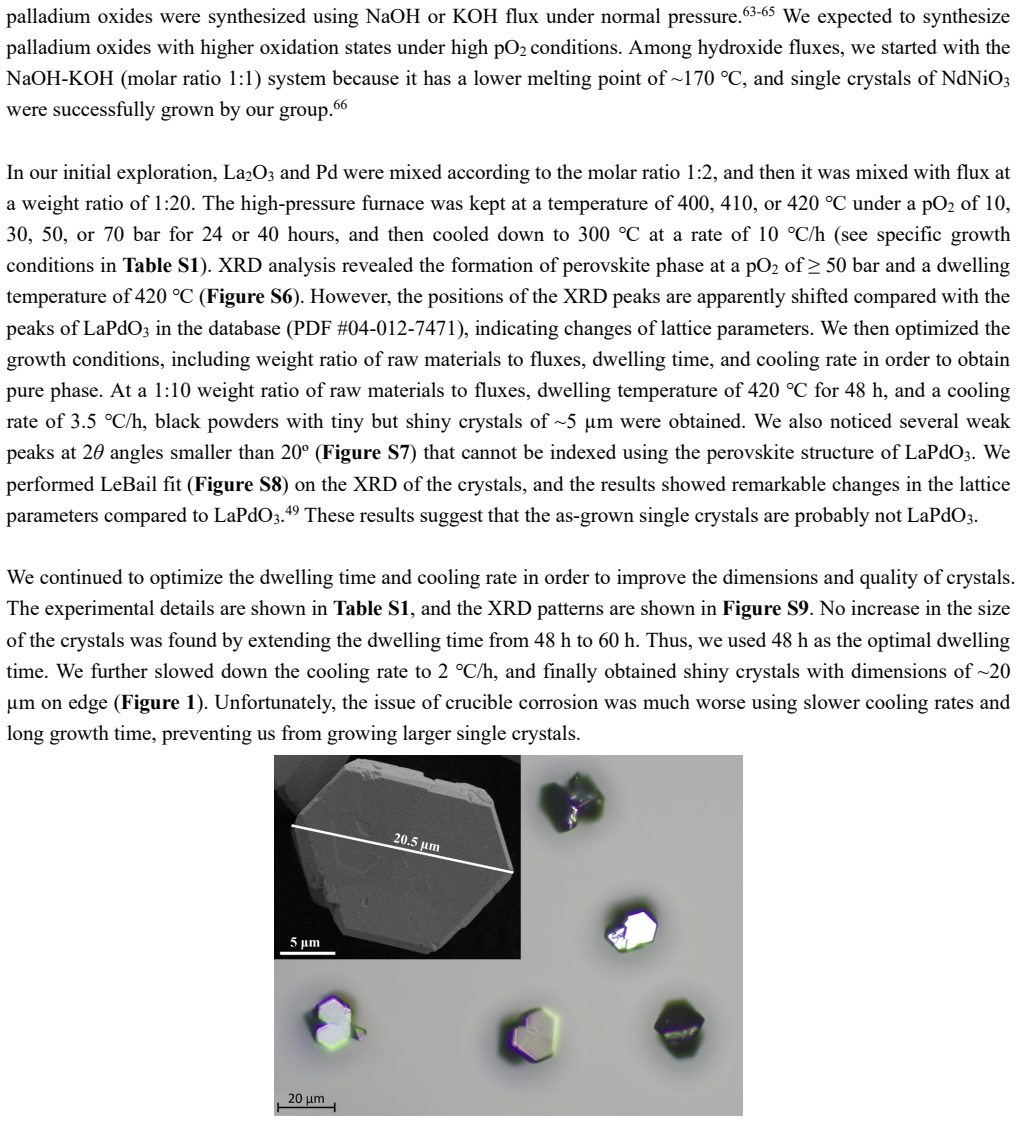
Summary. The manuscript reports the synthesis and characterization of a new palladate, La3Pd2NaO9, obtained as single crystals up to ~20 µm on edge via high-oxygen-pressure flux growth at 420 °C and 70 bar O2. The composition is determined by EDS and ICP, the Pd oxidation state is probed by XPS (dominated by Pd4+ with about 23% Pd2+), and the crystal structure is solved by synchrotron single-crystal X-ray diffraction in the monoclinic space group P21/c with an ordered arrangement of Na and Pd. STEM imaging is used to confirm the structural model and sample homogeneity. Electrical resistivity, measured on pressed powder pellets, is reported to show semiconducting/insulating behavior, and magnetic susceptibility shows a paramagnetic response attributed to a small fraction of high-spin Pd2+. The central claims are that La3Pd2NaO9 is a new high-valent palladate, that Na/Pd charge ordering is present, and that the material is an insulator.
Significance. The paper makes a solid experimental contribution in the synthesis and structural characterization of a previously unknown high-valent palladate. The crystallographic work is strong: synchrotron single-crystal data give R1 = 0.0575, the structure model is corroborated by Rietveld refinement of powder data and by HAADF-STEM, and the composition is supported by independent EDS and ICP measurements. The synthesis route at moderate temperature and oxygen pressure may be useful for exploring other palladates. The main weakness is that the central 'insulating' claim rests on transport measurements of porous powder pellets, which are not conclusive for the intrinsic electronic properties. If the insulating behavior is confirmed by additional evidence, the paper would be a meaningful contribution to the chemistry of high-valent 4d oxides; as it stands, the transport claim needs further support or more careful wording.
major comments (3)
- [3.6] The insulating character is a load-bearing claim, but the only direct transport evidence comes from four-probe and two-probe measurements on pellets pressed to only 65% and 73% relative density. In such porous polycrystalline samples, the measured resistance can be dominated by intergrain contacts, porosity, and surface barriers rather than by the intrinsic electronic structure. The observed variable-range-hopping behavior and the decrease of resistivity after annealing at 420 °C and 70 bar O2 are both consistent with improved intergrain connectivity. To firmly establish that La3Pd2NaO9 is an intrinsic insulator, the authors should provide complementary evidence, such as an optical gap (diffuse reflectance or ellipsometry), a measurement on a single crystal (even two-probe), or a comparison of resistivity for pellets of different densities. Alternatively, the conclusions should be rephrased to state that the pressed-pellet measurements suggest insulating behavior without claiming it definitively.
- [4] The statement that the insulating behavior 'can be attributed to charge ordering induced by the ordered Na and Pd' is not substantiated by any calculation or control experiment. Since Pd4+ in an octahedral field is low-spin d6 with a filled t2g manifold, a charge-transfer or ligand-to-metal gap is expected even in the absence of Na/Pd ordering. The authors should either present a quantitative electronic-structure argument (e.g., DFT band structure) or soften the attribution to one possible explanation.
- [3.3] The XPS analysis reports a Pd4+ fraction of 77% and a Pd2+ fraction of 23%, and these numbers are used to deduce an oxygen vacancy concentration (La3Pd2NaO8.55) and to rationalize the magnetic behavior. No uncertainties are given for the peak-area ratios or for the curve-fitting procedure. In addition, the structure refinement assumes full oxygen occupancy; the authors should discuss whether the derived 5% oxygen deficiency is compatible with the refined structure and with the reasonable thermal parameters of the oxygen atoms.
minor comments (5)
- [3.4 / Table 2] The occupancies for Pd3/Pd4 and Na3/Na4 are on special positions of multiplicity 2, but the table does not state the site multiplicities. Adding this information would help readers verify that the refined occupancies correspond to the nominal La3Pd2NaO9 composition.
- [3.6] The geometry of the transport measurement is not described: the dimensions of the cut bars and the contact spacing for the four-probe measurement are omitted. These details are needed to convert measured resistance to resistivity and to assess the reliability of the reported values.
- [3.7] The Curie-Weiss fit yields a Weiss temperature of -269 K, which is unusually large in magnitude for a paramagnetic contribution assigned to a small fraction (about 23%) of Pd2+ impurities. The authors should discuss whether this strong antiferromagnetic interaction is plausible for dilute moments or whether the fit is affected by the limited temperature range.
- [3.7 / Figure 8] The captions of Figure 8 do not identify which curve corresponds to ZFC-W, FC-C, or FC-W. Please add explicit labels or a legend.
- [1] In the introduction and conclusion, the connection to bilayer Ruddlesden-Popper palladates is speculative because La3Pd2NaO9 itself is a distorted perovskite, not an R-P phase. Please clarify the intended analogy.
Circularity Check
No significant circularity: the paper reports synthesis, composition, structure, and transport/magnetic characterization with no prediction that reduces to a fitted input or self-citation chain.
full rationale
This is an experimental synthesis-and-characterization paper. The central claims are the first synthesis of La3Pd2NaO9, its crystal structure, Pd valence, and insulating transport behavior. Each claim rests on independent measurements: EDS/ICP for composition, XPS for Pd oxidation state, synchrotron single-crystal diffraction and STEM for structure, and four-probe/two-probe resistivity of pressed pellets for transport. The Curie-Weiss fit and the VRH fit are data analyses used to interpret measurements, not parameters that are then renamed as predictions. The charge-ordering explanation for insulating behavior is a post hoc interpretation, not a derivation forced by an input. The only relevant self-citation (Ref. 12, La4Ni3O8, by the same corresponding author) is used as an analogy for charge-ordering-driven insulating behavior; it is not load-bearing for the structural or compositional claims. The pellet density limitation (65-73% of single-crystal density) is a genuine robustness concern about whether grain-boundary resistance dominates the measured resistivity, but it is a validity/correctness issue, not circularity: the resistivity is measured, not inferred from the model used to explain it. No fitted parameter is called a prediction, no uniqueness theorem is imported from the authors' prior work, and no ansatz is smuggled in via citation. The paper is self-contained against external benchmarks, so the circularity score is 0.
Assumptions & free parameters
free parameters (4)
- Curie-Weiss chi0 =
1.74e-5 emu mol^-1 Oe^-1
- Curie constant C =
0.035 emu K mol^-1 Oe^-1
- Weiss temperature theta =
-269 K
- XPS Pd4+ area fraction =
0.77 (Pd2+ 0.23)
assumptions (3)
- domain assumption The electrical resistivity of a pressed powder pellet at 65-73% density represents the intrinsic conductivity of the material.
- domain assumption Literature XPS binding-energy ranges for Pd2+ and Pd4+ are valid for assigning the observed Pd 3d5/2 peaks.
- domain assumption The observed paramagnetism originates from a fraction of high-spin (S=1) Pd2+ rather than from impurities or surface effects.
Cite this review
Pith. "Pith review of $La_3Pd_2NaO_9$: A High-Valent Insulating Palladate." pith.science (2026). https://pith.science/paper/F7DWPNU7
@misc{pith2026250615966,
  author       = {Pith},
  title        = {Pith review of: $La_3Pd_2NaO_9$: A High-Valent Insulating Palladate},
  year         = {2026},
  howpublished = {\url{https://pith.science/paper/F7DWPNU7}},
  note         = {Machine review of arXiv:2506.15966}
}
abstract
A high-valent palladate, $La_3Pd_2NaO_9$, has been synthesized for the first time. Single crystals with dimensions of 20 ${\mu}$m on edge were successfully grown using the flux method at 420 $^o$C and 70 bar oxygen pressure. Energy dispersive spectroscopy (EDS) and inductively coupled plasma mass spectroscopy (ICP) measurements show that the atomic ratio of La: (Pd+Na) is 3: 3 and Pd: Na is 2: 1. X-ray photoelectron spectroscopy (XPS) measurements show that the oxidation state of Pd is dominated by +4. Synchrotron X-ray single-crystal diffraction measurements revealed that this material crystallizes in the monoclinic $P2_1/c$ space group with charge ordering of Na and Pd. Real-space imaging via scanning transmission electron microscopy (STEM) confirmed the crystal structure and revealed excellent sample homogeneity. Electrical resistivity measurements show an insulating behavior. Magnetic measurements show an unexpected paramagnetic behavior, which probably originate from a small fraction of high-spin Pd$^{2+}$ evidenced by XPS. The successful growth of $La_3Pd_2NaO_9$ single crystals with a high-valent oxidation state of Pd offers an approach for exploring interesting palladates, including potential bilayer Ruddlesden-Popper palladates analogous to the high temperature superconducting $La_3Ni_2O_7$.
Figures
Reference graph
Works this paper leans on
-
[1]
(1) Bednorz, J. G.; Müller, K. A. Possible high T c superconductivity in the Ba-La-Cu-O system. Z. Phys. B: Condens. Matter 1986, 64 (2), 189-193. (2) Keimer, B.; Kivelson, S. A.; Norman, M. R.; Uchida, S.; Zaanen, J. From quantum matter to high-temperature superconductivity in copper oxides. Nature 2015, 518 (7538), 179-186. (3) Sanders, S. 125 questions...
work page 1986
-
[3]
J. Solid State Chem. 1994, 110 (1), 28-31. (57) Shivakumara, C.; Hegde, M. S.; Prakash, A. S.; Khadar, A. M. A.; Subbanna, G. N.; Lalla, N. P. Low temperature synthesis, structure and properties of alkali-doped La2NiO4, LaNiO3 and LaNi0.85Cu0.15O3 from alkali hydroxide fluxes. Solid State Sci. 2003, 5 (2), 351-357. (58) Azuma, M.; Saito, T.; Ishiwata, S.;...
work page 1994
-
[23]
(4) Gui, X.; Lv, B.; Xie, W. Chemistry in Superconductors. Chem. Rev. 2021, 121 (5), 2966-2991. (5) Nomura, Y .; Arita, R. Superconductivity in infinite-layer nickelates. Rep. Prog. Phys. 2022, 85 (5), 052501. (6) Norman, M. R. Materials design for new superconductors. Rep. Prog. Phys. 2016, 79 (7), 074502. (7) Tranquada, J. M.; Buttrey, D. J.; Sachan, V ...
work page 2021
-
[59]
(39) Held, K.; Si, L.; Worm, P.; Janson, O.; Arita, R.; Zhong, Z.; Tomczak, J. M.; Kitatani, M. Phase Diagram of Nickelate Superconductors Calculated by Dynamical Vertex Approximation. Front. Phys. 2022, 9, 810394. (40) Kitatani, M.; Si, L.; Worm, P.; Tomczak, J. M.; Arita, R.; Held, K. Optimizing Superconductivity: From Cuprates via Nickelates to Pallada...
arXiv 2022
-
[95]
Zur Kenntnis der Oxopalladate der Alkalimetalle [1]
(75) Wilhelm, M.; Hoppe, R. Zur Kenntnis der Oxopalladate der Alkalimetalle [1]. Z. Anorg. Allg. Chem. 1976, 424 (1), 5-12. (76) Demazeau, G.; Omeran, I.; Pouchard, M.; Hagenmuller, P. Sur une nouvelle phase oxygenee du palladium +IV: Zn2PdO4. Mater. Res. Bull. 1976, 11 (11), 1449-1452. (77) Panin, R. V .; Khasanova, N. R.; Bougerol, C.; Schnelle, W.; Van...
work page 1976
-
[180]
PdO/PdO2 functionalized ZnO: Pd films for lower operating temperature H2 gas sensing
(67) Lupan, O.; Postica, V .; Hoppe, M.; Wolff, N.; Polonskyi, O.; Pauporté, T.; Viana, B.; Majérus, O.; Kienle, L.; Faupel, F.; Adelung, R. PdO/PdO2 functionalized ZnO: Pd films for lower operating temperature H2 gas sensing. Nanoscale 2018, 10 (29), 14107-14127. (68) Mucalo, M.; Bullen, C. Electric arc generated (Bredig) palladium nanoparticles: Surface...
work page 2018
-
[1979]
(72) Taniguchi, S.; Nishikawa, T.; Yasui, Y .; Kobayashi, Y .; Takeda, J.; Shamoto, S. i.; Sato, M. Transport, Magnetic and Thermal Properties of La3Ni2O7−σ. J. Phys. Soc. Jpn. 1995, 64 (5), 1644-1650. (73) Carvalho, M. D.; Cruz, M. M.; Wattiaux, A.; Bassat, J. M.; Costa, F. M. A.; Godinho, M. Influence of oxygen stoichiometry on the electronic properties...
work page 1995
-
[2010]
(54) Jacob, K. T.; Lwin, K. T.; Waseda, Y . System La-Pd-O: phase diagram and thermodynamic properties of ternary oxides. Solid State Sci. 2002, 4 (2), 205-215. (55) Bruker. Computer code APEX4; Bruker Analytical X -ray Instruments, Bruker Inc.: Madison, Wisconsin, USA,
work page 2002
Show all 9 references
-
[4367]
S.; Yin, X.; Lim, Z
(18) Zeng, S.; Li, C.; Er Chow, L.; Cao, Y .; Zhang, Z.; Tang, C. S.; Yin, X.; Lim, Z. S.; Hu, J.; Yang, P.; Ariando, A. Superconductivity in infinite-layer nickelate La1-xCaxNiO2 thin films. Sci. Adv. 2022, 8 (7), eabl9927. (19) Chow, S. L. E.; Luo, Z.; Ariando, A. Bulk super...
2022 arXiv
Reviewed August 15, 2026 · model on record in the stance chip above.
Discussion (0). Continue with ORCID to comment.