REVIEW 3 major objections 5 minor 1 cited by
Optical centrifuge for nanoparticles
T0 review · 3 major / 5 minor · reviewed 2026-08-06 · deepseek-v4-flash
Pith's one-line read A chirped rotating polarization in an optical tweezer can drag a levitated anisotropic nanoparticle to rotation rates beyond 100 MHz, with the final frequency set by the chirp and duration.
desk verdict A promising application of the optical centrifuge to levitated nanorotors, but the key formula for a0 is dimensionally wrong and the central example is unverifiable as printed. read the letter →
The pith
A machine-rendered reading of the paper's core claim, the machinery that carries it, and where it could break.
The reading
What carries the argument
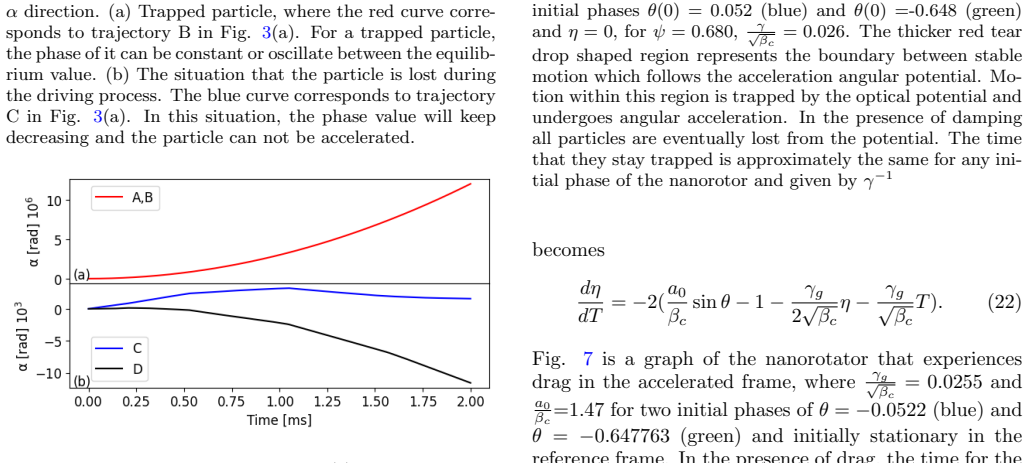
The load-bearing mechanism is the same pendulum-in-a-chirped-lattice dynamics used for molecular optical centrifuges, transplanted to a levitated nanorotor. Working in the accelerated frame defined by the phase $\theta = 2\alpha - \beta_c t^2$, the angular dynamics reduce to $d\eta/dT = -2(a_0/\beta_c)\sin\theta - 2$, with $\eta = d\theta/dT$ and $T = \sqrt{\beta_c}\,t$. This equation has stable critical points at $\sin\theta_c = -\psi$, so the stability parameter $\psi = \beta_c/a_0$ must satisfy $|\psi| < 1$; the phase space shows the characteristic teardrop separatrix that bounds trapped trajectories. The optical potential comes from the Hamiltonian term $H_{\mathrm{grad}}$ built from the lab-frame susceptibility tensor rotated by Euler angles, and the kinetic part $H_{\mathrm{free}}$ is the free-rotor energy; scattering forces are dropped because the rotor is taken to be subwavelength. The gyroscopic coupling among $\alpha$, $\beta$, and $\gamma$ is what drives $\beta$ toward $\pi/2$ during sustained acceleration.
What would settle it
Place a nanorotor of known volume, anisotropic susceptibility, and moment of inertia in the tweezer, sweep the chirp $\beta_c$ through the predicted $a_0$, and compare the loss boundary and final rotation frequency $f = \beta_c t_{\mathrm{acc}}/(2\pi)$ with the model; a mismatch outside experimental uncertainty would falsify the gradient-only adiabatic picture.
Extended reading notes
Core claim
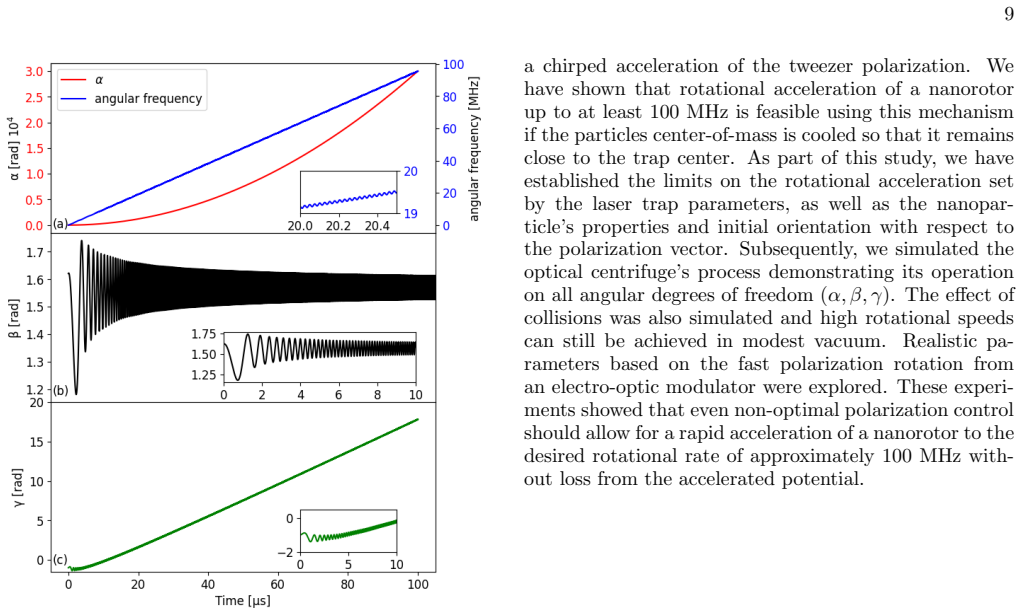
The central claim is that a focused optical tweezer whose linear polarization is chirped in angle can act as an optical centrifuge for a levitated symmetric nanorotor, accelerating it to rotation frequencies above 100 MHz in about a tenth of a millisecond. The condition for stable trapping in the accelerated frame is the inequality $\psi = \beta_c/a_0 < 1$, where $\beta_c$ is the angular chirp rate of the polarization and $a_0 = IV(\chi_1 - \chi_3)/(2c\epsilon_0 J_1)$ is the peak angular acceleration supplied by the gradient force on the rotor's anisotropic polarizability. When this holds, the rotor librates about the accelerating polarization axis and follows it, so the final rotation frequency is set by the chirp and duration as $f = \beta_c t_{\mathrm{acc}}/(2\pi)$. Numerical solutions of the full Euler-angle Hamiltonian confirm the trapping, with the $\beta$ and $\gamma$ degrees of freedom coupling gyroscopically and $\beta$ settling toward its equilibrium value during long acceleration. Stochastic simulations including gas damping show the rotor stays trapped for a time of order the inverse damping rate, and measured voltage-to-polarization maps from a fast electro-optic controller, even with small ellipticity, produce a simulated centrifuge that reaches the 100 MHz target in about 100 $\mu$s.
Load-bearing premise
The model assumes the nanoparticle is so much smaller than the 1064 nm trapping wavelength that only the gradient force matters and scattering forces can be dropped, and the paper gives no values for the particle's volume, anisotropic polarizability, or moment of inertia, so that assumption and the quoted numbers cannot be independently checked from the text.
Editorial extensions
If this is right
- A rotor trapped in the accelerating potential reaches a final rotation frequency $f = \beta_c t_{\mathrm{acc}}/(2\pi)$, so the target spin is programmed by the chirp rate and pulse duration rather than being set by gas damping.
- The stability condition $|\psi| < 1$ fixes the allowed chirp for a given trap intensity and rotor anisotropy and defines a constant phase lag $\theta_c$ at which the rotor follows the polarization.
- Gas collisions limit the acceleration window to roughly the inverse rotational damping rate, but in modest vacuum this still permits acceleration to MHz-scale rotation, and avoiding a single collision for quantum experiments at 100 MHz requires pressure below about $10^{-6}$ mbar.
- A slightly elliptical polarization from a practical electro-optic controller, with $|S_3| \le 0.01$ and $S_1^2 + S_2^2 \ge 0.78$, still drags the rotor to the target frequency in the simulated dynamics.
Reading between the lines
- An immediate extension implied by the paper is that stopping the chirp at different times would make the same tweezer a tunable source of nanorotors at arbitrary target frequencies, which could be used to search for rotational-state discretization at MHz-scale rotation rates.
- The $\psi < 1$ boundary also gives a clean experimental dial: sweeping $\beta_c$ upward and recording the chirp at which the rotor drops out of the optical potential would test the model and, if the trap intensity is known, infer the product $V(\chi_1 - \chi_3)/J_1$ of the particle, parameters the paper does not state.
- Because the model keeps only the gradient force, a natural test of its size limit is to repeat the centrifuge with particles whose radius approaches the trapping wavelength and check whether the loss boundary shifts relative to $\psi = 1$, which would isolate the omitted radiation-pressure torque.
Editorial analysis
A structured set of objections, weighed in public.
Referee Report
Summary. The manuscript proposes and analyzes an optical centrifuge for levitated anisotropic nanoparticles: the linear polarization of a tightly focused tweezer beam is chirped so that the induced-dipole potential adiabatically drags the particle's long axis to high rotation rates. The authors derive a Hamiltonian for a symmetric nanorotor, introduce the accelerated-frame phase θ = 2α − β_c t^2, obtain the stability parameter ψ = β_c/a0 and the condition |ψ| < 1, and illustrate the scheme with a 100 MHz example. They simulate the full Euler-angle dynamics with gas damping and characterize an electro-optic polarization controller; the measured Stokes parameters are then used in simulations of a 100 µs drive toward about 100 MHz.
Significance. If the central claim is correct, the paper offers a practical route to well-defined multi-MHz rotation of mesoscopic rotors, with applications to quantum rotation tests, the Barnett effect, and the quantum tennis-racket effect. The phase-space stability analysis, the inclusion of gas damping via stochastic equations, and the calibration protocol for the EOSpace modulator are useful, and the comparison with the molecular centrifuge analogy is apt. The numerical simulations appear to test the same equations consistently, and I see no circular fitting to the desired result. However, the quantitative 100 MHz claim is not independently checkable as printed, and the central acceleration formula needs correction.
major comments (3)
- [Section IV, Eqs. (12)–(19)] Equation (17), a0 = IV(χ1−χ3)/(2cε0J1), is dimensionally inconsistent and does not follow from Eq. (3). At the beam centre with |u|² = 1, a direct re-derivation from Eq. (3) with the intensity convention used in Eq. (15) gives a0 = VIΔχ/(2cJ1) or VIΔχ/(cJ1) depending on whether I denotes peak or average intensity; in neither case does the factor 1/ε0 appear. Since ψ = βc/a0 and the quoted numbers a0 = 8.85×10^12 rad/s² and ψ = 0.68 in Section IV come from Eq. (17), the 100 MHz example cannot be checked. The manuscript also never states V, χ1−χ3, or J1 for the bipyramidal nanorotor; with the printed formula the quoted a0 would require VΔχ/J1 ≈ 0.22 m³/(kg m²), which for solid densities corresponds to a macroscopic object, not a nanoparticle. Please correct the formula and provide the particle parameters used in the example and simulations.
- [Section IV, Eqs. (12)–(19)] The central stability condition |ψ| < 1 rests on Eqs. (12)–(19), but these are stated without derivation. In particular, the reduction of Eq. (5) to aα = a0 sin(βct² − 2α) for β = π/2, the transformation θ = 2α − βct², and the form dη/dT = −2(a0/βc) sin θ − 2 should be shown explicitly, since the factors of 2 and the signs determine the critical-angle equation sin θc = −ψ. Please include the intermediate steps so the pendulum analogy leading to Eq. (21) is verifiable.
- [Section VI, Figs. 13 and 14] The experimental chirp and the claimed final frequency are mutually inconsistent. Figure 13 applies a chirp βc = 10^12 s⁻² and Fig. 14 reports acceleration over 100 µs; this yields Δω = 10^8 rad/s, which is about 16 MHz if expressed as a rotation frequency f = ω/2π, not 100 MHz. Section IV has the same factor-of-2π ambiguity: 6×10^12 s⁻² × 0.11 ms = 6.6×10^8 rad/s, which gives about 105 MHz only when interpreted as f = ω/2π. Please define f and ω unambiguously and adjust the chirp, duration, or claimed final frequency consistently.
minor comments (5)
- [Section III, Eq. (4)] Equation (4) uses both w(z) and ω(z) for the beam-radius function; please unify the notation.
- [Section VI, text and Fig. 8 caption] There are several typos: 'polairzation' in Section VI, 'isimulations' in the Fig. 8 caption, and 'LiNbO2' should be 'LiNbO3' in the Fig. 9 caption.
- [Section VII, text after Eq. (27)] The quantity Jα = 6.6×10^-34 kg m²/s is given units of angular momentum, but a moment of inertia should have units kg m²; please correct the units.
- [Section VI, Fig. 12] The angle αpolar = cos⁻¹(S1/√(S1²+S2²)) is not single-valued over the full 2π range; the sorting procedure should specify the quadrant, for example by using atan2(S2, S1).
- [Section V, Eqs. (25)–(26)] The coefficients βtr and βrot are introduced but their values or explicit formulas are not given; please state what values were used in the damped simulations reported in Fig. 8.
Circularity Check
No significant circularity: the accelerated-frame stability criterion is derived algebraically from the Hamiltonian, and the self-citations are non-load-bearing; the main issue is an uncheckable and dimensionally inconsistent expression for a0, which is a correctness concern, not circularity.
full rationale
The central derivation is self-contained. Starting from the Hamiltonian (Eqs. 2-6), the paper obtains equations of motion (Eqs. 9-10) and, for beta = pi/2, the single-axis equation a_alpha = a0 sin(beta_c t^2 - 2 alpha) (Eq. 16). The transformation theta = 2 alpha - beta_c t^2, T = sqrt(beta_c) t turns this into the pendulum equation d eta/dT = -2(a0/beta_c) sin theta - 2 (Eq. 19). Setting eta = 0 and d eta/dT = 0 gives sin theta_c = -psi with psi = beta_c/a0, and the real-angle condition |psi| < 1 follows from requiring a real critical angle. Nothing here is defined in terms of the 100-MHz target; the stability boundary follows algebraically from the pendulum equation. The simulations (Figs. 4-8, 14) integrate the same Hamiltonian/stochastic equations, so they are internal consistency checks rather than independent predictions, which is not a circular defect. Self-citations are non-load-bearing: [41] is used only as an analogy to a chirped-lattice equation already derived in the text, and [15] supports the background assumption that 1-K initial cooling is achievable. The main checkability concern is Eq. (17): as printed, a0 = I V (chi1 - chi3)/(2 c epsilon0 J1) does not have the dimensions of an angular acceleration, and the volume, susceptibility anisotropy, and moment of inertia used for the 100-MHz example are not stated, so a0 = 8.85 x 10^12 rad/s^2 cannot be independently reproduced from the printed formula. That is a correctness/transparency problem, not circularity: the 100-MHz claim is not produced by substituting the target frequency back into the derivation.
Assumptions & free parameters
free parameters (3)
- Chirp rate beta_c =
6 x 10^12 rad/s^2 (theory), 10^12 s^-2 (experiment)
- Peak angular acceleration a0 =
8.85 x 10^12 rad/s^2
- Initial orientation and temperature =
theta0 near theta_c = -0.74 rad, beta0 = pi/2 + 0.05 rad, gamma0 = -1 rad, T = 1 K
assumptions (4)
- domain assumption The nanorotor is small enough that scattering forces can be neglected.
- domain assumption The rotor is a symmetric top with chi1 = chi2 and J1 = J2.
- domain assumption The optical field is a focused Gaussian beam with a given spatial profile (Eq. 4).
- standard math Stochastic collisions are modeled with Stratonovich integrals and damping coefficients from Cavalleri et al.
Cite this review
Pith. "Pith review of Optical centrifuge for nanoparticles." pith.science (2026). https://pith.science/paper/ZZ5G2ZP6
@misc{pith2026250616134,
  author       = {Pith},
  title        = {Pith review of: Optical centrifuge for nanoparticles},
  year         = {2026},
  howpublished = {\url{https://pith.science/paper/ZZ5G2ZP6}},
  note         = {Machine review of arXiv:2506.16134}
}
abstract
We study the creation of an optical centrifuge for the controlled rotation of levitated nanorotors within an optical tweezer. The optical centrifuge is created by rapidly rotating the linear polarization of the tightly focused optical field used to form an optical trap. We show that nanorotors, formed by anisotropic nanoparticles levitated within the trap, can be accelerated to well-defined rotational rates in excess of 100 MHz over durations of hundreds of microseconds. The initial conditions required for stable acceleration, based on optical trap properties and the anisotropic susceptibility of the nanorotor are established, and confirmed by numerical simulations. We also present initial experiments that have developed tools for the rapid angular acceleration of the polarization vector of the linearly polarized beam that is required to create the centrifuge. We show that over the acceleration durations in the 100 $\upmu$s range, high rotational speeds could be achieved in modest vacuum.
Figures


Figures from the paper (7 more)


Forward citations
Cited by 1 Pith paper
-
Roto-translational optomechanics
A comprehensive review of the coupled rotational and translational motion of levitated nanoparticles, with a classical-to-quantum theoretical framework and a survey of experiments and applications.
Reference graph
Works this paper leans on
-
[1]
U. Deli´ c, M. Reisenbauer, K. Dare, D. Grass, V. Vuleti´ c, N. Kiesel, and M. Aspelmeyer, Science 367, 892 (2020), ISSN 0036-8075, 1095-9203, URL https://www. science.org/doi/10.1126/science.aba3993
-
[2]
J. Piotrowski, D. Windey, J. Vijayan, C. Gonzalez- Ballestero, A. de los R ´ ıos Sommer, N. Meyer, R. Quidant, O. Romero-Isart, R. Reimann, and L. Novotny, Nature Physics (2023), ISSN 1745-2481, URLhttps://doi.org/ 10.1038/s41567-023-01956-1
-
[3]
L. Magrini, P. Rosenzweig, C. Bach, A. Deutschmann- Olek, S. G. Hofer, S. Hong, N. Kiesel, A. Kugi, and M. Aspelmeyer, Nature 595, 373 (2021), ISSN 1476-4687, URL https://doi.org/10.1038/s41586-021-03602-3
-
[4]
Tebbenjohanns, M
F. Tebbenjohanns, M. L. Mattana, M. Rossi, M. Frim- mer, and L. Novotny, Nature 595, 378 (2021)
2021
-
[5]
A. Ranfagni, K. Børkje, F. Marino, and F. Marin, Phys. Rev. Res. 4, 033051 (2022), URL https://link.aps. org/doi/10.1103/PhysRevResearch.4.033051
-
[6]
M. Kamba and K. Aikawa, Phys. Rev. Lett. 131, 183602 (2023), URL https://link.aps.org/doi/10. 1103/PhysRevLett.131.183602
work page 2023
-
[7]
G. F. M. Tomassi, D. Veldhuizen, B. Melo, D. Can- doli, A. Riera-Campeny, O. Romero-Isart, N. Meyer, and R. Quidant, Accelerated state expansion of a nanoparti- cle in a dark inverted potential(2025), 2503.20707, URL https://arxiv.org/abs/2503.20707
arXiv 2025
-
[8]
C. Gonzalez-Ballestero, M. Aspelmeyer, L. Novotny, R. Quidant, and O. Romero- Isart, Science 374, eabg3027 (2021), https://www.science.org/doi/pdf/10.1126/science.abg3027, URL https://www.science.org/doi/abs/10.1126/ science.abg3027
Show all 47 references
-
[9]
S. Bose, A. Mazumdar, G. W. Morley, H. Ul- bricht, M. Toroˇ s, M. Paternostro, A. A. Geraci, P. F. Barker, M. Kim, and G. Milburn, Physical Review Letters 119, 240401 (2017), ISSN 0031-9007, 1079-7114, URL https://link.aps.org/doi/10.1103/ PhysRevLett.119.240401
2017
-
[10]
S. Bose, I. Fuentes, A. A. Geraci, S. M. Khan, S. Qvar- fort, M. Rademacher, M. Rashid, M. Toroˇ s, H. Ul- bricht, and C. C. Wanjura, Rev. Mod. Phys. 97, 015003 (2025), URL https://link.aps.org/doi/10. 1103/RevModPhys.97.015003
2025
-
[11]
T. M. Hoang, Y. Ma, J. Ahn, J. Bang, F. Robicheaux, Z.-Q. Yin, and T. Li, Physical Review Letters 117 (2016), ISSN 1079-7114, URL http://dx.doi.org/10. 1103/PhysRevLett.117.123604
2016
-
[12]
Kamba, R
M. Kamba, R. Shimizu, and K. Aikawa, Nature Commu- nications 14, 7943 (2023), ISSN 2041-1723, URL https: //www.nature.com/articles/s41467-023-43745-7
2023
-
[13]
Rashid, M
M. Rashid, M. Toroˇ s, A. Setter, and H. Ulbricht, Physi- cal Review Letters 121, 253601 (2018), ISSN 0031-9007, 1079-7114, URL https://link.aps.org/doi/10.1103/ PhysRevLett.121.253601
2018
-
[14]
P. F. Staanum, K. Højbjerre, P. S. Skyt, A. K. Hansen, and M. Drewsen, Nature Physics 6, 271 (2010), ISSN 1745-2473, 1745-2481, URL https://www.nature.com/ articles/nphys1604
2010
-
[15]
Pontin, H
A. Pontin, H. Fu, M. Toroˇ s, T. S. Monteiro, and P. F. Barker, Nature Physics pp. 1–6 (2023), ISSN 1745-2481, publisher: Nature Publishing Group, URL https://www. nature.com/articles/s41567-023-02006-6
2023
-
[16]
J. Ahn, Z. Xu, J. Bang, P. Ju, X. Gao, and T. Li, Nature Nanotechnology 15, 89 (2020), ISSN 1748-3395, URL https://doi.org/10.1038/s41565-019-0605-9
2020 doi
-
[17]
J. Bang, T. Seberson, P. Ju, J. Ahn, Z. Xu, X. Gao, F. Robicheaux, and T. Li, Physical Review Re- search 2, 043054 (2020), publisher: American Physi- cal Society, URL https://link.aps.org/doi/10.1103/ PhysRevResearch.2.043054
2020
-
[18]
J. Gao, F. van der Laan, J. A. Zieli´ nska, A. Mili- taru, L. Novotny, and M. Frimmer, Phys. Rev. Res. 6, 033009 (2024), URL https://link.aps.org/doi/10. 1103/PhysRevResearch.6.033009
2024
-
[19]
Dania, O
L. Dania, O. S. Kremer, J. Piotrowski, D. Candoli, J. Vijayan, O. Romero-Isart, C. Gonzalez-Ballestero, L. Novotny, and M. Frimmer, High-purity quantum op- tomechanics at room temperature (2024), 2412.14117, URL https://arxiv.org/abs/2412.14117
2024 arXiv
-
[20]
B. A. Stickler, B. Papendell, S. Kuhn, B. Schrinski, J. Millen, M. Arndt, and K. Hornberger, New Jour- nal of Physics 20, 122001 (2018), ISSN 1367-2630, publisher: IOP Publishing, URL https://doi.org/10. 1088/1367-2630/aaece4
2018
-
[21]
B. A. Stickler, K. Hornberger, and M. S. Kim, Nature Reviews Physics 3, 589 (2021), ISSN 2522-5820, number: 8 Publisher: Nature Publishing Group, URL https:// www.nature.com/articles/s42254-021-00335-0
2021
-
[22]
Y. Ma, K. E. Khosla, B. A. Stickler, and M. Kim, Phys- ical Review Letters 125, 053604 (2020), URL https:// link.aps.org/doi/10.1103/PhysRevLett.125.053604
2020 doi
-
[24]
T. J. Michael, H. M. Ogden, and A. S. Mullin, The Jour- nal of Chemical Physics 154, 134307 (2021), ISSN 0021- 9606, 1089-7690, URL https://pubs.aip.org/aip/jcp/ article/1065576
2021
-
[26]
A. A. Milner, J. A. Fordyce, I. MacPhail-Bartley, W. Wasserman, V. Milner, I. Tutunnikov, and I. S. Averbukh, Physical Review Letters 122, 223201 (2019), ISSN 0031-9007, 1079-7114, URL https://link.aps. org/doi/10.1103/PhysRevLett.122.223201
2019 doi
-
[27]
MacPhail-Bartley, W
I. MacPhail-Bartley, W. W. Wasserman, A. A. Mil- ner, and V. Milner, Review of Scientific Instruments 11 91, 045122 (2020), ISSN 0034-6748, 1089-7623, URL https://pubs.aip.org/aip/rsi/article/1033099
2020
-
[28]
R. W. Minck, E. E. Hagenlocker, and W. G. Rado, Phys- ical Review Letters 17, 229 (1966), publisher: American Physical Society, URL https://link.aps.org/doi/10. 1103/PhysRevLett.17.229
1966
-
[29]
Microwave Spectroscopy - an overview | ScienceDirect Topics, URL https://www.sciencedirect.com/topics/ chemistry/microwave-spectroscopy
-
[30]
Rotational-Raman Spectrum - an overview| ScienceDi- rect Topics, URL https://www.sciencedirect.com/ topics/chemistry/rotational-raman-spectrum
-
[31]
Korobenko, Journal of Physics B: Atomic, Molecular and Optical Physics 51, 203001 (2018), ISSN 0953-4075, publisher: IOP Publishing, URL https://doi.org/10
A. Korobenko, Journal of Physics B: Atomic, Molecular and Optical Physics 51, 203001 (2018), ISSN 0953-4075, publisher: IOP Publishing, URL https://doi.org/10. 1088/1361-6455/aadd56
2018
-
[32]
R. A. Beth, Phys. Rev. 50, 115 (1936), URL https:// link.aps.org/doi/10.1103/PhysRev.50.115
1936 doi
-
[33]
M. E. J. Friese, T. A. Nieminen, N. R. Hecken- berg, and H. Rubinsztein-Dunlop, Nature 394, 348–350 (1998), ISSN 1476-4687, URL http://dx.doi.org/10. 1038/28566
1998
-
[35]
Reimann, M
R. Reimann, M. Doderer, E. Hebestreit, R. Diehl, M. Frimmer, D. Windey, F. Tebbenjohanns, and L. Novotny, Phys. Rev. Lett. 121, 033602 (2018), URL https://link.aps.org/doi/10.1103/PhysRevLett. 121.033602
2018 doi
-
[36]
Arita, M
Y. Arita, M. Mazilu, and K. Dholakia, Nature Communi- cations 4 (2013), ISSN 2041-1723, URL http://dx.doi. org/10.1038/ncomms3374
2013 doi
-
[37]
Karczmarek, J
J. Karczmarek, J. Wright, P. Corkum, and M. Ivanov, Phys. Rev. Lett. 82, 3420 (1999), URL https://link. aps.org/doi/10.1103/PhysRevLett.82.3420
1999 doi
-
[38]
Stapelfeldt and T
H. Stapelfeldt and T. Seideman, Reviews of Modern Physics 75, 543 (2003), publisher: American Physi- cal Society, URL https://link.aps.org/doi/10.1103/ RevModPhys.75.543
2003
-
[39]
T. M. Hoang, Y. Ma, J. Ahn, J. Bang, F. Ro- bicheaux, Z.-Q. Yin, and T. Li, Phys. Rev. Lett. 117, 123604 (2016), URL https://link.aps.org/doi/10. 1103/PhysRevLett.117.123604
2016
-
[40]
Toroˇ s, M
M. Toroˇ s, M. Rashid, and H. Ulbricht, Physical Review A, 98(5), 053803 (2018)
2018
-
[41]
P. F. Barker and M. N. Shneider, Physical Review A 64, 033408 (2001), ISSN 1050-2947, 1094-1622, URL https: //link.aps.org/doi/10.1103/PhysRevA.64.033408
2001 doi
-
[42]
Khodorkovsky, U
Y. Khodorkovsky, U. Steinitz, J.-M. Hartmann, and I. S. Averbukh, Nature Communications 6, 7791 (2015)
2015
-
[43]
D. S. Lemons and V. Ambegaokar, Amer- ican Journal of Physics 71, 191 (2003), ISSN 0002-9505, 1943-2909, URL https: //pubs.aip.org/ajp/article/71/2/191/1055925/ An-Introduction-to-Stochastic-Processes-in-Physics
2003
-
[44]
Cavalleri, G
A. Cavalleri, G. Ciani, R. Dolesi, M. Hueller, D. Ni- colodi, D. Tombolato, S. Vitale, P. Wass, and W. We- ber, Physics Letters A 374, 3365 (2010), ISSN 03759601, URL https://linkinghub.elsevier.com/ retrieve/pii/S0375960110007279
2010
-
[45]
Dania, D
L. Dania, D. S. Bykov, M. Knoll, P. Mestres, and T. E. Northup, Physical Review Research 3, 013018 (2021)
2021
-
[46]
com/polarization-controller
Polarization Controllers, URL https://www.eospace. com/polarization-controller
-
[47]
Lithium niobate polarization controller (2003), URL http://www.hanamuraoptics.com/device/EOSPACE/ PC030123_EO.pdf
2003
-
[48]
Hidayat, Ph.D
A. Hidayat, Ph.D. thesis, Universitat Paderborn. Pader- born (2008)
2008
-
[49]
J. Ahn, Z. Xu, J. Bang, Y.-H. Deng, T. M. Hoang, Q. Han, R.-M. Ma, and T. Li, Physical Review Let- ters 121, 033603 (2018), publisher: American Physi- cal Society, URL https://link.aps.org/doi/10.1103/ PhysRevLett.121.033603
2018
-
[50]
K. Zeng, X. Xu, Y. Wu, X. Wu, and D. Xiao, Microsys- tems ; Nanoengineering 10 (2024), ISSN 2055-7434, URL http://dx.doi.org/10.1038/s41378-024-00726-0
2024 doi
Reviewed August 6, 2026 · model on record in the stance chip above.
Discussion (0). Sign in to comment.