REVIEW 3 major objections 8 minor 1 cited by
Progenitor Insights of Type IIP SN 2018pq: A Comprehensive Photometric and Spectroscopic Study
T0 review · 3 major / 8 minor · reviewed 2026-08-06 · deepseek-v4-flash
Pith's one-line read SN 2018pq was a normal Type IIP supernova with a 97.57-day plateau that points to a red supergiant progenitor in the 11–16 solar-mass range.
desk verdict Solid observational study of a normal Type IIP whose MESA+STELLA progenitor mass claim is weaker than the abstract suggests; useful sample filler but the 14–16 Msun range should be treated as provisional. read the letter →
The pith
A machine-rendered reading of the paper's core claim, the machinery that carries it, and where it could break.
The reading
What carries the argument
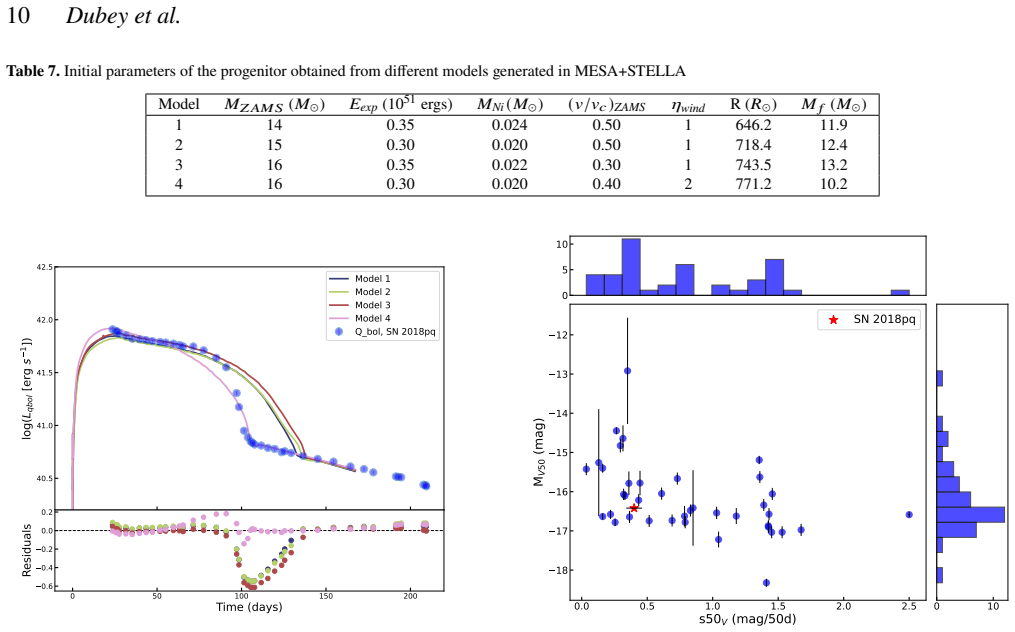
The central machinery is the comparison of the quasi-bolometric light curve to two generations of models. The first is a semi-analytic radiation-diffusion model with a constant-density core and exponentially declining envelope, fit by Markov-chain Monte Carlo; it supplies ejecta mass, radius, and explosion energy. The second is a set of one-dimensional stellar-evolution models exploded and followed by a multi-group radiation-hydrodynamics code, which produce full synthetic light curves and photospheric velocities; the mass range comes from matching the plateau and the plateau-to-nebular drop. The paper also uses a radiative-transfer spectral fitting procedure that treats hydrogen out of local thermodynamic equilibrium to match two early spectra and confirm that the object is a normal Type IIP.
What would settle it
If archival pre-explosion imaging of the explosion site reveals a progenitor with a zero-age main-sequence mass outside $14$--$16\,M_\odot$, or if nebular-phase or radio observations show narrow emission lines or synchrotron emission characteristic of circumstellar interaction at the transition, the hydrodynamic mass range would be wrong.
Extended reading notes
Core claim
The paper's central claim is that SN 2018pq is a spectroscopically and photometrically normal Type IIP supernova whose progenitor was a red supergiant, and that the sharpness of its plateau-to-nebular transition is a real physical signature rather than an observational artefact. Observational parameters place it alongside SN 1999em and SN 2012aw: a plateau of $97.57 \pm 0.05$ d, $V$-band absolute magnitude $-16.42 \pm 0.01$ mag at 50 d, a $2.24 \pm 0.01$ mag drop at the end of the plateau, and a nebular decay rate of $0.99 \pm 0.03$ mag per 100 d consistent with $^{56}$Co to $^{56}$Fe. On the progenitor side, the paper argues that hydrodynamic modelling places the zero-age main-sequence mass at $14$--$16\,M_\odot$ with a radius of $640$--$772\,R_\odot$ and low explosion energy ($0.30$--$0.35 \times 10^{51}$ erg), and interprets the sharp observed decline as evidence for strong mixing of the ejecta at the end of the plateau.
Load-bearing premise
The load-bearing premise is that the sharp $11.87 \pm 1.68$ mag per 100 d drop from plateau to nebular phase is caused by mixing inside the ejecta rather than by circumstellar interaction, asymmetry, or a different explosion energy, so the hydrodynamic models' failure to reproduce that drop can be attributed to underestimated mixing.
Editorial extensions
If this is right
- SN 2018pq can serve as a reference normal Type IIP supernova: its 97 d plateau, normal $V$-band luminosity, and $0.029\,M_\odot$ nickel budget are typical, making it a useful template for future studies.
- The steep $11.87$ mag per 100 d plateau-to-nebular decline links SN 2018pq to events like SN 2013ab, suggesting that transition sharpness is an independent axis of Type IIP diversity.
- The semi-analytic fit points to roughly $11\,M_\odot$ of ejecta and a $424\,R_\odot$ star, while the hydrodynamic fit points to $14$--$16\,M_\odot$ and a larger radius; the paper treats the hydrodynamic result as the more complete one.
- No single hydrodynamic model reproduces all phases of the light curve, so the quoted mass range carries systematic uncertainty beyond the statistical errors.
- The photospheric velocity evolution derived from the Fe II lines resembles that of SN 1999em, reinforcing the normal Type IIP classification.
Reading between the lines
- Going beyond the paper: the systematic failure of the hydrodynamic models to reproduce the sharp transition suggests that the plateau-to-nebular drop in Type IIP supernovae is a sensitive probe of mixing or circumstellar interaction, and it could be used to sort progenitors once more objects are modelled the same way.
- Going beyond the paper: if the sharp drop is instead caused by asymmetric nickel distribution or a small circumstellar shell, the $14$--$16\,M_\odot$ hydrodynamic range would be an artifact; nebular spectroscopy or radio/X-ray observations taken near the drop would test whether interaction is present.
- Going beyond the paper: the mass discrepancy between the two methods could be resolved by searching archival pre-explosion imaging of IC 3896A; a single detected progenitor with a derived mass near $11$--$13\,M_\odot$ would favour the analytic model and challenge the hydrodynamic assumptions, while no detection down to a $15\,M_\odot$ limit would support the higher range.
Editorial analysis
A structured set of objections, weighed in public.
Referee Report
Summary. This paper presents a photometric and spectroscopic study of the Type IIP SN 2018pq. Multi-band BVgri light curves from ~23 to 209 days post-explosion and six low-resolution spectra from ~25 to 79.5 days are analysed. The authors measure a V-band plateau duration of 97.57±0.05 d, an absolute V magnitude of −16.42±0.01 mag at 50 d, a plateau decline rate of 0.42±0.06 mag/50 d, and an unusually steep plateau-to-nebular transition of 11.87±1.68 mag/100 d. Three methods (tail luminosity, SN 1987A scaling, and the steepness relation) give a weighted 56Ni mass of 0.029±0.003 M_sun. TARDIS spectral fits at 25.5 and 27.7 d yield photospheric parameters consistent with a spectroscopically normal Type IIP. Semi-analytic light-curve modelling gives an ejecta mass of ~10.7 M_sun and an initial radius of ~424 R_sun, while MESA+STELLA hydrodynamic modelling is used to argue for a higher ZAMS mass of 14–16 M_sun.
Significance. The value of the paper lies in its detailed, well-sampled dataset for a normal Type IIP SN with a sharp plateau-to-nebular transition, and in the careful comparison with a homogeneous sample. The photometric parameters (plateau duration, decline rates, 56Ni mass) are useful additions to the Type IIP population. The TARDIS modelling at two epochs follows an established, reproducible methodology. However, the paper's headline progenitor claim from the hydrodynamic modelling is not supported by the models shown: none of the four MESA+STELLA models reproduces the full light curve, and the proposed RTI-mixing explanation is untested. The 14–16 M_sun range should therefore be treated as a tentative model-dependent inference until the models are extended or the claim is appropriately caveated.
major comments (3)
- [5.2, Fig. 11, Table 7] The central claim that MESA+STELLA modelling suggests a 14–16 M_sun ZAMS progenitor is not supported by the models as presented. The text explicitly states that 'none of the model light curves reproduce the entire observed light curve'. Models 1–3 reproduce the plateau but fail the sharp transition; model 4 reproduces the transition but overestimates the plateau slope. The authors attribute the sharp decline to underestimated Rayleigh-Taylor mixing (citing Paxton et al. 2018) without actually running a model with enhanced mixing; model 4 is instead selected purely on the basis of matching the transition. This selection does not constrain the ZAMS mass independently of the mixing assumption. In addition, Table 7 gives Model 4 a final mass of 10.2 M_sun, implying an ejecta mass of ~8.2 M_sun (for a 2 M_sun neutron star), which is lower than the semi-analytic ejecta mass of 10.7 M_sun; the quoted range is therefore degenerate with wind mass loss. To support the stated conclusion, the authors should either (a) compute and compare a model with enhanced mixing, or (b) soften the abstract and conclusions to present 14–16 M_sun as one of several possible interpretations, explicitly noting the absence of a full fit.
- [3.1, Eq. (5)] Equation (5) as printed, log M(56Ni) = −(3.5024±0.0960) S − 1.0167, is numerically impossible for the reported value: for S = 11.87 mag/100 d it gives M ~ 10^(−42.6) M_sun, not 0.037±0.006 M_sun. The intended coefficient appears to be 0.035024 (i.e., the decimal point is misplaced). This is presumably a typographical error, but as written the equation prevents reproduction of the stated result. Please correct the equation and verify that the quoted uncertainty on M_Ni (0.006 M_sun) follows from the propagated uncertainties in S and the calibration coefficients.
- [3, Figs. 2 and 4; Table 1; Section 6] The quoted uncertainties on the light-curve parameters do not include the explosion-epoch uncertainty. The explosion epoch is JD 2458135.14±3.84 (Table 1); the plateau duration of 97.57±0.05 d and the 50-d absolute magnitude are computed relative to this epoch, and the 3.8 d uncertainty should be propagated into these quantities (and into the 56Ni mass, which depends on t0). As it stands, the ±0.05 d on tPT is misleadingly precise. The same applies to the epoch-dependent comparison in Figures 3, 4, and 8.
minor comments (8)
- [Section 6 vs. Table 1] Section 6 and Table 1 give inconsistent values for the explosion epoch: JD 2458135.45±3.48 in Section 6 versus JD 2458135.14±3.84 in Table 1 and Section 1. Please reconcile.
- [Abstract vs. Section 3] The abstract quotes the V-band plateau decline as 0.42±0.06 mag/50 d, while Section 3 gives 0.81±0.06 mag/100 d; the two are equivalent but the abstract should state the conversion to avoid apparent inconsistency.
- [5.2, Table 7] Section 5.2 states 'The effect of Z and rotation are insignificant' but then lists different rotation values in Table 7 and describes varying rotation to match the plateau and transition. Please clarify whether rotation is a free parameter in the grid or a fixed input.
- [Figure 4 caption] Figure 4's caption is not a complete sentence ('The comparison sample (gray lines) corresponds to the Type II SN sample from Anderson et al. (2014).'); the in-text reference to the figure (Section 3) is also grammatically tangled. Please rephrase.
- [3.1] Section 3.1: the phrase 'We estimate M_Ni at the last five epochs in the nebular phase' should specify the epochs and whether the nebular-phase epoch numbering is after explosion or after plateau.
- [Data availability] The data availability statement ('will be provided upon request') is weaker than the journal's best practice; consider making the photometry tables available as machine-readable files at the time of publication.
- [Table 4] Table 4 lists A_tot_V = 0.578 for SN 2018pq; this is consistent with E(B−V)=0.186 and R_V=3.1, but the value should be quoted once in the text to avoid the impression of an additional extinction component.
- [Section 1] In Section 1, the phrase 'the plateau duration of normal Type IIP supernovae' should read 'comparable to that of normal Type IIP supernovae'; as written it is grammatically incomplete.
Circularity Check
No significant circularity: the TARDIS emulator self-citation is non-load-bearing, and the hydro progenitor range is an underdetermined model selection, not a construction from inputs.
full rationale
The derivation chain is not circular. The photometric parameters (plateau duration 97.57±0.05 d, V-band decline, transition steepness) come from direct fits of Eq. (1) to observed light curves. The 56Ni mass is a weighted average of three external calibrations (Hamuy 2003 Eqs. 2–3, Spiro 2014 Eq. 4, Singh 2018 Eq. 5), none of which is derived from this paper's own equations or fitted to SN 2018pq and then renamed as a prediction. The TARDIS fit uses the spectral emulator of Vogl et al. (2020) and Csörnyei et al. (2023b), and G. Csörnyei is a co-author; however, this is a method reference to a precomputed surrogate trained on TARDIS grids, not to a result fitted from SN 2018pq, and the 'spectroscopically normal Type IIP' conclusion is supported independently by direct line-profile comparison with comparison-sample SNe (Section 4, Figures 6–7). The MESA+STELLA progenitor range 14–16 M⊙ is not forced by construction: the paper explicitly states 'none of the model light curves reproduce the entire observed light curve' (Section 5.2, Figure 11), and the final range is a selection among four tested grid models with acknowledged degeneracies in wind scaling factor, rotation, and RTI mixing. That underdetermination is a correctness risk, not a circular reduction of the conclusion to its inputs. No load-bearing step is self-defined, and no fitted parameter is renamed as a prediction.
Assumptions & free parameters
free parameters (11)
- Recombination temperature T_rec =
5500 K
- Thomson scattering opacity kappa =
0.3 cm^2/g
- Proto-neutron star mass =
2 Msun
- TARDIS density index n =
8.9 (25.5 d), 8.6 (27.7 d)
- TARDIS photospheric velocity v_ph =
5662 km/s (25.5 d), 5642 km/s (27.7 d)
- TARDIS photospheric temperature T_ph =
6031 K (25.5 d), 5998 K (27.7 d)
- Hydrodynamic ZAMS mass M_ZAMS =
14, 15, 16 Msun for models 1 to 4
- Explosion energy E_exp =
0.30 to 0.35 x 10^51 erg
- Hydrodynamic 56Ni mass =
0.020 to 0.024 Msun
- Wind scaling factor eta_wind =
1 (models 1 to 3), 2 (model 4)
- Initial rotation (v/v_c)_ZAMS =
0.3 to 0.5
assumptions (9)
- domain assumption Spherical symmetry and homologous expansion of the ejecta
- domain assumption Power-law density profile and uniform composition in TARDIS
- domain assumption Exponential density profile plus uniform core in the semi-analytic model
- domain assumption Negligible host-galaxy extinction; only Galactic reddening E(B-V) = 0.186
- domain assumption Distance of 23.56 Mpc from NED
- domain assumption Explosion epoch JD 2458135.14 +/- 3.84 from GELATO spectral matching
- domain assumption Hydrodynamic models use solar metallicity Z = 0.02, default alpha_MLT = 3, and no CSM interaction
- ad hoc to paper The mismatch between synthetic and observed transition is due to underestimated Rayleigh-Taylor mixing
- domain assumption Gamma-ray leakage similar to SN 1987A in the 56Ni mass estimate
Cite this review
Pith. "Pith review of Progenitor Insights of Type IIP SN 2018pq: A Comprehensive Photometric and Spectroscopic Study." pith.science (2026). https://pith.science/paper/MA644L3D
@misc{pith2026250616148,
  author       = {Pith},
  title        = {Pith review of: Progenitor Insights of Type IIP SN 2018pq: A Comprehensive Photometric and Spectroscopic Study},
  year         = {2026},
  howpublished = {\url{https://pith.science/paper/MA644L3D}},
  note         = {Machine review of arXiv:2506.16148}
}
abstract
We present high-cadence photometric and low-resolution (R $\sim$ 400--700) optical spectroscopic observations of Type IIP supernova, SN~2018pq, which exploded on the outskirts of the galaxy IC~3896A. The optically thick phase (``plateau'') lasts approximately 97 d, the plateau duration of normal Type IIP supernovae. SN~2018pq has a {\em V}-band absolute magnitude of $-16.42 \pm 0.01$ mag at 50 d, resembles normal-luminous supernova, and the V-band decline rate of 0.42$\pm$0.06 mag 50 d$^{-1}$ during the plateau phase. A steeper decline rate of 11.87$\pm$1.68 mag 100 d$^{-1}$ was observed compared to that of typical Type IIP supernovae during the transition between plateau to nebular phase. We employ detailed radiative transfer spectra modelling, TARDIS, to reveal the photospheric temperature and velocity at two spectral epochs. The well-fitted model spectra indicate SN~2018pq is a spectroscopically normal Type IIP supernova. Semi-analytical light curve modelling suggests the progenitor as a red supergiant star with an ejecta mass of $\sim$11 $M_\odot$ and an initial radius of 424 $R_\odot$. On the contrary, hydrodynamical modelling suggests a higher mass progenitor between 14--16 $M_\odot$.
Figures


Figures from the paper (6 more)



Forward citations
Cited by 1 Pith paper
-
SN 2022xus: bridging the gap between Type IIP and IIL supernovae
SN 2022xus is a transitional Type II supernova with a 94.8-day plateau, a decline rate of 1.23 mag per 100 days, mixed IIP/IIL spectral features, and a likely 12-15 solar-mass progenitor.
Reference graph
Works this paper leans on
-
[1]
Anderson J. P., 2019, @doi [ ] 10.1051/0004-6361/201935027 , https://ui.adsabs.harvard.edu/abs/2019A&A...628A...7A 628, A7
-
[2]
Anderson J. P., et al., 2014, @doi [ ] 10.1088/0004-637X/786/1/67 , https://ui.adsabs.harvard.edu/abs/2014ApJ...786...67A 786, 67
-
[3]
E., Smith N., Tinyanont S., Kilpatrick C
Andrews J. E., Smith N., Tinyanont S., Kilpatrick C. D., 2022, @doi [The Astrophysical Journal] 10.3847/1538-4357/ac6c5a , 933, 140
-
[4]
Arcavi I., 2017, Hydrogen-Rich Core-Collapse Supernovae. Springer International Publishing, Cham, pp 239--276, @doi 10.1007/978-3-319-21846-5_39 , https://doi.org/10.1007/978-3-319-21846-5_39
-
[5]
D., 1980, @doi [ ] 10.1086/157898 , https://ui.adsabs.harvard.edu/abs/1980ApJ...237..541A 237, 541
Arnett W. D., 1980, @doi [ ] 10.1086/157898 , https://ui.adsabs.harvard.edu/abs/1980ApJ...237..541A 237, 541
doi:10.1086/157898 1980
-
[6]
Arnett D., Chevalier R., 1996, @doi [Physics Today - PHYS TODAY] 10.1063/1.2807808 , 49
-
[7]
Arnett W. D., Fu A., 1989, @doi [ ] 10.1086/167402 , https://ui.adsabs.harvard.edu/abs/1989ApJ...340..396A 340, 396
doi:10.1086/167402 1989
-
[8]
Barbon R., Ciatti F., Rosino L., 1979, , https://ui.adsabs.harvard.edu/abs/1979A&A....72..287B 72, 287
1979
Show all 110 references
-
[9]
R., Smith N., Jencson J
Beasor E. R., Smith N., Jencson J. E., 2025, @doi [ ] 10.3847/1538-4357/ad8f3f , https://ui.adsabs.harvard.edu/abs/2025ApJ...979..117B 979, 117
2025 doi
-
[10]
I., Bartunov O
Blinnikov S. I., Bartunov O. S., 2011, STELLA: Multi-group Radiation Hydrodynamics Code , Astrophysics Source Code Library, record ascl:1108.013 ( @eprint ascl 1108.013 )
2011
-
[11]
I., Eastman R., Bartunov O
Blinnikov S. I., Eastman R., Bartunov O. S., Popolitov V. A., Woosley S. E., 1998, @doi [ ] 10.1086/305375 , https://ui.adsabs.harvard.edu/abs/1998ApJ...496..454B 496, 454
1998 doi
-
[12]
Bose S., et al., 2013, @doi [ ] 10.1093/mnras/stt864 , https://ui.adsabs.harvard.edu/abs/2013MNRAS.433.1871B 433, 1871
2013 doi
-
[13]
Bose S., et al., 2015, @doi [ ] 10.1093/mnras/stv759 , https://ui.adsabs.harvard.edu/abs/2015MNRAS.450.2373B 450, 2373
2015 doi
-
[14]
M., et al., 2013, @doi [ ] 10.1086/673168 , https://ui.adsabs.harvard.edu/abs/2013PASP..125.1031B 125, 1031
Brown T. M., et al., 2013, @doi [ ] 10.1086/673168 , https://ui.adsabs.harvard.edu/abs/2013PASP..125.1031B 125, 1031
2013 doi
-
[15]
C., Vinko J., 2012, @doi [ ] 10.1088/0004-637X/746/2/121 , https://ui.adsabs.harvard.edu/abs/2012ApJ...746..121C 746, 121
Chatzopoulos E., Wheeler J. C., Vinko J., 2012, @doi [ ] 10.1088/0004-637X/746/2/121 , https://ui.adsabs.harvard.edu/abs/2012ApJ...746..121C 746, 121
2012 doi
-
[16]
A., 1976, @doi [ ] 10.1086/154557 , https://ui.adsabs.harvard.edu/abs/1976ApJ...207..872C 207, 872
Chevalier R. A., 1976, @doi [ ] 10.1086/154557 , https://ui.adsabs.harvard.edu/abs/1976ApJ...207..872C 207, 872
1976 doi
-
[17]
A., Klein R
Chevalier R. A., Klein R. I., 1978, @doi [ ] 10.1086/155864 , https://ui.adsabs.harvard.edu/abs/1978ApJ...219..994C 219, 994
1978 doi
-
[18]
Cs \"o rnyei G., et al., 2023a, @doi [ ] 10.1051/0004-6361/202245379 , https://ui.adsabs.harvard.edu/abs/2023A&A...672A.129C 672, A129
-
[19]
Cs \"o rnyei G., Anderson R. I., Vogl C., Taubenberger S., Blondin S., Leibundgut B., Hillebrandt W., 2023b, @doi [ ] 10.1051/0004-6361/202346971 , https://ui.adsabs.harvard.edu/abs/2023A&A...678A..44C 678, A44
-
[20]
R., 2020, @doi [ ] 10.1093/mnras/staa174 , https://ui.adsabs.harvard.edu/abs/2020MNRAS.493..468D 493, 468
Davies B., Beasor E. R., 2020, @doi [ ] 10.1093/mnras/staa174 , https://ui.adsabs.harvard.edu/abs/2020MNRAS.493..468D 493, 468
2020 doi
-
[21]
Dessart L., 2021, @doi [Astronomy & Astrophysics] 10.1051/0004-6361/202141648 , 656, A61
2021 doi
-
[22]
J., 2006, @doi [ ] 10.1051/0004-6361:20054044 , https://ui.adsabs.harvard.edu/abs/2006A&A...447..691D 447, 691
Dessart L., Hillier D. J., 2006, @doi [ ] 10.1051/0004-6361:20054044 , https://ui.adsabs.harvard.edu/abs/2006A&A...447..691D 447, 691
2006 doi
-
[23]
Dessart L., et al., 2008, @doi [ ] 10.1086/526451 , https://ui.adsabs.harvard.edu/abs/2008ApJ...675..644D 675, 644
2008 doi
-
[24]
J., Waldman R., Livne E., 2013, @doi [ ] 10.1093/mnras/stt861 , https://ui.adsabs.harvard.edu/abs/2013MNRAS.433.1745D 433, 1745
Dessart L., Hillier D. J., Waldman R., Livne E., 2013, @doi [ ] 10.1093/mnras/stt861 , https://ui.adsabs.harvard.edu/abs/2013MNRAS.433.1745D 433, 1745
2013 doi
-
[25]
Dessart L., et al., 2014, @doi [ ] 10.1093/mnras/stu417 , https://ui.adsabs.harvard.edu/abs/2014MNRAS.440.1856D 440, 1856
2014 doi
-
[26]
C., 2016, @doi [ ] 10.3847/0004-637X/821/2/76 , https://ui.adsabs.harvard.edu/abs/2016ApJ...821...76D 821, 76
Duffell P. C., 2016, @doi [ ] 10.3847/0004-637X/821/2/76 , https://ui.adsabs.harvard.edu/abs/2016ApJ...821...76D 821, 76
2016 doi
-
[27]
G., Pinto P
Eastman R. G., Pinto P. A., 1993, @doi [ ] 10.1086/172957 , https://ui.adsabs.harvard.edu/abs/1993ApJ...412..731E 412, 731
1993 doi
-
[28]
Elmhamdi A., et al., 2003a, @doi [ ] 10.1046/j.1365-8711.2003.06150.x , https://ui.adsabs.harvard.edu/abs/2003MNRAS.338..939E 338, 939
2003
-
[29]
N., Danziger I
Elmhamdi A., Chugai N. N., Danziger I. J., 2003b, @doi [ ] 10.1051/0004-6361:20030522 , https://ui.adsabs.harvard.edu/abs/2003A&A...404.1077E 404, 1077
-
[30]
Faran T., et al., 2014, @doi [ ] 10.1093/mnras/stu1760 , https://ui.adsabs.harvard.edu/abs/2014MNRAS.445..554F 445, 554
2014 doi
- [31]
-
[32]
L., 1999, @doi [ ] 10.1086/307647 , https://ui.adsabs.harvard.edu/abs/1999ApJ...522..413F 522, 413
Fryer C. L., 1999, @doi [ ] 10.1086/307647 , https://ui.adsabs.harvard.edu/abs/1999ApJ...522..413F 522, 413
1999 doi
-
[33]
Fuller J., Shiode J., 2020, @doi [The Astrophysical Journal] 10.3847/1538-4357/ab93ac , 896, 119
2020 doi
-
[34]
L., Harris C
Graham M. L., Harris C. E., Valenti S., Sand D. J., 2021, @doi [Monthly Notices of the Royal Astronomical Society] 10.1093/mnras/staa3341 , 500, 2724
2021 doi
-
[35]
P., et al., 2014, @doi [ ] 10.1088/2041-8205/786/2/L15 , https://ui.adsabs.harvard.edu/abs/2014ApJ...786L..15G 786, L15
Guti \'e rrez C. P., et al., 2014, @doi [ ] 10.1088/2041-8205/786/2/L15 , https://ui.adsabs.harvard.edu/abs/2014ApJ...786L..15G 786, L15
2014 doi
-
[36]
P., et al., 2017, @doi [ ] 10.3847/1538-4357/aa8f52 , https://ui.adsabs.harvard.edu/abs/2017ApJ...850...89G 850, 89
Guti \'e rrez C. P., et al., 2017, @doi [ ] 10.3847/1538-4357/aa8f52 , https://ui.adsabs.harvard.edu/abs/2017ApJ...850...89G 850, 89
2017 doi
-
[37]
A., 2001, PhD thesis, University of Arizona
Hamuy M. A., 2001, PhD thesis, University of Arizona
2001
-
[38]
Hamuy M., 2003, @doi [ ] 10.1086/344689 , https://ui.adsabs.harvard.edu/abs/2003ApJ...582..905H 582, 905
2003 doi
-
[39]
Hamuy M., et al., 2001, @doi [The Astrophysical Journal] 10.1086/322450 , 558, 615
2001 doi
-
[40]
H., et al., 2008, @doi [ ] 10.1051/0004-6361:20078859 , https://ui.adsabs.harvard.edu/abs/2008A&A...488..383H 488, 383
Harutyunyan A. H., et al., 2008, @doi [ ] 10.1051/0004-6361:20078859 , https://ui.adsabs.harvard.edu/abs/2008A&A...488..383H 488, 383
2008 doi
- [41]
-
[42]
E., 2000, @doi [ ] 10.1086/308158 , https://ui.adsabs.harvard.edu/abs/2000ApJ...528..368H 528, 368
Heger A., Langer N., Woosley S. E., 2000, @doi [ ] 10.1086/308158 , https://ui.adsabs.harvard.edu/abs/2000ApJ...528..368H 528, 368
2000 doi
-
[43]
L., Woosley S
Heger A., Fryer C. L., Woosley S. E., Langer N., Hartmann D. H., 2003, @doi [ ] 10.1086/375341 , https://ui.adsabs.harvard.edu/abs/2003ApJ...591..288H 591, 288
2003 doi
-
[44]
A., Templeton M., Terrell D., Smith T
Henden A. A., Templeton M., Terrell D., Smith T. C., Levine S., Welch D., 2016, VizieR Online Data Catalog, https://ui.adsabs.harvard.edu/abs/2016yCat.2336....0H p. II/336
2016
-
[45]
Hiramatsu D., et al., 2021, @doi [ ] 10.3847/1538-4357/abf6d6 , https://ui.adsabs.harvard.edu/abs/2021ApJ...913...55H 913, 55
2021 doi
-
[46]
Hosseinzadeh G., Gomez S., 2022, Light Curve Fitting , @doi 10.5281/zenodo.6363688
2022 doi
-
[47]
Hosseinzadeh G., et al., 2022, @doi [ ] 10.3847/1538-4357/ac75f0 , https://ui.adsabs.harvard.edu/abs/2022ApJ...935...31H 935, 31
2022 doi
-
[48]
Springer, pp 795--842, @doi 10.1007/978-3-030-84380-4_31
Jerkstrand A., 2022, in , Handbook of Supernovae (2nd Edition). Springer, pp 795--842, @doi 10.1007/978-3-030-84380-4_31
2022 doi
-
[49]
Jäger Zoltán J., et al., 2020, @doi [Monthly Notices of the Royal Astronomical Society] 10.1093/mnras/staa1743 , 496, 3725
2020 doi
-
[50]
E., 2009, @doi [ ] 10.1088/0004-637X/703/2/2205 , https://ui.adsabs.harvard.edu/abs/2009ApJ...703.2205K 703, 2205
Kasen D., Woosley S. E., 2009, @doi [ ] 10.1088/0004-637X/703/2/2205 , https://ui.adsabs.harvard.edu/abs/2009ApJ...703.2205K 703, 2205
2009 doi
-
[51]
E., Sim S
Kerzendorf W. E., Sim S. A., 2014, @doi [ ] 10.1093/mnras/stu055 , https://ui.adsabs.harvard.edu/abs/2014MNRAS.440..387K 440, 387
2014 doi
-
[52]
S., 2020, @doi [ ] 10.1093/mnras/staa605 , https://ui.adsabs.harvard.edu/abs/2020MNRAS.493.4945K 493, 4945
Kochanek C. S., 2020, @doi [ ] 10.1093/mnras/staa605 , https://ui.adsabs.harvard.edu/abs/2020MNRAS.493.4945K 493, 4945
2020 doi
-
[53]
Kozyreva A., Nakar E., Waldman R., 2019, @doi [ ] 10.1093/mnras/sty3185 , https://ui.adsabs.harvard.edu/abs/2019MNRAS.483.1211K 483, 1211
2019 doi
-
[54]
Kozyreva A., Shingles L., Mironov A., Baklanov P., Blinnikov S., 2020, @doi [ ] 10.1093/mnras/staa2704 , https://ui.adsabs.harvard.edu/abs/2020MNRAS.499.4312K 499, 4312
2020 doi
-
[55]
V., Baklanov P., Mironov A., Justham S., Chiavassa A., 2022, @doi [ ] 10.3847/2041-8213/ac835a , https://ui.adsabs.harvard.edu/abs/2022ApJ...934L..31K 934, L31
Kozyreva A., Klencki J., Filippenko A. V., Baklanov P., Mironov A., Justham S., Chiavassa A., 2022, @doi [ ] 10.3847/2041-8213/ac835a , https://ui.adsabs.harvard.edu/abs/2022ApJ...934L..31K 934, L31
2022 doi
-
[56]
L., Bell B., 1995, Atomic line list
Kurucz R. L., Bell B., 1995, Atomic line list
1995
-
[57]
E., Götberg Y., Zapartas E., Farmer R., 2021, @doi [Astronomy & Astrophysics] 10.1051/0004-6361/202140585 , 656, A58
Laplace E., Justham S., Renzo M., de Mink S. E., Götberg Y., Zapartas E., Farmer R., 2021, @doi [Astronomy & Astrophysics] 10.1051/0004-6361/202140585 , 656, A58
2021 doi
-
[58]
Ledoux P., 1947, @doi [ ] 10.1086/144905 , https://ui.adsabs.harvard.edu/abs/1947ApJ...105..305L 105, 305
1947 doi
-
[59]
C., et al., 2002, @doi [ ] 10.1086/324785 , https://ui.adsabs.harvard.edu/abs/2002PASP..114...35L 114, 35
Leonard D. C., et al., 2002, @doi [ ] 10.1086/324785 , https://ui.adsabs.harvard.edu/abs/2002PASP..114...35L 114, 35
2002 doi
-
[60]
Li W., et al., 2011, @doi [ ] 10.1111/j.1365-2966.2011.18160.x , https://ui.adsabs.harvard.edu/abs/2011MNRAS.412.1441L 412, 1441
2011
- [61]
-
[62]
J., Maeda K., Blinnikov S
Moriya T. J., Maeda K., Blinnikov S. I., 2023, @doi [Annual Review of Nuclear and Particle Science] 10.1146/annurev-nucl-030723-120620 , 73, 137
2023 doi
-
[63]
L., Valenti S., 2018, @doi [ ] 10.3847/1538-4357/aab9a6 , https://ui.adsabs.harvard.edu/abs/2018ApJ...858...15M 858, 15
Morozova V., Piro A. L., Valenti S., 2018, @doi [ ] 10.3847/1538-4357/aab9a6 , https://ui.adsabs.harvard.edu/abs/2018ApJ...858...15M 858, 15
2018 doi
-
[64]
B., 2016, @doi [ ] 10.1093/mnras/stw1083 , https://ui.adsabs.harvard.edu/abs/2016MNRAS.460..742M 460, 742
M \"u ller B., Heger A., Liptai D., Cameron J. B., 2016, @doi [ ] 10.1093/mnras/stw1083 , https://ui.adsabs.harvard.edu/abs/2016MNRAS.460..742M 460, 742
2016 doi
-
[65]
Murai Y., et al., 2024, @doi [ ] 10.1093/mnras/stae170 , https://ui.adsabs.harvard.edu/abs/2024MNRAS.528.4209M 528, 4209
2024 doi
-
[66]
P., Vink \'o J., 2016, @doi [ ] 10.1051/0004-6361/201527931 , https://ui.adsabs.harvard.edu/abs/2016A&A...589A..53N 589, A53
Nagy A. P., Vink \'o J., 2016, @doi [ ] 10.1051/0004-6361/201527931 , https://ui.adsabs.harvard.edu/abs/2016A&A...589A..53N 589, A53
2016 doi
-
[67]
P., Ordasi A., Vink \' o J., Wheeler J
Nagy A. P., Ordasi A., Vink \' o J., Wheeler J. C., 2014, @doi [Astronomy & Astrophysics] 10.1051/0004-6361/201424237 , 571, A77
2014 doi
-
[68]
Nicholl M., 2018, @doi [Research Notes of the American Astronomical Society] 10.3847/2515-5172/aaf799 , https://ui.adsabs.harvard.edu/abs/2018RNAAS...2..230N 2, 230
2018 doi
-
[69]
I., Iwamoto K., Suzuki T., 1995, @doi [ ] 10.1016/0370-1573(94)00107-E , https://ui.adsabs.harvard.edu/abs/1995PhR...256..173N 256, 173
Nomoto K. I., Iwamoto K., Suzuki T., 1995, @doi [ ] 10.1016/0370-1573(94)00107-E , https://ui.adsabs.harvard.edu/abs/1995PhR...256..173N 256, 173
1995 doi
-
[70]
D., 2011, @doi [ ] 10.1088/0004-637X/730/2/70 , https://ui.adsabs.harvard.edu/abs/2011ApJ...730...70O 730, 70
O'Connor E., Ott C. D., 2011, @doi [ ] 10.1088/0004-637X/730/2/70 , https://ui.adsabs.harvard.edu/abs/2011ApJ...730...70O 730, 70
2011 doi
-
[72]
Patat F., Barbon R., Cappellaro E., Turatto M., 1994, , https://ui.adsabs.harvard.edu/abs/1994A&A...282..731P 282, 731
1994
-
[73]
Paxton B., Bildsten L., Dotter A., Herwig F., Lesaffre P., Timmes F., 2010, @doi [The Astrophysical Journal Supplement Series] 10.1088/0067-0049/192/1/3 , 192, 3
2010 doi
-
[74]
Paxton B., et al., 2013, @doi [ ] 10.1088/0067-0049/208/1/4 , https://ui.adsabs.harvard.edu/abs/2013ApJS..208....4P 208, 4
2013 doi
-
[75]
Paxton B., et al., 2015, @doi [ ] 10.1088/0067-0049/220/1/15 , https://ui.adsabs.harvard.edu/abs/2015ApJS..220...15P 220, 15
2015 doi
-
[76]
Paxton B., et al., 2018, @doi [ ] 10.3847/1538-4365/aaa5a8 , https://ui.adsabs.harvard.edu/abs/2018ApJS..234...34P 234, 34
2018 doi
-
[77]
Paxton B., et al., 2019, @doi [ ] 10.3847/1538-4365/ab2241 , https://ui.adsabs.harvard.edu/abs/2019ApJS..243...10P 243, 10
2019 doi
-
[78]
V., 1993, @doi [ ] 10.1086/173117 , https://ui.adsabs.harvard.edu/abs/1993ApJ...414..712P 414, 712
Popov D. V., 1993, @doi [ ] 10.1086/173117 , https://ui.adsabs.harvard.edu/abs/1993ApJ...414..712P 414, 712
1993 doi
-
[79]
S., Blinnikov S
Potashov M. S., Blinnikov S. I., Sorokina E. I., 2021, @doi [Astronomy Letters] 10.1134/S1063773721030051 , https://ui.adsabs.harvard.edu/abs/2021AstL...47..204P 47, 204
2021 doi
-
[80]
L., Stanek K
Prieto J. L., Stanek K. Z., 2018, Transient Name Server Discovery Report, https://ui.adsabs.harvard.edu/abs/2018TNSTR.177....1P 2018-177, 1
2018
-
[81]
Rodr \' guez \'O ., Meza N., Pineda-Garc \' a J., Ramirez M., 2021, @doi [ ] 10.1093/mnras/stab1335 , https://ui.adsabs.harvard.edu/abs/2021MNRAS.505.1742R 505, 1742
2021 doi
-
[82]
Princeton University Press, http://www.jstor.org/stable/j.ctt183pq2p
SCHWARZSCHILD M., 1958, Structure and Evolution of Stars. Princeton University Press, http://www.jstor.org/stable/j.ctt183pq2p
1958
-
[83]
E., et al., 2015, @doi [ ] 10.1088/0004-637X/799/2/208 , https://ui.adsabs.harvard.edu/abs/2015ApJ...799..208S 799, 208
Sanders N. E., et al., 2015, @doi [ ] 10.1088/0004-637X/799/2/208 , https://ui.adsabs.harvard.edu/abs/2015ApJ...799..208S 799, 208
2015 doi
-
[84]
F., Finkbeiner D
Schlafly E. F., Finkbeiner D. P., 2011, @doi [ ] 10.1088/0004-637X/737/2/103 , https://ui.adsabs.harvard.edu/abs/2011ApJ...737..103S 737, 103
2011 doi
-
[85]
A., 2017, Spectra of Supernovae During the Photospheric Phase
Sim S. A., 2017, Spectra of Supernovae During the Photospheric Phase. Springer International Publishing, Cham, pp 769--793, @doi 10.1007/978-3-319-21846-5_28 , https://doi.org/10.1007/978-3-319-21846-5_28
2017 doi
-
[86]
C., Sahu D
Singh A., Srivastav S., Kumar B., Anupama G. C., Sahu D. K., 2018, @doi [ ] 10.1093/mnras/sty1957 , https://ui.adsabs.harvard.edu/abs/2018MNRAS.480.2475S 480, 2475
2018 doi
-
[87]
J., Anupama G
Singh A., Kumar B., Moriya T. J., Anupama G. C., Sahu D. K., Brown P. J., Andrews J. E., Smith N., 2019, @doi [ ] 10.3847/1538-4357/ab3050 , https://ui.adsabs.harvard.edu/abs/2019ApJ...882...68S 882, 68
2019 doi
-
[88]
J., 2009, @doi [ ] 10.1146/annurev-astro-082708-101737 , https://ui.adsabs.harvard.edu/abs/2009ARA&A..47...63S 47, 63
Smartt S. J., 2009, @doi [ ] 10.1146/annurev-astro-082708-101737 , https://ui.adsabs.harvard.edu/abs/2009ARA&A..47...63S 47, 63
2009 doi
-
[89]
J., 2015, @doi [ ] 10.1017/pasa.2015.17 , https://ui.adsabs.harvard.edu/abs/2015PASA...32...16S 32, e016
Smartt S. J., 2015, @doi [ ] 10.1017/pasa.2015.17 , https://ui.adsabs.harvard.edu/abs/2015PASA...32...16S 32, e016
2015 doi
-
[90]
J., Eldridge J
Smartt S. J., Eldridge J. J., Crockett R. M., Maund J. R., 2009, @doi [ ] 10.1111/j.1365-2966.2009.14506.x , https://ui.adsabs.harvard.edu/abs/2009MNRAS.395.1409S 395, 1409
2009
-
[91]
J., et al., 2015, @doi [ ] 10.1051/0004-6361/201425237 , https://ui.adsabs.harvard.edu/abs/2015A&A...579A..40S 579, A40
Smartt S. J., et al., 2015, @doi [ ] 10.1051/0004-6361/201425237 , https://ui.adsabs.harvard.edu/abs/2015A&A...579A..40S 579, A40
2015 doi
-
[92]
Smith N., 2014, @doi [ ] 10.1146/annurev-astro-081913-040025 , https://ui.adsabs.harvard.edu/abs/2014ARA&A..52..487S 52, 487
2014 doi
-
[93]
Spiro S., et al., 2014, @doi [ ] 10.1093/mnras/stu156 , https://ui.adsabs.harvard.edu/abs/2014MNRAS.439.2873S 439, 2873
2014 doi
-
[94]
E., Brown J
Sukhbold T., Ertl T., Woosley S. E., Brown J. M., Janka H. T., 2016, @doi [ ] 10.3847/0004-637X/821/1/38 , https://ui.adsabs.harvard.edu/abs/2016ApJ...821...38S 821, 38
2016 doi
-
[95]
E., Heger A., 2018, @doi [ ] 10.3847/1538-4357/aac2da , https://ui.adsabs.harvard.edu/abs/2018ApJ...860...93S 860, 93
Sukhbold T., Woosley S. E., Heger A., 2018, @doi [ ] 10.3847/1538-4357/aac2da , https://ui.adsabs.harvard.edu/abs/2018ApJ...860...93S 860, 93
2018 doi
-
[96]
E., Heger A., 2023, @doi [The Astrophysical Journal] 10.3847/1538-4357/acaa60 , 944, 92
Sukhbold T., Ertl T., Woosley S. E., Heger A., 2023, @doi [The Astrophysical Journal] 10.3847/1538-4357/acaa60 , 944, 92
2023 doi
-
[97]
A., Sutherland P
Swartz D. A., Sutherland P. G., Harkness R. P., 1995, @doi [ ] 10.1086/175834 , https://ui.adsabs.harvard.edu/abs/1995ApJ...446..766S 446, 766
1995 doi
-
[98]
Szalai T., et al., 2019, @doi [ ] 10.3847/1538-4357/ab12d0 , https://ui.adsabs.harvard.edu/abs/2019ApJ...876...19S 876, 19
2019 doi
-
[99]
Taddia F., et al., 2016, @doi [ ] 10.1051/0004-6361/201527983 , https://ui.adsabs.harvard.edu/abs/2016A&A...587L...7T 587, L7
2016 doi
-
[100]
S., Singh A., Sahu D
Teja R. S., Singh A., Sahu D. K., Anupama G. C., Kumar B., Nayana A. J., 2022, @doi [ ] 10.3847/1538-4357/ac610b , https://ui.adsabs.harvard.edu/abs/2022ApJ...930...34T 930, 34
2022 doi
-
[101]
Y., et al., 2022, @doi [Astronomy Letters] 10.1134/S1063773722040065 , https://ui.adsabs.harvard.edu/abs/2022AstL...48..209T 48, 209
Tsvetkov D. Y., et al., 2022, @doi [Astronomy Letters] 10.1134/S1063773722040065 , https://ui.adsabs.harvard.edu/abs/2022AstL...48..209T 48, 209
2022 doi
-
[102]
Valenti S., et al., 2014, @doi [ ] 10.1093/mnrasl/slt171 , https://ui.adsabs.harvard.edu/abs/2014MNRAS.438L.101V 438, L101
2014 doi
-
[103]
Valenti S., et al., 2016, @doi [ ] 10.1093/mnras/stw870 , https://ui.adsabs.harvard.edu/abs/2016MNRAS.459.3939V 459, 3939
2016 doi
-
[104]
S., et al., 2022, @doi [ ] 10.3847/1538-4357/ac7220 , https://ui.adsabs.harvard.edu/abs/2022ApJ...934..134V 934, 134
Vasylyev S. S., et al., 2022, @doi [ ] 10.3847/1538-4357/ac7220 , https://ui.adsabs.harvard.edu/abs/2022ApJ...934..134V 934, 134
2022 doi
-
[105]
S., et al., 2023, @doi [ ] 10.3847/2041-8213/ad0e6b , https://ui.adsabs.harvard.edu/abs/2023ApJ...959L..26V 959, L26
Vasylyev S. S., et al., 2023, @doi [ ] 10.3847/2041-8213/ad0e6b , https://ui.adsabs.harvard.edu/abs/2023ApJ...959L..26V 959, L26
2023 doi
-
[106]
A., Verner E
Verner D. A., Verner E. M., Ferland G. J., 1996, @doi [Atomic Data and Nuclear Data Tables] 10.1006/adnd.1996.0018 , https://ui.adsabs.harvard.edu/abs/1996ADNDT..64....1V 64, 1
1996
-
[107]
A., Noebauer U
Vogl C., Sim S. A., Noebauer U. M., Kerzendorf W. E., Hillebrandt W., 2019, @doi [ ] 10.1051/0004-6361/201833701 , https://ui.adsabs.harvard.edu/abs/2019A&A...621A..29V 621, A29
2019 doi
-
[108]
E., Sim S
Vogl C., Kerzendorf W. E., Sim S. A., Noebauer U. M., Lietzau S., Hillebrandt W., 2020, @doi [ ] 10.1051/0004-6361/201936137 , https://ui.adsabs.harvard.edu/abs/2020A&A...633A..88V 633, A88
2020 doi
-
[109]
D., 1950, @doi [Journal of Applied Physics] 10.1063/1.1699639 , https://ui.adsabs.harvard.edu/abs/1950JAP....21..232V 21, 232
Von Neumann J., Richtmyer R. D., 1950, @doi [Journal of Applied Physics] 10.1063/1.1699639 , https://ui.adsabs.harvard.edu/abs/1950JAP....21..232V 21, 232
1950 doi
-
[110]
You K.-A., Chen K.-J., Pan Y.-C., Tsai S.-H., Ou P.-S., 2024, @doi [ ] 10.3847/1538-4357/ad50c6 , https://ui.adsabs.harvard.edu/abs/2024ApJ...970..145Y 970, 145
2024 doi
-
[111]
de Jaeger T., et al., 2018, @doi [ ] 10.1093/mnras/sty1218 , https://ui.adsabs.harvard.edu/abs/2018MNRAS.478.3776D 478, 3776
2018 doi
Reviewed August 6, 2026 · model on record in the stance chip above.
Discussion (0). Sign in to comment.