REVIEW 4 major objections 5 minor 86 references
FOCoOp: Enhancing Out-of-Distribution Robustness in Federated Prompt Learning for Vision-Language Models
T0 review · 4 major / 5 minor · reviewed 2026-08-06 · deepseek-v4-flash
Pith's one-line read The paper claims FOCoOp, a federated prompt-learning framework for vision-language models, resolves the accuracy-versus-out-of-distribution-robustness trade-off by training three prompt sets and aligning them with semi-unbalanced optimal…
desk verdict Impressive empirical breadth and a plausible new architecture, but the headline OOD gains are confounded by metric alignment with the training loss, and the theory is not yet rigorous. read the letter →
The pith
A machine-rendered reading of the paper's core claim, the machinery that carries it, and where it could break.
The reading
What carries the argument
The load-bearing object is a three-set prompt architecture: ID global prompts $T^g$, client-local prompts $T^l_k$, and OOD prompts $T^o$, all of which are text-context vectors fed to a frozen vision-language model. Class-level separation comes from the prediction loss $\ell_P$ (Eq. 3), which uses a fused prompt $t_c = (1-\rho)t^l_c + \rho t^g_c$ and a softmax denominator that includes all OOD prompt scores; distribution-level separation comes from $\ell_D$ (Eq. 4), which pushes the summed ID-prompt score above the summed OOD-prompt score. Bi-level distributionally robust optimization (Eq. 6) turns both objectives into minimax problems, perturbing global prompts under an optimal-transport divergence and OOD prompts under an unbalanced optimal-transport divergence. The server then solves a semi-unbalanced optimal transport problem (Eq. 8) via Frank-Wolfe to produce a coupling between global and OOD prompts, calibrating global prompts by Eq. (10) and reselecting OOD prompts by Eq. (11). These pieces carry the argument because each corresponds to a failure mode the paper identifies: local overfitting, missing distribution-level separation, and inconsistent OOD judgments across clients.
What would settle it
Re-run the CIFAR-100 comparison with a fixed OOD score that does not include the trained OOD prompts in the denominator, such as energy or maximum-ID-logit scoring, and check whether FOCoOp's FPR95 lead over FedGalLoP and PromptFolio persists.
Extended reading notes
Core claim
The central claim is that OOD robustness in federated prompt learning should be engineered as two explicit separations: class-level separation between ID classes and distribution-level separation between ID and OOD data, maintained consistently across clients. FOCoOp trains ID global prompts and local prompts for generalization and personalization, plus OOD prompts sampled from WordNet negative labels for detection. Locally, the bi-level objective Eq. (5) maximizes the probability that an image matches its class while suppressing OOD prompt matches; the distributionally robust version (Eq. 6) perturbs global and OOD prompts to worst-case positions under optimal-transport constraints so limited local data still yields wide separation. On the server, semi-unbalanced optimal transport aligns all clients' OOD prompts with the aggregated global prompts, uses the closest 'seemly OOD' prompts to calibrate global prompts, and sends the most distant ones back as fresh OOD prompts. The paper reports that this resolves the trade-off, with CIFAR-100 pathological non-overlap accuracy at 93.85, covariate-shift accuracy at 91.47, FPR95 at 19.50, and AUROC at 95.42, and that both modules are needed since removing either degrades results.
Load-bearing premise
The reported OOD detection advantage assumes that the MCM score computed with the model's own 100 OOD prompts is a fair yardstick; if that scoring convention favors any model that adds extra OOD prompts to the denominator, the comparison overstates the gain.
Editorial extensions
If this is right
- On CIFAR-100 pathological non-overlap, FOCoOp reports ACC 93.85 and FPR95 19.50, roughly halving the false-positive rate of the best baseline while raising accuracy.
- Both modules matter: removing the bi-level OOD separations or the global-view OOD consistency degrades detection, and removing the server module causes the larger drop.
- The gains are claimed to persist across heterogeneity settings (Dirichlet and pathological, 10 and 100 clients), covariate shifts, domain generalization, and five additional label-shift datasets.
- Only prompts are exchanged between clients and server, so the OOD robustness improvement does not require communicating model weights.
- OOD prompts initialized from WordNet negative labels and then recalibrated on the server keep clients from mislabeling each other's unseen data as outliers.
Reading between the lines
- Editorial inference: the reported OOD gains may be partly attributable to the 100 OOD prompts sitting in the softmax denominator (Eq. 3) of the scoring rule; baselines that do not add such prompts to their denominator could look weaker under the MCM metric regardless of true separation.
- Editorial inference: the same three-prompt mechanism with bi-level distributionally robust optimization and semi-unbalanced optimal transport could transfer to other parameter-efficient federated fine-tuning methods, such as LoRA or adapter tuning, beyond textual prompts.
- Editorial inference: the server calibration might be achievable with simpler matching algorithms, for example nearest-neighbor alignment instead of optimal transport; the paper does not test whether the transport geometry is essential to the consistency gain.
- Editorial inference: evaluating detection with an independent OOD score that does not use the trained OOD prompts in the denominator would clarify whether the method achieves genuine geometric separation or a scoring convention advantage.
Editorial analysis
A structured set of objections, weighed in public.
Referee Report
Summary. The paper proposes FOCoOp, a federated prompt learning method for CLIP that trains three sets of prompts — global ID prompts, local ID prompts, and OOD prompts — using a bi-level distributionally robust optimization (BDRO) loss at the client and a semi-unbalanced optimal transport (SemiUOT) calibration at the server. The central empirical claim is that FOCoOp simultaneously improves ID accuracy, covariate-shift accuracy, and OOD detection (AUROC/FPR95) relative to seven federated baselines across 15 datasets. The paper also ablates the BOS and GOC modules and provides sensitivity analyses over shot counts and hyperparameters.
Significance. If the empirical claims hold, the paper would be a meaningful contribution: it targets OOD robustness specifically in federated prompt learning for VLMs, a setting where the performance/robustness trade-off is real and understudied. The evaluation is broad (15 datasets, two heterogeneity types, cross-device and cross-silo settings), and the consistent gains across many tables, including the ablation variants, suggest the method is not trivially overfit to one benchmark. The paper also includes a full theoretical appendix and a comparison set that mixes FPL methods with adapted centralized OOD methods, which is appropriate. The main weaknesses are that the theoretical derivation of the BDRO updates contains a mathematically invalid step, the stated objective in Eq. (1) does not match the implemented loss, and the OOD evaluation protocol may be aligned with the training objective in a way that favors FOCoOp over baselines. These issues are load-bearing for the paper's central claims and need to be resolved before the contribution can be fully credited.
major comments (4)
- [Appendix C.3, Eq. (19), and Theorem 3.1] The proof of Theorem 3.1/Theorem C.3 is not valid. The third line of Eq. (19) replaces the OT discrepancy D_OT(\hat P, P0) — which by Definition C.1 is an infimum over couplings — with the product expectation E_{\hat t~\hat P} E_{t~P0} c(\hat t, t). These two quantities are not equal; the product expectation corresponds to the independent coupling, not the optimal transport plan. The subsequent line also drops the inf over τ1 and the term τ1η1 without justification. The claimed solution forms in Eq. (7) and the update rules in Algorithm 2 therefore do not follow from the stated optimization problem. In addition, the main text states Theorem 3.1 under 'continuous and differentiable' while Appendix Theorem C.3 assumes 'concave and differentiable', and no concavity of L in the prompt arguments is established. Please provide a correct derivation, or weaken the theorem to a heuristic motivation for the BDRO updates.
- [Section 3.1, Eq. (1)] The stated global objective includes an explicit out-of-distribution detection loss ℓO(D_OOD, T^l_k, T^g, T^o), but no OOD training data D_OOD is ever defined or used: Eq. (5), Algorithm 2, and the local update only consume ID samples x ∈ D and WordNet-initialized OOD prompts. Either specify how ℓO and D_OOD are constructed, or remove ℓO from Eq. (1) so that the stated objective matches the implemented loss.
- [Section 3.2, Eqs. (3)-(4), and Section 4.1] The test-time OOD score is called MCM, but its exact formula is never given. The training probabilities in Eqs. (3)-(4) use a denominator that includes the 100 OOD prompts; if the MCM score at evaluation is computed from the same denominator, the reported FPR95/AUROC comparisons against baselines that do not add OOD prompts to the denominator are not made on the same yardstick. Please state the test-time MCM formula explicitly. If the OOD-prompt denominator is used, include a control that augments the MCM denominator with fixed WordNet initializations of the same 100 OOD prompts but without the ℓD/BDRO/GOC training, to separate the effect of the score change from the effect of learned OOD separation.
- [Section 4.1 and Tables 1-5] The paper reports averages over three random seeds but no standard deviations or confidence intervals. Because the FPR95 differences on the headline CIFAR-100 row are large (e.g., 19.50 vs. 38.22 in Table 1), the absence of variance is not fatal to the qualitative ordering, but it leaves the sensitivity of the smaller gaps (e.g., TinyImageNet ACC 88.35 vs. 88.03 in Table 1) unquantified. Please report error bars or per-seed results.
minor comments (5)
- [Abstract, Section 3.3, Fig. 2 caption, Section 4.1] The phrase 'seemly OOD prompts' should be 'seemingly OOD prompts', and 'Pathlogical' should be 'Pathological'.
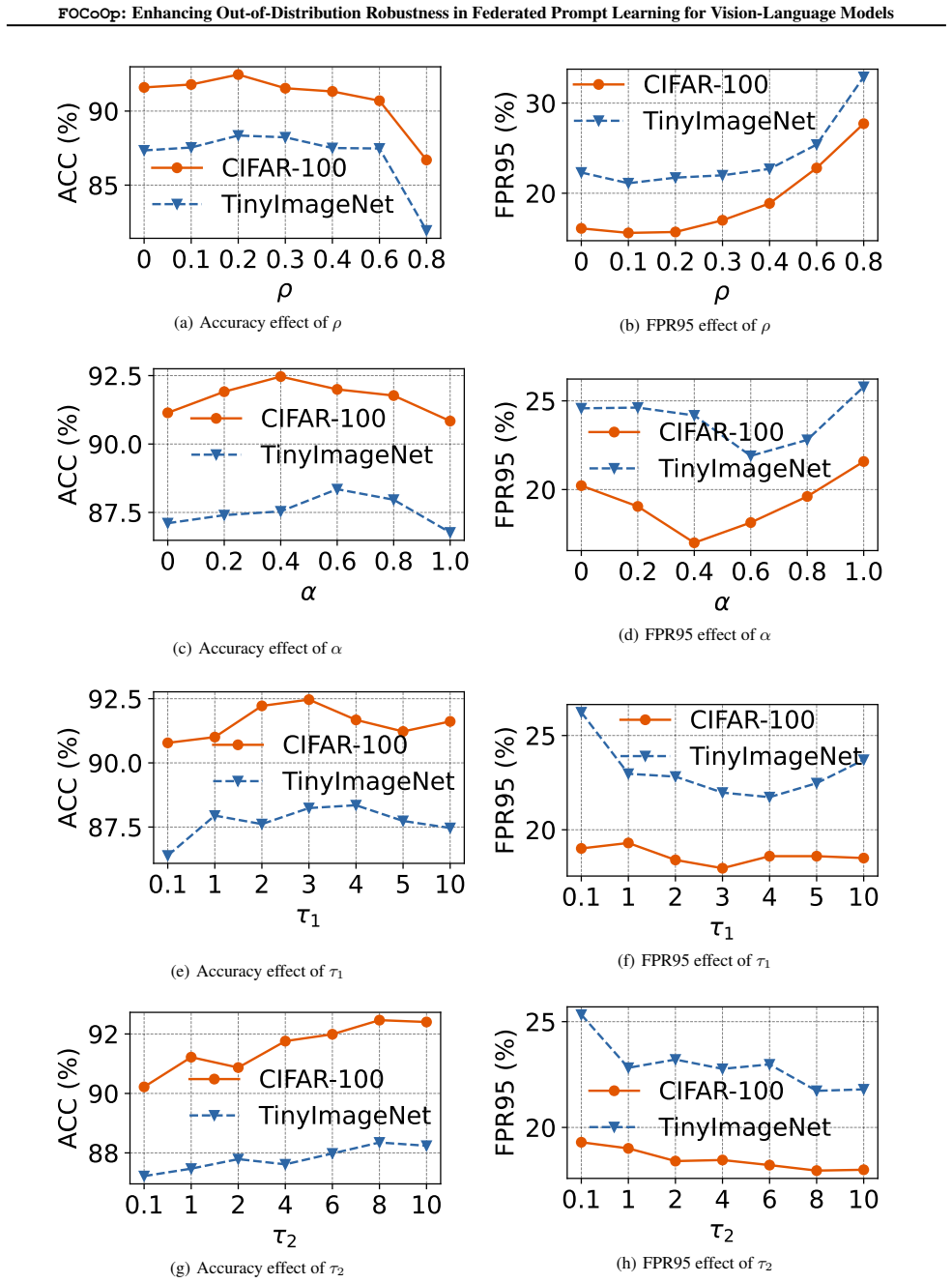
- [Section 4.2 and Fig. 7(a-b)] The text says 'optimal threshold ρ = 2', but the sensitivity grid in Fig. 7(a-b) is ρ ∈ {0, 0.1, 0.2, 0.3, 0.4, 0.5, 0.6, 0.8}; this should be ρ = 0.2 or the grid should be corrected.
- [Section 2.1 and Appendix D] The related work refers to 'FedFolio' while the experiments use 'PromptFolio'; please unify the naming. Similarly, Appendix D lists pFedprompt among comparison methods, but it does not appear in the main tables.
- [Appendix C, Eq. (8)] The KL term in Eq. (8) is written with a sum over c outside the bracket, while the argument π^T 1 is indexed by j; the notation should be aligned with the definition of KL(π^T 1 ‖ a).
- [Algorithm 2, lines 5 and 12] The gradients are taken of an expression containing 'arg min' with no indication of which variables are held fixed; the pseudocode should be rewritten to make the differentiation variables explicit.
Circularity Check
OOD-detection gains are partly a re-statement of the ℓD training objective because MCM shares the OOD-prompt softmax denominator.
-
fitted input called prediction
[Section 3.2, Eqs. (3)-(4); Section 4.1, Evaluation Metrics (MCM)]
"Similarly, we encourage distribution-level separation, by optimizing the loss for prediction probability of all ID prompts that are larger than OOD prompts, i.e., ℓD = Ex∈D [− log p(yID = 1|x)] , (4) where p(yID = 1|x) = PC c=1 S(x,tc)PC c=1 S(x,tc)+PU u=1 S(x,tou) ... We compute maximum concept matching (MCM) (Ming et al., 2022) as OOD detection score, which is based on similarity between textual features and image features."
MCM is the max-over-classes of the prediction probability defined in Eq. (3), whose denominator explicitly includes the trained OOD-prompt scores. Eq. (4)'s ℓD directly maximizes p(yID=1|x) = Σ_c S(x,t_c) / (Σ_c S(x,t_c) + Σ_u S(x,t_o_u)) on ID data. The reported OOD-detection metrics (FPR95, AUROC) therefore measure, by construction, the very ID-vs-OOD score ratio FOCoOp was trained to maximize; baselines that do not place OOD prompts in the MCM denominator, or that never train those scores down with ℓD, are not an equally matched yardstick. Part of the AUROC/FPR95 gain is a direct effect of the trained OOD-prompt set used in the score, not evidence of better OOD representation. The paper provides no control keeping the MCM denominator fixed while ablating the ℓD-trained OOD prompts.
full rationale
The paper's main empirical claim is benchmarked against seven external baselines on ACC/CACC/FPR95/AUROC and on domain-transfer tables, so the central comparison is not globally circular, and no load-bearing self-citation chain appears. Self-citations to FOOGD (Liao et al., 2024b) and to the authors' UOT works are motivational and background, not reductions. The proof of Theorem 3.1 has a support gap rather than a circularity: the main text assumes continuity and differentiability, while Supplement Theorem C.3 assumes concavity and never proves it; this needs fixing but does not make the DRO solution equivalent to its input. The one substantive circularity concern is evaluation-score alignment: Eq. (4) trains FOCoOp to maximize p(yID=1|x) = Σ_ID S / (Σ_ID S + Σ_OOD S), and MCM is computed from the same softmax-denominator family defined in Eq. (3), which contains the trained OOD prompts. Consequently, part of the reported FPR95/AUROC margin over baselines without OOD-prompt denominators re-states the training objective rather than providing independent evidence, and the missing matched-denominator control means the headline trade-off claim is only partially supported.
Assumptions & free parameters
free parameters (7)
- ρ =
swept over [0, 0.8]; text mentions optimal 2 (likely typo)
- α =
swept over [0, 1.0]
- τ1 =
swept over [0.1, 10]
- τ2 =
swept over [0.1, 10]
- U =
100
- M =
not specified
- γ =
not specified
assumptions (4)
- domain assumption WordNet supplies a sufficient lexical pool of OOD candidate classes for distribution-level separation
- domain assumption MCM with the modified softmax denominator is a valid OOD detection score
- ad hoc to paper The product-distribution expectation equals the OT distance in the dual derivation
- domain assumption All clients share the identical class label space
invented entities (1)
-
OOD prompts T^o
Cite this review
Pith. "Pith review of FOCoOp: Enhancing Out-of-Distribution Robustness in Federated Prompt Learning for Vision-Language Models." pith.science (2026). https://pith.science/paper/63ZIIKF3
@misc{pith2026250616218,
  author       = {Pith},
  title        = {Pith review of: FOCoOp: Enhancing Out-of-Distribution Robustness in Federated Prompt Learning for Vision-Language Models},
  year         = {2026},
  howpublished = {\url{https://pith.science/paper/63ZIIKF3}},
  note         = {Machine review of arXiv:2506.16218}
}
read the original abstract
Federated prompt learning (FPL) for vision-language models is a powerful approach to collaboratively adapt models across distributed clients while preserving data privacy. However, existing FPL approaches suffer from a trade-off between performance and robustness, particularly in out-of-distribution (OOD) shifts, limiting their reliability in real-world scenarios. The inherent in-distribution (ID) data heterogeneity among different clients makes it more challenging to maintain this trade-off. To fill this gap, we introduce a Federated OOD-aware Context Optimization (FOCoOp) framework, which captures diverse distributions among clients using ID global prompts, local prompts, and OOD prompts. Specifically, FOCoOp leverages three sets of prompts to create both class-level and distribution-level separations, which adapt to OOD shifts through bi-level distributionally robust optimization. Additionally, FOCoOp improves the discrimination consistency among clients, i.e., calibrating global prompts, seemingly OOD prompts, and OOD prompts by semi-unbalanced optimal transport. The extensive experiments on real-world datasets demonstrate that FOCoOp effectively captures decentralized heterogeneous distributions and enhances robustness of different OOD shifts. The project is available at GitHub.
Figures


Figures from the paper (5 more)


Reference graph
Works this paper leans on
-
[1]
Minimization of functions having lipschitz continuous first partial derivatives
Armijo, L. Minimization of functions having lipschitz continuous first partial derivatives. Pacific Journal of mathematics, 16 0 (1): 0 1--3, 1966
1966
-
[2]
D., and Li, Y
Bai, H., Canal, G., Du, X., Kwon, J., Nowak, R. D., and Li, Y. Feed two birds with one scone: Exploiting wild data for both out-of-distribution generalization and detection. In International Conference on Machine Learning, pp.\ 1454--1471. PMLR, 2023
2023
-
[3]
Diprompt: Disentangled prompt tuning for multiple latent domain generalization in federated learning
Bai, S., Zhang, J., Guo, S., Li, S., Guo, J., Hou, J., Han, T., and Lu, X. Diprompt: Disentangled prompt tuning for multiple latent domain generalization in federated learning. In Proceedings of the IEEE/CVF Conference on Computer Vision and Pattern Recognition, pp.\ 27284--27293, 2024 a
2024
-
[4]
Id-like prompt learning for few-shot out-of-distribution detection
Bai, Y., Han, Z., Cao, B., Jiang, X., Hu, Q., and Zhang, C. Id-like prompt learning for few-shot out-of-distribution detection. In Proceedings of the IEEE/CVF Conference on Computer Vision and Pattern Recognition, pp.\ 17480--17489, 2024 b
2024
-
[5]
Food-101--mining discriminative components with random forests
Bossard, L., Guillaumin, M., and Van Gool, L. Food-101--mining discriminative components with random forests. In Computer vision--ECCV 2014: 13th European conference, zurich, Switzerland, September 6-12, 2014, proceedings, part VI 13, pp.\ 446--461. Springer, 2014
2014
-
[6]
A Unified Wasserstein Distributional Robustness Framework for Adversarial Training
Bui, T. A., Le, T., Tran, Q., Zhao, H., and Phung, D. A unified wasserstein distributional robustness framework for adversarial training. arXiv preprint arXiv:2202.13437, 2022
work page Pith review arXiv 2022
-
[7]
and Chao, W.-L
Chen, H.-Y. and Chao, W.-L. On bridging generic and personalized federated learning for image classification. In International Conference on Learning Representations, 2021
2021
-
[8]
Describing textures in the wild
Cimpoi, M., Maji, S., Kokkinos, I., Mohamed, S., and Vedaldi, A. Describing textures in the wild. In Proceedings of the IEEE conference on computer vision and pattern recognition, pp.\ 3606--3613, 2014 a
work page 2014
Show all 86 references
-
[9]
Describing textures in the wild
Cimpoi, M., Maji, S., Kokkinos, I., Mohamed, S., and Vedaldi, A. Describing textures in the wild. In Proceedings of the IEEE conference on computer vision and pattern recognition, pp.\ 3606--3613, 2014 b
2014
-
[10]
Clarkson, K. L. Coresets, sparse greedy approximation, and the frank-wolfe algorithm. ACM Transactions on Algorithms (TALG), 6 0 (4): 0 1--30, 2010
2010
-
[11]
Harmonizing generalization and personalization in federated prompt learning
Cui, T., Li, H., Wang, J., and Shi, Y. Harmonizing generalization and personalization in federated prompt learning. In Salakhutdinov, R., Kolter, Z., Heller, K., Weller, A., Oliver, N., Scarlett, J., and Berkenkamp, F. (eds.), Proceedings of the 41st International Conference o...
2024
-
[12]
Q., Li, A., and Kung, H
Dong, X., Zhang, S. Q., Li, A., and Kung, H. Spherefed: Hyperspherical federated learning. In ECCV, pp.\ 165--184. Springer, 2022
2022
-
[13]
An image is worth 16x16 words: Transformers for image recognition at scale
Dosovitskiy, A. An image is worth 16x16 words: Transformers for image recognition at scale. arXiv preprint arXiv:2010.11929, 2020
2010 arXiv
-
[14]
Learning generative visual models from few training examples: An incremental bayesian approach tested on 101 object categories
Fei-Fei, L., Fergus, R., and Perona, P. Learning generative visual models from few training examples: An incremental bayesian approach tested on 101 object categories. In 2004 conference on computer vision and pattern recognition workshop, pp.\ 178--178. IEEE, 2004
2004
-
[15]
Wordnet: An electronic lexical database
Fellbaum, C. Wordnet: An electronic lexical database. MIT Press google schola, 2: 0 678--686, 1998
1998
-
[16]
Learning federated visual prompt in null space for mri reconstruction
Feng, C.-M., Li, B., Xu, X., Liu, Y., Fu, H., and Zuo, W. Learning federated visual prompt in null space for mri reconstruction. In Proceedings of the IEEE/CVF Conference on Computer Vision and Pattern Recognition, pp.\ 8064--8073, 2023
2023
-
[17]
Geodesic flow kernel for unsupervised domain adaptation
Gong, B., Shi, Y., Sha, F., and Grauman, K. Geodesic flow kernel for unsupervised domain adaptation. In 2012 IEEE conference on computer vision and pattern recognition, pp.\ 2066--2073. IEEE, 2012
2012
-
[18]
Pfedprompt: Learning personalized prompt for vision-language models in federated learning
Guo, T., Guo, S., and Wang, J. Pfedprompt: Learning personalized prompt for vision-language models in federated learning. In Proceedings of the ACM Web Conference 2023, pp.\ 1364--1374, 2023 a
2023
-
[19]
Promptfl: Let federated participants cooperatively learn prompts instead of models-federated learning in age of foundation model
Guo, T., Guo, S., Wang, J., Tang, X., and Xu, W. Promptfl: Let federated participants cooperatively learn prompts instead of models-federated learning in age of foundation model. IEEE Transactions on Mobile Computing, 2023 b
2023
-
[20]
Out-of-distribution generalization of federated learning via implicit invariant relationships
Guo, Y., Guo, K., Cao, X., Wu, T., and Chang, Y. Out-of-distribution generalization of federated learning via implicit invariant relationships. In International Conference on Machine Learning, pp.\ 11905--11933. PMLR, 2023 c
2023
-
[21]
Deep residual learning for image recognition
He, K., Zhang, X., Ren, S., and Sun, J. Deep residual learning for image recognition. In Proceedings of the IEEE conference on computer vision and pattern recognition, pp.\ 770--778, 2016
2016
-
[22]
and Dietterich, T
Hendrycks, D. and Dietterich, T. G. Benchmarking neural network robustness to common corruptions and surface variations. arXiv preprint arXiv:1807.01697, 2018
2018 arXiv
-
[23]
and Gimpel, K
Hendrycks, D. and Gimpel, K. A baseline for detecting misclassified and out-of-distribution examples in neural networks. In International Conference on Learning Representations, 2016
2016
-
[24]
Federated learning for generalization, robustness, fairness: A survey and benchmark
Huang, W., Ye, M., Shi, Z., Wan, G., Li, H., Du, B., and Yang, Q. Federated learning for generalization, robustness, fairness: A survey and benchmark. IEEE Transactions on Pattern Analysis and Machine Intelligence, 2024
2024
-
[25]
Revisiting frank-wolfe: Projection-free sparse convex optimization
Jaggi, M. Revisiting frank-wolfe: Projection-free sparse convex optimization. In International conference on machine learning, pp.\ 427--435. PMLR, 2013
2013
-
[26]
Scaling up visual and vision-language representation learning with noisy text supervision
Jia, C., Yang, Y., Xia, Y., Chen, Y.-T., Parekh, Z., Pham, H., Le, Q., Sung, Y.-H., Li, Z., and Duerig, T. Scaling up visual and vision-language representation learning with noisy text supervision. In International conference on machine learning, pp.\ 4904--4916. PMLR, 2021
2021
-
[27]
and Lin, T
Jiang, L. and Lin, T. Test-time robust personalization for federated learning. In The Eleventh International Conference on Learning Representations, 2022
2022
-
[28]
Negative label guided ood detection with pretrained vision-language models
Jiang, X., Liu, F., Fang, Z., Chen, H., Liu, T., Zheng, F., and Han, B. Negative label guided ood detection with pretrained vision-language models. In The Twelfth International Conference on Learning Representations, 2024
2024
-
[29]
P., Kale, S., Mohri, M., Reddi, S., Stich, S., and Suresh, A
Karimireddy, S. P., Kale, S., Mohri, M., Reddi, S., Stich, S., and Suresh, A. T. Scaffold: Stochastic controlled averaging for federated learning. In International conference on machine learning, pp.\ 5132--5143. PMLR, 2020
2020
-
[30]
Learning multiple layers of features from tiny images
Krizhevsky, A., Hinton, G., et al. Learning multiple layers of features from tiny images. 2009
2009
-
[31]
Fine-tuning can distort pretrained features and underperform out-of-distribution
Kumar, A., Raghunathan, A., Jones, R., Ma, T., and Liang, P. Fine-tuning can distort pretrained features and underperform out-of-distribution. arXiv preprint arXiv:2202.10054, 2022
2022 arXiv
-
[32]
Gallop: Learning global and local prompts for vision-language models
Lafon, M., Ramzi, E., Rambour, C., Audebert, N., and Thome, N. Gallop: Learning global and local prompts for vision-language models. In European Conference on Computer Vision, pp.\ 264--282. Springer, 2025
2025
-
[33]
and Yang, X
Le, Y. and Yang, X. Tiny imagenet visual recognition challenge. CS 231N, 7 0 (7): 0 3, 2015
2015
-
[34]
Li, D., Yang, Y., Song, Y.-Z., and Hospedales, T. M. Deeper, broader and artier domain generalization. In Proceedings of the IEEE international conference on computer vision, pp.\ 5542--5550, 2017
2017
-
[35]
Global and local prompts cooperation via optimal transport for federated learning
Li, H., Huang, W., Wang, J., and Shi, Y. Global and local prompts cooperation via optimal transport for federated learning. In Proceedings of the IEEE/CVF Conference on Computer Vision and Pattern Recognition, pp.\ 12151--12161, 2024
2024
-
[36]
Model-contrastive federated learning
Li, Q., He, B., and Song, D. Model-contrastive federated learning. In Proceedings of the IEEE/CVF conference on computer vision and pattern recognition, pp.\ 10713--10722, 2021
2021
-
[37]
K., Zaheer, M., Sanjabi, M., Talwalkar, A., and Smith, V
Li, T., Sahu, A. K., Zaheer, M., Sanjabi, M., Talwalkar, A., and Smith, V. Federated optimization in heterogeneous networks. Proceedings of Machine learning and systems, 2: 0 429--450, 2020
2020
-
[38]
and Wang, J
Li, X. and Wang, J. Position paper: Assessing robustness, privacy, and fairness in federated learning integrated with foundation models. arXiv preprint arXiv:2402.01857, 2024
2024
-
[39]
Hyperfed: hyperbolic prototypes exploration with consistent aggregation for non-iid data in federated learning
Liao, X., Liu, W., Chen, C., Zhou, P., Zhu, H., Tan, Y., Wang, J., and Qi, Y. Hyperfed: hyperbolic prototypes exploration with consistent aggregation for non-iid data in federated learning. In Proceedings of the Thirty-Second International Joint Conference on Artificial Intell...
2023
-
[40]
Rethinking the representation in federated unsupervised learning with non-iid data
Liao, X., Liu, W., Chen, C., Zhou, P., Yu, F., Zhu, H., Yao, B., Wang, T., Zheng, X., and Tan, Y. Rethinking the representation in federated unsupervised learning with non-iid data. In Proceedings of the IEEE/CVF Conference on Computer Vision and Pattern Recognition, pp.\ 2284...
2024
-
[41]
Foogd: Federated collaboration for both out-of-distribution generalization and detection
Liao, X., Liu, W., Zhou, P., Yu, F., Xu, J., Wang, J., Wang, W., Chen, C., and Zheng, X. Foogd: Federated collaboration for both out-of-distribution generalization and detection. arXiv preprint arXiv:2410.11397, 2024 b
2024 arXiv
-
[42]
Feddg: Federated domain generalization on medical image segmentation via episodic learning in continuous frequency space
Liu, Q., Chen, C., Qin, J., Dou, Q., and Heng, P.-A. Feddg: Federated domain generalization on medical image segmentation via episodic learning in continuous frequency space. In Proceedings of the IEEE/CVF Conference on Computer Vision and Pattern Recognition, pp.\ 1013--1023, 2021
2021
-
[43]
Reducing item discrepancy via differentially private robust embedding alignment for privacy-preserving cross domain recommendation
Liu, W., Zheng, X., Chen, C., Xu, J., Liao, X., Wang, F., Tan, Y., and Ong, Y.-S. Reducing item discrepancy via differentially private robust embedding alignment for privacy-preserving cross domain recommendation. In Proceedings of the 41st International Conference on Machine ...
2024
-
[44]
Hyperbolic variational graph auto-encoder for next poi recommendation
Liu, Y., Qi, L., Mao, X., Liu, W., Wang, F., Xu, X., Zhang, X., Dou, W., Zhou, X., and Beheshti, A. Hyperbolic variational graph auto-encoder for next poi recommendation. In Proceedings of the ACM on Web Conference 2025, pp.\ 3267--3275, 2025 a
2025
-
[45]
Guardreasoner-vl: Safeguarding vlms via reinforced reasoning
Liu, Y., Zhai, S., Du, M., Chen, Y., Cao, T., Gao, H., Wang, C., Li, X., Wang, K., Fang, J., et al. Guardreasoner-vl: Safeguarding vlms via reinforced reasoning. arXiv preprint arXiv:2505.11049, 2025 b
2025 arXiv
-
[46]
Does clip's generalization performance mainly stem from high train-test similarity? arXiv preprint arXiv:2310.09562, 2023
Mayilvahanan, P., Wiedemer, T., Rusak, E., Bethge, M., and Brendel, W. Does clip's generalization performance mainly stem from high train-test similarity? arXiv preprint arXiv:2310.09562, 2023
2023 arXiv
-
[47]
McMahan, B., Moore, E., Ramage, D., Hampson, S., and y Arcas, B. A. Communication-efficient learning of deep networks from decentralized data. In Artificial intelligence and statistics, pp.\ 1273--1282. PMLR, 2017
2017
-
[48]
Delving into out-of-distribution detection with vision-language representations
Ming, Y., Cai, Z., Gu, J., Sun, Y., Li, W., and Li, Y. Delving into out-of-distribution detection with vision-language representations. Advances in neural information processing systems, 35: 0 35087--35102, 2022
2022
-
[49]
Locoop: Few-shot out-of-distribution detection via prompt learning
Miyai, A., Yu, Q., Irie, G., and Aizawa, K. Locoop: Few-shot out-of-distribution detection via prompt learning. Advances in Neural Information Processing Systems, 36, 2024
2024
-
[50]
T., Torr, P., and Lim, S
Nguyen, A. T., Torr, P., and Lim, S. N. Fedsr: A simple and effective domain generalization method for federated learning. Advances in Neural Information Processing Systems, 35: 0 38831--38843, 2022 a
2022
-
[51]
T., Torr, P., and Lim, S
Nguyen, A. T., Torr, P., and Lim, S. N. Fedsr: A simple and effective domain generalization method for federated learning. Advances in Neural Information Processing Systems, 35: 0 38831--38843, 2022 b
2022
-
[52]
and Zisserman, A
Nilsback, M.-E. and Zisserman, A. Automated flower classification over a large number of classes. In 2008 Sixth Indian conference on computer vision, graphics & image processing, pp.\ 722--729. IEEE, 2008
2008
-
[53]
Federated learning from vision-language foundation models: Theoretical analysis and method
Pan, B., Huang, W., and Shi, Y. Federated learning from vision-language foundation models: Theoretical analysis and method. arXiv preprint arXiv:2409.19610, 2024
2024 arXiv
-
[54]
M., Vedaldi, A., Zisserman, A., and Jawahar, C
Parkhi, O. M., Vedaldi, A., Zisserman, A., and Jawahar, C. Cats and dogs. In 2012 IEEE conference on computer vision and pattern recognition, pp.\ 3498--3505. IEEE, 2012
2012
-
[55]
Moment matching for multi-source domain adaptation
Peng, X., Bai, Q., Xia, X., Huang, Z., Saenko, K., and Wang, B. Moment matching for multi-source domain adaptation. In Proceedings of the IEEE/CVF international conference on computer vision, pp.\ 1406--1415, 2019
2019
-
[56]
Counterfactual user sequence synthesis augmented with continuous time dynamic preference modeling for sequential poi recommendation
Qi, L., Liu, Y., Liu, W., Pei, S., Xu, X., Zhang, X., Wang, Y., and Dou, W. Counterfactual user sequence synthesis augmented with continuous time dynamic preference modeling for sequential poi recommendation. In Proceedings of the Thirty-Third International Joint Conference on...
2024
-
[57]
K., Ganesh, M
Qiu, C., Li, X., Mummadi, C. K., Ganesh, M. R., Li, Z., Peng, L., and Lin, W.-Y. Text-driven prompt generation for vision-language models in federated learning. In International Workshop on Federated Learning in the Age of Foundation Models in Conjunction with NeurIPS, 2023
2023
-
[58]
Generalized federated learning via sharpness aware minimization
Qu, Z., Li, X., Duan, R., Liu, Y., Tang, B., and Lu, Z. Generalized federated learning via sharpness aware minimization. In International Conference on Machine Learning, pp.\ 18250--18280. PMLR, 2022
2022
-
[59]
W., Hallacy, C., Ramesh, A., Goh, G., Agarwal, S., Sastry, G., Askell, A., Mishkin, P., Clark, J., et al
Radford, A., Kim, J. W., Hallacy, C., Ramesh, A., Goh, G., Agarwal, S., Sastry, G., Askell, A., Mishkin, P., Clark, J., et al. Learning transferable visual models from natural language supervision. In International conference on machine learning, pp.\ 8748--8763. PMLR, 2021
2021
-
[60]
Clip-guided federated learning on heterogeneity and long-tailed data
Shi, J., Zheng, S., Yin, X., Lu, Y., Xie, Y., and Qu, Y. Clip-guided federated learning on heterogeneity and long-tailed data. In Proceedings of the AAAI Conference on Artificial Intelligence, volume 38, pp.\ 14955--14963, 2024
2024
-
[61]
Clipood: Generalizing clip to out-of-distributions
Shu, Y., Guo, X., Wu, J., Wang, X., Wang, J., and Long, M. Clipood: Generalizing clip to out-of-distributions. In International Conference on Machine Learning, pp.\ 31716--31731. PMLR, 2023
2023
-
[62]
Certifying some distributional robustness with principled adversarial training
Sinha, A., Namkoong, H., Volpi, R., and Duchi, J. Certifying some distributional robustness with principled adversarial training. arXiv preprint arXiv:1710.10571, 2017
2017 arXiv
-
[63]
Is heterogeneity notorious? taming heterogeneity to handle test-time shift in federated learning
Tan, Y., Chen, C., Zhuang, W., Dong, X., Lyu, L., and Long, G. Is heterogeneity notorious? taming heterogeneity to handle test-time shift in federated learning. In Thirty-seventh Conference on Neural Information Processing Systems, 2023
2023
-
[64]
Exploiting personalized invariance for better out-of-distribution generalization in federated learning
Tang, X., Guo, S., and Zhang, J. Exploiting personalized invariance for better out-of-distribution generalization in federated learning. arXiv preprint arXiv:2211.11243, 2022
2022 arXiv
-
[65]
The inaturalist species classification and detection dataset
Van Horn, G., Mac Aodha, O., Song, Y., Cui, Y., Sun, C., Shepard, A., Adam, H., Perona, P., and Belongie, S. The inaturalist species classification and detection dataset. In Proceedings of the IEEE conference on computer vision and pattern recognition, pp.\ 8769--8778, 2018
2018
-
[66]
Ce-rcfr: Robust counterfactual regression for consensus-enabled treatment effect estimation
Wang, F., Chen, C., Liu, W., Fan, T., Liao, X., Tan, Y., Qi, L., and Zheng, X. Ce-rcfr: Robust counterfactual regression for consensus-enabled treatment effect estimation. In Proceedings of the 30th ACM SIGKDD Conference on Knowledge Discovery and Data Mining, pp.\ 3013--3023, 2024 a
2024
-
[67]
Inter- and intra- similarity preserved counterfactual incentive effect estimation for recommendation systems
Wang, F., Qi, L., Liu, W., Yu, B., Chen, J., and Xu, Y. Inter- and intra- similarity preserved counterfactual incentive effect estimation for recommendation systems. ACM Trans. Inf. Syst., 2025 a . doi:10.1145/3722104
2025 doi
-
[68]
Clipn for zero-shot ood detection: Teaching clip to say no
Wang, H., Li, Y., Yao, H., and Li, X. Clipn for zero-shot ood detection: Teaching clip to say no. In Proceedings of the IEEE/CVF International Conference on Computer Vision, pp.\ 1802--1812, 2023
2023
-
[69]
Outlier-robust distributionally robust optimization via unbalanced optimal transport
Wang, Z. Outlier-robust distributionally robust optimization via unbalanced optimal transport. In Annual Conference on Neural Information Processing Systems, 2025
2025
-
[70]
Flora: Federated fine-tuning large language models with heterogeneous low-rank adaptations
Wang, Z., Shen, Z., He, Y., Sun, G., Wang, H., Lyu, L., and Li, A. Flora: Federated fine-tuning large language models with heterogeneous low-rank adaptations. In Advances in Neural Information Processing Systems, volume 37, pp.\ 22513--22533. Curran Associates, Inc., 2024 b
2024
-
[71]
M., and Johansson, K
Wang, Z., Shen, Y., Zavlanos, M. M., and Johansson, K. H. Outlier-robust distributionally robust optimization via unbalanced optimal transport. In The Thirty-eighth Annual Conference on Neural Information Processing Systems, 2025 b
2025
-
[72]
T., Weng, L., and Hoang, N
Weng, P.-Y., Hoang, M., Nguyen, L., Thai, M. T., Weng, L., and Hoang, N. Probabilistic federated prompt-tuning with non-iid and imbalanced data. Advances in Neural Information Processing Systems, 37: 0 81933--81958, 2024
2024
-
[73]
A., Oliva, A., and Torralba, A
Xiao, J., Hays, J., Ehinger, K. A., Oliva, A., and Torralba, A. Sun database: Large-scale scene recognition from abbey to zoo. In 2010 IEEE computer society conference on computer vision and pattern recognition, pp.\ 3485--3492. IEEE, 2010
2010
-
[74]
A., Zhang, Y., Finkelstein, A., Kulkarni, S
Xu, P., Ehinger, K. A., Zhang, Y., Finkelstein, A., Kulkarni, S. R., and Xiao, J. Turkergaze: Crowdsourcing saliency with webcam based eye tracking. arXiv preprint arXiv:1504.06755, 2015
2015 arXiv
-
[75]
Yang, F.-E., Wang, C.-Y., and Wang, Y.-C. F. Efficient model personalization in federated learning via client-specific prompt generation. In Proceedings of the IEEE/CVF International Conference on Computer Vision, pp.\ 19159--19168, 2023
2023
-
[76]
Generalized out-of-distribution detection: A survey
Yang, J., Zhou, K., Li, Y., and Liu, Z. Generalized out-of-distribution detection: A survey. International Journal of Computer Vision, 132 0 (12): 0 5635--5662, 2024
2024
-
[77]
Lsun: Construction of a large-scale image dataset using deep learning with humans in the loop
Yu, F., Seff, A., Zhang, Y., Song, S., Funkhouser, T., and Xiao, J. Lsun: Construction of a large-scale image dataset using deep learning with humans in the loop. arXiv preprint arXiv:1506.03365, 2015
2015 arXiv
-
[78]
Turning the curse of heterogeneity in federated learning into a blessing for out-of-distribution detection
Yu, S., Hong, J., Wang, H., Wang, Z., and Zhou, J. Turning the curse of heterogeneity in federated learning into a blessing for out-of-distribution detection. In 2023 International Conference on Learning Representations, 2023
2023
-
[79]
R., Ning, L., and Singhal, K
Yuan, H., Morningstar, W. R., Ning, L., and Singhal, K. What do we mean by generalization in federated learning? In International Conference on Learning Representations, 2021
2021
-
[80]
Rethinking misalignment in vision-language model adaptation from a causal perspective
Zhang, Y., Li, J., Liu, L., and Qiang, W. Rethinking misalignment in vision-language model adaptation from a causal perspective. In Advances in Neural Information Processing Systems, volume 37, pp.\ 39224--39248, 2024
2024
-
[81]
Lapt: Label-driven automated prompt tuning for ood detection with vision-language models
Zhang, Y., Zhu, W., He, C., and Zhang, L. Lapt: Label-driven automated prompt tuning for ood detection with vision-language models. In European Conference on Computer Vision, pp.\ 271--288. Springer, 2025
2025
-
[82]
Places: A 10 million image database for scene recognition
Zhou, B., Lapedriza, A., Khosla, A., Oliva, A., and Torralba, A. Places: A 10 million image database for scene recognition. IEEE transactions on pattern analysis and machine intelligence, 40 0 (6): 0 1452--1464, 2017
2017
-
[83]
C., and Liu, Z
Zhou, K., Yang, J., Loy, C. C., and Liu, Z. Learning to prompt for vision-language models. International Journal of Computer Vision, 130 0 (9): 0 2337--2348, 2022
2022
-
[84]
Fedgog: Federated graph out-of-distribution generalization with diffusion data exploration and latent embedding decorrelation
Zhou, P., Chen, C., Liu, W., Liao, X., Shen, W., Xu, J., Fu, Z., Wang, J., Wen, W., and Zheng, X. Fedgog: Federated graph out-of-distribution generalization with diffusion data exploration and latent embedding decorrelation. In Proceedings of the AAAI Conference on Artificial ...
2025
-
[85]
Fedgf: Enhancing structural knowledge via graph factorization for federated graph learning
Zhou, P., Chen, C., Liu, W., Liao, X., Yu, F., Fu, Z., Lou, X., Wen, W., Zheng, X., and Wang, J. Fedgf: Enhancing structural knowledge via graph factorization for federated graph learning. In Proceedings of the Eighteenth ACM International Conference on Web Search and Data Min...
2025
-
[86]
write newline
" write newline "" before.all 'output.state := FUNCTION n.dashify 't := "" t empty not t #1 #1 substring "-" = t #1 #2 substring "--" = not "--" * t #2 global.max substring 't := t #1 #1 substring "-" = "-" * t #2 global.max substring 't := while if t #1 #1 substring * t #2 gl...
Reviewed August 6, 2026 · model on record in the stance chip above.
Discussion (0). Sign in to comment.