REVIEW 3 major objections 4 minor 1 cited by
Schwinger Effect in a Twice Anisotropic Holographic Model
T0 review · 3 major / 4 minor · reviewed 2026-08-06 · deepseek-v4-flash
Pith's one-line read In a holographic QCD model with both spatial and magnetic anisotropy, the magnetic parameters cB and q3 lower the Schwinger barrier, while the spatial parameter ν raises it.
desk verdict A compact, plausible holographic calculation of the Schwinger barrier in a twice-anisotropic QCD background, but the headline claim is only demonstrated for one spatial orientation and is stated more generally than the evidence supports. read the letter →
The pith
A machine-rendered reading of the paper's core claim, the machinery that carries it, and where it could break.
The reading
What carries the argument
The central object is the total potential $V_{\rm tot}(x)$ as a function of the pair separation $x$, obtained by extremizing the Nambu-Goto action of a string hanging in the anisotropic background. The metric contains the spatial-anisotropy parameter $\nu$ through factors $(z/L)^{2-2/\nu}$ and the magnetic anisotropy through $e^{c_B z^2}$; the blackening function $g(z)$ is assembled from integrals $\tilde I_1(z)$ and $\tilde I_2(z)$ that encode the charge parameters and the deformation factor $A(z)=-cz^2/4-(p-c_B q_3)z^4$. Conservation of the worldsheet Hamiltonian yields a first-order equation for the string profile, whose integration gives the separation length $x$ and the Coulomb-plus-static energy $V_{\rm (CP+SE)}$, while the Dirac-Born-Infeld action fixes the critical electric field $E_c$. Comparing $V_{\rm tot}$ across $c_B$, $q_3$, and $\nu$ at fixed temperature and $\alpha$ is what reveals the barrier trends.
What would settle it
Recompute the total potential from the stated action by independently solving for the blackening function instead of using Eqs. (4)–(6), or compute the static pair potential in a magnetized, spatially anisotropic quark-gluon plasma at $T\approx 0.6$ GeV on the lattice; if increasing $|c_B|$ or $q_3$ raises the barrier, or increasing $\nu$ lowers it, the paper's central claim fails.
Extended reading notes
Core claim
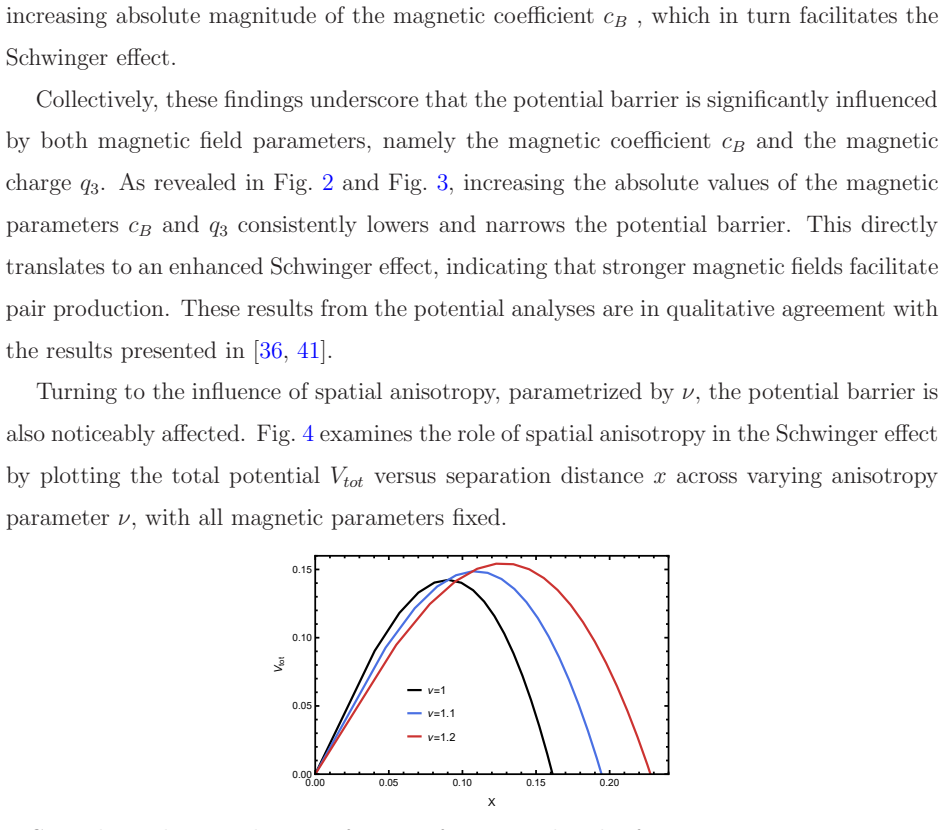
Within a five-dimensional Einstein-Maxwell-dilaton gravity background with three Maxwell fields, the paper derives the total potential $V_{\rm tot}=V_{\rm (CP+SE)}-Ex$ for a pair aligned with the magnetic direction $x_3$, using the Nambu-Goto string action and a Dirac-Born-Infeld critical-field argument. At fixed temperature $T=0.6$ GeV and fixed $\alpha=E/E_c=0.8$, increasing the magnetic charge $q_3$ or the absolute magnitude of the magnetic coefficient $c_B$ lowers the height and narrows the width of the potential barrier, which enhances quantum tunneling and hence the Schwinger effect. Increasing the spatial-anisotropy parameter $\nu$ raises and widens the barrier, increasing the energy needed to separate a virtual pair and suppressing the effect. The barrier vanishes at the critical field $\alpha=1$ for all parameter choices, and for $\alpha>1$ pair production is unsuppressed.
Load-bearing premise
The central result rests on the assumption that the fitted anisotropic holographic background, including the constants $R_{gg}=1.16$ and $p=0.273$, correctly describes the quark-gluon plasma at $T=0.6$ GeV; if that background is invalid or the numerical potential formulas contain an error, the claimed barrier trends could be artifacts.
Editorial extensions
If this is right
- A stronger magnetic field in off-central heavy-ion collisions should increase the Schwinger pair-production rate by lowering and narrowing the barrier.
- A more spatially anisotropic early-stage plasma should suppress pair production relative to an isotropic plasma with the same magnetic field.
- Because the magnetic and spatial anisotropies push the barrier in opposite directions, the net rate in a realistic collision depends on their competition, not on either one alone.
- At $\alpha=E/E_c\ge 1$ the barrier disappears, so sufficiently strong electric fields make the vacuum unstable independently of the anisotropy parameters.
Reading between the lines
- The paper does not compute a tunneling rate, but its barrier trends imply that the WKB exponent, and hence the pair-production rate, should decrease monotonically with $|c_B|$ and $q_3$ and increase with $\nu$; converting the potentials into rates would make the prediction quantitative.
- Because the magnetic and spatial anisotropies both evolve over a few fm/c in real collisions, a natural extension is a time-dependent background; if implemented, the barrier height should change with time, producing a time-dependent pair-production signal.
- The calculation aligns the pair and the electric field with the magnetic direction $x_3$; since the metric distinguishes $x_2$ and $x_3$, orientation-dependent barriers are a direct, untested consequence of the same model.
- In a heavy-ion event the magnetic field is strongest early and in peripheral collisions while spatial anisotropy is also large, so the competing effects may partially cancel; this could make the Schwinger signal weaker or harder to isolate than single-anisotropy studies suggest.
Editorial analysis
A structured set of objections, weighed in public.
Referee Report
Summary. The paper studies the holographic Schwinger effect in a five-dimensional Einstein-Maxwell-dilaton background that contains both a spatial anisotropy parameter ν and magnetic-field parameters c_B and q_3. Using a Nambu-Goto string action in the x3 direction with an external electric field parallel to the magnetic field, the author computes the total potential of a particle-antiparticle pair as a function of separation, extracts the potential barrier, and claims that increasing |c_B| and q_3 lowers and narrows the barrier, while increasing ν raises and widens it. The conclusion is that magnetic anisotropy enhances and spatial anisotropy suppresses Schwinger pair production in heavy-ion collisions, in qualitative agreement with earlier single-anisotropy studies.
Significance. If the computation is correct, the paper provides a useful demonstration that two competing sources of anisotropy can act in opposite directions on holographic pair production, and it is one of the few studies combining spatial and magnetic anisotropies in one background. The qualitative consistency with prior work [34,36,41,42] gives some plausibility to the reported trends. However, the central quantitative claim depends on a single spatial orientation, on an imported background whose dilaton potential is not specified, and on analytic expressions that appear to be inconsistent with the stated metric. The value of the paper lies mainly in the qualitative separation of the two anisotropy effects, not in a new quantitative precision result.
major comments (3)
- [Section III, Eq. (10)] I cannot reproduce Eq. (10) from the metric (2) and the embedding (8). For the induced worldsheet metric, det g_ab = -(b^2/z^4)(g e^{c_B z^2} z^{2-2/ν} + \dot z^2), so sqrt(-det) = (b/z^2) sqrt(g e^{c_B z^2} z^{2-2/ν} + \dot z^2). Eq. (10) instead contains e^{c_B z^2}/g(z) in the first term, with no factor of g(z) multiplying the exponential and the z^{2-2/ν} factor. Since Eqs. (13)-(15) and hence all the potential curves in Figs. 2-4 are derived from this Lagrangian, the numerical trends could be an artifact of this discrepancy. The author should provide the full derivation of Eq. (10) or correct the worldsheet action and rerun the numerics.
- [Section III, first paragraph; Section IV] The claim that the x1 and x2 directions are 'simplified special cases' of x3 when c_B=0 and ν=1 does not justify generalizing the results to those directions, because in that limit all anisotropies that are being studied are switched off. The calculation is performed only for a pair and an electric field aligned along x3, where the metric component carries both e^{c_B z^2} and the spatial-anisotropy factor. The abstract and Section IV state without qualification that magnetic parameters enhance and ν suppresses the Schwinger effect; as written, the evidence supports that conclusion only for the parallel x3 configuration. The author should either extend the calculation to x1 and x2 or explicitly restrict the conclusions to the configuration actually computed.
- [Section II, Eqs. (1)-(6)] The action (1) contains an unspecified dilaton potential V(φ), and the background is imported from Refs. [37-39] with A(z) and parameters stated only in the text. The paper states that 'solving the equations of motion yields' the blackening function g(z), but it does not give V(φ) or any consistency check that the chosen A(z), c, p, and c_B q_3 satisfy the Einstein-dilaton-Maxwell equations at T=0.6 GeV and μ=0.1. For the paper to be reproducible, the author should either provide V(φ) explicitly or cite the precise form and numerical procedure used in the underlying references, and state how z_h and the probe D3-brane position z_0 are fixed.
minor comments (4)
- [Section III, Eqs. (13)-(15)] The notation in Eqs. (14) and (15) is hard to parse: expressions such as z^{2+2/ν}_c and the placement of subscripts make it difficult to verify the algebra. A cleaner typesetting with explicit parentheses would help the reader check the formulas against the conserved Hamiltonian.
- [Introduction, p. 2] The sentence reporting 'magnetic fields (10^{-1}·m^2_π ∼ 15·m^2_π)' is unclear; it should state whether these are eB values in units of m_π^2 and use consistent notation.
- [Section III, Figs. 2-4] The figures show only three parameter values per scan and only a narrow x-window, so the claimed 'height and width' changes are read visually. The author should define the barrier height and width quantitatively and confirm that the monotonic trends persist for other values of α, since only α=0.8 is shown in the anisotropy scans.
- [Abstract and Section IV] The phrase 'consistently enhances' and the statement that the magnetic field 'facilitates pair production' are stated as general results; given that only the x3 orientation is computed, the abstract should include the qualifier that this is for the parallel configuration.
Circularity Check
No significant circularity: the Schwinger-potential calculation is a direct numerical evaluation in an inherited holographic background; the only self-citation, Ref. [42], is a consistency reference and is not load-bearing.
full rationale
The derivation chain is self-contained for what it computes. The metric of Eq. (2), the blackening function of Eqs. (4)-(6), and the constants Rgg=1.16 and p=0.273 are taken from Refs. [37]-[40], which constrain the QCD background independently of the Schwinger effect; c_B, q_3, nu, mu and T are scanned inputs for the potential analysis, not fitted to the barrier heights or pair-production rates. The total potential Vtot=V(CP+SE)-Ex is obtained by integrating the Nambu-Goto action (Eqs. (9)-(15)), and the critical field E_c is computed from the DBI action (Eqs. (16)-(17)). The barrier trends in Figs. 2-4 are numerical outputs of those expressions, so no fitted quantity is renamed as a prediction. The only self-citation, Ref. [42] by the author with D.-f. Hou, is invoked merely as one of several prior calculations (along with Refs. [34,35]) that also find spatial-anisotropy suppression; removing it would not change the computed curves, so it is not load-bearing. The broader claim that the result applies to arbitrary orientations may be overgeneralized because only the x3-aligned pair/electric-field configuration of Eq. (8) is computed, but that is a scope or correctness limitation, not a circularity. No equation reduces to its own input by construction.
Assumptions & free parameters
free parameters (5)
- Rgg =
1.16
- p =
0.273
- chemical potential mu =
0.1 GeV
- temperature T =
0.6 GeV
- probe D3-brane position z0
assumptions (6)
- domain assumption AdS/CFT correspondence maps the strongly coupled gauge theory to a classical gravity background.
- domain assumption The background solution (metric Eq. (2), blackening function Eq. (4)) is a valid solution of the Einstein-Maxwell-dilaton action with an unspecified V(φ).
- standard math The Nambu-Goto action for a fundamental string describes the particle-antiparticle pair.
- standard math The DBI action on the probe D3-brane gives the critical electric field.
- domain assumption The probe approximation: the string does not backreact on the background.
- domain assumption cB and q3 are interpreted as magnetic-field parameters whose magnitude increases with |cB| and q3.
Cite this review
Pith. "Pith review of Schwinger Effect in a Twice Anisotropic Holographic Model." pith.science (2026). https://pith.science/paper/4GVYRKKG
@misc{pith2026250616245,
  author       = {Pith},
  title        = {Pith review of: Schwinger Effect in a Twice Anisotropic Holographic Model},
  year         = {2026},
  howpublished = {\url{https://pith.science/paper/4GVYRKKG}},
  note         = {Machine review of arXiv:2506.16245}
}
abstract
In this work, we investigate the Schwinger effect in a twice anisotropic holographic QCD model that incorporates both spatial and magnetic anisotropies. Using the AdS/CFT correspondence, we calculate the total potential of a particle-antiparticle pair to evaluate how these anisotropies affect the holographic Schwinger effect. Our calculations reveal that the magnetic field, characterized by parameters $c_B$ and $q_3$, consistently enhances the Schwinger effect by lowering and narrowing the potential barrier. In contrast, increasing the spatial anisotropy, parameterized by $\nu$, raises and widens the barrier, thereby suppressing the process. These findings suggest the significance of treating both anisotropies concurrently for a realistic description of particle production in HIC.
Figures


Figures from the paper (1 more)
Forward citations
Cited by 1 Pith paper
-
Holographic Schwinger effect with Translational Symmetry Breaking
In a holographic model with broken translational symmetry, chemical potential and magnetic fields lower the Schwinger pair-production barrier, while the disorder parameter raises it near and above the critical field.
Reference graph
Works this paper leans on
-
[1]
E. V. Shuryak, Physics Reports 61, 71 (1980)
work page 1980
-
[2]
P. Braun-Munzinger and J. Wambach, Rev. Mod. Phys. 81, 1031 (2009)
work page 2009
-
[3]
J. M. Maldacena, Adv. Theor. Math. Phys. 2, 231 (1998) , arXiv:hep-th/9711200
arXiv 1998
-
[4]
S. S. Gubser, I. R. Klebanov, and A. M. Polyakov, Phys. Lett. B 428, 105 (1998) , arXiv:hep-th/9802109
arXiv 1998
- [5]
-
[6]
G. W. Semenoff and K. Zarembo, Phys. Rev. Lett. 107, 171601 (2011) , arXiv:1109.2920 [hep-th]
arXiv 2011
-
[7]
Holographic Schwinger effect in confining phase
Y. Sato and K. Yoshida, JHEP 09, 134 (2013) , arXiv:1306.5512 [hep-th]
work page Pith review arXiv 2013
-
[8]
Holographic Schwinger effect in a confining background with Gauss-Bonnet corrections
S.-J. Zhang and E. Abdalla, Gen. Rel. Grav. 48, 60 (2016) , arXiv:1508.03364 [hep-th]
work page Pith review arXiv 2016
Show all 42 references
-
[9]
Hashimoto, T
K. Hashimoto, T. Oka, and A. Sonoda, JHEP 06, 001 (2015) , arXiv:1412.4254 [hep-th]
2015 arXiv
-
[10]
Zhang, D.-f
Z.-q. Zhang, D.-f. Hou, and G. Chen, Eur. Phys. J. A 53, 51 (2017) , arXiv:1703.10213 [hep-th]
2017 arXiv
-
[11]
Cai and Z.-q
Y.-z. Cai and Z.-q. Zhang, Chin. Phys. C 48, 015102 (2024) , arXiv:2310.13865 [hep-ph]
2024 arXiv
-
[12]
Z.-R. Zhu, M. Sun, and J. Han, Eur. Phys. J. Plus 139, 420 (2024)
2024
-
[13]
Zhang, X
Z.-Q. Zhang, X. Zhu, and D.-F. Hou, Phys. Rev. D 101, 026017 (2020) , arXiv:2001.02321 [hep-th]
2020 arXiv
-
[14]
Cai, K.-l
W. Cai, K.-l. Li, and S.-w. Li, Eur. Phys. J. C 79, 904 (2019) , arXiv:1612.07087 [hep-th]
2019 arXiv
- [15]
-
[16]
Li, Z.-Q
F. Li, Z.-Q. Zhang, and G. Chen, Chin. Phys. C 42, 123109 (2018) , arXiv:1809.10898 [hep-th]
2018 arXiv
-
[17]
S. Lin, X. Liu, X. Chen, G.-F. Zhang, and J. Zhou, Phys. Rev. D 111, 046005 (2025) , arXiv:2407.14828 [hep-ph]
2025 arXiv
-
[18]
Zhao, X.-L
Y.-Q. Zhao, X.-L. Sheng, S.-W. Li, and D. Hou, JHEP 08, 070 (2024) , arXiv:2403.07468 [hep-ph]
2024 arXiv
-
[19]
Chang and D.-f
W.-B. Chang and D.-f. Hou, Phys. Rev. D 109, 086010 (2024) , arXiv:2403.04966 [hep-ph]
2024 arXiv
-
[20]
J. Zhou, K. Bitaghsir Fadafan, and X. Chen, Eur. Phys. J. C 84, 762 (2024) , arXiv:2403.07330 [hep-ph]
2024 arXiv
-
[21]
Chen and M
X. Chen and M. Huang, Phys. Rev. D 109, L051902 (2024) , arXiv:2401.06417 [hep-ph]
2024 arXiv
-
[22]
Jiang, J
B.-f. Jiang, J. Chen, and D.-f. Hou, Phys. Rev. D 111, 036016 (2025) , arXiv:2408.16528 [hep-ph]
2025 arXiv
- [23]
-
[24]
Chen, D.-F
J.-X. Chen, D.-F. Hou, and H.-C. Ren, JHEP 03, 171 (2024) , arXiv:2308.08126 [hep-ph]
2024 arXiv
-
[25]
X. Chen, D. Li, and M. Huang, Chin. Phys. C 43, 023105 (2019) , arXiv:1810.02136 [hep-ph]
2019 arXiv
- [26]
-
[27]
X. Chen, D. Li, D. Hou, and M. Huang, JHEP 03, 073 (2020) , arXiv:1908.02000 [hep-ph]
2020 arXiv
-
[28]
Z.-R. Zhu, S. Wang, Y.-K. Liu, and D. Hou, (2025), arXiv:2501.04318 [hep-ph] . 10
2025 arXiv
-
[29]
X. Chen, L. Zhang, D. Li, D. Hou, and M. Huang, JHEP 07, 132 (2021) , arXiv:2010.14478 [hep-ph]
2021 arXiv
-
[30]
Skokov, A
V. Skokov, A. Y. Illarionov, and V. Toneev, Int. J. Mod. Phys. A 24, 5925 (2009) , arXiv:0907.1396 [nucl-th]
2009 arXiv
-
[31]
Deng and X.-G
W.-T. Deng and X.-G. Huang, Phys. Rev. C 85, 044907 (2012) , arXiv:1201.5108 [nucl-th]
2012 arXiv
-
[32]
Strickland, Pramana 84, 671 (2015) , arXiv:1312.2285 [hep-ph]
M. Strickland, Pramana 84, 671 (2015) , arXiv:1312.2285 [hep-ph]
2015 arXiv
-
[33]
Song, H.-h
J. Song, H.-h. Li, and F.-l. Shao, Eur. Phys. J. C 81, 5 (2021) , arXiv:2008.03017 [nucl-th]
2021 arXiv
-
[34]
Li, S.-k
S.-w. Li, S.-k. Luo, and H.-q. Li, JHEP 08, 206 (2022) , arXiv:2205.01885 [hep-th]
2022 arXiv
-
[35]
J. Zhou, J. Chen, L. Zhang, J. Ping, and X. Chen, Eur. Phys. J. C 84, 94 (2024) , arXiv:2101.08105 [hep-th]
2024 arXiv
-
[36]
Zhu, D.-f
Z.-R. Zhu, D.-f. Hou, and X. Chen, Eur. Phys. J. C 80, 550 (2020) , arXiv:1912.05806 [hep-ph]
2020 arXiv
-
[37]
I. Y. Aref’eva, K. Rannu, and P. Slepov, JHEP 07, 161 (2021) , arXiv:2011.07023 [hep-th]
2021 arXiv
-
[38]
I. Y. Aref’eva, A. Ermakov, K. Rannu, and P. Slepov, Eur. Phys. J. C 83, 79 (2023) , arXiv:2203.12539 [hep-th]
2023 arXiv
-
[39]
I. Y. Aref’eva, A. Hajilou, K. Rannu, and P. Slepov, Eur. Phys. J. C 83, 1143 (2023) , arXiv:2305.06345 [hep-th]
2023 arXiv
-
[40]
S. He, Y. Yang, and P.-H. Yuan, (2020), arXiv:2004.01965 [hep-th]
2020 arXiv
- [41]
-
[42]
Chang and D.-f
W.-B. Chang and D.-f. Hou, Chin. Phys. C 47, 114105 (2023) . 11
2023
Reviewed August 6, 2026 · model on record in the stance chip above.
Discussion (0). Sign in to comment.