REVIEW 3 major objections 5 minor 1 cited by
R3eVision: A Survey on Robust Rendering, Restoration, and Enhancement for 3D Low-Level Vision
T0 review · 3 major / 5 minor · reviewed 2026-08-06 · deepseek-v4-flash
Pith's one-line read This survey argues that robust 3D rendering from degraded inputs is one field, not a collection of patches, and formalizes it with a single degradation-aware rendering equation and a five-family taxonomy.
desk verdict A useful, well-organized survey whose formal notation is more ambition than load-bearing; worth serious peer review after fixing a few concrete errors. read the letter →
The pith
A machine-rendered reading of the paper's core claim, the machinery that carries it, and where it could break.
The reading
What carries the argument
The load-bearing object is the degradation-aware rendering function $R_D(s, c_i)$ of Eq. 2, with its two instantiations: sequence-based modeling (Eq. 3), where a clean renderer is followed by a view-specific degradation operator $H_i$, and composition-based modeling (Eq. 4), where clean and degraded renderings are fused by a differentiable composition function $C$. This pair of equations supplies a uniform notation for every method in the survey and is used to carve the taxonomy of Fig. 6 into five task families: super-resolution, deblurring, weather degradation removal, restoration, and enhancement.
What would settle it
A concrete check: run a systematic literature search for peer-reviewed surveys of 3D low-level vision published before this one; finding one would falsify the 'first comprehensive' claim. Alternatively, find one published 3D LLV method whose degradation-aware rendering is neither sequence-based (Eq. 3) nor composition-based (Eq. 4), which would falsify the dichotomy that organizes the taxonomy.
Extended reading notes
Core claim
The central claim is that recent efforts to make neural rendering robust to degraded inputs share a single problem structure, expressible as $\hat{y}_i = R_D(s, c_i)$: a 3D representation $s$ rendered from camera $c_i$ through a degradation-aware function $R_D$ that is either sequence-based ($R_{D_{seq}}(s,c_i) = H_i R_c(s,c_i)$, degrade after rendering) or composition-based ($R_{D_{comp}}(s,c_i) = C(R_c(s,c_i), R_d(s,c_i))$, fuse clean and degraded renderings). The paper's contribution is to read the literature through this lens and organize it into five task families, arguing that 3D LLV is a distinct, first-class research direction rather than a collection of ad-hoc patches. It also compiles representative methods, datasets, and evaluation metrics for each family, and identifies where the field's next advances are expected.
Load-bearing premise
The survey's value depends on its taxonomy being accurate and complete: if the five task families and their subcategories misplace significant methods, omit an important line of work, or misdescribe technical details, the map and the 'first comprehensive survey' claim lose their usefulness.
Editorial extensions
If this is right
- Methods that currently seem unrelated—super-resolving a NeRF, deblurring a dynamic 3DGS, removing haze with atmospheric models—can be described within one notation, which should make cross-method comparison and modular combination easier.
- The five-family taxonomy gives practitioners a direct route from a degradation type (blur, haze, low light, missing data, low resolution) to a family of solutions and its representative methods.
- The survey identifies datasets and metrics for each family, so benchmarking a new 3D LLV method can follow an established protocol instead of being improvised.
- The future-directions list (blind LLV, dynamic scenes, sparse views, real-time, all-in-one, interactive restoration) marks where the field expects its next advances.
- Application areas such as autonomous driving, AR/VR, and robotics are concrete beneficiaries: robust 3D LLV is framed as a prerequisite for reliable perception from degraded sensors.
Reading between the lines
- A direct test of the paper's dichotomy: if a published 3D LLV method uses a degradation model that is neither a post-rendering operator nor a differentiable fusion of clean and degraded renderings, the sequence/composition split is not exhaustive, and a third category would be needed.
- The formalization suggests a benchmark the authors do not run: generate multi-view inputs with identical degradations and compare a sequence-based and a composition-based model under matched compute; the outcome would reveal whether the choice of $R_D$ form is a substantive design axis or a notational one.
- The survey stops at cataloging 2D-to-3D integration; one could extend the same notation to end-to-end joint optimization, where the degradation model and the scene representation are learned simultaneously from raw sensor streams rather than from synthetic degradations.
- Because the paper positions 3D LLV as foundational for robust 3D perception, a plausible downstream consequence is that evaluation should shift from single-image quality metrics toward multi-view consistency metrics; the survey lists temporal optical flow but does not itself make this argument.
Editorial analysis
A structured set of objections, weighed in public.
Referee Report
Summary. This paper presents a survey of 3D Low-Level Vision (3D LLV), which extends classical 2D low-level vision tasks such as super-resolution, deblurring, weather degradation removal, restoration, and enhancement to 3D neural rendering frameworks including NeRF and 3D Gaussian Splatting. The survey introduces a formalization of degradation-aware rendering (Eq. 2) with two proposed degradation modeling strategies, sequence-based (Eq. 3) and composition-based (Eq. 4), and uses this framing to organize a taxonomy of representative methods. It also reviews datasets, evaluation metrics, training strategies, and future research directions.
Significance. If the formalization and taxonomy are made fully coherent, this survey could be a valuable entry point to a rapidly growing subfield. The organization into five task families, the structured taxonomy in Fig. 6, the compilation of datasets and metrics in Tables 1 and 2, and the discussion of future directions are useful contributions. The paper does not present novel algorithms or machine-checked proofs; its value depends on the accuracy and completeness of its descriptions and on whether the proposed formalization genuinely unifies the surveyed methods. The collected method descriptions are generally accurate and the survey is well structured, which is a credit to the authors. However, the central formalization currently does not cover several method families it claims to unify, and at least one formal equation is dimensionally wrong; these issues need to be addressed before the survey can serve as a reliable reference.
major comments (3)
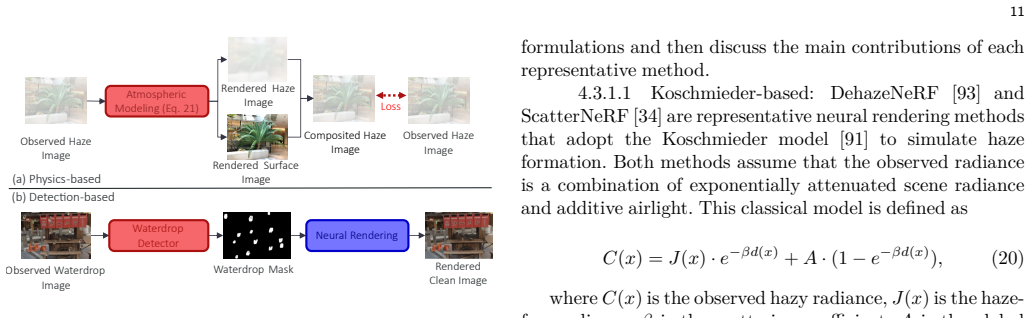
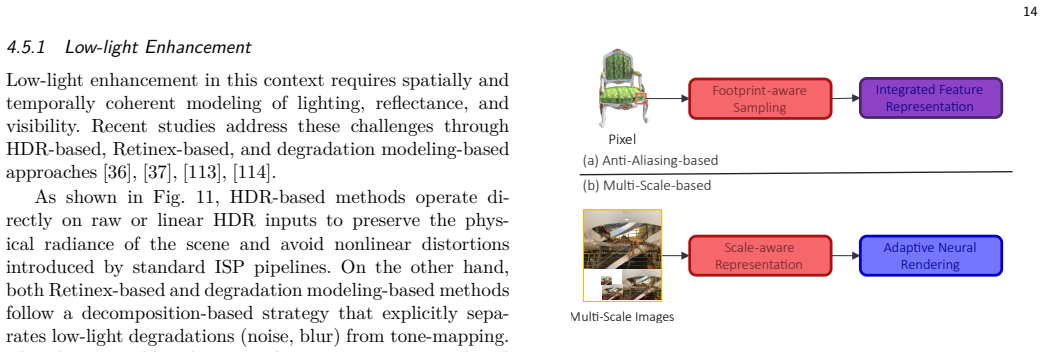
- [Section 1, Eqs. 2-4] The binary distinction between sequence-based and composition-based degradation is not instantiated by many of the surveyed methods. For example, trajectory-based deblurring (Section 4.2.2, Eq. 14) averages sharp renders over a continuous trajectory, which is not a view-specific operator H_i applied to a single clean render; event-based methods (Section 4.2.1, Eqs. 12-13) require the event stream E(t) as an additional input, so R_D would need more arguments than (s, c_i); detection-based weather removal (Section 4.3.2, DerainNeRF and WeatherGS) trains with a masked loss, so R_D is undefined for masked pixels; and anti-aliasing methods (Section 4.5.2.1, Mip-NeRF and Zip-NeRF) introduce degradation through the sampling process itself rather than through a post-rendering operator. Please either extend the formalism to cover these cases (e.g., by including masks, event streams, time integration, and an explicit handling of sampling footprint) or clearly scope Eq. 2 as a high-level abstraction that does not capture every method discussed in the survey.
- [Section 2 and Eq. 2] Eq. 2 assumes known camera parameters c_i, but Section 2 identifies pose estimation from degraded inputs as a core failure mode and illustrates the problem in Fig. 4. This is a direct contradiction between the formalization and the challenges the survey itself emphasizes. The authors should either extend the degradation-aware rendering function to account for unknown or estimated poses, or explicitly state that Eq. 2 presupposes poses obtained from a separate robust SfM pipeline and is not intended to cover pose-refinement methods.
- [Section 4.2.3, Eq. 19] The circle-of-confusion radius formula R_CoC = (1/(2Q)) |1/z_o - 1/f| with Q = F·A is dimensionally inconsistent: the left-hand side is a length, while the right-hand side has units of 1/length^3 if F and A are measured in meters (or, more generally, the units do not match). The standard thin-lens CoC derivation does not produce this expression. Please replace Eq. 19 with a correct formula and verify the associated discussion in Sections 4.2.3 and 5.3.2 that depends on it.
minor comments (5)
- [Figure 12] The caption of Figure 12 cites reference [96] for Mip-NeRF, but the text in Section 4.5.2.1 correctly cites [39]; reference [96] is the Dark Channel Prior paper and is unrelated to Mip-NeRF. Please correct the citation.
- [Fig. 6] The taxonomy figure contains typographical errors in method names: "S2Gaussain" should be "S2Gaussian", "SuperGaussain" should be "SuperGaussian", and "CoCoGaussain" should be "CoCoGaussian".
- [Section 3.1] The phrase "azimuth azimuth and elevation angles" contains a duplicated word; it should read "azimuth and elevation angles".
- [Section 1] The claim that this is "the first comprehensive survey dedicated to 3D LLV" is not supported by a comparison with existing related surveys on neural rendering, 3D Gaussian splatting, or robust reconstruction from degraded inputs. Please add a brief discussion of prior surveys or soften the claim.
- [Section 5.1, Table 1] The "Type" entry for BlendedMVS is listed as "R S" without explanation; please clarify that this denotes a mix of real and synthetic scenes, and apply similar clarity to other ambiguous entries in the table.
Circularity Check
No significant circularity: the survey's formalization is descriptive notation, and its taxonomy is assembled from external literature.
full rationale
This paper is a survey, not a derivation or prediction pipeline. Its formal contribution is Eq. 2 (y_i = R_D(s, c_i)) together with the two decomposition strategies in Eqs. 3 and 4. These equations are introduced as definitions or organizing notation: they are not fitted to data, they do not generate benchmark predictions, and no later result is obtained by substituting them back into themselves. The taxonomy in Fig. 6 is built by citing external published methods, and no category is justified solely by the present authors' prior work. The authors do cite their own earlier papers (ExBluRF [20], MoBluRF [30], MoBGS [10]) as representative trajectory-based deblurring methods, but those citations are ordinary survey entries used as examples; they do not function as a load-bearing premise that forces a conclusion. The skeptical concern that Eq. 2 does not cleanly express trajectory averaging (Eq. 14), event-stream models (Eqs. 12-13), masking-based weather removal, or footprint-based anti-aliasing is a question about whether the proposed common notation accurately covers the surveyed field; such a completeness or accuracy objection is not an instance of circularity. There is no fitted parameter relabeled as a prediction, no self-citation chain carrying the central claim, and no derivation that is equivalent to its input by construction. A survey's utility can be criticized by taxonomy coverage, but nothing in this paper's own argument reduces to its own inputs.
Assumptions & free parameters
assumptions (2)
- domain assumption The proposed taxonomy of 3D LLV tasks (SR, deblurring, weather removal, restoration, enhancement) and their subcategories is a valid and useful way to organize the literature.
- domain assumption The descriptions of the surveyed methods are faithful to the original papers and the cited references correspond to the described works.
Cite this review
Pith. "Pith review of R3eVision: A Survey on Robust Rendering, Restoration, and Enhancement for 3D Low-Level Vision." pith.science (2026). https://pith.science/paper/NJZPGOVR
@misc{pith2026250616262,
  author       = {Pith},
  title        = {Pith review of: R3eVision: A Survey on Robust Rendering, Restoration, and Enhancement for 3D Low-Level Vision},
  year         = {2026},
  howpublished = {\url{https://pith.science/paper/NJZPGOVR}},
  note         = {Machine review of arXiv:2506.16262}
}
read the original abstract
Neural rendering methods such as Neural Radiance Fields (NeRF) and 3D Gaussian Splatting (3DGS) have achieved significant progress in photorealistic 3D scene reconstruction and novel view synthesis. However, most existing models assume clean and high-resolution (HR) multi-view inputs, which limits their robustness under real-world degradations such as noise, blur, low-resolution (LR), and weather-induced artifacts. To address these limitations, the emerging field of 3D Low-Level Vision (3D LLV) extends classical 2D Low-Level Vision tasks including super-resolution (SR), deblurring, weather degradation removal, restoration, and enhancement into the 3D spatial domain. This survey, referred to as R\textsuperscript{3}eVision, provides a comprehensive overview of robust rendering, restoration, and enhancement for 3D LLV by formalizing the degradation-aware rendering problem and identifying key challenges related to spatio-temporal consistency and ill-posed optimization. Recent methods that integrate LLV into neural rendering frameworks are categorized to illustrate how they enable high-fidelity 3D reconstruction under adverse conditions. Application domains such as autonomous driving, AR/VR, and robotics are also discussed, where reliable 3D perception from degraded inputs is critical. By reviewing representative methods, datasets, and evaluation protocols, this work positions 3D LLV as a fundamental direction for robust 3D content generation and scene-level reconstruction in real-world environments.
Figures


Figures from the paper (10 more)




Forward citations
Cited by 1 Pith paper
-
CoDe-NeRF: Neural Rendering via Dynamic Coefficient Decomposition
A neural rendering method that decomposes appearance into static bases and dynamic coefficients, improving the sharpness of specular highlights in novel view synthesis.
Reference graph
Works this paper leans on
-
[96]
Single image haze removal using dark channel prior,
K. He, J. Sun, and X. Tang, “Single image haze removal using dark channel prior,”IEEE Transactions on Pattern Analysis and Machine Intelligence, 2010
2010
-
[39]
Mip-nerf: A multiscale represen- tation for anti-aliasing neural radiance fields,
J. T. Barron, B. Mildenhall, M. Tancik, P. Hedman, R. Martin- Brualla, and P. P. Srinivasan, “Mip-nerf: A multiscale represen- tation for anti-aliasing neural radiance fields,” inProceedings of the IEEE/CVF International Conference on Computer Vision, 2021
2021
-
[1]
3d gaussian splatting: Survey, technologies, challenges, and opportunities,
Y. Bao, T. Ding, J. Huo, Y. Liu, Y. Li, W. Li, Y. Gao, and J. Luo, “3d gaussian splatting: Survey, technologies, challenges, and opportunities,”IEEE Transactions on Circuits and Sys- tems for Video Technology, 2025
2025
-
[2]
Nerf: Representing scenes as neural radiance fields for view synthesis,
B. Mildenhall, P. P. Srinivasan, M. Tancik, J. T. Barron, R. Ramamoorthi, and R. Ng, “Nerf: Representing scenes as neural radiance fields for view synthesis,”Communications of the ACM, 2021
2021
-
[3]
3d gaussian splatting for real-time radiance field rendering
B. Kerbl, G. Kopanas, T. Leimk¨ uhler, and G. Drettakis, “3d gaussian splatting for real-time radiance field rendering. ”ACM Transactions on Graphics, 2023
2023
-
[4]
E2nerf: Event enhanced neural radiance fields from blurry images,
Y. Qi, L. Zhu, Y. Zhang, and J. Li, “E2nerf: Event enhanced neural radiance fields from blurry images,” inProceedings of the IEEE/CVF International Conference on Computer Vision, 2023
2023
-
[5]
Mitigating motion blur in neural radiance fields with events and frames,
M. Cannici and D. Scaramuzza, “Mitigating motion blur in neural radiance fields with events and frames,” inProceedings of the IEEE/CVF Conference on Computer Vision and Pattern Recognition, 2024
2024
-
[6]
Dyblurf: Dynamic neural radiance fields from blurry monocular video,
H. Sun, X. Li, L. Shen, X. Ye, K. Xian, and Z. Cao, “Dyblurf: Dynamic neural radiance fields from blurry monocular video,” inProceedings of the IEEE/CVF Conference on Computer Vision and Pattern Recognition, 2024
2024
Show all 190 references
-
[7]
Bard-gs: Blur- aware reconstruction of dynamic scenes via gaussian splatting,
Y. Lu, Y. Zhou, D. Liu, T. Liang, and Y. Yin, “Bard-gs: Blur- aware reconstruction of dynamic scenes via gaussian splatting,” Proceedings of the IEEE/CVF Conference on Computer Vision and Pattern Recognition, 2025
2025
-
[8]
Nerflix: High-quality neural view synthesis by learning a degradation-driven inter-viewpoint mixer,
K. Zhou, W. Li, Y. Wang, T. Hu, N. Jiang, X. Han, and J. Lu, “Nerflix: High-quality neural view synthesis by learning a degradation-driven inter-viewpoint mixer,” inProceedings of the IEEE/CVF Conference on Computer Vision and Pattern Recognition, 2023
2023
-
[9]
Rustnerf: Robust neu- ral radiance field with low-quality images,
M. Li, M. Lu, X. Li, and S. Zhang, “Rustnerf: Robust neu- ral radiance field with low-quality images,”arXiv preprint arXiv:2401.03257, 2024
2024 arXiv
-
[10]
Mobgs: Motion deblurring dynamic 3d gaus- sian splatting for blurry monocular video,
M.-Q. V. Bui, J. Park, J. L. G. Bello, J. Moon, J. Oh, and M. Kim, “Mobgs: Motion deblurring dynamic 3d gaus- sian splatting for blurry monocular video,”arXiv preprint arXiv:2504.15122, 2025
2025
-
[11]
Supergs: Super- resolution 3d gaussian splatting via latent feature field and gradient-guided splitting,
S. Xie, Z. Wang, Y. Zhu, and C. Pan, “Supergs: Super- resolution 3d gaussian splatting via latent feature field and gradient-guided splitting,”arXiv preprint arXiv:2410.02571, 2024
2024 arXiv
-
[12]
Gaura: Generalizable approach for unified restora- tion and rendering of arbitrary views,
V. Gupta, R. S. V. Girish, T. Mukund Varma, A. Tewari, and K. Mitra, “Gaura: Generalizable approach for unified restora- tion and rendering of arbitrary views,” inProceedings of the European Conference on Computer Vision, 2024
2024
-
[13]
Autosplat: Constrained gaussian splatting for autonomous driving scene reconstruction,
M. Khan, H. Fazlali, D. Sharma, T. Cao, D. Bai, Y. Ren, and B. Liu, “Autosplat: Constrained gaussian splatting for autonomous driving scene reconstruction,” inProceedings of the IEEE International Conference on Robotics and Automation, 2025
2025
-
[14]
Splatad: Real-time lidar and camera rendering with 3d gaussian splatting for autonomous driving,
G. Hess, C. Lindstr¨ om, M. Fatemi, C. Petersson, and L. Svens- son, “Splatad: Real-time lidar and camera rendering with 3d gaussian splatting for autonomous driving,”arXiv preprint arXiv:2411.16816, 2024
2024 arXiv
-
[15]
Vr- nerf: High-fidelity virtualized walkable spaces,
L. Xu, V. Agrawal, W. Laney, T. Garcia, A. Bansal, C. Kim, S. Rota Bul` o, L. Porzi, P. Kontschieder, A. Boˇ ziˇ cet al., “Vr- nerf: High-fidelity virtualized walkable spaces,” inProceedings of the ACM SIGGRAPH Asia 2023 Conference, 2023
2023
-
[16]
Magic nerf lens: Interactive fusion of neural radi- ance fields for virtual facility inspection,
K. Li, S. Schmidt, T. Rolff, R. Bacher, W. Leemans, and F. Steinicke, “Magic nerf lens: Interactive fusion of neural radi- ance fields for virtual facility inspection,”Frontiers in Virtual Reality, 2024
2024
-
[17]
Graspnerf: Multiview-based 6-dof grasp detection for trans- parent and specular objects using generalizable nerf,
Q. Dai, Y. Zhu, Y. Geng, C. Ruan, J. Zhang, and H. Wang, “Graspnerf: Multiview-based 6-dof grasp detection for trans- parent and specular objects using generalizable nerf,” inPro- ceedings of the IEEE International Conference on Robotics and Automation, 2023
2023
-
[18]
Splatsim: Zero-shot sim2real transfer of rgb manipulation policies using gaussian splatting,
M. N. Qureshi, S. Garg, F. Yandun, D. Held, G. Kantor, and A. Silwal, “Splatsim: Zero-shot sim2real transfer of rgb manipulation policies using gaussian splatting,” 2025
2025
-
[19]
Gs-slam: Dense visual slam with 3d gaussian splatting,
C. Yan, D. Qu, D. Xu, B. Zhao, Z. Wang, D. Wang, and X. Li, “Gs-slam: Dense visual slam with 3d gaussian splatting,” in Proceedings of the IEEE/CVF Conference on Computer Vision and Pattern Recognition, 2024
2024
-
[20]
Exblurf: Efficient radiance fields for extreme motion blurred images,
D. Lee, J. Oh, J. Rim, S. Cho, and K. M. Lee, “Exblurf: Efficient radiance fields for extreme motion blurred images,” inProceedings of the IEEE/CVF International Conference on Computer Vision, 2023. 21
2023
-
[21]
Pdrf: Progressively deblurring radiance field for fast and robust scene reconstruction from blurry images,
C. Peng and R. Chellappa, “Pdrf: Progressively deblurring radiance field for fast and robust scene reconstruction from blurry images,”arXiv preprint arXiv:2208.08049, 2022
2022 arXiv
-
[22]
Building rome in a day,
S. Agarwal, Y. Furukawa, N. Snavely, I. Simon, B. Curless, S. M. Seitz, and R. Szeliski, “Building rome in a day,”Com- munications of the ACM, 2011
2011
-
[23]
Discrete-continuous optimization for large-scale structure from motion,
D. Crandall, A. Owens, N. Snavely, and D. Huttenlocher, “Discrete-continuous optimization for large-scale structure from motion,” inProceedings of the IEEE/CVF Conference on Computer Vision and Pattern Recognition, 2011
2011
-
[24]
Photo tourism: explor- ing photo collections in 3d,
N. Snavely, S. M. Seitz, and R. Szeliski, “Photo tourism: explor- ing photo collections in 3d,” inACM SIGGRAPH Conference on Computer Graphics and Interactive Techniques, 2006
2006
-
[25]
Structure-from-motion revisited,
J. L. Schonberger and J.-M. Frahm, “Structure-from-motion revisited,” inProceedings of the IEEE/CVF Conference on Computer Vision and Pattern Recognition, 2016
2016
-
[26]
Pixelwise view selection for unstructured multi-view stereo,
J. L. Schonberger, E. Zheng, J.-M. Frahm, and M. Pollefeys, “Pixelwise view selection for unstructured multi-view stereo,” inProceedings of the European Conference on Computer Vi- sion, 2016
2016
-
[27]
Robust dynamic radiance fields,
Y.-L. Liu, C. Gao, A. Meuleman, H.-Y. Tseng, A. Saraf, C. Kim, Y.-Y. Chuang, J. Kopf, and J.-B. Huang, “Robust dynamic radiance fields,” inProceedings of the IEEE/CVF Conference on Computer Vision and Pattern Recognition, 2023
2023
-
[28]
Nerf-sr: High quality neural radiance fields using super- sampling,
C. Wang, X. Wu, Y.-C. Guo, S.-H. Zhang, Y.-W. Tai, and S.-M. Hu, “Nerf-sr: High quality neural radiance fields using super- sampling,” inProceedings of the ACM International Conference on Multimedia, 2022
2022
-
[29]
Refsr-nerf: Towards high fidelity and super resolution view synthesis,
X. Huang, W. Li, J. Hu, H. Chen, and Y. Wang, “Refsr-nerf: Towards high fidelity and super resolution view synthesis,” in Proceedings of the IEEE/CVF Conference on Computer Vision and Pattern Recognition, 2023
2023
-
[30]
Moblurf: Motion deblurring neural radiance fields for blurry monocular video,
M.-Q. V. Bui, J. Park, J. Oh, and M. Kim, “Moblurf: Motion deblurring neural radiance fields for blurry monocular video,” IEEE Transactions on Pattern Analysis and Machine Intelli- gence, 2025
2025
-
[31]
Dof-gs: Adjustable depth-of-field 3d gaussian splatting for refocusing, defocus ren- dering and blur removal,
Y. Wang, P. Chakravarthula, and B. Chen, “Dof-gs: Adjustable depth-of-field 3d gaussian splatting for refocusing, defocus ren- dering and blur removal,”Proceedings of the IEEE/CVF Con- ference on Computer Vision and Pattern Recognition, 2025
2025
-
[32]
Cocogaussian: Leveraging circle of confu- sion for gaussian splatting from defocused images,
J. Lee, S. Cho, T. Kim, H.-D. Jang, M. Lee, G. Cha, D. Wee, D. Lee, and S. Lee, “Cocogaussian: Leveraging circle of confu- sion for gaussian splatting from defocused images,”Proceedings of the IEEE/CVF Conference on Computer Vision and Pattern Recognition, 2025
2025
-
[33]
Dehazing-nerf: neural radiance fields from hazy images,
T. Li, L. Li, W. Wang, and Z. Feng, “Dehazing-nerf: neural radiance fields from hazy images,”arXiv preprint arXiv:2304.11448, 2023
2023 arXiv
-
[34]
Scatternerf: Seeing through fog with physically- based inverse neural rendering,
A. Ramazzina, M. Bijelic, S. Walz, A. Sanvito, D. Scheuble, and F. Heide, “Scatternerf: Seeing through fog with physically- based inverse neural rendering,” inProceedings of the IEEE/CVF International Conference on Computer Vision, 2023
2023
-
[35]
Derainnerf: 3d scene estima- tion with adhesive waterdrop removal,
Y. Li, J. Wu, L. Zhao, and P. Liu, “Derainnerf: 3d scene estima- tion with adhesive waterdrop removal,” inIEEE International Conference on Robotics and Automation, 2024
2024
-
[36]
Nerf in the dark: High dynamic range view synthesis from noisy raw images,
B. Mildenhall, P. Hedman, R. Martin-Brualla, P. P. Srini- vasan, and J. T. Barron, “Nerf in the dark: High dynamic range view synthesis from noisy raw images,” inProceedings of the IEEE/CVF Conference on Computer Vision and Pattern Recognition, 2022
2022
-
[37]
Lighting up nerf via unsupervised decomposition and enhancement,
H. Wang, X. Xu, K. Xu, and R. W. Lau, “Lighting up nerf via unsupervised decomposition and enhancement,” inProceedings of the IEEE/CVF International Conference on Computer Vi- sion, 2023
2023
-
[38]
Mip-nerf 360: Unbounded anti-aliased neural ra- diance fields,
J. T. Barron, B. Mildenhall, D. Verbin, P. P. Srinivasan, and P. Hedman, “Mip-nerf 360: Unbounded anti-aliased neural ra- diance fields,” inProceedings of the IEEE/CVF Conference on Computer Vision and Pattern Recognition, 2022
2022
-
[40]
Efficient ray tracing of volume data,
M. Levoy, “Efficient ray tracing of volume data,”ACM Trans- actions on Graphics, 1990
1990
-
[41]
Optical models for direct volume rendering,
N. Max, “Optical models for direct volume rendering,”IEEE Transactions on Visualization and Computer Graphics, 1995
1995
-
[42]
Fourier features let networks learn high frequency functions in low dimensional domains,
M. Tancik, P. Srinivasan, B. Mildenhall, S. Fridovich-Keil, N. Raghavan, U. Singhal, R. Ramamoorthi, J. Barron, and R. Ng, “Fourier features let networks learn high frequency functions in low dimensional domains,”Advances in Neural Information Processing Systems, 2020
2020
-
[43]
On the spectral bias of neural networks,
N. Rahaman, A. Baratin, D. Arpit, F. Draxler, M. Lin, F. Ham- precht, Y. Bengio, and A. Courville, “On the spectral bias of neural networks,” inInternational Conference on Machine Learning, 2019
2019
-
[44]
Frequency bias in neural networks for input of non-uniform density,
R. Basri, M. Galun, A. Geifman, D. Jacobs, Y. Kasten, and S. Kritchman, “Frequency bias in neural networks for input of non-uniform density,” inInternational Conference on Machine Learning, 2020
2020
-
[45]
Plenoxels: Radiance fields without neural net- works,
S. Fridovich-Keil, A. Yu, M. Tancik, Q. Chen, B. Recht, and A. Kanazawa, “Plenoxels: Radiance fields without neural net- works,” inProceedings of the IEEE/CVF Conference on Com- puter Vision and Pattern Recognition, 2022
2022
-
[46]
Instant neu- ral graphics primitives with a multiresolution hash encoding,
T. M¨ uller, A. Evans, C. Schied, and A. Keller, “Instant neu- ral graphics primitives with a multiresolution hash encoding,” ACM transactions on graphics, 2022
2022
-
[47]
Pulsar: Efficient sphere-based neural rendering,
C. Lassner and M. Zollhofer, “Pulsar: Efficient sphere-based neural rendering,” inProceedings of the IEEE/CVF Conference on Computer Vision and Pattern Recognition, 2021
2021
-
[48]
Image quality assessment: from error visibility to structural similarity,
Z. Wang, A. C. Bovik, H. R. Sheikh, and E. P. Simoncelli, “Image quality assessment: from error visibility to structural similarity,”IEEE Transactions on Image Processing, 2004
2004
-
[49]
Cross-guided optimization of radiance fields with multi-view image super-resolution for high-resolution novel view synthesis,
Y. Yoon and K.-J. Yoon, “Cross-guided optimization of radiance fields with multi-view image super-resolution for high-resolution novel view synthesis,” inProceedings of the IEEE/CVF Conference on Computer Vision and Pattern Recognition, 2023
2023
-
[50]
Enhanced deep residual networks for single image super-resolution,
B. Lim, S. Son, H. Kim, S. Nah, and K. Mu Lee, “Enhanced deep residual networks for single image super-resolution,” in Proceedings of the IEEE/CVF Conference on Computer Vision and Pattern Recognition workshops, 2017
2017
-
[51]
Swinir: Image restoration using swin transformer,
J. Liang, J. Cao, G. Sun, K. Zhang, L. Van Gool, and R. Tim- ofte, “Swinir: Image restoration using swin transformer,” in Proceedings of the IEEE/CVF International Conference on Computer Vision, 2021
2021
-
[52]
Fastsr- nerf: improving nerf efficiency on consumer devices with a sim- ple super-resolution pipeline,
C.-Y. Lin, Q. Fu, T. Merth, K. Yang, and A. Ranjan, “Fastsr- nerf: improving nerf efficiency on consumer devices with a sim- ple super-resolution pipeline,” inProceedings of the IEEE/CVF Winter Conference on Applications of Computer Vision, 2024
2024
-
[53]
Srgs: Super-resolution 3d gaussian splatting,
X. Feng, Y. He, Y. Wang, Y. Yang, W. Li, Y. Chen, Z. Kuang, J. Fan, Y. Junet al., “Srgs: Super-resolution 3d gaussian splatting,”arXiv preprint arXiv:2404.10318, 2024
2024
-
[54]
Sequence matters: Harnessing video models in 3d super- resolution,
H.-k. Ko, D. Park, Y. Park, B. Lee, J. Han, and E. Park, “Sequence matters: Harnessing video models in 3d super- resolution,” inProceedings of the AAAI Conference on Arti- ficial Intelligence, 2025
2025
-
[55]
Orb: An efficient alternative to sift or surf,
E. Rublee, V. Rabaud, K. Konolige, and G. Bradski, “Orb: An efficient alternative to sift or surf,” inProceedings of the IEEE/CVF International Conference on Computer Vision, 2011
2011
-
[56]
Rethinking alignment in video super-resolution transformers,
S. Shi, J. Gu, L. Xie, X. Wang, Y. Yang, and C. Dong, “Rethinking alignment in video super-resolution transformers,” Advances in Neural Information Processing Systems, 2022
2022
-
[57]
Super-nerf: view-consistent detail gen- eration for nerf super-resolution,
Y. Han, T. Yu, X. Yu, D. Xu, B. Zheng, Z. Dai, C. Yang, Y. Wang, and Q. Dai, “Super-nerf: view-consistent detail gen- eration for nerf super-resolution,”IEEE Transactions on Visu- alization and Computer Graphics, 2024
2024
-
[58]
Esrgan: Enhanced super-resolution generative adversarial networks,
X. Wang, K. Yu, S. Wu, J. Gu, Y. Liu, C. Dong, Y. Qiao, and C. Change Loy, “Esrgan: Enhanced super-resolution generative adversarial networks,” inProceedings of the European Confer- ence on Computer Vision, 2018
2018
-
[59]
Disr-nerf: Diffusion-guided view-consistent super-resolution nerf,
J. L. Lee, C. Li, and G. H. Lee, “Disr-nerf: Diffusion-guided view-consistent super-resolution nerf,” inProceedings of the IEEE/CVF Conference on Computer Vision and Pattern Recognition, 2024
2024
-
[60]
High-resolution image synthesis with latent diffusion models,
R. Rombach, A. Blattmann, D. Lorenz, P. Esser, and B. Om- mer, “High-resolution image synthesis with latent diffusion models,” inProceedings of the IEEE/CVF Conference on Com- puter Vision and Pattern Recognition, 2022
2022
-
[61]
Dreamfu- 22 sion: Text-to-3d using 2d diffusion,
B. Poole, A. Jain, J. T. Barron, and B. Mildenhall, “Dreamfu- 22 sion: Text-to-3d using 2d diffusion,”Proceedings of the Interna- tional Conference on Learning Representations, 2023
2023
-
[62]
Gaussiansr: 3d gaus- sian super-resolution with 2d diffusion priors,
X. Yu, H. Zhu, T. He, and Z. Chen, “Gaussiansr: 3d gaus- sian super-resolution with 2d diffusion priors,”arXiv preprint arXiv:2406.10111, 2024
2024 arXiv
-
[63]
S2gaussian: Sparse- view super-resolution 3d gaussian splatting,
Y. Wan, M. Shao, Y. Cheng, and W. Zuo, “S2gaussian: Sparse- view super-resolution 3d gaussian splatting,”Proceedings of the IEEE/CVF Conference on Computer Vision and Pattern Recognition, 2025
2025
-
[64]
Vision transformers for dense prediction,
R. Ranftl, A. Bochkovskiy, and V. Koltun, “Vision transformers for dense prediction,” inProceedings of the IEEE/CVF Inter- national Conference on Computer Vision, 2021
2021
-
[65]
Resshift: Efficient diffusion model for image super-resolution by residual shifting,
Z. Yue, J. Wang, and C. C. Loy, “Resshift: Efficient diffusion model for image super-resolution by residual shifting,”Ad- vances in Neural Information Processing Systems, 2023
2023
-
[66]
Supergaussian: Repurposing video models for 3d super resolution,
Y. Shen, D. Ceylan, P. Guerrero, Z. Xu, N. J. Mitra, S. Wang, and A. Fr¨ uhst¨ uck, “Supergaussian: Repurposing video models for 3d super resolution,” inProceedings of the European Con- ference on Computer Vision, 2024
2024
-
[67]
Videogigagan: Towards detail-rich video super-resolution,
Y. Xu, T. Park, R. Zhang, Y. Zhou, E. Shechtman, F. Liu, J.-B. Huang, and D. Liu, “Videogigagan: Towards detail-rich video super-resolution,”Proceedings of the IEEE/CVF Conference on Computer Vision and Pattern Recognition, 2025
2025
-
[68]
Deblur-nerf: Neural radiance fields from blurry images,
L. Ma, X. Li, J. Liao, Q. Zhang, X. Wang, J. Wang, and P. V. Sander, “Deblur-nerf: Neural radiance fields from blurry images,” inProceedings of the IEEE/CVF Conference on Com- puter Vision and Pattern Recognition, 2022
2022
-
[69]
Bags: Blur agnostic gaussian splatting through multi-scale kernel modeling,
C. Peng, Y. Tang, Y. Zhou, N. Wang, X. Liu, D. Li, and R. Chellappa, “Bags: Blur agnostic gaussian splatting through multi-scale kernel modeling,” inProceedings of the European Conference on Computer Vision, 2024
2024
-
[70]
Bad-nerf: Bundle adjusted deblur neural radiance fields,
P. Wang, L. Zhao, R. Ma, and P. Liu, “Bad-nerf: Bundle adjusted deblur neural radiance fields,” inProceedings of the IEEE/CVF Conference on Computer Vision and Pattern Recognition, 2023
2023
-
[71]
Bad-gaussians: Bundle adjusted deblur gaussian splatting,
L. Zhao, P. Wang, and P. Liu, “Bad-gaussians: Bundle adjusted deblur gaussian splatting,” inProceedings of the European Conference on Computer Vision, 2024
2024
-
[72]
Crim-gs: Contin- uous rigid motion-aware gaussian splatting from motion blur images,
J. Lee, D. Kim, D. Lee, S. Cho, and S. Lee, “Crim-gs: Contin- uous rigid motion-aware gaussian splatting from motion blur images,”arXiv preprint arXiv:2407.03923, 2024
2024 arXiv
-
[73]
De- blur4dgs: 4d gaussian splatting from blurry monocular video,
R. Wu, Z. Zhang, M. Chen, X. Fan, Z. Yan, and W. Zuo, “De- blur4dgs: 4d gaussian splatting from blurry monocular video,” arXiv preprint arXiv:2412.06424, 2024
2024
-
[74]
Comogaussian: Continuous motion-aware gaussian splatting from motion-blurred images,
J. Lee, D. Kim, D. Lee, S. Cho, M. Lee, W. Lee, T. Kim, D. Wee, and S. Lee, “Comogaussian: Continuous motion-aware gaussian splatting from motion-blurred images,”arXiv preprint arXiv:2503.0533, 2025
2025
-
[75]
E- nerf: Neural radiance fields from a moving event camera,
S. Klenk, L. Koestler, D. Scaramuzza, and D. Cremers, “E- nerf: Neural radiance fields from a moving event camera,”IEEE Robotics and Automation Letters, 2023
2023
-
[76]
Evagaussians: Event stream as- sisted gaussian splatting from blurry images,
W. Yu, C. Feng, J. Tang, J. Yang, Z. Tang, X. Jia, Y. Yang, L. Yuan, and Y. Tian, “Evagaussians: Event stream as- sisted gaussian splatting from blurry images,”arXiv preprint arXiv:2405.20224, 2024
2024 arXiv
-
[77]
Eadeblur- gs: Event assisted 3d deblur reconstruction with gaussian splat- ting,
Y. Weng, Z. Shen, R. Chen, Q. Wang, and J. Wang, “Eadeblur- gs: Event assisted 3d deblur reconstruction with gaussian splat- ting,”arXiv preprint arXiv:2407.13520, 2024
2024 arXiv
-
[78]
Diet-gs: Diffusion prior and event stream-assisted motion deblurring 3d gaussian splatting,
S. Lee and G. H. Lee, “Diet-gs: Diffusion prior and event stream-assisted motion deblurring 3d gaussian splatting,”Pro- ceedings of the IEEE/CVF Conference on Computer Vision and Pattern Recognition, 2025
2025
-
[79]
Dp-nerf: Deblurred neural radiance field with physical scene priors,
D. Lee, M. Lee, C. Shin, and S. Lee, “Dp-nerf: Deblurred neural radiance field with physical scene priors,” inProceedings of the IEEE/CVF Conference on Computer Vision and Pattern Recognition, 2023
2023
-
[80]
Deblurring 3d gaussian splatting,
B. Lee, H. Lee, X. Sun, U. Ali, and E. Park, “Deblurring 3d gaussian splatting,” inProceedings of the European Conference on Computer Vision, 2024
2024
-
[81]
Bringing a blurry frame alive at high frame-rate with an event camera,
L. Pan, C. Scheerlinck, X. Yu, R. Hartley, M. Liu, and Y. Dai, “Bringing a blurry frame alive at high frame-rate with an event camera,” inProceedings of the IEEE/CVF Conference on Computer Vision and Pattern Recognition, 2019
2019
-
[82]
Esim: an open event camera simulator,
H. Rebecq, D. Gehrig, and D. Scaramuzza, “Esim: an open event camera simulator,” inConference on Robot Learning, 2018
2018
-
[83]
v2e: From video frames to realistic dvs events,
Y. Hu, S.-C. Liu, and T. Delbruck, “v2e: From video frames to realistic dvs events,” inProceedings of the IEEE/CVF Confer- ence on Computer Vision and Pattern Recognition, 2021
2021
-
[84]
Lush-nerf: Light- ing up and sharpening nerfs for low-light scenes,
Z. Qu, K. Xu, G. P. Hancke, and R. W. Lau, “Lush-nerf: Light- ing up and sharpening nerfs for low-light scenes,”Advances in Neural Information Processing Systems, 2024
2024
-
[85]
Light field blind motion deblurring,
P. P. Srinivasan, R. Ng, and R. Ramamoorthi, “Light field blind motion deblurring,” inProceedings of the IEEE/CVF Confer- ence on Computer Vision and Pattern Recognition, 2017
2017
-
[86]
Neural ordinary differential equations,
R. T. Chen, Y. Rubanova, J. Bettencourt, and D. K. Duvenaud, “Neural ordinary differential equations,”Advances in Neural Information Processing Systems, 2018
2018
-
[87]
Track anything: Segment anything meets videos,
J. Yang, M. Gao, Z. Li, S. Gao, F. Wang, and F. Zheng, “Track anything: Segment anything meets videos,”arXiv preprint arXiv:2304.11968, 2023
2023 arXiv
-
[88]
Exploiting deblurring networks for radiance fields,
H. Choi, H. Yang, J. Han, and S. Cho, “Exploiting deblurring networks for radiance fields,”Proceedings of the IEEE/CVF Conference on Computer Vision and Pattern Recognition, 2025
2025
-
[89]
Simple baselines for image restoration,
L. Chen, X. Chu, X. Zhang, and J. Sun, “Simple baselines for image restoration,” inProceedings of the European Conference on Computer Vision, 2022
2022
-
[90]
Weathergs: 3d scene reconstruction in adverse weather conditions via gaussian splatting,
C. Qian, Y. Guo, W. Li, and G. Markkula, “Weathergs: 3d scene reconstruction in adverse weather conditions via gaussian splatting,”IEEE International Conference on Robotics and Automation, 2025
2025
-
[91]
Isra¨ el, F
H. Isra¨ el, F. Kasten, H. Isra¨ el, and F. Kasten,Koschmieders theorie der horizontalen sichtweite, 1959
1959
-
[92]
Attentive generative adversarial network for raindrop removal from a single image,
R. Qian, R. T. Tan, W. Yang, J. Su, and J. Liu, “Attentive generative adversarial network for raindrop removal from a single image,” inProceedings of the IEEE/CVF Conference on Computer Vision and Pattern Recognition, 2018
2018
-
[93]
Dehazen- erf: Multi-image haze removal and 3d shape reconstruction using neural radiance fields,
W.-T. Chen, W. Yifan, S.-Y. Kuo, and G. Wetzstein, “Dehazen- erf: Multi-image haze removal and 3d shape reconstruction using neural radiance fields,” inInternational Conference on 3D Vision, 2024
2024
-
[94]
Dehazegs: Seeing through fog with 3d gaussian splatting,
J. Yu, Y. Wang, Z. Lu, J. Guo, Y. Li, H. Qin, and X. Zhang, “Dehazegs: Seeing through fog with 3d gaussian splatting,” arXiv preprint arXiv:2501.03659, 2025
2025 arXiv
-
[95]
Chandrasekhar,Radiative transfer, 2013
S. Chandrasekhar,Radiative transfer, 2013
2013
-
[97]
Optics of the atmosphere: scattering by molecules and particles,
E. J. McCartney, “Optics of the atmosphere: scattering by molecules and particles,”New York, 1976
1976
-
[98]
Image enhancement using bright channel prior,
S. Sun and X. Guo, “Image enhancement using bright channel prior,” inInternational Conference on Industrial Informatics – Computing Technology, Intelligent Technology, Industrial Information Integration, 2016
2016
-
[99]
Towards degradation-robust reconstruction in generalizable nerf,
C. H. Park, K. L. Cheng, Z. Wang, and Q. Chen, “Towards degradation-robust reconstruction in generalizable nerf,”arXiv preprint arXiv:2411.11691, 2024
2024 arXiv
-
[100]
U2nerf: Un- supervised underwater image restoration and neural radiance fields,
V. Gupta, S. Manoj, M. Varma, and K. Mitra, “U2nerf: Un- supervised underwater image restoration and neural radiance fields,”Proceedings of the Second Tiny Papers Track at the International Conference on Learning Representations Work- shops, 2024
2024
-
[101]
Hypernetworks,
D. Ha, A. Dai, and Q. V. Le, “Hypernetworks,” inProceedings of the International Conference on Learning Representations, 2017
2017
-
[102]
Nerfool: Uncovering the vulnerability of generalizable neu- ral radiance fields against adversarial perturbations,
Y. Fu, Y. Yuan, S. Kundu, S. Wu, S. Zhang, and Y. Lin, “Nerfool: Uncovering the vulnerability of generalizable neu- ral radiance fields against adversarial perturbations,”arXiv preprint arXiv:2306.06359, 2023
2023 arXiv
-
[103]
Is attention all that nerf needs?
P. Wang, X. Chen, T. Chen, S. Venugopalan, Z. Wanget al., “Is attention all that nerf needs?” inProceedings of the Inter- national Conference on Learning Representations, 2022
2022
-
[104]
Rafe: Generative radiance fields restoration,
Z. Wu, Z. Wan, J. Zhang, J. Liao, and D. Xu, “Rafe: Generative radiance fields restoration,” inProceedings of the European Conference on Computer Vision, 2024
2024
-
[105]
Drantal-nerf: Diffusion- based restoration for anti-aliasing neural radiance field,
G. Yang, K. Zhang, J. Fu, and D. Liu, “Drantal-nerf: Diffusion- based restoration for anti-aliasing neural radiance field,”arXiv preprint arXiv:2407.07461, 2024
2024 arXiv
-
[106]
Photorealistic text-to-image diffusion models with 23 deep language understanding,
C. Saharia, W. Chan, S. Saxena, L. Li, J. Whang, E. L. Denton, K. Ghasemipour, R. Gontijo Lopes, B. Karagol Ayan, T. Sali- manset al., “Photorealistic text-to-image diffusion models with 23 deep language understanding,”Advances in Neural Informa- tion Processing Systems, 2022
2022
-
[107]
Hierarchical integration diffusion model for realistic image de- blurring,
Z. Chen, Y. Zhang, D. Liu, J. Gu, L. Kong, X. Yuanet al., “Hierarchical integration diffusion model for realistic image de- blurring,”Advances in Neural Information Processing Systems, 2024
2024
-
[108]
Diffbir: Toward blind image restora- tion with generative diffusion prior,
X. Lin, J. He, Z. Chen, Z. Lyu, B. Dai, F. Yu, Y. Qiao, W. Ouyang, and C. Dong, “Diffbir: Toward blind image restora- tion with generative diffusion prior,” inProceedings of the European Conference on Computer Vision, 2024
2024
-
[109]
Alias-free generative adversarial net- works,
T. Karras, M. Aittala, S. Laine, E. H¨ ark¨ onen, J. Hellsten, J. Lehtinen, and T. Aila, “Alias-free generative adversarial net- works,”Advances in Neural Information Processing Systems, 2021
2021
-
[110]
Denoising diffusion implicit models,
J. Song, C. Meng, and S. Ermon, “Denoising diffusion implicit models,” inProceedings of the International Conference on Learning Representations, 2021
2021
-
[111]
Ex- ploiting diffusion prior for real-world image super-resolution,
J. Wang, Z. Yue, S. Zhou, K. C. Chan, and C. C. Loy, “Ex- ploiting diffusion prior for real-world image super-resolution,” International Journal of Computer Vision, 2024
2024
-
[112]
Towards robust blind face restoration with codebook lookup transformer,
S. Zhou, K. Chan, C. Li, and C. C. Loy, “Towards robust blind face restoration with codebook lookup transformer,”Advances in Neural Information Processing Systems, 2022
2022
-
[113]
Learning novel view syn- thesis from heterogeneous low-light captures,
Q. Zheng, H. Sun, H. Xu, and F. Xu, “Learning novel view syn- thesis from heterogeneous low-light captures,”arXiv preprint arXiv:2403.13337, 2024
2024 arXiv
-
[114]
Bright- nerf: Brightening neural radiance field with color restoration from low-light raw images,
M. Wang, X. Huang, G. Zhou, Q. Guo, and Q. Wang, “Bright- nerf: Brightening neural radiance field with color restoration from low-light raw images,” inProceedings of the AAAI Con- ference on Artificial Intelligence, 2025
2025
-
[115]
Leveraging thermal modality to enhance reconstruction in low-light condi- tions,
J. Xu, M. Liao, R. P. Kathirvel, and V. M. Patel, “Leveraging thermal modality to enhance reconstruction in low-light condi- tions,” inProceedings of the European Conference on Computer Vision, 2024
2024
-
[116]
Aleth- nerf: Illumination adaptive nerf with concealing field assump- tion,
Z. Cui, L. Gu, X. Sun, X. Ma, Y. Qiao, and T. Harada, “Aleth- nerf: Illumination adaptive nerf with concealing field assump- tion,” inProceedings of the AAAI Conference on Artificial Intelligence, 2024
2024
-
[117]
Ambient-nerf: light train enhancing neural radiance fields in low-light conditions with ambient-illumination,
P. Zhang, G. Hu, M. Chen, and M. Emam, “Ambient-nerf: light train enhancing neural radiance fields in low-light conditions with ambient-illumination,”Multimedia Tools and Applica- tions, 2024
2024
-
[118]
Illumination for computer generated pictures,
B. T. Phong, “Illumination for computer generated pictures,” inSeminal graphics: pioneering efforts that shaped the field, 1998
1998
-
[119]
Real-time neural radiance caching for path tracing,
T. M¨ uller, F. Rousselle, J. Nov´ ak, and A. Keller, “Real-time neural radiance caching for path tracing,”ACM Transactions on Graphics, 2021
2021
-
[120]
Gaussian in the dark: Real-time view synthesis from inconsistent dark im- ages using gaussian splatting,
S. Ye, Z.-H. Dong, Y. Hu, Y.-H. Wen, and Y.-J. Liu, “Gaussian in the dark: Real-time view synthesis from inconsistent dark im- ages using gaussian splatting,” inComputer Graphics Forum, 2024
2024
-
[121]
Hogs: Unified near and far object reconstruction via homogeneous gaussian splatting,
X. Liu, Z. Huang, F. Okura, and Y. Matsushita, “Hogs: Unified near and far object reconstruction via homogeneous gaussian splatting,” inProceedings of the IEEE/CVF Conference on Computer Vision and Pattern Recognition, 2025
2025
-
[122]
Zip-nerf: Anti-aliased grid-based neural radiance fields,
J. T. Barron, B. Mildenhall, D. Verbin, P. P. Srinivasan, and P. Hedman, “Zip-nerf: Anti-aliased grid-based neural radiance fields,” inProceedings of the IEEE/CVF International Confer- ence on Computer Vision, 2023
2023
-
[123]
Tri-miprf: Tri-mip representation for efficient anti-aliasing neural radiance fields,
W. Hu, Y. Wang, L. Ma, B. Yang, L. Gao, X. Liu, and Y. Ma, “Tri-miprf: Tri-mip representation for efficient anti-aliasing neural radiance fields,” inProceedings of the IEEE/CVF In- ternational Conference on Computer Vision, 2023
2023
-
[124]
Mip- splatting: Alias-free 3d gaussian splatting,
Z. Yu, A. Chen, B. Huang, T. Sattler, and A. Geiger, “Mip- splatting: Alias-free 3d gaussian splatting,” inProceedings of the IEEE/CVF Conference on Computer Vision and Pattern Recognition, 2024
2024
-
[125]
Bungeenerf: Progressive neural radiance field for extreme multi-scale scene rendering,
Y. Xiangli, L. Xu, X. Pan, N. Zhao, A. Rao, C. Theobalt, B. Dai, and D. Lin, “Bungeenerf: Progressive neural radiance field for extreme multi-scale scene rendering,” inProceedings of the European Conference on Computer Vision, 2022
2022
-
[126]
Pynerf: Pyramidal neural radiance fields,
H. Turki, M. Zollh¨ ofer, C. Richardt, and D. Ramanan, “Pynerf: Pyramidal neural radiance fields,”Advances in Neural Infor- mation Processing Systems, 2023
2023
-
[127]
Multiscale representation for real-time anti-aliasing neural rendering,
D. Hu, Z. Zhang, T. Hou, T. Liu, H. Fu, and M. Gong, “Multiscale representation for real-time anti-aliasing neural rendering,” inProceedings of the IEEE/CVF International Conference on Computer Vision, 2023
2023
-
[128]
Multi-scale 3d gaussian splatting for anti-aliased rendering,
Z. Yan, W. F. Low, Y. Chen, and G. H. Lee, “Multi-scale 3d gaussian splatting for anti-aliased rendering,” inProceedings of the IEEE/CVF Conference on Computer Vision and Pattern Recognition, 2024
2024
-
[129]
3denhancer: Consistent multi-view diffusion for 3d enhancement,
Y. Luo, S. Zhou, Y. Lan, X. Pan, and C. C. Loy, “3denhancer: Consistent multi-view diffusion for 3d enhancement,”Proceed- ings of the IEEE/CVF Conference on Computer Vision and Pattern Recognition, 2025
2025
-
[130]
Textured-gs: Gaussian splatting with spatially defined color and opacity,
Z. Huang and M. Gong, “Textured-gs: Gaussian splatting with spatially defined color and opacity,”arXiv preprint arXiv:2407.09733, 2024
2024 arXiv
-
[131]
Latte3d: Large-scale amortized text- to-enhanced3d synthesis,
K. Xie, J. Lorraine, T. Cao, J. Gao, J. Lucas, A. Torralba, S. Fidler, and X. Zeng, “Latte3d: Large-scale amortized text- to-enhanced3d synthesis,” inProceedings of the European Con- ference on Computer Vision, 2024
2024
-
[132]
3dgs-enhancer: Enhancing un- bounded 3d gaussian splatting with view-consistent 2d diffusion priors,
X. Liu, C. Zhou, and S. Huang, “3dgs-enhancer: Enhancing un- bounded 3d gaussian splatting with view-consistent 2d diffusion priors,”Advances in Neural Information Processing Systems, 2024
2024
-
[133]
Texture-gs: Disentangling the geometry and texture for 3d gaussian splatting editing,
T.-X. Xu, W. Hu, Y.-K. Lai, Y. Shan, and S.-H. Zhang, “Texture-gs: Disentangling the geometry and texture for 3d gaussian splatting editing,” inProceedings of the European Conference on Computer Vision, 2024
2024
-
[134]
Textured gaussians for enhanced 3d scene appearance modeling,
B. Chao, H.-Y. Tseng, L. Porzi, C. Gao, T. Li, Q. Li, A. Saraf, J.-B. Huang, J. Kopf, G. Wetzsteinet al., “Textured gaussians for enhanced 3d scene appearance modeling,”Proceedings of the IEEE/CVF Conference on Computer Vision and Pattern Recognition, 2025
2025
-
[135]
Large scale multi-view stereopsis evaluation,
R. Jensen, A. Dahl, G. Vogiatzis, E. Tola, and H. Aanæs, “Large scale multi-view stereopsis evaluation,” inProceedings of the IEEE/CVF Conference on Computer Vision and Pattern Recognition, 2014
2014
-
[136]
Tanks and temples: Benchmarking large-scale scene reconstruction,
A. Knapitsch, J. Park, Q.-Y. Zhou, and V. Koltun, “Tanks and temples: Benchmarking large-scale scene reconstruction,”ACM Transactions on Graphics, 2017
2017
-
[137]
Deep blending for free-viewpoint image-based rendering,
P. Hedman, J. Philip, T. Price, J.-M. Frahm, G. Drettakis, and G. Brostow, “Deep blending for free-viewpoint image-based rendering,”ACM Transactions on Graphics, 2018
2018
-
[138]
Local light field fusion: Practical view synthesis with prescriptive sampling guidelines,
B. Mildenhall, P. P. Srinivasan, R. Ortiz-Cayon, N. K. Kalan- tari, R. Ramamoorthi, R. Ng, and A. Kar, “Local light field fusion: Practical view synthesis with prescriptive sampling guidelines,”ACM Transactions on Graphics, 2019
2019
-
[139]
Da- vanet: Stereo deblurring with view aggregation,
S. Zhou, J. Zhang, W. Zuo, H. Xie, J. Pan, and J. S. Ren, “Da- vanet: Stereo deblurring with view aggregation,” inProceedings of the IEEE/CVF Conference on Computer Vision and Pattern Recognition, 2019
2019
-
[140]
Blendedmvs: A large-scale dataset for generalized multi-view stereo networks,
Y. Yao, Z. Luo, S. Li, J. Zhang, Y. Ren, L. Zhou, T. Fang, and L. Quan, “Blendedmvs: A large-scale dataset for generalized multi-view stereo networks,” inProceedings of the IEEE/CVF Conference on Computer Vision and Pattern Recognition, 2020
2020
-
[141]
Neural sparse voxel fields,
L. Liu, J. Gu, K. Zaw Lin, T.-S. Chua, and C. Theobalt, “Neural sparse voxel fields,”Advances in Neural Information Processing Systems, 2020
2020
-
[142]
Hypernerf: a higher-dimensional representation for topologically varying neural radiance fields,
K. Park, U. Sinha, P. Hedman, J. T. Barron, S. Bouaziz, D. B. Goldman, R. Martin-Brualla, and S. M. Seitz, “Hypernerf: a higher-dimensional representation for topologically varying neural radiance fields,”ACM Transactions on Graphics, 2021
2021
-
[143]
Rtmv: A ray-traced multi-view synthetic dataset for novel view synthesis,
J. Tremblay, M. Meshry, A. Evans, J. Kautz, A. Keller, S. Khamis, T. M¨ uller, C. Loop, N. Morrical, K. Naganoet al., “Rtmv: A ray-traced multi-view synthetic dataset for novel view synthesis,”Proceedings of the European Conference on Computer Vision Workshops, 2022
2022
-
[144]
Monocular dynamic view synthesis: A reality check,
H. Gao, R. Li, S. Tulsiani, B. Russell, and A. Kanazawa, “Monocular dynamic view synthesis: A reality check,”Ad- vances in Neural Information Processing Systems, 2022
2022
-
[145]
Scalable 3d captioning with pretrained models,
T. Luo, C. Rockwell, H. Lee, and J. Johnson, “Scalable 3d captioning with pretrained models,”Advances in Neural Infor- mation Processing Systems, 2023
2023
-
[146]
Blender - a 3d modelling and rendering package,
Blender Online Community, “Blender - a 3d modelling and rendering package,” Blender Foundation, Amsterdam, The Netherlands, 2022. [Online]. Available: https://www.blender. org
2022
-
[147]
Scope of validity of psnr in image/video quality assessment,
Q. Huynh-Thu and M. Ghanbari, “Scope of validity of psnr in image/video quality assessment,”Electronics letters, 2008. 24
2008
-
[148]
The unreasonable effectiveness of deep features as a percep- tual metric,
R. Zhang, P. Isola, A. A. Efros, E. Shechtman, and O. Wang, “The unreasonable effectiveness of deep features as a percep- tual metric,” inProceedings of the IEEE/CVF Conference on Computer Vision and Pattern Recognition, 2018
2018
-
[149]
Imagenet clas- sification with deep convolutional neural networks,
A. Krizhevsky, I. Sutskever, and G. E. Hinton, “Imagenet clas- sification with deep convolutional neural networks,”Advances in Neural Information Processing Systems, 2012
2012
-
[150]
Very deep convolutional net- works for large-scale image recognition,
K. Simonyan and A. Zisserman, “Very deep convolutional net- works for large-scale image recognition,”Proceedings of the International Conference on Learning Representations, 2014
2014
-
[151]
Making a “com- pletely blind
A. Mittal, R. Soundararajan, and A. C. Bovik, “Making a “com- pletely blind” image quality analyzer,”IEEE Signal processing letters, 2012
2012
-
[152]
Blind image quality evaluation using perception based features,
N. Venkatanath, D. Praneeth, M. C. Bh, S. S. Channappayya, and S. S. Medasani, “Blind image quality evaluation using perception based features,” inProceedings of the 2015 Twenty First National Conference on Communications, 2015
2015
-
[153]
No-reference image quality assessment in the spatial domain,
A. Mittal, A. K. Moorthy, and A. C. Bovik, “No-reference image quality assessment in the spatial domain,”IEEE Transactions on image processing, 2012
2012
-
[154]
Blind image quality assessment via vision-language correspondence: A mul- titask learning perspective,
W. Zhang, G. Zhai, Y. Wei, X. Yang, and K. Ma, “Blind image quality assessment via vision-language correspondence: A mul- titask learning perspective,” inProceedings of the IEEE/CVF Conference on Computer Vision and Pattern Recognition, 2023
2023
-
[155]
Rankiqa: Learning from rankings for no-reference image quality assess- ment,
X. Liu, J. Van De Weijer, and A. D. Bagdanov, “Rankiqa: Learning from rankings for no-reference image quality assess- ment,” inProceedings of the IEEE/CVF International Confer- ence on Computer Vision, 2017
2017
-
[156]
Metaiqa: Deep meta-learning for no-reference image quality assessment,
H. Zhu, L. Li, J. Wu, W. Dong, and G. Shi, “Metaiqa: Deep meta-learning for no-reference image quality assessment,” in Proceedings of the IEEE/CVF Conference on Computer Vision and Pattern Recognition, 2020
2020
-
[157]
Musiq: Multi-scale image quality transformer,
J. Ke, Q. Wang, Y. Wang, P. Milanfar, and F. Yang, “Musiq: Multi-scale image quality transformer,” inProceedings of the IEEE/CVF International Conference on Computer Vision, 2021
2021
-
[158]
Exploring clip for assessing the look and feel of images,
J. Wang, K. C. Chan, and C. C. Loy, “Exploring clip for assessing the look and feel of images,” inProceedings of the AAAI conference on artificial intelligence, 2023
2023
-
[159]
Maniqa: Multi-dimension attention network for no-reference image quality assessment,
S. Yang, T. Wu, S. Shi, S. Lao, Y. Gong, M. Cao, J. Wang, and Y. Yang, “Maniqa: Multi-dimension attention network for no-reference image quality assessment,” inProceedings of the IEEE/CVF Conference on Computer Vision and Pattern Recognition, 2022
2022
-
[160]
Learning temporal coherence via self-supervision for gan- based video generation,
M. Chu, Y. Xie, J. Mayer, L. Leal-Taix´ e, and N. Thuerey, “Learning temporal coherence via self-supervision for gan- based video generation,”ACM Transactions on Graphics, 2020
2020
-
[161]
A blind image super- resolution network guided by kernel estimation and structural prior knowledge,
J. Zhang, Y. Zhou, J. Bi, Y. Xue, W. Deng, W. He, T. Zhao, K. Sun, T. Tong, Q. Gaoet al., “A blind image super- resolution network guided by kernel estimation and structural prior knowledge,”Scientific Reports, 2024
2024
-
[162]
Blind super-resolution via meta-learning and markov chain monte carlo simulation,
J. Xia, Z. Yang, S. Li, S. Zhang, Y. Fu, D. G¨ und¨ uz, and X. Li, “Blind super-resolution via meta-learning and markov chain monte carlo simulation,”IEEE Transactions on Pattern Analysis and Machine Intelligence, 2024
2024
-
[163]
Unsupervised blind image deblurring based on self-enhancement,
L. Chen, X. Tian, S. Xiong, Y. Lei, and C. Ren, “Unsupervised blind image deblurring based on self-enhancement,” inProceed- ings of the IEEE/CVF Conference on Computer Vision and Pattern Recognition, 2024
2024
-
[164]
Addsr: Accelerating diffusion-based blind super- resolution with adversarial diffusion distillation,
R. Xie, Y. Tai, C. Zhao, K. Zhang, Z. Zhang, J. Zhou, X. Ye, J. Yanget al., “Addsr: Accelerating diffusion-based blind super- resolution with adversarial diffusion distillation,” inProceed- ings of the International Conference on Learning Representa- tions, 2025
2025
-
[165]
4d gaussian splatting for real-time dy- namic scene rendering,
G. Wu, T. Yi, J. Fang, L. Xie, X. Zhang, W. Wei, W. Liu, Q. Tian, and X. Wang, “4d gaussian splatting for real-time dy- namic scene rendering,” inProceedings of the IEEE/CVF Con- ference on Computer Vision and Pattern Recognition, 2024
2024
-
[166]
Grid4d: 4d decomposed hash encoding for high-fidelity dynamic gaussian splatting,
J. Xu, Z. Fan, J. Yang, and J. Xie, “Grid4d: 4d decomposed hash encoding for high-fidelity dynamic gaussian splatting,” Advances in Neural Information Processing Systems, 2024
2024
-
[167]
Sc-gs: Sparse-controlled gaussian splatting for editable dynamic scenes,
Y.-H. Huang, Y.-T. Sun, Z. Yang, X. Lyu, Y.-P. Cao, and X. Qi, “Sc-gs: Sparse-controlled gaussian splatting for editable dynamic scenes,” inProceedings of the IEEE/CVF Conference on Computer Vision and Pattern Recognition, 2024
2024
-
[168]
D-nerf: Neural radiance fields for dynamic scenes,
A. Pumarola, E. Corona, G. Pons-Moll, and F. Moreno-Noguer, “D-nerf: Neural radiance fields for dynamic scenes,” inProceed- ings of the IEEE/CVF Conference on Computer Vision and Pattern Recognition, 2021
2021
-
[169]
Nerf-ds: Neural radiance fields for dynamic specular objects,
Z. Yan, C. Li, and G. H. Lee, “Nerf-ds: Neural radiance fields for dynamic specular objects,” inProceedings of the IEEE/CVF Conference on Computer Vision and Pattern Recognition, 2023
2023
-
[170]
Snowflakenet: Point cloud completion by snowflake point deconvolution with skip-transformer,
P. Xiang, X. Wen, Y.-S. Liu, Y.-P. Cao, P. Wan, W. Zheng, and Z. Han, “Snowflakenet: Point cloud completion by snowflake point deconvolution with skip-transformer,” inProceedings of the IEEE/CVF International Conference on Computer Vision, 2021
2021
-
[171]
Endosparse: Real-time sparse view synthesis of endoscopic scenes using gaussian splatting,
C. Li, B. Y. Feng, Y. Liu, H. Liu, C. Wang, W. Yu, and Y. Yuan, “Endosparse: Real-time sparse view synthesis of endoscopic scenes using gaussian splatting,” inInternational Conference on Medical Image Computing and Computer-Assisted Interven- tion, 2024
2024
-
[172]
Mvsplat: Efficient 3d gaussian splat- ting from sparse multi-view images,
Y. Chen, H. Xu, C. Zheng, B. Zhuang, M. Pollefeys, A. Geiger, T.-J. Cham, and J. Cai, “Mvsplat: Efficient 3d gaussian splat- ting from sparse multi-view images,” inProceedings of the European Conference on Computer Vision, 2024
2024
-
[173]
Dipnet: Efficiency distillation and iterative pruning for image super-resolution,
L. Yu, X. Li, Y. Li, T. Jiang, Q. Wu, H. Fan, and S. Liu, “Dipnet: Efficiency distillation and iterative pruning for image super-resolution,” inProceedings of the IEEE/CVF Conference on Computer Vision and Pattern Recognition, 2023
2023
-
[174]
Lightweight real-time image super-resolution network for 4k images,
G. Gankhuyag, K. Yoon, J. Park, H. S. Son, and K. Min, “Lightweight real-time image super-resolution network for 4k images,” inProceedings of the IEEE/CVF Conference on Com- puter Vision and Pattern Recognition, 2023
2023
-
[175]
Frr-net: a fast reparameterized residual network for low-light image enhance- ment,
Y. Chen, G. Zhu, X. Wang, and H. Yang, “Frr-net: a fast reparameterized residual network for low-light image enhance- ment,”Signal, Image and Video Processing, 2024
2024
-
[176]
Denoising point clouds with fewer learn- able parameters,
H. Sheng and Y. Li, “Denoising point clouds with fewer learn- able parameters,”Computer-Aided Design, 2024
2024
-
[177]
Geenet: robust and fast point cloud completion for ground elevation estimation towards au- tonomous vehicles,
L. Liu, W. Yang, and B. Fei, “Geenet: robust and fast point cloud completion for ground elevation estimation towards au- tonomous vehicles,”Frontiers of Information Technology & Electronic Engineering, 2024
2024
-
[178]
Generative diffusion prior for uni- fied image restoration and enhancement,
B. Fei, Z. Lyu, L. Pan, J. Zhang, W. Yang, T. Luo, B. Zhang, and B. Dai, “Generative diffusion prior for uni- fied image restoration and enhancement,” inProceedings of the IEEE/CVF Conference on Computer Vision and Pattern Recognition
-
[179]
Dp- mambair: All-in-one image restoration via degradation-aware prompt state space model,
Z. Liu, S. Zhou, Y. Dai, Y. Wang, Y. An, and X. Zhao, “Dp- mambair: All-in-one image restoration via degradation-aware prompt state space model,”arXiv preprint arXiv:2504.17732, 2025
2025
-
[180]
Promptir: Prompting for all-in-one image restoration,
V. Potlapalli, S. W. Zamir, S. H. Khan, and F. Shahbaz Khan, “Promptir: Prompting for all-in-one image restoration,”Ad- vances in Neural Information Processing Systems, 2023
2023
-
[181]
Any image restoration with efficient automatic degradation adaptation,
B. Ren, E. Zamfir, Y. Li, Z. Wu, D. P. Paudel, R. Timo- fte, N. Sebe, and L. Van Gool, “Any image restoration with efficient automatic degradation adaptation,”arXiv preprint arXiv:2407.13372, 2024
2024 arXiv
-
[182]
Autodir: Automatic all- in-one image restoration with latent diffusion,
Y. Jiang, Z. Zhang, T. Xue, and J. Gu, “Autodir: Automatic all- in-one image restoration with latent diffusion,” inProceedings of the European Conference on Computer Vision, 2024
2024
-
[183]
Gridformer: Residual dense transformer with grid structure for image restoration in ad- verse weather conditions,
T. Wang, K. Zhang, Z. Shao, W. Luo, B. Stenger, T. Lu, T.-K. Kim, W. Liu, and H. Li, “Gridformer: Residual dense transformer with grid structure for image restoration in ad- verse weather conditions,”International Journal of Computer Vision, 2024
2024
-
[184]
Prompt-based ingredient-oriented all-in-one image restora- tion,
H. Gao, J. Yang, Y. Zhang, N. Wang, J. Yang, and D. Dang, “Prompt-based ingredient-oriented all-in-one image restora- tion,”IEEE Transactions on Circuits and Systems for Video Technology, 2024
2024
-
[185]
Instructir: High- quality image restoration following human instructions,
M. V. Conde, G. Geigle, and R. Timofte, “Instructir: High- quality image restoration following human instructions,” in Proceedings of the European Conference on Computer Vision, 2024
2024
-
[186]
Instructre- store: Region-customized image restoration with human in- structions,
S. Liu, J. Ma, L. Sun, X. Kong, and L. Zhang, “Instructre- store: Region-customized image restoration with human in- structions,”arXiv preprint arXiv:2503.24357, 2025
2025 arXiv
-
[187]
Tell me what you see: Text-guided real-world image denoising,
E. Yosef and R. Giryes, “Tell me what you see: Text-guided real-world image denoising,”arXiv preprint arXiv:2312.10191, 2023. 25
2023 arXiv
-
[188]
Applying ar technology integrating unity3d with the vuforia sdk for oral english teaching,
W. Huang and H. Zhang, “Applying ar technology integrating unity3d with the vuforia sdk for oral english teaching,”IEIE Transactions on Smart Processing & Computing, 2023
2023
-
[189]
Neural rendering survey targeted on speed, quality, 3d reconstruction, and editing,
C. Kwag and S. S. Hwang, “Neural rendering survey targeted on speed, quality, 3d reconstruction, and editing,”IEIE Trans- actions on Smart Processing & Computing, 2025
2025
-
[190]
Ballorg: State-of-the-art image restoration using block-augmented lagrangian and low- rank gradients,
L. Tojo, M. Devi, V. Maiket al., “Ballorg: State-of-the-art image restoration using block-augmented lagrangian and low- rank gradients,”IEIE Transactions on Smart Processing & Computing, 2023
2023
Reviewed August 6, 2026 · model on record in the stance chip above.
Discussion (0). Sign in to comment.