REVIEW 4 major objections 7 minor 169 references
Investigating Transit Timing Variations in the Ultra-short Period Exoplanet WASP-19b
T0 review · 4 major / 7 minor · reviewed 2026-08-06 · deepseek-v4-flash
Pith's one-line read WASP-19b's transit timing variations are best explained by apsidal precession of a slightly eccentric orbit, not by orbital decay or a second planet.
desk verdict Useful extended-baseline TTV dataset and a statistically tidy precession fit, but the paper's own Applegate discussion leaves the interpretation genuinely ambiguous. read the letter →
The pith
A machine-rendered reading of the paper's core claim, the machinery that carries it, and where it could break.
The reading
What carries the argument
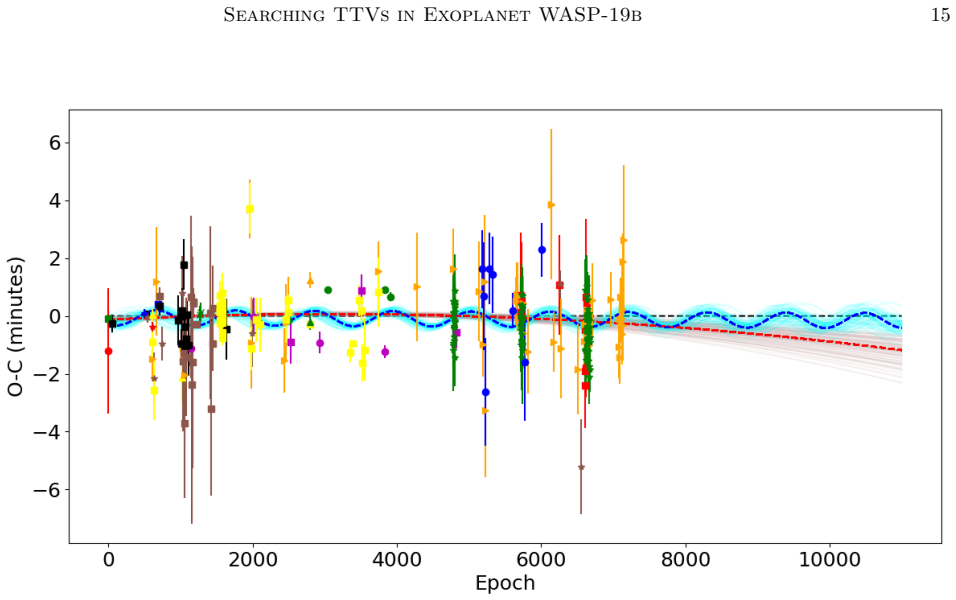
The central mechanism is the apsidal precession timing model, which describes a planet on a constant-period, slightly eccentric orbit whose argument of periastron rotates uniformly. The model's timing formula, $T_{\rm ap}(E) = T_{\rm ap0} + P_s E - \frac{e P_s}{\pi(1 - d\omega/dE/2\pi)}\cos(\omega_0 + E\,d\omega/dE)$, turns the slow rotation of the orbital ellipse into a sinusoidal observed-minus-calculated (O-C) curve whose amplitude is set by $e P_s/\pi$. The paper fits this five-parameter model with an MCMC sampler and compares it against the linear ephemeris and the quadratic orbital-decay model using reduced chi-squared, AIC, and BIC, taking the large BIC difference as decisive evidence for precession.
What would settle it
A decisive test is to obtain high-precision secondary-eclipse timing measurements over the next several years: apsidal precession predicts that eclipse timing drift is anti-correlated with transit timing drift, whereas orbital decay predicts that both drift in the same direction, so the observed sign of that correlation would settle which model is correct.
Extended reading notes
Core claim
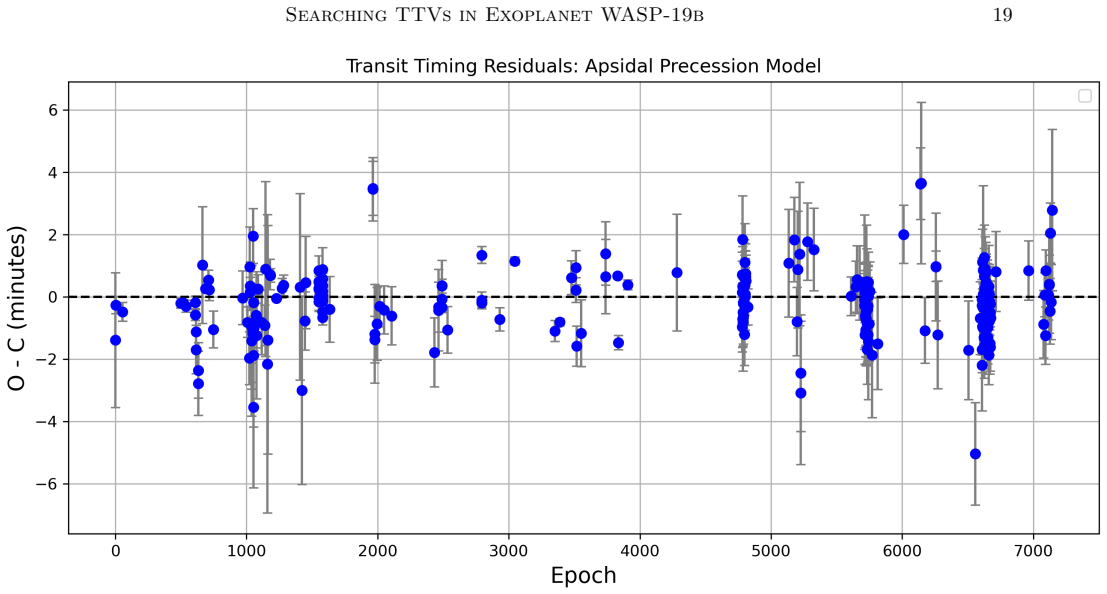
The central claim is that the transit timing variations of WASP-19b over a 14-year baseline are best described by apsidal precession of a slightly eccentric orbit. Fitting the apsidal precession model gives an eccentricity of $e = 0.0058$, a periastron precession rate of $d\omega/dE = 0.0008$ rad/epoch, and a precession period of about 18.6 years, with a reduced chi-squared of $\chi^2_{\rm red} = 1.19$ and a BIC improvement of $\Delta\mathrm{BIC} > 10$ over both the constant-period and orbital-decay models. The orbital-decay model yields a period derivative of $dP/dE = (-0.28 \pm 0.10)\times10^{-10}$, corresponding to $\dot{P} \sim -1.1 \pm 0.40$ ms/yr, which the paper regards as too weak to claim tidal decay. A search for a companion planet found no convincing periodic signal: the highest Lomb-Scargle peak has a false-alarm probability of 22.5%, and the best sinusoidal companion model requires an unphysically high frequency that oscillates faster than the typical spacing between transits. The paper concludes that no second planet is needed and that the observed TTVs are dominated by apsidal precession, with the Applegate mechanism driven by stellar magnetic activity as a possible additional contributor.
Load-bearing premise
The entire analysis rests on the assumption that the 252 retained mid-transit times are free of starspot-induced time shifts, since WASP-19 is an active star and stellar activity alone can produce a timing signal comparable to the roughly 17-second variation attributed to precession.
Editorial extensions
If this is right
- If apsidal precession is correct, WASP-19b's orbit is slightly eccentric with $e \approx 0.006$, and its transit times will continue to follow a sinusoidal O-C pattern with a period near 18.6 years.
- The measured period derivative of about $-1.1$ ms/yr implies an inspiral timescale near 60 Myr, meaning tidal orbital decay is too slow to explain the timing variations and previous faster-decay claims are not supported by this dataset.
- No second planet is required to explain the TTVs, since the periodogram's strongest peak is consistent with noise and the sinusoidal companion model is not physically viable.
- Measuring secondary-eclipse times would discriminate between the two surviving models: apsidal precession predicts an anti-correlated drift between transit and eclipse timings, whereas orbital decay predicts both drift in the same direction.
- Stellar activity, through the Applegate mechanism, could mimic part of the timing signal, so continued high-precision photometric monitoring is needed to separate activity from the precession contribution.
Reading between the lines
- If the precession interpretation holds, WASP-19b joins the small set of hot Jupiters where a slightly eccentric orbit is maintained against tidal circularization, possibly by an unseen dynamical driver or by an internal structure that responds strongly to tides.
- The inferred planetary Love number of about $k_p = 1.21 \pm 0.56$, roughly twice Jupiter's value, suggests an unusually deformable interior; if confirmed by independent methods, this would constrain the planet's internal density profile, but it could also indicate that unmodeled stellar activity is inflating the precession signal.
- The same data-processing template, with explicit starspot rejection and a three-model comparison, could be applied to other ultra-short-period hot Jupiters where orbital decay and apsidal precession are disputed, providing a uniform way to separate geometric from tidal timing signals.
- A clean testable extension: track the TTV amplitude and phase across at least one full stellar activity cycle; if the Applegate mechanism dominates, the timing signal should modulate on the activity-cycle timescale rather than remaining a coherent precession sinusoid.
Signed reviews
Editorial analysis
A structured set of objections, weighed in public.
Referee Report
Summary. The paper assembles 252 mid-transit times of WASP-19b spanning about 14 years from TESS, ETD, ExoClock, and the literature, after excluding 52 starspot-affected light curves. It fits a linear ephemeris, an orbital-decay model, and an apsidal-precession model with eccentricity e, argument of periastron omega0, precession rate domega/dE, and a free jitter term. The apsidal-precession model is reported as preferred, with e = 0.0058, domega/dE = 0.000725 rad/epoch, a precession period of about 18.6 yr, chi^2_red = 1.19, and DeltaBIC > 10 over the other two models. A Lomb-Scargle search of the linear residuals is used to argue against a planetary companion, and a sinusoidal model is rejected as physically unviable. The paper then derives Q'_* ~ 2.6e6 and k_p ~ 1.21, and it discusses the Applegate mechanism and the Shklovskii effect as alternative explanations.
Significance. If the apsidal-precession interpretation were secure, this would be a valuable contribution to a currently disputed system, providing a homogeneous long-baseline TTV dataset, machine-readable tables, and detailed MCMC diagnostics. The paper is careful in its light-curve fitting and in reporting convergence diagnostics, and it is transparent about the three timing models considered. However, the central attribution is not established as claimed: the Applegate mechanism is discussed but is not included in the quantitative model comparison, and the paper's own Section 6.3.1 states that the transit-timing variation is most likely caused by the Applegate mechanism or stellar magnetic activity. Because the activity alternative is amplitude-compatible with the fitted precession signal, the manuscript currently overstates the strength of the evidence for apsidal precession.
major comments (4)
- [Abstract; §5.3; §6.3.1] The principal claim that apsidal precession 'more consistently explains' the observed TTVs is not supported by the model comparison, because the Applegate mechanism is discussed only qualitatively and is omitted from Table 8. The paper states at the end of §6.3.1 that 'the variation in transit times is most likely caused by Applegate mechanism or the magnetic activity of the host star,' which directly contradicts the abstract's preference for apsidal precession. Scaling the paper's own §6.3.1 estimate (delta_t ~ 27.5 s for a 50-yr activity cycle) to the fitted precession timescale of 18.6 yr via the T_mod^{-3/2} scaling gives delta_t ~ 120 s, comparable to the precession-model amplitude of about 2 min. Since the DeltaBIC comparison in Table 8 includes only the linear, orbital-decay, and apsidal-precession models, it does not discriminate against a stellar-activity origin. The authors should either include an activity model in the quantitative comparison or substantially soften the central attribution.
- [§5.4] The companion search contains a direct internal contradiction. The text reports a false alarm probability of 22.5% for the highest Lomb-Scargle peak and then states that this value is 'significantly below' the 1% and 5% thresholds; 22.5% is far above both thresholds. As written, the conclusion that a planetary companion can be ruled out is not supported. The correct reading, that the peak is not significant, should be stated explicitly, and the consequences for the companion-exclusion claim should be reassessed.
- [§5.3; Table 8] The statistical preference for apsidal precession rests on a fit in which the jitter term was initially fixed and then freed, with the freed-jitter version adopted because it improves chi^2_red, AIC, and BIC. A model-selection statement based on a noise parameter that was tuned to improve the fit is not a clean test of the precession signal. In addition, omega0 is formally insignificant (-0.71 with 1-sigma uncertainties +1.17/-0.62), and the text itself notes strong correlations among e, omega0, and domega/dE. The paper should report the fixed-jitter fit, the covariance or corner plots for the precession parameters, and ideally a likelihood-ratio test of the precession term that does not rely on the jitter prior.
- [§4; §5.2.2] The exclusion of 52 starspot-affected light curves is based on manual visual inspection for a positive bump near mid-transit, and the paper provides no quantitative test of how residual spot contamination affects the fitted TTV amplitude. WASP-19 is an active star (P_rot ~ 10.5 d), and spot-induced timing offsets can be comparable to the roughly 17 s signal attributed to precession. The robustness of the precession amplitude and model ranking should be tested, for example by refitting without the excluded curves, by comparing mid-times fitted with and without spot models, or by injecting simulated spot anomalies. Without such a test, the claim that the 252-point dataset is free of activity-induced timing noise is not established.
minor comments (7)
- [Abstract; §3; §7] The number of fitted light curves is inconsistent: the abstract says 204 transit light curves, Section 3 lists 116 + 65 + 24 + 12 + 4 + 2 = 223, and Section 7 says 222. Please reconcile these counts.
- [§5.2; §5.2.2] The significance of dP/dE is given as 2.8 sigma in §5.2 and as 2.6 sigma in §5.2.2; since 0.28/0.10 = 2.8, the later value appears to be a typo.
- [§5.3; Table 8] The precession rate is quoted as 0.0008 rad/epoch in the text of §5.3 and as 0.000725 rad/epoch in Table 8; please use one consistent value.
- [§5.1] The phrase that the ephemeris is '5.6 sigma times more precise' is not meaningful; this should be expressed as a ratio of uncertainties.
- [§5.4] The frequency search range used for the Lomb-Scargle and sinusoidal fits (0.02-0.10 cycles/epoch) does not cover the apsidal-precession frequency of about 1.16e-4 cycles/epoch, so the frequency analysis cannot directly test the precession interpretation.
- [§6.3.2] 'Romer effect' should be 'Rømer effect'.
- [References] The Bernabò et al. (2024) reference appears twice in the reference list.
Circularity Check
Ancillary physical quantities Q'_*, Tremain, T_shift, and kp are algebraic rescalings of the fitted dP/dE and dω/dE; the 'consistency with residual rms' check is tautological, while the central apsidal-versus-decay model comparison rests on independent data.
-
fitted input called prediction
[Section 6.1-6.1.2 (Equations 5-7)]
"By substituting the derived value of ˙P (see Section 5.2.1) and the above values in Equation 5, we have inferred the modified stellar tidal quality factor to be ∼ 2.6 × 10⁶ for WASP-19b ... we calculated the value of Tremain of WASP-19b to be ∼ 8.8Myr ... the expected shift in the transit arrival time of WASP-19b after 15 yr (T = 15 yr) is found to be T_shift ∼ 56.56 s. This value of T_shift is consistent with the rms of the obtained timing residuals."
Eq. (5) gives Q'_* = -(27/2π)(Mp/M*)(a/R*)^-5(1/Pdot). Pdot is the orbital-decay model's fitted parameter from the same 252 transit times (Table 8). Eq. (6) then gives Tremain = (1/48) Q'_* n (a/R*)^5 (M*/Mp) = -(27/(48 P Pdot)), and Eq. (7) with dn/dT = -(2π/P^2) Pdot gives Tshift = -T^2 Pdot/(2P). Thus Tremain and Tshift are scaled versions of the fitted Pdot, not independent predictions. The 'consistent with the rms of the obtained timing residuals' check is guaranteed, because the quadratic fit was adjusted to those residuals; the agreement carries no confirmatory information.
-
self definitional
[Section 6.2 (Equation 9)]
"To estimate the value of planetary love number, kp, we adopted the following equation of Patra et al. (2017): dω/dE = 15πkp (M∗/Mp)(Rp/a)^5, (9) where the value dω/dE is taken from Table 8 ... Our estimated value of the planetary Love number, kp = 1.21 ± 0.56 ... Since the apsidal precession rate is directly proportional to the Love number kp ... this enhanced deformability results in a faster apsidal precession"
Eq. (9), dω/dE = 15π kp (M*/Mp)(Rp/a)^5, is solved for kp after inserting the fitted dω/dE from Table 8 and fixed literature masses/radii. Hence kp is the precession-rate fit multiplied by constants; it contains no new datum. The paper then explains the fitted fast precession by the resulting high kp ('higher Love number ... results in a faster apsidal precession'), which is exactly Eq. (9) restated. The derivation of kp is therefore self-definitional: the physical 'explanation' is the input fit expressed in different units.
full rationale
The paper's central model-selection claim (apsidal precession preferred over linear and orbital-decay models, ΔBIC > 10) is not circular: it compares three timing models fitted to 252 mid-transit times assembled from TESS, ETD, ExoClock, and literature, and the apsidal-precession equation is attributed to Gimenez & Bastero (1995) via Biswas et al. (2024), so the self-citation does not supply the model's content. The derived physical quantities, however, are re-parameterizations of the fits. Q'_* is obtained by inserting the fitted dP/dE (equivalently Pdot) into Eq. (5); Tremain (Eq. 6) and Tshift (Eq. 7) are then algebraic rescalings of the same fitted Pdot, so the statement that Tshift is 'consistent with the rms of the obtained timing residuals' is a tautology rather than a validation. Similarly, kp is defined by Eq. (9) as a constant multiple of the fitted dω/dE, so reporting kp = 1.21 and then invoking 'higher kp -> faster precession' as an explanation restates the fitted precession rate in new units. These are genuine but ancillary circularities; the abstract's main preference is still an independent model-comparison result. Separately, Section 6.3.1 states that the TTVs are 'most likely caused by Applegate mechanism', which conflicts with the abstract's apsidal-precession claim; that is a consistency or correctness concern, not circularity, and does not increase the score.
Assumptions & free parameters
free parameters (5)
- Orbital decay rate dP/dE =
-0.28e-10 days/epoch
- Eccentricity e =
0.0058
- Precession rate dω/dE =
0.0008 rad/epoch
- Jitter =
0.0002 days
- Argument of periastron ω0 =
-0.71 rad
assumptions (5)
- standard math Mandel-Agol transit model and Carter-Winn wavelet likelihood correctly describe the light curves
- domain assumption Apsidal precession model of Giménez & Bastero (1995) applies to WASP-19b
- standard math GLS periodogram and bootstrap FAP are appropriate for unevenly sampled timing residuals
- ad hoc to paper Excluded starspot-affected light curves are the only significant stellar activity contamination
- standard math Equations from Patra et al. (2017), Ragozzine & Wolf (2009), Goldreich & Soter (1966) relate fitted timing parameters to physical quantities Q'_*, k_p
Cite this review
Pith. "Pith review of Investigating Transit Timing Variations in the Ultra-short Period Exoplanet WASP-19b." pith.science (2026). https://pith.science/paper/MMOO5QE3
@misc{pith2026250616306,
  author       = {Pith},
  title        = {Pith review of: Investigating Transit Timing Variations in the Ultra-short Period Exoplanet WASP-19b},
  year         = {2026},
  howpublished = {\url{https://pith.science/paper/MMOO5QE3}},
  note         = {Machine review of arXiv:2506.16306}
}
read the original abstract
In this study, we present a comprehensive analysis of transit timing variations (TTVs) in the ultra-short-period gas giant WASP-19b, which orbits a G-type main-sequence star. Our analysis is based on a dataset comprising 204 transit light curves obtained from the Transiting Exoplanet Survey Satellite (TESS), the Exoplanet Transit Database (ETD), and the ExoClock project, supplemented by 18 publicly available light curves. Mid-transit times were extracted from these data, and an additional 98 mid-transit times compiled from the literature were incorporated, resulting in a combined dataset spanning approximately 14 years. After excluding light curves significantly impacted by stellar activity, such as starspot anomalies, the final dataset consisted of 252 high-quality mid-transit times. Initial inspection of the transit timing residuals using an apsidal precession model suggested the possible presence of an additional planetary companion. However, subsequent frequency analysis and sinusoidal model fitting indicate that the observed TTVs are more consistently explained by apsidal precession of WASP-19b's orbit. We also considered alternative mechanisms, including the Applegate mechanism and the Shklovskii effect. Our findings suggest that stellar magnetic activity, potentially linked to the Applegate mechanism, may also contribute to the observed timing variations. To further constrain the origin of the TTVs and assess the contributions of these mechanisms, continued high-precision photometric monitoring of the WASP-19 system is strongly recommended.
Figures


Figures from the paper (1 more)
Reference graph
Works this paper leans on
-
[1]
, " * write output.state after.block = add.period write newline
ENTRY address archivePrefix author booktitle chapter doi edition editor eprint howpublished institution journal key month number organization pages publisher school series title misctitle type volume year version url label extra.label sort.label short.list INTEGERS output.state before.all mid.sentence after.sentence after.block FUNCTION init.state.consts ...
-
[2]
write newline
" write newline "" before.all 'output.state := FUNCTION format.url url empty "" new.block "" url * "" * if FUNCTION format.eprint eprint empty "" archivePrefix empty "" archivePrefix "arXiv" = new.block " " eprint * " " * new.block " " eprint * " " * if if if FUNCTION format.doi doi empty "" " " doi * " " * if FUNCTION format.pid doi empty eprint empty ur...
-
[3]
2022, , 163, 77, 10.3847/1538-3881/ac416d
A-thano , N., Jiang , I.-G., Awiphan , S., et al. 2022, , 163, 77, 10.3847/1538-3881/ac416d
-
[4]
2023, , 166, 223, 10.3847/1538-3881/acfeea
A-thano , N., Awiphan , S., Jiang , I.-G., et al. 2023, , 166, 223, 10.3847/1538-3881/acfeea
-
[5]
2013, , 553, A49, 10.1051/0004-6361/201220351
Abe , L., Gon c alves , I., Agabi , A., et al. 2013, , 553, A49, 10.1051/0004-6361/201220351
-
[6]
R., Jackson , B., Sickafoose , A
Adams , E. R., Jackson , B., Sickafoose , A. A., et al. 2024, , 5, 163, 10.3847/PSJ/ad3e80
-
[7]
2005, , 359, 567, 10.1111/j.1365-2966.2005.08922.x
Agol , E., Steffen , J., Sari , R., & Clarkson , W. 2005, , 359, 567, 10.1111/j.1365-2966.2005.08922.x
arXiv 2005
-
[8]
1974, IEEE Transactions on Automatic Control, 19, 716
Akaike , H. 1974, IEEE Transactions on Automatic Control, 19, 716
1974
Show all 169 references
-
[9]
Akinsanmi , B., Barros , S. C. C., Lendl , M., et al. 2024, , 685, A63, 10.1051/0004-6361/202348502
2024 doi
-
[10]
M., D \' az , R
Almenara , J. M., D \' az , R. F., Bonfils , X., & Udry , S. 2016, , 595, L5, 10.1051/0004-6361/201629770
2016 doi
-
[11]
2009, , 501, L23, 10.1051/0004-6361/200912505
Alonso , R., Guillot , T., Mazeh , T., et al. 2009, , 501, L23, 10.1051/0004-6361/200912505
2009 doi
-
[13]
R., Gillon, M., Maxted, P
Anderson, D. R., Gillon, M., Maxted, P. F. L., et al. 2010, Astronomy and Astrophysics, 513, L3, 10.1051/0004-6361/201014226
2010 doi
-
[14]
R., Smith , A
Anderson , D. R., Smith , A. M. S., Madhusudhan , N., et al. 2013, , 430, 3422, 10.1093/mnras/stt140
2013 doi
-
[15]
Applegate , J. H. 1992, , 385, 621, 10.1086/170967
1992 doi
- [16]
-
[17]
L., Charbonneau , D., et al
Ballard , S., Christiansen , J. L., Charbonneau , D., et al. 2010, , 716, 1047, 10.1088/0004-637X/716/2/1047
2010 doi
-
[18]
Barker , A. J. 2020, , 498, 2270, 10.1093/mnras/staa2405
2020 doi
-
[19]
Barros , S. C. C., Bou \'e , G., Gibson , N. P., et al. 2013, , 430, 3032, 10.1093/mnras/stt111
2013 doi
-
[20]
Barros, S. C. C., Akinsanmi, B., Boué, G., et al. 2022, Astronomy & Astrophysics, 657, A52, 10.1051/0004-6361/202142196
2022 doi
-
[21]
Bean , J. L. 2009, , 506, 369, 10.1051/0004-6361/200912030
2009 doi
-
[22]
C., Vanderburg , A., Adams , F
Becker , J. C., Vanderburg , A., Adams , F. C., Rappaport , S. A., & Schwengeler , H. M. 2015, , 812, L18, 10.1088/2041-8205/812/2/L18
2015 doi
-
[24]
M., Csizmadia, S., Smith, A
Bernabò, L. M., Csizmadia, S., Smith, A. M. S., et al. 2024, Astronomy & Astrophysics, 684, A78, 10.1051/0004-6361/202346852
2024 doi
-
[25]
L., Cappetta , M., Cruz , P., et al
Birkby , J. L., Cappetta , M., Cruz , P., et al. 2014, , 440, 1470, 10.1093/mnras/stu343
2014 doi
-
[26]
P., & Parthasarathy , K
Biswas , S., Bisht , D., Jiang , I.-G., Sariya , D. P., & Parthasarathy , K. 2024, , 168, 176, 10.3847/1538-3881/ad6d66
2024 doi
-
[27]
2014, , 781, 116, 10.1088/0004-637X/781/2/116
Blecic , J., Harrington , J., Madhusudhan , N., et al. 2014, , 781, 116, 10.1088/0004-637X/781/2/116
2014 doi
-
[28]
S., Desidera , S., Benatti , S., et al
Bonomo , A. S., Desidera , S., Benatti , S., et al. 2017, , 602, A107, 10.1051/0004-6361/201629882
2017 doi
-
[29]
J., & Summers , A
Borucki , W. J., & Summers , A. L. 1984, , 58, 121, 10.1016/0019-1035(84)90102-7
1984 doi
-
[30]
G., Winn , J
Bouma , L. G., Winn , J. N., Howard , A. W., et al. 2020, , 893, L29, 10.3847/2041-8213/ab8563
2020 doi
-
[31]
G., Winn , J
Bouma , L. G., Winn , J. N., Baxter , C., et al. 2019, , 157, 217, 10.3847/1538-3881/ab189f
2019 doi
-
[32]
I., Wang , S., Mahadevan , S., et al
Ca \ n as , C. I., Wang , S., Mahadevan , S., et al. 2019, , 870, L17, 10.3847/2041-8213/aafa1e
2019 doi
- [33]
-
[34]
M., Latham , D
Charbonneau , D., Brown , T. M., Latham , D. W., & Mayor , M. 2000, , 529, L45, 10.1086/312457
2000 doi
-
[35]
2017, , 600, A30, 10.1051/0004-6361/201629705
Claret , A. 2017, , 600, A30, 10.1051/0004-6361/201629705
2017 doi
-
[36]
2011, , 529, A75, 10.1051/0004-6361/201116451
Claret , A., & Bloemen , S. 2011, , 529, A75, 10.1051/0004-6361/201116451
2011 doi
-
[37]
2018, , 476, 2542, 10.1093/mnras/sty292
Collier Cameron , A., & Jardine , M. 2018, , 476, 2542, 10.1093/mnras/sty292
2018 doi
- [38]
-
[39]
2020, , 636, A98, 10.1051/0004-6361/201936279
Cort \'e s-Zuleta , P., Rojo , P., Wang , S., et al. 2020, , 636, A98, 10.1051/0004-6361/201936279
2020 doi
-
[40]
Counselman , III, C. C. 1973, , 180, 307, 10.1086/151964
1973 doi
-
[41]
Cowling , T. G. 1938, , 98, 734, 10.1093/mnras/98.9.734
1938 doi
-
[42]
Csizmadia, S., Hellard, H., & Smith, A. M. S. 2019, Astronomy & Astrophysics, 623, A45, 10.1051/0004-6361/201834376
2019 doi
-
[43]
I., & Johnson , J
Dawson , R. I., & Johnson , J. A. 2018, , 56, 175, 10.1146/annurev-astro-081817-051853
2018 doi
-
[44]
R., Pilyavsky , G., et al
Dragomir , D., Kane , S. R., Pilyavsky , G., et al. 2011, , 142, 115, 10.1088/0004-6256/142/4/115
2011 doi
- [45]
-
[46]
V., Jord \'a n , A., et al
Espinoza , N., Rackham , B. V., Jord \'a n , A., et al. 2019, , 482, 2065, 10.1093/mnras/sty2691
2019 doi
-
[47]
Essick , R., & Weinberg , N. N. 2016, , 816, 18, 10.3847/0004-637X/816/1/18
2016 doi
-
[48]
Ford , E. B. 2006, , 642, 505, 10.1086/500802
2006 doi
-
[49]
W., Lang , D., & Goodman , J
Foreman-Mackey , D., Hogg , D. W., Lang , D., & Goodman , J. 2013, , 125, 306, 10.1086/670067
2013 doi
-
[50]
A., Charbonneau , D., et al
Fressin , F., Knutson , H. A., Charbonneau , D., et al. 2010, , 711, 374, 10.1088/0004-637X/711/1/374
2010 doi
-
[51]
Z., Johnson , J
Gazak , J. Z., Johnson , J. A., Tonry , J., et al. 2012, Advances in Astronomy, 2012, 697967, 10.1155/2012/697967
2012 doi
-
[52]
P., Pollacco, D., Simpson, E
Gibson, N. P., Pollacco, D., Simpson, E. K., et al. 2009, The Astrophysical Journal, 700, 1078, 10.1088/0004-637X/700/2/1078
2009 doi
-
[53]
1995, , 226, 99, 10.1007/BF00626903
Gim \'e nez , A., & Bastero , M. 1995, , 226, 99, 10.1007/BF00626903
1995 doi
-
[54]
1963, , 126, 257, 10.1093/mnras/126.3.257
Goldreich , P. 1963, , 126, 257, 10.1093/mnras/126.3.257
1963 doi
-
[55]
1966, , 5, 375, 10.1016/0019-1035(66)90051-0
Goldreich , P., & Soter , S. 1966, , 5, 375, 10.1016/0019-1035(66)90051-0
1966 doi
-
[56]
2010, Communications in Applied Mathematics and Computational Science, 5, 65, 10.2140/camcos.2010.5.65
Goodman , J., & Weare , J. 2010, Communications in Applied Mathematics and Computational Science, 5, 65, 10.2140/camcos.2010.5.65
2010 doi
-
[58]
M., Seager , S., Huang , C
Guerrero , N. M., Seager , S., Huang , C. X., et al. 2021, , 254, 39, 10.3847/1538-4365/abefe1
2021 doi
-
[59]
2023, Research in Astronomy and Astrophysics, 23, 095014, 10.1088/1674-4527/ace028
Guo , S.-S. 2023, Research in Astronomy and Astrophysics, 23, 095014, 10.1088/1674-4527/ace028
2023 doi
-
[60]
2014, , 787, 80, 10.1088/0004-637X/787/1/80
Hadden , S., & Lithwick , Y. 2014, , 787, 80, 10.1088/0004-637X/787/1/80
2014 doi
-
[61]
R., Edwards , B., & Boley , A
Hagey , S. R., Edwards , B., & Boley , A. C. 2022, , 164, 220, 10.3847/1538-3881/ac959a
2022 doi
-
[62]
H., & Schlaufman , K
Hamer , J. H., & Schlaufman , K. C. 2019, , 158, 190, 10.3847/1538-3881/ab3c56
2019 doi
-
[63]
Hansen , B. M. S. 2010, , 723, 285, 10.1088/0004-637X/723/1/285
2010 doi
- [64]
-
[65]
A., Harrington , J., Hardin , M
Hardy , R. A., Harrington , J., Hardin , M. R., et al. 2017, , 836, 143, 10.3847/1538-4357/836/1/143
2017 doi
-
[66]
V., Smith , A
Harre , J. V., Smith , A. M. S., Barros , S. C. C., et al. 2023, , 669, A124, 10.1051/0004-6361/202244529
2023 doi
-
[67]
Hebb , L., Collier-Cameron , A., Triaud , A. H. M. J., et al. 2010, , 708, 224, 10.1088/0004-637X/708/1/224
2010 doi
-
[68]
R., Collier-Cameron , A., et al
Hellier , C., Anderson , D. R., Collier-Cameron , A., et al. 2011, , 730, L31, 10.1088/2041-8205/730/2/L31
2011 doi
-
[69]
R., Collier Cameron , A., et al
Hellier , C., Anderson , D. R., Collier Cameron , A., et al. 2009, , 460, 1098, 10.1038/nature08245
2009 doi
-
[70]
W., Marcy , G
Henry , G. W., Marcy , G. W., Butler , R. P., & Vogt , S. S. 2000, , 529, L41, 10.1086/312458
2000 doi
-
[71]
W., & Foreman-Mackey , D
Hogg , D. W., & Foreman-Mackey , D. 2018, , 236, 11, 10.3847/1538-4365/aab76e
2018 doi
-
[72]
J., & Murray , N
Holman , M. J., & Murray , N. W. 2005, Science, 307, 1288, 10.1126/science.1107822
2005 doi
-
[73]
2016, , 151, 137, 10.3847/0004-6256/151/6/137
Hoyer , S., Pall \'e , E., Dragomir , D., & Murgas , F. 2016, , 151, 137, 10.3847/0004-6256/151/6/137
2016 doi
-
[74]
2012, The Astrophysical Journal, 748, 22, 10.1088/0004-637X/748/1/22
Hoyer, S., Rojo, P., & López-Morales, M. 2012, The Astrophysical Journal, 748, 22, 10.1088/0004-637X/748/1/22
2012 doi
-
[75]
2013, , 434, 46, 10.1093/mnras/stt962
Hoyer , S., L \'o pez-Morales , M., Rojo , P., et al. 2013, , 434, 46, 10.1093/mnras/stt962
2013 doi
-
[76]
M., Sing , D
Huitson , C. M., Sing , D. K., Pont , F., et al. 2013, , 434, 3252, 10.1093/mnras/stt1243
2013 doi
-
[77]
2012, , 422, 3151, 10.1111/j.1365-2966.2012.20839.x
Husnoo , N., Pont , F., Mazeh , T., et al. 2012, , 422, 3151, 10.1111/j.1365-2966.2012.20839.x
2012
-
[78]
1980, , 92, 167
Hut , P. 1980, , 92, 167
1980
- [79]
-
[80]
2008, , 681, 1631, 10.1086/587641
Jackson , B., Greenberg , R., & Barnes , R. 2008, , 681, 1631, 10.1086/587641
2008 doi
-
[81]
2016, Celestial Mechanics and Dynamical Astronomy, 126, 227, 10.1007/s10569-016-9704-1
Jackson , B., Jensen , E., Peacock , S., Arras , P., & Penev , K. 2016, Celestial Mechanics and Dynamical Astronomy, 126, 227, 10.1007/s10569-016-9704-1
2016 doi
-
[82]
M., Twicken , J
Jenkins , J. M., Twicken , J. D., McCauliff , S., et al. 2016, in Society of Photo-Optical Instrumentation Engineers (SPIE) Conference Series, Vol. 9913, Software and Cyberinfrastructure for Astronomy IV, ed. G. Chiozzi & J. C. Guzman , 99133E, 10.1117/12.2233418
2016 doi
-
[83]
2016, , 151, 17, 10.3847/0004-6256/151/1/17
Jiang , I.-G., Lai , C.-Y., Savushkin , A., et al. 2016, , 151, 17, 10.3847/0004-6256/151/1/17
2016 doi
-
[84]
2023, , 265, 4, 10.3847/1538-4365/ac9da4
Kokori , A., Tsiaras , A., Edwards , B., et al. 2023, , 265, 4, 10.3847/1538-4365/ac9da4
2023 doi
-
[85]
2023, Universe, 10, 12, 10.3390/universe10010012
Korth , J., & Parviainen , H. 2023, Universe, 10, 12, 10.3390/universe10010012
2023 doi
-
[86]
Lanza , A. F. 2010, , 512, A77, 10.1051/0004-6361/200912789
2010 doi
-
[87]
2013, , 552, A2, 10.1051/0004-6361/201220924
Lendl , M., Gillon , M., Queloz , D., et al. 2013, , 552, A2, 10.1051/0004-6361/201220924
2013 doi
-
[88]
2024, , 686, A84, 10.1051/0004-6361/202348363
Leonardi , P., Nascimbeni , V., Granata , V., et al. 2024, , 686, A84, 10.1051/0004-6361/202348363
2024 doi
-
[89]
Levrard , B., Correia , A. C. M., Chabrier , G., et al. 2007, , 462, L5, 10.1051/0004-6361:20066487
2007 doi
-
[90]
2009, , 692, L9, 10.1088/0004-637X/692/1/L9
Levrard , B., Winisdoerffer , C., & Chabrier , G. 2009, , 692, L9, 10.1088/0004-637X/692/1/L9
2009 doi
- [91]
-
[92]
2021, , 656, A88, 10.1051/0004-6361/202142424
Maciejewski , G., Fern \'a ndez , M., Aceituno , F., et al. 2021, , 656, A88, 10.1051/0004-6361/202142424
2021 doi
-
[93]
2024, , 692, A35, 10.1051/0004-6361/202452101
Maciejewski , G., Golonka , J., Fern \'a ndez , M., et al. 2024, , 692, A35, 10.1051/0004-6361/202452101
2024 doi
-
[95]
2013, , 551, A108, 10.1051/0004-6361/201220739
Maciejewski , G., Dimitrov , D., Seeliger , M., et al. 2013, , 551, A108, 10.1051/0004-6361/201220739
2013 doi
-
[96]
2016, , 588, L6, 10.1051/0004-6361/201628312
Maciejewski , G., Dimitrov , D., Fern \'a ndez , M., et al. 2016, , 588, L6, 10.1051/0004-6361/201628312
2016 doi
-
[97]
2018, , 68, 371, 10.32023/0001-5237/68.4.4
Maciejewski , G., Fern \'a ndez , M., Aceituno , F., et al. 2018, , 68, 371, 10.32023/0001-5237/68.4.4
2018 doi
-
[98]
2013, , 436, 2, 10.1093/mnras/stt1394
Mancini , L., Ciceri , S., Chen , G., et al. 2013, , 436, 2, 10.1093/mnras/stt1394
2013 doi
-
[99]
2002, , 580, L171, 10.1086/345520
Mandel , K., & Agol , E. 2002, , 580, L171, 10.1086/345520
2002 doi
-
[100]
2021, TESS Light Curves - All Sectors, STScI/MAST, 10.17909/t9-nmc8-f686
MAST Team . 2021, TESS Light Curves - All Sectors, STScI/MAST, 10.17909/t9-nmc8-f686
2021 doi
-
[101]
2019, in EAS Publications Series, Vol
Mathis , S. 2019, in EAS Publications Series, Vol. 82, EAS Publications Series, 5--33, 10.1051/eas/1982002
2019
-
[102]
J., & Rasio , F
Matsumura , S., Peale , S. J., & Rasio , F. A. 2010, , 725, 1995, 10.1088/0004-637X/725/2/1995
2010 doi
-
[103]
1995, , 378, 355, 10.1038/378355a0
Mayor , M., & Queloz , D. 1995, , 378, 355, 10.1038/378355a0
1995 doi
-
[104]
Mede , K., & Brandt , T. D. 2017, , 153, 135, 10.3847/1538-3881/aa5e4a
2017 doi
-
[105]
A., Platais , I., et al
Meibom , S., Barnes , S. A., Platais , I., et al. 2015, , 517, 589, 10.1038/nature14118
2015 doi
-
[106]
Meibom , S., & Mathieu , R. D. 2005, , 620, 970, 10.1086/427082
2005 doi
-
[107]
D., & Stassun , K
Meibom , S., Mathieu , R. D., & Stassun , K. G. 2006, , 653, 621, 10.1086/508252
2006 doi
- [108]
-
[109]
Mo c nik , T., Clark , B. J. M., Anderson , D. R., Hellier , C., & Brown , D. J. A. 2016, , 151, 150, 10.3847/0004-6256/151/6/150
2016 doi
-
[110]
D., & Dermott , S
Murray , C. D., & Dermott , S. F. 1999, Solar System Dynamics , 10.1017/CBO9781139174817
1999 doi
-
[111]
Ogilvie , G. I. 2014, , 52, 171, 10.1146/annurev-astro-081913-035941
2014 doi
- [112]
-
[113]
M., et al
P \'a l , A., S \'a rneczky , K., Szab \'o , G. M., et al. 2011, , 413, L43, 10.1111/j.1745-3933.2011.01029.x
2011
-
[114]
2022, , 512, 3651, 10.1093/mnras/stac203
Patel , R., & Penev , K. 2022, , 512, 3651, 10.1093/mnras/stac203
2022 doi
-
[115]
C., Winn , J
Patra , K. C., Winn , J. N., Holman , M. J., et al. 2017, , 154, 4, 10.3847/1538-3881/aa6d75
2017 doi
- [116]
-
[117]
G., Winn , J
Penev , K., Bouma , L. G., Winn , J. N., & Hartman , J. D. 2018, , 155, 165, 10.3847/1538-3881/aaaf71
2018 doi
-
[118]
2012, , 751, 96, 10.1088/0004-637X/751/2/96
Penev , K., Jackson , B., Spada , F., & Thom , N. 2012, , 751, 96, 10.1088/0004-637X/751/2/96
2012 doi
-
[119]
2020, , 491, 1243, 10.1093/mnras/stz3034
Petrucci , R., Jofr \'e , E., G \'o mez Maqueo Chew , Y., et al. 2020, , 491, 1243, 10.1093/mnras/stz3034
2020 doi
-
[120]
2010, , 15, 297, 10.1016/j.newast.2009.09.001
Poddan \'y , S., Br \'a t , L., & Pejcha , O. 2010, , 15, 297, 10.1016/j.newast.2009.09.001
2010 doi
-
[121]
J., Alonso , R., Belmonte , J
Rabus , M., Deeg , H. J., Alonso , R., Belmonte , J. A., & Almenara , J. M. 2009, , 508, 1011, 10.1051/0004-6361/200912252
2009 doi
-
[122]
Raetz , S., Mugrauer , M., Schmidt , T. O. B., et al. 2009, Astronomische Nachrichten, 330, 475, 10.1002/asna.200811200
2009 doi
-
[123]
Rafikov, R. R. 2009, The Astrophysical Journal, 700, 965, 10.1088/0004-637X/700/2/965
2009 doi
-
[124]
Ragozzine , D., & Wolf , A. S. 2009, , 698, 1778, 10.1088/0004-637X/698/2/1778
2009 doi
-
[125]
A., Tout , C
Rasio , F. A., Tout , C. A., Lubow , S. H., & Livio , M. 1996, , 470, 1187, 10.1086/177941
1996 doi
-
[126]
2014, Experimental Astronomy, 38, 249, 10.1007/s10686-014-9383-4
Rauer , H., Catala , C., Aerts , C., et al. 2014, Experimental Astronomy, 38, 249, 10.1007/s10686-014-9383-4
2014 doi
-
[127]
R., Winn , J
Ricker , G. R., Winn , J. N., Vanderspek , R., et al. 2014, in Society of Photo-Optical Instrumentation Engineers (SPIE) Conference Series, Vol. 9143, Space Telescopes and Instrumentation 2014: Optical, Infrared, and Millimeter Wave, ed. J. M. Oschmann , Jr., M. Clampin , G. G...
2014 doi
-
[129]
M., Barros, S
Rosário, N. M., Barros, S. C. C., Demangeon, O. D. S., & Santos, N. C. 2022, Astronomy & Astrophysics, 668, A114, 10.1051/0004-6361/202244513
2022 doi
-
[130]
Russell , H. N. 1928, , 88, 641, 10.1093/mnras/88.8.641
1928 doi
-
[131]
Sanchis-Ojeda , R., & Winn , J. N. 2011, , 743, 61, 10.1088/0004-637X/743/1/61
2011 doi
-
[132]
Sasselov , D. D. 2003, , 596, 1327, 10.1086/378145
2003 doi
-
[133]
1978, Annals of Statistics, 6, 461
Schwarz , G. 1978, Annals of Statistics, 6, 461
1978
-
[134]
Sedaghati , E., Boffin , H. M. J., Csizmadia , S., et al. 2015, , 576, L11, 10.1051/0004-6361/201525822
2015 doi
-
[135]
Sedaghati , E., Boffin , H. M. J., MacDonald , R. J., et al. 2017, , 549, 238, 10.1038/nature23651
2017 doi
-
[136]
J., Casasayas-Barris , N., et al
Sedaghati , E., MacDonald , R. J., Casasayas-Barris , N., et al. 2021, , 505, 435, 10.1093/mnras/stab1164
2021 doi
-
[137]
2024, Research Notes of the AAS, 8, 223, 10.3847/2515-5172/ad77a6
Shen, Z. 2024, Research Notes of the AAS, 8, 223, 10.3847/2515-5172/ad77a6
2024 doi
-
[138]
Shklovskii , I. S. 1970, , 13, 562
1970
-
[139]
Silva , A. V. R. 2003, , 585, L147, 10.1086/374324
2003 doi
-
[140]
C., Stumpe , M
Smith , J. C., Stumpe , M. C., Van Cleve , J. E., et al. 2012, , 124, 1000, 10.1086/667697
2012 doi
-
[141]
2017, , 153, 191, 10.3847/1538-3881/aa6477
Southworth , J., Mancini , L., Madhusudhan , N., et al. 2017, , 153, 191, 10.3847/1538-3881/aa6477
2017 doi
-
[142]
G., et al
Southworth , J., Dominik , M., J rgensen , U. G., et al. 2019, , 490, 4230, 10.1093/mnras/stz2602
2019 doi
-
[143]
G., Oelkers , R
Stassun , K. G., Oelkers , R. J., Pepper , J., et al. 2018, , 156, 102, 10.3847/1538-3881/aad050
2018 doi
-
[144]
Steffen , J. H. 2013, , 433, 3246, 10.1093/mnras/stt966
2013 doi
-
[145]
2005, in Astronomical Society of the Pacific Conference Series, Vol
Sterken , C. 2005, in Astronomical Society of the Pacific Conference Series, Vol. 335, The Light-Time Effect in Astrophysics: Causes and cures of the O-C diagram, ed. C. Sterken , 3
2005
-
[146]
Sterne , T. E. 1939 a , , 99, 451, 10.1093/mnras/99.5.451
1939 doi
- [147]
-
[148]
C., Smith , J
Stumpe , M. C., Smith , J. C., Catanzarite , J. H., et al. 2014, , 126, 100, 10.1086/674989
2014 doi
-
[149]
C., Smith , J
Stumpe , M. C., Smith , J. C., Van Cleve , J. E., et al. 2012, , 124, 985, 10.1086/667698
2012 doi
-
[150]
P., et al
Su , L.-H., Jiang , I.-G., Sariya , D. P., et al. 2021, , 161, 108, 10.3847/1538-3881/abd4d8
2021 doi
-
[151]
M., D \'a lya , G., et al
Szab \'o , R., Szab \'o , G. M., D \'a lya , G., et al. 2013, , 553, A17, 10.1051/0004-6361/201220132
2013 doi
-
[152]
2013, , 428, 3671, 10.1093/mnras/sts306
Tregloan-Reed , J., Southworth , J., & Tappert , C. 2013, , 428, 3671, 10.1093/mnras/sts306
2013 doi
-
[153]
D., Flagg , L., Ridden-Harper , A., & Jayawardhana , R
Turner , J. D., Flagg , L., Ridden-Harper , A., & Jayawardhana , R. 2022, , 163, 281, 10.3847/1538-3881/ac686f
2022 doi
-
[154]
D., Ridden-Harper , A., & Jayawardhana , R
Turner , J. D., Ridden-Harper , A., & Jayawardhana , R. 2021, , 161, 72, 10.3847/1538-3881/abd178
2021 doi
-
[155]
A., Marchant , P., & Rogers , L
Valsecchi , F., Rappaport , S., Rasio , F. A., Marchant , P., & Rogers , L. A. 2015, , 813, 101, 10.1088/0004-637X/813/2/101
2015 doi
-
[156]
Valsecchi , F., & Rasio , F. A. 2014, , 787, L9, 10.1088/2041-8205/787/1/L9
2014 doi
-
[157]
2022, , 941, L31, 10.3847/2041-8213/aca47e
Vissapragada , S., Chontos , A., Greklek-McKeon , M., et al. 2022, , 941, L31, 10.3847/2041-8213/aca47e
2022 doi
-
[158]
2019, , 622, A71, 10.1051/0004-6361/201833837
von Essen , C., Mallonn , M., Welbanks , L., et al. 2019, , 622, A71, 10.1051/0004-6361/201833837
2019 doi
-
[159]
M., Hubbard , W
Wahl , S. M., Hubbard , W. B., & Militzer , B. 2016, , 831, 14, 10.3847/0004-637X/831/1/14
2016 doi
-
[160]
2024, , 270, 14, 10.3847/1538-4365/ad0847
Wang , W., Zhang , Z., Chen , Z., et al. 2024, , 270, 14, 10.3847/1538-4365/ad0847
2024 doi
-
[161]
A., & Dhillon , V
Watson , C. A., & Dhillon , V. S. 2004, , 351, 110, 10.1111/j.1365-2966.2004.07763.x
2004
-
[162]
A., & Marsh , T
Watson , C. A., & Marsh , T. R. 2010, , 405, 2037, 10.1111/j.1365-2966.2010.16602.x
2010
-
[163]
N., Davachi , N., Essick , R., et al
Weinberg , N. N., Davachi , N., Essick , R., et al. 2024, , 960, 50, 10.3847/1538-4357/ad05c9
2024 doi
-
[164]
N., Delrez , L., Barker , A
Wilkins , A. N., Delrez , L., Barker , A. J., et al. 2017, , 836, L24, 10.3847/2041-8213/aa5d9f
2017 doi
-
[165]
Wolter , U., Schmitt , J. H. M. M., Huber , K. F., et al. 2009, , 504, 561, 10.1051/0004-6361/200912329
2009 doi
-
[166]
A., Kataria , T., et al
Wong , I., Knutson , H. A., Kataria , T., et al. 2016, , 823, 122, 10.3847/0004-637X/823/2/122
2016 doi
-
[167]
2020, , 159, 104, 10.3847/1538-3881/ab6d6e
Wong , I., Benneke , B., Shporer , A., et al. 2020, , 159, 104, 10.3847/1538-3881/ab6d6e
2020 doi
-
[168]
H., & Laughlin, G
Wu, D.-H., Wang, S., Zhou, J.-L., Steffen, J. H., & Laughlin, G. 2018, The Astronomical Journal, 156, 96, 10.3847/1538-3881/aad22b
2018 doi
-
[169]
2022, Research in Astronomy and Astrophysics, 22, 055005, 10.1088/1674-4527/ac5801
Yang , F., Wang , W., Wei , X., et al. 2022, Research in Astronomy and Astrophysics, 22, 055005, 10.1088/1674-4527/ac5801
2022 doi
-
[170]
W., Winn , J
Yee , S. W., Winn , J. N., Knutson , H. A., et al. 2020, , 888, L5, 10.3847/2041-8213/ab5c16
2020 doi
-
[171]
2024, , 106, 102130, 10.1016/j.newast.2023.102130
Yeh , L.-C., Jiang , I.-G., & A-thano , N. 2024, , 106, 102130, 10.1016/j.newast.2023.102130
2024
-
[172]
Zahn , J. P. 1977, , 57, 383
1977
-
[173]
Zahn , J. P. 2008, in EAS Publications Series, Vol. 29, EAS Publications Series, ed. M. J. Goupil & J. P. Zahn , 67--90, 10.1051/eas:0829002
2008 doi
-
[174]
2009, , 496, 577, 10.1051/0004-6361:200811296
Zechmeister , M., & K \"u rster , M. 2009, , 496, 577, 10.1051/0004-6361:200811296
2009 doi
Reviewed August 6, 2026 · model on record in the stance chip above.
Discussion (0). Continue with ORCID to comment.