REVIEW 3 major objections 6 minor 52 references
Bayesian Optimization over Bounded Domains with the Beta Product Kernel
T0 review · 3 major / 6 minor · reviewed 2026-08-06 · deepseek-v4-flash
Pith's one-line read A covariance kernel that sees the edges of the search box improves Bayesian optimization on bounded domains.
desk verdict A simple, correct kernel for bounded-domain BO whose headline empirical margins are currently undercut by an unspecified GP calibration protocol and a false bound. read the letter →
The pith
A machine-rendered reading of the paper's core claim, the machinery that carries it, and where it could break.
The reading
What carries the argument
The load-bearing object is the Beta kernel of Eq. (8), the probability product kernel between Beta densities whose modes are the input points $x$ and $x'$; Theorem 1, inherited from probability product kernels, guarantees it is positive semidefinite, so it can serve as a GP covariance. The mechanism that carries the argument is the position-dependent diagonal of Eq. (16): a point near the boundary has larger prior variance than a point near the center, so acquisition functions such as UCB are naturally pushed to explore faces and vertices rather than over-exploring the whole domain. The bandwidth $h$ controls how strongly the variance rises toward the boundary, and it is learned by marginal-likelihood maximization alongside standard kernel parameters.
What would settle it
Fix the GP output-scale and noise variance to identical values across the Beta, RBF, and Matérn kernels and rerun the ViT and BERT compression protocol; if the reported objective margins (for example $0.478$ versus $0.651$ on ViT) shrink to noise or reverse, the boundary-awareness explanation would be falsified.
Extended reading notes
Core claim
The central claim is that the Beta kernel of Eq. (8), defined on $[0,1]^d$ as a product over dimensions of Gamma-function ratios with $\alpha_i = 1 + x_i/h_i$ and $\beta_i = 1 + (1-x_i)/h_i$, is a valid positive-semidefinite covariance function, and that its non-stationarity encodes boundary knowledge that stationary kernels lack. The paper argues this translates into better Bayesian optimization when the optimum lies near a face or vertex: in the $d=20$ synthetic settings it outperforms RBF, Matérn, SM, NGA, and CYL in 9 of 10 boundary-focused cases, and in model compression it reports an objective of $0.478\pm0.006$ on ViT versus $0.671$ for RBF and $0.651$ for Matérn, with comparable margins on BERT, GPT-2, and DeBERTa at roughly equal F1 or accuracy. It further claims, from regression fits of log eigenvalues against index, that the kernel's eigenvalues decay exponentially like RBF's rather than polynomially like Matérn's.
Load-bearing premise
The headline comparisons assume every kernel was given equally fair GP hyperparameter calibration; the paper specifies how lengthscales and the Beta bandwidth were learned but not how the GP output scale and likelihood noise were set, and the Beta kernel's position-dependent diagonal changes its effective prior scale.
Editorial extensions
If this is right
- On unit-hypercube problems with optima near a face or vertex, GP-BO with the Beta kernel should find better solutions than with RBF or Matérn under the same acquisition function.
- Because the kernel's diagonal puts extra prior variance at the boundary, the acquisition function spends more evaluations near edges; this is the intended mechanism behind the reported compression gains.
- The apparent exponential eigendecay suggests the Beta kernel has information-gain behavior comparable to RBF, and therefore likely sublinear regret in GP bandit settings, although the paper does not prove a regret bound.
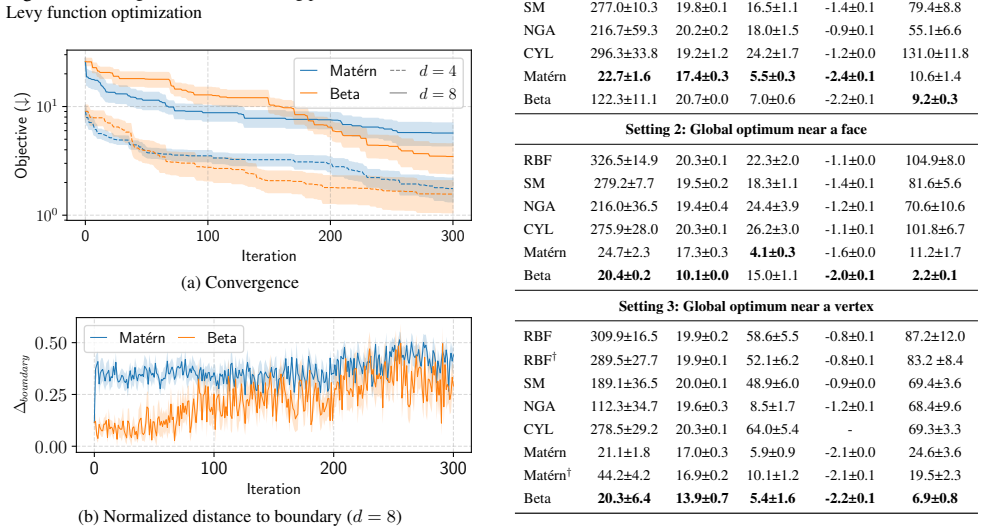
- The kernel works with UCB, PI, EI, corrected PI, and corrected EI; the advantage over Matérn persists across all five acquisition functions on the MNLI compression task.
- In model compression, the Beta kernel drives the search to strongly compress a few irrelevant layers while lightly compressing the rest, implying the optimal rank allocation in these tasks lies near the boundary of the search box.
Reading between the lines
- A direct comparison against input warping on the same compression tasks would separate the kernel's boundary sensitivity from the mere effect of transforming coordinates; the paper only includes warped baselines on one synthetic setting.
- The paper's Setting 1 results, where Matérn wins on 4 of 5 functions, suggest the Beta kernel trades away some central-region performance for boundary sensitivity; a practical rule would be to use it when prior knowledge places optima near the boundary.
- If the exponential eigendecay were proven rather than fitted, the existing regret machinery for RBF-like kernels would carry over; formalizing this is the natural next step the paper itself flags.
- The calibration question -- whether the output scale and noise variance were matched across kernels -- is the main unresolved confound; a controlled rerun would determine how much of the margin is boundary awareness rather than scale handling.
Editorial analysis
A structured set of objections, weighed in public.
Referee Report
Summary. The paper proposes a non-stationary covariance kernel for Gaussian-process Bayesian optimization on the unit hypercube. The kernel is obtained as a probability product kernel between Beta densities whose modes are the input coordinates, leading to the closed form in Eq. (8). The authors prove positive semidefiniteness in Theorem 1, derive a (claimed) diagonal bound in Proposition 2, and present numerical evidence for an exponential eigendecay rate. Experiments on synthetic test functions with optima near faces or vertices and on compression of ViT, BERT, GPT-2, and DeBERTa report substantial improvements over RBF, Matérn, and several other kernels, especially when using UCB. The conclusion acknowledges the lack of a formal regret bound as a limitation.
Significance. If the empirical results withstand a controlled hyperparameter-calibration check, the Beta kernel is a simple and useful drop-in alternative for GP-based BO on bounded domains: it is closed-form, valid by a standard probability-product-kernel argument, and its boundary sensitivity is a plausible inductive bias for problems whose optima lie near the boundary. The paper is explicit about its main weakness (no regret bound), and the experimental section is unusually broad, covering several synthetic settings, multiple acquisition functions, and real model-compression tasks with public code. The central kernel derivation and PSD proof are sound. However, the significance is currently tempered by (i) a false diagonal-bound proposition, (ii) underspecified GP hyperparameter calibration in the experimental protocol, and (iii) a statistical eigendecay analysis that does not actually distinguish exponential from polynomial decay.
major comments (3)
- [Section 2.3 / Appendix A.3, Proposition 2 and Eq. (17)] The stated bound is false for h < 1. For d = 1, h = 0.1, and x = 0.5, direct evaluation of Eq. (16) gives K_beta(x,x) ≈ 1.98, whereas the right-hand side of Eq. (17) is approximately 1.6e-4. The proof in Appendix A.3 drops a factor of 2^{2/h_i} when passing from Eq. (8) to Eq. (9), so the subsequent derivation cannot establish the claimed bound. This proposition is not used in the downstream experiments, but a false theorem in the properties section is a correctness defect that must be fixed, either by correcting the bound or by removing/weakening Proposition 2.
- [Section 3.1 (Implementation Details)] The experimental protocol is underspecified with respect to GP hyperparameter calibration. The text states only that lengthscales of RBF/Matérn and the bandwidth of the Beta kernel are learned by maximum marginal likelihood; it does not state how the outputscale (signal variance) and the likelihood noise variance are set. This matters because the Beta kernel's diagonal is position-dependent and can substantially exceed 1 (Eq. (16), Figure 1), while RBF and Matérn have constant diagonal 1 under a unit outputscale. Since UCB is used throughout and is directly sensitive to posterior variance, unequal prior variance could produce large margins in Tables 3-5 without any boundary-awareness effect. Please specify exactly how outputscale and noise were configured (fixed at defaults, learned per kernel, or normalized), and report a controlled comparison in which the effective prior variance of each kernel is matched or jointly learned.
- [Section 2.4 (Numerical Analyses of Eigenvalue Decay)] The evidence for an 'exponential eigendecay rate' is not sufficient. The statistical test fits log lambda_j against the index j and reports very small p-values, but a significant nonzero slope does not distinguish exponential decay from polynomial decay over a finite range. Moreover, the analysis averages eigenvalues of 300 random finite kernel matrices rather than the spectrum of the integral operator, and the p-values ignore dependence across the replicated matrices. Since the abstract and Section 2.4 make a strong spectral claim, this part needs either a substantially stronger empirical analysis (e.g., comparing fitted decay rates against explicit exponential and polynomial models with model-selection criteria) or a more cautious wording that reports an approximately linear log-spectrum without asserting exponential decay.
minor comments (6)
- [Section 2.4, step 2] The text says the kernel matrix Ki is in R^{d x d}, but the preceding step draws 100 points, so the matrix should be 100 x 100.
- [Figure 1 caption] The caption says the figure compares the Matérn kernel and the Beta kernel, but panel (a) shows the RBF kernel; the caption should mention RBF explicitly.
- [Table 3] Several rows in Settings 2 and 3 lack spacing between numeric entries (e.g., '20.4±0.210.1±0.015.0±1.1-2.0±0.1 2.2±0.1'), making the table hard to read and potentially ambiguous.
- [Section 3.3, paragraph after Figure 8] The sentence listing acquisition-function combinations says 'corrected PI' twice; the second occurrence should presumably be 'corrected EI' or the two corrected variants should be named distinctly.
- [Appendix A.3] The proposition proved in the appendix is labeled Proposition 3, while the main text refers to Proposition 2; the numbering should be consistent.
- [Equation (18)] The objective is w·R(x) + L(x), but the paper does not explicitly state whether R(x) is the compression ratio (larger = more compression) or the retained fraction, nor whether L(x) is error rate or (1 - accuracy); please define these quantities precisely so that the reported objective values are interpretable.
Circularity Check
No significant circularity: the Beta kernel is constructed directly from the probability product kernel definition with an independent PSD proof, and the empirical claims rest on external benchmarks rather than on fitting the target results.
full rationale
The paper's derivation chain is self-contained. The Beta kernel is defined explicitly in Eq. (8) as a probability product kernel of Beta densities (Eqs. (6)-(7)), and its positive semidefiniteness is proved in Theorem 1 without invoking any fitted quantity or self-citation. The reparameterization alpha = 1 + x/h, beta = 1 + (1-x)/h is a definition, not an inference. The eigendecay analysis in Sec. 2.4 is presented as an empirical statistical hypothesis about the kernel's own spectrum, and the Conclusion explicitly disclaims a formal regret bound, so no performance claim is derived from the eigendecay. The BO comparisons in Tables 3-5 are external benchmark outcomes (synthetic functions and model compression objectives), and the kernel's parameters are learned by maximum marginal likelihood independently of the reported objectives. The only self-citations (Zhou et al. 2024 for corrected EI, Ma et al. 2019 for corrected PI) are baseline acquisition functions and are not load-bearing for the central kernel claim. The acknowledged limitation—absence of a regret bound—further confirms that no theoretical result is being imported from self-citation. The unspecified outputscale/noise calibration in Sec. 3.1 is a potential experimental-protocol concern but not a circularity: no fitted parameter is renamed as a prediction. Overall, no step in the claimed derivation reduces to its own inputs by construction.
Assumptions & free parameters
free parameters (3)
- per-dimension bandwidth h_i =
learned by MLE; e.g., the 2D Levy run converges near 0.2 to 0.5 (Fig. 4)
- GP likelihood noise sigma^2 =
learned by MLE (standard)
- outputscale (signal variance) =
not stated in the paper
assumptions (5)
- standard math Probability product kernel integrals are finite and the Mercer kernel framework applies (Theorem 1).
- domain assumption The mode parametrization alpha = 1 + x/h, beta = 1 + (1-x)/h gives a well-defined density for every x in [0,1]^d.
- domain assumption Independence across dimensions in the product kernel (Eq. 8).
- ad hoc to paper The averaged spectrum of 300 random 100x100 kernel matrices approximates the integral operator's eigendecay.
- domain assumption The compression objective w*R(x) + L(x) with w = 1 and x in [0.05,0.95]^d captures the real quality/compute trade-off.
Cite this review
Pith. "Pith review of Bayesian Optimization over Bounded Domains with the Beta Product Kernel." pith.science (2026). https://pith.science/paper/XPXFER33
@misc{pith2026250616316,
  author       = {Pith},
  title        = {Pith review of: Bayesian Optimization over Bounded Domains with the Beta Product Kernel},
  year         = {2026},
  howpublished = {\url{https://pith.science/paper/XPXFER33}},
  note         = {Machine review of arXiv:2506.16316}
}
read the original abstract
Bayesian optimization with Gaussian processes (GP) is commonly used to optimize black-box functions. The Mat\'ern and the Radial Basis Function (RBF) covariance functions are used frequently, but they do not make any assumptions about the domain of the function, which may limit their applicability in bounded domains. To address the limitation, we introduce the Beta kernel, a non-stationary kernel induced by a product of Beta distribution density functions. Such a formulation allows our kernel to naturally model functions on bounded domains. We present statistical evidence supporting the hypothesis that the kernel exhibits an exponential eigendecay rate, based on empirical analyses of its spectral properties across different settings. Our experimental results demonstrate the robustness of the Beta kernel in modeling functions with optima located near the faces or vertices of the unit hypercube. The experiments show that our kernel consistently outperforms a wide range of kernels, including the well-known Mat\'ern and RBF, in different problems, including synthetic function optimization and the compression of vision and language models.
Figures


Figures from the paper (6 more)



Reference graph
Works this paper leans on
-
[1]
Handbook of mathematical functions with formulas, graphs, and mathematical tables, volume 55
Milton Abramowitz and Irene A Stegun. Handbook of mathematical functions with formulas, graphs, and mathematical tables, volume 55. US Government printing office, 1968
work page 1968
-
[2]
Thomas Back. Evolutionary algorithms in theory and practice: evolution strategies, evolutionary programming, genetic algorithms. Oxford university press, 1996
work page 1996
-
[3]
Jiang, Samuel Daulton, Benjamin Letham, Andrew Gordon Wilson, and Eytan Bakshy
Maximilian Balandat, Brian Karrer, Daniel R. Jiang, Samuel Daulton, Benjamin Letham, Andrew Gordon Wilson, and Eytan Bakshy. BoTorch: A Framework for Efficient Monte-Carlo Bayesian Optimization . In Advances in Neural Information Processing Systems 33, 2020. URL http://arxiv.org/abs/1910.06403
arXiv 2020
-
[4]
The second pascal recognising textual entailment challenge
Roy Bar-Haim, Ido Dagan, Bill Dolan, Lisa Ferro, Danilo Giampiccolo, Bernardo Magnini, and Idan Szpektor. The second pascal recognising textual entailment challenge. In Proceedings of the second PASCAL challenges workshop on recognising textual entailment, volume 1. Citeseer, 2006
work page 2006
-
[5]
Approximation beats concentration? an approximation view on inference with smooth radial kernels
Mikhail Belkin. Approximation beats concentration? an approximation view on inference with smooth radial kernels. In Conference On Learning Theory, pages 1348--1361. PMLR, 2018
work page 2018
-
[6]
The fifth pascal recognizing textual entailment challenge
Luisa Bentivogli, Peter Clark, Ido Dagan, and Danilo Giampiccolo. The fifth pascal recognizing textual entailment challenge. TAC, 7 0 (8): 0 1, 2009
2009
-
[7]
On lower bounds for standard and robust gaussian process bandit optimization
Xu Cai and Jonathan Scarlett. On lower bounds for standard and robust gaussian process bandit optimization. In International Conference on Machine Learning, pages 1216--1226. PMLR, 2021
work page 2021
-
[8]
Beta kernel estimators for density functions
Song Xi Chen. Beta kernel estimators for density functions. Computational Statistics & Data Analysis, 31 0 (2): 0 131--145, 1999
work page 1999
Show all 52 references
-
[9]
The pascal recognising textual entailment challenge
Ido Dagan, Oren Glickman, and Bernardo Magnini. The pascal recognising textual entailment challenge. In Machine learning challenges workshop, pages 177--190. Springer, 2005
2005
-
[10]
Imagenet: A large-scale hierarchical image database
Jia Deng, Wei Dong, Richard Socher, Li-Jia Li, Kai Li, and Li Fei-Fei. Imagenet: A large-scale hierarchical image database. In 2009 IEEE conference on computer vision and pattern recognition, pages 248--255. Ieee, 2009
2009
-
[11]
Bert: Pre-training of deep bidirectional transformers for language understanding
Jacob Devlin. Bert: Pre-training of deep bidirectional transformers for language understanding. arXiv preprint arXiv:1810.04805, 2018
2018 arXiv
-
[12]
The global optimization problem: an introduction
Laurence Charles Ward Dixon. The global optimization problem: an introduction. Towards Global Optimiation 2, pages 1--15, 1978
1978
-
[13]
Automatically constructing a corpus of sentential paraphrases
Bill Dolan and Chris Brockett. Automatically constructing a corpus of sentential paraphrases. In Third international workshop on paraphrasing (IWP2005), 2005
2005
-
[14]
An image is worth 16x16 words: Transformers for image recognition at scale
Alexey Dosovitskiy. An image is worth 16x16 words: Transformers for image recognition at scale. arXiv preprint arXiv:2010.11929, 2020
2010 arXiv
-
[15]
Additive gaussian processes
David K Duvenaud, Hannes Nickisch, and Carl Rasmussen. Additive gaussian processes. Advances in neural information processing systems, 24, 2011
2011
-
[16]
Gpytorch: Blackbox matrix-matrix gaussian process inference with gpu acceleration
Jacob Gardner, Geoff Pleiss, Kilian Q Weinberger, David Bindel, and Andrew G Wilson. Gpytorch: Blackbox matrix-matrix gaussian process inference with gpu acceleration. Advances in neural information processing systems, 31, 2018
2018
-
[17]
The third pascal recognizing textual entailment challenge
Danilo Giampiccolo, Bernardo Magnini, Ido Dagan, and William B Dolan. The third pascal recognizing textual entailment challenge. In Proceedings of the ACL-PASCAL workshop on textual entailment and paraphrasing, pages 1--9, 2007
2007
-
[18]
Deberta: Decoding-enhanced bert with disentangled attention
Pengcheng He, Xiaodong Liu, Jianfeng Gao, and Weizhu Chen. Deberta: Decoding-enhanced bert with disentangled attention. arXiv preprint arXiv:2006.03654, 2020
2006 arXiv
-
[19]
scikit-optimize/scikit-optimize: v0
Tim Head, Gilles Louppe MechCoder, Iaroslav Shcherbatyi, et al. scikit-optimize/scikit-optimize: v0. 5.2. Version v0, 5, 2018
2018
-
[20]
Non-stationary spatial modeling
D Higdon, J Swall, and J Kern. Non-stationary spatial modeling. bayesian statistics 6, eds. j. bernardo, j. berger, a. dawid, and a. smith, 1999
1999
-
[21]
Vanilla B ayesian optimization performs great in high dimensions
Carl Hvarfner, Erik Orm Hellsten, and Luigi Nardi. Vanilla B ayesian optimization performs great in high dimensions. In Ruslan Salakhutdinov, Zico Kolter, Katherine Heller, Adrian Weller, Nuria Oliver, Jonathan Scarlett, and Felix Berkenkamp, editors, Proceedings of the 41st I...
2024
-
[22]
Probability product kernels
Tony Jebara, Risi Kondor, and Andrew Howard. Probability product kernels. The Journal of Machine Learning Research, 5: 0 819--844, 2004
2004
-
[23]
Efficient global optimization of expensive black-box functions
Donald R Jones, Matthias Schonlau, and William J Welch. Efficient global optimization of expensive black-box functions. Journal of Global optimization, 13: 0 455--492, 1998
1998
-
[24]
A new method of locating the maximum point of an arbitrary multipeak curve in the presence of noise
Harold J Kushner. A new method of locating the maximum point of an arbitrary multipeak curve in the presence of noise. 1964
1964
-
[25]
Experimental testing of advanced scatter search designs for global optimization of multimodal functions
Manuel Laguna and Rafael Marti. Experimental testing of advanced scatter search designs for global optimization of multimodal functions. Journal of Global Optimization, 33: 0 235--255, 2005
2005
-
[26]
Losparse: Structured compression of large language models based on low-rank and sparse approximation
Yixiao Li, Yifan Yu, Qingru Zhang, Chen Liang, Pengcheng He, Weizhu Chen, and Tuo Zhao. Losparse: Structured compression of large language models based on low-rank and sparse approximation. In International Conference on Machine Learning, pages 20336--20350. PMLR, 2023
2023
-
[27]
A bayesian optimization framework for neural network compression
Xingchen Ma, Amal Rannen Triki, Maxim Berman, Christos Sagonas, Jacques Cali, and Matthew B Blaschko. A bayesian optimization framework for neural network compression. In Proceedings of the IEEE/CVF International Conference on Computer Vision, pages 10274--10283, 2019
2019
-
[28]
Test functions for optimization needs
Marcin Molga and Czes aw Smutnicki. Test functions for optimization needs. Test functions for optimization needs, 101: 0 48, 2005
2005
-
[29]
Spatial interpolation: an overview
Donald E Myers. Spatial interpolation: an overview. Geoderma, 62 0 (1-3): 0 17--28, 1994
1994
-
[30]
Bock: Bayesian optimization with cylindrical kernels
ChangYong Oh, Efstratios Gavves, and Max Welling. Bock: Bayesian optimization with cylindrical kernels. In International Conference on Machine Learning, pages 3868--3877. PMLR, 2018
2018
-
[31]
Scrambling sobol'and niederreiter--xing points
Art B Owen. Scrambling sobol'and niederreiter--xing points. Journal of complexity, 14 0 (4): 0 466--489, 1998
1998
-
[32]
Nonstationary covariance functions for gaussian process regression
Christopher Paciorek and Mark Schervish. Nonstationary covariance functions for gaussian process regression. Advances in neural information processing systems, 16, 2003
2003
-
[33]
Pytorch: An imperative style, high-performance deep learning library
Adam Paszke, Sam Gross, Francisco Massa, Adam Lerer, James Bradbury, Gregory Chanan, Trevor Killeen, Zeming Lin, Natalia Gimelshein, Luca Antiga, et al. Pytorch: An imperative style, high-performance deep learning library. Advances in neural information processing systems, 32, 2019
2019
-
[34]
Scikit-learn: Machine learning in python
Fabian Pedregosa, Ga \"e l Varoquaux, Alexandre Gramfort, Vincent Michel, Bertrand Thirion, Olivier Grisel, Mathieu Blondel, Peter Prettenhofer, Ron Weiss, Vincent Dubourg, et al. Scikit-learn: Machine learning in python. the Journal of machine Learning research, 12: 0 2825--2...
2011
-
[35]
Language models are unsupervised multitask learners
Alec Radford, Jeffrey Wu, Rewon Child, David Luan, Dario Amodei, Ilya Sutskever, et al. Language models are unsupervised multitask learners. OpenAI blog, 1 0 (8): 0 9, 2019
2019
-
[36]
Squad: 100,000+ questions for machine comprehension of text
Pranav Rajpurkar, Jian Zhang, Konstantin Lopyrev, and Percy Liang. Squad: 100,000+ questions for machine comprehension of text. arXiv preprint arXiv:1606.05250, 2016
2016 arXiv
-
[37]
Gaussian processes in machine learning
Carl Edward Rasmussen. Gaussian processes in machine learning. In Summer school on machine learning, pages 63--71. Springer, 2003
2003
-
[38]
Non-stationary spectral kernels
Sami Remes, Markus Heinonen, and Samuel Kaski. Non-stationary spectral kernels. Advances in neural information processing systems, 30, 2017
2017
-
[39]
Approximation of eigenfunctions in kernel-based spaces
Gabriele Santin and Robert Schaback. Approximation of eigenfunctions in kernel-based spaces. Advances in Computational Mathematics, 42 0 (4): 0 973--993, 2016
2016
-
[40]
Tight regret bounds for bayesian optimization in one dimension
Jonathan Scarlett. Tight regret bounds for bayesian optimization in one dimension. In International Conference on Machine Learning, pages 4500--4508. PMLR, 2018
2018
-
[41]
Lower bounds on regret for noisy gaussian process bandit optimization
Jonathan Scarlett, Ilija Bogunovic, and Volkan Cevher. Lower bounds on regret for noisy gaussian process bandit optimization. In Conference on Learning Theory, pages 1723--1742. PMLR, 2017
2017
-
[42]
Input warping for bayesian optimization of non-stationary functions
Jasper Snoek, Kevin Swersky, Rich Zemel, and Ryan Adams. Input warping for bayesian optimization of non-stationary functions. In International conference on machine learning, pages 1674--1682. PMLR, 2014
2014
-
[43]
On the distribution of points in a cube and the approximate evaluation of integrals
Il'ya Meerovich Sobol'. On the distribution of points in a cube and the approximate evaluation of integrals. Zhurnal Vychislitel'noi Matematiki i Matematicheskoi Fiziki, 7 0 (4): 0 784--802, 1967
1967
-
[44]
Gaussian process optimization in the bandit setting: No regret and experimental design
Niranjan Srinivas, Andreas Krause, Sham M Kakade, and Matthias Seeger. Gaussian process optimization in the bandit setting: No regret and experimental design. arXiv preprint arXiv:0912.3995, 2009
2009 arXiv
-
[45]
Interpolation of spatial data: some theory for kriging
Michael L Stein. Interpolation of spatial data: some theory for kriging. Springer Science & Business Media, 2012
2012
-
[46]
Improving Bayesian optimization for machine learning using expert priors
Kevin Swersky. Improving Bayesian optimization for machine learning using expert priors. University of Toronto (Canada), 2017
2017
-
[47]
On information gain and regret bounds in gaussian process bandits
Sattar Vakili, Kia Khezeli, and Victor Picheny. On information gain and regret bounds in gaussian process bandits. In International Conference on Artificial Intelligence and Statistics, pages 82--90. PMLR, 2021
2021
-
[48]
Glue: A multi-task benchmark and analysis platform for natural language understanding
Alex Wang. Glue: A multi-task benchmark and analysis platform for natural language understanding. arXiv preprint arXiv:1804.07461, 2018
2018 arXiv
-
[49]
A broad-coverage challenge corpus for sentence understanding through inference
Adina Williams, Nikita Nangia, and Samuel R Bowman. A broad-coverage challenge corpus for sentence understanding through inference. arXiv preprint arXiv:1704.05426, 2017
2017 arXiv
-
[50]
Gaussian processes for machine learning, volume 2
Christopher KI Williams and Carl Edward Rasmussen. Gaussian processes for machine learning, volume 2. MIT press Cambridge, MA, 2006
2006
-
[51]
Gaussian process kernels for pattern discovery and extrapolation
Andrew Wilson and Ryan Adams. Gaussian process kernels for pattern discovery and extrapolation. In International conference on machine learning, pages 1067--1075. PMLR, 2013
2013
-
[52]
A corrected expected improvement acquisition function under noisy observations
Han Zhou, Xingchen Ma, and Matthew B Blaschko. A corrected expected improvement acquisition function under noisy observations. In Asian Conference on Machine Learning, pages 1747--1762. PMLR, 2024
2024
Reviewed August 6, 2026 · model on record in the stance chip above.
Discussion (0). Continue with ORCID to comment.