REVIEW 4 major objections 5 minor 43 references
LegiGPT: Party Politics and Transport Policy with Large Language Model
T0 review · 4 major / 5 minor · reviewed 2026-08-06 · deepseek-v4-flash
Pith's one-line read Sponsor party composition and district size are the dominant predictors of a lawmaker's party affiliation in South Korean transportation legislation, according to an LLM-plus-XAI analysis of the 21st National Assembly.
desk verdict The LLM filtering pipeline is genuinely useful, but the XAI half is sunk by target leakage that makes the headline SHAP findings near-tautological. read the letter →
The pith
A machine-rendered reading of the paper's core claim, the machinery that carries it, and where it could break.
The reading
What carries the argument
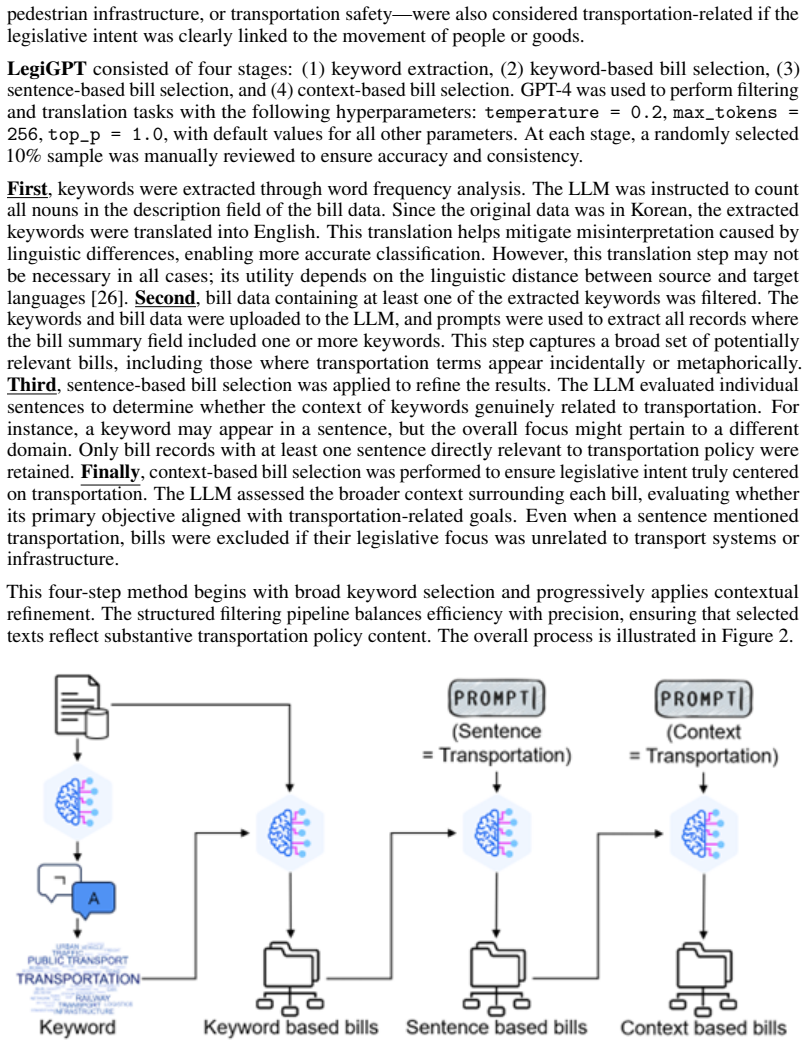
The load-bearing machinery is a two-stage pipeline. First, a zero-shot GPT-4 classifier applies a three-step filtering cascade—keyword matching, sentence-level relevance, and context-level focus—to isolate transportation bills, reducing the corpus from 23,655 to 577 bills and improving thematic precision by roughly 85% over keyword-only selection. Second, XGBoost models political affiliation from 19 legislator, constituency, and bill-sponsor features, and SHAP (Shapley additive explanations) decomposes each prediction into additive feature contributions. The sponsor-composition features, counts and percentages of conservative and progressive sponsors, are the ones that dominate the SHAP ranking.
What would settle it
Train the same XGBoost and SHAP pipeline on the 577 transportation bills with the four sponsor-party composition features removed; if electoral population and district area still top the SHAP ranking and accuracy stays near baseline, the constituency claim survives, but if accuracy collapses and the remaining features drop out, the sponsor-composition result is an artifact of label leakage.
Extended reading notes
Core claim
The paper's central discovery is that, after GPT-4 filters 23,655 South Korean bills to 577 transportation-focused proposals, an XGBoost model predicts a lawmaker's party affiliation (conservative or progressive) with an F1 score of about 0.978, and SHAP attributions rank the share and count of conservative sponsors, the share of progressive sponsors, electoral population, and district area as the top drivers. The modeled outcome is the lawmaker's party label rather than bill passage, and the authors use this as evidence that party-affiliated sponsorship patterns and constituency characteristics are strong predictors of political alignment in transportation policy. The paper further argues that these results reveal bipartisan engagement through different roles: conservatives and progressives both participate in cross-party bills, but their sponsorship profiles remain distinct.
Load-bearing premise
The load-bearing premise is that the number and percentage of conservative and progressive sponsors can be treated as independent explanatory variables for a lawmaker's party affiliation, even though those counts are derived from the very party labels the model is trained to predict.
Editorial extensions
If this is right
- If sponsorship composition reliably marks alignment, analysts can use co-sponsorship networks to map partisan polarization in transport policy without reading full bill text.
- The three-stage filtering protocol and the 577-bill transport corpus can serve as a reusable template for applying LLM classifiers to legislative datasets in other policy domains.
- The prominence of electoral population and district area implies that rural-versus-urban constituency structure shapes which legislators engage with transport policy, independent of party label.
- The SHAP ranking gives policymakers a diagnostic tool for identifying bills with unusual cross-party sponsorship, which the paper interprets as bipartisan cooperation.
Reading between the lines
- The abstract's phrase 'shaping legislative outcomes' is broader than the modeled target, which is the sponsor's party label; a stricter test would set bill approval or passage as the outcome variable.
- Because the sponsor-party counts are computed from the same conservative/progressive labels the model predicts, the top SHAP results are partly circular; rerunning with features 10-13 removed would reveal how much signal comes from constituency geography alone.
- The same pipeline could be applied to committee votes or amendment co-sponsorship to test whether the homophily pattern holds within individual bills rather than across the corpus.
- In other legislatures, the raw sponsor-count features would need party-base-rate normalization, otherwise the model may simply learn the relative sizes of party caucuses.
Editorial analysis
A structured set of objections, weighed in public.
Referee Report
Summary. The paper proposes LegiGPT, a pipeline that combines GPT-4-based multi-stage filtering of transportation-related bills from South Korea's 21st National Assembly with XAI (XGBoost + SHAP) to analyze determinants of lawmakers' party affiliation. From 23,655 bills, the LLM pipeline retains 577 transportation bills; the authors construct 7,872 lawmaker-bill participation instances, train classifiers to predict conservative vs. progressive affiliation, and use SHAP to conclude that sponsor party composition, district size, and electoral population are critical determinants of legislative outcomes. The LLM filtering component is a useful methodological contribution, but the central explanatory claim is compromised by target leakage in the feature construction and by inconsistencies in the reported dataset sizes.
Significance. If valid, the framework would offer a novel way to combine LLM-based text filtering with interpretable machine learning for legislative analysis, and the finding that sponsor composition and district characteristics drive political alignment would extend existing survey-based work. However, the core empirical result is not reliable because features 10-13 are constructed from the same party-affiliation labels the model is asked to predict, making the high predictive accuracy and the SHAP ranking of those features largely tautological. The LLM multi-stage filtering approach itself may be of interest to the text-mining community, but the paper's headline conclusion about legislative determinants does not follow from the current experimental design.
major comments (4)
- [Section 3.2, features 10-13] Features 10-13 (number of conservative sponsors, number of progressive sponsors, percentage of conservative sponsors, percentage of progressive sponsors) are bill-level aggregates computed directly from the party affiliations of sponsors. Because each row is a lawmaker-bill participation record and the prediction target is that same lawmaker's party affiliation, the lawmaker's own label contributes to these features. For bills sponsored predominantly by a single party, the feature values almost fully determine the target, so the reported XGBoost F1 of 0.978 and the SHAP ranking of these features as the most important are largely forced by circular feature construction rather than by an independent empirical relationship. This invalidates the central claim that sponsor party composition is a critical determinant of political alignment. Please remove features derived from the target variable or reformulate the prediction task (e.g., predict bill approval or lawmaker participation) so that the features are not functions of the label.
- [Section 4.2 vs Section 4.3] The dataset size is stated inconsistently. Section 4.2 reports that the preprocessed dataset contains 7,872 bill participation instances across 577 bills, and Table 2 repeats this count. Section 4.3, however, states that the training set consists of 8,048 records and the test set of 2,012 records, totaling 10,060 records. Since 10,060 exceeds the stated total of 7,872, the quantitative results in Section 4.3 cannot be reproduced from the described dataset. Please clarify which dataset is used for model training and evaluation, and ensure all reported counts are consistent.
- [Section 4.4.1, Figure 5] The claim that the top four features--percentage of conservative sponsors, percentage of progressive sponsors, number of conservative sponsors, and number of progressive sponsors--are 'strongly positively correlated, each exhibiting Pearson correlation coefficients greater than 0.6' is inconsistent with the definitions of the percentage features. For any given row, the percentage of conservative sponsors and the percentage of progressive sponsors sum to 1 (assuming the two-party categorization used throughout the paper), so their Pearson correlation is exactly -1, not a positive value greater than 0.6. This error suggests a problem in the computation or reporting of the correlation matrix and undermines the subsequent interpretation of feature interdependencies.
- [Section 4.3, data splitting] The data splitting protocol is not appropriate for the structured nature of the dataset. Rows are lawmaker-bill participation instances, so multiple rows share the same bill and the same lawmaker appears across many bills. A random 85:15 split without grouping by bill or lawmaker allows the same bill or lawmaker to appear in both training and test sets, which can substantially inflate the reported performance metrics via information leakage. Please use grouped or time-based splits (e.g., split by bill ID or by time period) and report performance under such conditions, along with details of how many unique bills and lawmakers appear in each split.
minor comments (5)
- [Section 4.4.2, Figure 6 caption] Subfigures (a) and (b) are both labeled 'proportion of conservative sponsors' in the caption; one of them should presumably refer to the proportion of progressive sponsors, given the accompanying text.
- [Abstract and Section 5] The phrase 'legislative outcomes' is used to describe the prediction target, but the model actually predicts a lawmaker's party affiliation (conservative vs. progressive), not bill approval or enactment. Please reword the claims to refer to 'political affiliation' or 'political alignment' to avoid overstating the scope.
- [Section 4.2, descriptive statistics] The descriptive differences (e.g., more progressive than conservative participants, more male than female) are presented without any statistical test. Please add appropriate significance tests or explicitly state that these comparisons are descriptive only.
- [Section 3.2.2] The text cites 'Lundberg and Lee, 2017' and 'Lee, 2024' without full entries in the reference list; only reference [27] corresponds to Lundberg and Lee. Please ensure all in-text citations have corresponding references.
- [Section 3.1, validation of LLM filtering] The manual validation of the 10% sample is mentioned but no agreement metrics, error counts, or details of the review protocol are provided. Please include quantitative validation results for the multi-stage filtering.
Circularity Check
Central SHAP finding reduces by construction: sponsor-party composition features are aggregates of the target party labels the model predicts.
-
self definitional
[Section 3.2 (model output and feature list 10–13), Section 4.2 (bill-level party attributes), Section 4.4.1 (SHAP ranking)]
"The output was political affiliation (1 = conservative, 0 = progressive), modeled through an additive feature function. The 19 input features were: ... (10) number of conservative sponsors, (11) number of progressive sponsors, (12) percentage of conservative sponsors, (13) percentage of progressive sponsors ... Bill-level attributes captured the total number of sponsors per bill, broken down by party (progressive, conservative) and gender (male, female), as well as the corresponding proportions."
Each record is a lawmaker–bill participation instance, and the target is the lawmaker's own party label. Features 10–13 are bill-level aggregates over the same party labels: for a bill with N participants including the target lawmaker, '% conservative sponsors' = (C_other + I(label = conservative)) / N, so the feature contains the target label as a direct additive term. The XGBoost model's near-perfect F1 (0.978) and the SHAP ranking that places these sponsor-composition features first therefore reflect the model reading the dependent variable out of the independent variables, not an independent empirical discovery.
full rationale
The paper's derivation chain is: GPT-4 filters 577 transportation bills; rows are lawmaker–bill participation instances; XGBoost predicts the lawmaker's party affiliation from 19 features; SHAP ranks feature importance; the authors conclude that conservative/progressive sponsor counts and proportions, plus district size and electoral population, are critical determinants. The circular step is the sponsor-composition features. Features 10–13 are built by counting sponsor party labels on each bill, and the target is exactly the sponsor's party label; therefore the top SHAP result is an artifact of the target being embedded in the features. This is not rescued by the LLM stage, which only selects which bills enter the sample. The self-citations in the reference list (e.g., [18], [21], [28], [35], [36], [38]) are ordinary methodological citations and are not load-bearing for the central claim, so they do not add circularity. A separate non-circularity concern is the numeric inconsistency between 7,872 participation instances (Section 4.2) and 10,060 records (Section 4.3), which undermines the quantitative claims but is a data-reporting issue, not a definitional reduction. The district-size and electoral-population findings come from features that are not derived from the target and could in principle support an independent claim; however, because the paper's most emphasized result—sponsor-party composition as the top determinant—is forced by construction, the overall circularity score is high.
Assumptions & free parameters
assumptions (4)
- domain assumption The GPT-4 zero-shot classification is accurate enough that manual validation of a random 10% sample, all confirmed accurate, is representative of the full dataset.
- ad hoc to paper Sponsor party composition features are legitimate predictors of the target party affiliation rather than leakage from the label.
- domain assumption The National Assembly open data and election data are complete, correctly joined, and free of coding errors.
- ad hoc to paper The operational definition of 'transportation-related', as implemented through the LLM prompts, is the correct scope for the analysis.
Cite this review
Pith. "Pith review of LegiGPT: Party Politics and Transport Policy with Large Language Model." pith.science (2026). https://pith.science/paper/X6WIVSGW
@misc{pith2026250616692,
  author       = {Pith},
  title        = {Pith review of: LegiGPT: Party Politics and Transport Policy with Large Language Model},
  year         = {2026},
  howpublished = {\url{https://pith.science/paper/X6WIVSGW}},
  note         = {Machine review of arXiv:2506.16692}
}
read the original abstract
Given the significant influence of lawmakers' political ideologies on legislative decision-making, analyzing their impact on transportation-related policymaking is of critical importance. This study introduces a novel framework that integrates a large language model (LLM) with explainable artificial intelligence (XAI) to analyze transportation-related legislative proposals. Legislative bill data from South Korea's 21st National Assembly were used to identify key factors shaping transportation policymaking. These include political affiliations and sponsor characteristics. The LLM was employed to classify transportation-related bill proposals through a stepwise filtering process based on keywords, sentences, and contextual relevance. XAI techniques were then applied to examine the relationships between political party affiliation and associated attributes. The results revealed that the number and proportion of conservative and progressive sponsors, along with district size and electoral population, were critical determinants shaping legislative outcomes. These findings suggest that both parties contributed to bipartisan legislation through different forms of engagement, such as initiating or supporting proposals. This integrated approach offers a valuable tool for understanding legislative dynamics and guiding future policy development, with broader implications for infrastructure planning and governance.
Figures


Figures from the paper (3 more)


Reference graph
Works this paper leans on
-
[1]
Rune J Sørensen. Political competition, party polarization, and government performance.Public Choice, 161:427–450, 2014
work page 2014
-
[2]
Conservatives and progressives in south korea
Haesook Chae and Steven Kim. Conservatives and progressives in south korea. Washington Quarterly, 31(4):77–95, 2008
work page 2008
-
[3]
J. W. Yun. A new neoliberal offensive in south korea: The conservative politics of rollback and the disciplining of organized labor. Critical Asian Studies, 56(3):471–494, 2024
work page 2024
-
[4]
Political partisanship and transportation reform
Nicholas J Klein, Kelcie Ralph, Calvin Thigpen, and Anne Brown. Political partisanship and transportation reform. Journal of the American Planning Association, 88(2):163–178, 2022
work page 2022
-
[5]
Consensus planning in transport: The case of vancouver’s transportation plebiscite
Crystal Legacy and John Stone. Consensus planning in transport: The case of vancouver’s transportation plebiscite. Transportation research part A: policy and practice, 120:295–305, 2019
work page 2019
-
[6]
The politics of collective public participation in transportation decision-making
Carolyn McAndrews and Justine Marcus. The politics of collective public participation in transportation decision-making. Transportation Research Part A: Policy and Practice, 78:537– 550, 2015
work page 2015
-
[7]
Gian-Claudia Sciara, Andrew Waxman, and Ross Buchanan. State legislator views on funding 21st century transportation: Important problems, missed connections.Transport Policy, 150:206– 218, 2024
work page 2024
-
[8]
J. Christenson. Nearly three-quarters of infrastructure bucks — about $7.8b — go to blue states, watchdog finds, 2024. Retrieved from https://nypost.com/2024/09/06/us-news/
work page 2024
Show all 43 references
-
[9]
What does america spend on transportation and infrastructure? is infrastruc- ture improving?, 2024
USAfacts. What does america spend on transportation and infrastructure? is infrastruc- ture improving?, 2024. Retrieved from https://usafacts.org/state-of-the-union/ transportation-infrastructure/
2024
-
[10]
Bipartisan infrastructure law (bil) / infrastructure investment and jobs act (iija), 2023
USDOT. Bipartisan infrastructure law (bil) / infrastructure investment and jobs act (iija), 2023. Retrieved from https://www.phmsa.dot.gov/legislative-mandates/
2023
-
[11]
Public support of transport policy instruments, perceived transport quality and satisfaction with democracy
Petter Christiansen. Public support of transport policy instruments, perceived transport quality and satisfaction with democracy. what is the relationship? Transportation Research Part A: Policy and Practice, 118:305–318, 2018
2018
-
[12]
Toward human-centric urban infrastructure: Text mining for social media data to identify the public perception of covid-19 policy in transportation hubs
June Young Park, Evan Mistur, Donghwan Kim, Yunjeong Mo, and Richard Hoefer. Toward human-centric urban infrastructure: Text mining for social media data to identify the public perception of covid-19 policy in transportation hubs. Sustainable Cities and Society, 76:103524, 2022
2022
-
[13]
Investigation of critical factors for future-proofed trans- portation infrastructure planning using topic modeling and association rule mining
Sudipta Chowdhury and Jin Zhu. Investigation of critical factors for future-proofed trans- portation infrastructure planning using topic modeling and association rule mining. Journal of Computing in Civil Engineering, 37(1):04022044, 2023
2023
-
[14]
P. Zou, B. Zhang, Y . Yi, and Z. Wang. How does travel satisfaction affect preference for shared electric vehicles? an empirical study using large-scale monitoring data and online text mining. Transportation Policy, 146:59–71, 2024
2024
-
[15]
Exploring the evolution trends of port integration policy in china by a text mining approach
Qi Chen, Yuhui Tang, and Bo Lu. Exploring the evolution trends of port integration policy in china by a text mining approach. Transport Policy, 153:159–172, 2024
2024
-
[16]
Deciphering political entity sentiment in news with large language models: Zero-shot and few-shot strategies
Alapan Kuila and Sudeshna Sarkar. Deciphering political entity sentiment in news with large language models: Zero-shot and few-shot strategies. arXiv preprint arXiv:2404.04361, 2024
2024 arXiv
-
[17]
Metroberta: Leveraging traditional customer rela- tionship management data to develop a transit-topic-aware language model
Michael Leong, Awad Abdelhalim, Jude Ha, Diane Patterson, Gabriel L Pincus, Anthony B Harris, Michael Eichler, and Jinhua Zhao. Metroberta: Leveraging traditional customer rela- tionship management data to develop a transit-topic-aware language model. Transportation Research R...
2024
-
[18]
A large language model for feasible and diverse population synthesis
Sung Yoo Lim, Hyunsoo Yun, Prateek Bansal, Dong-Kyu Kim, and Eui-Jin Kim. A large language model for feasible and diverse population synthesis. arXiv preprint arXiv:2505.04196, 2025
2025 arXiv
-
[19]
Large language models outperform expert coders and supervised classi- fiers at annotating political social media messages
Petter Törnberg. Large language models outperform expert coders and supervised classi- fiers at annotating political social media messages. Social Science Computer Review, page 08944393241286471, 2024
2024
-
[20]
Linear representations of political perspective emerge in large language models
Jihun Kim, James Evans, and Aaron Schein. Linear representations of political perspective emerge in large language models. arXiv preprint arXiv:2503.02080, 2025
2025 arXiv
-
[21]
Y . Wang, S. Xing, C. Can, R. Li, H. Hua, K. Tian, Z. Mo, X. Gao, K. Wu, S. Zhou, H. You, J. Peng, J. Zhang, Zehao Wang, R. Song, M. Yan, W. Zimmer, X. Zhou, P. Li, Z. Lu, C.-J. Chen, Y . Huang, R.A. Rossi, L. Sun, H. Yu, Z. Fan, F.H. Yang, Y . Kang, R. Greer, C. Liu, E.H. Lee...
2025
-
[22]
J. Wei, Y . Tay, R. Bommasani, C. Raffel, B. Zoph, S. Borgeaud, D. Yogatama, M. Bosma, D. Zhou, D. Metzler, E.H. Chi, T. Hashimoto, O. Vinyals, P. Liang, J. Dean, and W. Fedus. Emergent abilities of large language models, 2022. Available at: https://arxiv.org/abs/ 2206.07682
2022 arXiv
-
[23]
J. Wei, M. Bosma, V .Y . Zhao, K. Guu, A.W. Yu, B. Lester, N. Du, A.M. Dai, and Q. V . Le. Finetuned language models are zero-shot learners. In Proceedings of the 10th International Conference on Learning Representations (ICLR), pages 1–46, 2022
2022
-
[24]
Zhang, D
S. Zhang, D. Fu, W. Liang, Z. Zhang, B. Yu, P. Cai, and B. Yao. Trafficgpt: Viewing, processing and interacting with traffic foundation models. Transportation Policy, 150:95–105, 2024
2024
-
[25]
Public data portal, 2024
Korean Open Data Portal. Public data portal, 2024. Retrieved from https://www.data.go. kr/
2024
-
[26]
Could we have had better multilingual llms if english was not the central language? arXiv preprint arXiv:2402.13917, 2024
Ryandito Diandaru, Lucky Susanto, Zilu Tang, Ayu Purwarianti, and Derry Wijaya. Could we have had better multilingual llms if english was not the central language? arXiv preprint arXiv:2402.13917, 2024
2024 arXiv
-
[27]
A unified approach to interpreting model predictions
Scott M Lundberg and Su-In Lee. A unified approach to interpreting model predictions. Advances in neural information processing systems, 30, 2017
2017
-
[28]
Deep multimodal learning for traffic speed estimation combining dedicated short-range communication and vehicle detection system data
Jin Hong Min, Seung Woo Ham, Dong-Kyu Kim, and Eun Hak Lee. Deep multimodal learning for traffic speed estimation combining dedicated short-range communication and vehicle detection system data. Transportation research record, 2677(5):247–259, 2023
2023
-
[29]
Mlp- mixer: An all-mlp architecture for vision
Ilya O Tolstikhin, Neil Houlsby, Alexander Kolesnikov, Lucas Beyer, Xiaohua Zhai, Thomas Unterthiner, Jessica Yung, Andreas Steiner, Daniel Keysers, Jakob Uszkoreit, et al. Mlp- mixer: An all-mlp architecture for vision. Advances in neural information processing systems, 34:24...
2021
-
[30]
Random forests
Leo Breiman. Random forests. Machine learning, 45:5–32, 2001
2001
-
[31]
Lightgbm: A highly efficient gradient boosting decision tree
Guolin Ke, Qi Meng, Thomas Finley, Taifeng Wang, Wei Chen, Weidong Ma, Qiwei Ye, and Tie-Yan Liu. Lightgbm: A highly efficient gradient boosting decision tree. Advances in neural information processing systems, 30, 2017
2017
-
[32]
Xgboost: A scalable tree boosting system
Tianqi Chen and Carlos Guestrin. Xgboost: A scalable tree boosting system. In Proceedings of the 22nd ACM SIGKDD International Conference on Knowledge Discovery and Data Mining, pages 785–794. ACM, 2016
2016
-
[33]
On the possibility of short-term traffic prediction during disaster with machine learning approaches: An exploratory analysis
Makoto Chikaraishi, Prateek Garg, Varun Varghese, Kazuki Yoshizoe, Junji Urata, Yasuhiro Shiomi, and Ryuki Watanabe. On the possibility of short-term traffic prediction during disaster with machine learning approaches: An exploratory analysis. Transport Policy, 98:91–104, 2020. 15
2020
-
[34]
Container terminal daily gate in and gate out forecasting using machine learning methods
Jiahuan Jin, Mingyu Ma, Huan Jin, Tianxiang Cui, and Ruibin Bai. Container terminal daily gate in and gate out forecasting using machine learning methods. Transport Policy, 132:163–174, 2023
2023
-
[35]
explainable dea approach for evaluating performance of public transport origin- destination pairs
Eun Hak Lee. explainable dea approach for evaluating performance of public transport origin- destination pairs. Research in Transportation Economics, 108:101491, 2024
2024
-
[36]
Impact of road transport system on groundwater qual- ity inferred from explainable artificial intelligence (xai)
Kyungwon Kwak and Eun Hak Lee. Impact of road transport system on groundwater qual- ity inferred from explainable artificial intelligence (xai). Science of the Total Environment, 917:170388, 2024
2024
-
[37]
M. Wan, T. Safavi, S.K. Jauhar, Y . Kim, S. Counts, J. Neville, S. Suri, C. Shah, R.W. White, L. Yang, R. Andersen, G. Buscher, D. Joshi, and N. Rangan. Tnt-llm: Text mining at scale with large language models. In Proceedings of the ACM SIGKDD International Conference on Knowl...
2024
-
[38]
Estimating express train preference of urban railway passengers based on extreme gradient boosting (xgboost) using smart card data
Eun Hak Lee, Kyoungtae Kim, Seung-Young Kho, Dong-Kyu Kim, and Shin-Hyung Cho. Estimating express train preference of urban railway passengers based on extreme gradient boosting (xgboost) using smart card data. Transportation Research Record, 2675(11):64–76, 2021
2021
-
[39]
Experimenting xgboost algorithm for prediction and classification of different datasets
Santhanam Ramraj, Nishant Uzir, R Sunil, and Shatadeep Banerjee. Experimenting xgboost algorithm for prediction and classification of different datasets. International Journal of Control Theory and Applications, 9(40):651–662, 2016
2016
-
[40]
Would americans pay more in taxes for better transportation? answers from seven years of national survey data
Hilary Nixon and Asha Weinstein Agrawal. Would americans pay more in taxes for better transportation? answers from seven years of national survey data. Transportation, 46(3):819– 840, 2019
2019
-
[41]
Policy feedback in an age of polarization, 2019
Jacob S Hacker and Paul Pierson. Policy feedback in an age of polarization, 2019
2019
-
[42]
The politics of sustainable development opposition: State legislative efforts to stop the united nation’s agenda 21 in the united states
Karen Trapenberg Frick, David Weinzimmer, and Paul Waddell. The politics of sustainable development opposition: State legislative efforts to stop the united nation’s agenda 21 in the united states. Urban Studies, 52(2):209–232, 2015
2015
-
[43]
Towards sustainable neighbourhoods? tensions and heterogeneous transport priorities among suburban residents
Ignacio Tiznado-Aitken, Zehui Yin, and Steven Farber. Towards sustainable neighbourhoods? tensions and heterogeneous transport priorities among suburban residents. Transportation Research Part D: Transport and Environment, 138:104514, 2025. 16
2025
Reviewed August 6, 2026 · model on record in the stance chip above.
Discussion (0). Sign in to comment.