REVIEW 3 major objections 5 minor 80 references
Transition of AI Models in dependence of noise
T0 review · 3 major / 5 minor · reviewed 2026-08-15 · deepseek-v4-flash
Pith's one-line read The authors show that the accuracy-versus-noise transition narrows as a power law in model size, with exponent 0.27 over three decades.
desk verdict A potentially useful empirical scaling law, undermined by a bad noise conversion and a lack of reproducibility. read the letter →
The pith
A machine-rendered reading of the paper's core claim, the machinery that carries it, and where it could break.
The reading
What carries the argument
The central object is the finite-size scaling ansatz $F(L) \propto L^{-\lambda} f((T-T_c)L^{1/\nu})$, applied with $L$ the number of trainable parameters and $T$ the diffusion noise step. The transition width is extracted with the level-set method: nested accuracy thresholds such as $(0.1,0.9)$ and $(0.2,0.8)$ define noise-step intervals, and the interval width $\Delta = |\beta(a_{\text{up}})-\beta(a_{\text{low}})|$ is plotted against model size. Noise is injected through the forward process of denoising diffusion probabilistic models with the linear schedule $\beta_t = 10^{-4} + 4\times 10^{-6} t$ over 5000 steps, giving Gaussian corruption with analytic marginals. This machinery produces the central plot: a double-logarithmic straight line of slope 0.27 for transition width versus parameter count.
What would settle it
Apply the same noise schedule and level-set width measurement to a second architecture family; if the log-log plot of transition width versus parameter count is not a straight line with a stable slope, the claimed universal scaling fails. As an arithmetic check, compute $\sigma = \sqrt{1-\bar\alpha_t}$ from the stated schedule at $t_c = 1845.934$ and compare $\log \sigma$ with the quoted value 11.
Extended reading notes
Core claim
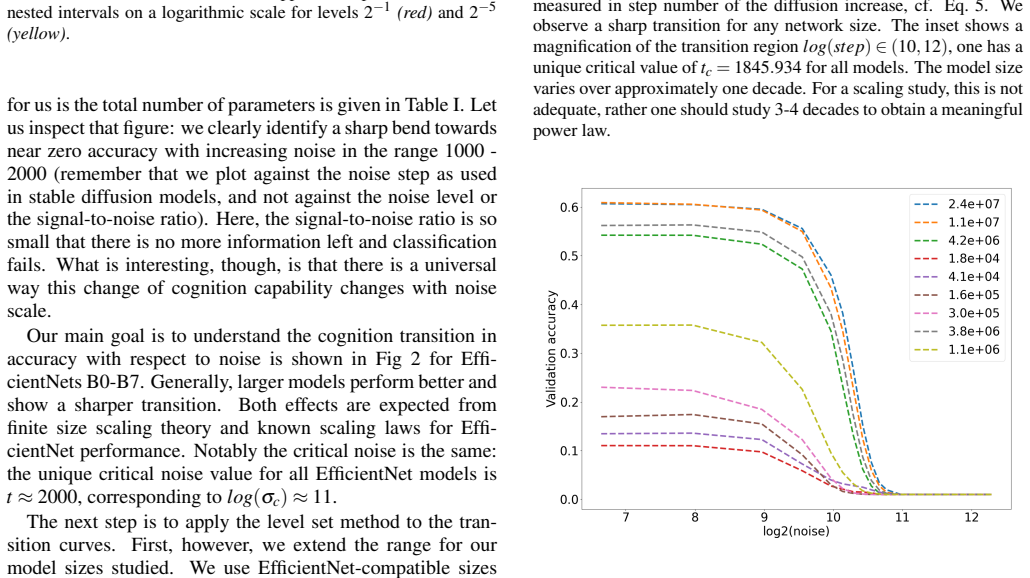
The central discovery is that the transition from good classification to chance-level performance under controlled Gaussian noise behaves like a finite-size critical phenomenon. For a fixed family of models, larger networks perform better and the accuracy transition becomes sharper, while the critical noise level remains fixed (the authors report $t_c = 1845.934$ in diffusion steps for all EfficientNet sizes). The sharpness, defined as the width $\Delta$ of nested accuracy level sets, is claimed to obey a power law in the number of parameters, $\Delta \sim N^{-0.27}$, across three decades. The authors interpret this as evidence for the finite-size scaling form $F(L) \sim L^{-\lambda} f((T-T_c)L^{1/\nu})$ and take it to indicate universal behavior within a class of similarly built models.
Load-bearing premise
The argument assumes that accuracy-versus-noise curves for models of different sizes all line up according to one statistical scaling law, with a particular step-counting scheme for Gaussian noise as the measure of noise; this has been tested only on one model family.
Editorial extensions
If this is right
- If the power law is correct, a practitioner can measure the transition on a small, cheaply trained model and extrapolate to the model size needed for a target robustness, avoiding full large-scale training.
- The finding that the critical noise is the same across EfficientNet sizes implies that scaling up model size sharpens the transition rather than moving where failure begins.
- The reported exponent 0.27 gives a quantitative baseline: model families in the same universality class should reproduce this slope, and deviations would signal a different class.
- The level-set width protocol offers a systematic way to compare robustness across models without depending on the exact accuracy at any one noise level.
Reading between the lines
- If the scaling extends beyond EfficientNet, applying the same protocol to other architecture families would be a direct test; a shared exponent would mean robustness to Gaussian noise is governed mainly by parameter count, not by architectural detail.
- The noise axis itself deserves scrutiny: the quoted $\log \sigma_c \approx 11$ does not match the analytic $\sigma = \sqrt{1-\bar\alpha_t}$ from Eq. 5 at the reported $t_c = 1845.934$, so the quantitative position of the transition may need a corrected conversion.
- Beyond classification accuracy, the same finite-size scaling could be probed on regression tasks or calibration error to ask whether the cognition transition and its exponent are universal across tasks.
Signed reviews
Editorial analysis
A structured set of objections, weighed in public.
Referee Report
Summary. The paper studies the accuracy of image classifiers (EfficientNet family, both ImageNet-pretrained B0–B7 and custom small models trained on CIFAR100) as a function of Gaussian noise added via the DDPM forward process. The authors identify a sharp “cognition transition” from high accuracy to near-zero accuracy when the noise step t reaches a critical value, and they report that the width of this transition narrows with increasing model size according to a power law with slope ≈ 0.27 over approximately three decades of model size. They interpret this as finite-size scaling, claim a unique critical noise for all models, and suggest that the result can be used to extrapolate robustness to larger models without full training. The paper is written as an empirical physics-style scaling study.
Significance. If the reported power law were correct, it would provide a quantitative finite-size scaling relation for classifier robustness under additive Gaussian noise, with practical value for model sizing and an interesting bridge between statistical mechanics and deep learning. The paper also attempts to use a level-set method for measuring transition widths, which, if validated, could be a useful tool. However, the central quantitative claim rests on the choice of the DDPM step index t as the noise variable, and the manuscript contains an internal inconsistency in the conversion between t and the actual noise standard deviation sigma. Because the scaling may be an artifact of the t-to-sigma saturation, the significance of the result, while potentially high, is not currently established. Strengths include the use of a controlled, well-defined noise process (DDPM) and a clear statement of the finite-size scaling hypothesis, but the analysis lacks error bars, seed variability, and a data-collapse test.
major comments (3)
- [Section IV, Fig. 2 and Eqs. (2)–(5)] The claim that the unique critical step t_c = 1845.934 corresponds to log(sigma_c) ≈ 11 is internally inconsistent with the stated noise schedule. Using beta_t = 1e-4 + 4e-6 t, the cumulative variance at t_c is sum_{s=0}^{t_c} beta_s ≈ 7.0, giving alpha_bar(t_c) ≈ e^{-7} and sigma(t_c) = sqrt(1 - alpha_bar) ≈ 0.9991, so log(sigma_c) is near 0, not 11. More importantly, sigma(t) is a saturating function of t: between t = 1000 and t = 2000 it changes from about 0.94 to 0.9998. Thus the transition region in t spans only a tiny interval of actual noise amplitude sigma, and a power law in the step index t does not imply a power law in the physical noise level. The claimed “three decades of noise” (lead paragraph) is actually three decades of model size, and the quantitative core of the paper—the width scaling—is measured in the proxy variable t without demonstrating that it survives conversion to sigma.
- [Section II and Fig. 4] The finite-size scaling form F(L) ∝ L^{-lambda} f((T - T_c) L^{1/nu}) is asserted but never tested by a data collapse. The exponent 0.27 is obtained from a log-log fit of transition width versus parameter count, but no error bars, number of seeds, or uncertainty analysis are reported, and the fit range includes only about ten model sizes. A genuine scaling hypothesis should collapse all the accuracy-versus-noise curves onto a single master curve when plotted against (t - t_c) L^{1/nu}; this is not shown. Without such a collapse, the reported power law could reflect the specific choice of level sets or the accidental alignment of a small number of points, rather than a universal scaling relation.
- [Section IV (Fig. 2 inset)] The assertion that there is a single critical noise value t_c ≈ 1845.934 for all EfficientNet models is stated without any description of how this value was determined. In standard finite-size scaling, the effective transition point typically shifts with system size, approaching the thermodynamic limit as L grows. If the transition center is claimed to be exactly size-independent, that is a special and non-generic property that needs justification; otherwise the nested-interval level-set measurement of the width may be dominated by the arbitrarily chosen accuracy levels rather than by a well-defined scaling variable. The uniqueness of t_c is load-bearing for the interpretation of the width scaling, and it is asserted rather than demonstrated.
minor comments (5)
- [Lead paragraph and Section IV, Fig. 3] The lead paragraph states that the authors “can determine scaling behavior over three decades of noise,” but the scaling in Fig. 4 is over model size (parameter count). Please clarify which quantity spans the three decades; if both are intended, the text should distinguish them explicitly.
- [Section III.B.1, Eq. (6)] In the accuracy definition, the text defines y as the predicted label and ŷ as the true label, but the indicator function is written as 1(ŷ_i = y_i), which is symmetric. Please correct the notation so that the roles of predicted and true labels are unambiguous.
- [Section III.B] The description of the custom small models as “EfficientNet-compatible sizes” is vague. Please specify the exact architecture (depth, width, resolution) and training hyperparameters for these models, since they form the majority of the data points in the scaling fit.
- [Table I] The FLOPS column appears to use units of GFLOPs (or similar), but the units are not stated. Please add explicit units and a brief definition of how FLOPS is computed.
- [General] Several references in the bibliography (e.g., references to MNIST and Fashion-MNIST in the reference list) are not cited in the text. Please ensure that all listed references are actually used and cited where relevant.
Circularity Check
No significant circularity: the power-law exponent is an empirical fit whose inputs do not include the claimed result, and the only self-citation is not load-bearing.
full rationale
The paper's central claim—a power-law narrowing of the cognition-transition width with model size—is obtained by first defining transition widths Δ from measured accuracy curves via level sets and then fitting log Δ versus log N in Fig. 4. Nothing in the definition of Δ or in the level-set procedure presupposes the power law or fixes its exponent; the exponent 0.27 is a regression output, not a pre-imposed input. The proposed model-size estimation is an extrapolation of that fitted law to larger sizes, not a prediction of a quantity already used as a fit target, so it does not reduce to the fit. The finite-size scaling form F(L) ∝ L^{-λ} f((T−Tc)L^{1/ν}) is borrowed from standard statistical mechanics and used as an organizing assumption; using an assumed scaling form to analyze data is not circular, even if untested. The self-citation to the authors' earlier ICAART paper supports only the generic expectation that larger models show sharper transitions, an expectation that is independently standard in finite-size scaling theory, and the measurements do not rest on that citation. The internal inconsistencies noted by the skeptical reading—t_c≈1845.934 versus 'log(σ_c)≈11' and the axis label 'log(step)∈(10,12)'—are correctness issues about the mapping from diffusion step to noise amplitude, not circularity: they do not make any derived quantity equal to an input by construction. The paper also explicitly acknowledges its limitation that it cannot yet identify which other models share the universality class, further indicating that the scaling claim is presented as an empirical finding rather than as a consequence of its own definitions.
Assumptions & free parameters
free parameters (3)
- transition width scaling exponent alpha =
0.27
- DDPM noise schedule constants =
beta_0 = 1e-4, slope = 4e-6, T = 5000
- accuracy level sets =
e.g., (0.1, 0.9), (0.2, 0.8)
assumptions (4)
- domain assumption Accuracy of a classifier behaves as an order parameter analogous to magnetization, with noise playing the role of temperature.
- ad hoc to paper The transition width follows the finite-size scaling form F(L) ~ L^{-lambda} f((T-Tc)L^{1/nu}).
- domain assumption The DDPM forward process with linear schedule produces noise levels that are a meaningful monotonic proxy for data corruption.
- ad hoc to paper EfficientNet variants of different sizes, plus the custom small models, belong to a single universality class.
Cite this review
Pith. "Pith review of Transition of AI Models in dependence of noise." pith.science (2026). https://pith.science/paper/TV6EVQNS
@misc{pith2026250616715,
  author       = {Pith},
  title        = {Pith review of: Transition of AI Models in dependence of noise},
  year         = {2026},
  howpublished = {\url{https://pith.science/paper/TV6EVQNS}},
  note         = {Machine review of arXiv:2506.16715}
}
read the original abstract
We investigate the dependence of the score on noise in the data, and on the network size. As a result, we obtain the so-called "cognition transition" from good performance to zero with increasing noise. The understanding of this transition is of fundamental scientific and practical interest. We use concepts from statistical mechanics to understand how a changing finite size of models affects the cognition ability under the presence or corrupted data. On one hand, we study if there is a universal aspect in the transition to several models, on the other hand we go into detail how the approach of the cognition transition point can be captured quantitatively. Therefore, we use the so-called scaling approach from statistical mechanics and find a power-law behaviour of the transition width with increasing model size. Since our study is aimed at universal aspects we use well-know models and data for image classification. That way we avoid uncertainties in data handling or model setup. The practical implication of our results is a tool to estimate model sizes for a certain "universality class" of models, without the need to investigate large sizes, just by extrapolating the scaling results. In turn, that allows for cost reduction in hyperparameter studies. Here, we present first results on a concrete setup; we think that the understanding the mechanics of large system sizes is of fundamental interest for a further exploration of even larger models.
Figures


Reference graph
Works this paper leans on
-
[1]
author author K. R. \ Popper ,\ @noop title Logik der Forschung. Zur Erkenntnistheorie der modernen Naturwissenschaft \ ( publisher Julius Springer ,\ year 1935 ) NoStop
work page 1935
-
[2]
author author I. Goodfellow , author Y. Bengio , \ and\ author A. Courville ,\ deeplearningbook.org title Deep Learning \ ( publisher MIT Press ,\ year 2016 ) NoStop
work page 2016
-
[3]
author author R. Rombach , author A. Blattmann , author D. Lorenz , author P. Esser , \ and\ author B. Ommer ,\ title title High-resolution image synthesis with latent diffusion models , \ in\ @noop booktitle Proceedings of the IEEE/CVF conference on computer vision and pattern recognition \ ( year 2022 )\ pp.\ pages 10684--10695 NoStop
work page 2022
-
[4]
author author J. Sohl-Dickstein , author E. A. \ Weiss , author N. Maheswaranathan , \ and\ author S. Ganguli ,\ title title Deep unsupervised learning using nonequilibrium thermodynamics , \ @noop journal journal 32nd International Conference on Machine Learning, ICML 2015 \ volume 3 ( year 2015 ) NoStop
work page 2015
-
[5]
author author K. Huang ,\ https://books.google.de/books?id=8bkBJgAACAAJ title Introduction to Statistical Physics, Second Edition \ ( publisher Taylor & Francis ,\ year 2009 ) NoStop
work page 2009
-
[6]
author author T. Seidler \ and\ author M. Abel ,\ title title Transition of model performance in dependence of the amount of data corruption with respect to network sizes , \ in\ 10.5220/0012435000003636 booktitle Proceedings of the 16th International Conference on Agents and Artificial Intelligence - Volume 3: ICAART ,\ organization INSTICC \ ( publisher...
-
[7]
author author K. Binder ,\ title title Finite size effects at phase transitions , \ in\ @noop booktitle Computational Methods in Field Theory ,\ editor edited by\ editor H. Gausterer \ and\ editor C. B. \ Lang \ ( publisher Springer Berlin Heidelberg ,\ address Berlin, Heidelberg ,\ year 1992 )\ pp.\ pages 59--125 NoStop
work page 1992
-
[8]
author author Y. Bahri , author J. Kadmon , author J. Pennington , author S. S. \ Schoenholz , author J. Sohl-Dickstein , \ and\ author S. Ganguli ,\ title title Statistical mechanics of deep learning , \ 10.1146/annurev-conmatphys-031119-050745 journal journal Annual Review of Condensed Matter Physics \ volume 11 ,\ pages 501--528 ( year 2020 ) NoStop
Show all 80 references
-
[10]
Mézard \ and\ author A
author author M. Mézard \ and\ author A. Montanari ,\ 10.1093/acprof:oso/9780198570837.001.0001 title Information, Physics, and Computation \ ( publisher Oxford University Press ,\ year 2009 ) NoStop
2009
-
[11]
author author E. Gardner ,\ title title The space of interactions in neural network models , \ 10.1088/0305-4470/21/1/030 journal journal Journal of Physics A: Mathematical and General \ volume 21 ,\ pages 257 ( year 1988 ) NoStop
1988 doi
-
[12]
Sompolinsky , author N
author author H. Sompolinsky , author N. Tishby , \ and\ author H. S. \ Seung ,\ title title Learning from examples in large neural networks , \ 10.1103/PhysRevLett.65.1683 journal journal Phys. Rev. Lett. \ volume 65 ,\ pages 1683--1686 ( year 1990 ) NoStop
-
[13]
author author G. Györgyi ,\ title title First-order transition to perfect generalization in a neural network with binary synapses , \ 10.1103/PhysRevA.41.7097 journal journal Physical Review A \ volume 41 ,\ pages 7097--7100 ( year 1990 ) NoStop
-
[15]
author author T. L. \ Watkin , author A. Rau , \ and\ author M. Biehl ,\ title title The statistical mechanics of learning a rule , \ 10.1103/RevModPhys.65.499 journal journal Reviews of Modern Physics \ volume 65 ( year 1993 ),\ 10.1103/RevModPhys.65.499 NoStop
-
[16]
Biehl , author M
author author M. Biehl , author M. Ahr , \ and\ author E. Schlösser ,\ title title Statistical physics of learning: Phase transitions in multilayered neural networks , \ 10.1007/bfb0108398 journal journal Advances in Solid State Physics 40 \ ,\ pages 819--826 ( year 2007 ) NoStop
-
[17]
Advani , author S
author author M. Advani , author S. Lahiri , \ and\ author S. Ganguli ,\ title title Statistical mechanics of complex neural systems and high dimensional data , \ 10.1088/1742-5468/2013/03/P03014 journal journal Journal of Statistical Mechanics: Theory and Experiment \ volume ...
2013 doi
-
[18]
Tian , author L
author author C. Tian , author L. Fei , author W. Zheng , author Y. Xu , author W. Zuo , \ and\ author C.-W. \ Lin ,\ title title Deep learning on image denoising: An overview , \ https://doi.org/10.1016/j.neunet.2020.07.025 journal journal Neural Networks \ volume 131 ,\ page...
2020 doi
-
[19]
Smilkov , author N
author author D. Smilkov , author N. Thorat , author B. Kim , author F. B. \ Vi \' e gas , \ and\ author M. Wattenberg ,\ title title Smoothgrad: removing noise by adding noise , \ http://arxiv.org/abs/1706.03825 journal journal CoRR \ volume abs/1706.03825 ( year 2017 ) ,\ ht...
2017 arXiv
-
[20]
Koziarski \ and\ author B
author author M. Koziarski \ and\ author B. Cyganek ,\ title title Image recognition with deep neural networks in presence of noise – dealing with and taking advantage of distortions , \ 10.3233/ICA-170551 journal journal Integrated Computer-Aided Engineering \ volume 24 ,\ pa...
-
[21]
Drenkow , author N
author author N. Drenkow , author N. Sani , author I. Shpitser , \ and\ author M. Unberath ,\ title title A systematic review of robustness in deep learning for computer vision: Mind the gap? \ @noop journal journal arXiv preprint arXiv:2112.00639 \ ( year 2021 ) NoStop
2021 arXiv
-
[22]
Elgendy ,\ @noop title Deep Learning for Vision Systems \ ( publisher Mannings ,\ year 2020 ) NoStop
author author M. Elgendy ,\ @noop title Deep Learning for Vision Systems \ ( publisher Mannings ,\ year 2020 ) NoStop
2020
-
[23]
author author C. Boncelet ,\ title title Chapter 7 - Image Noise Models , \ in\ https://doi.org/10.1016/B978-0-12-374457-9.00007-X booktitle The Essential Guide to Image Processing ,\ editor edited by\ editor A. Bovik \ ( publisher Academic Press ,\ address Boston ,\ year 2009...
-
[24]
Ho , author A
author author J. Ho , author A. Jain , \ and\ author P. Abbeel ,\ title title Denoising diffusion probabilistic models , \ @noop journal journal Advances in Neural Information Processing Systems \ ( year 2020 ) NoStop
2020
-
[25]
James , author D
author author G. James , author D. Witten , author T. Hastie , \ and\ author R. Tibshirani ,\ @noop title An Introduction to Statistical Learning: with Applications in R \ ( publisher Springer Publishing Company, Incorporated ,\ year 2014 ) NoStop
2014
-
[26]
Heffern , author H
author author E. Heffern , author H. Huelskamp , author S. Bahar , \ and\ author R. F. \ Inglis ,\ title title Phase transitions in biology: From bird flocks to population dynamics , \ 10.1098/rspb.2021.1111 journal journal Proceedings of the Royal Society B: Biological Scienc...
2021
-
[27]
author author O. C. \ Martin , author R. Monasson , \ and\ author R. Zecchina ,\ title title Statistical mechanics methods and phase transitions in optimization problems , \ https://doi.org/10.1016/S0304-3975(01)00149-9 journal journal Theoretical Computer Science \ volume 265...
-
[28]
Perc , author J
author author M. Perc , author J. J. \ Jordan , author D. G. \ Rand , author Z. Wang , author S. Boccaletti , \ and\ author A. Szolnoki ,\ title title Statistical physics of human cooperation , \ 10.1016/j.physrep.2017.05.004 journal journal Physics Reports \ volume 687 ( year...
2017 doi
-
[29]
Rem , author N
author author B. Rem , author N. Käming , author M. Tarnowski , author L. Asteria , author N. Fläschner , author C. Becker , author K. Sengstock , \ and\ author C. Weitenberg ,\ title title Identifying quantum phase transitions using artificial neural networks on experimental ...
-
[30]
Ni , author M
author author Q. Ni , author M. Tang , author Y. Liu , \ and\ author Y.-C. \ Lai ,\ title title Machine learning dynamical phase transitions in complex networks , \ 10.1103/PhysRevE.100.052312 journal journal Phys. Rev. E \ volume 100 ,\ pages 052312 ( year 2019 ) NoStop
-
[31]
Carrasquilla \ and\ author R
author author J. Carrasquilla \ and\ author R. G. \ Melko ,\ title title Machine learning phases of matter , \ 10.1038/nphys4035 journal journal Nature Physics \ volume 13 ,\ pages 431--434 ( year 2017 ) ,\ http://arxiv.org/abs/1605.01735 arXiv:1605.01735 [cond-mat.str-el] NoStop
2017 arXiv
-
[32]
Canabarro , author F
author author A. Canabarro , author F. F. \ Fanchini , author A. L. \ Malvezzi , author R. Pereira , \ and\ author R. Chaves ,\ title title Unveiling phase transitions with machine learning , \ 10.1103/PhysRevB.100.045129 journal journal Phys. Rev. B \ volume 100 ,\ pages 0451...
-
[33]
Giannetti , author B
author author C. Giannetti , author B. Lucini , \ and\ author D. Vadacchino ,\ title title Machine learning as a universal tool for quantitative investigations of phase transitions , \ https://doi.org/10.1016/j.nuclphysb.2019.114639 journal journal Nuclear Physics B \ volume 9...
-
[34]
Suchsland \ and\ author S
author author P. Suchsland \ and\ author S. Wessel ,\ title title Parameter diagnostics of phases and phase transition learning by neural networks , \ 10.1103/PhysRevB.97.174435 journal journal Phys. Rev. B \ volume 97 ,\ pages 174435 ( year 2018 ) NoStop
-
[35]
Cortes , author L
author author C. Cortes , author L. D. \ Jackel , \ and\ author W.-P. \ Chiang ,\ title title Limits on learning machine accuracy imposed by data quality , \ @noop journal journal Advances in Neural Information Processing Systems \ volume 7 ( year 1994 ) NoStop
1994
-
[36]
author author O. Y. \ Al-Jarrah , author P. D. \ Yoo , author S. Muhaidat , author G. K. \ Karagiannidis , \ and\ author K. Taha ,\ title title Efficient machine learning for big data: A review , \ https://doi.org/10.1016/j.bdr.2015.04.001 journal journal Big Data Research \ v...
-
[37]
Kaplan , author S
author author J. Kaplan , author S. McCandlish , author T. Henighan , author T. B. \ Brown , author B. Chess , author R. Child , author S. Gray , author A. Radford , author J. Wu , \ and\ author D. Amodei ,\ title title Scaling laws for neural language models. \ https://arxiv....
2001 arXiv
-
[38]
Deng , author W
author author J. Deng , author W. Dong , author R. Socher , author L.-J. \ Li , author K. Li , \ and\ author L. Fei-Fei ,\ title title ImageNet: A Large-Scale Hierarchical Image Database , \ in\ @noop booktitle CVPR09 \ ( year 2009 ) NoStop
2009
-
[39]
Krizhevsky , author G
author author A. Krizhevsky , author G. Hinton , et al. ,\ title title Learning multiple layers of features from tiny images , \ @noop \ ( year 2009 ) NoStop
2009
-
[40]
Tan \ and\ author Q
author author M. Tan \ and\ author Q. V. \ Le ,\ https://arxiv.org/abs/1905.11946 title Efficientnet: Rethinking model scaling for convolutional neural networks , \ ( year 2020 ),\ http://arxiv.org/abs/1905.11946 arXiv:1905.11946 [cs.LG] NoStop
1905 arXiv
-
[41]
van Kampen ,\ @noop title S tochastic P rocesses in P hysics and C hemistry \ ( publisher Elsevier Science Publishers, Amsterdam ,\ year 1992 ) NoStop
author author N. van Kampen ,\ @noop title S tochastic P rocesses in P hysics and C hemistry \ ( publisher Elsevier Science Publishers, Amsterdam ,\ year 1992 ) NoStop
1992
-
[42]
note For simplicity we write R ^ mn since R ^ mn is isomorphic to R ^ m n . Stop
-
[43]
Meyn \ and\ author R
author author S. Meyn \ and\ author R. Tweedie ,\ title title Markov chains and stochastic stability , \ 10.2307/2965732 journal journal Journal of the American Statistical Association \ volume 92 ( year 1993 ),\ 10.2307/2965732 NoStop
1993 doi
-
[44]
Chollet et al
author author F. Chollet et al. ,\ @noop title Keras , \ howpublished https://keras.io ( year 2015 ) NoStop
2015
-
[45]
Howard ,\ https://github.com/fastai/imagenette title Imagenette: A smaller subset of 10 easily classified classes from imagenet , \ ( year 2019 ) NoStop
author author J. Howard ,\ https://github.com/fastai/imagenette title Imagenette: A smaller subset of 10 easily classified classes from imagenet , \ ( year 2019 ) NoStop
2019
-
[46]
Stanley , author L
author author H. Stanley , author L. Amaral , author P. Gopikrishnan , author P. Ivanov , author T. Keitt , \ and\ author V. Plerou ,\ title title Scale invariance and universality: organizing principles in complex systems , \ https://doi.org/10.1016/S0378-4371(00)00195-3 jour...
-
[47]
Lovejoy ,\ ed.,\ title Scaling and scale invariance , \ pp.\ pages 1244--1256 ,\ in\ Sagar2023 ( year 2023 ) NoStop
editor S. Lovejoy ,\ ed.,\ title Scaling and scale invariance , \ pp.\ pages 1244--1256 ,\ in\ Sagar2023 ( year 2023 ) NoStop
2023
-
[48]
author author L. C. \ Evans \ and\ author J. Spruck ,\ title title Motion of level sets by mean curvature. i , \ 10.4310/jdg/1214446559 journal journal Journal of Differential Geometry \ volume 33 ( year 1991 ),\ 10.4310/jdg/1214446559 NoStop
1991
-
[49]
author author L. C. \ Evans , author H. M. \ Soner , \ and\ author P. E. \ Souganidis ,\ title title Phase transitions and generalized motion by mean curvature , \ 10.1002/cpa.3160450903 journal journal Communications on Pure and Applied Mathematics \ volume 45 ,\ pages 1097--...
-
[50]
Gardiner ,\ @noop title Handbook of stochastic methods for physics, chemistry, and the natural sciences \ ( publisher Springer ,\ year 1985 ) NoStop
author author C. Gardiner ,\ @noop title Handbook of stochastic methods for physics, chemistry, and the natural sciences \ ( publisher Springer ,\ year 1985 ) NoStop
1985
-
[51]
Carleo , author I
author author G. Carleo , author I. Cirac , author K. Cranmer , author L. Daudet , author M. Schuld , author N. Tishby , author L. Vogt-Maranto , \ and\ author L. Zdeborová ,\ title title Machine learning and the physical sciences , \ 10.1103/RevModPhys.91.045002 journal journ...
-
[52]
author author H. S. \ Seung , author H. Sompolinsky , \ and\ author N. Tishby ,\ title title Statistical mechanics of learning from examples , \ 10.1103/PhysRevA.45.6056 journal journal Physical Review A \ volume 45 ,\ pages 6056--6091 ( year 1992 b ) NoStop
-
[53]
Xiao , author K
author author H. Xiao , author K. Rasul , \ and\ author R. Vollgraf ,\ title title Fashion-MNIST: a Novel Image Dataset for Benchmarking Machine Learning Algorithms , \ http://arxiv.org/abs/1708.07747 journal journal arXiv preprint arXiv:1708.07747 \ ( year 2017 ) NoStop
2017 arXiv
-
[54]
Ising ,\ title title Beitrag zur theorie des ferromagnetismus , \ 10.1007/BF02980577 journal journal Zeitschrift für Physik \ volume 31 ,\ pages 253--258 ( year 1925 ) NoStop
author author E. Ising ,\ title title Beitrag zur theorie des ferromagnetismus , \ 10.1007/BF02980577 journal journal Zeitschrift für Physik \ volume 31 ,\ pages 253--258 ( year 1925 ) NoStop
1925 doi
-
[55]
author author C. E. \ Shannon ,\ title title A mathematical theory of communication , \ 10.1002/j.1538-7305.1948.tb01338.x journal journal The Bell System Technical Journal \ volume 27 ,\ pages 379--423 ( year 1948 ) NoStop
1948
-
[56]
author author A. Lesne ,\ title title Shannon entropy: A rigorous notion at the crossroads between probability, information theory, dynamical systems and statistical physics , \ 10.1017/S0960129512000783 journal journal Mathematical Structures in Computer Science \ volume 24 (...
-
[57]
Quade , author M
author author M. Quade , author M. Abel , author J. N. \ Kutz , \ and\ author S. L. \ Brunton ,\ title title Sparse identification of nonlinear dynamics for rapid model recovery , \ 10.1063/1.5027470 journal journal Chaos \ volume 28 ( year 2018 ),\ 10.1063/1.5027470 NoStop
-
[58]
LeCun , author C
author author Y. LeCun , author C. Cortes , \ and\ author C. J. \ Burges ,\ title title MNIST handwritten digit database , \ @noop journal journal ATT Labs [Online]. Available: http://yann.lecun.com/exdb/mnist \ volume 2 ( year 2010 ) NoStop
2010
-
[59]
author author L. Deng ,\ title title The mnist database of handwritten digit images for machine learning research , \ 10.1109/MSP.2012.2211477 journal journal IEEE Signal Processing Magazine \ volume 29 ,\ pages 141--142 ( year 2012 ) NoStop
2012
-
[60]
Cohen , author S
author author G. Cohen , author S. Afshar , author J. Tapson , \ and\ author A. V. \ Schaik ,\ title title EMNIST: Extending MNIST to handwritten letters , \ 10.1109/IJCNN.2017.7966217 journal journal Proceedings of the International Joint Conference on Neural Networks \ volum...
2017
-
[61]
Quade , author M
author author M. Quade , author M. Abel , author K. Shafi , author R. K. \ Niven , \ and\ author B. R. \ Noack ,\ title title Prediction of dynamical systems by symbolic regression , \ 10.1103/PhysRevE.94.012214 journal journal Physical Review E \ volume 94 ( year 2016 ),\ 10....
-
[62]
Roscher , author B
author author R. Roscher , author B. Bohn , author M. F. \ Duarte , \ and\ author J. Garcke ,\ title title Explainable machine learning for scientific insights and discoveries , \ 10.1109/ACCESS.2020.2976199 journal journal IEEE Access \ volume 8 ( year 2020 ),\ 10.1109/ACCESS...
2020
-
[63]
author author F. Rosenblatt ,\ title title The perceptron: A probabilistic model for information storage and organization in the brain , \ 10.1037/h0042519 journal journal Psychological Review \ volume 65 ( year 1958 ),\ 10.1037/h0042519 NoStop
1958 doi
-
[64]
author author J. R. \ Koza ,\ title title Genetic programming as a means for programming computers by natural selection , \ 10.1007/BF00175355 journal journal Statistics and Computing \ volume 4 ( year 1994 ),\ 10.1007/BF00175355 NoStop
1994 doi
-
[65]
author author L. G. \ Valiant ,\ title title A theory of the learnable , \ 10.1145/1968.1972 journal journal Commun. ACM \ volume 27 ,\ pages 1134–1142 ( year 1984 ) NoStop
1968
-
[66]
author author J. Hopfield ,\ title title Neural networks and physical systems with emergent collective computational abilities , \ 10.1073/pnas.79.8.2554 journal journal Proceedings of the National Academy of Sciences of the United States of America \ volume 79 ,\ pages 2554--...
-
[67]
Gardner ,\ title title Maximum storage capacity in neural networks , \ 10.1209/0295-5075/4/4/016 journal journal Europhysics Letters \ volume 4 ,\ pages 481 ( year 1987 ) NoStop
author author E. Gardner ,\ title title Maximum storage capacity in neural networks , \ 10.1209/0295-5075/4/4/016 journal journal Europhysics Letters \ volume 4 ,\ pages 481 ( year 1987 ) NoStop
1987 doi
-
[68]
Perc ,\ 10.1016/j.physleta.2016.06.017 title Phase transitions in models of human cooperation , \ ( year 2016 ) NoStop
author author M. Perc ,\ 10.1016/j.physleta.2016.06.017 title Phase transitions in models of human cooperation , \ ( year 2016 ) NoStop
2016 doi
-
[69]
Baldominos , author Y
author author A. Baldominos , author Y. Saez , \ and\ author P. Isasi ,\ title title A survey of handwritten character recognition with MNIST and EMNIST , \ 10.3390/app9153169 journal journal Applied Sciences (Switzerland) \ volume 9 ( year 2019 ),\ 10.3390/app9153169 NoStop
-
[70]
Pedregosa , author G
author author F. Pedregosa , author G. Varoquaux , author A. Gramfort , author V. Michel , author B. Thirion , author O. Grisel , author M. Blondel , author P. Prettenhofer , author R. Weiss , author V. Dubourg , author J. Vanderplas , author A. Passos , author D. Cournapeau ,...
2011
-
[71]
author author Tensorflow Development Team ,\ @noop title TensorFlow Datasets , a collection of ready-to-use datasets , \ howpublished https://www.tensorflow.org/datasets ( year 2023 ),\ note accessed: 13.11.2023 NoStop
2023
-
[72]
author author Dask Development Team ,\ https://dask.org title Dask: Library for dynamic task scheduling , \ ( year 2016 ) NoStop
2016
-
[73]
Seidler , author F
author author T. Seidler , author F. Emmerich , author K. Ehlert , author R. Berner , author O. Nagel-Kanzler , author N. Schultz , author M. Quade , author M. G. \ Schultz , \ and\ author M. Abel ,\ title title Mantik: A workflow platform for the development of artificial int...
2023
-
[74]
author author C. M. \ Bishop ,\ @noop title Pattern Recognition and Machine Learning (Information Science and Statistics) \ ( publisher Springer-Verlag ,\ address Berlin, Heidelberg ,\ year 2006 ) NoStop
2006
-
[75]
Lecun , author L
author author Y. Lecun , author L. Bottou , author Y. Bengio , \ and\ author P. Haffner ,\ title title Gradient-based learning applied to document recognition , \ 10.1109/5.726791 journal journal Proceedings of the IEEE \ volume 86 ,\ pages 2278--2324 ( year 1998 ) NoStop
-
[76]
Szegedy , author W
author author C. Szegedy , author W. Zaremba , author I. Sutskever , author J. Bruna , author D. Erhan , author I. J. \ Goodfellow , \ and\ author R. Fergus ,\ title title Intriguing properties of neural networks , \ in\ http://arxiv.org/abs/1312.6199 booktitle 2nd Internation...
2014 arXiv
-
[77]
author author I. J. \ Goodfellow , author J. Shlens , \ and\ author C. Szegedy ,\ title title Explaining and harnessing adversarial examples , \ in\ http://arxiv.org/abs/1412.6572 booktitle 3rd International Conference on Learning Representations, ICLR 2015, San Diego, CA, USA...
2015 arXiv
-
[78]
Nishimori \ and\ author G
author author H. Nishimori \ and\ author G. Ortiz ,\ 10.1093/acprof:oso/9780199577224.001.0001 title Elements of Phase Transitions and Critical Phenomena \ ( publisher Oxford University Press ,\ year 2010 )\ http://arxiv.org/abs/https://academic.oup.com/book/8876/book-pdf/5343...
2010
-
[79]
Michaelis , author B
author author C. Michaelis , author B. Mitzkus , author R. Geirhos , author E. Rusak , author O. Bringmann , author A. S. \ Ecker , author M. Bethge , \ and\ author W. Brendel ,\ title title Benchmarking robustness in object detection: Autonomous driving when winter is coming ...
1907 arXiv
-
[80]
Guo , author U
author author J. Guo , author U. Kurup , \ and\ author M. Shah ,\ title title Is it safe to drive? an overview of factors, metrics, and datasets for driveability assessment in autonomous driving , \ 10.1109/TITS.2019.2926042 journal journal IEEE Transactions on Intelligent Tra...
2019
-
[81]
Koziarski \ and\ author B
author author M. Koziarski \ and\ author B. Cyganek ,\ title title Deep neural image denoising , \ \ ( year 2016 )\ pp.\ pages 163--173 NoStop
2016
-
[82]
editor B. S. \ Daya Sagar , editor Q. Cheng , editor J. McKinley , \ and\ editor F. Agterberg ,\ eds.,\ 10.1007/978-3-030-85040-1_282 title Encyclopedia of Mathematical Geosciences \ ( publisher Springer International Publishing ,\ year 2023 ) NoStop
Reviewed August 15, 2026 · model on record in the stance chip above.
Discussion (0). Continue with ORCID to comment.