REVIEW 4 major objections 6 minor 50 references
Generalizable Agent Modeling for Agent Collaboration-Competition Adaptation with Multi-Retrieval and Dynamic Generation
T0 review · 4 major / 6 minor · reviewed 2026-08-15 · deepseek-v4-flash
Pith's one-line read This paper claims that a single agent can adapt to unfamiliar teammates and opponents by retrieving their behavior from memory and generating its own policy parameters on the fly, and it validates this claim across three multi-agent…
desk verdict Solid engineering with a useful new benchmark, but the 'unseen' claim is undercut by test partners being drawn from the same policy pool used in training. read the letter →
The pith
A machine-rendered reading of the paper's core claim, the machinery that carries it, and where it could break.
The reading
What carries the argument
The central mechanism is the sample-interact-retrieve-generate-store loop of Multi-Retrieval and Dynamic Generation (MRDG). A Diversity Policy Pool (DPP) randomly samples substrates and teammate/opponent policies so the learner experiences a wide range of coordination schemes. The learner's episodic memory stores short trajectories of other agents' observations and actions, encoded by per-agent Viewpoint Alignment (VA) encoders that map third-person perspectives into the learner's observational frame. At decision time, a retrieval network uses the learner's observation as a query and returns the most frequent action among the closest memory entries for each other agent. A positional encoder marks each agent's index and structural role, and a hypernetwork takes the summed retrieved actions and positional encodings to generate the parameters of the first layers of the learner's policy network, so the policy is rebuilt for the current situation rather than selected from a fixed library. Base MARL parameters are updated separately and interpolated with re-initialization weights, giving a stable base strategy plus a dynamically adapted component.
What would settle it
Train MRDG on one predefined policy pool, then test it against partners produced independently, for example agents trained by a different MARL algorithm or human demonstrations, with no policy overlap with the pool. If the learner's performance drops to the level of RPM, CSP, or ODITS, then the reported generalization is memory interpolation rather than adaptation to genuinely new behavior.
Extended reading notes
Core claim
The central claim is that a single agent, called the learner, can simultaneously handle unfamiliar teammates and opponents by explicitly modeling their behavior through retrieval and by dynamically generating its own policy parameters. The paper defines ACCA as a framework where the learner must adapt to changes in substrate environment, task objective, and the strategies and numbers of other agents. MRDG builds a Diversity Policy Pool of training-time teammate and opponent policies, records their observation-action trajectories in episodic memory, retrieves the most similar past actions given the learner's current observation, and feeds those retrieved actions together with positional encodings into a hypernetwork that generates parameters for the learner's policy network. The paper reports that this method outperforms RPM, CSP, and ODITS in the tested scenarios: 76% win rate on SMAC's unseen 5m_vs_6m map, a score of 205 on Overcooked-AI's Coordination Ring, and leading rewards across Chicken Game, Clean Up, Pure Coordination, Prisoner's Dilemma, Rational Coordination, and Stag Hunt in Melting Pot. The paper also reports ablations showing that each component, the policy pool, positional encoding, hypernetwork, and viewpoint alignment, contributes to the final performance.
Load-bearing premise
The claim rests on the assumption that test-time teammates and opponents are drawn from the same predefined policy set that supplied the training-time Diversity Policy Pool, so the episodic memory already covers the behavioral distribution the learner must adapt to.
Editorial extensions
If this is right
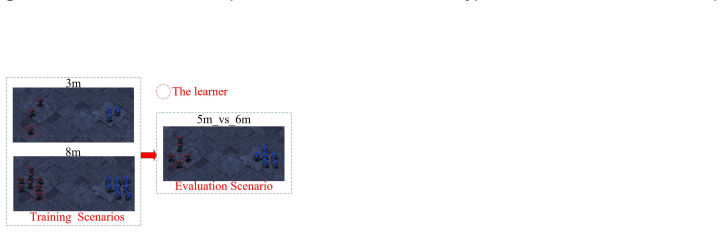
- If MRDG's central claim holds, a learner trained on a few map sizes and task layouts can transfer to unseen team sizes and enemy counts without new gradient updates, as demonstrated by training on SMAC 3m and 8m and testing on 5m_vs_6m.
- Explicit opponent modeling alongside teammate modeling should give an advantage in mixed-motive settings, where choosing cooperate or defect depends on the partner's current behavior, which matches the reported Melting Pot results.
- Retrieval plus hypernetwork parameter generation is presented as faster and more flexible than static policy libraries such as RPM or fixed latent-conditioned policies such as ODITS, because the policy can be rebuilt every timestep from the current behavioral evidence.
- The ablation results imply that each module has a distinct role: the diversity pool supplies the behavioral coverage, positional encoding handles varying team structure, the hypernetwork provides dynamic policy generation, and viewpoint alignment enables cross-agent experience reuse.
- Dynamic parameter generation could make a single agent adaptable to new tasks and partners without maintaining a separate policy or sub-policy per scenario.
Reading between the lines
- This is an inference: because the test-time 'unseen' policies are drawn from the same predefined policy set that includes held-out Diversity Policy Pool entries, the reported gains may reflect interpolation within the training behavioral distribution rather than adaptation to genuinely out-of-distribution partners; a test with partners trained independently by a different algorithm would settle th
- This is an inference: the paper assumes in its formalization that all other agents are non-adaptive, so in deployment settings where teammates or opponents also update their strategies in response to the learner, the retrieval memory could become stale and the method would need an extension that tracks or anticipates the other agents' learning.
- This is an inference: the same retrieve-and-generate architecture, hypernetwork output from episodic memory, could be applied to single-agent continual or meta-RL settings where the task itself changes, with episodic memory storing rewarding behaviors instead of agent strategies.
- This is an inference: the viewpoint alignment module is a general technique for merging partial observations from agents with different sensors or fields of view; a direct testable extension would be measuring whether the aligned representations transfer to new observability configurations not seen during training.
Signed reviews
Editorial analysis
A structured set of objections, weighed in public.
Referee Report
Summary. This paper introduces a new problem setting, Agent Collaborative-Competitive Adaptation (ACCA), in which a single learner must generalize across tasks and environments while cooperating with unseen teammates and competing against unseen opponents. To address it, the authors propose MRDG, a method combining a Diversity Policy Pool (DPP), episodic memory with multi-retrieval, a viewpoint-alignment encoder, positional encoding, and a hypernetwork that dynamically generates policy parameters. The method is evaluated on SMAC, Overcooked-AI, and Melting Pot against RPM, CSP, and ODITS, with MRDG reported as best in all evaluated scenarios; ablation studies on two Melting Pot substrates are also provided. The paper includes a public code repository.
Significance. If the central claim were fully supported, MRDG would be a useful contribution to agent modeling and multi-agent generalization, and the ACCA framing is a reasonable extension of zero-shot MARL and ad hoc teamwork. The paper has notable strengths: it tackles a broad and practically motivated problem, evaluates on three established benchmarks, includes multiple baselines and ablations, and releases code. However, the current evidence for generalization to genuinely unseen agents is weakened by the overlap between test policies and the training-time policy pool, and the reported performance advantages are not backed by statistical significance tests. The contribution is therefore promising but needs stronger evaluation to support the claims.
major comments (4)
- [Section 4, Methodology (test-phase protocol)] The evaluation protocol does not support the central claim that MRDG adapts to 'unseen' teammates and opponents. Section 4 states that test strategies are 'drawn from a predefined set, potentially including policies from the DPP held out from the training set.' Since the episodic memory D_r is populated during training with trajectories of DPP-sampled G-1, any held-out DPP policy is still represented in the retrieval index; the reported gains can therefore be explained by in-distribution memory interpolation rather than by adaptation to out-of-distribution agents. I ask for an evaluation with test policies that are guaranteed absent from both DPP and D_r (e.g., independently trained policies from different algorithms, human data, or a strict policy-family split), and for a clear statement of the distributional relationship between training and test policies. Section 3.3's assumption that G-1 is non-adaptive should also be explicitly tested or softened, since real deployments may involve adaptive partners.
- [Section 5.2, Tables 2-4] The word 'significantly' is used repeatedly (e.g., in the abstract and in Section 5.2), but no statistical test is reported. In Table 3, MRDG's 205±18 overlaps with CSP's 162±61 and RPM's 158±56 within one standard deviation; in Table 4, Stag Hunt MRDG 14.6±1.3 overlaps with RPM 13.7±2.2, and Chicken MRDG 34±7 overlaps with RPM 27±5 at one standard deviation. With only four seeds, these differences are not established. Please report per-scenario significance tests or, if four seeds are insufficient, report individual seed values, confidence intervals, and effect sizes; also align the caption conventions, since Tables 2-3 say 'standard error' while Table 4 says 'standard deviation.'
- [Section 5.3, Tables 5-6] The ablation claims are not supported by the reported tables. For example, the text says that removing DPP yields 'an improvement of over 40% in generalization reward retention,' but Table 5 shows W/O(DPP) 7.9±2.2 vs MRDG 14.6±1.3, a performance drop of about 46%, while Table 6 shows 10.2±1.67 vs 12.3±0.56, a drop of about 17%. Other quantitative statements in this section (20%, 26%, 35%, 60%, 55%) are not backed by any table or figure. Please report complete ablation results for all modules and all tested substrates, define each claimed metric (e.g., 'reward retention,' 'convergence speed'), and remove or substantiate unsupported quantitative assertions.
- [Section 3.3, Eqs. (2)-(3)] The formal objective maximizes the joint team reward under a 'shared reward structure,' but the paper's mixed-motive experiments (Chicken, Prisoner's Dilemma) involve individual payoffs that conflict with team returns; Eq. (2) uses a single r_t without specifying whose reward is used or how the mixed-motive payoff matrix enters the objective. This makes it unclear whether MRDG optimizes team return, individual return, or a combination. Please clarify the reward used in Eq. (2), in Algorithm 1, and in the Melting Pot evaluation, and discuss why optimizing a team objective is appropriate for mixed-motive substrates.
minor comments (6)
- [Section 3.2] The symbol ∏_f is introduced in Section 3.2 but never defined; please define it formally.
- [Eq. (10)] The indicator 1(b=i) in Eq. (10) is unclear because b has not been defined; either define b or remove the indicator, and clarify the indexing of the summation.
- [Abstract and Highlights] The method is called both 'Multi-Retriever' and 'Multi-Retrieval' in different places; please standardize the name throughout.
- [Section 5.2] There are typographical issues such as 'trival' for 'trivial,' and repeated phrasing such as 'In the scenario with pure common interest' in Section 5.1; a proofread would improve clarity.
- [Figures 6-7 and Tables 5-6] The main text refers to Figure 7 for ablation curves while Figure 6 is labelled as the ablation study figure; please check the figure references and captions for consistency.
- [Appendix F] Appendix F reports architecture sizes but not key hyperparameters (retrieval count m, memory length l, re-initialization factors λ and γ, learning rates, update schedules); adding a hyperparameter table would improve reproducibility, even with the code link.
Circularity Check
Test-time agents are held-out DPP policies, while episodic memory is built from DPP trajectories, so 'unseen' gains partly reduce to in-distribution retrieval.
-
fitted input called prediction
[Section 4, Methodology (testing-phase paragraph); Section 4.3, Retrieval Augment Module, Eqs. (5a)-(5b) and (7).]
"These test strategies are drawn from a predefined set, potentially including policies from the DPP held out from the training set. ... we have established a new episodic memory of l-step trajectories, D_r ... D_r is adopted to collect data on others, to assist the learner in modeling G_{-1}."
Test-time teammates/opponents are held-out members of the same Diversity Policy Pool (DPP) whose trajectories are collected into episodic memory D_r during training (Algorithm 1 lines 8-9). At inference, the retrieval network in Eqs. (5a)-(5b) outputs the mode of actions retrieved from D_r for the learner's current observation, and Eq. (7) builds the policy parameters from those retrieved actions. A held-out DPP policy is therefore still in the support of the memory constructed from the DPP's training-time realizations. The reported 'unseen' win rates and rewards can thus be achieved by nearest-neighbor lookup or interpolation over the DPP behavioral manifold; they do not demonstrate adaptation to policies outside the predefined set.
full rationale
MRDG is an empirical retrieval-augmented policy-generation method, and the paper correctly reports comparisons on standard benchmarks. The main circularity signal is confined to the operationalization of 'unseen' agents: Section 4 states that test strategies are drawn from a predefined set that may include DPP policies held out from training, while Section 4.3 builds episodic memory D_r from the same DPP-sampled trajectories. Because the retrieval mechanism (Eqs. 5a-5b) and hypernetwork (Eq. 7) consume D_r, held-out DPP policies are in-distribution for the memory, making the 'unseen' evaluation an interpolation/lookup test rather than a test of extrapolation to genuinely out-of-distribution agents. This does not nullify all contributions: the benchmark transfer (SMAC 3m/8m to 5m_vs_6m, Overcooked layout transfer, Melting Pot substrates) is external, and the ablation studies (DPP, PE, HN, VA) give independent evidence that the components matter. The self-citations (e.g., [6], [40], [41]) are related-work context and are not load-bearing for MRDG's derivation. However, because the strongest claim—generalization to unseen teammates and opponents—partly reduces to retrieving members of the DPP used to build the memory, the circularity score is moderate. The Limitations section discusses memory and latency but does not disclose this DPP/test overlap, so the limitation is unaddressed in the paper itself.
Assumptions & free parameters
free parameters (4)
- retrieval count m (top-k actions)
- episodic memory length l
- re-initialization factors lambda and gamma
- viewpoint alignment loss weight
assumptions (6)
- standard math Dec-POMDP formalism and Markov decision assumptions in Section 3.1.
- domain assumption The uncontrollable group G^{-1} uses fixed, non-adaptive policies regardless of the learner's actions (Section 3.3).
- domain assumption Test-time partners are drawn from a predefined policy set overlapping the training DPP (Section 4).
- ad hoc to paper A shared reward structure is postulated even for mixed-motive scenarios (Section 3.3).
- ad hoc to paper Viewpoint alignment via L2 loss in encoded feature space generalizes across substrates (Eq. 10).
- domain assumption TD-learning is stable and appropriate in the non-stationary DPP regime (Section 4.2).
Cite this review
Pith. "Pith review of Generalizable Agent Modeling for Agent Collaboration-Competition Adaptation with Multi-Retrieval and Dynamic Generation." pith.science (2026). https://pith.science/paper/PKSXNT7G
@misc{pith2026250616718,
  author       = {Pith},
  title        = {Pith review of: Generalizable Agent Modeling for Agent Collaboration-Competition Adaptation with Multi-Retrieval and Dynamic Generation},
  year         = {2026},
  howpublished = {\url{https://pith.science/paper/PKSXNT7G}},
  note         = {Machine review of arXiv:2506.16718}
}
read the original abstract
Adapting a single agent to a new multi-agent system brings challenges, necessitating adjustments across various tasks, environments, and interactions with unknown teammates and opponents. Addressing this challenge is highly complex, and researchers have proposed two simplified scenarios, Multi-agent reinforcement learning for zero-shot learning and Ad-Hoc Teamwork. Building on these foundations, we propose a more comprehensive setting, Agent Collaborative-Competitive Adaptation (ACCA), which evaluates an agent to generalize across diverse scenarios, tasks, and interactions with both unfamiliar opponents and teammates. In ACCA, agents adjust to task and environmental changes, collaborate with unseen teammates, and compete against unknown opponents. We introduce a new modeling approach, Multi-Retrieval and Dynamic Generation (MRDG), that effectively models both teammates and opponents using their behavioral trajectories. This method incorporates a positional encoder for varying team sizes and a hypernetwork module to boost agents' learning and adaptive capabilities. Additionally, a viewpoint alignment module harmonizes the observational perspectives of retrieved teammates and opponents with the learning agent. Extensive tests in benchmark scenarios like SMAC, Overcooked-AI, and Melting Pot show that MRDG significantly improves robust collaboration and competition with unseen teammates and opponents, surpassing established baselines. Our code is available at: https://github.com/vcis-wangchenxu/MRDG.git
Figures


Figures from the paper (8 more)




Reference graph
Works this paper leans on
-
[1]
Van der Hoek, M
W. Van der Hoek, M. Wooldridge, Multi-agent systems, Foundations of Artificial Intelligence 3 (2008) 887–928
2008
- [2]
-
[3]
P. G. Balaji, D. Srinivasan, An introduction to multi-agent systems, Innovations in Multi-agent Systems and Applications-1 (2010) 1–27
work page 2010
-
[4]
X. Ge, Q.-L. Han, X.-M. Zhang, D. Ding, Communication resource- efficient vehicle platooning control with various spacing policies, IEEE/CAA Journal of Automatica Sinica (2023). Chenxu Wang et al.:Preprint submitted to ElsevierPage 17 of 19 Generalizable Agent Modeling for Agent Collaboration-Competition Adaptation
work page 2023
-
[5]
M.Afrin,J.Jin,A.Rahman,A.Rahman,J.Wan,E.Hossain,Resource allocation and service provisioning in multi-agent cloud robotics: A comprehensive survey, IEEE Communications Surveys & Tutorials 23 (2) (2021) 842–870
work page 2021
-
[6]
F. Lin, S. Huang, T. Pearce, W. Chen, W.-W. Tu, Tizero: Mastering multi-agent football with curriculum learning and self-play, arXiv preprint arXiv:2302.07515 (2023)
arXiv 2023
-
[7]
Y. Xu, Y. Yuan, Z. Wang, X. Li, Noncooperative model predictive game with markov jump graph, IEEE/CAA Journal of Automatica Sinica 10 (4) (2023) 931–944
work page 2023
-
[8]
C.Ding,Z.Zheng,Multi-agentcooperativeoperationbasedoncross- domainzero-shotlearning,InformationSciences659(2024)120052
work page 2024
Show all 50 references
-
[9]
X. Guo, D. Shi, J. Yu, W. Fan, Heterogeneous multi-agent reinforce- ment learning for zero-shot scalable collaboration, arXiv preprint arXiv:2404.03869 (2024)
2024 arXiv
-
[10]
K. Xue, Y. Wang, L. Yuan, C. Guan, C. Qian, Y. Yu, Heterogeneous multi-agent zero-shot coordination by coevolution, arXiv preprint arXiv:2208.04957 (2022)
2022 arXiv
-
[11]
Stone, G
P. Stone, G. Kaminka, S. Kraus, J. Rosenschein, Ad hoc autonomous agent teams: Collaboration without pre-coordination, in: AAAI Con- ference on Artificial Intelligence (AAAI), Vol. 24, 2010, pp. 1504– 1509
2010
-
[12]
S. Reed, K. Zolna, E. Parisotto, S. G. Colmenarejo, A. Novikov, G. Barth-Maron, M. Gimenez, Y. Sulsky, J. Kay, J. T. Springenberg, et al., A generalist agent, arXiv preprint arXiv:2205.06175 (2022)
2022 arXiv
-
[13]
Samvelyan, T
M. Samvelyan, T. Rashid, C. S. de Witt, G. Farquhar, N. Nardelli, T. G. J. Rudner, C.-M. Hung, P. H. S. Torr, J. Foerster, S. Whiteson, The starCraft multi-agent challenge, CoRR abs/1902.04043 (2019)
2019 arXiv
-
[14]
Dragan, On the utility of learning about humans for human-ai coordination, arXiv preprint arXiv:1910.05789 (2020)
M.Carroll,R.Shah,M.K.Ho,T.L.Griffiths,S.A.Seshia,P.Abbeel, A. Dragan, On the utility of learning about humans for human-ai coordination, arXiv preprint arXiv:1910.05789 (2020)
2020 arXiv
-
[15]
J. Z. Leibo, E. A. Dueñez-Guzman, A. Vezhnevets, J. P. Agapiou, P.Sunehag,R.Koster,J.Matyas,C.Beattie,I.Mordatch,T.Graepel, Scalable evaluation of multi-agent reinforcement learning with melt- ing pot, in: International Conference on Machine Learning (ICML), PMLR, 2021, pp. 6187–6199
2021
-
[16]
Wang,Q.J.Wu,Areviewofgeneralizedzero-shotlearningmethods, IEEE Transactions on Pattern Analysis and Machine Intelligence 45 (4) (2022) 4051–4070
F.Pourpanah,M.Abdar,Y.Luo,X.Zhou,R.Wang,C.P.Lim,X.-Z. Wang,Q.J.Wu,Areviewofgeneralizedzero-shotlearningmethods, IEEE Transactions on Pattern Analysis and Machine Intelligence 45 (4) (2022) 4051–4070
2022
-
[17]
Mancini, M
M. Mancini, M. F. Naeem, Y. Xian, Z. Akata, Open world compo- sitional zero-shot learning, in: IEEE/CVF Conference on Computer Vision and Pattern Recognition (CVPR), 2021, pp. 5222–5230
2021
-
[18]
Keshari, R
R. Keshari, R. Singh, M. Vatsa, Generalized zero-shot learning via over-complete distribution, in: IEEE/CVF Conference on Computer Vision and Pattern Recognition (CVPR), 2020, pp. 13300–13308
2020
-
[19]
Y.Hu,M.Chen,W.Saad,H.V.Poor,S.Cui,Distributedmulti-agent meta learning for trajectory design in wireless drone networks, IEEE Journal on Selected Areas in Communications 39 (10) (2021) 3177– 3192
2021
-
[20]
W. J. Yun, J. Park, J. Kim, Quantum multi-agent meta reinforcement learning,in:ProceedingsoftheAAAIConferenceonArtificialIntel- ligence, Vol. 37, 2023, pp. 11087–11095
2023
-
[21]
M. S. Munir, N. H. Tran, W. Saad, C. S. Hong, Multi-agent meta- reinforcementlearningforself-poweredandsustainableedgecomput- ingsystems,IEEETransactionsonNetworkandServiceManagement 18 (3) (2021) 3353–3374
2021
-
[22]
V. K. Verma, D. Brahma, P. Rai, Meta-learning for generalized zero- shotlearning,in:AAAIConferenceonArtificialIntelligence(AAAI), Vol. 34, 2020, pp. 6062–6069
2020
-
[23]
Z. Liu, Y. Li, L. Yao, X. Wang, G. Long, Task aligned generative meta-learningforzero-shotlearning,in:AAAIConferenceonArtifi- cial Intelligence (AAAI), Vol. 35, 2021, pp. 8723–8731
2021
-
[24]
H. Shi, J. Li, J. Mao, K.-S. Hwang, Lateral transfer learning for multiagentreinforcementlearning,IEEETransactionsonCybernetics 53 (3) (2021) 1699–1711
2021
-
[25]
T.Yang,W.Wang,H.Tang,J.Hao,Z.Meng,H.Mao,D.Li,W.Liu, Y. Chen, Y. Hu, et al., An efficient transfer learning framework for multiagent reinforcement learning, Advances in neural information processing systems 34 (2021) 17037–17048
2021
-
[26]
J.Wu,J.Wang,X.Kong,Strategicbiddinginacompetitiveelectricity market: An intelligent method using multi-agent transfer learning based on reinforcement learning, Energy 256 (2022) 124657
2022
-
[27]
Kumar, D
Y. Kumar, D. Sahrawat, S. Maheshwari, D. Mahata, A. Stent, Y. Yin, R. R. Shah, R. Zimmermann, Harnessing gans for zero-shot learning of new classes in visual speech recognition, in: AAAI Conference on Artificial Intelligence (AAAI), Vol. 34, 2020, pp. 2645–2652
2020
-
[28]
Zhang, Z
K. Zhang, Z. Yang, T. Başar, Multi-agent reinforcement learning: A selective overview of theories and algorithms, Handbook of Rein- forcement Learning and Control (2021) 321–384
2021
-
[29]
Y.Yang,J.Wang,Anoverviewofmulti-agentreinforcementlearning from game theoretical perspective, arXiv preprint arXiv:2011.00583 (2020)
2020 arXiv
-
[30]
Padakandla, A survey of reinforcement learning algorithms for dynamically varying environments, ACM Computing Surveys 54 (6) (2021) 1–25
S. Padakandla, A survey of reinforcement learning algorithms for dynamically varying environments, ACM Computing Surveys 54 (6) (2021) 1–25
2021
-
[31]
Y. Zhao, N. Behari, E. Hughes, E. Zhang, D. Nagaraj, K. Tuyls, A. Taneja, M. Tambe, Towards zero shot learning in restless multi- armed bandits, arXiv preprint arXiv:2310.14526 (2023)
2023 arXiv
-
[32]
Stone, S
R.Mirsky,I.Carlucho,A.Rahman,E.Fosong,W.Macke,M.Sridha- ran, P. Stone, S. V. Albrecht, A survey of ad hoc teamwork research, in:EuropeanConferenceonMulti-AgentSystems,Springer,2022,pp. 275–293
2022
-
[33]
A. Lupu, B. Cui, H. Hu, J. Foerster, Trajectory diversity for zero- shotcoordination,in:InternationalConferenceonMachineLearning (ICML), PMLR, 2021, pp. 7204–7213
2021
-
[34]
S. Chen, E. Andrejczuk, Z. Cao, J. Zhang, Aateam: Achieving the ad hoc teamwork by employing the attention mechanism, in: AAAI Conference on Artificial Intelligence (AAAI), Vol. 34, 2020, pp. 7095–7102
2020
-
[35]
Sarratt, A
T. Sarratt, A. Jhala, Tuning belief revision for coordination with in- consistentteammates,in:AAAIConferenceonArtificialIntelligence and Interactive Digital Entertainment, Vol. 11, 2015, pp. 177–183
2015
-
[36]
Zintgraf, S
L. Zintgraf, S. Devlin, K. Ciosek, S. Whiteson, K. Hofmann, Deep interactive bayesian reinforcement learning via meta-learning, arXiv preprint arXiv:2101.03864 (2021)
2021 arXiv
-
[37]
H. Ding, C. Jia, C. Guan, F. Chen, L. Yuan, Z. Zhang, Y. Yu, Coor- dination scheme probing for generalizable multi-agent reinforcement learning (2023). URLhttps://openreview.net/forum?id=PAKkOriJBd
2023
-
[38]
S. V. Albrecht, P. Stone, Autonomous agents modelling other agents: A comprehensive survey and open problems, Artificial Intelligence 258 (2018) 66–95
2018
-
[39]
Eysenbach, A
B. Eysenbach, A. Gupta, J. Ibarz, S. Levine, Diversity is all you need: Learning skills without a reward function, arXiv preprint arXiv:1802.06070 (2018)
2018 arXiv
-
[40]
W. Chen, S. Huang, Y. Chiang, T. Pearce, W.-W. Tu, T. Chen, J. Zhu, Dgpo: Discovering multiple strategies with diversity-guided policy optimization, arXiv preprint arXiv:2207.05631 (2022)
2022 arXiv
-
[41]
Huang, C
S. Huang, C. Yu, B. Wang, D. Li, Y. Wang, T. Chen, J. Zhu, Vmapd: Generate diverse solutions for multi-agent games with recurrent tra- jectory discriminators, in: IEEE Conference on Games, IEEE, 2022, pp. 9–16
2022
-
[42]
S. Park, O. Rybkin, S. Levine, Metra: Scalable unsupervised rl with metric-aware abstraction, arXiv preprint arXiv:2310.08887 (2023)
2023 arXiv
-
[43]
Canaan, J
R. Canaan, J. Togelius, A. Nealen, S. Menzel, Diverse agents for ad- hoc cooperation in hanabi, in: IEEE Conference on Games, IEEE, 2019, pp. 1–8
2019
-
[44]
P.Gu,M.Zhao,J.Hao,B.An,Onlineadhocteamworkunderpartial observability, in: International Conference on Learning Representa- tions (ICLR), 2021
2021
-
[45]
W.Qiu,X.Ma,B.An,S.Obraztsova,S.Yan,Z.Xu,Rpm:Generaliz- ablebehaviorsformulti-agentreinforcementlearning,arXivpreprint arXiv:2210.09646 (2022)
2022 arXiv
-
[46]
F. A. Oliehoek, C. Amato, et al., A concise introduction to decentral- ized POMDPs, Vol. 1, Springer, 2016. Chenxu Wang et al.:Preprint submitted to ElsevierPage 18 of 19 Generalizable Agent Modeling for Agent Collaboration-Competition Adaptation
2016
-
[47]
Fujimoto, H
S. Fujimoto, H. Hoof, D. Meger, Addressing function approximation errorinactor-criticmethods,in:InternationalConferenceonMachine Learning (ICML), PMLR, 2018, pp. 1587–1596
2018
-
[48]
P.Humphreys,A.Guez,O.Tieleman,L.Sifre,T.Weber,T.Lillicrap, Large-scale retrieval for reinforcement learning, Advances in Neural Information Processing Systems (NeurIPS) 35 (2022) 20092–20104
2022
-
[49]
Vaswani, N
A. Vaswani, N. Shazeer, N. Parmar, J. Uszkoreit, L. Jones, A. N. Gomez, Ł. Kaiser, I. Polosukhin, Attention is all you need, Advances in Neural Information Processing Systems (NeurIPS) 30 (2017)
2017
-
[50]
D. Ha, A. Dai, Q. V. Le, Hypernetworks, arXiv preprint arXiv:1609.09106 (2016). Figure 3:Evaluation results of MRDG and baseline on SMAC. The results demonstrate that MRDG significantly outperforms the baseline algorithms in both convergence speed and overall performance on th...
2016 arXiv
Reviewed August 15, 2026 · model on record in the stance chip above.
Discussion (0). Continue with ORCID to comment.