REVIEW 3 major objections 4 minor 70 references
Few-Shot Generalized Category Discovery With Retrieval-Guided Decision Boundary Enhancement
T0 review · 3 major / 4 minor · reviewed 2026-08-06 · deepseek-v4-flash
Pith's one-line read The paper introduces Few-shot Generalized Category Discovery, a regime of extreme label scarcity, and reports that a retrieval-guided decision-boundary enhancement framework outperforms prior methods on six benchmarks, with novel-class…
desk verdict The FSGCD setting is a genuine, code-backed contribution, but the headline NEW numbers are selected on the test set without error bars, so the empirical claim needs a fairer evaluation before it is accepted. read the letter →
The pith
A machine-rendered reading of the paper's core claim, the machinery that carries it, and where it could break.
The reading
What carries the argument
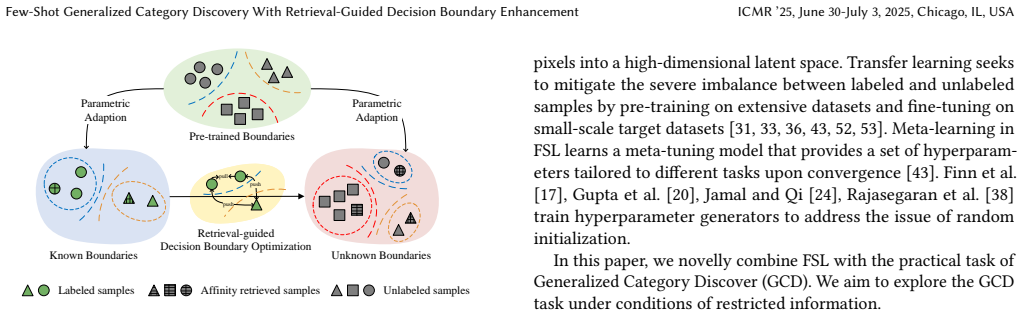
The load-bearing object is the retrieval-guided decision boundary enhancement framework, composed of a parametric adapter (a low-dimensional bottleneck MLP added beside the frozen transformer MLP blocks), a known-boundary pre-training stage using triplet loss on labeled features, a known-boundary augmentation stage using affinity-retrieved pseudo-labels with supervised contrastive loss, and an affinity-augmented boundary transfer stage using triplet and affinity losses on unlabeled features. The adapter preserves pretrained decision boundaries while limiting trainable parameters; the triplet and contrastive losses draw same-class features together and push different-class features apart; and affinity retrieval supplies the pseudo-positives that let scarce labels propagate to unlabeled data.
What would settle it
Measure pseudo-label precision on the six FSGCD splits: compare each labeled sample's affinity-retrieved nearest neighbor against its true label at the start of training and after each epoch. If precision is far below the reported NEW accuracy, the supervised contrastive loss is being trained on noisy labels and the claimed gains cannot be attributed to boundary transfer rather than to the strong pretrained features alone.
Extended reading notes
Core claim
Under the FSGCD setting, the paper's central claim is that scarce known information can be amplified by explicitly separating known and unknown decision boundaries. The model keeps pretrained DINO ViT-B/16 features largely frozen and learns only a small adapter, which the paper shows yields tighter clusters than fine-tuning the last transformer block. A known-boundary pre-training stage applies triplet loss to labeled samples, then a two-stage retrieval-guided optimization stage assigns each labeled feature the label of its nearest neighbor, trains supervised contrastive loss on labeled plus pseudo-labeled features, and finally builds triplets among unlabeled features and their affinity-retrieved neighbors to transfer the known boundary structure to unknown clusters. The reported outcome is that this pipeline outperforms the GCD baseline, SimGCD, and CMS on all six datasets in NEW accuracy and in overall accuracy, with the largest gains on CIFAR10 and CUB and smaller gains on ImageNet100, Stanford Cars, and Herbarium19.
Load-bearing premise
The whole pipeline leans on the assumption that each labeled sample's nearest neighbor in the pretrained feature space is almost always from the same class, because that neighbor is given the labeled sample's class as a pseudo-label and then trained on as if it were ground truth.
Editorial extensions
If this is right
- Under FSGCD, fine-tuning a small adapter instead of later transformer blocks prevents overfitting to the few known categories and improves clustering quality on unlabeled data.
- Affinity-retrieved nearest neighbors can serve as pseudo-labels that restore enough supervision for contrastive learning to sharpen known-class boundaries.
- Known-class boundary geometry, encoded by triplet relationships, transfers to unknown classes through the same triplet loss applied to unlabeled anchors and their retrieved neighbors.
- The framework provides a concrete baseline for large-scale discovery tasks, such as plant species identification, where labeled data are scarce but unlabeled imagery is abundant.
- Because the number of categories is assumed known, FSGCD extends existing GCD evaluation to settings where the known-class proportion is at most 20 percent.
Reading between the lines
- Editorial: The evaluation reports the highest NEW accuracy over the course of training while the total category count is given to the model; a stricter protocol that selects a single checkpoint without novel-class labels could shrink the reported margins.
- Editorial: The pseudo-labeling step has no confidence filter; a direct extension would threshold retrieval similarity or require mutual nearest neighbors, which could either raise accuracy or reveal how much of the gain depends on trusted neighbors.
- Editorial: The framework's components are not tightly coupled to a specific backbone, so the same adapter-plus-retrieval recipe could be tested on other self-supervised features, but the paper only reports DINO ViT-B/16.
- Editorial: The paper attributes smaller OLD gains on Stanford Cars and Herbarium19 to domain gap; one testable consequence is that a domain-adapted adapter or retrieval in a metric space tuned on known categories should recover OLD accuracy without sacrificing NEW.
Editorial analysis
A structured set of objections, weighed in public.
Referee Report
Summary. The paper introduces Few-shot Generalized Category Discovery (FSGCD), a setting where both the number of known categories and the number of labeled samples are severely limited, and proposes a framework that combines a parametric adapter, known-boundary pre-training with triplet loss, and two-stage affinity-retrieval-guided boundary optimization. The central empirical claim is that the proposed method outperforms existing GCD baselines on six public benchmarks under the FSGCD setting, with NEW accuracy gains of 11.5%, 11.2%, 0.2%, 15.1%, 1.5%, and 0.7% over the second-best model. The manuscript also reports ablations and visualizations supporting the utility of each component.
Significance. If the empirical claim is validated under a fair evaluation protocol, the paper would provide a useful new problem formulation and a strong baseline for few-shot generalized category discovery, with practical relevance to domains where labeled data are scarce. The paper's strengths include releasing code, evaluating on six standard benchmarks, and proposing a parameter-efficient adapter that appears to improve clustering quality in the reported ablations. However, the current evaluation protocol undermines the central claim: reporting the highest NEW result on the test set, without error bars or a matched selection rule for baselines, means the reported gains may not reflect genuine method superiority.
major comments (3)
- [Section 4.3] The evaluation protocol selects the checkpoint with the highest NEW accuracy on D_u, which is the test set, and the paper does not report how many epochs or steps were searched, nor whether the same best-epoch selection was applied to the GCD*, SimGCD, and CMS* baselines. This creates a structural bias: the proposed model is selected over its training trajectory on the test set, while the baselines may be evaluated at a fixed epoch. The central claim in Section 4.4 that the method 'significantly improves NEW performance on all datasets' is therefore not supported by the reported numbers.
- [Table 3] Table 3 reports a single run for each method without error bars, seed counts, or significance tests. On ImageNet100, Stanford Cars, and Herbarium19, the NEW gains over the second-best model are only 0.2%, 1.5%, and 0.7%, respectively. Without variance estimates or multiple seeds, these differences are plausibly within noise, especially under the best-on-test selection rule. The authors should report mean and standard deviation over at least three seeds and, ideally, apply identical checkpoint selection to all methods.
- [Section 3.3.1] The pseudo-labeling mechanism assigns the label of each labeled feature to its nearest neighbor without any confidence threshold or filtering. Because Eq. (6) uses these pseudo-labels in a supervised contrastive loss, incorrect pseudo-labels are directly reinforced, and Section 3.3.2 transfers the resulting boundaries to unknown clusters. The paper does not report pseudo-label accuracy or analyze sensitivity to retrieval quality, so the load-bearing assumption that DINO features plus a lightweight adapter produce trustworthy neighbors in the few-shot regime remains unverified.
minor comments (4)
- [Section 2.1] The phrase 'Generalized Category Discover' appears to be a typo for 'Generalized Category Discovery'.
- [Equation (7)] The notation in Eq. (7) is garbled: the set cardinality and summation limits are difficult to parse. Please rewrite the expression with clear indexing over the augmented minibatch.
- [Figure 5] The axes of Figure 5 appear inconsistent with the caption and text: panel (a) is said to vary the labeled sample proportion p_l but the axis values 1-5 do not match the definition p_l <= 0.2, and panel (b) is said to vary the known category proportion c_l but the same axis range is used. Please clarify the actual ranges and units.
- [Table 1] The row labels in Table 1 are ambiguous: the parameter counts appear in the Adapter column, but the table would be clearer if the first column explicitly stated the adapter configuration (e.g., 'full fine-tuning' vs. 'adapter').
Circularity Check
No significant circularity: the FSGCD framework is an empirical method whose reported gains are not equivalent to its loss terms or to a self-citation chain.
full rationale
The paper's central claim is an empirical performance comparison under a newly defined FSGCD protocol; it does not purport to derive a result from first principles. The method trains a ViT adapter with triplet loss, supervised contrastive loss on labeled and affinity-retrieved pseudo-labeled features (Eqs. 5 and 6), knowledge-transfer triplet loss (Eq. 8), affinity loss (Eq. 9), and unsupervised contrastive loss (Eq. 10). The pseudo-labels are obtained by nearest-neighbor retrieval from the model's own features, so there is a self-training loop, but the paper does not claim these pseudo-labels are independent ground truth, and the loss is not equivalent to the reported NEW accuracy by construction. The framework's components are incremental and evaluated by ablations; the only questionable protocol choice is reporting the highest NEW result on D_u in Section 4.3, which is an evaluation-bias or overfitting concern, not a circular derivation. There are no load-bearing self-citations: references [48, 55, 10, 7, 51] are external prior work, and no uniqueness theorem is invoked. The derivation chain, such as it is, is self-contained, with the admitted limitation that OLD accuracy drops on two fine-grained datasets, attributed to domain gap. Therefore no circularity is established.
Assumptions & free parameters
free parameters (5)
- Balance weight lambda =
0.35
- Supervised temperature tau_s =
0.07
- Unsupervised temperature tau_u =
1.0
- Triplet margin alpha =
not reported
- Adapter bottleneck dimension and scale factor s =
not reported
assumptions (6)
- domain assumption The total number of categories |C| is known to the model.
- domain assumption Labeled samples belong only to known categories, and unlabeled samples may belong to known or unknown categories.
- ad hoc to paper The first |C_kwn| classes of each dataset form a suitable known-category split.
- ad hoc to paper Affinity nearest neighbors computed with the model's own features carry correct class labels.
- domain assumption Decision boundaries learned for known categories transfer to unknown categories through triplet relationships.
- domain assumption Pretrained DINO features provide a useful representation for all six downstream domains.
Cite this review
Pith. "Pith review of Few-Shot Generalized Category Discovery With Retrieval-Guided Decision Boundary Enhancement." pith.science (2026). https://pith.science/paper/ZPYA7SW4
@misc{pith2026250616728,
  author       = {Pith},
  title        = {Pith review of: Few-Shot Generalized Category Discovery With Retrieval-Guided Decision Boundary Enhancement},
  year         = {2026},
  howpublished = {\url{https://pith.science/paper/ZPYA7SW4}},
  note         = {Machine review of arXiv:2506.16728}
}
read the original abstract
While existing Generalized Category Discovery (GCD) models have achieved significant success, their performance with limited labeled samples and a small number of known categories remains largely unexplored. In this work, we introduce the task of Few-shot Generalized Category Discovery (FSGCD), aiming to achieve competitive performance in GCD tasks under conditions of known information scarcity. To tackle this challenge, we propose a decision boundary enhancement framework with affinity-based retrieval. Our framework is designed to learn the decision boundaries of known categories and transfer these boundaries to unknown categories. First, we use a decision boundary pre-training module to mitigate the overfitting of pre-trained information on known category boundaries and improve the learning of these decision boundaries using labeled samples. Second, we implement a two-stage retrieval-guided decision boundary optimization strategy. Specifically, this strategy further enhances the severely limited known boundaries by using affinity-retrieved pseudo-labeled samples. Then, these refined boundaries are applied to unknown clusters via guidance from affinity-based feature retrieval. Experimental results demonstrate that our proposed method outperforms existing methods on six public GCD benchmarks under the FSGCD setting. The codes are available at: https://github.com/Ryh1218/FSGCD
Figures


Figures from the paper (3 more)


Reference graph
Works this paper leans on
-
[1]
Adewole S. Adamson and Avery Smith. 2018. Machine Learning and Health Care Disparities in Dermatology.JAMA Dermatology154, 11 (2018), 1247–1248
work page 2018
-
[2]
Amit Alfassy, Leonid Karlinsky, Amit Aides, Joseph Shtok, Sivan Harary, Rogerio Feris, Raja Giryes, and Alex M. Bronstein. 2019. LaSO: Label-Set Operations Networks for Multi-Label Few-Shot Learning. InProceedings of the IEEE conference on computer vision and pattern recognition (CVPR)
work page 2019
-
[3]
Wenbin An, Feng Tian, Wenkai Shi, Yan Chen, Yaqiang Wu, Qianying Wang, and Ping Chen. 2024. Transfer and alignment network for generalized category discovery. InProceedings of the AAAI Conference on Artificial Intelligence (AAAI)
work page 2024
-
[4]
Malik Boudiaf, Etienne Bennequin, Myriam Tami, Antoine Toubhans, Pablo Piantanida, Celine Hudelot, and Ismail Ben Ayed. 2023. Open-Set Likelihood Maximization for Few-Shot Learning. InProceedings of the IEEE conference on computer vision and pattern recognition (CVPR). Few-Shot Generalized Category Discovery With Retrieval-Guided Decision Boundary Enhance...
work page 2023
-
[5]
Tadeusz Caliński and Jerzy Harabasz. 1974. A dendrite method for cluster analysis. Communications in Statistics-theory and Methods3, 1 (1974), 1–27
work page 1974
-
[6]
Mathilde Caron, Hugo Touvron, Ishan Misra, Hervé Jégou, Julien Mairal, Piotr Bojanowski, and Armand Joulin. 2021. Emerging Properties in Self-Supervised Vision Transformers. InProceedings of the IEEE/CVF International Conference on Computer Vision (ICCV)
work page 2021
-
[7]
Shoufa Chen, Chongjian Ge, Zhan Tong, Jiangliu Wang, Yibing Song, Jue Wang, and Ping Luo. 2022. AdaptFormer: Adapting Vision Transformers for Scalable Visual Recognition. InAdvances in neural information processing systems (NIPS)
work page 2022
-
[8]
Ting Chen, Simon Kornblith, Mohammad Norouzi, and Geoffrey Hinton. 2020. A Simple Framework for Contrastive Learning of Visual Representations. In International conference on machine learning (ICML)
work page 2020
Show all 70 references
-
[9]
Zitian Chen, Yanwei Fu, Yu-Xiong Wang, Lin Ma, Wei Liu, and Martial Hebert
-
[10]
Sua Choi, Dahyun Kang, and Minsu Cho. 2024. Contrastive Mean-Shift Learning for Generalized Category Discovery. InProceedings of the IEEE conference on computer vision and pattern recognition (CVPR)
2024
-
[11]
Zhiyong Dai, Jianjun Yi, Lei Yan, Qingwen Xu, Liang Hu, Qi Zhang, Jiahui Li, and Guoqiang Wang. 2023. PFEMed: Few-shot medical image classification using prior guided feature enhancement.Pattern Recognition134 (2023), 109108
2023
-
[12]
Shule Deng, Jin-Gang Yu, Zihao Wu, Hongxia Gao, Yansheng Li, and Yang Yang
-
[13]
Alexey Dosovitskiy, Lucas Beyer, Alexander Kolesnikov, Dirk Weissenborn, Xi- aohua Zhai, Thomas Unterthiner, Mostafa Dehghani, Matthias Minderer, Georg Heigold, Sylvain Gelly, Jakob Uszkoreit, and Neil Houlsby. 2021. An Image is Worth 16x16 Words: Transformers for Image Recogn...
2021
-
[14]
Yixin Fei, Zhongkai Zhao, Siwei Yang, and Bingchen Zhao. 2022. XCon: Learning with Experts for Fine-grained Category Discovery. InThe British Machine Vision Conference (BMVC)
2022
-
[15]
Yong Feng, Yonghuai Wang, Honghe Li, Mingjun Qu, and Jinzhu Yang. 2023. Learning what and where to segment: A new perspective on medical image few-shot segmentation.Medical Image Analysis87 (2023), 102834
2023
-
[16]
Enrico Fini, Enver Sangineto, Stéphane Lathuilière, Zhun Zhong, Moin Nabi, and Elisa Ricci. 2021. A Unified Objective for Novel Class Discovery. InProceedings of the IEEE/CVF International Conference on Computer Vision (ICCV)
2021
-
[17]
Chelsea Finn, Pieter Abbeel, and Sergey Levine. 2017. Model-Agnostic Meta- Learning for Fast Adaptation of Deep Networks. InInternational conference on machine learning (ICML)
2017
-
[18]
Hang Gao, Zheng Shou, Alireza Zareian, Hanwang Zhang, and Shih-Fu Chang
-
[19]
Codella, Leonid Karlinsky, James V
Yunhui Guo, Noel C. Codella, Leonid Karlinsky, James V. Codella, John R. Smith, Kate Saenko, Tajana Rosing, and Rogerio Feris. 2020. A Broader Study of Cross- Domain Few-Shot Learning. InEuropean Conference on Computer Vision (ECCV)
2020
-
[20]
Gunshi Gupta, Karmesh Yadav, and Liam Paull. 2020. Look-ahead Meta Learning for Continual Learning. InAdvances in neural information processing systems (NIPS). 11588–11598
2020
-
[21]
Kai Han, Sylvestre-Alvise Rebuffi, Sebastien Ehrhardt, Andrea Vedaldi, and An- drew Zisserman. 2020. Automatically Discovering and Learning New Visual Categories with Ranking Statistics. InInternational Conference on Learning Rep- resentations (ICLR)
2020
-
[22]
Kai Han, Andrea Vedaldi, and Andrew Zisserman. 2019. Learning to Discover Novel Visual Categories via Deep Transfer Clustering. InProceedings of the IEEE/CVF International Conference on Computer Vision (ICCV)
2019
-
[23]
Shiyuan Huang, Jiawei Ma, Guangxing Han, and Shih-Fu Chang. 2022. Task- Adaptive Negative Envision for Few-Shot Open-Set Recognition. InProceedings of the IEEE conference on computer vision and pattern recognition (CVPR)
2022
-
[24]
Muhammad Abdullah Jamal and Guo-Jun Qi. 2019. Task Agnostic Meta-Learning for Few-Shot Learning. InProceedings of the IEEE conference on computer vision and pattern recognition (CVPR)
2019
-
[25]
Minki Jeong, Seokeon Choi, and Changick Kim. 2021. Few-Shot Open-Set Recog- nition by Transformation Consistency. InProceedings of the IEEE conference on computer vision and pattern recognition (CVPR)
2021
-
[26]
Prannay Khosla, Piotr Teterwak, Chen Wang, Aaron Sarna, Yonglong Tian, Phillip Isola, Aaron Maschinot, Ce Liu, and Dilip Krishnan. 2020. Supervised Contrastive Learning. InAdvances in neural information processing systems (NIPS)
2020
-
[27]
Jonathan Krause, Michael Stark, Jia Deng, and Li Fei-Fei. 2013. 3D Object Repre- sentations for Fine-Grained Categorization. InProceedings of the IEEE Interna- tional Conference on Computer Vision Workshops
2013
-
[28]
2009.Learning multiple layers of features from tiny images
Alex Krizhevsky and Geoffrey Hinton. 2009.Learning multiple layers of features from tiny images. Technical Report. Citeseer
2009
-
[29]
Junjie Li, Zilei Wang, and Xiaoming Hu. 2021. Learning Intact Features by Erasing- Inpainting for Few-shot Classification. InProceedings of the AAAI Conference on Artificial Intelligence (AAAI)
2021
-
[30]
Bo Liu, Hao Kang, Haoxiang Li, Gang Hua, and Nuno Vasconcelos. 2020. Few-Shot Open-Set Recognition Using Meta-Learning. InProceedings of the IEEE conference on computer vision and pattern recognition (CVPR)
2020
-
[31]
Changsheng Lu and Piotr Koniusz. 2024. Detect Any Keypoints: An Efficient Light-Weight Few-Shot Keypoint Detector. InProceedings of the AAAI Conference on Artificial Intelligence (AAAI)
2024
-
[32]
Jinzhu Lu, Lijuan Tan, and Huanyu Jiang. 2021. Review on Convolutional Neural Network (CNN) Applied to Plant Leaf Disease Classification.Agriculture11, 8 (2021), 707
2021
-
[33]
Xu Luo, Hao Wu, Ji Zhang, Lianli Gao, Jing Xu, and Jingkuan Song. 2023. A Closer Look at Few-shot Classification Again. InInternational conference on machine learning (ICML)
2023
-
[34]
Laurens van der Maaten and Geoffrey Hinton. 2008. Visualizing Data using t-SNE.Journal of Machine Learning Research9, 86 (2008), 2579–2605
2008
-
[35]
Chao Mou, Aokang Liang, Chunying Hu, Fanyu Meng, Baixun Han, and Fu Xu
-
[36]
Akihiro Nakamura and Tatsuya Harada. 2019. Revisiting fine-tuning for few-shot learning.arXiv preprint arXiv:1910.00216(2019)
2019 arXiv
-
[37]
Jona Otholt, Christoph Meinel, and Haojin Yang. 2024. Guided Cluster Aggre- gation: A Hierarchical Approach to Generalized Category Discovery. InIEEE Winter Conference on Applications of Computer Vision (W ACV)
2024
-
[38]
Jathushan Rajasegaran, Salman Khan, Munawar Hayat, Fahad Shahbaz Khan, and Mubarak Shah. 2020. iTAML: An Incremental Task-Agnostic Meta-learning Approach. InProceedings of the IEEE conference on computer vision and pattern recognition (CVPR)
2020
-
[39]
Monitoring Endangered and Rare Wildlife in the Field: A Foundation Deep Learning Model Integrating Human Knowledge for Incremental Recognition with Few Data and Low Cost.Animals13, 20 (2023), 3168
2023
-
[40]
Florian Schroff, Dmitry Kalenichenko, and James Philbin. 2015. FaceNet: A Unified Embedding for Face Recognition and Clustering. InProceedings of the IEEE conference on computer vision and pattern recognition (CVPR)
2015
-
[41]
Wenkai Shi, Wenbin An, Feng Tian, Yan Chen, Yaqiang Wu, Qianying Wang, and Ping Chen. 2024. A Unified Knowledge Transfer Network for Generalized Category Discovery. InProceedings of the AAAI Conference on Artificial Intelligence (AAAI)
2024
-
[42]
Nan Song, Chi Zhang, and Guosheng Lin. 2022. Few-shot Open-set Recogni- tion Using Background as Unknowns. InProceedings of the ACM International Conference on Multimedia (ACMMM)
2022
-
[43]
Berg, and Li Fei-Fei
Olga Russakovsky, Jia Deng, Hao Su, Jonathan Krause, Sanjeev Satheesh, Sean Ma, Zhiheng Huang, Andrej Karpathy, Aditya Khosla, Michael Bernstein, Alexander C. Berg, and Li Fei-Fei. 2015. ImageNet Large Scale Visual Recognition Challenge. International Journal of Computer Visio...
2015
-
[44]
Liang-Yu Sun and Wei-Ta Chu. 2024. Overall positive prototype for few-shot open-set recognition.Pattern Recognition151 (2024), 110400
2024
-
[45]
Kiat Chuan Tan, Yulong Liu, Barbara Ambrose, Melissa Tulig, and Serge Belongie
-
[46]
Costelloe, Silvia Zuffi, Benjamin Risse, Alexander Mathis, Mackenzie W
Devis Tuia, Benjamin Kellenberger, Sara Beery, Blair R. Costelloe, Silvia Zuffi, Benjamin Risse, Alexander Mathis, Mackenzie W. Mathis, Frank van Langevelde, Tilo Burghardt, Roland Kays, Holger Klinck, Martin Wikelski, Iain D. Couzin, Grant van Horn, Margaret C. Crofoot, Charl...
2022
-
[47]
Mondal, and Jyoti Prakash Sahoo
Yisheng Song, Ting Wang, Puyu Cai, Subrota K. Mondal, and Jyoti Prakash Sahoo
-
[48]
A Comprehensive Survey of Few-shot Learning: Evolution, Applications, Challenges, and Opportunities.ACM computing surveys55, 13 (2023), 1–40
2023
-
[49]
2011.The caltech-ucsd birds-200-2011 dataset
Catherine Wah, Steve Branson, Peter Welinder, Pietro Perona, and Serge Belongie. 2011.The caltech-ucsd birds-200-2011 dataset. Technical Report. California Institute of Technology
2011
-
[50]
Haoyu Wang, Guansong Pang, Peng Wang, Lei Zhang, Wei Wei, and Yanning Zhang. 2023. Glocal Energy-based Learning for Few-Shot Open-Set Recognition. InProceedings of the IEEE conference on computer vision and pattern recognition (CVPR)
2023
-
[51]
The herbarium challenge 2019 dataset.arXiv preprint arXiv:1906.05372 (2019)
2019 arXiv
-
[52]
Kevin I-Kai Wang, Xiaokang Zhou, Wei Liang, Zheng Yan, and Jinhua She. 2022. Federated Transfer Learning Based Cross-Domain Prediction for Smart Manufac- turing.IEEE Transactions on Industrial Informatics18, 6 (2022), 4088–4096
2022
-
[53]
Sagar Vaze, Kai Han, Andrea Vedaldi, and Andrew Zisserman. 2021. Open- Set Recognition: A Good Closed-Set Classifier is All You Need. InInternational Conference on Learning Representations (ICLR)
2021
-
[54]
Sagar Vaze, Kai Hant, Andrea Vedaldi, and Andrew Zisserman. 2022. Generalized Category Discovery. InProceedings of the IEEE conference on computer vision and pattern recognition (CVPR)
2022
-
[55]
Xin Wen, Bingchen Zhao, and Xiaojuan Qi. 2023. Parametric Classification for Generalized Category Discovery: A Baseline Study. InProceedings of the IEEE/CVF International Conference on Computer Vision (ICCV)
2023
-
[56]
M. B. Wright. 1990. Speeding up the hungarian algorithm.Computers & Operations Research17, 1 (1990), 95–96
1990
-
[57]
Hongjun Wang, Sagar Vaze, and Kai Han. 2024. SPTNet: An Efficient Alternative Framework for Generalized Category Discovery with Spatial Prompt Tuning. In International Conference on Learning Representations (ICLR)
2024
-
[58]
Hongguang Zhang, Jing Zhang, and Piotr Koniusz. 2019. Few-Shot Learning via Saliency-Guided Hallucination of Samples. InProceedings of the IEEE conference on computer vision and pattern recognition (CVPR)
2019
-
[59]
Qi-Wei Wang, Da-Wei Zhou, Yi-Kai Zhang, De-Chuan Zhan, and Han-Jia Ye. 2023. Few-Shot Class-Incremental Learning via Training-Free Prototype Calibration. InAdvances in neural information processing systems (NIPS). ICMR ’25, June 30-July 3, 2025, Chicago, IL, USA Yunhan Ren, Fe...
2023
-
[60]
Kwok, and Lionel M
Yaqing Wang, Quanming Yao, James T. Kwok, and Lionel M. Ni. 2020. Generalizing from a Few Examples: A Survey on Few-shot Learning.ACM computing surveys 53, 3 (2020), 1–34
2020
-
[61]
Bingchen Zhao and Kai Han. 2021. Novel Visual Category Discovery with Dual Ranking Statistics and Mutual Knowledge Distillation. InAdvances in neural information processing systems (NIPS)
2021
-
[62]
Bingchen Zhao, Xin Wen, and Kai Han. 2023. Learning Semi-supervised Gauss- ian Mixture Models for Generalized Category Discovery. InProceedings of the IEEE/CVF International Conference on Computer Vision (ICCV)
2023
-
[63]
Jianzong Wu, Xiangtai Li, Shilin Xu, Haobo Yuan, Henghui Ding, Yibo Yang, Xia Li, Jiangning Zhang, Yunhai Tong, Xudong Jiang, Bernard Ghanem, and Dacheng Tao. 2024. Towards Open Vocabulary Learning: A Survey.IEEE Transactions on Pattern Analysis and Machine Intelligence46, 7 (...
2024
-
[65]
Junjie Zhang, Yutao Rao, Xiaoshui Huang, Guanyi Li, Xin Zhou, and Dan Zeng
-
[67]
Jianhong Zhang, Manli Zhang, Zhiwu Lu, and Tao Xiang. 2021. AdarGCN: Adaptive Aggregation GCN for Few-Shot Learning. InIEEE Winter Conference on Applications of Computer Vision (W ACV)
2021
-
[70]
Da-Wei Zhou, Han-Jia Ye, and De-Chuan Zhan. 2021. Learning Placeholders for Open-Set Recognition. InProceedings of the IEEE conference on computer vision and pattern recognition (CVPR)
2021
-
[2018]
InAdvances in neural information processing systems (NIPS)
Low-shot Learning via Covariance-Preserving Adversarial Augmentation Networks. InAdvances in neural information processing systems (NIPS)
-
[2019]
InProceedings of the IEEE conference on computer vision and pattern recognition (CVPR)
Image Deformation Meta-Networks for One-Shot Learning. InProceedings of the IEEE conference on computer vision and pattern recognition (CVPR)
-
[2023]
IEEE Transactions on Multimedia25 (2023), 5763–5774
Learning Relative Feature Displacement for Few-Shot Open-Set Recognition. IEEE Transactions on Multimedia25 (2023), 5763–5774
2023
-
[2024]
Frequency-Aware Multi-Modal Fine-Tuning for Few-Shot Open-Set Remote Sensing Scene Classification.IEEE Transactions on Multimedia26 (2024), 7823– 7837
2024
Reviewed August 6, 2026 · model on record in the stance chip above.
Discussion (0). Sign in to comment.