REVIEW 3 major objections 4 minor 1 cited by
The Indian Pulsar Timing Array Data Release 2: I. Dataset and Timing Analysis
T0 review · 3 major / 4 minor · reviewed 2026-08-15 · deepseek-v4-flash
Pith's one-line read The Indian Pulsar Timing Array's second data release reprocesses 7.5 years of dual-band observations of 27 millisecond pulsars into sub-banded times of arrival and epoch-resolved dispersion measures, reporting some of the most precise…
desk verdict Solid InPTA data release, but the headline DM precision claim rests on uncalibrated formal errors; fix that and the dataset is a strong IPTA DR3 input. read the letter →
The pith
A machine-rendered reading of the paper's core claim, the machinery that carries it, and where it could break.
The reading
What carries the argument
The load-bearing mechanism is the combination of a noise-free, frequency-resolved template built from one carefully selected high-S/N epoch per pulsar, a per-pulsar optimization of the number of frequency sub-bands, and the DMCalc pipeline that cross-correlates each epoch's sub-banded data against that template to produce sub-banded ToAs and epoch-wise DMs. A fiducial DM, estimated iteratively by aligning concurrent band 3 and band 5 template epochs, fixes the reference for both bands so that frequency-dependent delays are measured rather than modeled. The epoch-wise DMs are written into the ephemeris as DMX values representing instantaneous measured DMs, which is conceptually different from the usual piecewise-linear DMX fitting, and this is what lets the timing analysis absorb interstellar dispersion without fitting extra frequency-dependent parameters.
What would settle it
Re-time the full dataset for any one pulsar using a template built from the latest epoch instead of the selected template epoch; if the resulting ToA and DM time series shift by more than the quoted uncertainties or develop new annual artifacts, the single-template assumption fails. A sharper check is to search the released residuals of PSR J1713+0747 for an unmodeled step at MJD 59309, the truncation point imposed by its profile-change event, since an unmodeled step there would show that the dataset is not internally consistent.
Extended reading notes
Core claim
The paper establishes that simultaneous dual-band timing at 300–500 MHz and 1260–1460 MHz, with a single high-signal-to-noise template epoch per pulsar and per-epoch dispersion-measure fits, can produce dispersion-measure time series precise to parts in $10^{-5}$ to $10^{-6}$ pc cm$^{-3}$ for many millisecond pulsars. It shows that applying these epoch-resolved DMs directly as DMX delays, rather than as piecewise-linear fits, leaves timing residuals with post-fit weighted RMS as low as 1.095 microseconds for PSR J1909−3744. It further claims that the reprocessed dataset cleanly reveals annual solar-wind electron-content variations in PSRs J0034−0534, J0613−0200, J1744−1134, J1909−3744, and J2145−0750, and a candidate DM jump in PSR J1125+7819 near MJD 59741. On this basis the paper argues that the data release will characterize interstellar-medium noise better than the previous release and increase the sensitivity of upcoming nanohertz gravitational-wave searches.
Load-bearing premise
The analysis assumes that one noise-free pulse template built from a single high-signal observation stays a valid cross-correlation reference for the full 7.5-year baseline; if a pulsar's pulse shape drifts or jumps, as happened for PSR J1713+0747 in April 2021, the measured arrival times and dispersion measures inherit that drift.
Editorial extensions
If this is right
- The released ToAs, DMs, and ephemerides for 27 pulsars enter the next combined international data release, so gravitational-wave searches inherit a better-characterized interstellar-medium noise term.
- Epoch-wise DMX values measured from simultaneous dual-band data replace fitted piecewise-linear DM models, which should remove a class of chromatic timing artifacts in the residuals.
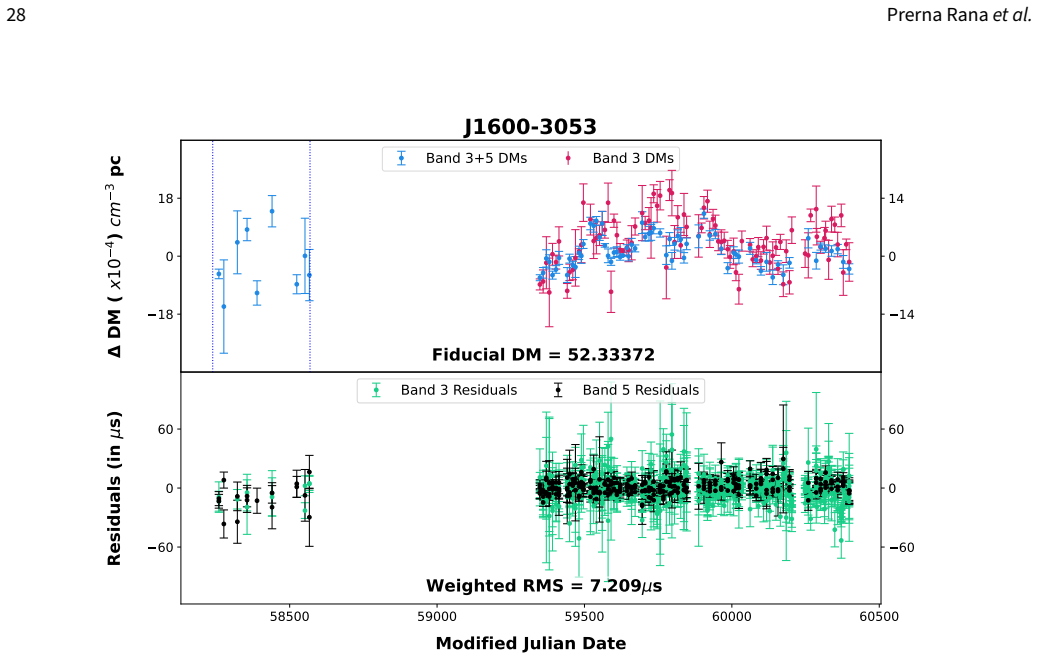
- Five pulsars show annual solar-wind DM modulations, giving a direct multi-year record of solar-wind electron content along those lines of sight.
- The per-pulsar sub-band optimization eliminates the need for frequency-dependent timing parameters even at low radio frequencies.
- The template-epoch strategy means any future pulse-profile shape-change event, like the one that truncates PSR J1713+0747 data at MJD 59309, must be detected and handled explicitly to preserve the precision claims.
Reading between the lines
- If the claimed dispersion-measure precision transfers to other low-frequency arrays, the same dual-band epoch-DM scheme could be adopted there to separate interstellar and solar-wind delays without relying on external solar wind models.
- The five pulsars with annual solar-wind signatures provide a testable solar-wind monitor: comparing their DM curves with spacecraft-based solar-wind density measurements should either confirm the calibration or reveal residual unmodeled delays.
- A concrete prediction for the next combined data release is that pulsars with the largest chromatic noise, such as PSR J1909−3744, should show the greatest improvement in gravitational-wave detection statistics once these DMs are included.
- The candidate DM jump in PSR J1125+7819 at MJD 59741, if confirmed by independent telescopes, would be a rare probe of compact structure in the ionized interstellar medium.
Signed reviews
Editorial analysis
A structured set of objections, weighed in public.
Referee Report
Summary. This paper presents InPTA Data Release 2, a reprocessed seven-year dataset of sub-banded times of arrival (ToAs), epoch-wise dispersion measures (DMs), and initial timing ephemerides for 27 millisecond pulsars observed with the uGMRT in two simultaneous frequency bands (300–500 MHz and 1260–1460 MHz). The authors describe their full pipeline: noise-free template generation, per-pulsar optimization of sub-band count, iterative estimation of a fiducial DM, DMX-based deterministic timing, and the production of DM time series. The central claims are that the dual-band, low-frequency dataset provides some of the highest-precision DM estimates published so far and that annual DM variations attributable to the solar wind are visible in several pulsars. The paper is written as a data-release paper, with detailed documentation of the observing setup, exclusions, outlier flagging, and known limitations such as the J1643–1224 scatter-broadening bias and the J1713+0747 profile change.
Significance. If the precision and calibration claims hold, this dataset is genuinely valuable for the PTA community: it adds a low-frequency, high-cadence, simultaneous dual-band component to IPTA DR3, and its per-epoch DMX measurements could improve chromatic-noise modeling in combined GW searches. The paper is unusually transparent about processing choices: band-4 exclusion, J0900–3144 band-3 exclusion, J2302+4442 band-5 exclusion, J1713+0747 truncation at MJD 59309, and the use of FDJUMPDM for J1643–1224 are all disclosed. The pipeline is reproducible in principle, with the code and data to be released on GitHub. The main significance risk is that the headline precision claim rests on formal DM uncertainties that are not yet calibrated by the EFAC factors the paper itself reports.
major comments (3)
- [Section 4.4 and Table 3 vs. Section 5] The DM uncertainties quoted in Table 3 are formal errors from a weighted fit to sub-banded ToA errors, but Section 5 states that the same ToAs require T2EFAC scaling factors of 0.3–7, and about 14 for PSR J1939+2134 band 3 with 200 MHz bandwidth and CDP, to bring reduced chi-squared to unity. Because a DM fit is a linear function of the ToA uncertainties, a T2EFAC of 14 would inflate the quoted 0.3e-5 pc/cm^3 minimum for J1939+2134 to roughly 4e-5 pc/cm^3, which is no longer outstanding relative to other PTA DM measurements. The abstract's claim of 'some of the highest precision DM estimates so far' is therefore not yet supported by validated measurement uncertainties. I ask the authors to either propagate the EFACs into the DM uncertainties before quoting them in Table 3 and the abstract, or to explicitly label Table 3 as reporting uncalibrated formal errors and to temper the precision claim accordingly. This also affects the significance of the claimed solar-wind DM variations, which use the same error bars.
- [Section 4.1 and Section 6] The analysis uses a single high-S/N epoch per pulsar to build the noise-free template that is then cross-correlated with all data across the full 7.5-year baseline. The paper itself acknowledges that the J1713+0747 profile-shape event at MJD 59320–59321 required truncating that pulsar's data, which demonstrates that profile instability is a real hazard for this method. Yet no explicit test of profile stability over time is reported for the other 26 pulsars, and Section 5 argues that FD parameters are unnecessary without a quantitative demonstration that the sub-band selection removes all frequency-dependent profile evolution over the full time span. I recommend adding a stability check, for example by comparing templates built from early and late epochs or by examining per-epoch profile residuals, or at minimum a clear statement of the implied systematic risk for the DM and ToA precision claims.
- [Section 4.3 and Section 4.4] The fiducial DM is estimated from the same template-epoch data that is used to align the templates, and all DMX values are then measured relative to this fiducial DM. Any systematic error in the fiducial DM is a constant offset that does not affect timing residuals or GW sensitivity, so this is not circular for the timing products. However, the DM time series and the absolute DM precision claims in Table 3 do depend on the fiducial DM uncertainty, which is not reported anywhere. I ask the authors to state the uncertainty on each fiducial DM, or to explicitly note that all quoted DM uncertainties are relative to the fiducial value.
minor comments (4)
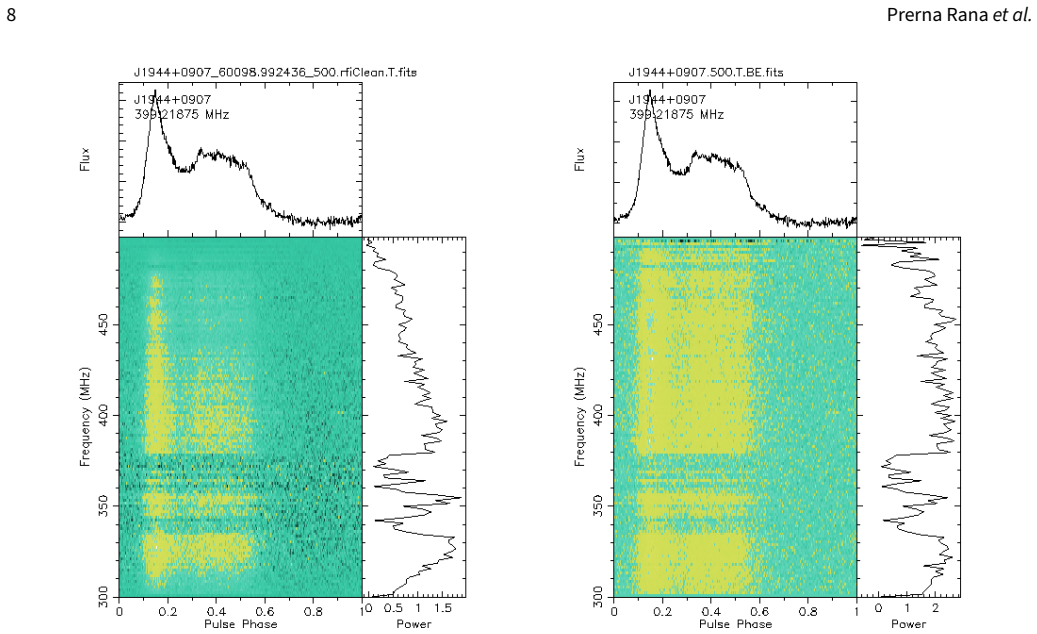
- [Figure 6 and Appendix 2] In the Figure 6 panel for PSR J2124–3358, the fiducial DM is listed as 24.35335, which is identical to the value listed for J1944+0907 and differs from the value 4.59288 shown in Figure 33 of Appendix 2; this appears to be a typo and should be corrected.
- [Appendix 2] The manuscript includes a Figure 13 without a caption in the provided text; please ensure every figure has a caption and that cross-references are correct.
- [Section 5] The sentence beginning 'In the case of PSRs J0613−0200, the scaling factor decreases to approximately 0.2...' has a grammatical issue ('In the case of PSRs J0613−0200' should be 'In the case of PSR J0613−0200') and should be reworded.
- [Section 4.2 and Appendix 1] Equation (1) is dimensionally inconsistent as written (S/N is set equal to an expression involving T_peak/T_sys with non-obvious units); please add a short definition of each symbol and state that this is a proportionality relation rather than an exact equality.
Circularity Check
No significant circularity: the fiducial-DM reference is a calibration convention, and the precision and solar-wind claims rest on independent epoch-wise fits cross-checked against LOFAR and NANOGrav.
full rationale
The paper's load-bearing claims are (1) that the reprocessed DR2 gives very precise DM estimates and (2) that the DM time series show solar-wind-like annual variations. Neither claim is circular. The fiducial DM (Section 4.3) is explicitly a calibration reference: it is fitted once from the template epoch to align the band-3 and band-5 templates, and all epoch DMs are measured relative to this fixed value. The solar-wind signature is an epoch-dependent annual modulation around this single constant; a single fitted constant cannot manufacture a time-varying annual signal. The epoch-wise DMs in Section 4.4 are free parameters fitted by TEMPO2 from sub-banded ToAs, not set equal to the fiducial DM. The paper also validates the DM trends against LOFAR and NANOGrav data (Section 6), providing external benchmarks. The self-citations (Tarafdar et al. 2022; Krishnakumar et al. 2021; Susobhanan et al. 2021) are to the collaboration's own pipeline and method papers; these are code-based, externally used in EPTA+InPTA analyses, and are not invoked as a uniqueness theorem or as a substitute for the present measurements. The one substantive caveat, flagged in Section 5, is that the Table 3 DM uncertainties appear to be raw formal errors: 'We plan to have better constraints on such scaling factors by modeling them as white noise parameters in subsequent noise analysis.' This means the quoted 10^-5 pc cm^-3 precisions may be uncalibrated by T2EFAC factors, but that is a correctness/calibration issue, not a circularity; the DM values themselves are still fitted from data and the EFACs are derived from the same residuals rather than being assumed as the DM answer. No step in the derivation reduces to its own inputs.
Assumptions & free parameters
free parameters (5)
- Fiducial DM per pulsar =
e.g., 4.333298 pc cm^-3 for J0030+0451
- Optimum sub-band count per pulsar, band, and bandwidth =
Values in Table 2 (e.g., 32 for J0030+0451 band 3, 200 MHz)
- EFAC scaling factors =
Range approximately 0.2 to 14
- Solar wind electron density =
Not tabulated
- Template epoch selection =
Chosen per pulsar from MJD 59692 to 60582 or earlier for five pulsars
assumptions (5)
- domain assumption DE440 solar system ephemeris and TT(BIPM2023) time-scale are accurate enough for microsecond-level timing
- domain assumption Fourier-domain template cross-correlation yields unbiased ToA and DM estimates
- domain assumption The optimized sub-band choices fully remove frequency-dependent profile evolution, so FD parameters are not needed
- domain assumption Epoch-wise DMX parameters absorb all IISM and solar wind propagation delays
- domain assumption Wavelet smoothing preserves pulse profile features
Cite this review
Pith. "Pith review of The Indian Pulsar Timing Array Data Release 2: I. Dataset and Timing Analysis." pith.science (2026). https://pith.science/paper/H2ZDWA24
@misc{pith2026250616769,
  author       = {Pith},
  title        = {Pith review of: The Indian Pulsar Timing Array Data Release 2: I. Dataset and Timing Analysis},
  year         = {2026},
  howpublished = {\url{https://pith.science/paper/H2ZDWA24}},
  note         = {Machine review of arXiv:2506.16769}
}
read the original abstract
The Indian Pulsar Timing Array (InPTA) employs unique features of the upgraded Giant Metrewave Radio Telescope (uGMRT) to monitor dozens of the International Pulsar Timing Array (IPTA) millisecond pulsars (MSPs), simultaneously in the 300-500 MHz and the 1260-1460 MHz bands. This dual-band approach ensures that any frequency-dependent delays are accurately characterized, significantly improving the timing precision for pulsar observations, which is crucial for pulsar timing arrays. We present details of InPTA's second data release that involves 7 yrs of data on 27 IPTA MSPs. This includes sub-banded Times of Arrival (ToAs), Dispersion Measures (DM), and initial timing ephemerides for our MSPs. A part of this dataset, originally released in InPTA's first data release, is being incorporated into IPTA's third data release which is expected to detect and characterize nanohertz gravitational waves in the coming years. The entire dataset is reprocessed in this second data release providing some of the highest precision DM estimates so far and interesting solar wind related DM variations in some pulsars. This is likely to characterize the noise introduced by the dynamic inter-stellar ionised medium much better than the previous release thereby increasing sensitivity to any future gravitational wave search.
Figures


Figures from the paper (32 more)




Forward citations
Cited by 1 Pith paper
-
The Indian Pulsar Timing Array Data Release 2: III. Search for a Stochastic Gravitational Wave Background
The 7.2-year InPTA DR2 data yield no detection of a stochastic gravitational wave background, a prior-dominated common-process posterior, and a 95% upper limit of A_GWB < 3.4e-14 at gamma = 13/3.
Reference graph
Works this paper leans on
-
[1]
, " * write output.state after.block = add.period write newline
ENTRY address archivePrefix author booktitle chapter doi edition editor eprint howpublished institution journal key month note number organization pages publisher school series title type volume year label extra.label sort.label short.list INTEGERS output.state before.all mid.sentence after.sentence after.block FUNCTION init.state.consts #0 'before.all :=...
-
[2]
write newline
" write newline "" before.all 'output.state := FUNCTION format.doi doi empty "" "doi:" doi * "" * if FUNCTION format.eprint eprint empty "" archivePrefix empty "" archivePrefix ":" * if eprint field.or.null * if FUNCTION format.pid eprint empty format.doi format.eprint if FUNCTION n.dashify 't := "" t empty not t #1 #1 substring "-" = t #1 #2 substring "-...
-
[3]
P., Abbott, R., Abbott, T
Abbott, B. P., Abbott, R., Abbott, T. D., et al. 2016, Phys. Rev. Lett., 116, 061102
2016
-
[4]
2017, Phys
---. 2017, Phys. Rev. Lett., 119, 161101
2017
-
[5]
M., et al
Agazie , G., Anumarlapudi , A., Archibald , A. M., et al. 2023 a , , 951, L50
2023
-
[6]
2023 b , , 951, L8
---. 2023 b , , 951, L8
2023
-
[7]
F., Anumarlapudi , A., et al
Agazie , G., Alam , M. F., Anumarlapudi , A., et al. 2023 c , , 951, L9
2023
-
[8]
Agazie , G., Antoniadis , J., Anumarlapudi , A., et al. 2024 a , , 966, 105
work page 2024
Show all 87 references
-
[9]
T., et al
Agazie , G., Arzoumanian , Z., Baker , P. T., et al. 2024 b , , 963, 61
2024
-
[10]
A., Cheng , A
Alpar , M. A., Cheng , A. F., Ruderman , M. A., & Shaham , J. 1982, , 300, 728
1982
-
[11]
W., & Darling , D
Anderson , T. W., & Darling , D. A. 1952, The Annals of Mathematical Statistics, 23, 193
1952
-
[12]
1954, Journal of the American statistical association, 49, 765
---. 1954, Journal of the American statistical association, 49, 765
1954
-
[13]
2022, , 510, 4873
Antoniadis , J., Arzoumanian , Z., Babak , S., et al. 2022, , 510, 4873
2022
-
[14]
2015, The Astrophysical Journal, 813, 65
Arzoumanian, Z., Brazier, A., Burke-Spolaor, S., et al. 2015, The Astrophysical Journal, 813, 65
2015
-
[15]
T., Blumer , H., et al
Arzoumanian , Z., Baker , P. T., Blumer , H., et al. 2020, , 905, L34
2020
-
[16]
C., Kulkarni , S
Backer , D. C., Kulkarni , S. R., Heiles , C., Davis , M. M., & Goss , W. M. 1982, , 300, 615
1982
-
[17]
R., Charisi , M., et al
Burke-Spolaor , S., Taylor , S. R., Charisi , M., et al. 2019, , 27, 5
2019
-
[18]
2022, , 509, 5538
Chalumeau , A., Babak , S., Petiteau , A., et al. 2022, , 509, 5538
2022
-
[19]
N., Guo , Y
Chen , S., Caballero , R. N., Guo , Y. J., et al. 2021, , 508, 4970
2021
-
[20]
R., & Donoho, D
Coifman, R. R., & Donoho, D. L. 1995, Translation-Invariant De-Noising, ed. A. Antoniadis & G. Oppenheim (New York, NY: Springer New York), 125--150
1995
-
[21]
Damour , T., & Taylor , J. H. 1991, , 366, 501
1991
-
[22]
1992, , 45, 1840
---. 1992, , 45, 1840
1992
-
[23]
2024, , 109, 103018
Dandapat , S., Susobhanan , A., Dey , L., et al. 2024, , 109, 103018
2024
-
[24]
2016, Experimental Astronomy, 41, 67
De, K., & Gupta, Y. 2016, Experimental Astronomy, 41, 67
2016
-
[25]
N., Lentati , L., et al
Desvignes , G., Caballero , R. N., Lentati , L., et al. 2016, , 458, 3341
2016
-
[26]
1979, , 234, 1100
Detweiler , S. 1979, , 234, 1100
1979
-
[27]
Y., Verbiest , J
Donner , J. Y., Verbiest , J. P. W., Tiburzi , C., et al. 2020, , 644, A153
2020
-
[28]
T., Hobbs , G
Edwards , R. T., Hobbs , G. B., & Manchester , R. N. 2006, , 372, 1549
2006
-
[29]
A., Vallisneri , M., Taylor , S
Ellis , J. A., Vallisneri , M., Taylor , S. R., & Baker , P. T. 2019, ENTERPRISE: Enhanced Numerical Toolbox Enabling a Robust PulsaR Inference SuitE , Astrophysics Source Code Library, record ascl:1912.015
2019
-
[30]
2023 a , , 678, A48
EPTA Collaboration , Antoniadis , J., Babak , S., et al. 2023 a , , 678, A48
2023
-
[31]
2023 b , , 678, A49
EPTA Collaboration , InPTA Collaboration , Antoniadis , J., et al. 2023 b , , 678, A49
2023
-
[32]
2023 c , , 678, A50
---. 2023 c , , 678, A50
2023
-
[33]
2024 a , , 685, A94
---. 2024 a , , 685, A94
2024
-
[34]
2024 b , , 690, A118
---. 2024 b , , 690, A118
2024
-
[35]
B., & Wahlquist , H
Estabrook , F. B., & Wahlquist , H. D. 1975, General Relativity and Gravitation, 6, 439
1975
-
[36]
S., & Backer , D
Foster , R. S., & Backer , D. C. 1990, , 361, 300
1990
-
[37]
1968, , 218, 731
Gold , T. 1968, , 218, 731
1968
-
[38]
M., Reardon , D
Goncharov , B., Shannon , R. M., Reardon , D. J., et al. 2021, , 917, L19
2021
-
[39]
S., et al
Gupta , Y., Ajithkumar , B., Kale , H. S., et al. 2017, Current Science, 113, 707
2017
-
[40]
W., & Downs , G
Hellings , R. W., & Downs , G. S. 1983, , 265, L39
1983
-
[41]
N., et al
Hobbs , G., Guo , L., Caballero , R. N., et al. 2020, , 491, 5951
2020
-
[42]
B., Edwards , R
Hobbs , G. B., Edwards , R. T., & Manchester , R. N. 2006, , 369, 655
2006
-
[43]
W., van Straten , W., & Manchester , R
Hotan , A. W., van Straten , W., & Manchester , R. N. 2004, , 21, 302
2004
-
[44]
J., & Ronchetti, E
Huber, P. J., & Ronchetti, E. M. 2011, Robust Statistics (John Wiley & Sons), 172
2011
-
[45]
Hunter , J. D. 2007, Computing in Science and Engineering, 9, 90
2007
-
[46]
S., Lazio , J., et al
Jenet , F., Finn , L. S., Lazio , J., et al. 2009, arXiv e-prints, arXiv:0909.1058
2009 arXiv
-
[47]
J., Cordes , J
Jennings , R. J., Cordes , J. M., Chatterjee , S., et al. 2024, , 964, 179
2024
-
[48]
L., McLaughlin , M
Jones , M. L., McLaughlin , M. A., Lam , M. T., et al. 2017, , 841, 125
2017
-
[49]
C., Arumugasamy, P., Bagchi, M., et al
Joshi, B. C., Arumugasamy, P., Bagchi, M., et al. 2018, Journal of Astrophysics and Astronomy, 39, 51
2018
-
[50]
C., Gopakumar , A., Pandian , A., et al
Joshi , B. C., Gopakumar , A., Pandian , A., et al. 2022, Journal of Astrophysics and Astronomy, 43, 98
2022
-
[51]
D., et al
Kikunaga , T., Hisano , S., Batra , N. D., et al. 2024, , 41, e036
2024
-
[52]
A., Manoharan , P
Krishnakumar , M. A., Manoharan , P. K., Joshi , B. C., et al. 2021, , 651, A5
2021
-
[53]
T., Ellis , J
Lam , M. T., Ellis , J. A., Grillo , G., et al. 2018, , 861, 132
2018
-
[54]
M., Prakash , M., Masak , D., & Yahil , A
Lattimer , J. M., Prakash , M., Masak , D., & Yahil , A. 1990, , 355, 241
1990
-
[55]
R., & Kramer , M
Lorimer , D. R., & Kramer , M. 2004, Handbook of Pulsar Astronomy , Vol. 4 (Cambridge University Press)
2004
-
[56]
2021, , 650, A80
Maan , Y., van Leeuwen , J., & Vohl , D. 2021, , 650, A80
2021
-
[57]
N., Hobbs , G., Bailes , M., et al
Manchester , R. N., Hobbs , G., Bailes , M., et al. 2013, , 30, e017
2013
-
[58]
T., Shannon , R
Miles , M. T., Shannon , R. M., Bailes , M., et al. 2023, , 519, 3976
2023
-
[59]
2022, , 512, 1234
Nobleson , K., Agarwal , N., Girgaonkar , R., et al. 2022, , 512, 1234
2022
-
[60]
K., Dwivedi , C., Rana , P., et al
Paladi , A. K., Dwivedi , C., Rana , P., et al. 2024, , 527, 213
2024
-
[61]
Perera , B. B. P., DeCesar , M. E., Demorest , P. B., et al. 2019, , 490, 4666
2019
-
[62]
M., Lim, P
Price-Whelan, A. M., Lim, P. L., Earl, N., et al. 2022, The Astrophysical Journal, 935, 167
2022
-
[63]
1982, Current Science, 51, 1096
Radhakrishnan , V., & Srinivasan , G. 1982, Current Science, 51, 1096
1982
-
[64]
M., Cordes , J
Ransom , S. M., Cordes , J. M., & Eikenberry , S. S. 2003, , 589, 911
2003
-
[65]
M., Eikenberry , S
Ransom , S. M., Eikenberry , S. S., & Middleditch , J. 2002, , 124, 1788
2002
-
[66]
J., Zic , A., Shannon , R
Reardon , D. J., Zic , A., Shannon , R. M., et al. 2023, , 951, L6
2023
-
[67]
H., Kudale, S., Shinde, N., et al
Reddy, S. H., Kudale, S., Shinde, N., et al. 2021, Timestamp flow in GWB and correction , Tech. rep., National Centre for Radio Astrophysics, Pune
2021
-
[68]
H., Kudale, S., Gokhale, U., et al
Reddy, S. H., Kudale, S., Gokhale, U., et al. 2017, Journal of Astronomical Instrumentation, 6, 1641011
2017
-
[69]
Rickett , B. J. 1977, , 15, 479
1977
-
[70]
S., & Schutz , B
Sathyaprakash , B. S., & Schutz , B. F. 2009, Living Reviews in Relativity, 12, 2
2009
-
[71]
Sazhin , M. V. 1978, , 22, 36
1978
-
[72]
P., Joshi , B
Singha , J., Surnis , M. P., Joshi , B. C., et al. 2021, , 507, L57
2021
-
[73]
C., Krishnakumar , M
Singha , J., Joshi , B. C., Krishnakumar , M. A., et al. 2024, , 535, 1184
2024
-
[74]
2023, , 108, 023008
Srivastava , A., Desai , S., Kolhe , N., et al. 2023, , 108, 023008
2023
-
[75]
C., Chalumeau , A., Tiburzi , C., et al
Susarla , S. C., Chalumeau , A., Tiburzi , C., et al. 2024, , 692, A18
2024
-
[76]
C., et al
Susobhanan , A., Maan , Y., Joshi , B. C., et al. 2021, , 38, e017
2021
-
[77]
1991, in Astronomical Society of the Pacific Conference Series, Vol
Swarup , G. 1991, in Astronomical Society of the Pacific Conference Series, Vol. 19, IAU Colloq. 131: Radio Interferometry. Theory, Techniques, and Applications, ed. T. J. Cornwell & R. A. Perley , 376--380
1991
-
[78]
2022, , 39, e053
Tarafdar , P., Nobleson , K., Rana , P., et al. 2022, , 39, e053
2022
-
[79]
1994, Reviews of Modern Physics, 66, 711
Taylor , Joseph H., J. 1994, Reviews of Modern Physics, 66, 711
1994
-
[80]
H., & Weisberg , J
Taylor , J. H., & Weisberg , J. M. 1982, , 253, 908
1982
-
[81]
M., Bassa , C
Tiburzi , C., Shaifullah , G. M., Bassa , C. G., et al. 2021, , 647, A84
2021
-
[82]
2011, , 28, 1
van Straten , W., & Bailes , M. 2011, , 28, 1
2011
-
[83]
P., Lentati, L., Hobbs, G., et al
Verbiest, J. P., Lentati, L., Hobbs, G., et al. 2016, Monthly Notices of the Royal Astronomical Society, 458, 1267
2016
-
[84]
Wolszczan , A., & Frail , D. A. 1992, , 355, 145
1992
-
[85]
2023, Research in Astronomy and Astrophysics, 23, 075024
Xu , H., Chen , S., Guo , Y., et al. 2023, Research in Astronomy and Astrophysics, 23, 075024
2023
-
[86]
P., Hobbs, G., Coles, W
You, X. P., Hobbs, G., Coles, W. A., et al. 2007, Monthly Notices of the Royal Astronomical Society, 378, 493
2007
-
[87]
J., Kapur , A., et al
Zic , A., Reardon , D. J., Kapur , A., et al. 2023, , 40, e049
2023
Reviewed August 15, 2026 · model on record in the stance chip above.
Discussion (0). Continue with ORCID to comment.