A few notes about viscoplastic rheologies
Pith reviewed 2026-05-19 08:21 UTC · model grok-4.3
The pith
Convex analysis synthesizes a single convex viscoplastic dissipation potential by combining viscous and plastic elements in serial and parallel.
A machine-rendered reading of the paper's core claim, the machinery that carries it, and where it could break.
Core claim
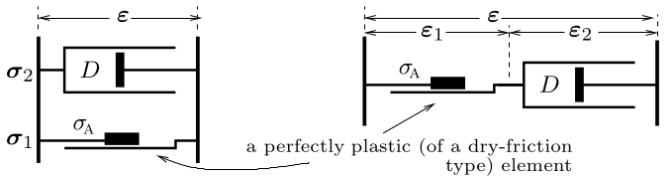
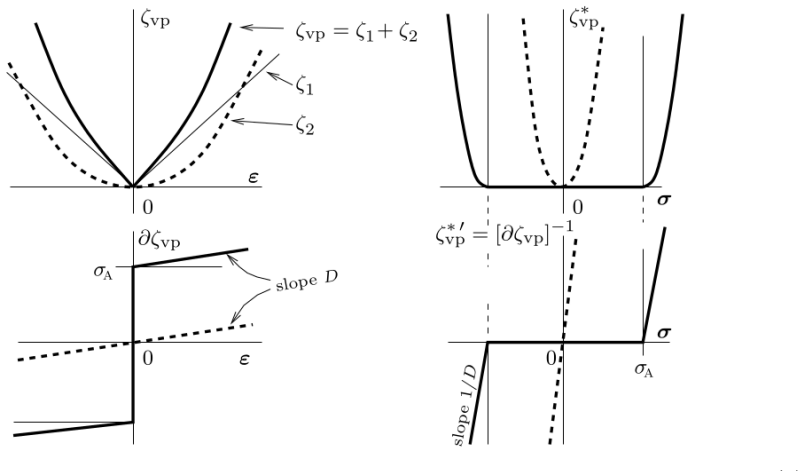
The rigorous tools of convex analysis are used to examine various serial and parallel combinations of linear viscosity and perfect plasticity. Nonlinear viscosities are also considered. The general aim is to synthesize a single convex viscoplastic dissipation potential from the potentials of particular viscous or plastic elements. Rigorous serial-viscosity models are then compared with empirical models based on harmonic means, which are commonly used for various geomaterials.
What carries the argument
A single convex viscoplastic dissipation potential constructed via serial and parallel combination rules from individual viscous and plastic potentials.
Load-bearing premise
That the rules for serial and parallel combinations preserve convexity of the dissipation potential and that the resulting models sufficiently correspond to physical behavior in geomaterials.
What would settle it
Direct comparison of stress-strain curves predicted by the convex model against experimental data from geomaterials where the harmonic mean approximation shows clear discrepancies.
Figures


read the original abstract
The rigorous tools of convex analysis are used to examine various serial and parallel combinations of linear viscosity and perfect plasticity. Nonlinear viscosities are also considered. The general aim is to synthesize a single convex ``viscoplastic'' dissipation potential from the potentials of particular viscous or plastic elements. Rigorous serial-viscosity models are then compared with empirical models based on harmonic means, which are commonly used for various geomaterials.
Editorial analysis
A structured set of objections, weighed in public.
Referee Report
Summary. The manuscript uses tools from convex analysis to derive single convex viscoplastic dissipation potentials by combining the potentials of individual viscous and plastic rheological elements under serial and parallel arrangements. It treats both linear viscosity/perfect plasticity and nonlinear viscosity cases, then compares the resulting rigorous serial-viscosity models against empirical harmonic-mean approximations commonly employed for geomaterials.
Significance. If the central constructions hold, the work supplies a systematic, convexity-preserving route to synthesizing viscoplastic potentials from elementary components. This strengthens the theoretical underpinnings of rheological modeling in geomechanics by replacing ad-hoc combinations with operations (sums and infimal convolutions) whose properties are guaranteed by convex analysis, while the comparison to harmonic-mean models offers a useful consistency check against existing empirical practice.
major comments (1)
- [§3 and abstract] The abstract and §3 state that serial-viscosity models are compared with harmonic-mean empirical models as a consistency check. However, the manuscript provides no quantitative assessment (e.g., relative error or parameter-range plots) of how closely the convex-analysis result matches the harmonic-mean form for representative nonlinear viscosity exponents; without this, the practical utility of the rigorous model as a replacement or refinement remains difficult to judge.
minor comments (2)
- [Throughout] The notation for dissipation potentials (e.g., the distinction between viscous, plastic, and combined potentials) would benefit from an explicit symbol table or consistent subscript convention to avoid ambiguity when multiple elements are combined.
- [§2] A brief remark on the physical interpretation of the resulting combined potentials (e.g., effective yield stress or effective viscosity) would help readers connect the mathematical constructions to measurable material properties.
Simulated Author's Rebuttal
We thank the referee for the careful reading and constructive comment on our manuscript. We address the major comment below.
read point-by-point responses
-
Referee: [§3 and abstract] The abstract and §3 state that serial-viscosity models are compared with harmonic-mean empirical models as a consistency check. However, the manuscript provides no quantitative assessment (e.g., relative error or parameter-range plots) of how closely the convex-analysis result matches the harmonic-mean form for representative nonlinear viscosity exponents; without this, the practical utility of the rigorous model as a replacement or refinement remains difficult to judge.
Authors: We agree that a quantitative assessment would strengthen the presentation and help readers evaluate the practical implications. In the revised manuscript we will add figures in §3 showing the relative difference (and, where appropriate, absolute deviation) between the rigorous serial-viscosity potential obtained via infimal convolution and the harmonic-mean approximation, for representative nonlinear viscosity exponents (e.g., power-law indices n=1.5, 2 and 3) over a suitable range of normalized stress or strain-rate values. These plots will be accompanied by a brief discussion of the observed agreement and any systematic deviations. revision: yes
Circularity Check
No significant circularity in derivation chain
full rationale
The paper applies standard convex-analysis operations (sums for parallel combinations and infimal convolutions for serial combinations) to synthesize a single convex viscoplastic dissipation potential from component potentials. These operations are established mathematical facts that preserve convexity independently of the specific models under consideration. The comparison to empirical harmonic-mean approximations is presented explicitly as a consistency check rather than an equivalence or prediction derived from the synthesis itself. No load-bearing step reduces to a self-definition, a fitted parameter renamed as a prediction, or a self-citation chain that substitutes for independent justification. The derivation remains self-contained against external convex-analysis benchmarks.
Axiom & Free-Parameter Ledger
axioms (2)
- domain assumption Dissipation potentials of individual viscous and plastic elements are convex.
- domain assumption Serial and parallel combinations are realized through infimal convolution or supremal convolution operations.
Lean theorems connected to this paper
-
IndisputableMonolith/Cost/FunctionalEquation.leanwashburn_uniqueness_aczel unclear?
unclearRelation between the paper passage and the cited Recognition theorem.
synthesize a single convex “viscoplastic” dissipation potential from the potentials of particular viscous or plastic elements... ζ_vp = ζ1 □ ζ2 ... effective viscosity μ_eff(ε) = min(σ_a/|ε|, D) + D3
What do these tags mean?
- matches
- The paper's claim is directly supported by a theorem in the formal canon.
- supports
- The theorem supports part of the paper's argument, but the paper may add assumptions or extra steps.
- extends
- The paper goes beyond the formal theorem; the theorem is a base layer rather than the whole result.
- uses
- The paper appears to rely on the theorem as machinery.
- contradicts
- The paper's claim conflicts with a theorem or certificate in the canon.
- unclear
- Pith found a possible connection, but the passage is too broad, indirect, or ambiguous to say the theorem truly supports the claim.
Reference graph
Works this paper leans on
-
[1]
R. Agrusta, S. Goes, and J. van Hunen. Subducting-slab transition-zone interaction: Stagna- tion, penetration and mode switches.Earth & Planet. Sci. Letters, 464:10–23, 2017
work page 2017
-
[2]
A. Beck and M. Teboulle. Smoothing and first order methods: a unified framework.SIAM J. Optim., 22:557–580, 2012
work page 2012
- [3]
-
[4]
M.I. Billen. Modeling the dynamics of subducting slabs.Annu. Rev. Earth Planet. Sci., 36:325–356, 2008
work page 2008
-
[5]
E.B. Burov. Rheology and strength of the lithosphere.Marine and Petroleum Geology, 28:1402–1443, 2011
work page 2011
-
[6]
M.O. Chevrel, H. Pinkerton, and A.J.L. Harris. Measuring the viscosity of lava in the field: A review.Earth-Sci. Rev., 196:Art.no.102852, 2019. 12
work page 2019
-
[7]
H. ˇC´ ıˇ zkov´ a and C.R. Bina. Effects of mantle and subduction-interface rheologies on slab stagnation and trench rollback.Earth & Planetary Sci. Letters, 379:95–103, 2013
work page 2013
-
[8]
H. ˇC´ ıˇ zkov´ a, A.P. van den Berg, W. Spakman, and C. Matyska. The viscosity of Earth’s lower mantle inferred from sinking speed of subducted lithosphere.Phys. Earth&Planetary Interiors, 200–201:56–62, 2012
work page 2012
-
[9]
H. ˇC´ ıˇ zkov´ a, J. van Hunen, A.P. van den Berg, and N.J. Vlaar. The inluence of rheological weakening and yield stress on the interaction of slabs with the 670 km discontinuity.Earth Planetary Sci. Letters, 199:447–457, 2002
work page 2002
-
[10]
K.M. Cuffey and W.S.B. Paterson.The Physics of Glaciers,4th ed. Elsevier, Amsterdam, 2010
work page 2010
-
[11]
R. de Borst and T. Duretz. On viscoplastic regularisation of strain-softening rocks and soils. Intl. J. Numer. Anal. Methods Geomech., 44:890–903, 2020
work page 2020
- [12]
- [13]
-
[14]
I. Ekeland and R. Temam.Convex Analysis and Variational Problems. North Holland, Ams- terdam, 1976
work page 1976
-
[15]
S.A. Faroughi and C. Huber. Rheological state variables: A framework for viscosity parametrization in crystal-rich magmas.J. Volcanology & Geothermal Res., 440:Art.no.107856, 2023
work page 2023
-
[16]
R. Fischer and T. Gerya. Early Earth plume-lid tectonics: A high-resolution 3D numerical modelling approach.J. Geodynam., 100:198–214, 2016
work page 2016
-
[17]
Gerya.Introduction to Numerial Geodynamic Modelling,2nd
T.V. Gerya.Introduction to Numerial Geodynamic Modelling,2nd. ed.,. Cambridge Univ. Press, New York, 2019
work page 2019
-
[18]
J.W. Glen. The creep of polycrystalline ice.Proc. R. Soc. Lond. A, 228:519–538, 1955
work page 1955
-
[19]
A. Glerum et al. Nonlinear viscoplasticity in ASPECT: benchmarking and applications to subduction.Solid Earth, 9:267–294, 2018
work page 2018
-
[20]
D.L. Goldsby and D.L. Kohlstedt. Superplastic deformation of ice: Experimental observations. J. Geophys. Res.: Solid Earth, 106:11017–11030, 2001
work page 2001
-
[21]
P. J. Huber.Robust Statistics. J.Wiley, New York, 1981
work page 1981
-
[22]
Huilgol.Fluid Mechanics of Viscoplasticity
R.R. Huilgol.Fluid Mechanics of Viscoplasticity. Springer, Berlin, 2015
work page 2015
-
[23]
M. Jir´ asek and Z.P. Baˇ zant.Inelastic Analysis of Structures. J.Wiley, Chichester, 2002
work page 2002
-
[24]
M. Kameyama, D.A. Yuen, and S. Karato. Thermal-mechanical effects of low-temperature plasticity (the Peierls mechanism) on the deformation of a viscoelastic shear zone.Earth and Planetary Sci. Letters, 168:159–172, 1999
work page 1999
-
[25]
Karato.Deformation of Earth Materials – An Introduction to the Rheology of Solid Earth
S. Karato.Deformation of Earth Materials – An Introduction to the Rheology of Solid Earth. Cambridge Univ. Press, New York, 2008
work page 2008
-
[26]
S. Karato and P. Wu. Rheology of the upper mantle: a synthesis.Science, 260:771–778, 1993
work page 1993
-
[27]
S. Kolzenburg, M.O. Chevrel, and D.B. Dingwell. Magma / suspension rheology.Reviews in Mineralogy & Geochemistry, 87:639–720, 2022. 13
work page 2022
-
[28]
Z.-H. Li, Z. Xu, T. Gerya, and J.-P. Burg. Collision of continental corner from 3-D numerical modeling.Earth & Planetary Sci. Lett., 380:98–111, 2013
work page 2013
-
[29]
Z.H. Li, T. Gerya, and J.A.D. Connolly. Variability of subducting slab morphologies in the mantle transition zone: Insight from petrological-thermomechanical modeling.Earth-Sci. Rev., 196:Art.no.102874, 2019
work page 2019
-
[30]
J. Liao, Q. Wang, T. Gerya, and M.D. Ballmer. Modeling craton destruction by hydration- induced weakening of the upper mantle.J. Geophys. Res. Solid Earth, 122:7449–7466, 2017
work page 2017
-
[31]
P. Maierov´ a et al. The effect of variable thermal diffusivity on kinematic models of subduction. J. Geophys. Res., 117:B07202, 2012
work page 2012
-
[32]
B. Mordukhovich and N. Mau Nam.An Easy Path to Convex Analysis and Applications,2nd ed.Springer, Cham/Switzerland, 2023
work page 2023
-
[33]
J.F. Nye. The flow law of ice from measurements in glacier tunnels, laboratory experiments and the Jungfraufirn borehole experiment.Proc. Royal Soc. A, 219:477–489, 1953
work page 1953
-
[34]
T.C. Papanastasiou. Flows of materials with yield.J. Rheol., 31:385–404, 1987
work page 1987
-
[35]
Patoˇ cka, H.ˇC´ ıˇ zkov´ a, and J
V. Patoˇ cka, H.ˇC´ ıˇ zkov´ a, and J. Pokorn´ y. Dynamic component of the asthenosphere: Lateral viscosity variations due to dislocation creep at the base of oceanic plates.Geophys. Res. Letters, 51:e2024GL109116, 2024
work page 2024
-
[36]
M. Pistone, B. Cordonnier, P. Ulmer, and L. Caricchi. Rheological flow laws for multiphase magmas: an empirical approach.J. Volcanology Geothermal Res., 321:158–170, 2016
work page 2016
-
[37]
Pokorn´ y, H.ˇC´ ıˇ zkov´ a, and A
J. Pokorn´ y, H.ˇC´ ıˇ zkov´ a, and A. van den Berg. Feedbacks between subduction dynamics and slab deformation: combined effects of nonlinear rheology of a weak decoupling layer and phase transitions.Phys. Earth & Planetary Interiors, 313:Art.no.106679, 2021
work page 2021
-
[38]
R.T. Rockafellar.Convex Analysis. Princeton Univ. Press, 1970
work page 1970
-
[39]
A. Rozel, G.J. Golabek, R. N¨ af, and P.J. Tackley. Formation of ridges in a stable lithosphere in mantle convection models with a viscoplastic rheology.Geophys. Res. Lett., 42:4770–4777, 2015
work page 2015
-
[40]
O. Souˇ cek, K. Kalousov´ a, and O.ˇCadek. Water transport in planetary ice shells by two-phase flow - a parametric study.Geophys. & Astrophys. Fluid Dynamics, 108:639–666, 2014
work page 2014
- [41]
-
[42]
N. Tosi at al. A community benchmark for viscoplastic thermal convection in a 2-D square box.Geochem. Geophys. Geosyst., 16:2175–2196, 2015
work page 2015
-
[43]
A.P. van den Berg, P.E. van Keken, and D.A. Yuen. The effects of a composite non-Newtonian and Newtonian rheology on mantle convection.Geophys. J. Int., 115:62–78, 1993
work page 1993
-
[44]
S. Wang, J. Qi, Z. Yin, J. Zhang, and W. Ma. A simple rheological element based creep model for frozen soils.Cold Regions Science and Technology, 106–107:47–54, 2014. Mathematical Institute, Faculty of Math. & Phys., Charles University, Sokolovsk´ a 83, CZ-186 75 Praha 8, Czech Republic, and Institute of Thermomechanics, Czech Academy of Sciences, Dolejˇ ...
work page 2014
discussion (0)
Sign in with ORCID, Apple, or X to comment. Anyone can read and Pith papers without signing in.