Winding-control mechanism of non-Hermitian systems
Pith reviewed 2026-05-22 00:54 UTC · model grok-4.3
The pith
Conditional boundary conditions enable selective collapse of non-Hermitian periodic spectra to open-boundary spectra based on winding numbers.
A machine-rendered reading of the paper's core claim, the machinery that carries it, and where it could break.
Core claim
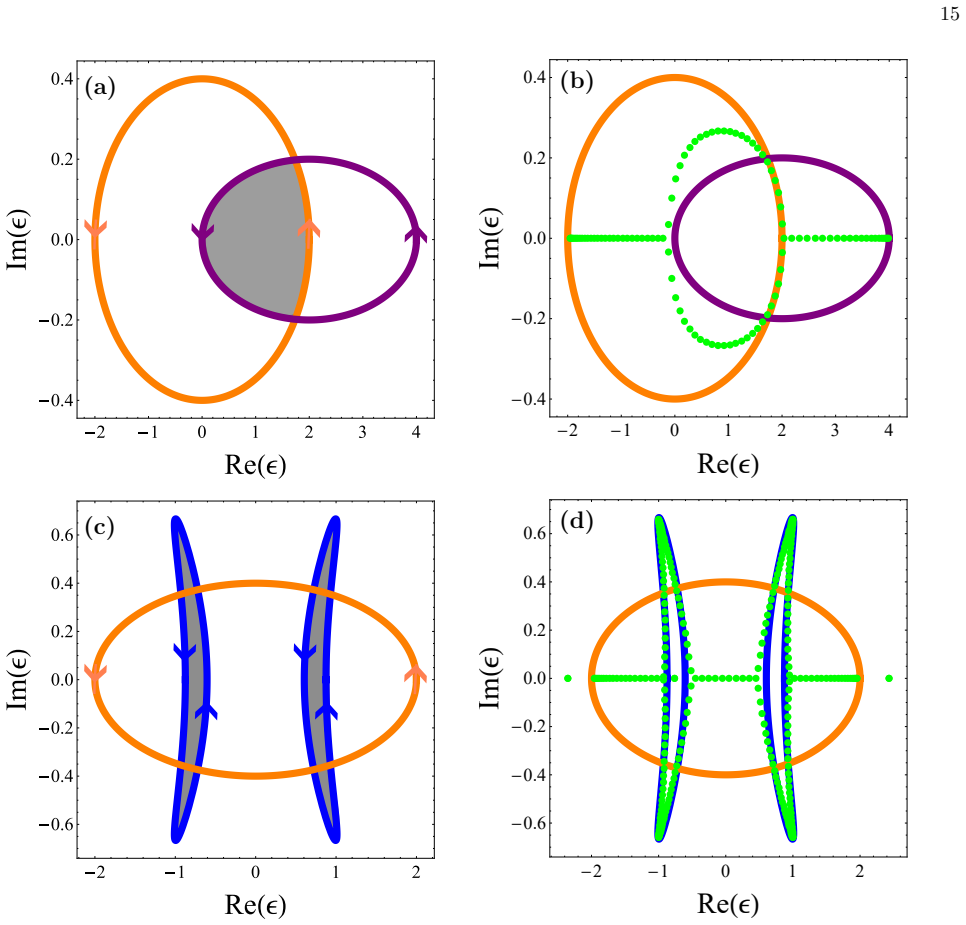
By introducing conditional boundary conditions for non-Hermitian quantum systems, a winding-control mechanism is established that selectively collapses specific periodic boundary condition loop-type spectra onto their open boundary condition counterparts, guided by their winding numbers, accompanied by a composite reconstruction of the Brillouin zone and generalized Brillouin zone.
What carries the argument
Conditional boundary conditions (CBCs), which serve as transition boundaries between different non-Hermitian topologies of spectral windings, tied to residual imaginary velocity from the Fermi sea.
If this is right
- The eigenstates exhibit nontrivial skin effects or extended behaviors due to the interplay between Brillouin zone and generalized Brillouin zone structures.
- The control can be generalized by incorporating similarity transformations and holomorphic mappings with the boundary controls.
- The mechanism enriches understanding of non-Hermitian physics across spectrum, topology, and bulk-boundary correspondence.
- Specific models demonstrate the winding control numerically.
Where Pith is reading between the lines
- This approach could be extended to other types of boundary conditions in different non-Hermitian models to predict new topological phases.
- Connecting the imaginary velocity concept might allow similar controls in classical wave systems or photonic structures.
- Further exploration could test whether this control affects transport properties or response functions in these systems.
Load-bearing premise
The residual imaginary velocity from the corresponding Fermi sea directly sets up the conditional boundary conditions as the transition boundaries for different spectral winding topologies.
What would settle it
A numerical calculation in a specific non-Hermitian model where applying the conditional boundary conditions does not result in the predicted selective collapse of spectra according to their winding numbers.
Figures


read the original abstract
Non-Hermitian quantum systems exhibit various interesting and inter-connected spectral, topological, and boundary-sensitive features. By introducing conditional boundary conditions (CBCs) for non-Hermitian quantum systems, we explore a winding-control mechanism that selectively collapses specific periodic boundary condition (PBC) loop-type spectra onto their open boundary condition (OBC) counterparts, guided by their specific winding numbers, together with a composite reconstruction of the Brillouin zone (BZ) and generalized Brillouin zone (GBZ). The corresponding eigenstates also manifest nontrivial skin effects or extended behaviors arising from the interplay between BZ and GBZ structures. Intuitively, the winding-control mechanism is tied to the residual imaginary velocity originating from the corresponding Fermi sea, establishing the CBCs as the transition boundaries between different non-Hermitian topology of spectral windings. Furthermore, we can generalize our control by incorporating similarity transformations and holomorphic mappings with the boundary controls. We demonstrate the winding control numerically within various models, which enriches our knowledge of non-Hermitian physics across the spectrum, topology, and bulk-boundary correspondence.
Editorial analysis
A structured set of objections, weighed in public.
Referee Report
Summary. The manuscript introduces conditional boundary conditions (CBCs) for non-Hermitian quantum systems and proposes a winding-control mechanism that selectively collapses specific PBC loop-type spectra onto their OBC counterparts, guided by winding numbers, together with a composite reconstruction of the Brillouin zone (BZ) and generalized Brillouin zone (GBZ). Eigenstates exhibit nontrivial skin effects or extended behaviors arising from the BZ-GBZ interplay. The mechanism is intuitively linked to residual imaginary velocity from the Fermi sea, which is said to establish CBCs as transition boundaries between different non-Hermitian spectral winding topologies. Generalizations via similarity transformations and holomorphic mappings are discussed, with numerical demonstrations provided in various models.
Significance. If the proposed mechanism can be placed on a firmer first-principles footing, the work would enrich the understanding of non-Hermitian bulk-boundary correspondence by offering a controllable link between winding numbers, boundary conditions, and spectral topology. The numerical demonstrations across multiple models constitute a concrete strength, illustrating the interplay between BZ and GBZ structures and the resulting skin or extended states.
major comments (2)
- [Abstract] Abstract and the central claim: the assertion that residual imaginary velocity from the Fermi sea directly establishes CBCs as the transition boundaries between distinct non-Hermitian winding topologies is presented without an explicit derivation or model-independent argument showing how the velocity condition enforces selective collapse exactly according to winding number. The manuscript therefore relies on numerical verification in selected models rather than a general justification, leaving the first-principles status of the winding-control mechanism unclear.
- [Numerical demonstrations] Numerical demonstrations section: while demonstrations are reported in various models, no error analysis, convergence tests with respect to system size, or explicit mapping from computed winding numbers to the observed CBC-induced spectral collapses is provided. This weakens the ability to assess whether the selectivity holds robustly or is an artifact of the chosen examples.
Simulated Author's Rebuttal
We thank the referee for the careful reading of our manuscript and the constructive comments. We address the two major comments point by point below. Where the comments identify areas that would benefit from additional clarification or supporting analysis, we have revised the manuscript accordingly.
read point-by-point responses
-
Referee: [Abstract] Abstract and the central claim: the assertion that residual imaginary velocity from the Fermi sea directly establishes CBCs as the transition boundaries between distinct non-Hermitian winding topologies is presented without an explicit derivation or model-independent argument showing how the velocity condition enforces selective collapse exactly according to winding number. The manuscript therefore relies on numerical verification in selected models rather than a general justification, leaving the first-principles status of the winding-control mechanism unclear.
Authors: The manuscript develops the winding-control mechanism through the definition of conditional boundary conditions and their action on the loop spectra, with the residual imaginary velocity introduced as an intuitive link to the Fermi-sea contribution. We agree that the abstract states this connection concisely and that a more explicit, model-independent derivation would strengthen the first-principles grounding. In the revised manuscript we add a dedicated subsection that derives the velocity condition from the non-Hermitian dispersion relation and shows how it enforces selective collapse according to the winding number, using the properties of the generalized Brillouin zone reconstruction. revision: yes
-
Referee: [Numerical demonstrations] Numerical demonstrations section: while demonstrations are reported in various models, no error analysis, convergence tests with respect to system size, or explicit mapping from computed winding numbers to the observed CBC-induced spectral collapses is provided. This weakens the ability to assess whether the selectivity holds robustly or is an artifact of the chosen examples.
Authors: The numerical examples were selected to demonstrate the mechanism across representative non-Hermitian models, with system sizes chosen to reveal the qualitative skin-effect and spectral-collapse features. We acknowledge that explicit error analysis, finite-size convergence tests, and direct mappings from winding numbers to the observed collapses were not included. The revised manuscript adds these elements: finite-size scaling of the spectra, convergence of the computed winding numbers with system size, and explicit correspondence tables linking each winding number to the subset of loops that collapse under the conditional boundary conditions. revision: yes
Circularity Check
No significant circularity; derivation remains independent of its outputs
full rationale
The paper introduces CBCs as a new construct and links the winding-control mechanism intuitively to residual imaginary velocity from the Fermi sea, while treating winding numbers as given topological invariants. Claims are supported by numerical demonstrations across models and generalizations via similarity transformations and holomorphic mappings. No equations, definitions, or steps in the provided text reduce any prediction or result to the inputs by construction, nor do they rely on fitted parameters renamed as predictions, self-citation chains, or ansatzes smuggled from prior work. The central mechanism is presented as an exploratory construction rather than a self-referential fit, rendering the derivation chain self-contained against external benchmarks.
Axiom & Free-Parameter Ledger
axioms (2)
- domain assumption Winding numbers of non-Hermitian spectra remain invariant under the introduction of conditional boundary conditions.
- ad hoc to paper The residual imaginary velocity from the Fermi sea provides the physical mechanism that makes CBCs act as topological transition boundaries.
invented entities (1)
-
Conditional boundary conditions (CBCs)
no independent evidence
Forward citations
Cited by 1 Pith paper
-
$\mathbb{Z}_{2}$ Skin Channels and Effective Dynamical Quantum Phase Transitions
Z2 skin channels in non-Hermitian systems with ATRS exhibit circulations that imply quantum revivals and scale-dependent effective DQPTs distinct from conventional ones.
Reference graph
Works this paper leans on
-
[1]
A. Yuto, G. Zongping, and U. Masahito, Advances in Physics 69, 249 (2020)
work page 2020
-
[2]
E. J. Bergholtz, J. C. Budich, and F. K. Kunst, Rev. Mod. Phys. 93, 015005 (2021)
work page 2021
-
[3]
T. E. Lee, Phys. Rev. Lett. 116, 133903 (2016)
work page 2016
- [4]
-
[5]
V. M. Martinez Alvarez, J. E. Barrios Vargas, and L. E. F. Foa Torres, Phys. Rev. B 97, 121401 (2018)
work page 2018
-
[6]
H. Shen, B. Zhen, and L. Fu, Phys. Rev. Lett. 120, 146402 (2018)
work page 2018
-
[7]
Z. Gong, Y. Ashida, K. Kawabata, K. Takasan, S. Hi- gashikawa, and M. Ueda, Phys. Rev. X 8, 031079 (2018)
work page 2018
-
[8]
K. Kawabata, K. Shiozaki, M. Ueda, and M. Sato, Phys. Rev. X 9, 041015 (2019)
work page 2019
-
[9]
F. K. Kunst, E. Edvardsson, J. C. Budich, and E. J. Bergholtz, Phys. Rev. Lett. 121, 026808 (2018)
work page 2018
- [10]
-
[11]
S. Yao, F. Song, and Z. Wang, Phys. Rev. Lett. 121, 136802 (2018)
work page 2018
- [12]
- [13]
-
[14]
D. S. Borgnia, A. J. Kruchkov, and R.-J. Slager, Phys. Rev. Lett. 124, 056802 (2020)
work page 2020
-
[15]
Z. Yang, K. Zhang, C. Fang, and J. Hu, Phys. Rev. Lett. 125, 226402 (2020)
work page 2020
- [16]
-
[17]
H.-Y. Wang, F. Song, and Z. Wang, Phys. Rev. X 14, 021011 (2024). 6
work page 2024
-
[18]
C. H. Lee, L. Li, and J. Gong, Phys. Rev. Lett. 123, 016805 (2019)
work page 2019
- [19]
-
[20]
R. Okugawa, R. Takahashi, and K. Yokomizo, Phys. Rev. B 102, 241202 (2020)
work page 2020
-
[21]
Y. Fu, J. Hu, and S. Wan, Phys. Rev. B 103, 045420 (2021)
work page 2021
- [22]
-
[23]
Y. Li, X. Ji, Y. Chen, X. Yan, and X. Yang, Phys. Rev. B 106, 195425 (2022)
work page 2022
- [24]
-
[25]
X. Ji, H. Geng, N. Akhtar, and X. Yang, Phys. Rev. B 111, 195419 (2025)
work page 2025
-
[26]
F. Song, S. Yao, and Z. Wang, Phys. Rev. Lett. 123, 170401 (2019)
work page 2019
- [27]
- [28]
-
[29]
A. G´ omez-Le´ on, T. Ramos, A. Gonz´ alez-Tudela, and D. Porras, Phys. Rev. A 106, L011501 (2022)
work page 2022
- [30]
-
[31]
A. Guo, G. J. Salamo, D. Duchesne, R. Morandotti, M. Volatier-Ravat, V. Aimez, G. A. Siviloglou, and D. N. Christodoulides, Phys. Rev. Lett. 103, 093902 (2009)
work page 2009
- [32]
-
[33]
L. Xiao, K. Wang, X. Zhan, Z. Bian, K. Kawabata, M. Ueda, W. Yi, and P. Xue, Phys. Rev. Lett. 123, 230401 (2019)
work page 2019
-
[34]
L. Xiao, T. Deng, K. Wang, G. Zhu, Z. Wang, W. Yi, and P. Xue, Nature Physics 16, 761 (2020)
work page 2020
-
[35]
L. Xiao, T. Deng, K. Wang, Z. Wang, W. Yi, and P. Xue, Phys. Rev. Lett. 126, 230402 (2021)
work page 2021
-
[36]
L. Xiao, W.-T. Xue, F. Song, Y.-M. Hu, W. Yi, Z. Wang, and P. Xue, Phys. Rev. Lett. 133, 070801 (2024)
work page 2024
- [37]
- [38]
-
[39]
T. Hofmann, T. Helbig, F. Schindler, N. Salgo, M. Brzezi´ nska, M. Greiter, T. Kiessling, D. Wolf, A. Voll- hardt, A. Kabaˇ si, C. H. Lee, A. Biluˇ si´ c, R. Thomale, and T. Neupert, Phys. Rev. Res. 2, 023265 (2020)
work page 2020
- [40]
-
[41]
L. Li, C. H. Lee, and J. Gong, Communications Physics 4, 42 (2021)
work page 2021
-
[42]
M. Brandenbourger, X. Locsin, E. Lerner, and C. Coulais, Nature Communications 10, 4608 (2019)
work page 2019
- [43]
-
[44]
Y. Chen, X. Li, C. Scheibner, V. Vitelli, and G. Huang, Nature Communications 12, 5935 (2021)
work page 2021
-
[45]
W. Wang, X. Wang, and G. Ma, Nature 608, 50 (2022)
work page 2022
-
[46]
W. Wang, M. Hu, X. Wang, G. Ma, and K. Ding, Phys. Rev. Lett. 131, 207201 (2023)
work page 2023
- [47]
-
[48]
R. Hamazaki, K. Kawabata, and M. Ueda, Phys. Rev. Lett. 123, 090603 (2019)
work page 2019
-
[49]
L.-Z. Tang, L.-F. Zhang, G.-Q. Zhang, and D.-W. Zhang, Phys. Rev. A 101, 063612 (2020)
work page 2020
-
[50]
S. Schiffer, X.-J. Liu, H. Hu, and J. Wang, Phys. Rev. A 103, L011302 (2021)
work page 2021
-
[51]
Y. Liu, Q. Zhou, and S. Chen, Phys. Rev. B 104, 024201 (2021)
work page 2021
- [52]
- [53]
-
[54]
E. Lee, H. Lee, and B.-J. Yang, Phys. Rev. B101, 121109 (2020)
work page 2020
-
[55]
S. Mu, C. H. Lee, L. Li, and J. Gong, Phys. Rev. B 102, 081115 (2020)
work page 2020
-
[56]
P.-Y. Chang, J.-S. You, X. Wen, and S. Ryu, Phys. Rev. Res. 2, 033069 (2020)
work page 2020
- [57]
- [58]
-
[59]
N. Matsumoto, K. Kawabata, Y. Ashida, S. Furukawa, and M. Ueda, Phys. Rev. Lett. 125, 260601 (2020)
work page 2020
-
[60]
F. Alsallom, L. Herviou, O. V. Yazyev, and M. Brzezi´ nska, Phys. Rev. Res.4, 033122 (2022)
work page 2022
- [61]
-
[62]
T. Haga, M. Nakagawa, R. Hamazaki, and M. Ueda, Phys. Rev. Lett. 127, 070402 (2021)
work page 2021
-
[63]
F. Yang, Q.-D. Jiang, and E. J. Bergholtz, Phys. Rev. Res. 4, 023160 (2022)
work page 2022
-
[64]
S. Guo, C. Dong, F. Zhang, J. Hu, and Z. Yang, Phys. Rev. A 106, L061302 (2022)
work page 2022
- [65]
- [66]
-
[67]
R. Shen, F. Qin, J.-Y. Desaules, Z. Papi´ c, and C. H. Lee, Phys. Rev. Lett. 133, 216601 (2024)
work page 2024
-
[68]
J. Gliozzi, G. De Tomasi, and T. L. Hughes, Phys. Rev. Lett. 133, 136503 (2024)
work page 2024
- [69]
-
[70]
J. Gliozzi, F. Balducci, T. L. Hughes, and G. D. Tomasi, Non-hermitian multipole skin effects challenge localiza- tion (2025), arXiv:2504.10580 [cond-mat.dis-nn]
- [71]
-
[72]
P. Molignini, O. Arandes, and E. J. Bergholtz, Phys. Rev. Res. 5, 033058 (2023)
work page 2023
-
[73]
C.-X. Guo, X. Wang, H. Hu, and S. Chen, Phys. Rev. B 107, 134121 (2023)
work page 2023
- [74]
- [75]
-
[76]
Throughout the paper, we adopt a unified notation convention for the Hamiltonians. The symbol with a hat, ˆH, explicitly denotes the Hamiltonian operator in the second-quantized formalism. In contrast, the sym- bol without a hat, H, refers to the Hamiltonian matrix under OBCs, with boundary hoppings excluded. Mean- while, H(z) represents the so-called non...
-
[77]
This filling convention can be generalized to filled (empty) states with Re( eiθϵ) < µ [Re(eiθϵ) > µ ] via a mapping ˆH ′ = ˆHe iθ − µ ˆN, where ˆN is the fermion num- ber operator, e.g., the Fermi sea Im( ϵ) > 0 in terms of long-time steady-state dynamics [53]
-
[78]
Multiple bands, if exist, need to be summered over
-
[79]
S.-X. Hu, Y. Fu, and Y. Zhang, Phys. Rev. B108, 245114 (2023)
work page 2023
-
[80]
See the supplementary materials for further details
discussion (0)
Sign in with ORCID, Apple, or X to comment. Anyone can read and Pith papers without signing in.