REVIEW 3 major objections 6 minor 65 references
Soft and semihard components of multiplicity distributions in the $k_T$ factorization approach
T0 review · 3 major / 6 minor · reviewed 2026-08-15 · deepseek-v4-flash
Pith's one-line read The two components of LHC multiplicity distributions are soft and semihard gluon multiplicities computed from kT factorization, split by a 1.4 GeV momentum cutoff.
desk verdict A good idea—kT factorization to fix the two NBD means—undone by a truncation inconsistency that makes the extracted alpha and k_total trends unreliable. read the letter →
The pith
A machine-rendered reading of the paper's core claim, the machinery that carries it, and where it could break.
The reading
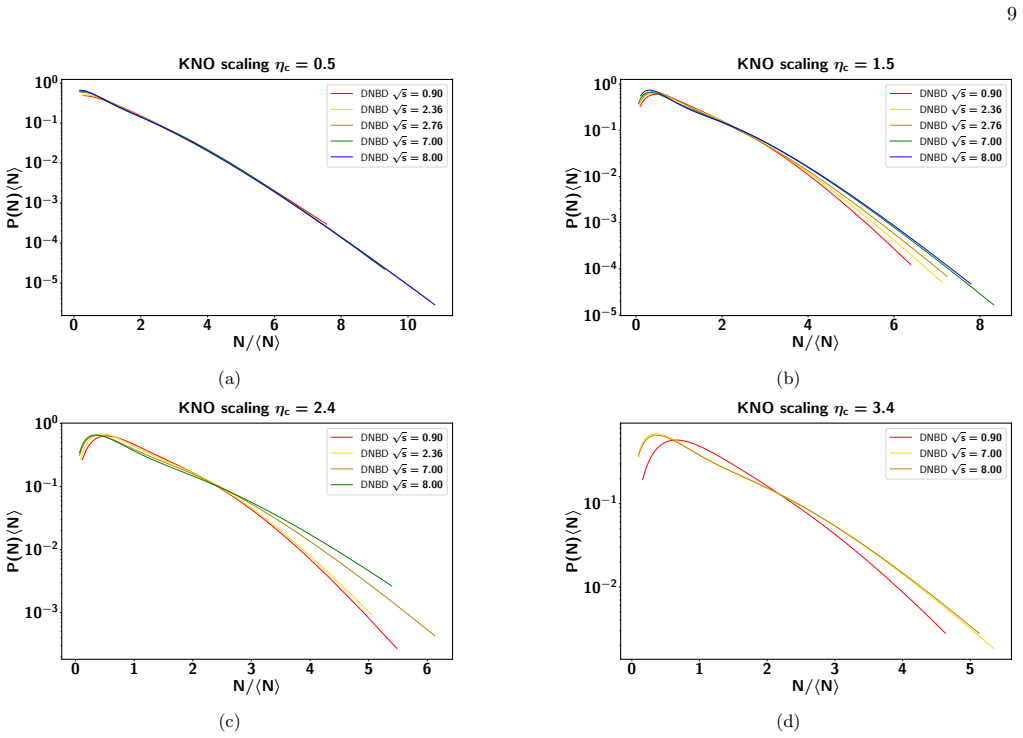
What carries the argument
The load-bearing object is the kT-factorization gluon production formula (10), with a dipole-model unintegrated gluon distribution supplying the gluon densities, and the separation scale Lambda inserted as a cutoff on the transverse momentum integral that splits the total mean multiplicity into Ns and Nsh. The identity that carries the argument is Eq. (19), which identifies the DNBD combinations lambda alpha <n>s and lambda(1 - alpha)<n>sh with the computed Ns and Nsh; this is what reduces the fit from six to four parameters and ties every extracted trend (alpha, ks, ksh, and ktotal) to a QCD calculation. The combined parameter ktotal, defined in Eq. (25) through the DNBD variance, is the diagnostic for KNO scaling: KNO holds when ktotal is independent of collision energy.
What would settle it
Repeat the calculation of Ns and Nsh from Eq. (10) with a different unintegrated gluon distribution, or with the cutoff moved from 1.4 GeV to, say, 1.0 or 2.0 GeV, and refit the same multiplicity data. If the extracted trends, particularly alpha falling with energy and ktotal remaining constant only for |eta| < 1.0, shift by more than the quoted uncertainties, then the physical meaning assigned to the DNBD components is not stable enough to support the conclusions.
Extended reading notes
Core claim
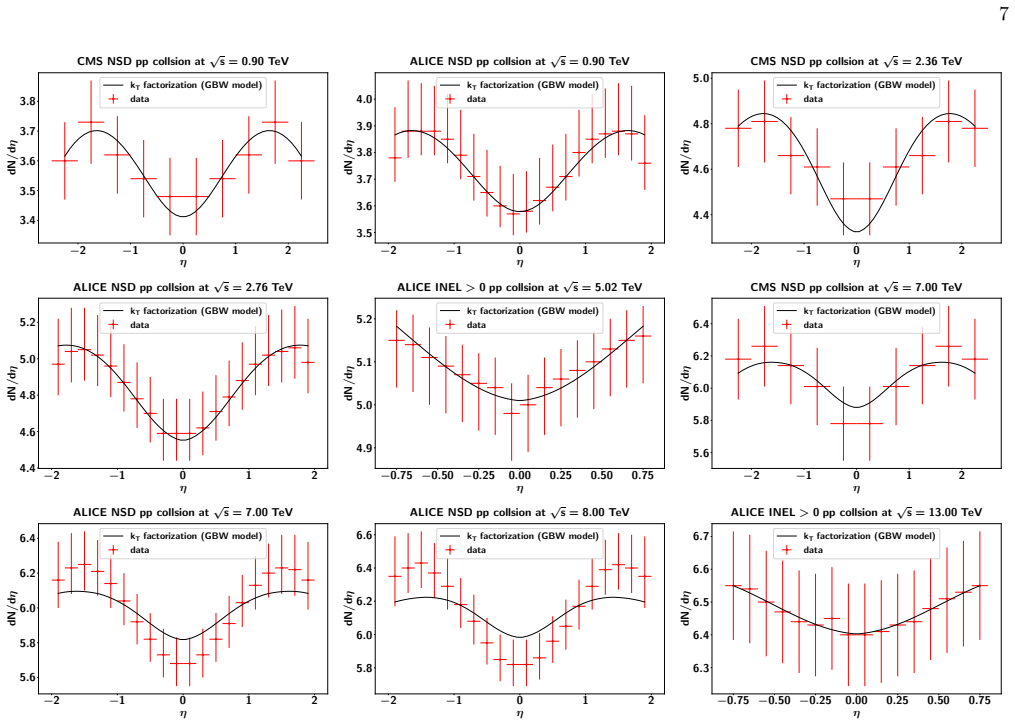
On the paper's own terms: the mean multiplicities of the two negative binomial components used in double-NBD fits to LHC multiplicity distributions are not free phenomenological inputs. They are the soft and semihard gluon multiplicities obtained from the kT-factorization expression (10), in which the integral over the produced gluon's transverse momentum is cut at Lambda = 1.4 GeV. Equation (19), together with parton-hadron duality, then tells the fit that lambda alpha <n>s = Ns and lambda(1 - alpha)<n>sh = Nsh, where Ns and Nsh are computed. With these constraints, the remaining four parameters (lambda, alpha, ks, ksh) fit the measured distributions, and the extracted energy dependence shows a clear boundary: for |eta| < 1.0 the parameters ks, ksh and the combined ktotal are energy-independent and KNO scaling holds; for wider windows they fall with energy and KNO scaling is violated. The paper concludes that the previously used components n1 and n2 are actually soft and semihard multiplicities, that they approximately satisfy <nsh> ~ 3<ns>, and that the violation of KNO scaling is not tied to the soft-event fraction alpha but to the rapidity-window dependence of Ns, Nsh, ks, and ksh.
Load-bearing premise
The whole argument rests on assuming each computed gluon becomes one final hadron and that the cutoff at 1.4 GeV is the true soft/semihard boundary; if either is wrong, the fitted parameters do not have the physical meaning claimed.
Editorial extensions
If this is right
- The two components n1 and n2 in double negative binomial fits are identified as soft and semihard mean multiplicities that can be computed from a kT-factorization calculation, giving a physical meaning to a formerly empirical decomposition.
- The constrained fit uses four free parameters instead of six and still reproduces the LHC multiplicity distributions from 0.9 TeV to 13 TeV with low chi2/dof values.
- The soft-event fraction alpha decreases with collision energy in every pseudorapidity window, so the growth of semihard events alone does not explain KNO violation; the violation instead comes from the energy and window dependence of the soft/semihard mean multiplicities and NBD parameters.
- KNO scaling of the total multiplicity holds precisely when ktotal is energy-independent, which the fit finds only for |eta| < 1.0; in those windows ks and ksh are also energy-independent.
- The energy trends of ks and ksh do not match any of the three scenarios proposed by earlier two-component studies, indicating a change of dynamics between narrow central windows and wide pseudorapidity windows.
Reading between the lines
- If the identification is right, the separation scale Lambda becomes a physical parameter: one should be able to locate it independently from the transverse momentum at which final-state hadron production switches from a non-perturbative to a perturbative signature, rather than fixing it at 1.4 GeV by hand.
- A direct test would be to repeat the calculation with other unintegrated gluon distributions and see whether the predicted Ns and Nsh, and thus the fitted alpha and ktotal trends, remain within the quoted errors; if the boundary at |eta| ~ 1.0 moves with the choice of gluon distribution, the boundary is not a property of the data.
- Because alpha falls with energy while KNO violation appears only in wide windows, one could check the predicted semihard fraction against an independent observable such as the rate of mini-jets or the transverse-momentum spectrum; these should track the computed Nsh/(Ns+Nsh) rather than the fitted alpha.
Signed reviews
Editorial analysis
A structured set of objections, weighed in public.
Referee Report
Summary. The paper proposes to separate soft and semihard particle production in pp collisions using the kT factorization formalism with a transverse momentum cutoff Lambda = 1.4 GeV. The computed average multiplicities Ns and Nsh are then inserted as constraints, via Eq. (19), into a double negative binomial (DNBD) fit of LHC multiplicity distributions, reducing the number of free parameters from six to four. From the resulting fits, the authors extract the energy dependence of the soft fraction alpha, the NBD parameters ks and ksh, and the combination ktotal. They conclude that KNO scaling of the total multiplicity distribution holds only for |eta| < 1.0, where ktotal is energy independent, and that alpha decreases with energy in all pseudorapidity windows.
Significance. If the central identification is valid, the paper gives a physical interpretation to the two NBD components of the empirically successful DNBD model and connects parton-level kT-factorization calculations to measured multiplicity distributions. The algebraic derivations in Sections III and IV are internally consistent, and the reported fits are of high quality, with the claim of parameter reduction from six to four being a concrete and falsifiable proposition. However, the main physical conclusions rest on untested assumptions and on a constraint whose consistency with the actual fitting procedure is questionable; the significance of the results is therefore conditional on resolving these issues.
major comments (3)
- [Section III, Eq. (19)] The constraint (19) is derived from Eq. (18), which is the mean of the full DNBD expression summed over all n. However, the fits explicitly remove the first few multiplicity bins, stating that they cannot be reproduced by any NBD. For a truncated fit, the mean of the fitted distribution over the fitted range is not <n> = lambda[alpha<n>_s + (1-alpha)<n>_sh]; the excluded bins carry positive multiplicity, and lambda only rescales the total probability. Table II reports lambda values between 0.851 and 1.083, so the model is not normalized over all n. Consequently, equating N = <n> in Eq. (19) imposes constraints that are inconsistent with the truncated likelihood actually fitted. The extracted alpha, ks, ksh, and ktotal are therefore not determined by a self-consistent procedure, and the central claim that the kT-factorization multiplicities give physical meaning to the NBD components is not established. The manuscript also does not specify which bins are excluded for each data set, so the fits are not reproducible.
- [Section V, Lambda = 1.4 GeV] The separation scale Lambda = 1.4 GeV is fixed by hand, with no sensitivity scan. Because Ns and Nsh enter directly into Eq. (19), all extracted parameters and the conclusion that ktotal is constant only for |eta| < 1.0 depend on this choice. The authors cite [37] for the value, but do not demonstrate that the qualitative conclusions are stable under variations of Lambda in a reasonable range (for example, 1.0 to 2.0 GeV). A sensitivity scan is needed to establish that the reported trends are physical rather than artifacts of the cutoff.
- [Section II, parton-hadron duality] The identification of the computed gluon multiplicities with the mean multiplicities of the two NBD components of final charged hadrons is assumed in Section II ('we shall assume here that the number of produced partons is equal to the number of hadrons'). This assumption is load-bearing for Eq. (19). The cited test [27] concerns hadron multiplicities within jets, not inclusive pp collisions, and no quantitative uncertainty is assigned to the parton-hadron duality assumption. Without a dedicated justification or an estimated hadronization correction, the constraints in Eq. (19) inherit an unquantified systematic error that propagates into all physical conclusions.
minor comments (6)
- [Abstract] The phrase 'can be well understood with in perturbative QCD' contains a typo; it should read 'within perturbative QCD'.
- [Section I] In the first sentence, 'one the observables' should be 'one of the observables'.
- [Figure 1 and Figure 4 captions] There are typos in the captions: 'collsion' should be 'collision', and in Fig. 4 'refet' should be 'refer'.
- [Table II and Section V] The reported chi2/dof values are extremely low, with several below 0.1 (e.g., 0.040 and 0.057). The authors should comment on whether the experimental uncertainties include correlated systematics and whether such low values indicate that the uncertainties are overestimated or that the model is overfitting.
- [Section V and Table II] The 5.02 and 13 TeV data are INEL > 0 while the other data are NSD, yet the model does not distinguish event classes. The authors note the resulting break in trend, but a more explicit discussion of the possible systematic effect of mixing event classes would be useful.
- [Reference [18]] The formatting of reference [18] is inconsistent with the other references; please standardize it.
Circularity Check
No significant circularity: the kT-factorization multiplicities are used as input constraints for the DNBD fit, and the extracted parameters are genuine outputs.
full rationale
The paper's derivation chain is not circular. The kT-factorization expression (10) with the fitted normalization K/S is used to compute the soft and semihard gluon multiplicities Ns and Nsh, which are then imposed as constraints through Eq. (19) on the double-NBD fit. The fitted parameters alpha, lambda, ks, ksh, and the derived ktotal are outputs of that constrained fit, not inputs used to construct Ns and Nsh. Eq. (19) is an identification/constraint, not a hidden restatement of the fit results: it fixes the NBD component means in terms of the theoretically computed multiplicities and the fitted alpha and lambda. The identification of the two NBD components with soft and semihard processes relies on the stated parton-hadron duality assumption, which is model dependence rather than circular reasoning. Self-citations, such as refs. [25] and [33], are used for context or for a secondary KNO relation and are not load-bearing for the central claim. The removal of the first few multiplicity bins does create a normalization tension between the full-distribution mean in Eq. (18) and the truncated fit, as the paper itself acknowledges by introducing lambda, but this is an internal-consistency and model-validation concern, not a reduction of a prediction to its own input. No quoted equation equates a claimed prediction with a fitted value, and no load-bearing self-citation chain forces the conclusions. Therefore the paper receives a circularity score of 0.
Assumptions & free parameters
free parameters (6)
- K/S normalization =
0.0888 to 0.1015 GeV^2 (Table I)
- Cutoff Lambda =
1.4 GeV (chosen, not fitted)
- alpha (soft fraction) =
about 0.57 to 0.73 (Table II)
- lambda =
about 0.85 to 1.08 (Table II)
- ks =
about 1.6 to 3.4 (Table II)
- ksh =
about 3.1 to 7.3 (Table II)
assumptions (9)
- domain assumption kT factorization formula Eq. (1) for inclusive gluon production from CGC
- domain assumption GBW unintegrated gluon distribution Eq. (5) with parameters Q0=0.6 GeV, x0=0.01, lambda_bar=0.205, sigma0=23 mb from Ref. [19]
- standard math One-loop running coupling frozen at 0.52 with Lambda_QCD=0.226 GeV, Eq. (7)
- domain assumption Pseudo-rapidity transformation Eq. (11) with mu(sqrt(s)) from Eq. (12) (Ref. [26])
- ad hoc to paper Parton-hadron duality: number of produced gluons equals number of final hadrons
- ad hoc to paper Separation scale Lambda=1.4 GeV defines soft versus semihard
- ad hoc to paper First few multiplicity bins are excluded and a normalization lambda is introduced
- ad hoc to paper The NBD component means are constrained by Eq. (19): lambda*alpha*<n>s = Ns and lambda*(1-alpha)*<n>sh = Nsh
- standard math KNO scaling algebra: omega = 1 + <n>/ktotal and 1/ktotal from Eq. (25)
Cite this review
Pith. "Pith review of Soft and semihard components of multiplicity distributions in the $k_T$ factorization approach." pith.science (2026). https://pith.science/paper/NGFXK4BD
@misc{pith2026250617127,
  author       = {Pith},
  title        = {Pith review of: Soft and semihard components of multiplicity distributions in the $k_T$ factorization approach},
  year         = {2026},
  howpublished = {\url{https://pith.science/paper/NGFXK4BD}},
  note         = {Machine review of arXiv:2506.17127}
}
abstract
Particle production in hadronic collisions can be studied in the low-momentum (soft) and high-momentum (hard) transfer regimes. While the latter can be well understood with in perturbative QCD the former contains non-perturbative effects which cannot be calculated from first principles. There is also an intermediate regime called semihard, in which the momentum transfer runs typically from $~1$ to $~10$ GeV. As the hadron-hadron collision energy increases, we expect to see a relative growth of the number of semihard events. It has been conjectured that this growth would be the cause of some changes observed in the multiplicity distributions measured in proton - proton collisions. In this note we revisit the separation between soft and semihard events using the formalism of $k_T$ factorization. The separation is implemented through the introduction of a scale that is the cutoff $\Lambda$ in the transverse momentum of the produced gluon and allows us to compute the average number of particles produced in each regime. These numbers are used as input in the double negative binomial fit of data, from which we can extract correlations between the fraction of semihard events and the violation of KNO scaling.
Figures

Figures from the paper (1 more)

Reference graph
Works this paper leans on
-
[37]
7.00 0.920± 0.0320.610± 0.012 3.376± 0.182 11.214± 0.711 5.915± 0.075 2.192± 0.4443.788± 0.2321.117± 0.235 0.102
-
[27]
Y. V. Kovchegov and E. Levin, Camb. Monogr. Part. Phys. Nucl. Phys. Cosmol. 33, 1 (2012), Oxford Univer- sity Press, 2013, ISBN 978-1-009-29144-6, 978-1-009-29141-5, 978-1-009-29142-2, 978-0-521-11257-4, 978-1-139-55768-9, doi:10.1017/9781009291446
-
[1]
Using the kT factorization formalism and introducing a separation scale in the transverse momentum we were able to properly define soft and semihard multiplicities, giving a physical meaning to the previously called multiplicity components n1 and n2, proposed in [28] and used in [7, 15, 29]
-
[2]
With this separation, we could perform a DNBD fit of the multiplicy distributions measured at the LHC with fewer free parameters (4 instead of 6), obtaining very good fits
-
[3]
The resulting behavior of the parameters α, ks and ksh with the collision energy is consistent (but slightly different) with those found in previous analises
-
[4]
The data used for the fits are from CMS [35, 36] and ALICE [7, 16]
13.0 0.0888 ± 0.0005 TABLE I: Values of K/S for different energies. The data used for the fits are from CMS [35, 36] and ALICE [7, 16]. To obtain the soft and semihard average multiplicities from (10) we will fix the separation scale to be Λ = 1.4 GeV. This is approximately the same number used in [37] and is in the range of usual values used to define th...
-
[5]
KNO violation is not related to changes in α and may have a dynamical origin due to changes in Ns, Nsh, ks and ksh with pseudorapidity. 9 0 2 4 6 8 10 N/⟨N⟩ 10□5 10□4 10□3 10□2 10□1 100 P(N)⟨N⟩ KNO scaling ηc = 0.5 DNBD √ s = 0.90 DNBD √ s = 2.36 DNBD √ s = 2.76 DNBD √ s = 7.00 DNBD √ s = 8.00 (a) 0 2 4 6 8 N/⟨N⟩ 10□5 10□4 10□3 10□2 10□1 100 P(N)⟨N⟩ KNO s...
-
[6]
K. Aamodt et al. [ALICE], Eur. Phys. J. C 68, 89 (2010); [arXiv:1004.3034 [hep-ex]]
arXiv 2010
Show all 65 references
-
[7]
2.76 0.1001 ± 0.0012
-
[8]
Furthermore, within the same pseudorapidity window, KNO scaling is also satisfied for the soft and semihard components; that is, ks and ksh are also energy independent
KNO scaling occurs for the total MD when ktotal is independent of the√s and this happens only for |η|< 1.0. Furthermore, within the same pseudorapidity window, KNO scaling is also satisfied for the soft and semihard components; that is, ks and ksh are also energy independent
-
[9]
G. N. Fowler, E. M. Friedlander, R. M. Weiner and G. Wilk, Phys. Rev. Lett. 57, 2119 (1986); [erratum: Phys. Rev. Lett. 57, 3124 (1986)]. 10 0 1 2 3 4 5 6 7 8 9 10 11 12 13√ s (TeV) 0.6 0.7 0.8 0.9 1.0 1.1 1.2α α vs √ s for all ηc |η|< 0.5 × 1 |η|< 0.8 × 1.1 |η|< 1.0 × 1.2 |η|...
1986
-
[10]
J. F. Grosse-Oetringhaus and K. Reygers, J. Phys. G 37, 083001 (2010); [arXiv:0912.0023 [hep-ex]]
2010 arXiv
-
[11]
Y. L. Dokshitzer and B. R. Webber, [arXiv:2505.00652 [hep-ph]]
-
[12]
Gelis, E
F. Gelis, E. Iancu, J. Jalilian-Marian and R. Venugopalan, Ann. Rev. Nucl. Part. Sci. 60, 463 (2010); [arXiv:1002.0333 [hep-ph]]
2010 arXiv
-
[13]
Sjostrand, S
T. Sjostrand, S. Mrenna and P. Z. Skands, JHEP 05, 026 (2006); [arXiv:hep-ph/0603175 [hep-ph]]
2006 arXiv
-
[14]
Bierlich, S
C. Bierlich, S. Chakraborty, G. Gustafson and L. L¨ onnblad, JHEP 03, 270 (2021); [arXiv:2010.07595 [hep-ph]]
2021 arXiv
-
[15]
Acharya et al
S. Acharya et al. [ALICE], Phys. Lett. B 845, 138110 (2023); [arXiv:2211.15326 [nucl-ex]]
2023 arXiv
-
[16]
5.02 0.0929 ± 0.0005
-
[17]
Adam et al
J. Adam et al. [ALICE], Eur. Phys. J. C 77, 33 (2017); [arXiv:1509.07541 [nucl-ex]]
2017 arXiv
-
[18]
G. N. Fowler, F. S. Navarra, M. Plumer, A. Vourdas, R. M. Weiner and G. Wilk, Phys. Rev. C 40, 1219 (1989)
1989
-
[19]
Giovannini and R
A. Giovannini and R. Ugoccioni, Phys. Rev. D 59, 094020 (1999); [erratum: Phys. Rev. D 69, 059903 (2004)] [arXiv:hep- ph/9810446 [hep-ph]]
1999
- [20]
-
[21]
Zborovsk´ y, Eur
I. Zborovsk´ y, Eur. Phys. J. C78, 816 (2018); [arXiv:1811.11230 [hep-ph]]
2018 arXiv
-
[22]
Giovannini and R
A. Giovannini and R. Ugoccioni, Int. J. Mod. Phys. A 20, 3897 (2005); [arXiv:hep-ph/0405251 [hep-ph]]
2005 arXiv
-
[23]
Z. Koba, H. B. Nielsen and P. Olesen, Nucl. Phys. B 40, 317-334 (1972)
1972
-
[24]
Henkels, E
C. Henkels, E. G. de Oliveira, R. Pasechnik and H. Trebien, Nucl. Phys. A 1055, 123018 (2025); [arXiv:2310.06965 [hep-ph]]
2025 arXiv
-
[25]
Acharya et al
S. Acharya et al. [ALICE], Phys. Rev. D 108, 072008 (2023); [arXiv:2211.15364 [nucl-ex]]
2023 arXiv
-
[26]
L. v. Gribov, E. m. Levin and M. g. Ryskin, Phys. Lett. B 121, 65 (1983)
1983
-
[28]
H. M. Wang, J. F. Liu, Z. Y. Hou and X. J. Sun, Chin. Phys. C 37, 084101 (2013); [arXiv:1305.5106 [nucl-th]]
2013 arXiv
-
[29]
Kharzeev, E
D. Kharzeev, E. Levin and M. Nardi, Nucl. Phys. A 747, 609 (2005); [arXiv:hep-ph/0408050 [hep-ph]]
2005 arXiv
-
[30]
K. J. Golec-Biernat and M. Wusthoff, Phys. Rev. D 59, 014017 (1998); [arXiv:hep-ph/9807513 [hep-ph]]
1998 arXiv
-
[31]
Golec-Biernat and S
K. Golec-Biernat and S. Sapeta, JHEP 03, 102 (2018), [arXiv:1711.11360 [hep-ph]]
2018 arXiv
-
[32]
L. S. Moriggi, G. M. Peccini and M. V. T. Machado, Phys. Rev. D 102, 034016 (2020); [arXiv:2005.07760 [hep-ph]]
2020 arXiv
-
[33]
G. R. Germano and F. S. Navarra, Phys. Rev. D 105, 014005 (2022); [arXiv:2110.12028 [hep-ph]]
2022 arXiv
-
[34]
Carvalho, F
F. Carvalho, F. O. Duraes, V. P. Goncalves and F. S. Navarra, Mod. Phys. Lett. A 23, 2847 (2008). 11 ηc data√s (TeV) λ α ⟨n⟩s ⟨n⟩sh ⟨n⟩ ks ksh ktotal χ2/dof 0.5
2008
-
[35]
2.36 0.0993 ± 0.0011
-
[36]
2.76 0.936± 0.0110.661± 0.010 3.028± 0.065 8.599± 0.273 4.599± 0.057 2.061± 0.3363.770± 0.2791.249± 0.168 0.057
-
[38]
8.00 0.955± 0.0090.594± 0.008 3.270± 0.055 10.733± 0.219 6.018± 0.049 1.882± 0.2633.344± 0.1521.164± 0.108 0.106 0.8 [15] 5.02 1.072± 0.0060.640± 0.002 4.195± 0.041 13.634± 0.130 8.135± 0.052 1.890± 0.0543.652± 0.0541.519± 0.073 0.615 13.00 1.083± 0.0050.584± 0.001 4.429± 0.04...
-
[39]
0.90 0.895± 0.0540.704± 0.066 2.803± 0.234 6.319± 1.270 3.437± 0.040 1.743± 0.9603.685± 2.1541.257± 1.117 0.265 2.36 0.875± 0.0390.669± 0.019 3.150± 0.182 8.719± 0.689 4.370± 0.050 2.310± 0.7864.489± 1.0991.183± 0.457 0.587
-
[40]
0.90 0.891± 0.0210.730± 0.009 5.514± 0.176 14.160± 0.680 6.987± 0.081 2.552± 0.3886.096± 0.7451.405± 0.289 0.254 2.36 0.893± 0.0230.669± 0.009 6.310± 0.227 17.494± 0.808 8.938± 0.103 2.546± 0.3865.280± 0.5151.315± 0.261 0.355
-
[41]
2.76 0.936± 0.0090.662± 0.007 6.176± 0.122 17.594± 0.442 9.393± 0.116 2.268± 0.1784.195± 0.1901.315± 0.111 0.040
1901
-
[42]
7.00 0.918± 0.0220.598± 0.008 6.994± 0.267 21.978± 0.94311.958± 0.1512.108± 0.2583.847± 0.1611.178± 0.172 0.113
-
[43]
8.00 0.947± 0.0080.600± 0.005 6.608± 0.104 22.196± 0.39212.157± 0.0982.151± 0.1293.767± 0.1091.187± 0.074 0.080 1.5
-
[44]
0.90 0.910± 0.0160.726± 0.007 8.270± 0.212 20.798± 0.79510.650± 0.1242.663± 0.2876.430± 0.6841.546± 0.243 0.143 2.36 0.925± 0.0200.662± 0.009 9.427± 0.299 25.370± 1.04413.704± 0.1582.325± 0.2955.010± 0.5781.429± 0.264 0.180
-
[45]
2.76 0.941± 0.0080.654± 0.006 9.504± 0.177 26.216± 0.59914.386± 0.1772.590± 0.1674.397± 0.2201.430± 0.121 0.100
-
[46]
7.00 0.918± 0.0180.591± 0.00710.723± 0.34732.745± 1.15318.097± 0.2282.168± 0.2113.994± 0.1391.229± 0.151 0.188
-
[47]
8.00 0.947± 0.0070.597± 0.00410.061± 0.14233.238± 0.49718.372± 0.1492.281± 0.1193.910± 0.1121.231± 0.073 0.144 2.0 [39] 0.90 0.909± 0.0150.719± 0.00611.233± 0.26927.433± 0.93914.344± 0.1672.895± 0.3006.679± 0.6961.633± 0.251 0.167 2.36 0.929± 0.0180.663± 0.00712.671± 0.35934.3...
-
[48]
8.00 0.898± 0.0050.584± 0.00414.539± 0.17545.398± 0.52624.580± 0.1992.139± 0.0653.478± 0.1161.099± 0.053 0.861 2.4 [39] 0.90 0.913± 0.0130.718± 0.00513.464± 0.29632.726± 1.00117.245± 0.2003.069± 0.2707.321± 0.6771.716± 0.228 0.180 2.36 0.934± 0.0160.660± 0.00615.252± 0.39440.8...
1992
-
[49]
8.00 0.897± 0.0070.579± 0.00517.579± 0.25553.966± 0.81829.495± 0.2392.213± 0.0893.581± 0.1791.132± 0.073 0.337 3.0 [29] 0.90 0.860± 0.0060.692± 0.00619.265± 0.30341.306± 0.99322.409± 0.2533.247± 0.1474.750± 0.4281.503± 0.126 2.322 7.00 0.912± 0.0070.592± 0.00421.332± 0.30465.4...
1951
-
[50]
3.0 0.860± 0.0060.692± 0.00619.265± 0.30341.306± 0.99322.409± 0.2533.247± 0.1474.750± 0.4281.503± 0.126 2.322 3.4 0.851± 0.0060.691± 0.00521.766± 0.32146.526± 0.95225.036± 0.2833.435± 0.1475.482± 0.4071.545± 0.113 2.656 2.36 [39] 0.5 0.875± 0.0390.669± 0.019 3.150± 0.182 8.719...
-
[51]
The data used for the fits are from CMS [39] and ALICE [7, 15, 29]
3.0 0.912± 0.0070.592± 0.00421.332± 0.30465.459± 0.96035.886± 0.2942.278± 0.1013.873± 0.1751.200± 0.080 0.281 3.4 0.916± 0.0070.587± 0.00424.058± 0.34672.604± 1.05940.405± 0.3312.310± 0.1023.998± 0.1891.250± 0.082 0.216 8.00 [7] 0.5 0.955± 0.0090.594± 0.008 3.270± 0.055 10.733...
-
[52]
Dumitru, D
A. Dumitru, D. E. Kharzeev, E. M. Levin and Y. Nara, Phys. Rev. C 85, 044920 (2012); [arXiv:1111.3031 [hep-ph]]. 12
2012 arXiv
-
[53]
X. P. Duan, L. Chen, G. L. Ma, C. A. Salgado and B. Wu, [arXiv:2503.24200 [hep-ph]]
-
[54]
Giovannini and R
A. Giovannini and R. Ugoccioni, Nucl. Phys. B Proc. Suppl. 71, 201 (1999); [arXiv:hep-ph/9710361 [hep-ph]]
1999 arXiv
-
[55]
Acharya et al
S. Acharya et al. [ALICE], Eur. Phys. J. C 77, 852 (2017); [arXiv:1708.01435 [hep-ex]]
2017 arXiv
-
[56]
V. V. Begun, M. Gazdzicki and M. I. Gorenstein, Phys. Rev. C 78, 024904 (2008); [arXiv:0804.0075 [hep-ph]]
2008 arXiv
-
[57]
Ma´ ckowiak-Paw lowskaet al
M. Ma´ ckowiak-Paw lowskaet al. [NA61/SHINE], J. Phys. Conf. Ser. 509, 012044 (2014); [arXiv:1402.0707 [hep-ex]]
2014 arXiv
-
[58]
Chandra, B
A. Chandra, B. Ali and S. Ahmad, Adv. High Energy Phys. 2019, 3905376 (2019); [arXiv:1908.00233 [nucl-th]]
2019 arXiv
-
[59]
L. S. Moriggi, F. S. Navarra and M. V. T. Machado, [arXiv:2506.09899 [hep-ph]]
-
[60]
Khachatryan et al
V. Khachatryan et al. [CMS], JHEP 02, 041 (2010); [arXiv:1002.0621 [hep-ex]]
2010 arXiv
-
[61]
Khachatryan et al
V. Khachatryan et al. [CMS], Phys. Rev. Lett. 105, 022002 (2010); [arXiv:1005.3299 [hep-ex]]
2010 arXiv
-
[62]
Broilo, D
M. Broilo, D. A. Fagundes, E. G. S. Luna and M. J. Menon, Phys. Lett. B 799, 135047 (2019); [arXiv:1904.10061 [hep-ph]]
2019 arXiv
-
[63]
T. V. Iser and E. G. S. Luna, Acta Phys. Polon. Supp. 18, 1-A42 (2025); [arXiv:2502.03168 [hep-ph]]
2025 arXiv
-
[64]
Khachatryan et al
V. Khachatryan et al. [CMS], JHEP 01, 079 (2011); [arXiv:1011.5531 [hep-ex]]
2011 arXiv
-
[65]
Giovannini and R
A. Giovannini and R. Ugoccioni, Phys. Rev. D 60, 074027 (1999); [arXiv:hep-ph/9905210 [hep-ph]]
1999 arXiv
Reviewed August 15, 2026 · model on record in the stance chip above.
Discussion (0). Continue with ORCID to comment.