REVIEW 3 major objections 5 minor 35 references
Worst-case convergence analysis of relatively inexact gradient descent on smooth convex functions
T0 review · 3 major / 5 minor · reviewed 2026-08-06 · deepseek-v4-flash
Pith's one-line read The paper proves that for smooth convex functions, relatively inexact gradient descent converges for every stepsize $h\in[0,\tfrac{2}{1+\delta}]$ and that the one-step worst-case rate is given by an explicit three-regime formula, with…
desk verdict The one-step three-regime rate and the sharp h_max = 2/(1+δ) are solid and useful, but the 'exact worst-case' claim rests on an unproven intermediate-regime conjecture. read the letter →
The pith
A machine-rendered reading of the paper's core claim, the machinery that carries it, and where it could break.
The reading
What carries the argument
The central object is the performance-estimation formulation of worst-case analysis: the worst-case rate is posed as an optimization over gradients, iterates, and function values subject to the smooth-convex interpolation inequalities $f_i \ge f_j + \langle g_j, x_i-x_j\rangle + \tfrac{1}{2L}\|g_i-g_j\|^2$ and the relative inexactness constraint $\|d_0-g_0\|^2 \le \delta^2\|g_0\|^2$. The one-step argument takes a nonnegative linear combination of the interpolation inequalities and the inexactness constraint, then reduces the resulting $3\times 3$ matrix positivity condition, via a Schur complement, to a scalar optimization over a multiplier $\lambda$; the optimal multiplier is the largest real root $\tilde\lambda$ of the cubic in Definition 2.2. This machinery produces the three-regime formula and, in the left and right regimes, the explicit univariate worst-case functions that certify tightness.
What would settle it
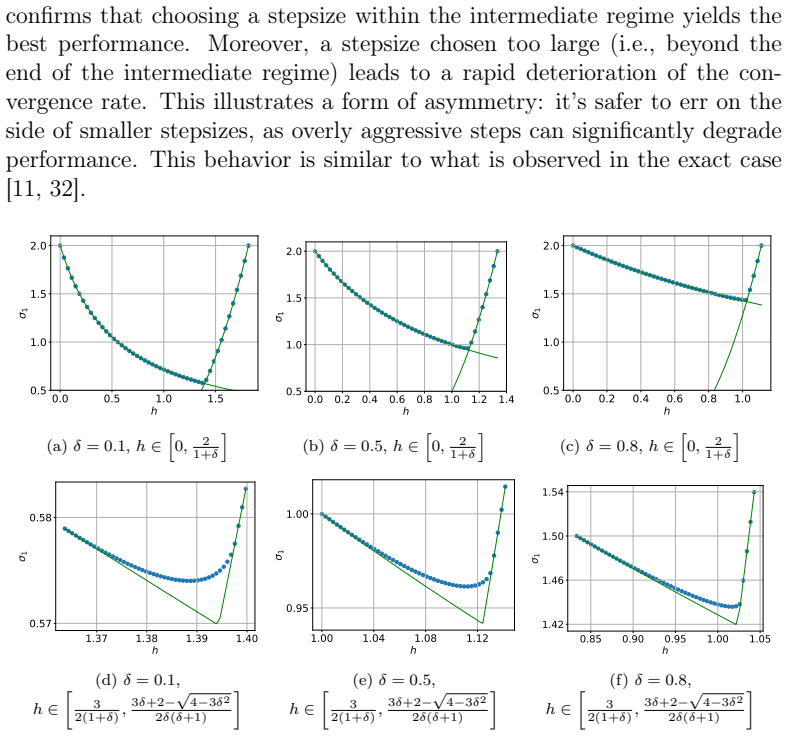
Take $\delta=0.5$ and a stepsize $h$ strictly inside the intermediate regime, such as the near-optimal value shown in Figure 2.3, and compute a certified upper bound on the one-step worst-case rate using a branch-and-bound performance-estimation method. If the certified value lies strictly below the formula $C(h,\delta)$ of Theorem 2.3, then the intermediate regime is not tight; if it exceeds it, the upper bound itself fails. A single such gap would settle whether the claimed exact one-step rate is correct.
Extended reading notes
Core claim
The paper's discovery is that one step of relatively inexact gradient descent on an $L$-smooth convex function has a worst-case behavior split into three stepsize regimes, instead of the two regimes of exact gradient descent. In the left short-step regime $h\le \tfrac{3}{2(1+\delta)}$ the rate for the squared gradient norm in terms of the initial objective gap is $\frac{1}{h(1-\delta)}+\frac12$; in the right long-step regime $h\ge \tfrac{3\delta+2-\sqrt{4-3\delta^2}}{2\delta(1+\delta)}$ it is $2\bigl(1-h(1+\delta)\bigr)^2$; in the middle regime the rate is $\frac{2\tilde\lambda}{h\tilde\lambda^2+(2h-1)\tilde\lambda+h-1}$, where $\tilde\lambda$ is the largest real root of a cubic equation. The left and right rates are tight, attained by univariate worst-case functions (a Huber-like function and a quadratic), and the worst-case inexact direction is $d=(1\pm\delta)\nabla f(x)$, meaning the worst relative error acts exactly like a miscalibrated stepsize. The intermediate regime is conjectured to be tight with a bivariate worst-case function, for which the paper gives a partial two-dimensional construction and strong numerical evidence but no full analytical proof.
Load-bearing premise
The claim that the one-step rate is exactly the stated formula in the intermediate regime rests on Conjecture 2.6, which asserts tightness of the bound and bivariate worst-case structure, but is supported only by numerical performance-estimation evidence and a partial two-dimensional construction, not by an analytical worst-case function.
Editorial extensions
If this is right
- For any relative error level $\delta\in[0,1)$, convergence to a minimizer is guaranteed for every constant stepsize $h\le \tfrac{2}{1+\delta}$, and this threshold is tight: no larger constant stepsize retains the guarantee.
- In the short-step regime the rate per step is scaled by the factor $1-\delta$, while in the long-step regime the effective stepsize is $h(1+\delta)$, so relative noise behaves like a deliberate mistuning of the stepsize rather than an arbitrary perturbation.
- The optimal stepsize for the worst-case one-step rate lies inside the narrow intermediate regime and, for moderate to large $\delta$, depends very little on the number of iterations, in contrast to the exact case where the optimal stepsize grows with the iteration count.
- For multiple steps, the upper and lower bounds coincide in the left regime, giving a tight $O(1/N)$ rate with the same $\delta$-dependent prefactor, and a sharper tight subinterval exists in the right regime.
- Using a stepsize at the right end of the intermediate regime, $h=\tfrac{3\delta+2-\sqrt{4-3\delta^2}}{2\delta(1+\delta)}$, yields near-optimal worst-case performance across a wide range of iteration counts and inexactness levels.
Reading between the lines
- If Conjecture 2.6 is correct, the intermediate regime shows that one-dimensional worst-case examples miss the true difficulty of relative inexactness: the error must rotate around the gradient, so analyses restricted to univariate functions systematically understate the worst case.
- The near-independence of the optimal stepsize from the iteration count suggests a practical design rule for low-precision training: choose the stepsize near the right end of the intermediate regime once the relative error level is known, and do not increase it as the training horizon grows.
- Because the worst-case relative error is equivalent to stepsize miscalibration, accelerated methods with momentum, which are more sensitive to stepsize, may suffer disproportionately under relative inexactness; this is a testable conjecture for a performance-estimation analysis of accelerated variants.
- The numerical observation that the worst-case error becomes orthogonal to the gradient at the optimal stepsize hints at a general principle for designing inexact oracles: aligning the error budget perpendicular to the gradient may be the least harmful way to spend an inexactness allowance.
Signed reviews
Editorial analysis
A structured set of objections, weighed in public.
Referee Report
Summary. The manuscript analyzes constant-stepsize gradient descent with relative gradient inexactness on L-smooth convex functions. Using the Performance Estimation Problem (PEP) framework, it derives a one-step worst-case upper bound C(h, delta) with three stepsize regimes (Theorem 2.3), proves tightness of the left and right regimes via explicit Huber and quadratic worst-case functions (Theorem 2.4), and conjectures tightness of the intermediate regime (Conjecture 2.6). It then extends the analysis to several steps with an upper bound (Theorem 3.1), a lower bound (Theorem 3.2), and numerical observations on optimal stepsizes. The abstract advertises an 'exact worst-case' one-step result, but the intermediate-regime tightness is not proven.
Significance. If the intermediate-regime conjecture were resolved, the paper would provide the exact one-step worst-case rate for relatively inexact gradient descent on smooth convex functions, with a clean three-regime structure and explicit worst-case functions in the two outer regimes. The proven upper bound also yields an admissible stepsize range h in [0, 2/(1+delta)] that improves on previous bounds such as those of Vasin. The use of PEP with explicit multiplier constructions, computer-assisted symbolic algebra, and openly available code is a strength: the derivation is self-contained and reproducible. However, the advertised exactness claim for the one-step rate is only fully proven in the left and right regimes; the intermediate regime rests on numerical evidence, so the significance of the central claim is currently conditional.
major comments (3)
- [Section 2.4; Conjecture 2.6] The abstract and Section 1.3 claim that the paper derives 'the exact worst-case behavior of the method after one step.' This exactness claim is not established for the whole one-step stepsize range. Theorem 2.3 provides an upper bound, and Theorem 2.4 proves tightness only in the left and right regimes. For h in the intermediate interval [3/(2(1+delta)), (3delta+2-sqrt(4-3delta^2))/(2delta(delta+1))], the lower bound is Conjecture 2.6, supported by numerical PEP solutions and a bivariate construction that matches the bound only at the optimal stepsize (Section 2.4, Figure 2.6). The manuscript should either supply a certified analytical lower-bound certificate for the whole intermediate interval or amend the abstract and introduction to state the result as a proven upper bound with a conjectured matching lower bound.
- [Section 3.2; Theorem 3.2] The lower-bound theorem for N steps is not fully proved. The proof defines f1 and f2 and then says the result follows 'using an argument similar to that in Theorem 2.4, adapted to the N-steps case.' This adaptation is nontrivial: one must verify that the iterates stay in the appropriate linear/quadratic regions for all N steps, that the max of the two candidate lower bounds is valid for every h in [0, 2/(1+delta)], and that the boundary between the regimes is handled. As written, this is a proof sketch rather than a complete proof; it should be expanded or the statement should be marked as conditional.
- [Section 3.2; Remark 3.3] Remark 3.3 asserts that a sharper upper bound, matching the lower bound 2(1-h(1+delta))^{-2N}, holds for all h >= h_tilde(N), where h_tilde(N) is defined implicitly as a root of a polynomial whose degree increases with N. No proof or even outline is provided for this claim. Since this remark is used to support the statement that the multi-step rate is tight on [h_tilde(N), 2/(1+delta)), it should be proved, or explicitly labeled as a conjecture. The definition of h_tilde(N) also needs a uniqueness/validity statement.
minor comments (5)
- [Section 2.1] In the proof of Theorem 2.1, 'previsously' should read 'previously.'
- [Figure 2.2] The axis labels for lambda(h) are garbled: expressions such as 'right = 2 h(1 + ) / h(1 + ) 1' are missing delta and are hard to read. Please render the formulas with proper symbols.
- [Section 2.4] The sentence 'whereas the worse 1D constructions fall short' is grammatically unclear; it should be 'whereas the 1D constructions fall short' or a similar correction.
- [Section 1.5] The statement that an explicit worst-case function is provided 'for nearly all values of the stepsize' is accurate, but it would help the reader if the exceptional values were identified explicitly as the intermediate regime, consistent with Conjecture 2.6.
- [Definition 2.2] Definition 2.2 defines lambda-tilde as the largest real root of a cubic, but the text does not state explicitly that this root is unique and positive over the relevant parameter range. A short lemma or explicit verification would make the definition more robust.
Circularity Check
No significant circularity: the PEP-based rate is derived from interpolation and inexactness inequalities, and the only notable gap is an unproven tightness conjecture, which is not circular.
full rationale
The derivation chain in this paper is self-contained. The one-step upper bound in Theorem 2.3 is obtained by taking nonnegative linear combinations of the smooth-convex interpolation inequalities (INT) and the relative inexactness constraint (1), with multipliers whose values come from the semidefinite-positiveness conditions in the proof; the quantity lambda-tilde is the largest real root of a cubic obtained from the proof structure, not a parameter fitted to the claimed rate. Tightness in the left and right regimes is established by explicit worst-case functions: a Huber function for the left regime and a quadratic for the right regime, with admissible inexact directions d0 = (1±delta) grad f(x0). These are genuine lower-bound constructions, not reverse-engineered fits. The intermediate regime is explicitly labelled as a conjecture (Conjecture 2.6), supported only by numerical PEP evidence, so the abstract's phrase 'exact worst-case behavior' is stronger than what is proven in that regime; however, this is an unproven completeness gap, not circularity, because the conjectured lower bound is not an input to the upper-bound derivation. The multi-step upper bound in Theorem 3.1 is a direct summation of the one-step inequality, and the lower bound in Theorem 3.2 uses explicit Huber and quadratic functions; both are transparent. References to [11] and [24] supply standard interpolation conditions and the exact-case rate, and the paper even reproves the one-step exact case as preparation. No fitted input is renamed as a prediction, and no load-bearing premise is justified only by the authors' prior work. Thus the central claim is not circular; the appropriate score is 0.
Assumptions & free parameters
assumptions (5)
- standard math The class of L-smooth convex functions is exactly characterized by the interpolation condition (INT) of Section 1.4.
- domain assumption An admissible value of the smoothness constant L is available, so the normalized stepsize h can be chosen in the guaranteed interval.
- domain assumption At every iteration the approximate gradient satisfies the relative bound ||d_k - grad f(x_k)|| <= delta ||grad f(x_k)||.
- ad hoc to paper The one-step worst-case rate in the intermediate regime is tight (Conjecture 2.6).
- standard math The problem can be rescaled so that L = 1 without loss of generality.
Cite this review
Pith. "Pith review of Worst-case convergence analysis of relatively inexact gradient descent on smooth convex functions." pith.science (2026). https://pith.science/paper/CP6V6ZF3
@misc{pith2026250617145,
  author       = {Pith},
  title        = {Pith review of: Worst-case convergence analysis of relatively inexact gradient descent on smooth convex functions},
  year         = {2026},
  howpublished = {\url{https://pith.science/paper/CP6V6ZF3}},
  note         = {Machine review of arXiv:2506.17145}
}
read the original abstract
We consider the classical gradient descent algorithm with constant stepsizes, where some error is introduced in the computation of each gradient. More specifically, we assume some relative bound on the inexactness, in the sense that the norm of the difference between the true gradient and its approximate value is bounded by a certain fraction of the gradient norm. This paper presents a worst-case convergence analysis of this so-called relatively inexact gradient descent on smooth convex functions, using the Performance Estimation Problem (PEP) framework. We first derive the exact worst-case behavior of the method after one step. Then we study the case of several steps and provide computable upper and lower bounds using the PEP framework. Finally, we discuss the optimal choice of constant stepsize according to the obtained worst-case convergence rates.
Figures


Figures from the paper (10 more)


Reference graph
Works this paper leans on
-
[12]
Gradient directions and relative inexactness in optimization and machine learning
A. Vasin, Gradient directions and relative inexactness in optimization and machine learning, arXiv preprint arXiv:2407.00667 (2024)
work page Pith review arXiv 2024
-
[1]
M. Fazlyab, A. Robey, H. Hassani, M. Morari, G. Pappas, Efficient and accurate estimation of Lipschitz constants for deep neural networks, Advances in neural information processing systems 32 (2019)
work page 2019
-
[2]
Lan, First-order and stochastic optimization methods for machine learning, Vol
G. Lan, First-order and stochastic optimization methods for machine learning, Vol. 1, Springer, 2020
work page 2020
-
[3]
Nesterov, Introductory lectures on convex optimization: A basic course, Vol
Y. Nesterov, Introductory lectures on convex optimization: A basic course, Vol. 87, Springer Science & Business Media, 2013
work page 2013
-
[4]
P. Vernimmen, F. Glineur, Empirical and computer-aided robustness analysis of long-step and accelerated methods in smooth convex opti- mization, arXiv preprint arXiv:2506.09730 (2025)
work page Pith review arXiv 2025
-
[5]
A. d’Aspremont, Smooth optimization with approximate gradient, SIAM Journal on Optimization 19 (3) (2008) 1171–1183.doi:10.1137/ 060676386
work page 2008
-
[6]
Devolder, F
O. Devolder, F. Glineur, Y. Nesterov, First-order methods of smooth convex optimization with inexact oracle, Mathematical Programming 146 (2014) 37–75
2014
-
[7]
N.-C.Kempke, T.Koch, Low-precisionfirst-ordermethod-basedfix-and- propagate heuristics for large-scale mixed-integer linear optimization, arXiv preprint arXiv:2503.10344 (2025)
arXiv 2025
Show all 35 references
-
[8]
De Klerk, F
E. De Klerk, F. Glineur, A. B. Taylor, On the worst-case complexity of the gradient method with exact line search for smooth strongly convex functions, Optimization Letters 11 (2017) 1185–1199
2017
-
[9]
De Klerk, F
E. De Klerk, F. Glineur, A. B. Taylor, Worst-case convergence analysis of inexact gradient and newton methods through semidefinite program- ming performance estimation, SIAM Journal on Optimization 30 (3) (2020) 2053–2082
2020
-
[10]
Drori, M
Y. Drori, M. Teboulle, Performance of first-order methods for smooth convex minimization: a novel approach, Mathematical Programming 145 (1) (2014) 451–482. 38
2014
-
[11]
A. B. Taylor, J. M. Hendrickx, F. Glineur, Smooth strongly convex interpolation and exact worst-case performance of first-order methods, Mathematical Programming 161 (2017) 307–345
2017
-
[13]
Vasin, A
A. Vasin, A. Gasnikov, P. Dvurechensky, V. Spokoiny, Accelerated gra- dient methods with absolute and relative noise in the gradient, Opti- mization Methods and Software 38 (6) (2023) 1180–1229
2023
-
[14]
Kornilov, E
N. Kornilov, E. Gorbunov, M. Alkousa, F. Stonyakin, P. Dvurechensky, A. Gasnikov, Intermediate gradient methods with relative inexactness, arXiv preprint arXiv:2310.00506 (2023)
2023 arXiv
-
[15]
Vasin, V
A. Vasin, V. Krivchenko, D. Kovalev, F. Stonyakin, N. Tupitsa, P. Dvurechensky, M. Alkousa, N. Kornilov, A. Gasnikov, On solving minimization and min-max problems by first-order methods with rela- tive error in gradients, arXiv preprint arXiv:2503.06628 (2025)
2025
-
[16]
Hallak, K
N. Hallak, K. Y. Levy, A study of first-order methods with a proba- bilistic relative-error gradient oracle, Preprint, optimization-online. URLhttps://optimization-online.org/wp-content/uploads/ 2025/02/RAGM.pdf
2025
-
[17]
P. D. Khanh, B. Mordukhovich, D. B. Tran, Convergence of first-order algorithms with momentum from the perspective of an inexact gradient descent method, arXiv preprint arXiv:2505.03050 (2025)
2025 arXiv
-
[18]
Bello-Cruz, M
Y. Bello-Cruz, M. L. Gonçalves, J. G. Melo, C. Mohr, A relative in- exact proximal gradient method with an explicit linesearch, Journal of Optimization Theory and Applications 206 (1) (2025) 1–32
2025
-
[19]
S. Wang, V. Y. Tan, Robust distributed gradient descent to corrup- tion over noisy channels, in: 2024 IEEE International Symposium on Information Theory (ISIT), IEEE, 2024, pp. 2520–2525
2024
-
[20]
Vasin, A
A. Vasin, A. Gasnikov, V. Spokoiny, Stopping rules for accelerated gra- dient methods with additive noise in gradient (2021). 39
2021
-
[21]
D. B. Thomsen, A. Taylor, A. Dieuleveut, Tight analyses of first-order methods with error feedback, arXiv preprint arXiv:2506.05271 (2025)
2025
-
[22]
Vernimmen, F
P. Vernimmen, F. Glineur, Convergence analysis of an inexact gradient method on smooth convex functions, in: Proceedings of the 32nd Euro- pean Symposium on Artificial Neural Networks, Computational Intelli- gence and Machine Learning, 2024, pp. 125–130
2024
-
[23]
D. Kim, J. A. Fessler, Optimizing the efficiency of first-order methods for decreasing the gradient of smooth convex functions, Journal of opti- mization theory and applications 188 (1) (2021) 192–219
2021
-
[24]
T.Rotaru, F.Glineur, P.Patrinos, Exactworst-caseconvergenceratesof gradient descent: a complete analysis for all constant stepsizes over non- convex and convex functions, arXiv preprint arXiv:2406.17506 (2024)
2024
-
[25]
A. B. Taylor, J. M.Hendrickx, F.Glineur, Exactworst-case performance of first-order methods for composite convex optimization, SIAM Journal on Optimization 27 (3) (2017) 1283–1313
2017
-
[26]
Version 11.0
MOSEK ApS, The MOSEK Python Fusion API manual. Version 11.0. (2025). URLhttps://docs.mosek.com/latest/pythonfusion/index.html
2025
-
[27]
A. B. Taylor, J. M. Hendrickx, F. Glineur, Performance estimation tool- box (pesto): Automated worst-case analysis of first-order optimization methods, in: 2017 IEEE 56th Annual Conference on Decision and Con- trol (CDC), IEEE, 2017, pp. 1278–1283
2017
-
[28]
Goujaud, C
B. Goujaud, C. Moucer, F. Glineur, J. M. Hendrickx, A. B. Taylor, A. Dieuleveut, PEPit: computer-assisted worst-case analyses of first- order optimization methods in Python, Mathematical Programming Computation 16 (3) (2024) 337–367
2024
-
[29]
Zhang, The Schur complement and its applications, Vol
F. Zhang, The Schur complement and its applications, Vol. 4, Springer Science & Business Media, 2006
2006
-
[30]
Meurer, C
A. Meurer, C. P. Smith, M. Paprocki, O. Čertík, S. B. Kirpichev, M. Rocklin, A. Kumar, S. Ivanov, J. K. Moore, S. Singh, T. Rathnayake, S.Vig, B.E.Granger, R.P.Muller, F.Bonazzi, H.Gupta, S.Vats, F.Jo- hansson, F. Pedregosa, M. J. Curry, A. R. Terrel, v. Roučka, A. Saboo, 40 I...
2017
-
[31]
URLhttps://www.wolfram.com/mathematica
Wolfram Research Inc., Mathematica, Version 14.2, champaign, IL, 2024. URLhttps://www.wolfram.com/mathematica
2024
-
[32]
Vernimmen, Tight convergence analysis of exact and inexact gradient methods with constant and silver schedules, Master’s thesis, UCLouvain (2024)
P. Vernimmen, Tight convergence analysis of exact and inexact gradient methods with constant and silver schedules, Master’s thesis, UCLouvain (2024)
2024
-
[33]
Das Gupta, B
S. Das Gupta, B. P. Van Parys, E. K. Ryu, Branch-and-bound perfor- mance estimation programming: A unified methodology for construct- ing optimal optimization methods, Mathematical Programming 204 (1) (2024) 567–639
2024
-
[34]
Cortild, L
D. Cortild, L. Ketels, J. Peypouquet, G. Garrigos, New tight bounds for SGD without variance assumption: A computer-aided lyapunov analy- sis, arXiv preprint arXiv:2505.17965 (2025)
2025
-
[35]
Rubbens, S
A. Rubbens, S. Colla, J. M. Hendrickx, Computer-aided analyses of stochastic first-order methods, via interpolation conditions for stochastic optimization, arXiv preprint arXiv:2507.05466 (2025). 41
2025
Reviewed August 6, 2026 · model on record in the stance chip above.
Discussion (0). Continue with ORCID to comment.