Tunable anyonic permeability across {mathbb{Z}₂} spin liquid junctions
Pith reviewed 2026-05-19 07:58 UTC · model grok-4.3
The pith
In Z2 spin liquid junctions electric anyons transmit freely while magnetic anyons require a critical Zeeman field.
A machine-rendered reading of the paper's core claim, the machinery that carries it, and where it could break.
Core claim
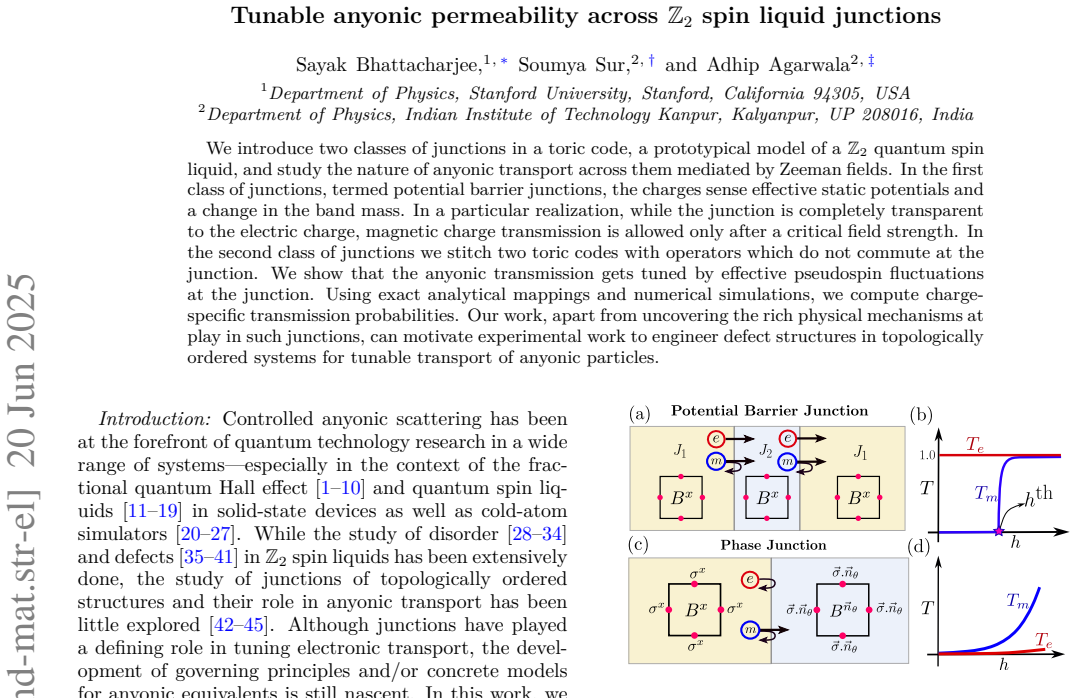
We introduce two classes of junctions in a toric code. In potential barrier junctions the charges sense effective static potentials and a change in the band mass; in a particular realization the junction is completely transparent to the electric charge while magnetic charge transmission occurs only after a critical field strength. In the second class we stitch two toric codes with operators which do not commute at the junction and show that the anyonic transmission gets tuned by effective pseudospin fluctuations at the junction. Using exact analytical mappings and numerical simulations we compute charge-specific transmission probabilities.
What carries the argument
Potential barrier junctions created by Zeeman fields and stitched junctions with non-commuting operators in the toric code, which map anyonic transport to effective single-particle or pseudospin problems.
If this is right
- Electric anyons experience complete transparency and can form barrier-free channels in engineered spin-liquid devices.
- Magnetic anyons can be selectively gated by tuning the Zeeman field across a threshold value.
- Stitched junctions provide continuous control of anyon permeability through local pseudospin dynamics.
- Defect structures can be designed for tunable anyonic transport in topologically ordered systems.
Where Pith is reading between the lines
- These junction designs could be realized in quantum simulators or materials to test selective anyon filtering.
- The electric-magnetic asymmetry suggests possible applications in anyon-based routing or separation devices.
- Similar constructions may extend to junctions in other topological orders or lattice gauge theories.
Load-bearing premise
The chosen Zeeman-field-mediated junctions and non-commuting stitching operators preserve the topological order of the underlying Z2 spin liquid sufficiently for the analytical mappings to remain valid across the parameter regimes studied.
What would settle it
A direct simulation or measurement of magnetic anyon transmission probability that stays zero below the predicted critical Zeeman field and rises above it would confirm or refute the central transport claims.
Figures


read the original abstract
We introduce two classes of junctions in a toric code, a prototypical model of a $\mathbb{Z}_2$ quantum spin liquid, and study the nature of anyonic transport across them mediated by Zeeman fields. In the first class of junctions, termed potential barrier junctions, the charges sense effective static potentials and a change in the band mass. In a particular realization, while the junction is completely transparent to the electric charge, magnetic charge transmission is allowed only after a critical field strength. In the second class of junctions we stitch two toric codes with operators which do not commute at the junction. We show that the anyonic transmission gets tuned by effective pseudospin fluctuations at the junction. Using exact analytical mappings and numerical simulations, we compute charge-specific transmission probabilities. Our work, apart from uncovering the rich physical mechanisms at play in such junctions, can motivate experimental work to engineer defect structures in topologically ordered systems for tunable transport of anyonic particles.
Editorial analysis
A structured set of objections, weighed in public.
Referee Report
Summary. The manuscript explores anyonic transport in two types of junctions within the toric code, a model for Z_2 spin liquids. In potential barrier junctions created by Zeeman fields, electric charges are fully transparent while magnetic charges transmit only above a critical field strength. In stitched junctions with non-commuting operators, transmission is tuned by pseudospin fluctuations. Exact analytical mappings to scattering problems and numerical simulations are used to calculate transmission probabilities for different anyon types.
Significance. This work demonstrates tunable control over anyon permeability in topologically ordered systems through specific junction designs. The exact mappings provide a solid foundation for understanding the mechanisms, and if validated, could inspire experiments in quantum spin ice or Rydberg atom arrays to realize such junctions. The separation of e and m particle behaviors highlights the distinct roles of electric and magnetic anyons in transport.
major comments (2)
- [§3, potential barrier junctions] The analytical mapping to an effective potential for m-particles assumes the Zeeman field does not close the vison gap or cause condensation at the junction. However, without an explicit calculation showing the gap remains open for fields around the critical value (e.g., in the derivation leading to the transmission probability), the interpretation of the critical field as a topological feature rather than a gap-closing transition is not fully supported.
- [§4, stitched junctions] For the non-commuting stitching operators, the claim that they only induce pseudospin fluctuations without affecting bulk Z2 order needs verification that the interface does not introduce relevant perturbations that condense anyons. If the operators violate the stabilizer conditions locally, the effective scattering problem may not capture the full topological protection.
minor comments (2)
- [Abstract] Consider adding a sentence on the range of parameters where the mappings are valid to set expectations for readers.
- [Figure 2] The transmission probability plots would benefit from error bars or convergence checks for the numerical data to allow assessment of statistical reliability.
Simulated Author's Rebuttal
We thank the referee for their careful reading of our manuscript and for the constructive major comments. We address each point below with clarifications based on the existing analysis and indicate the revisions we will make.
read point-by-point responses
-
Referee: [§3, potential barrier junctions] The analytical mapping to an effective potential for m-particles assumes the Zeeman field does not close the vison gap or cause condensation at the junction. However, without an explicit calculation showing the gap remains open for fields around the critical value (e.g., in the derivation leading to the transmission probability), the interpretation of the critical field as a topological feature rather than a gap-closing transition is not fully supported.
Authors: We appreciate the referee's observation regarding the validity regime of the effective potential. The mapping is performed in the limit where the local Zeeman field at the junction is below the bulk gap-closing threshold of the toric code, ensuring the system remains in the deconfined phase. Our numerical simulations of the full lattice model already confirm the absence of vison condensation for field values near the critical transmission strength, as evidenced by the persistence of the topological gap in the energy spectrum and the lack of long-range correlations indicative of condensation. To address the concern explicitly, we will add a short discussion and a supplementary plot of the vison gap versus Zeeman field strength in the revised manuscript. revision: yes
-
Referee: [§4, stitched junctions] For the non-commuting stitching operators, the claim that they only induce pseudospin fluctuations without affecting bulk Z2 order needs verification that the interface does not introduce relevant perturbations that condense anyons. If the operators violate the stabilizer conditions locally, the effective scattering problem may not capture the full topological protection.
Authors: We thank the referee for raising this point on the topological integrity of the stitched junctions. The non-commuting operators are strictly localized to the interface and do not alter the stabilizer conditions in the bulk regions on either side. The effective scattering model incorporates the local violation as pseudospin degrees of freedom whose fluctuations modulate transmission without inducing anyon condensation, consistent with the finite and tunable transmission probabilities obtained from both the exact mapping and numerical results. We will add an explicit verification in the revised manuscript by reporting the expectation values of bulk stabilizers away from the junction, confirming that the Z_2 order remains intact. revision: yes
Circularity Check
No circularity: central claims rest on explicit mappings from toric-code Hamiltonian
full rationale
The paper derives transmission probabilities via exact analytical mappings of the introduced junction Hamiltonians (potential-barrier and stitched) onto effective anyon scattering problems in the standard toric-code model, supplemented by numerical simulations. No load-bearing step reduces by construction to a fitted input, self-definition, or self-citation chain; the mappings start from the explicit toric-code operators and Zeeman or stitching terms and produce charge-specific transmission results without renaming or tautological closure. The topological-order preservation assumption is an explicit modeling choice, not a hidden redefinition of the output.
Axiom & Free-Parameter Ledger
axioms (1)
- domain assumption The toric code Hamiltonian realizes a Z2 quantum spin liquid with deconfined electric and magnetic anyons.
Reference graph
Works this paper leans on
-
[1]
to link eigenstates of the J1 (leads) and J2 (scat- terer) regions in the JW fermionized Eq. (3) [56]. The main results are summarized in Fig. 2(c). For a fixed J2/J1 = 0.75 (potential well) and for Einc = 2J1 (the 3 FIG. 3. The XYJC junction: (a) The 2D lattice Hamilto- nian with its constituent star, plaquette, domino and dimer operators (see Eqs. (4),(...
-
[2]
Bunching of fractionally charged quasi- particles tunnelling through high-potential barriers,
E Comforti, YC Chung, Moty Heiblum, V Umansky, and Diana Mahalu, “Bunching of fractionally charged quasi- particles tunnelling through high-potential barriers,” Na- ture 416, 515–518 (2002)
work page 2002
-
[3]
Topological vacuum bubbles by anyon braiding,
Cheolhee Han, Jinhong Park, Yuval Gefen, and H-S Sim, “Topological vacuum bubbles by anyon braiding,” Nature communications 7, 11131 (2016)
work page 2016
-
[4]
Direct observation of anyonic braiding statistics,
James Nakamura, Shuang Liang, Geoffrey C Gardner, and Michael J Manfra, “Direct observation of anyonic braiding statistics,” Nature Physics 16, 931–936 (2020)
work page 2020
-
[5]
Anyons in quantum hall interferometry,
Matteo Carrega, Luca Chirolli, Stefan Heun, and Lucia Sorba, “Anyons in quantum hall interferometry,” Nature Reviews Physics 3, 698–711 (2021)
work page 2021
-
[6]
Andreev reflection of fractional quantum hall quasiparticles,
Masayuki Hashisaka, Thibaut Jonckheere, Takafumi Ak- iho, Satoshi Sasaki, Jerome Rech, Thierry Martin, and Koji Muraki, “Andreev reflection of fractional quantum hall quasiparticles,” Nature communications 12, 2794 (2021)
work page 2021
-
[7]
Frac- tional statistics in anyon collisions,
H. Bartolomei, M. Kumar, R. Bisognin, A. Marguerite, J.-M. Berroir, E. Bocquillon, B. Pla¸ cais, A. Cavanna, Q. Dong, U. Gennser, Y. Jin, and G. F` eve, “Frac- tional statistics in anyon collisions,” Science 368, 173– 177 (2020)
work page 2020
-
[8]
Shot noise does not always provide the quasiparticle charge,
Sourav Biswas, Rajarshi Bhattacharyya, Hemanta Ku- mar Kundu, Ankur Das, Moty Heiblum, Vladimir Uman- sky, Moshe Goldstein, and Yuval Gefen, “Shot noise does not always provide the quasiparticle charge,” Na- ture physics 18, 1476–1481 (2022)
work page 2022
-
[9]
Anyonic inter- ference and braiding phase in a mach-zehnder interfer- ometer,
Hemanta Kumar Kundu, Sourav Biswas, Nissim Ofek, Vladimir Umansky, and Moty Heiblum, “Anyonic inter- ference and braiding phase in a mach-zehnder interfer- ometer,” Nature physics 19, 515–521 (2023)
work page 2023
-
[10]
Coherent bunch- ing of anyons and their dissociation in interference exper- iments,
Bikash Ghosh, Maria Labendik, Vladimir Umansky, Moty Heiblum, and David F. Mross, “Coherent bunch- ing of anyons and their dissociation in interference exper- iments,” (2024), arXiv:2412.16316 [cond-mat.mes-hall]
-
[11]
Ob- servation of the scaling dimension of fractional quantum hall anyons,
A Veillon, C Piquard, P Glidic, Y Sato, A Aassime, A Ca- vanna, Y Jin, U Gennser, A Anthore, and F Pierre, “Ob- servation of the scaling dimension of fractional quantum hall anyons,” Nature 632, 517–521 (2024)
work page 2024
-
[12]
Thermal interferometry of anyons in spin liquids,
Zezhu Wei, V. F. Mitrovi´ c, and D. E. Feldman, “Thermal interferometry of anyons in spin liquids,” Phys. Rev. Lett. 127, 167204 (2021)
work page 2021
-
[13]
Time-domain anyon inter- ferometry in kitaev honeycomb spin liquids and beyond,
Kai Klocke, David Aasen, Roger S. K. Mong, Eugene A. Demler, and Jason Alicea, “Time-domain anyon inter- ferometry in kitaev honeycomb spin liquids and beyond,” Phys. Rev. Lett. 126, 177204 (2021)
work page 2021
-
[14]
Kai Klocke, Joel E. Moore, Jason Alicea, and G´ abor B. Hal´ asz, “Thermal probes of phonon-coupled kitaev spin liquids: From accurate extraction of quantized edge transport to anyon interferometry,” Phys. Rev. X 12, 011034 (2022)
work page 2022
-
[15]
Scatter- ing phenomena for spin transport in a kitaev spin liquid,
Joji Nasu, Yuta Murakami, and Akihisa Koga, “Scatter- ing phenomena for spin transport in a kitaev spin liquid,” Phys. Rev. B 106, 024411 (2022)
work page 2022
-
[16]
Anyon dynamics in field-driven phases of the anisotropic kitaev model,
Shi Feng, Adhip Agarwala, Subhro Bhattacharjee, and Nandini Trivedi, “Anyon dynamics in field-driven phases of the anisotropic kitaev model,” Physical Review B108, 035149 (2023)
work page 2023
-
[17]
Thermal interferometry of anyons,
Zezhu Wei, Navketan Batra, V. F. Mitrovi´ c, and D. E. Feldman, “Thermal interferometry of anyons,” Phys. Rev. B 107, 104406 (2023)
work page 2023
-
[18]
Real-time control of non-abelian anyons in kitaev spin liquid under energy dissipation,
Chihiro Harada, Atsushi Ono, and Joji Nasu, “Real-time control of non-abelian anyons in kitaev spin liquid under energy dissipation,” Phys. Rev. B 110, 214426 (2024)
work page 2024
-
[19]
Gate-controlled anyon generation and detection in kitaev spin liquids,
G´ abor B. Hal´ asz, “Gate-controlled anyon generation and detection in kitaev spin liquids,” Phys. Rev. Lett. 132, 206501 (2024)
work page 2024
-
[20]
Probing anyonic statistics via Mach-Zehnder interferometry in quantum computers
Shiyu Zhou, Yi Teng, Claudio Chamon, Claudio Castel- novo, and Armin Rahmani, “Probing anyonic statistics via mach-zehnder interferometry in quantum comput- ers,” (2025), arXiv:2402.16944 [quant-ph]
work page internal anchor Pith review Pith/arXiv arXiv 2025
-
[21]
Anyon hubbard model in one-dimensional optical lattices,
Sebastian Greschner and Luis Santos, “Anyon hubbard model in one-dimensional optical lattices,” Phys. Rev. Lett. 115, 053002 (2015)
work page 2015
-
[22]
Creating and manipulating non-abelian anyons in cold atom sys- tems using auxiliary bosons,
Yuhe Zhang, G. J. Sreejith, and J. K. Jain, “Creating and manipulating non-abelian anyons in cold atom sys- tems using auxiliary bosons,” Phys. Rev. B 92, 075116 (2015)
work page 2015
-
[23]
Logan W. Clark, Brandon M. Anderson, Lei Feng, Anita Gaj, K. Levin, and Cheng Chin, “Observa- tion of density-dependent gauge fields in a bose-einstein condensate based on micromotion control in a shaken two-dimensional lattice,” Phys. Rev. Lett. 121, 030402 (2018)
work page 2018
-
[24]
Frederik G¨ org, Kilian Sandholzer, Joaqu´ ın Minguzzi, R´ emi Desbuquois, Michael Messer, and Tilman Esslinger, “Realization of density-dependent peierls phases to engineer quantized gauge fields coupled to ul- tracold matter,” Nature Physics 15, 1161–1167 (2019)
work page 2019
-
[25]
Realization of a density-dependent peierls phase in a synthetic, spin- orbit coupled rydberg system,
Vincent Lienhard, Pascal Scholl, Sebastian Weber, Daniel Barredo, Sylvain de L´ es´ eleuc, Rukmani Bai, Nico- lai Lang, Michael Fleischhauer, Hans Peter B¨ uchler, Thierry Lahaye, and Antoine Browaeys, “Realization of a density-dependent peierls phase in a synthetic, spin- orbit coupled rydberg system,” Phys. Rev. X 10, 021031 (2020)
work page 2020
-
[26]
Realization of a fractional quan- tum hall state with ultracold atoms,
Julian L´ eonard, Sooshin Kim, Joyce Kwan, Perrin Se- gura, Fabian Grusdt, C´ ecile Repellin, Nathan Goldman, and Markus Greiner, “Realization of a fractional quan- tum hall state with ultracold atoms,” Nature 619, 495– 499 (2023). 6
work page 2023
-
[27]
Realization of one- dimensional anyons with arbitrary statistical phase,
Joyce Kwan, Perrin Segura, Yanfei Li, Sooshin Kim, Alexey V Gorshkov, Andr´ e Eckardt, Brice Bakkali- Hassani, and Markus Greiner, “Realization of one- dimensional anyons with arbitrary statistical phase,” Sci- ence 386, 1055–1060 (2024)
work page 2024
-
[28]
Realization of fermionic Laughlin state on a quantum processor
Lingnan Shen, Mao Lin, Cedric Yen-Yu Lin, Di Xiao, and Ting Cao, “Realization of fermionic laughlin state on a quantum processor,” (2025), arXiv:2503.13294 [quant- ph]
work page internal anchor Pith review Pith/arXiv arXiv 2025
-
[29]
Disorder in a quantum spin liquid: Flux binding and local moment formation,
A. J. Willans, J. T. Chalker, and R. Moessner, “Disorder in a quantum spin liquid: Flux binding and local moment formation,” Phys. Rev. Lett. 104, 237203 (2010)
work page 2010
-
[30]
Fabian Zschocke and Matthias Vojta, “Physical states and finite-size effects in kitaev’s honeycomb model: Bond disorder, spin excitations, and nmr line shape,” Phys. Rev. B 92, 014403 (2015)
work page 2015
-
[31]
Matthias Vojta, Andrew K. Mitchell, and Fabian Zschocke, “Kondo impurities in the kitaev spin liquid: Numerical renormalization group solution and gauge- flux-driven screening,” Phys. Rev. Lett. 117, 037202 (2016)
work page 2016
-
[32]
Thermodynamic and transport properties in disordered kitaev models,
Joji Nasu and Yukitoshi Motome, “Thermodynamic and transport properties in disordered kitaev models,” Phys. Rev. B 102, 054437 (2020)
work page 2020
-
[33]
Vacancy- induced low-energy density of states in the kitaev spin liquid,
Wen-Han Kao, Johannes Knolle, G´ abor B. Hal´ asz, Roderich Moessner, and Natalia B. Perkins, “Vacancy- induced low-energy density of states in the kitaev spin liquid,” Phys. Rev. X 11, 011034 (2021)
work page 2021
-
[34]
Disorder, low-energy excitations, and topology in the kitaev spin liquid,
Vitor Dantas and Eric C. Andrade, “Disorder, low-energy excitations, and topology in the kitaev spin liquid,” Phys. Rev. Lett. 129, 037204 (2022)
work page 2022
-
[35]
Kondo screening in a majorana metal,
Suheon Lee, YS Choi, S-H Do, Wonjun Lee, CH Lee, Minseong Lee, M Vojta, CN Wang, H Luetkens, Z Guguchia, et al. , “Kondo screening in a majorana metal,” Nature Communications 14, 7405 (2023)
work page 2023
-
[36]
Models for gapped boundaries and domain walls,
Alexei Kitaev and Liang Kong, “Models for gapped boundaries and domain walls,” Communications in Mathematical Physics 313, 351–373 (2012)
work page 2012
-
[37]
Topological order with a twist: Ising anyons from an abelian model,
H´ ector Bomb´ ın, “Topological order with a twist: Ising anyons from an abelian model,” Physical review letters 105, 030403 (2010)
work page 2010
-
[38]
Theory of defects in abelian topological states,
Maissam Barkeshli, Chao-Ming Jian, and Xiao-Liang Qi, “Theory of defects in abelian topological states,” Phys. Rev. B 88, 235103 (2013)
work page 2013
-
[39]
Un- conventional fusion and braiding of topological defects in a lattice model,
Jeffrey C. Y. Teo, Abhishek Roy, and Xiao Chen, “Un- conventional fusion and braiding of topological defects in a lattice model,” Phys. Rev. B 90, 115118 (2014)
work page 2014
-
[40]
Gapped domain walls, gapped boundaries, and topological degen- eracy,
Tian Lan, Juven C Wang, and Xiao-Gang Wen, “Gapped domain walls, gapped boundaries, and topological degen- eracy,” Physical review letters 114, 076402 (2015)
work page 2015
-
[41]
Unpaired majorana modes on dislocations and string defects in kitaev’s honeycomb model,
Olga Petrova, Paula Mellado, and Oleg Tchernyshyov, “Unpaired majorana modes on dislocations and string defects in kitaev’s honeycomb model,” Phys. Rev. B 90, 134404 (2014)
work page 2014
-
[42]
Jacob C Bridgeman, Stephen D Bartlett, and An- drew C Doherty, “Tensor networks with a twist: Anyon- permuting domain walls and defects in projected entan- gled pair states,” Physical Review B 96, 245122 (2017)
work page 2017
-
[43]
Coherent transmutation of electrons into fractionalized anyons,
Maissam Barkeshli, Erez Berg, and Steven Kivelson, “Coherent transmutation of electrons into fractionalized anyons,” Science 346, 722–725 (2014)
work page 2014
-
[44]
Tunneling spectroscopy of quantum spin liquids,
Elio J. K¨ onig, Mallika T. Randeria, and Berthold J¨ ack, “Tunneling spectroscopy of quantum spin liquids,” Phys. Rev. Lett. 125, 267206 (2020)
work page 2020
-
[45]
Converting electrons into emergent fermions at a superconductor–kitaev spin liquid interface,
Gilad Kishony and Erez Berg, “Converting electrons into emergent fermions at a superconductor–kitaev spin liquid interface,” Phys. Rev. B 104, 235118 (2021)
work page 2021
-
[46]
Monopole josephson effects in a dirac spin liquid,
Gautam Nambiar, Daniel Bulmash, and Victor Galitski, “Monopole josephson effects in a dirac spin liquid,” Phys. Rev. Res. 5, 013169 (2023)
work page 2023
-
[47]
Fault-tolerant quantum computation by anyons,
A Yu Kitaev, “Fault-tolerant quantum computation by anyons,” Annals of physics 303, 2–30 (2003)
work page 2003
-
[48]
Quantum spin liquids: a review,
Lucile Savary and Leon Balents, “Quantum spin liquids: a review,” Reports on Progress in Physics 80, 016502 (2016)
work page 2016
-
[49]
Colloquium: Zoo of quantum- topological phases of matter,
Xiao-Gang Wen, “Colloquium: Zoo of quantum- topological phases of matter,” Rev. Mod. Phys. 89, 041004 (2017)
work page 2017
-
[50]
On the theory of identical particles,
JM Leinaas and J Myrheim, “On the theory of identical particles,” Il nuovo cimento 37, 132 (1977)
work page 1977
-
[51]
Frank Wilczek, Fractional statistics and anyon supercon- ductivity, Vol. 5 (World scientific, 1990)
work page 1990
-
[52]
F. D. M. Haldane, ““fractional statistics” in arbitrary di- mensions: A generalization of the pauli principle,” Phys. Rev. Lett. 67, 937–940 (1991)
work page 1991
-
[53]
Non-abelian anyons and topological quantum computation,
Chetan Nayak, Steven H. Simon, Ady Stern, Michael Freedman, and Sankar Das Sarma, “Non-abelian anyons and topological quantum computation,” Rev. Mod. Phys. 80, 1083–1159 (2008)
work page 2008
-
[54]
Breakdown of a topologi- cal phase: Quantum phase transition in a loop gas model with tension,
Simon Trebst, Philipp Werner, Matthias Troyer, Kirill Shtengel, and Chetan Nayak, “Breakdown of a topologi- cal phase: Quantum phase transition in a loop gas model with tension,” Phys. Rev. Lett. 98, 070602 (2007)
work page 2007
-
[55]
Interplay of topological order and spin glassiness in the toric code under random magnetic fields,
Dimitris I. Tsomokos, Tobias J. Osborne, and Clau- dio Castelnovo, “Interplay of topological order and spin glassiness in the toric code under random magnetic fields,” Phys. Rev. B 83, 075124 (2011)
work page 2011
-
[56]
Ising order parameter and topological phase transitions: Toric code in a uniform magnetic field,
Mohammad Hossein Zarei, “Ising order parameter and topological phase transitions: Toric code in a uniform magnetic field,” Phys. Rev. B 100, 125159 (2019)
work page 2019
-
[57]
See Supplementary Material at [url] for details on the an- alytical and numerical calculations discussed in the main text
-
[58]
(Cambridge University Press, 2011)
Subir Sachdev, Quantum Phase Transitions , 2nd ed. (Cambridge University Press, 2011)
work page 2011
-
[59]
Conductance calcula- tions for quantum wires and interfaces: Mode matching and green’s functions,
PA Khomyakov, G Brocks, Volodymyr Karpan, M Zwierzycki, and Paul J Kelly, “Conductance calcula- tions for quantum wires and interfaces: Mode matching and green’s functions,” Physical Review B—Condensed Matter and Materials Physics 72, 035450 (2005)
work page 2005
-
[60]
The junction line is thus called the equatorEq
The N,S nomenclature for the two regions is inspired by considering the toric code on a manifold of genus 0 (a sphere such as the Earth). The junction line is thus called the equatorEq
-
[61]
We mention here that for arbitrary θ, [ Bx p− l ,B nθ p+ l ] = 2i sinθσz lHd (see above Eq
A study of the model for generalθ, including an opacity of the barriers as a function of θwill be reported elsewhere. We mention here that for arbitrary θ, [ Bx p− l ,B nθ p+ l ] = 2i sinθσz lHd (see above Eq. 6 for the definition of the Hd operator)
-
[62]
Oliver Hart, Yuan Wan, and Claudio Castelnovo, “Cor- relation holes and slow dynamics induced by fractional statistics in gapped quantum spin liquids,” Nature com- munications 12, 1459 (2021)
work page 2021
-
[63]
Quan- tum percolation of monopole paths and the response of quantum spin ice,
Matthew Stern, Claudio Castelnovo, Roderich Moessner, Vadim Oganesyan, and Sarang Gopalakrishnan, “Quan- tum percolation of monopole paths and the response of quantum spin ice,” Phys. Rev. B 104, 115114 (2021). 7
work page 2021
-
[64]
Max McGinley, Michele Fava, and S. A. Parameswaran, “Anomalous thermal relaxation and pump-probe spec- troscopy of two-dimensional topologically ordered sys- tems,” Phys. Rev. B 109, 075108 (2024)
work page 2024
-
[65]
De- tection of anyon braiding through pump-probe spec- troscopy,
Xu Yang, Ryan Buechele, and Nandini Trivedi, “De- tection of anyon braiding through pump-probe spec- troscopy,” (2025), arXiv:2503.22792 [cond-mat.str-el]
-
[66]
Probing topological spin liquids on a programmable quantum simulator,
G. Semeghini et al, “Probing topological spin liquids on a programmable quantum simulator,” Science 374, 1242– 1247 (2021)
work page 2021
-
[67]
Realizing topologically ordered states on a quantum processor,
KJ Satzinger, Y-J Liu, A Smith, C Knapp, M New- man, C Jones, Zhaoshi Chen, C´ eline Quintana, Xiaohua Mi, A Dunsworth, et al., “Realizing topologically ordered states on a quantum processor,” Science 374, 1237–1241 (2021)
work page 2021
-
[68]
Non-abelian topological order and anyons on a trapped-ion processor,
Mohsin Iqbal, Nathanan Tantivasadakarn, Ruben Verre- sen, Sara L Campbell, Joan M Dreiling, Caroline Figgatt, John P Gaebler, Jacob Johansen, Michael Mills, Steven A Moses, et al., “Non-abelian topological order and anyons on a trapped-ion processor,” Nature626, 505–511 (2024)
work page 2024
-
[69]
Unpaired majorana fermions in quan- tumwires,
A Yu Kitaev, “Unpaired majorana fermions in quan- tumwires,” Physics-uspekhi 44, 131 (2001). 8 Supplemental Material for: T unable anyonic permeability across Z2 spin liquid junctions Contents References 5 I. Mapping of the J1-J2 junction in a Zeeman field to an Ising chain 8 II. Properties of XY junction: zero-field ground states and topological degenera...
work page 2001
discussion (0)
Sign in with ORCID, Apple, or X to comment. Anyone can read and Pith papers without signing in.