REVIEW 4 major objections 5 minor 56 references
Master equation study of three-body recombination of nitrogen and oxygen in non-equilibrium hypersonic flows
T0 review · 4 major / 5 minor · reviewed 2026-08-15 · deepseek-v4-flash
Pith's one-line read In oxygen, rotational and vibrational relaxation proceed on comparable timescales during recombination, so the conventional rotational-equilibrium assumption fails for O2+O.
desk verdict A solid state-to-state recombination study with a genuinely useful hybrid binning result, but the headline relaxation-time comparisons rest on a tau extraction procedure that is never defined. read the letter →
The pith
A machine-rendered reading of the paper's core claim, the machinery that carries it, and where it could break.
The reading
What carries the argument
The load-bearing object is the state-to-state rovibrational master equation with quasi-classical-trajectory rate coefficients for excitation, de-excitation, exchange, dissociation, and recombination, all connected by micro-reversibility relations between forward and backward rate constants. From the resulting population histories, the paper extracts rotational and vibrational temperatures and pressure-scaled relaxation-time constants, and it defines effective recombination rate constants by summing source terms at quasi-steady state. For model reduction, the key mechanism is maximum-entropy coarse graining of rovibrational levels into groups; the proposed hybrid grouping uses centrifugal-barrier distance in high-lying states and network clustering of strongly coupled low-lying states, and this combined criterion carries the reported accuracy improvement.
What would settle it
Recomputing the relaxation-time constants from the raw master-equation energy-relaxation curves with a single stated fitting window, and checking whether the cooling and heating values in Figure 10 and Table I are reproduced, would settle whether the relaxation-time comparisons are genuine.
Extended reading notes
Core claim
On the paper's own terms, the central discovery is a quantitative answer to a modeling question: for N2+N, rotational temperature relaxes much faster than vibrational temperature, confirming the conventional ordering, while for O2+O the two time constants are close enough that assuming rotational equilibrium during recombination is not a strong assumption. The paper also reports that pressure-scaled relaxation times are shorter in cooling than in heating, attributes the difference to anharmonicity in overpopulated high-lying vibrational states, and shows that recombination feeds those states preferentially, delaying vibrational thermalization. The matching of the quasi-steady-state recombination rate constant with the full state-to-state value supports using reduced-order models, and the comparison of binning strategies identifies a hybrid scheme as the most accurate for both chemical systems.
Load-bearing premise
The headline comparisons of relaxation behavior rest on pressure-scaled relaxation-time constants whose definition and fitting procedure are not given in the paper; if the heating and cooling values were extracted in different ways, the central conclusion about different relaxation times would not be well supported.
Editorial extensions
If this is right
- For N2+N, rotational and vibrational modes should not be lumped into one internal temperature at low heat-bath temperatures; separate treatments are supported.
- For O2+O, a model that assumes rotational equilibrium on the vibrational timescale can misrepresent energy transfer and recombination, because the two timescales are comparable.
- Heating and cooling relaxation-time constants differ, so empirical correlations used for vibrational relaxation in expanding flows may need correction for anharmonicity effects.
- The quasi-steady-state dissociation rate constant, combined with micro-reversibility, gives a recombination rate constant consistent with the full state-to-state value, validating a common reduced-order shortcut.
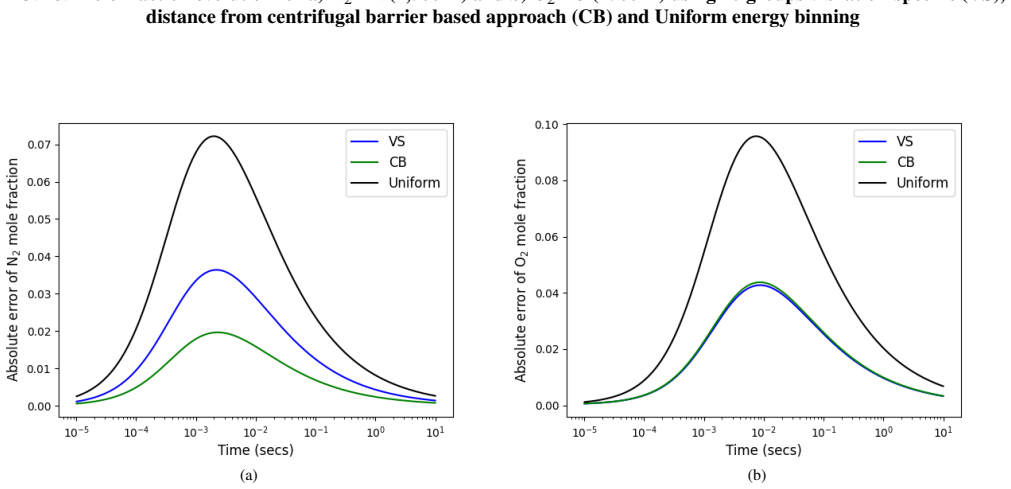
- A hybrid binning strategy, combining centrifugal-barrier grouping near dissociation with network clustering of low-lying states, reproduces state-to-state mole fractions better than uniform, vibration-specific, or barrier-only grouping.
Reading between the lines
- If the comparable O2+O timescales hold generally, reduced-order models for oxygen recombination should treat rotational and vibrational relaxation as coupled, and single-internal-temperature schemes may mispredict heat release in nozzle expansions.
- The hybrid grouping logic should transfer to other recombining molecules, such as NO, provided high-lying states are populated by barrier-mediated capture and low-lying states by resonant exchange; this is a testable extension rather than a result of this paper.
- A time-resolved experiment in a fast-expansion tube, using Raman or coherent anti-Stokes Raman spectroscopy to track rotational and vibrational temperatures separately, could directly test whether oxygen relaxes both modes on comparable timescales.
Signed reviews
Editorial analysis
A structured set of objections, weighed in public.
Referee Report
Summary. The paper presents state-to-state master equation simulations of three-body recombination and energy transfer for N2+N and O2+O in a 0-D isothermal heat bath after sudden cooling from 10,000 K. Using QCT rate coefficients from previously published potential energy surfaces, the authors track rovibrational populations, rotational and vibrational temperatures, effective recombination rate constants, and relaxation times. The central claims are that rotational equilibration is faster than vibrational for N2+N but only comparable for O2+O, that relaxation times differ between heating and cooling conditions, that recombination couples more strongly to the vibrational mode than to the rotational mode, and that a hybrid binning strategy combining centrifugal-barrier grouping and network clustering outperforms uniform, vibration-specific, and centrifugal-barrier-only binning for recombination.
Significance. If the claims are substantiated, the work would provide useful guidance for reduced-order modeling of hypersonic recombining flows, particularly the O2+O result that rotational and vibrational relaxation time scales are comparable. The strengths of the paper are its use of standard, internally consistent StS master equation machinery, externally computed QCT rate databases, and detailed rovibrational energy level descriptions; the qualitative population evolution, including preferential recombination into high-lying vibrational states and vibrational strand structure, is plausible and consistent with prior literature. The proposed hybrid binning strategy is physically motivated. However, the quantitative headline conclusions rest on relaxation-time values whose extraction procedure is never defined, and the binning claims are demonstrated only on the same two cases used to design the method, with no sensitivity or uncertainty analysis. These gaps currently prevent the quantitative conclusions from being fully assessed.
major comments (4)
- [Section III.B, Figures 10-12, Table I] The relaxation time constants P_N tau shown in Figures 10-12 and used in Table I are never defined. No formula, fitting window, initial condition, or extraction method is given for obtaining tau_r and tau_v from the master-equation temperature histories. The heating-case values are taken from Panesi et al. (ref. 9), but the manuscript does not state whether the identical extraction procedure was used for the cooling cases. Because the headline comparisons (heating vs cooling, rotational vs vibrational, and the phi coupling ratios) all depend on these values, the manuscript must specify the definition and extraction method, and ideally provide uncertainty estimates or at least a sensitivity statement regarding the fitting window.
- [Table I and Section III.B] The phi values in Table I are described as the ratio between P_B tau values for simulations with and without recombination, but the notation P_B tau is not defined consistently with the P_N tau used in the figures, and no uncertainties are reported. The statement that this ratio is 'higher for vibrational modes' and 'nearly unity for rotational modes' is the quantitative basis for the claimed recombination-vibrational coupling. As written, the reader cannot reproduce or assess the statistical significance of these ratios.
- [Section III.D, Figures 18-21] The claim that the hybrid binning strategy 'outperforms all the other binning strategies' is supported only on the two specific heat-bath cases (N2+N at 2,500 K and O2+O at 1,500 K) that were used to design and test the strategy. The number of groups (10) and the centrifugal-barrier energy-deficit cutoff (1 eV) are chosen without a sensitivity study. The paper should either add a sensitivity analysis with respect to these parameters and test on additional conditions, or restrict the conclusion to the demonstrated cases.
- [Section II.D and Figure 17] The agreement between k_Rbar and k_R* in Figure 17 is presented as a validation that the QSS dissociation rate can be used to obtain a recombination rate constant, but no derivation or error analysis is given for why the two quantities should coincide. Since k_R* is defined by imposing micro-reversibility on a QSS dissociation rate, the equality may reflect a consistency property of the QSS population distribution rather than an independent confirmation. The authors should state the conditions under which the equality is expected and quantify the discrepancy (e.g., the observed factors differ by about 2-8 percent in Table II).
minor comments (5)
- [Section IV] There is a typo in the Summary and Conclusions: 'nitroge,n' should be 'nitrogen'.
- [Figures 20-21] The captions refer to an 'adaptive' strategy while the text calls it 'hybrid'; please use one consistent name throughout.
- [Section III.B] The notation for the relaxation-time product is inconsistent: the figures use P_N tau while Table I and the text use P_B tau. Please define the symbol once and use it consistently.
- [Table I] The caption states the table lists 'relaxation time constant for vibrational and rotational modes,' but the entries are the ratios phi, not the time constants themselves; the caption should be revised.
- [Section III.D.1] The sentence 'Further analysis is needed to determine the optimal energy deficit from the centrifugal barrier' is an acknowledged limitation, but it should appear with the main binning results rather than as an aside, since the 1 eV cutoff is a free parameter of the proposed method.
Circularity Check
No circularity found: the master-equation predictions are self-contained outputs of externally supplied QCT kinetics; the undefined relaxation-time and binning concerns are rigor gaps, not circular reductions.
full rationale
The paper's central results are generated by solving the master equations (Eqs. 4-5) with state-resolved QCT rates and PESs from the literature (Varga et al. for O2+O; NASA Ames PES for N2+N). Rotational and vibrational temperatures are moments of the computed population (Eqs. 12-16), so the ordering of rotational vs vibrational relaxation is a direct simulation output, not a fitted target. The recombination rate constants are likewise defined from either the instantaneous mole-fraction derivative (Eq. 7) or the QSS dissociation rate plus equilibrium constant (Eqs. 9-11); the agreement between kbar_R and k_R* is a micro-reversibility consistency check, not an identity imposed by definition. The heating/cooling comparison imports heating relaxation times from Panesi et al. (ref. 9), a prior publication with independent content; this is self-citation, but the cited result is parameter-free and externally reviewable, so it is not load-bearing circularity. The hybrid binning is a combination of previously published CB and network-clustering ideas, tested on the same two heat-bath cases used to motivate it; this limits the strength of the generalizability claim but is not a circular reduction, since the binning is scored against full-StS mole-fraction error rather than constructed to match it. Two rigor gaps should be separated from circularity: P_N tau in Figs. 10-12 and Table I is never defined (no extraction formula or fitting window), and the heating-case tau values are taken from ref. 9 without stating whether the same extraction procedure was applied. These are reproducibility/comparability concerns, not cases where an output equals an input by construction. No step in the derivation chain reduces to its own premise.
Assumptions & free parameters
free parameters (2)
- CB energy deficit cutoff =
1 eV
- Number of groups (bins) =
10
assumptions (6)
- domain assumption QCT rate coefficients from the NASA Ames N2+N PES and Varga et al. O2+O PES are accurate and complete for the simulated conditions.
- domain assumption The master equation can be truncated to bound and quasi-bound rovibrational levels; continuum contributions and electronic excited states are neglected.
- standard math Micro-reversibility (Eqs. 1, 2, 11) is valid for constructing endothermic excitation and recombination rates from the computed exothermic QCT rates.
- domain assumption For O2, only odd rotational states are populated and the semi-classical degeneracy gi = 1/2(2J+1) is appropriate.
- domain assumption Sudden plunge into a constant-temperature heat bath in a 0-D reactor adequately represents non-equilibrium recombination in expanding hypersonic flows.
- domain assumption The heating-case relaxation times from Panesi et al. are defined and computed consistently with the cooling-case values presented here.
Cite this review
Pith. "Pith review of Master equation study of three-body recombination of nitrogen and oxygen in non-equilibrium hypersonic flows." pith.science (2026). https://pith.science/paper/SNDROMS3
@misc{pith2026250617452,
  author       = {Pith},
  title        = {Pith review of: Master equation study of three-body recombination of nitrogen and oxygen in non-equilibrium hypersonic flows},
  year         = {2026},
  howpublished = {\url{https://pith.science/paper/SNDROMS3}},
  note         = {Machine review of arXiv:2506.17452}
}
abstract
This work aims to study the energy transfer and recombination processes in N$_{2}$$\left(^{1}\sum^{+}_{g}\right)$+N$\left(^{4}S_{u}\right)$ and O$_{2}$$\left(^{3}\sum^{+}_{g}\right)$+O$\left(^{3}P_{2}\right)$ chemical systems when the system is suddenly cooled in a 0-D isothermal reactor thereby inducing strong non-equilibrium. A state-to-state (StS) study of the non-equilibrium phenomenon is crucial for developing accurate and efficient reduced-order models that can accurately capture the thermophysics involved. The gas mixture, consisting primarily of atoms at a high initial temperature of 10,000 K, is suddenly plunged into a low-temperature heat bath to simulate non-equilibrium recombination conditions. The population distribution of microscopic energy levels for each system is determined by solving a system of master equations. The conventional assumption of faster equilibration of rotational mode as compared to the vibrational mode holds for $ N_2 +N$, while it is not a very strong assumption for $ O_2 +O$ as the two relaxation time scales are comparable. Effective recombination rate constants for the quasi-steady state (QSS) period are calculated using the population distribution obtained by solving the master equations. It was also observed that the relaxation time constants for heating and cooling are different, with the time constant being lower for the cooling case due to anharmonicity effects in expanding flows. An attempt has also been made to use the insights from the StS analysis to determine an accurate binning strategy for the recombination processes involved in the two chemical systems.
Figures


Figures from the paper (16 more)




Reference graph
Works this paper leans on
-
[1]
merlin.mbs aapmrev4-1.bst 2010-07-25 4.21a (PWD, AO, DPC) hacked
FUNCTION id.bst "merlin.mbs aapmrev4-1.bst 2010-07-25 4.21a (PWD, AO, DPC) hacked" ENTRY address archive archivePrefix author bookaddress booktitle chapter collaboration doi edition editor eid eprint howpublished institution isbn issn journal key language month note number organization pages primaryClass publisher school SLACcitation series title translat...
2010
-
[2]
merlin.mbs aipauth4-1.bst 2010-07-25 4.21a (PWD, AO, DPC) hacked
FUNCTION id.bst "merlin.mbs aipauth4-1.bst 2010-07-25 4.21a (PWD, AO, DPC) hacked" ENTRY address archive archivePrefix author bookaddress booktitle chapter collaboration doi edition editor eid eprint howpublished institution isbn issn journal key language month note number organization pages primaryClass publisher school SLACcitation series title translat...
2010
-
[3]
merlin.mbs aipnum4-1.bst 2010-07-25 4.21a (PWD, AO, DPC) hacked
FUNCTION id.bst "merlin.mbs aipnum4-1.bst 2010-07-25 4.21a (PWD, AO, DPC) hacked" ENTRY address archive archivePrefix author bookaddress booktitle chapter collaboration doi edition editor eid eprint howpublished institution isbn issn journal key language month note number organization pages primaryClass publisher school SLACcitation series title translati...
2010
-
[4]
merlin.mbs apsrev4-1.bst 2010-07-25 4.21a (PWD, AO, DPC) hacked
FUNCTION id.bst "merlin.mbs apsrev4-1.bst 2010-07-25 4.21a (PWD, AO, DPC) hacked" ENTRY address archive archivePrefix author bookaddress booktitle chapter collaboration doi edition editor eid eprint howpublished institution isbn issn journal key language month note number organization pages primaryClass publisher school SLACcitation series title translati...
2010
-
[5]
merlin.mbs apsrmp4-1.bst 2010-07-25 4.21a (PWD, AO, DPC) hacked
FUNCTION id.bst "merlin.mbs apsrmp4-1.bst 2010-07-25 4.21a (PWD, AO, DPC) hacked" ENTRY address archive archivePrefix author bookaddress booktitle chapter collaboration doi edition editor eid eprint howpublished institution isbn issn journal key language month note number organization pages primaryClass publisher school SLACcitation series title translati...
2010
-
[6]
author author C. Park ,\ @noop title Nonequilibrium Hypersonic Aerothermodynamics \ ( publisher John Wiley and Sons Inc ,\ year 1990 ) NoStop
work page 1990
-
[7]
author author P. A. \ Gnoffo , author R. N. \ Gupta , \ and\ author J. L. \ Shinn ,\ @noop title Conservation equations and physical models for hypersonic air flows in thermal and chemical nonequilibrium , \ type Tech. Rep. \ ( institution NASA ,\ year 1989 ) NoStop
work page 1989
-
[8]
author author I. V. \ Adamovich , author S. O. \ Macheret , author J. W. \ Rich , \ and\ author C. E. \ Treanor ,\ title title Vibrational relaxation and dissociation behind shock waves part 1: Kinetic rate models , \ @noop journal journal AIAA \ ( year 1995 ) NoStop
work page 1995
Show all 56 references
-
[9]
author author S. P. \ Sharma , author W. M. \ Huo , \ and\ author C. Park ,\ title title Rate parameters for coupled vibration-dissociation in a generalized ssh approximation , \ @noop journal journal Journal of Thermophysics and Heat Transfer \ ( year 1992 ) NoStop
1992
-
[10]
Schwartz , author Z
author author R. Schwartz , author Z. Slawsky , \ and\ author K. Herzfeld ,\ title title Calculation of vibrational relaxation times in gases , \ @noop journal journal The Journal of Chemical Physics \ ( year 1952 ) NoStop
1952
-
[11]
Park ,\ title title Assessment of two-temperature kinetic model for ionizing air , \ @noop journal journal AIAA-87-1574 \ ( year 1987 ) NoStop
author author C. Park ,\ title title Assessment of two-temperature kinetic model for ionizing air , \ @noop journal journal AIAA-87-1574 \ ( year 1987 ) NoStop
1987
-
[12]
author author J. G. \ Kim \ and\ author I. D. \ Boyd ,\ title title Master equation analysis of post normal shock waves of nitrogen , \ @noop journal journal Journal of Thermophysics and Heat Transfer \ ( year 2015 ) NoStop
2015
-
[13]
author author J. G. \ Kim , author O. J. \ Kwon , \ and\ author C. Park ,\ title title Master equation study and nonequilibrium chemical reactions for hydrogen molecule , \ @noop journal journal Journal of Thermophysics and Heat Transfer \ ( year 2010 ) NoStop
2010
-
[14]
Panesi , author R
author author M. Panesi , author R. L. \ Jaffe , author D. W. \ Schwenke , \ and\ author T. E. \ Magin ,\ title title Rovibrational internal energy transfer and dissociation of N _2( ^1 _g^+) - N ( ^4 S _u ) system , \ 10.1063/1.4774412 journal journal Journal of Chemical Phys...
-
[15]
author author S. M. \ Jo , author S. Venturi , author M. P. \ Sharma , author A. Munafò , \ and\ author M. Panesi ,\ title title Rovibrational-specific qct and master equation study on N _2( X ^1 ^+_g) + O ( ^3 P ) and NO ( X ^2 ) + N ( ^4 S ) systems in high-energy collisions...
-
[16]
author author J. G. \ Kim \ and\ author I. D. \ Boyd ,\ title title State-resolved master equation analysis of thermochemical non-equilibrium of nitrogen , \ @noop journal journal Chemical Physics \ ( year 2013 ) NoStop
2013
-
[17]
author author D. A. \ Andrienko \ and\ author I. D. \ Boyd ,\ title title Rovibrational energy transfer and dissociation in O _2+ O collisions , \ @noop journal journal The Journal of Chemical Physics \ ( year 2016 ) NoStop
2016
-
[18]
author author R. L. \ Macdonald , author E. Torres , author T. E. \ Schwartzentruber , \ and\ author M. Panesi ,\ title title State-to-state master equation and direct molecular simulation study of energy transfer and dissociation for the N _2 - N system , \ 10.1021/acs.jpca.0...
-
[19]
Venturi , author M
author author S. Venturi , author M. P. \ Sharma , author B. Lopez , \ and\ author M. Panesi ,\ title title Data-inspired and physics-driven model reduction for dissociation: Application to the O _2 + O system , \ 10.1021/acs.jpca.0c04516 journal journal Journal of Physical Ch...
-
[20]
Munaf\` o , author S
author author A. Munaf\` o , author S. Venturi , author M. P. \ Sharma , \ and\ author M. Panesi ,\ title title Reduced-Order Modeling for Non-Equilibrium Air Flows , \ in\ @noop booktitle AIAA Scitech 2020 Forum, AIAA 2020-1226 \ ( year 2020 ) NoStop
2020
-
[21]
Sahai , author B
author author A. Sahai , author B. Lopez , author C. O. \ Johnston , \ and\ author M. Panesi ,\ title title Adaptive coarse graining method for energy transfer and dissociation kinetics of polyatomic species , \ 10.1063/1.4996654 journal journal Journal of Chemical Physics \ v...
-
[22]
author author R. L. \ Macdonald , author R. L. \ Jaffe , author D. W. \ Schwenke , \ and\ author M. Panesi ,\ title title Construction of a coarse-grain quasi-classical trajectory method. i. theory and application to N _2 – N _2 system , \ 10.1063/1.5011331 journal journal Jou...
-
[23]
author author R. L. \ Macdonald , author M. Grover , author T. Schwartzentruber , \ and\ author M. Panesi ,\ title title Construction of a coarse-grain quasi-classical trajectory method. ii. comparison against the direct molecular simulation method , \ 10.1063/1.5011332 journa...
-
[24]
author author R. L. \ Macdonald , author R. L. \ Jaffe , \ and\ author M. Panesi ,\ title title Hybrid reduced order model for N _2 -n interactions for application to dissociation and energy tranfer processes , \ @noop journal journal AIP Conference Proceedings \ ( year 2019 ) NoStop
2019
-
[25]
Colonna , author L
author author G. Colonna , author L. D. \ Pietanza , \ and\ author M. Capitelli ,\ title title Reduced two-level approach for air kinetics in recombination regime , \ @noop journal journal 27th International Symposium on Rarefied Gas Dynamics \ ( year 2011 ) NoStop
2011
-
[26]
Colonna , author L
author author G. Colonna , author L. D. \ Pietanza , \ and\ author M. Capitelli ,\ title title Macroscopic kinetic model for air in nozzle flow , \ @noop journal journal 28th International Symposium on Rarefied Gas Dynamics \ ( year 2012 ) NoStop
2012
-
[27]
Zanardi , author A
author author I. Zanardi , author A. Padovan , author D. Bodony , \ and\ author M. Panesi ,\ title title Petrov-galerkin model reduction for thermochemical nonequilibrium gas mixtures , \ @noop journal journal Journal of Computational Physics \ ( year 2025 a ) NoStop
2025
-
[28]
Zanardi , author A
author author I. Zanardi , author A. Meini , author A. Padovan , author D. Bodony , \ and\ author M. Panesi ,\ title title Petrov-galerkin model reduction for collisional-radiative argon plasma , \ @noop journal journal arXiv preprint arXiv:2506.05483 \ ( year 2025 b ) NoStop
2025 arXiv
-
[29]
Liu , author M
author author Y. Liu , author M. Panesi , author A. Sahai , \ and\ author M. Vinokur ,\ title title General multi-group macroscopic modeling for thermo-chemical non-equilibrium gas mixtures , \ 10.1063/1.4915926 journal journal Journal of Chemical Physics \ volume 142 ( year 2...
-
[30]
Neitzel , author D
author author K. Neitzel , author D. Andrienko , \ and\ author I. D. \ Boyd ,\ title title Aerothermochemical nonequilibrium modeling for oxygen flows , \ @noop journal journal Journal of Thermophysics and Heat Transfer \ ( year 2017 ) NoStop
2017
-
[31]
Munafo\`'' , author S
author author A. Munafo\`'' , author S. Venturi , author R. Macdonald , \ and\ author M. Panesi ,\ title title State-to-state and reduced-order models for recombination and energy transfer in aerothermal environments , \ @noop journal journal AIAA SciTech Forum \ ( year 2016 ) NoStop
2016
-
[32]
Capitelli , author I
author author M. Capitelli , author I. Armenise , \ and\ author C. Gorse ,\ title title State-to-state approach in the kinetics of air components under re-entry conditions , \ @noop journal journal Journal of Thermophysics and Heat Transfer \ ( year 1997 ) NoStop
1997
-
[33]
Colonna , author M
author author G. Colonna , author M. Tuttafesta , author M. Capitelli , \ and\ author D. Giordano ,\ title title Non- A rrhenius NO formation rate in one-dimensional nozzle airflow , \ @noop journal journal J. Thermophys. Heat Transfer \ volume 13 ,\ pages 372--375 ( year 1999...
1999
-
[34]
Colonna \ and\ author M
author author G. Colonna \ and\ author M. Capitelli ,\ title title Self-consistent model of chemical, vibrational, electron kinetics in nozzle expansion , \ @noop journal journal J. Thermophys. Heat Transfer \ volume 15 ,\ pages 308--316 ( year 2001 ) NoStop
2001
-
[35]
\ Pan , author T
author author T.-J. \ Pan , author T. J. \ Wilson , \ and\ author K. A. \ Stephani ,\ title title Vibrational state-specific model for dissociation and recombination of the o_ 2 (^3 ^ + _ g )+o(^ 3 p_ 2 ) system in dsmc , \ @noop journal journal The Journal of Chemical Physics...
2019
-
[36]
author author R. L. \ Macdonald ,\ title title State-to-state study of non-equilibrium recombination of oxygen and nitrogen molecules , \ @noop journal journal The Journal of Chemical Physics \ ( year 2024 ) NoStop
2024
-
[37]
Esposito , author I
author author F. Esposito , author I. Armenise , author G. Capitta , \ and\ author M. Capitelli ,\ title title O- O _2 state-to-state vibrational relaxation and dissociation rates based on quasiclassical calculations , \ @noop journal journal Chemical Physics \ ( year 2008 ) NoStop
2008
-
[38]
author author R. S. \ Chaudhry , author M. S. \ Grover , author J. D. \ Bender , author T. E. \ Schwartzentruber , \ and\ author G. V. \ Candler ,\ title title Quasiclassical trajectory analysis of oxygen dissociation via O _2 , o, and N _2 , \ @noop journal journal AIAA SciTe...
2018
-
[39]
Venturi , author R
author author S. Venturi , author R. L. \ Jaffe , \ and\ author M. Panesi ,\ title title Bayesian machine learning approach to the quantification of uncertainties on ab initio potential energy surfaces , \ 10.1021/acs.jpca.0c02395 journal journal Journal of Physical Chemistry ...
-
[40]
author author D. W. \ Schwenke ,\ title title Calculations of rate constants for the three-body recombination of H _2 in the presence of H _2 , \ 10.1063/1.455104 journal journal Journal of Chemical Physics \ volume 89 ,\ pages 2076--2091 ( year 1988 ) NoStop
-
[41]
Jaffe , author D
author author R. Jaffe , author D. W. \ Schwenke , \ and\ author G. Chaban ,\ title title Vibrational and rotational excitation and relaxation of nitrogen from accurate theoretical calculations , \ @noop journal journal 46th AIAA Aerospace Sciences Meeting and Exhibit \ ( year...
2008
-
[42]
Chaban , author R
author author G. Chaban , author R. Jaffe , author D. Schwenke , \ and\ author W. Huo ,\ title title Dissociation cross sections and rate coefficients for nitrogen from accurate theoretical calculations , \ @noop journal journal 46th AIAA Aerospace Sciences Meeting and Exhibit...
2008
-
[43]
Varga , author Y
author author Z. Varga , author Y. Paukku , \ and\ author D. G. \ Truhlar ,\ title title Potential energy surfaces for o+o2 collisions , \ @noop journal journal The Journal of Chemical Physics \ ( year 2017 ) NoStop
2017
-
[44]
author author A. C. \ Hindmarsh , author P. N. \ Brown , author K. E. \ Grant , author S. L. \ Lee , author R. Serban , author D. E. \ Shumaker , \ and\ author C. S. \ Woodward ,\ title title SUNDIALS : Suite of nonlinear and differential/algebraic equation solvers , \ @noop j...
2005
-
[45]
Munafò \ and\ author M
author author A. Munafò \ and\ author M. Panesi ,\ title title Plato: a high-fidelity tool for multi-component plasmas , \ @noop journal journal AIAA 2023 - AIAA Aviation Forum, San Diego, CA \ ( year 2023 ) NoStop
2023
-
[46]
Munaf\` o \ and\ author M
author author A. Munaf\` o \ and\ author M. Panesi ,\ title title Plato: a high-fidelity library for multicomponent gases and plasmas , \ @noop journal journal J. Thermophys. Heat Transfer \ ( year 2025 ) ,\ note in press NoStop
2025
-
[47]
Bourdon \ and\ author P
author author A. Bourdon \ and\ author P. Vervisch ,\ title title Three-body recombination rate of atomic nitrogen in low-pressure plasma flows , \ @noop journal journal Physical Review E \ ( year 1996 ) NoStop
1996
-
[48]
author author J. G. \ Kim \ and\ author S. M. \ Jo ,\ title title Modification of chemical-kinetic parameters for 11-air species in re-entry flows , \ @noop journal journal International Journal of Heat and Mass Transfer \ ( year 2021 ) NoStop
2021
-
[49]
author author I. Hurle ,\ title title Nonequilibrium flows with special reference to the nozzle-flow problem , \ @noop journal journal Proceedings of the 8th International Shock Tube Symposium \ ( year 1971 ) NoStop
1971
-
[50]
Hurle , author A
author author I. Hurle , author A. Russo , \ and\ author J. Hall ,\ title title Spectroscopic studies of vibrational nonequilibrium in supersonic nozzle flows , \ @noop journal journal Journal of Chemical Physics, Vol. 40, No.8 \ ( year 1964 ) NoStop
1964
-
[51]
MacDermott \ and\ author J
author author W. MacDermott \ and\ author J. Marshall ,\ title title Nonequilibrium nozzle expansions of partially dissociated air: A comparison of theory and electron-beam experiments , \ @noop journal journal Arnold Engineering Development Center, AEDC-TR-69-66 \ ( year 1969...
1969
-
[52]
Howard , author K
author author R. Howard , author K. Dietz , author W. McGregor , \ and\ author C. Limbaugh ,\ title title Nonintrusive nitric oxide density measurements in the effluent of core-heated airstreams , \ @noop journal journal AIAA Paper 90-1478 \ ( year June 1990 ) NoStop
1990
-
[53]
Sharma , author S
author author S. Sharma , author S. Ruffin , author W. Gillespie , \ and\ author S. Meyer ,\ title title Nonequilibrium vibrational population measurements in an expanding flow using spontaneous raman spectroscopy , \ @noop journal journal AIAA Paper 92-2855 \ ( year July 1992...
1992
-
[54]
Gillespie , author D
author author W. Gillespie , author D. Bershader , author S. Sharma , \ and\ author S. Ruffin ,\ title title Raman scattering measurements of vibrational and rotational distributions in expanding nitrogen , \ @noop journal journal AIAA Paper 93-0274 \ ( year Jan 1993 ) NoStop
1993
-
[55]
author author R. C. \ Millikan \ and\ author D. R. \ White ,\ title title Systematics of vibrational relaxation , \ @noop journal journal The Journal of Chemical Physics \ ( year 1963 ) NoStop
1963
-
[56]
author author M. S. \ Grover , author T. E. \ Schwartzentruber , author Z. Varga , \ and\ author D. G. \ Truhlar ,\ title title Vibrational energy transfer and collision-induced dissociation in O + O _2 collisions , \ @noop journal journal Journal of Thermophysics and Heat Tra...
2019
Reviewed August 15, 2026 · model on record in the stance chip above.
Discussion (0). Continue with ORCID to comment.