REVIEW 5 major objections 5 minor 1 cited by
When Every Millisecond Counts: Real-Time Anomaly Detection via the Multimodal Asynchronous Hybrid Network
T0 review · 5 major / 5 minor · reviewed 2026-08-15 · deepseek-v4-flash
Pith's one-line read A hybrid network fusing event-camera streams with RGB frames detects driving anomalies at millisecond latency while holding accuracy at or near the top of published baselines.
desk verdict A plausible multimodal fusion system with a useful new latency metric, but the paper's central 'millisecond-level' real-time claim is contradicted by its own mResponse numbers, which are over a second. read the letter →
The pith
A machine-rendered reading of the paper's core claim, the machinery that carries it, and where it could break.
The reading
What carries the argument
The load-bearing object is the asynchronous event graph. Every brightness-change event becomes a node carrying normalized pixel coordinates and a scaled timestamp; edges link nodes within a spatial and temporal radius (up to 16 neighbors), and edge features encode relative spatial offsets. A deep asynchronous graph network with spline convolution aggregates these nodes, with RGB features from the ResNet branch sampled at each node's location and concatenated in, and the fusion is deliberately unidirectional so the GNN gains appearance context without making the CNN wait for event processing. Because events carry sub-frame timestamps, this graph can produce motion features between video frames, which is the mechanism behind the paper's inter-frame anomaly detection and its low response latency; downstream, GRUs accumulate object-level temporal evidence and an attention mechanism weights anomalous objects.
What would settle it
Mount a real event camera alongside an RGB camera on a vehicle, drive or replay the ROL/DoTA-type sudden-appearance scenarios, and compare anomaly delay (mResponse and mTTA) and accuracy against the RGB-only baseline and against the same model fed v2e-converted video. If real event streams do not reproduce the inter-frame detection advantage, for instance if mResponse on real events is no better than frame-only processing or accuracy drops because the network trained on synthetic events does not generalize, then the central claim about asynchronous event processing fails.
Extended reading notes
Core claim
The paper's central claim is that asynchronous event data and frame-based imagery are complementary enough, when fused in one network, to make anomaly detection both more accurate and much faster than frame-only methods. The architecture is a ResNet appearance branch plus a deep asynchronous graph network, DAGr, whose nodes are individual brightness-change events with normalized coordinates and scaled timestamps and whose edges join events that are close in space and time; each node's features are enriched with the RGB feature sampled at its location, and a GRU with object-level attention turns the fused features into risk scores. On ROL and DoTA the method reports AUC of 0.879 and 0.896, mean time-to-accident of 2.80 and 2.78 seconds, inference near 579 FPS, and mResponse of 1.17 and 1.21 seconds, outperforming all prior baselines on response time while staying at or near the top on accuracy; the one metric where a rival (TTHF) leads is frame-level AUC. The authors additionally show the event branch detects anomalies between consecutive frames, flagging fast-appearing objects before they are visible in the next image.
Load-bearing premise
The model is trained and evaluated on event streams generated from ordinary video by the v2e converter rather than recorded by a real event camera, and the paper's own validation of that synthetic fidelity covers normal driving scenes, so the millisecond-level inter-frame detection advantage is assumed to transfer to real hardware in actual anomaly moments.
Editorial extensions
If this is right
- A detector that runs near 579 FPS and reports anomalies with sub-second mean response leaves room in the latency budget for braking and evasive planning, which is the paper's stated reason for measuring response time at all.
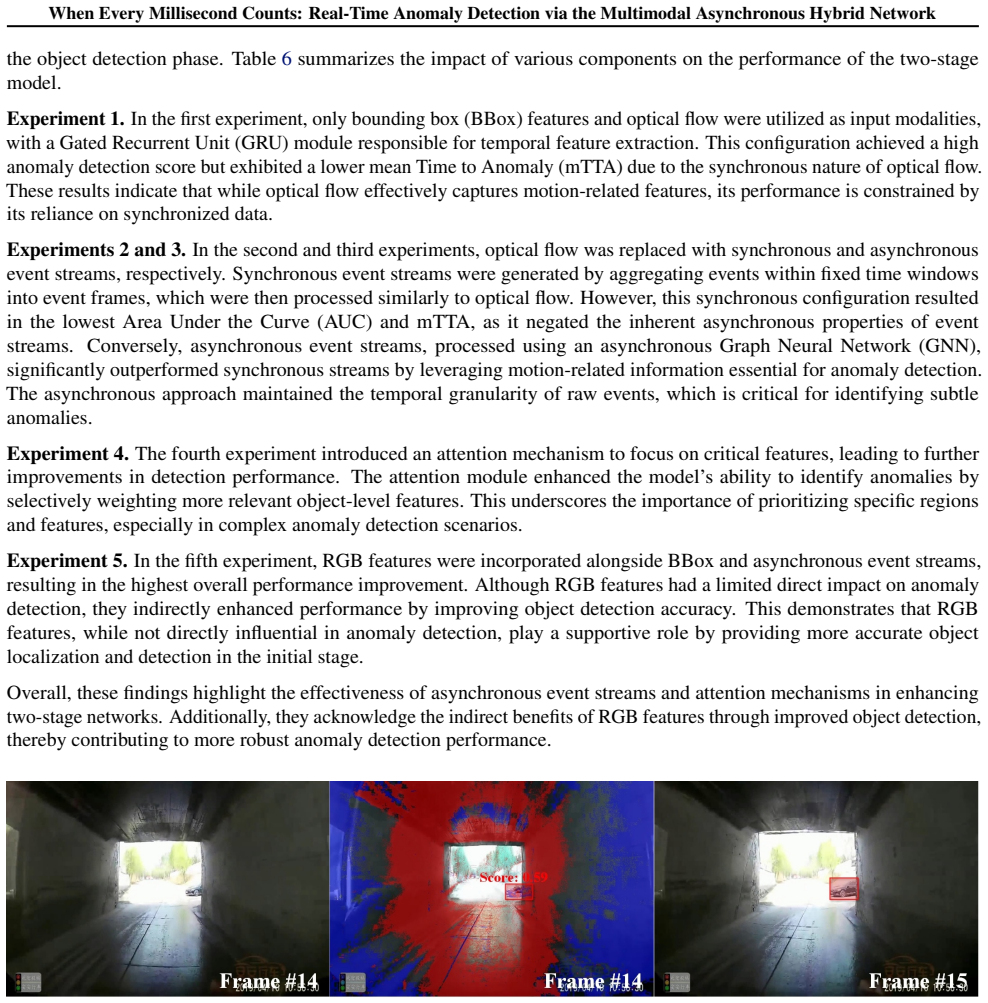
- Because event streams carry timestamps between video frames, the model can raise an anomaly score before an abruptly appearing object is visible in the next RGB frame, an inter-frame detection capability the paper demonstrates on rush-out scenarios.
- The mResponse metric, averaging detection delay across thresholds, gives a threshold-independent way to compare timeliness, and the experiments report it alongside FPS for every method.
- In adverse weather and low-light subsets, the event branch keeps detection performance well above the best frame-based baselines, since events encode brightness change rather than absolute illumination.
- The network is sized for on-board compute, with about 8.7 MFLOPs per event and roughly 87 TFLOPs worst case at high event rates, which the authors argue fits within Orin-class chip capability.
Reading between the lines
- The decisive test the paper does not run is synthetic-to-real transfer: v2e fidelity is validated on classification and normal driving scenes only, so if a physical event camera's noise, bandwidth, or calibration differs in anomaly moments, the headline latency advantage could shrink on real hardware.
- If the inter-frame advantage survives real hardware, event cameras look most plausible as a low-cost early-warning add-on to existing RGB-only stacks, targeted at sudden-appearance hazards, rather than as a replacement modality.
- The mResponse idea generalizes: any time-critical perception output, from pedestrian warning to collision trigger, could report multi-threshold latency instead of a single time-to-event number, which would make latency comparisons meaningful across systems.
- The 579 FPS figure assumes sparse event graphs; dense traffic at one to ten million events per second drives worst-case compute to roughly 87 TFLOPs, so the headline speed depends on event sparsity holding in congested scenes.
Signed reviews
Editorial analysis
A structured set of objections, weighed in public.
Referee Report
Summary. The paper proposes a multimodal asynchronous hybrid network for real-time traffic anomaly detection in autonomous driving. The method fuses RGB frames (processed with a ResNet) and event streams (processed with an asynchronous graph neural network using spline convolution), then applies GRUs and attention at the object level to produce risk scores. The authors introduce a mean response time metric (mResponse) and claim millisecond-level real-time performance, reporting improvements in AUC, AP, mTTA, and response time on the ROL and DoTA datasets. They also present ablations, a new Rush-Out subset, comparisons with other real-time methods, and appendices on synthetic event validation and hardware deployment. The event data are generated from RGB videos using v2e because the datasets lack real event camera recordings.
Significance. If the results are reproducible and the v2e-generated events are a valid proxy for real event camera signals, the paper would demonstrate a useful method for anomaly detection with lower response time than several frame-based baselines, which matters for safety-critical driving. The paper ships a code link, provides extensive ablation tables, and discusses hardware feasibility, which are strengths. However, the central 'millisecond-level real-time' claim is directly contradicted by the paper's own mResponse values (1.17 s and 1.21 s), and the event modality is simulated from the same RGB frames, so the claimed advantages of event cameras' high temporal resolution are not empirically established. The architecture may still be of interest, but the headline claims need substantial revision and additional evidence.
major comments (5)
- [Abstract / Sec. 3 / Table 1] The abstract and Section 3 claim 'millisecond-level real-time performance' and 'response times at the millisecond level,' but Table 1 reports mResponse = 1.17 s on ROL and 1.21 s on DoTA. Since Eq. (3) defines R = ΔT_detection + T_inference, these are total response times; 1.17 s is 1170 ms. Section 5.3 then calls this 'exceptionally low mean response time,' which is internally inconsistent. The 579 FPS figure supports an inference latency of roughly 1.7 ms, but the paper does not limit its claim to inference latency. Please recalibrate the headline claims to the reported metric or re-report the metric in milliseconds with a clear breakdown of inference time and detection delay.
- [Sec. 5.1 / Appendix H / Sec. 5.5] The event stream is generated from the RGB video using v2e, as stated in Section 5.1 and Appendix H. Because the events are a deterministic transformation of the same RGB frames, they do not constitute an independent sensory modality; any information in the events is already present in the RGB input. Claims in Section 5.5 and Appendix D that the method performs 'inter-frame anomaly detection' and exploits the 'high temporal resolution' of event cameras are not supported by experiments with simulated events. The DSEC comparison in Appendix H validates v2e only on normal driving scenes, not on anomaly scenes, so it does not justify transfer to anomaly detection. The authors should either test with real event data on at least a subset of anomaly videos, or substantially soften the conclusions about event-camera advantages and add an explicit argument that v2e-generated events provide a meaningful proxy.
- [Sec. 5.2, Eq. (20)] The mResponse metric, which is the primary latency metric for the paper's central claim, is not reproducibly defined. Eq. (20) gives mResponse = (1/n) Σ Response_j, but the paper does not specify how Response_j is computed, what threshold values are used, or the value of n. Without this information, Table 1's latency numbers cannot be independently checked, and the comparison to baselines is not verifiable. Please provide the full protocol, including the threshold grid and the definition of Response_j.
- [Abstract / Table 1 / Sec. 5.3] The claim of outperforming existing methods 'in both accuracy and response time' is not supported by Table 1. For ROL, TTHF achieves AP = 0.585, while OURS achieves 0.570; for DoTA, TTHF achieves AUC-Frame = 0.847, while OURS achieves 0.823. Section 5.3 states 'OURS achieves leading performance in both AUC and AP metrics,' which is contradicted by these numbers. Please revise the claims to specify the metrics on which the method is actually superior, or include error bars and significance tests to support the superiority claims.
- [Sec. 5.4, Table 2] The ablation analysis attributes specific improvements to individual modules in a way not supported by the table. The text states 'Integrating GRUs increases AUC from 0.805 to 0.817 and AP from 0.479 to 0.508,' but the row with 0.817/0.508 corresponds to adding several modules at once (row 2 has five checkmarks), not GRU alone. Without a row that adds only the GRU to the baseline, the observed gain cannot be attributed to the GRU. The same issue applies to the attention module discussion. Please add per-module ablations or revise the attribution statements.
minor comments (5)
- [Table 2 / Table 5] Table 2 and Table 5 (Appendix A) contain rows with only checkmarks; the column alignment is ambiguous, so it is impossible to determine exactly which modules are active in each row. Please add explicit row labels (e.g., '+GRU') or use check/cross marks for all columns.
- [Table 8] Table 8 reports OURS mResponse = 2.35 s on ROL, while Table 1 reports 1.17 s for the same configuration; if both tables refer to the same model, this discrepancy needs to be reconciled.
- [Appendix H, Table 9] The comparison 'DSEC' vs 'DSEC+V2E' in Appendix H is not clearly described; please clarify whether both rows use real DSEC event data or whether the second row uses v2e-generated events from DSEC frames.
- [Appendix J] The statement 'requires only 8.732 MFLOPs per event' is confusing because MFLOPs is not naturally a per-event unit when combined with the event rate of 560k events/s; please specify the total computational cost per second or per frame.
- [Table 1] Table 1 reports single-point numbers for all metrics without error bars or multiple runs, which makes it difficult to assess whether the differences between OURS and the closest baselines are statistically meaningful.
Circularity Check
No meaningful circularity: the fusion network is built from external components and evaluated on external benchmarks; the v2e-based event modality is a data-validity caveat, not a derivation step that reduces to its input.
full rationale
The paper's derivation chain is not circular. The network combines externally cited building blocks (ResNet, DAGr, GRU, attention) with an event stream generated by the external v2e simulator from the same RGB video; no equation makes the predicted anomaly score equal to a fitted input or to the v2e transformation. The event-modality contribution is weakened by the fact that v2e events are a deterministic transform of RGB frames and Appendix H admits DSEC 'only covers normal driving and lacks anomaly events', so the real-event benefit is not independently validated; however, that is an external-validity limitation, not a self-referential derivation. The mResponse metric (Sec. 5.2, Eq. 20) is underspecified (Response_j and the threshold set are not given), and the abstract's 'millisecond-level' claim conflicts with mResponse = 1.17/1.21 s in Table 1; these are internal-consistency/reproducibility problems rather than circularity. Self-citations (e.g., STFE of Zhou et al. 2022, which shares author Dong Xiao, and related-work citations by Chen/Tian) appear only as baselines or background and are not load-bearing for the central claim, so at most a trivial score of 1 is warranted.
Assumptions & free parameters
free parameters (3)
- Negative class weight =
0.27
- Event graph construction parameters (radius R, max neighbors 16) =
radius not given, neighbors = 16
- mResponse threshold set =
undefined
assumptions (3)
- domain assumption v2e-generated event streams faithfully represent real DVS event camera outputs for traffic anomaly detection, including the temporal resolution that enables inter-frame detection.
- domain assumption The YOLOX object detector provides reliable bounding boxes for all relevant agents, including small and blurred objects.
- domain assumption The event camera model in Eq. 4, where events trigger when |ΔL| > C, is a valid representation of real event sensors.
Cite this review
Pith. "Pith review of When Every Millisecond Counts: Real-Time Anomaly Detection via the Multimodal Asynchronous Hybrid Network." pith.science (2026). https://pith.science/paper/LUSYNCTP
@misc{pith2026250617457,
  author       = {Pith},
  title        = {Pith review of: When Every Millisecond Counts: Real-Time Anomaly Detection via the Multimodal Asynchronous Hybrid Network},
  year         = {2026},
  howpublished = {\url{https://pith.science/paper/LUSYNCTP}},
  note         = {Machine review of arXiv:2506.17457}
}
read the original abstract
Anomaly detection is essential for the safety and reliability of autonomous driving systems. Current methods often focus on detection accuracy but neglect response time, which is critical in time-sensitive driving scenarios. In this paper, we introduce real-time anomaly detection for autonomous driving, prioritizing both minimal response time and high accuracy. We propose a novel multimodal asynchronous hybrid network that combines event streams from event cameras with image data from RGB cameras. Our network utilizes the high temporal resolution of event cameras through an asynchronous Graph Neural Network and integrates it with spatial features extracted by a CNN from RGB images. This combination effectively captures both the temporal dynamics and spatial details of the driving environment, enabling swift and precise anomaly detection. Extensive experiments on benchmark datasets show that our approach outperforms existing methods in both accuracy and response time, achieving millisecond-level real-time performance.
Figures


Figures from the paper (7 more)




Forward citations
Cited by 1 Pith paper
-
Few-shot Human Action Anomaly Detection via a Unified Contrastive Learning Framework
A single contrastive action encoder with diffusion-based motion augmentation performs few-shot human action anomaly detection on HumanAct12 with an average AUC of 86.9%, including three categories excluded from encode...
Reference graph
Works this paper leans on
-
[1]
write newline
" write newline "" before.all 'output.state := FUNCTION n.dashify 't := "" t empty not t #1 #1 substring "-" = t #1 #2 substring "--" = not "--" * t #2 global.max substring 't := t #1 #1 substring "-" = "-" * t #2 global.max substring 't := while if t #1 #1 substring * t #2 global.max substring 't := if while FUNCTION format.date year duplicate empty "emp...
-
[2]
Drive: Deep reinforced accident anticipation with visual explanation
Bao, W., Yu, Q., and Kong, Y. Drive: Deep reinforced accident anticipation with visual explanation. In Proceedings of the IEEE/CVF International Conference on Computer Vision, pp.\ 7619--7628, 2021
work page 2021
-
[3]
Batanina, E., Bekkouch, I. E. I., Youssry, Y., Khan, A., Khattak, A. M., and Bortnikov, M. Domain adaptation for car accident detection in videos. In 2019 ninth international conference on image processing theory, tools and applications (IPTA), pp.\ 1--6. IEEE, 2019
work page 2019
-
[4]
Efficientad: Accurate visual anomaly detection at millisecond-level latencies
Batzner, K., Heckler, L., and K \"o nig, R. Efficientad: Accurate visual anomaly detection at millisecond-level latencies. In Proceedings of the IEEE/CVF Winter Conference on Applications of Computer Vision, pp.\ 128--138, 2024
work page 2024
-
[5]
H., Vora, S., Liong, V
Caesar, H., Bankiti, V., Lang, A. H., Vora, S., Liong, V. E., Xu, Q., Krishnan, A., Pan, Y., Baldan, G., and Beijbom, O. nuscenes: A multimodal dataset for autonomous driving. In Proceedings of the IEEE/CVF conference on computer vision and pattern recognition, pp.\ 11621--11631, 2020
2020
-
[6]
Freeway traffic incident detection from cameras: A semi-supervised learning approach
Chakraborty, P., Sharma, A., and Hegde, C. Freeway traffic incident detection from cameras: A semi-supervised learning approach. In 2018 21st International Conference on Intelligent Transportation Systems (ITSC), pp.\ 1840--1845. IEEE, 2018
work page 2018
-
[7]
Anticipating accidents in dashcam videos
Chan, F.-H., Chen, Y.-T., Xiang, Y., and Sun, M. Anticipating accidents in dashcam videos. In Computer Vision--ACCV 2016: 13th Asian Conference on Computer Vision, Taipei, Taiwan, November 20-24, 2016, Revised Selected Papers, Part IV 13, pp.\ 136--153. Springer, 2017
work page 2016
-
[8]
Adaptive discovering and merging for incremental novel class discovery
Chen, G., Peng, P., Huang, Y., Geng, M., and Tian, Y. Adaptive discovering and merging for incremental novel class discovery. In Proceedings of the AAAI Conference on Artificial Intelligence, volume 38, pp.\ 11276--11284, 2024
work page 2024
Show all 65 references
-
[9]
Automated essential concept discovery for few-shot out-of-distribution detection
Chen, G., Horstmann, K., Wang, Z., and You, F. Automated essential concept discovery for few-shot out-of-distribution detection. In The IEEE/CVF Conference on Computer Vision and Pattern Recognition, 2025
2025
-
[10]
Fblnet: Feedback loop network for driver attention prediction
Chen, Y., Nan, Z., and Xiang, T. Fblnet: Feedback loop network for driver attention prediction. In Proceedings of the IEEE/CVF International Conference on Computer Vision, pp.\ 13371--13380, 2023
2023
-
[11]
Chong, Y. S. and Tay, Y. H. Abnormal event detection in videos using spatiotemporal autoencoder. In Advances in Neural Networks-ISNN 2017: 14th International Symposium, ISNN 2017, Sapporo, Hakodate, and Muroran, Hokkaido, Japan, June 21--26, 2017, Proceedings, Part II 14, pp.\...
2017
-
[12]
Gorela: Go relative for viewpoint-invariant motion forecasting
Cui, A., Casas, S., Wong, K., Suo, S., and Urtasun, R. Gorela: Go relative for viewpoint-invariant motion forecasting. In 2023 IEEE International Conference on Robotics and Automation (ICRA), pp.\ 7801--7807. IEEE, 2023
2023
-
[13]
K., Winn, J., and Zisserman, A
Everingham, M., Van Gool, L., Williams, C. K., Winn, J., and Zisserman, A. The pascal visual object classes (voc) challenge. International journal of computer vision, 88: 0 303--338, 2010
2010
-
[14]
Traffic accident detection via self-supervised consistency learning in driving scenarios
Fang, J., Qiao, J., Bai, J., Yu, H., and Xue, J. Traffic accident detection via self-supervised consistency learning in driving scenarios. IEEE Transactions on Intelligent Transportation Systems, 23 0 (7): 0 9601--9614, 2022
2022
-
[15]
Vision-based traffic accident detection and anticipation: A survey
Fang, J., Qiao, J., Xue, J., and Li, Z. Vision-based traffic accident detection and anticipation: A survey. IEEE Transactions on Circuits and Systems for Video Technology, 2023
2023
-
[16]
Abductive ego-view accident video understanding for safe driving perception
Fang, J., Li, L.-l., Zhou, J., Xiao, J., Yu, H., Lv, C., Xue, J., and Chua, T.-S. Abductive ego-view accident video understanding for safe driving perception. In Proceedings of the IEEE/CVF Conference on Computer Vision and Pattern Recognition, pp.\ 22030--22040, 2024
2024
-
[17]
J., Conradt, J., Daniilidis, K., et al
Gallego, G., Delbr \"u ck, T., Orchard, G., Bartolozzi, C., Taba, B., Censi, A., Leutenegger, S., Davison, A. J., Conradt, J., Daniilidis, K., et al. Event-based vision: A survey. IEEE transactions on pattern analysis and machine intelligence, 44 0 (1): 0 154--180, 2020
2020
-
[18]
and Scaramuzza, D
Gehrig, D. and Scaramuzza, D. Low-latency automotive vision with event cameras. Nature, 629 0 (8014): 0 1034--1040, 2024
2024
-
[19]
Dsec: A stereo event camera dataset for driving scenarios
Gehrig, M., Aarents, W., Gehrig, D., and Scaramuzza, D. Dsec: A stereo event camera dataset for driving scenarios. IEEE Robotics and Automation Letters, 6 0 (3): 0 4947--4954, 2021
2021
-
[20]
R., Venkatesh, S., and Hengel, A
Gong, D., Liu, L., Le, V., Saha, B., Mansour, M. R., Venkatesh, S., and Hengel, A. v. d. Memorizing normality to detect anomaly: Memory-augmented deep autoencoder for unsupervised anomaly detection. In Proceedings of the IEEE/CVF international conference on computer vision, pp...
2019
-
[21]
and Pedraza, C
Gutierrez-Osorio, C. and Pedraza, C. Modern data sources and techniques for analysis and forecast of road accidents: A review. Journal of traffic and transportation engineering (English edition), 7 0 (4): 0 432--446, 2020
2020
-
[22]
Hanley, J. A. and McNeil, B. J. The meaning and use of the area under a receiver operating characteristic (roc) curve. Radiology, 143 0 (1): 0 29--36, 1982
1982
-
[23]
A., Rehman, F
Haris, M., Moin, M. A., Rehman, F. A., and Farhan, M. Vehicle crash prediction using vision. In 2021 55th Annual Conference on Information Sciences and Systems (CISS), pp.\ 1--5. IEEE, 2021
2021
-
[24]
K., and Davis, L
Hasan, M., Choi, J., Neumann, J., Roy-Chowdhury, A. K., and Davis, L. S. Learning temporal regularity in video sequences. In Proceedings of the IEEE conference on computer vision and pattern recognition, pp.\ 733--742, 2016
2016
-
[25]
Deep residual learning for image recognition
He, K., Zhang, X., Ren, S., and Sun, J. Deep residual learning for image recognition. In Proceedings of the IEEE conference on computer vision and pattern recognition, pp.\ 770--778, 2016
2016
-
[26]
Cost-sensitive semi-supervised deep learning to assess driving risk by application of naturalistic vehicle trajectories
Hu, H., Wang, Q., Cheng, M., and Gao, Z. Cost-sensitive semi-supervised deep learning to assess driving risk by application of naturalistic vehicle trajectories. Expert Systems with Applications, 178: 0 115041, 2021 a
2021
-
[27]
v2e: From video frames to realistic dvs events
Hu, Y., Liu, S.-C., and Delbruck, T. v2e: From video frames to realistic dvs events. In Proceedings of the IEEE/CVF conference on computer vision and pattern recognition, pp.\ 1312--1321, 2021 b
2021
-
[28]
The apolloscape dataset for autonomous driving
Huang, X., Cheng, X., Geng, Q., Cao, B., Zhou, D., Wang, P., Lin, Y., and Yang, R. The apolloscape dataset for autonomous driving. In Proceedings of the IEEE conference on computer vision and pattern recognition workshops, pp.\ 954--960, 2018
2018
-
[29]
M., Li, Y., Qin, R., and Yin, Z
Karim, M. M., Li, Y., Qin, R., and Yin, Z. A dynamic spatial-temporal attention network for early anticipation of traffic accidents. IEEE Transactions on Intelligent Transportation Systems, 23 0 (7): 0 9590--9600, 2022
2022
-
[30]
M., Yin, Z., and Qin, R
Karim, M. M., Yin, Z., and Qin, R. An attention-guided multistream feature fusion network for early localization of risky traffic agents in driving videos. IEEE Transactions on Intelligent Vehicles, 9 0 (1): 0 1792--1803, 2023
2023
-
[31]
Attention r-cnn for accident detection
Le, T.-N., Ono, S., Sugimoto, A., and Kawasaki, H. Attention r-cnn for accident detection. In 2020 IEEE intelligent vehicles symposium (IV), pp.\ 313--320. IEEE, 2020
2020
-
[32]
Graph-based asynchronous event processing for rapid object recognition
Li, Y., Zhou, H., Yang, B., Zhang, Y., Cui, Z., Bao, H., and Zhang, G. Graph-based asynchronous event processing for rapid object recognition. In Proceedings of the IEEE/CVF International Conference on Computer Vision, pp.\ 934--943, 2021
2021
-
[33]
A memory-augmented multi-task collaborative framework for unsupervised traffic accident detection in driving videos
Liang, R., Li, Y., Yi, Y., Zhou, J., and Li, X. A memory-augmented multi-task collaborative framework for unsupervised traffic accident detection in driving videos. arXiv preprint arXiv:2307.14575, 2023
2023 arXiv
-
[34]
Text-driven traffic anomaly detection with temporal high-frequency modeling in driving videos
Liang, R., Li, Y., Zhou, J., and Li, X. Text-driven traffic anomaly detection with temporal high-frequency modeling in driving videos. IEEE Transactions on Circuits and Systems for Video Technology, 2024
2024
-
[35]
Lin, T.-Y., Maire, M., Belongie, S., Hays, J., Perona, P., Ramanan, D., Doll \'a r, P., and Zitnick, C. L. Microsoft coco: Common objects in context. In Computer Vision--ECCV 2014: 13th European Conference, Zurich, Switzerland, September 6-12, 2014, Proceedings, Part V 13, pp....
2014
-
[36]
Future frame prediction for anomaly detection--a new baseline
Liu, W., Luo, W., Lian, D., and Gao, S. Future frame prediction for anomaly detection--a new baseline. In Proceedings of the IEEE conference on computer vision and pattern recognition, pp.\ 6536--6545, 2018
2018
-
[37]
H., and Li, J
Malla, S., Choi, C., Dwivedi, I., Choi, J. H., and Li, J. Drama: Joint risk localization and captioning in driving. In Proceedings of the IEEE/CVF winter conference on applications of computer vision, pp.\ 1043--1052, 2023
2023
-
[38]
Towards explainable artificial intelligence (xai) for early anticipation of traffic accidents
Monjurul Karim, M., Li, Y., and Qin, R. Towards explainable artificial intelligence (xai) for early anticipation of traffic accidents. arXiv e-prints, pp.\ arXiv--2108, 2021
2021
-
[39]
T., Popescu, M., Khan, F
Ristea, N.-C., Croitoru, F.-A., Ionescu, R. T., Popescu, M., Khan, F. S., Shah, M., et al. Self-distilled masked auto-encoders are efficient video anomaly detectors. In Proceedings of the IEEE/CVF Conference on Computer Vision and Pattern Recognition, pp.\ 15984--15995, 2024
2024
-
[40]
Memory-augmented online video anomaly detection
Rossi, L., Bernuzzi, V., Fontanini, T., Bertozzi, M., and Prati, A. Memory-augmented online video anomaly detection. In ICASSP 2024-2024 IEEE International Conference on Acoustics, Speech and Signal Processing (ICASSP), pp.\ 6590--6594. IEEE, 2024
2024
-
[41]
K., and Fukuda, A
Roy, D., Ishizaka, T., Mohan, C. K., and Fukuda, A. Detection of collision-prone vehicle behavior at intersections using siamese interaction lstm. IEEE transactions on intelligent transportation systems, 23 0 (4): 0 3137--3147, 2020
2020
-
[42]
K., Dogra, D
Santhosh, K. K., Dogra, D. P., Roy, P. P., and Mitra, A. Vehicular trajectory classification and traffic anomaly detection in videos using a hybrid cnn-vae architecture. IEEE Transactions on Intelligent Transportation Systems, 23 0 (8): 0 11891--11902, 2021
2021
-
[43]
Potential risk localization via weak labeling out of blind spot
Shimomura, K., Hirakawa, T., Yamashita, T., and Fujiyoshi, H. Potential risk localization via weak labeling out of blind spot. In Proceedings of the IEEE/CVF Conference on Computer Vision and Pattern Recognition, pp.\ 4504--4513, 2024
2024
-
[44]
Classification of crash and near-crash events from dashcam videos and telematics
Taccari, L., Sambo, F., Bravi, L., Salti, S., Sarti, L., Simoncini, M., and Lori, A. Classification of crash and near-crash events from dashcam videos and telematics. In 2018 21st International Conference on intelligent transportation systems (ITSC), pp.\ 2460--2465. IEEE, 2018
2018
-
[45]
G., Huynh, M
Tamagusko, T., Correia, M. G., Huynh, M. A., and Ferreira, A. Deep learning applied to road accident detection with transfer learning and synthetic images. Transportation research procedia, 64: 0 90--97, 2022
2022
-
[46]
Graph (graph): A nested graph-based framework for early accident anticipation
Thakur, N., Gouripeddi, P., and Li, B. Graph (graph): A nested graph-based framework for early accident anticipation. In Proceedings of the IEEE/CVF Winter Conference on Applications of Computer Vision, pp.\ 7533--7541, 2024
2024
-
[47]
Latency-aware road anomaly segmentation in videos: A photorealistic dataset and new metrics
Tian, B., Gao, H.-a., Cui, L., Zheng, Y., Luo, L., Wang, B., Zhi, R., Zhou, G., and Zhao, H. Latency-aware road anomaly segmentation in videos: A photorealistic dataset and new metrics. arXiv preprint arXiv:2401.04942, 2024
2024 arXiv
-
[48]
W., and Chanda, P
Veeramani, B., Raymond, J. W., and Chanda, P. Deepsort: deep convolutional networks for sorting haploid maize seeds. BMC bioinformatics, 19: 0 1--9, 2018
2018
-
[49]
K., Dogra, D
Vijay, T. K., Dogra, D. P., Choi, H., Nam, G., and Kim, I.-J. Detection of road accidents using synthetically generated multi-perspective accident videos. IEEE Transactions on Intelligent Transportation Systems, 24 0 (2): 0 1926--1935, 2022
1926
-
[50]
Prophnet: Efficient agent-centric motion forecasting with anchor-informed proposals
Wang, X., Su, T., Da, F., and Yang, X. Prophnet: Efficient agent-centric motion forecasting with anchor-informed proposals. In Proceedings of the IEEE/CVF Conference on Computer Vision and Pattern Recognition, pp.\ 21995--22003, 2023
2023
-
[51]
A new framework of vehicle collision prediction by combining svm and hmm
Xiong, X., Chen, L., and Liang, J. A new framework of vehicle collision prediction by combining svm and hmm. IEEE Transactions on Intelligent Transportation Systems, 19 0 (3): 0 699--710, 2017
2017
-
[52]
Classifying near-miss traffic incidents through video, sensor, and object features
Yamamoto, S., Kurashima, T., and Toda, H. Classifying near-miss traffic incidents through video, sensor, and object features. IEICE TRANSACTIONS on Information and Systems, 105 0 (2): 0 377--386, 2022
2022
-
[53]
J., and Atkins, E
Yao, Y., Xu, M., Wang, Y., Crandall, D. J., and Atkins, E. M. Unsupervised traffic accident detection in first-person videos. In 2019 IEEE/RSJ International Conference on Intelligent Robots and Systems (IROS), pp.\ 273--280. IEEE, 2019
2019
-
[54]
Yao, Y., Wang, X., Xu, M., Pu, Z., Wang, Y., Atkins, E., and Crandall, D. J. Dota: Unsupervised detection of traffic anomaly in driving videos. IEEE transactions on pattern analysis and machine intelligence, 45 0 (1): 0 444--459, 2022
2022
-
[55]
and Han, B
You, T. and Han, B. Traffic accident benchmark for causality recognition. In Computer Vision--ECCV 2020: 16th European Conference, Glasgow, UK, August 23--28, 2020, Proceedings, Part VII 16, pp.\ 540--556. Springer, 2020
2020
-
[56]
Agent-centric risk assessment: Accident anticipation and risky region localization
Zeng, K.-H., Chou, S.-H., Chan, F.-H., Carlos Niebles, J., and Sun, M. Agent-centric risk assessment: Accident anticipation and risky region localization. In Proceedings of the IEEE Conference on Computer Vision and Pattern Recognition, pp.\ 2222--2230, 2017
2017
-
[57]
Systems and methods for actor motion forecasting within a surrounding environment of an autonomous vehicle, November 2 2023
Zeng, W., Liao, R., Urtasun, R., and Liang, M. Systems and methods for actor motion forecasting within a surrounding environment of an autonomous vehicle, November 2 2023. US Patent App. 18/346,518
2023
-
[58]
Training-free anomaly event detection via llm-guided symbolic pattern discovery
Zeng, Y., Wu, H., Nie, W., Chen, G., Zheng, X., Shen, Y., Li, G., Zou, Y., Tian, Y., and Ji, R. Training-free anomaly event detection via llm-guided symbolic pattern discovery. arXiv preprint arXiv:2502.05843, 2025
2025 arXiv
-
[59]
Anonymous model pruning for compressing deep neural networks
Zhang, L., Chen, G., Shi, Y., Zhang, Q., Tan, M., Wang, Y., Tian, Y., and Huang, T. Anonymous model pruning for compressing deep neural networks. In 2020 IEEE Conference on Multimedia Information Processing and Retrieval (MIPR), pp.\ 157--160. IEEE, 2020
2020
-
[60]
Micm: Rethinking unsupervised pretraining for enhanced few-shot learning
Zhang, Z., Chen, G., Zou, Y., Huang, Z., Li, Y., and Li, R. Micm: Rethinking unsupervised pretraining for enhanced few-shot learning. In Proceedings of the 32nd ACM International Conference on Multimedia, pp.\ 7686--7695, 2024 a
2024
-
[61]
Learning unknowns from unknowns: Diversified negative prototypes generator for few-shot open-set recognition
Zhang, Z., Chen, G., Zou, Y., Li, Y., and Li, R. Learning unknowns from unknowns: Diversified negative prototypes generator for few-shot open-set recognition. In Proceedings of the 32nd ACM International Conference on Multimedia, pp.\ 6053--6062, 2024 b
2024
-
[62]
Spatio-temporal autoencoder for video anomaly detection
Zhao, Y., Deng, B., Shen, C., Liu, Y., Lu, H., and Hua, X.-S. Spatio-temporal autoencoder for video anomaly detection. In Proceedings of the 25th ACM international conference on Multimedia, pp.\ 1933--1941, 2017
1933
-
[63]
and Jiang, J
Zhou, B. and Jiang, J. Deep event-based object detection in autonomous driving: A survey. arXiv preprint arXiv:2405.03995, 2024
2024 arXiv
-
[64]
Spatio-temporal feature encoding for traffic accident detection in vanet environment
Zhou, Z., Dong, X., Li, Z., Yu, K., Ding, C., and Yang, Y. Spatio-temporal feature encoding for traffic accident detection in vanet environment. IEEE Transactions on Intelligent Transportation Systems, 23 0 (10): 0 19772--19781, 2022
2022
-
[65]
Zou, Y., Zhang, S., Chen, G., Tian, Y., Keutzer, K., and Moura, J. M. Annotation-efficient untrimmed video action recognition. In Proceedings of the 29th ACM International Conference on Multimedia, pp.\ 487--495, 2021
2021
Reviewed August 15, 2026 · model on record in the stance chip above.
Discussion (0). Continue with ORCID to comment.