REVIEW 4 major objections 5 minor 15 references
Mapping the Evolution of Research Contributions using KnoVo
T0 review · 4 major / 5 minor · reviewed 2026-08-06 · deepseek-v4-flash
Pith's one-line read KnoVo quantifies research novelty by having a large language model extract comparison dimensions from a paper's abstract and score the paper +1, 0, or −1 against related work along those dimensions.
desk verdict KnoVo is a well-described prototype for dimension- and time-aware LLM-based novelty scoring, but its aggregate score silently discards all inferiority signals and the paper offers no ground-truth validation; worth reviewing for its ideas, but not for its current claims. read the letter →
The pith
A machine-rendered reading of the paper's core claim, the machinery that carries it, and where it could break.
The reading
What carries the argument
The load-bearing mechanism is a two-stage LLM pipeline anchored by a fixed, target-derived dimension set. A dimension extraction function Λ_extract turns the target abstract into comparable "dimension: value" pairs; a comparison function Λ_compare then uses LLM function calling to judge, on those same dimensions, whether earlier, contemporary, or later papers are superior, equivalent, or inferior to the target. The resulting ternary scores populate a score matrix that feeds (i) an entropy-inspired dimension-weighting scheme producing the overall novelty score Ω, and (ii) a "best-so-far" cumulative update that yields temporal scores ν(d,i) and marginal advancement Δν(i). The fixed dimension set is what makes the pairwise comparisons transitive and aggregable; without it, superiority relative to different dimension sets would be incomparable.
What would settle it
Have domain experts independently assign +1/0/−1 comparison scores to a sample of the same paper pairs on the same extracted dimensions, and measure inter-rater agreement between the LLM and experts. If agreement is near chance, or if replacing the LLM with random scores produces indistinguishable novelty-score distributions, the proposed novelty scores cannot be said to track research novelty.
Extended reading notes
Core claim
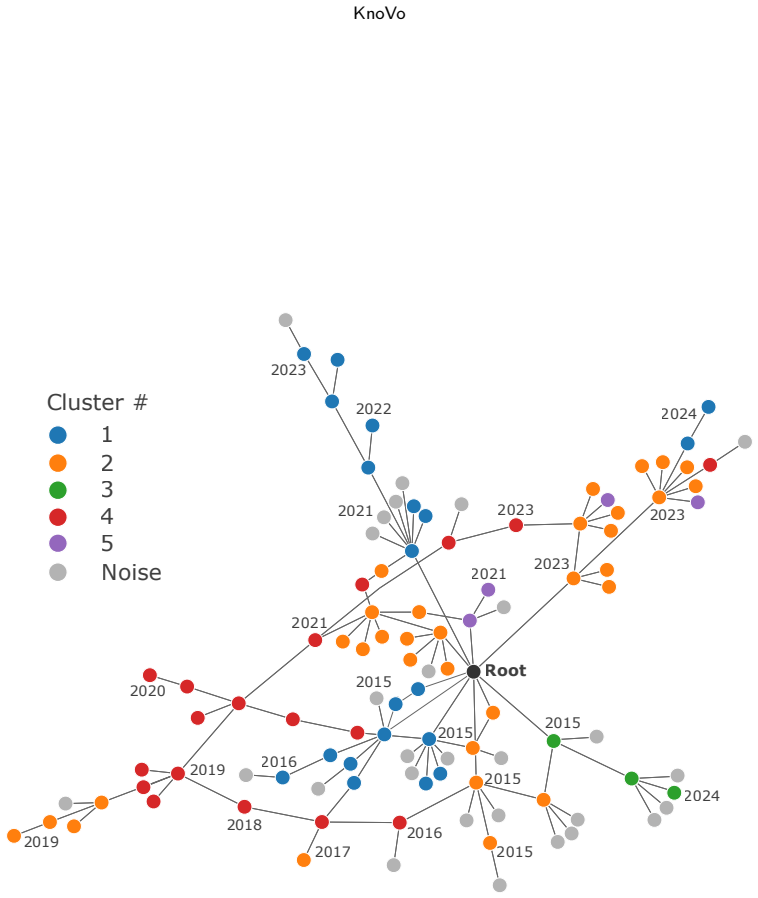
On the paper's own terms, KnoVo establishes that novelty can be operationalized as a tournament-style comparison along LLM-extracted dimensions. From a target paper's abstract, the framework dynamically derives a fixed set of "dimension: value" pairs — for example, architecture type, technique used, and BLEU scores — and then extracts the corresponding values from each related paper in a two-layer citation network. A comparison function awards +1 when the target improves on a related paper in a dimension, 0 for equivalence, and −1 for inferiority, with the −1 outcome most reliable for numerical dimensions. The paper computes an overall novelty score Ω as an entropy-weighted aggregate of these pairwise scores, and a "best-so-far" temporal comparison yields cumulative and marginal advancement scores that trace when each dimension's frontier moved. The central demonstration is that these scores separate papers with high novelty (e.g., the Transformer paper at Ω = 0.97) from those with moderate novelty (e.g., a program-equivalence paper at Ω = 0.33), and that evolution graphs recover lineages such as Encoder–Decoder to Attention to Transformer.
Load-bearing premise
The framework rests on the assumption that an LLM's judgment of whether a paper improves on, matches, or is inferior to a related paper, along an automatically extracted dimension, faithfully captures true research novelty; the paper supplies no independent ground truth and notes that inferiority judgments on categorical dimensions are unreliable.
Editorial extensions
If this is right
- If KnoVo's scores are valid, novelty becomes a computable, quantitative attribute of a paper relative to its citation neighborhood, not a subjective reviewer impression.
- Dimension-specific evolution graphs and temporal scores let researchers see which approaches were tried and abandoned, making research gaps visible and helping to redirect effort.
- Reviewers and funding agencies could use the radar-chart profiles to compare a proposal's contributions against prior art along the proposal's own stated dimensions.
- Because the method operates on abstracts and open-source LLMs, it can be applied to arbitrary document sets, not just formal citation networks.
Reading between the lines
- A direct testable extension is to validate KnoVo's pairwise judgments against human expert ratings on the same extracted dimensions; agreement rates would quantify how much of the score is signal.
- The entropy-inspired weighting rewards dimensions on which the target happens to win, so a paper's score partly reflects the choice of dimensions; because dimensions come from the target's own abstract, this could inflate scores for papers whose claims are already framed favorably.
- If temporal advancement scores predict future citation impact, KnoVo's output would become a forecasting tool for scientific influence — a claim the paper does not make but its data could test.
- The paper's own caveat that −1 is unreliable for categorical dimensions implies the overall scores that include such judgments are the least trustworthy part of the pipeline; restricting −1 to numeric dimensions would change many reported Ω values.
Editorial analysis
A structured set of objections, weighed in public.
Referee Report
Summary. The paper presents KnoVo, an automated framework that uses open-source LLMs to quantify research novelty. KnoVo dynamically extracts comparison dimensions from a target paper's abstract, compares the target against related papers along those dimensions using ternary (+1/0/−1) judgments, and aggregates the results into an overall novelty score Ω, temporal cumulative scores, and dimension-level evolution graphs. The authors demonstrate the pipeline on 20 papers from multiple fields and compare several local LLMs. The central claim is that these scores provide a quantitative, dimension-specific, temporally aware measure of a paper's novelty relative to both prior and subsequent work.
Significance. If validated, KnoVo would be a useful practical contribution: it offers a transparent, explainable, open-source alternative to black-box novelty scoring, and its temporal evolution graphs and dimension-specific analyses go beyond simple citation counts. The paper also provides a systematic comparison of local LLMs for structured extraction and comparison tasks, which is of practical value. However, the significance is currently limited because the core measurement is not validated against any ground truth, and the aggregation formula has a structural flaw that undermines the claim that inferiority is reflected in Ω.
major comments (4)
- [§3.3.1 (Eq. 7 and Algorithm 1)] The weighting scheme w'_d = P_d(1) assigns zero weight to any dimension whose comparisons contain no +1 scores, regardless of how many −1 (inferiority) scores it contains. Consequently, Ω is insensitive to inferiority in exactly those dimensions where the target is never superior. For example, with two dimensions D_A (10 comparisons all +1) and D_B (10 comparisons all −1), the formulas give w_A=1, w_B=0, Score_A=1, Score_B=−1, so Ω=1.0—identical to a target that is superior on both dimensions. This contradicts the abstract's claim that the scores reflect "relative improvement, equivalence, or inferiority." The weighting must be revised, for instance by using an importance measure that does not vanish when P_d(1)=0, or the scope of Ω must be explicitly restricted to improvement-only aggregation.
- [§3.3.1 and §3.3.2] The weighting is circular: the same LLM judgments that populate Score_d are used to set the dimension weights via P_d(1). A dimension receives more weight precisely when the LLM happens to award +1, and Score_d is itself highest when P_d(1) is high. Thus Ω double-counts the LLM's positive judgments and is not an independent aggregation of evidence. This is not a question of external validity; it is an internal property of the estimator. Please provide a justification for why P_d(1) is an appropriate importance measure, or replace it with a measure derived independently of the comparison outcomes (e.g., from dimension extraction frequency or human input).
- [§4.3 (Validation)] The validation section offers no ground-truth comparison. It reports only a qualitative review of LLM-generated justifications and states that assessments "generally align with an expert understanding," without providing any quantitative evidence such as inter-annotator agreement, human expert novelty ratings, or correlation with existing novelty metrics (e.g., Uzzi et al.'s atypicality or RAG-Novelty scores). Without such evidence, the central claim that KnoVo "quantifies research novelty" is unsupported. The manuscript should include a human-evaluation study or a benchmark comparison against established novelty measures.
- [§3.5.2 and Algorithm 2] The paper concedes that −1 judgments are unreliable for categorical dimensions (§3.5.2), and the temporal scoring in Algorithm 2 only increments on +1, never decrements on −1. Combined with the weighting issue in §3.3.1, inferiority is effectively absent from both the aggregate and temporal representations. This should be acknowledged explicitly as a limitation, or the framework should be extended to handle negative evidence in a principled way.
minor comments (5)
- [General] There are several typos and inconsistencies, including "Mowcow" for "Moscow" (title page), "KOKNOWLEDGEORGANIZATION" in the reference to Chen and Fang, and inconsistent use of "KNOVO" vs "KnoVo" in the abstract and body.
- [Table 4] Table 4 lists "Attention is All you Need" with a 2023 publication year for Vaswani et al., while the reference list gives 2017; please correct the year. The table also spells "Attention is Not All You Need" in the text at §4.2.2 where the intended title is clearly "Attention is All You Need."
- [§4.2.2] The text states that Vaswani et al. achieves Ω=0.97, but Table 4 reports Ω=0.8936 for that paper; this discrepancy should be reconciled.
- [§3.3.2] Algorithm 2 iterates over all papers in R, which includes the target paper T placed in chronological order, but the relationship between T and the best-so-far state β(d,i−1) is not clearly distinguished from the treatment of other papers; please clarify how the target's own temporal score is computed and whether it is compared against itself.
- [§3.6 and §4.1.2] The prompt templates are described only at a high level; for reproducibility, the full prompts (or a link to them) should be included as supplementary material, particularly since prompt design is central to the method's behavior.
Circularity Check
KnoVo's Ω and temporal novelty scores are reweighted echoes of the LLM's own +1 comparison judgments; inferiority-only dimensions are zeroed by construction.
-
self definitional
[Sec. 3.3.1 (Overall Novelty Score Ω), equations for w'_d, Score_d, and Ω]
"Dimension Importance Weighting: ... In our context, this density reflects the frequency with which T introduces advancements (S(d,R_i)=1) relative to the compared papers R_i. ... The raw weight w′d is therefore set directly proportional to this measure, using the proportion P_d(1): w′d = P_d(1) ... Dimension Score Calculation: ... Score_d = P_d(1)+(α·P_d(0))−P_d(−1) ... Final Weighted Aggregation: Ω = Σ w_d · Score_d"
The weight w_d is P_d(1)/Σ_j P_j(1), so a dimension matters exactly in proportion to how often Λcompare already output +1, and Score_d adds the same P_d(1) again. Hence Ω is a self-weighted sum of the LLM's own improvement judgments. If a dimension has P_d(1)=0 but P_d(−1)>0, w_d=0 and its −1 scores are multiplied out, so the aggregate cannot represent inferiority unless the same dimension also contains a +1. The 'Information Density' rationale defines importance by the outcome being measured, making the claimed 'relative improvement, equivalence, or inferiority' score definitionally blind to inferiority-only dimensions.
-
self definitional
[Sec. 3.3.2 and Sec. 3.5.3 (ν update and best-so-far rationale)]
"An advancement is formally registered (S(d,R_i)=1), thus incrementing the cumulative score ν(d,i), only when the current paper's value v_i,d is measured by Λcompare as superior to the prior best state represented by β(d,i−1)."
Temporal 'advancement' is defined as the LLM comparison output +1. Consequently ν(d,i), ν(i), and Δν(i) are not independent measurements of knowledge evolution; they are counts of Λcompare's +1 judgments divided by |D|. The paper labels Δν(i) as 'the average advancement across dimensions attributable specifically to paper R_i', but by construction it is just the fraction of dimensions on which the same LLM emitted +1 at that step. The evolution curve is a renamed trace of the input comparisons, not a derived result.
full rationale
No load-bearing self-citations or imported uniqueness theorems appear: the reference list contains no overlapping-author citations, and the implementation is locally described. The circularity is in the score definitions. Ω is built from the same pairwise LLM judgments twice: P_d(1) sets the dimension weight and also dominates Score_d, so a dimension contributes to the aggregate only when the LLM already judged the target superior on it. A dimension with only −1 outcomes receives w_d=0 and is dropped, making the advertised 'inferiority' component of the novelty score mathematically invisible in the aggregate. The temporal novelty scores are likewise exact counts of the LLM's +1 outputs renamed as cumulative and marginal advancement. Thus the central quantitative outputs reduce by construction to the framework's own comparison inputs; the 20-paper study and qualitative review in Sec. 4.3 do not supply an external criterion that would break the circularity. Overall: partial but genuine circularity, score 6.
Assumptions & free parameters
free parameters (5)
- Equivalence weight alpha =
0.5
- Edge score exponent gamma =
1
- Edge score exponent delta =
1
- Citation cap per layer =
50
- DBSCAN parameters =
Not specified
assumptions (5)
- domain assumption LLM can extract comparable dimensions and values from abstracts
- domain assumption LLM pairwise comparisons (+1, 0, -1) are reliable measures of research novelty
- ad hoc to paper The dimension set extracted from the target paper is a fixed axiom for all comparisons
- domain assumption Citation networks reflect the relevant related literature
- ad hoc to paper Information density measured by P_d(1) is a valid proxy for dimension importance
Cite this review
Pith. "Pith review of Mapping the Evolution of Research Contributions using KnoVo." pith.science (2026). https://pith.science/paper/QRK6YCRF
@misc{pith2026250617508,
  author       = {Pith},
  title        = {Pith review of: Mapping the Evolution of Research Contributions using KnoVo},
  year         = {2026},
  howpublished = {\url{https://pith.science/paper/QRK6YCRF}},
  note         = {Machine review of arXiv:2506.17508}
}
read the original abstract
This paper presents KnoVo (Knowledge Evolution), an intelligent framework designed for quantifying and analyzing the evolution of research novelty in the scientific literature. Moving beyond traditional citation analysis, which primarily measures impact, KnoVo determines a paper's novelty relative to both prior and subsequent work within its multilayered citation network. Given a target paper's abstract, KnoVo utilizes Large Language Models (LLMs) to dynamically extract dimensions of comparison (e.g., methodology, application, dataset). The target paper is then compared to related publications along these same extracted dimensions. This comparative analysis, inspired by tournament selection, yields quantitative novelty scores reflecting the relative improvement, equivalence, or inferiority of the target paper in specific aspects. By aggregating these scores and visualizing their progression, for instance, through dynamic evolution graphs and comparative radar charts, KnoVo facilitates researchers not only to assess originality and identify similar work, but also to track knowledge evolution along specific research dimensions, uncover research gaps, and explore cross-disciplinary connections. We demonstrate these capabilities through a detailed analysis of 20 diverse papers from multiple scientific fields and report on the performance of various open-source LLMs within the KnoVo framework.
Figures


Figures from the paper (7 more)




Reference graph
Works this paper leans on
-
[1]
Y. Zhao, C. Zhang, A review on the novelty measurements of academic papers, Scientometrics (2025) 1–27. R. K. Amplayo, S.-w. Hwang, M. Song, Evaluating research novelty detection: Counterfactual approaches, in: Proceedings of the thirteenth workshop on graph-based methods for natural language processing (TextGraphs-13), 2019, pp. 124–133. Y. Yan, S. Tian,...
arXiv 2025
-
[3]
URL: https://mistral.ai/news/mistral-small-3-1, accessed: 2025-04-30. J.G.Foster,A.Rzhetsky,J.A.Evans, Traditionandinnovationinscientists’researchstrategies, Americansociologicalreview80(2015)875–908. C. S. Wagner, T. A. Whetsell, S. Mukherjee, International research collaboration: Novelty, conventionality, and atypicality in knowledge recombination, Rese...
work page 2015
-
[7]
OpenAI, Gpt-4 technical report,
Accessed: 2025-05-19. OpenAI, Gpt-4 technical report,
work page 2025
-
[8]
Anthropic, The claude 3 model family: Opus, sonnet, haiku, Anthropic (2024)
URL: https://arxiv.org/abs/2303.08774.arXiv:2303.08774. Anthropic, The claude 3 model family: Opus, sonnet, haiku, Anthropic (2024). G.Team,M.Riviere,S.Pathak,P.G.Sessa,C.Hardin,S.Bhupatiraju,L.Hussenot,T.Mesnard,B.Shahriari,A.Ramé,etal., Gemma2:Improving open language models at a practical size, arXiv preprint arXiv:2408.00118 (2024). B.Churchill,O.Padon...
arXiv 2024
-
[9]
URL: https://arxiv.org/abs/1706.03762.arXiv:1706.03762. J. Devlin, M.-W. Chang, K. Lee, K. Toutanova, Bert: Pre-training of deep bidirectional transformers for language understanding,
-
[11]
URL: https://arxiv.org/abs/2403.01680.arXiv:2403.01680. G. DeCandia, D. Hastorun, M. Jampani, G. Kakulapati, A. Lakshman, A. Pilchin, S. Sivasubramanian, P. Vosshall, W. Vogels, Dynamo: amazon’s highly available key-value store, SOSP ’07, Association for Computing Machinery, New York, NY, USA, 2007, p. 205–220. URL: https://doi.org/10.1145/1294261.1294281...
arXiv 2008
-
[510]
S. P. Jordan, K. S. M. Lee, J. Preskill, Quantum algorithms for quantum field theories, Science 336 (2011) 1130 –
work page 2011
-
[821]
K.M.Roosa,Y.Lee,R.Luo,A.S.Kirpich,R.B.Rothenberg,J.M.Hyman,P.Yan,G.Chowell, Real-timeforecastsofthe2019-ncovepidemicin china from february 5th to february 24th, 2020, arXiv: Populations and Evolution (2020). P.Christopher,J.L.Murray,N.Rabiee, Globalburdenof369diseasesandinjuriesin204countriesandterritories,1990–2019:asystematicanalysis for the global burd...
work page 2020
Show all 15 references
-
[1133]
Farrelly, J
T. Farrelly, J. Streich, Discretizing quantum field theories for quantum simulation, arXiv: Quantum Physics (2020). P. R. Rosenbaum, D. B. Rubin, The central role of the propensity score in observational studies for causal effects, Biometrika 70 (1983) 41–55. J. D. Angrist, J....
2020
-
[1222]
A. Y. Kitaev, Fault tolerant quantum computation by anyons, Annals of Physics 303 (1997) 2–30. F. Arute, K. Arya, R. Babbush, D. Bacon, J. C. Bardin, R. Barends, R. Biswas, S. Boixo, F. G. S. L. Brandão, et al., Quantum supremacy using a programmable superconducting processor,...
1997
-
[2008]
Attention is All You Need
URL: https://api.semanticscholar.org/CorpusID: 63231051. S. Mullainathan, J. Spiess, Machine learning: An applied econometric approach, Journal of Economic Perspectives 31 (2017) 87–106. D. Trudel, L. S. Horowitz, M. Wormuth, M. Scheringer, I. T. Cousins, K. Hungerbühler, Esti...
2017
-
[2019]
URL: https://arxiv.org/abs/1810.04805.arXiv:1810.04805. J. Deng, H. Zhang, K. Ding, J. Hu, X. Zhang, Y. Wang, Zero-shot generalizable incremental learning for vision-language object detection,
-
[2023]
Accessed: 2025-06-14. W. Ammar, D. Groeneveld, C. Bhagavatula, I. Beltagy, M. Crawford, D. Downey, J. Dunkelberger, A. Elgohary, S. Feldman, V. Ha, R. Kinney, S. Kohlmeier, K. Lo, T. Murray, H.-H. Ooi, M. Peters, J. Power, S. Skjonsberg, L. L. Wang, C. Wilhelm, Z. Yuan, M. van...
2025
-
[2024]
OpenAI, J
URL: https: //arxiv.org/abs/2409.16605.arXiv:2409.16605. OpenAI, J. Achiam, S. Adler, Others, Gpt-4 technical report,
-
[2025]
URL: https://arxiv.org/abs/2503.19786.arXiv:2503.19786. A. Dubey, A. Jauhri, A. Pandey, A. Kadian, A. Al-Dahle, A. Letman, A. Mathur, A. Schelten, A. Yang, A. Fan, et al., The llama 3 herd of models, arXiv preprint arXiv:2407.21783 (2024). Mistral AI, Mistral Small 3.1,
2024 arXiv
Reviewed August 6, 2026 · model on record in the stance chip above.
Discussion (0). Continue with ORCID to comment.