REVIEW 3 major objections 4 minor 34 references
EQuARX: Efficient Quantized AllReduce in XLA for Distributed Machine Learning Acceleration
T0 review · 3 major / 4 minor · reviewed 2026-08-15 · deepseek-v4-flash
Pith's one-line read EQuARX, a native XLA int8 AllReduce on TPUs, cuts collective time to about 55 percent of BF16 and speeds Gemma 3 prefill by up to 1.28 times.
desk verdict Solid TPU compiler engineering with internally consistent speedups, but the paper's own significance test contradicts the 'negligible quality impact' claim that anchors the trade-off. read the letter →
The pith
A machine-rendered reading of the paper's core claim, the machinery that carries it, and where it could break.
The reading
What carries the argument
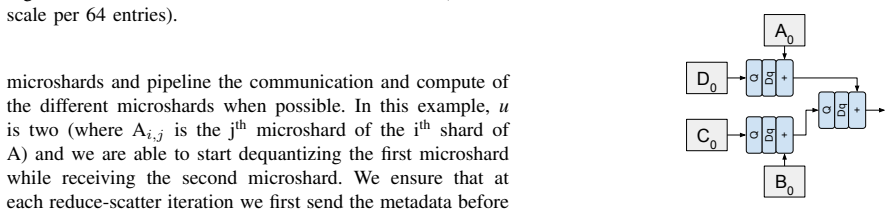
The load-bearing mechanism is dynamic block-wise symmetric int8 quantization fused into a ring-based reduce-scatter. For each shard, EQuARX computes 8x128 scale factors by an absolute-value maximum reduction over VPU-friendly 2D chunks (one FP32 scale per 64 entries for the default block size), then quantizes in two phases: Qp1 computes the metadata and Qp2 scales the data. Receivers dequantize each incoming microshard to FP32 before adding, so all arithmetic on partial sums stays in high precision and only the wire bytes are int8. Deep pipelining splits shards into microshards, sends metadata first, and overlaps dequantize-add of one microshard with reception of the next; the full-loop ring is bandwidth-optimal (N-1 hops) and the semi-loop ring uses both directions to halve the number of quantization hops at some bandwidth cost.
What would settle it
Run EQuARX int8 with block size 64 on real prefill activations recorded from a third model family and compare the AllReduce output to the BF16 baseline: if the mean squared error rises materially above the 0.0014 reported for standard-normal tensors, or if downstream accuracy drops beyond the HellaSwag and AGIEval margins on 27B, the scheme's accuracy claim fails.
Extended reading notes
Core claim
On its own terms, EQuARX claims that the reduce-scatter half of AllReduce can run in int8 while preserving the quality of the sum, as long as each transmitted shard is dynamically block-wise quantized and every received shard is dequantized to FP32 before the partial-sum addition. Shards are divided into 8x128 chunks that match the TPU's vector registers, one FP32 scale factor is computed per chunk (block size 64 in the example), and metadata is sent before the data so receivers can dequantize immediately. Microshard pipelining overlaps quantization and dequantization with network transfers, removing most of the compute overhead. With both reduce-scatter and all-gather quantized, full-loop EQuARX reaches about 55 percent of BF16 AllReduce runtime (a 1.8x speedup), within 10 percent of the ideal for halving data volume, and the semi-loop variant trades some throughput for lower accumulated error.
Load-bearing premise
The accuracy claims rest on the untested-in-general assumption that one FP32 scale per 64 values keeps quantized inter-device sums close enough to the BF16 result for arbitrary LLM activation distributions, since the paper gives no formal error bound and measures error only on N(0,1) tensors and two Gemma models.
Editorial extensions
If this is right
- For tensors above roughly 2 MiB, EQuARX reduces AllReduce time to about 55 percent of the BF16 baseline—a 1.8x speedup—while tensors below that size remain latency-bound and gain little.
- Quantizing both the reduce-scatter and all-gather stages yields the largest speedup with a mean squared error of 0.0014 on standard-normal data, about two orders of magnitude lower than a naive FP8 AllReduce at comparable speed.
- The semi-loop variant lowers accumulated error (MSE 0.001 versus 0.0014) at a reduced 1.6x speedup, and quantizing only the all-gather gives the smallest error (0.0003) at 1.3x, giving users an explicit accuracy-throughput knob.
- On Gemma 3, EQuARX speeds the prefill stage by up to 1.28x for the 27B model and 1.1x for the 12B model, with most benchmark differences within noise; the two statistically significant 27B drops are HellaSwag and AGIEval.
- Because the decode-stage AllReduce is latency-bound, EQuARX is applied only to prefill, so its gains are specific to bandwidth-bound collectives with large tensors.
Reading between the lines
- The same microshard-pipelined, VPU-shaped block quantization could be applied to other bandwidth-bound collectives, such as the reduce-scatter used in data-parallel training, but training convergence under repeated quantized reductions is not demonstrated in this paper.
- The block size of 64 is tied to TPU register geometry rather than to activation statistics, so an adaptive per-layer or per-tensor block size is a natural testable extension that could reclaim accuracy where HellaSwag and AGIEval showed significant drops.
- If future TPU generations raise interconnect bandwidth faster than vector-unit throughput, the quantization compute that is currently hidden behind communication may become the bottleneck, requiring deeper pipelining or cheaper metadata computation.
- The near-roofline efficiency of the scheme implies most of the gain comes from halving wire bytes, so comparable speedups should appear on any bandwidth-bound torus topology, not only the 2x2 and 4x4 configurations tested.
Signed reviews
Editorial analysis
A structured set of objections, weighed in public.
Referee Report
Summary. The paper presents EQuARX, a native XLA implementation of block-wise dynamic int8 quantization for AllReduce on TPUs. It contributes deep pipelining of quantization/dequantization with communication, a VPU-friendly 8x128 block-wise scaling scheme, and two ring variants (full-loop and semi-loop) with options to quantize the reduce-scatter stage, the all-gather stage, or both. Microbenchmarks on TPU v5e report that int8 EQuARX reduces AllReduce execution time to about 55% of a BF16 baseline for large tensors, close to the roofline for halving transferred data, with measured speedups of about 1.8x and an MSE of 0.0014 on a synthetic N(0,1) tensor. On Gemma 3, the paper reports 1.1x prefill speedup for the 12B model and up to 1.28x for the 27B model, while claiming small to negligible quality impact. The speedup evidence is internally consistent, but the quality claim is weakened by the paper's own statistically significant drops on HellaSwag and AGIEval for the 27B model.
Significance. If the results hold after revision, EQuARX is a practically valuable contribution: it is a compiler-integrated, topology-aware collective that converts part of the AllReduce bandwidth win into measured end-to-end prefill speedups on production-scale models, with transparent comparison to a roofline. The paper reports measured outcomes rather than fitting constants, uses standard benchmarks, and includes statistical significance checks; the microbenchmark speedup claims are plausible and well explained by the pipelining design. The main weakness is the accuracy side of the trade-off: the synthetic error measurement and the statistically significant task regressions do not support the blanket "small to negligible" quality claim. With a recalibrated quality assessment and a stronger error characterization, the contribution would be solid.
major comments (3)
- [V, Table I; Abstract; Conclusion] The qualitative claim that EQuARX has 'small to negligible' quality impact is contradicted by the paper's own significance results. For Gemma 3 27B, HellaSwag drops from 83.26 to 81.46 (-1.80 points) and AGIEval from 67.44 to 64.86 (-2.58 points), and Section V states that both are statistically significant at p=0.05. These are task-dependent, statistically significant regressions on the two largest evaluation sets (N=10042 and N=2340), so the blanket characterization in the abstract and conclusion is too strong. Because quality degradation is the cost side of the speedup/accuracy trade-off, the central claim as stated needs either softened wording or additional evidence, such as per-task confidence intervals, an aggregate quality analysis, or results on additional model sizes and sharding configurations, showing that the drops are acceptable in context.
- [IV-A, Fig. 7] The microbenchmark error characterization rests on a single tensor sampled from N(0,1) on one topology, with no confidence intervals or repeated trials. The paper reports MSE 0.0014 for the fastest EQuARX flavor but provides no distributional evidence that quantization errors at actual AllReduce boundaries in Gemma prefill resemble this synthetic case, and no formal error bound is derived for the block-wise dynamic scheme. Since the end-to-end quality impact is the load-bearing cost of the method, the authors should measure error on realistic activation distributions from the evaluated models or provide an analytical error analysis, and report variability across trials.
- [V, Table I] The claim that 'EQuARX results in small to negligible accuracy drop across all tasks' is not supported by the table even setting statistical significance aside: the 12B model shows -2.80 on MBPP and -2.60 on MedQA with full-loop, and the 27B model shows -1.80 on MedQA and -2.58 on AGIEval. The authors do report that the smaller-n tasks are not statistically significant, but no confidence intervals are given for any metric, so the reader cannot assess the precision of the reported drops. Please report confidence intervals or standard errors for the accuracy metrics and avoid 'negligible' for point estimates of this size.
minor comments (4)
- [III-C] Please clarify the derivation of the bandwidth lower bounds. As written, the full-loop bound (N-1)D/(2NB) appears to differ from the standard ring reduce-scatter bound by a factor of two, and the precise role of B as per-direction bandwidth in the bidirectional semi-loop variant should be defined more carefully.
- [Fig. 7] The axis labels contain typos: 'Mean Sqaured Error' and 'basline' should be 'Mean Squared Error' and 'baseline'.
- [III-B] Minor wording issues: 'to to determine' and 'result in under utilizing' should be cleaned up.
- [V] The end-to-end evaluation covers only two model sizes and one sharding configuration each (4x4 for 27B, 2x2 for 12B). Please discuss the extent to which the reported quality and speedup results generalize to other topologies and model families.
Circularity Check
No circularity: EQuARX's speedup and accuracy claims are measured against independent BF16 baselines and external benchmarks, with no fitted parameter renamed as a prediction.
full rationale
EQuARX's central claims are empirical rather than derived from fitted constants. Fig. 6 reports measured normalized AllReduce time for int8 EQuARX versus a BF16 baseline, and Fig. 7 plots measured speedup against measured MSE on tensors sampled from N(0,1). The 'ideal' 2x-compression reference is a roofline (halving transferred bytes with no quantization compute and no metadata), not a quantity fitted from EQuARX's own parameters, so comparing against it is not circular. The block size of 64 is a design choice, but the paper does not select it to force a target result; it exposes full-loop/semi-loop and RS/AG-only variants and reports the resulting trade-offs. End-to-end quality numbers are measured on Gemma 3 12B/27B against a BF16 AllReduce baseline and external benchmarks (HellaSwag, AGIEval, etc.), with no fitted constants entering the accuracy computation. The paper's own significance statement ('for 27B the HellaSwag and AGIEval were (N=10042 and 2340, respectively)') undercuts the abstract's 'small to negligible' phrasing, but that is an overgeneralization in the accuracy claim, not a circular derivation: the accuracy numbers are not defined in terms of the conclusion. No load-bearing self-citation chain appears; citations to prior collective-communication and quantization work are contextual. Hence no step reduces by construction to its inputs.
Assumptions & free parameters
free parameters (3)
- block size (entries per scale factor) =
64 entries (8x128 block with m=1)
- microshard count u =
2 in the example
- minishard count m =
1 in the example
assumptions (3)
- domain assumption Symmetric int8 quantization with per-block scale factors preserves AllReduce accuracy for the tested distributions.
- standard math Ring-based reduce-scatter followed by all-gather is bandwidth-optimal and remains the right algorithmic skeleton.
- domain assumption TPU VPU operations on 8x128 chunks are representative of the cost model for quantization overhead.
Cite this review
Pith. "Pith review of EQuARX: Efficient Quantized AllReduce in XLA for Distributed Machine Learning Acceleration." pith.science (2026). https://pith.science/paper/HO75WA3B
@misc{pith2026250617615,
  author       = {Pith},
  title        = {Pith review of: EQuARX: Efficient Quantized AllReduce in XLA for Distributed Machine Learning Acceleration},
  year         = {2026},
  howpublished = {\url{https://pith.science/paper/HO75WA3B}},
  note         = {Machine review of arXiv:2506.17615}
}
read the original abstract
While Large Language Models (LLMs) have become highly influential, their enormous scale presents significant deployment challenges. Efficiently serving these models typically requires distributing them across numerous accelerator devices, which introduces substantial performance overhead from inter-device communication (collectives). While model quantization has been widely adopted to reduce the memory and compute requirements of LLM weights and activations with minimal quality impact, applying quantization directly to collectives like AllReduce is inherently difficult due to the inter-device summation involved, which can lead to numerical instability or significant error accumulation. In this work, we present a native dynamic block-wise efficient quantized AllReduce within the XLA compiler for TPUs (EQuARX). By using TPU-friendly quantization and deep pipelining of communication and compute, EQuARX with int8 precision achieves a 1.8X speedup over baseline BF16 AllReduce across various network topologies. Furthermore, EQuARX accelerates the prefill stage of Gemma 3 27B by 1.25X and Gemma 3 12B by 1.1X, respectively, with small to negligible impact on quality.
Figures



Figures from the paper (3 more)


Reference graph
Works this paper leans on
-
[1]
Program synthesis with large language models,
J. Austin, A. Odena, M. Nye, M. Bosma, H. Michalewski, D. Dohan, E. Jiang, C. Cai, M. Terry, Q. Le et al., “Program synthesis with large language models,” arXiv preprint arXiv:2108.07732 , 2021
arXiv 2021
-
[2]
Language models are few-shot learners,
T. B. Brown, B. Mann, N. Ryder, M. Subbiah, J. Kaplan, P. Dhariwal, A. Neelakantan, P. Shyam, G. Sastry, A. Askell, S. Agarwal, A. Herbert- V oss, G. Krueger, T. Henighan, R. Child, A. Ramesh, D. M. Ziegler, J. Wu, C. Winter, C. Hesse, M. Chen, E. Sigler, M. Litwin, S. Gray, B. Chess, J. Clark, C. Berner, S. McCandlish, A. Radford, I. Sutskever, and D. Am...
2020
-
[3]
Collective Communication: Theory, Practice, and Experience: Research Articles,
E. Chan, M. Heimlich, A. Purkayastha, and R. van de Geijn, “Collective Communication: Theory, Practice, and Experience: Research Articles,” Concurr. Comput. : Pract. Exper. , vol. 19, no. 13, p. 1749–1783, Sep. 2007
work page 2007
-
[4]
Evaluating large language models trained on code,
M. Chen, J. Tworek, H. Jun, Q. Yuan, H. P. de Oliveira Pinto, J. Kaplan, H. Edwards, Y . Burda, N. Joseph, G. Brockman, A. Ray, R. Puri, G. Krueger, M. Petrov, H. Khlaaf, G. Sastry, P. Mishkin, B. Chan, S. Gray, N. Ryder, M. Pavlov, A. Power, L. Kaiser, M. Bavarian, C. Winter, P. Tillet, F. P. Such, D. Cummings, M. Plappert, F. Chantzis, E. Barnes, A. Her...
2021
-
[5]
Boolq: Exploring the surprising difficulty of natural yes/no questions,
C. Clark, K. Lee, M.-W. Chang, T. Kwiatkowski, M. Collins, and K. Toutanova, “Boolq: Exploring the surprising difficulty of natural yes/no questions,” arXiv preprint arXiv:1905.10044 , 2019
arXiv 1905
-
[6]
A Survey of Quantization Methods for Efficient Neural Network Inference,
A. Gholami, S. Kim, Z. Dong, Z. Yao, M. W. Mahoney, and K. Keutzer, “A Survey of Quantization Methods for Efficient Neural Network Inference,” 2021. [Online]. Available: https://arxiv.org/abs/2103.13630
arXiv 2021
-
[7]
Accurate, Large Minibatch SGD: Training ImageNet in 1 Hour,
P. Goyal, P. Doll ´ar, R. Girshick, P. Noordhuis, L. Wesolowski, A. Kyrola, A. Tulloch, Y . Jia, and K. He, “Accurate, Large Minibatch SGD: Training ImageNet in 1 Hour,” 2018. [Online]. Available: https://arxiv.org/abs/1706.02677
arXiv 2018
-
[8]
Measuring massive multitask language understanding,
D. Hendrycks, C. Burns, S. Basart, A. Zou, M. Mazeika, D. Song, and J. Steinhardt, “Measuring massive multitask language understanding,” arXiv preprint arXiv:2009.03300 , 2020
arXiv 2009
Show all 34 references
-
[9]
gZCCL: Compression-Accelerated Collective Communication Framework for GPU Clusters,
J. Huang, S. Di, X. Yu, Y . Zhai, J. Liu, Y . Huang, K. Raffenetti, H. Zhou, K. Zhao, X. Lu, Z. Chen, F. Cappello, Y . Guo, and R. Thakur, “gZCCL: Compression-Accelerated Collective Communication Framework for GPU Clusters,” in Proceedings of the 38th ACM International Confere...
2024
-
[10]
Huang, Y
Y . Huang, Y . Cheng, A. Bapna, O. Firat, M. X. Chen, D. Chen, H. Lee, J. Ngiam, Q. V . Le, Y . Wu, and Z. Chen, GPipe: Efficient Training of Giant Neural Networks using Pipeline Parallelism . Red Hook, NY , USA: Curran Associates Inc., 2019
2019
-
[11]
Quantization and Training of Neural Networks for Efficient Integer-Arithmetic-Only Inference,
B. Jacob, S. Kligys, B. Chen, M. Zhu, M. Tang, A. Howard, H. Adam, and D. Kalenichenko, “Quantization and Training of Neural Networks for Efficient Integer-Arithmetic-Only Inference,”
-
[12]
Optimal Bucket Algorithms for Large MPI Collectives on Torus Interconnects,
N. Jain and Y . Sabharwal, “Optimal Bucket Algorithms for Large MPI Collectives on Torus Interconnects,” in Proceedings of the 24th ACM International Conference on Supercomputing, ser. ICS ’10. New York, NY , USA: Association for Computing Machinery, 2010, p. 27–36. [Online]. ...
-
[13]
SDP4Bit: Toward 4-bit Communication Quantization in Sharded Data Parallelism for LLM Training,
J. Jia, C. Xie, H. Lu, D. Wang, H. Feng, C. Zhang, B. Sun, H. Lin, Z. Zhang, X. Liu et al. , “SDP4Bit: Toward 4-bit Communication Quantization in Sharded Data Parallelism for LLM Training,” arXiv preprint arXiv:2410.15526, 2024
-
[14]
What disease does this patient have? a large-scale open domain question answering dataset from medical exams,
D. Jin, E. Pan, N. Oufattole, W.-H. Weng, H. Fang, and P. Szolovits, “What disease does this patient have? a large-scale open domain question answering dataset from medical exams,” Applied Sciences , vol. 11, no. 14, p. 6421, 2021
2021
-
[15]
In-Datacenter Performance Analysis of a Tensor Processing Unit,
N. P. Joppi, C. Young, N. Patil, D. Patterson, G. Agrawal, R. Bajwa, S. Bates, S. Bhatia, N. Boden, A. Borchers, R. Boyle, P.-l. Cantin, C. Chao, C. Clark, J. Coriell, M. Daley, M. Dau, J. Dean, B. Gelb, T. V . Ghaemmaghami, R. Gottipati, W. Gulland, R. Hagmann, C. R. Ho, D. H...
2017
-
[16]
Triviaqa: A large scale distantly supervised challenge dataset for reading comprehen- sion,
M. Joshi, E. Choi, D. S. Weld, and L. Zettlemoyer, “Triviaqa: A large scale distantly supervised challenge dataset for reading comprehen- sion,” in Proceedings of the 55th Annual Meeting of the Association for Computational Linguistics . Vancouver, Canada: Association for Comp...
2017
-
[17]
TPU v4: An Optically Reconfigurable Supercomputer for Machine Learning with Hardware Support for Embeddings,
N. Jouppi, G. Kurian, S. Li, P. Ma, R. Nagarajan, L. Nai, N. Patil, S. Subramanian, A. Swing, B. Towles, C. Young, X. Zhou, Z. Zhou, and D. A. Patterson, “TPU v4: An Optically Reconfigurable Supercomputer for Machine Learning with Hardware Support for Embeddings,” ser. ISCA ’2...
-
[18]
A domain-specific Supercomputer for Training Deep Neural Networks,
N. P. Jouppi, D. H. Yoon, G. Kurian, S. Li, N. Patil, J. Laudon, C. Young, and D. Patterson, “A domain-specific Supercomputer for Training Deep Neural Networks,” Commun. ACM , vol. 63, no. 7, p. 67–78, Jun. 2020. [Online]. Available: https://doi.org/10.1145/3360307
2020 doi
-
[19]
Scaling Laws for Neural Language Models,
J. Kaplan, S. McCandlish, T. Henighan, T. B. Brown, B. Chess, R. Child, S. Gray, A. Radford, J. Wu, and D. Amodei, “Scaling Laws for Neural Language Models,” 2020. [Online]. Available: https://arxiv.org/abs/2001.08361
2020 arXiv
-
[20]
Evaluating Modern GPU Interconnect: PCIe, NVLink, NV- SLI, NVSwitch and GPUDirect,
A. Li, S. L. Song, J. Chen, J. Li, X. Liu, N. R. Tallent, and K. J. Barker, “Evaluating Modern GPU Interconnect: PCIe, NVLink, NV- SLI, NVSwitch and GPUDirect,” IEEE Transactions on Parallel and Distributed Systems, vol. 31, no. 1, pp. 94–110, 2020
2020
-
[21]
Quantized Distributed Training of Large Models with Convergence Guarantees,
I. Markov, A. Vladu, Q. Guo, and D. Alistarh, “Quantized Distributed Training of Large Models with Convergence Guarantees,” in Interna- tional Conference on Machine Learning . PMLR, 2023, pp. 24 020– 24 044
2023
-
[22]
PipeDream: Generalized Pipeline Parallelism for DNN Training,
D. Narayanan, A. Harlap, A. Phanishayee, V . Seshadri, N. R. Devanur, G. R. Ganger, P. B. Gibbons, and M. Zaharia, “PipeDream: Generalized Pipeline Parallelism for DNN Training,” in Proceedings of the 27th ACM Symposium on Operating Systems Principles , ser. SOSP ’19. New York...
2019
-
[23]
Efficiently Scaling Transformer Inference,
R. Pope, S. Douglas, A. Chowdhery, J. Devlin, J. Bradbury, A. Levskaya, J. Heek, K. Xiao, S. Agrawal, and J. Dean, “Efficiently Scaling Transformer Inference,” 2022. [Online]. Available: https://arxiv.org/abs/2211.05102
2022 arXiv
-
[24]
Gpqa: A graduate-level google-proof q&a benchmark,
D. Rein, B. L. Hou, A. C. Stickland, J. Petty, R. Y . Pang, J. Dirani, J. Michael, and S. R. Bowman, “Gpqa: A graduate-level google-proof q&a benchmark,” in First Conference on Language Modeling , 2024
2024
-
[25]
Winogrande: An adversarial winograd schema challenge at scale,
K. Sakaguchi, R. L. Bras, C. Bhagavatula, and Y . Choi, “Winogrande: An adversarial winograd schema challenge at scale,” Communications of the ACM , vol. 64, no. 9, pp. 99–106, 2021
2021
-
[26]
Megatron-LM: Training Multi-Billion Parameter Language Models Using Model Parallelism,
M. Shoeybi, M. Patwary, R. Puri, P. LeGresley, J. Casper, and B. Catanzaro, “Megatron-LM: Training Multi-Billion Parameter Language Models Using Model Parallelism,” 2020. [Online]. Available: https://arxiv.org/abs/1909.08053
2020 arXiv
-
[27]
M. Snir, S. W. Otto, D. W. Walker, J. Dongarra, and S. Huss-Lederman, MPI: The Complete Reference . Cambridge, MA, USA: MIT Press, 1995
1995
-
[28]
Attention is all you need,
A. Vaswani, N. Shazeer, N. Parmar, J. Uszkoreit, L. Jones, A. N. Gomez, L. Kaiser, and I. Polosukhin, “Attention is all you need,” in Proceedings of the 31st International Conference on Neural Information Processing Systems, ser. NIPS’17. Red Hook, NY , USA: Curran Associates ...
2017
-
[29]
Zero++: Extremely Efficient Col- lective Communication for Giant Model Training,
G. Wang, H. Qin, S. A. Jacobs, C. Holmes, S. Rajbhandari, O. Ruwase, F. Yan, L. Yang, and Y . He, “Zero++: Extremely Efficient Col- lective Communication for Giant Model Training,” arXiv preprint arXiv:2306.10209, 2023
2023 arXiv
-
[30]
Integer Quantization for Deep Learning Inference: Principles and Empirical evaluation,
H. Wu, P. Judd, X. Zhang, M. Isaev, and P. Micikevicius, “Integer Quantization for Deep Learning Inference: Principles and Empirical evaluation,” arXiv preprint arXiv:2004.09602 , 2020
2004 arXiv
-
[31]
Hel- laswag: Can a machine really finish your sentence?
R. Zellers, A. Holtzman, Y . Bisk, A. Farhadi, and Y . Choi, “Hel- laswag: Can a machine really finish your sentence?” arXiv preprint arXiv:1905.07830, 2019
1905 arXiv
-
[32]
Agieval: A human-centric benchmark for evaluating foundation models,
W. Zhong, R. Cui, Y . Guo, Y . Liang, S. Lu, Y . Wang, A. Saied, W. Chen, and N. Duan, “Agieval: A human-centric benchmark for evaluating foundation models,” arXiv preprint arXiv:2304.06364 , 2023. 6
2023 arXiv
-
[2017]
Available: https://arxiv.org/abs/1712.05877
[Online]. Available: https://arxiv.org/abs/1712.05877
-
[2023]
Available: https://doi.org/10.1145/3579371.3589350
[Online]. Available: https://doi.org/10.1145/3579371.3589350
Reviewed August 15, 2026 · model on record in the stance chip above.
Discussion (0). Continue with ORCID to comment.